A first drone often arrives with equal parts excitement and hesitation. The box promises aerial photos, smooth video, and a new way to see familiar places. At the same time, the first question usually isn't about the camera. It's much simpler. Can this thing be flown safely and legally without getting it wrong?
That uncertainty is sensible. Drones now appear in property marketing, farm work, infrastructure checks, surf lifesaving support, mapping, and emergency response. Someone who has watched that growth in Australia might reasonably wonder where a beginner fits into the picture. Recreational flying can look easy from the outside, but safe operation depends on understanding both the aircraft and the rules around it.
That's why a beginner guide should start with the Australian regulatory environment, not as an afterthought but as part of the first lesson. A new pilot who learns what the aircraft is doing, how the controls work, and what CASA expects from the start will build better habits and avoid the common mistakes that catch people out.
For readers curious about how drones fit into the wider Australian operating environment, this overview of the drone ecosystem in Australia provides useful context.
Table of Contents
- Introduction
- What Is a Drone and How Does It Work
- Choosing Your First Drone Types and Key Features
- Your First Flight Basic Controls and Safety Essentials
- Flying Legally in Australia CASA Rules for Beginners
- Common Beginner Mistakes and How to Avoid Them
- From Hobbyist to Professional Your Drone Pilot Learning Path
- Frequently Asked Questions
Introduction
A beginner usually starts in one of two places. Either there's a drone already on the kitchen table waiting to be charged, or there's a browser full of tabs and no confidence about which model to buy. In both cases, the next step should be the same. Slow down, learn the basics, and treat the first flight like an aviation activity rather than a gadget test.
That approach matters because drones respond quickly. A small stick movement can produce an immediate change in height, direction, or speed. A new pilot who understands that early tends to stay calmer and make cleaner decisions. A new pilot who doesn't often over-correct, drifts into a poor position, and then focuses on the screen instead of the airspace.
Australia adds another layer that beginners can't ignore. Flying for fun still comes with legal responsibilities. CASA rules affect where a drone can be flown, how high it can go, and how close it can be to people, airports, and emergency activity. Those aren't advanced topics for later. They belong at the start.
A good foundation in drones for beginners includes four things:
- Aircraft knowledge: what the main components do
- Sound purchasing decisions: choosing a drone that matches the learner's goal
- Basic handling skills: take-off, hover, turning, and landing
- Regulatory awareness: following CASA requirements from the first flight
A beginner doesn't need to know everything before take-off. A beginner does need to know enough to avoid preventable mistakes.
What Is a Drone and How Does It Work
A drone is an unmanned aircraft. In practical beginner terms, it's a small flying machine that uses motors, propellers, onboard electronics, and sensors to stay stable and respond to pilot inputs.
A helpful way to think about it is as a compact aircraft with the logic of a computer. The frame is the body. The motors and propellers produce movement. The battery supplies power. The flight controller processes information and turns pilot commands into controlled motion.
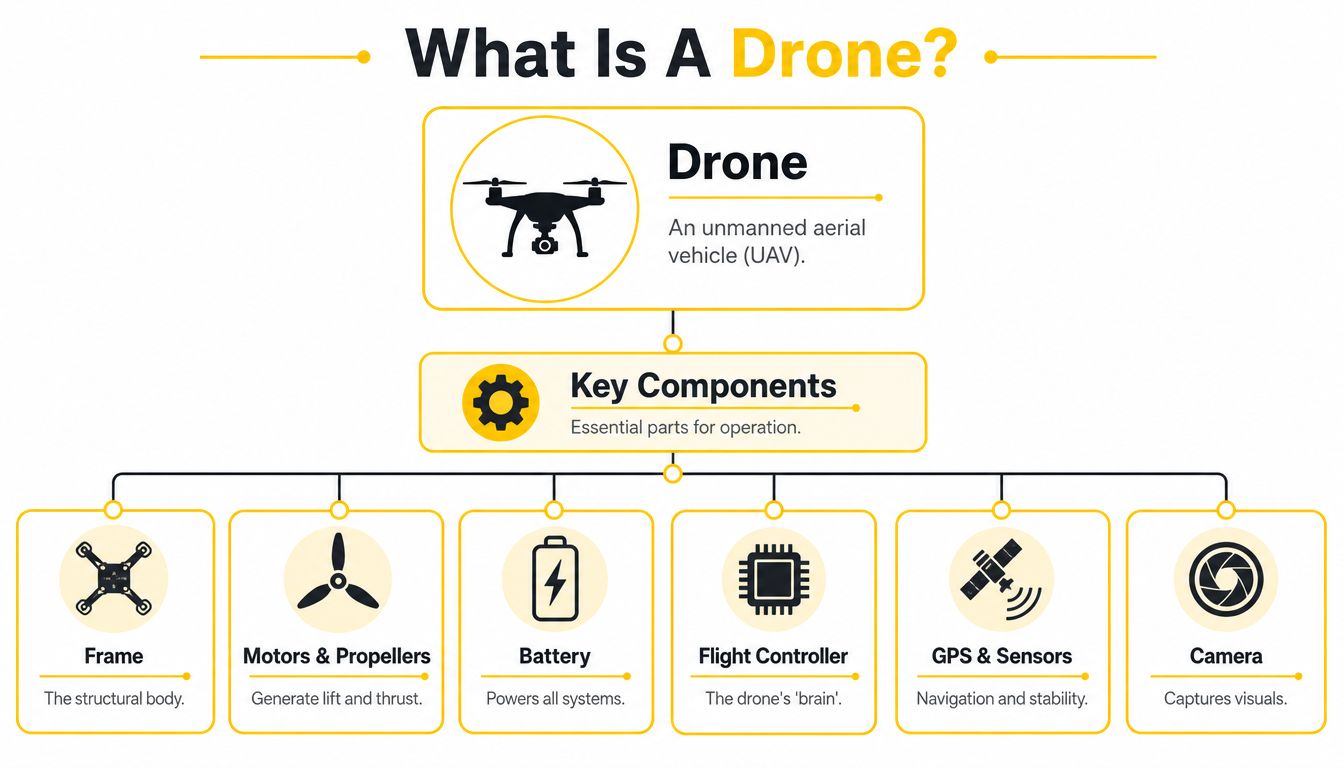
The basic parts of a drone
Most beginners start with a quadcopter, which means a drone with four motors and four propellers. That layout is popular because it balances stability, simplicity, and cost.
The main parts are straightforward:
- Frame: The structure that holds everything together. It's the airframe of the drone.
- Motors and propellers: These create lift and directional control. Faster spinning usually means more lift.
- Battery: This powers the aircraft, controller link, sensors, and camera systems.
- Flight controller: This is the onboard computer. It reads inputs from the pilot and data from sensors, then adjusts motor speed to keep the aircraft stable.
- GPS and sensors: These help with positioning, stability, and functions such as hovering or return-to-home.
- Camera and gimbal: On camera drones, this system captures stills or video and often helps keep footage steady.
A new pilot doesn't need engineering depth to fly safely. It helps, though, to know that if the drone suddenly behaves oddly, the issue often relates to one of these basic systems. A loose propeller, poor GPS lock, weak battery, or damaged motor can all change how the aircraft handles.
How a quadcopter stays in the air
Four forces shape flight. Lift pulls the aircraft upward. Weight pulls it downward. Thrust moves it in the commanded direction. Drag resists movement through the air.
On a quadcopter, the motors work together to manage those forces. To climb, the drone increases overall motor output. To descend, it reduces it. To turn, it changes motor speeds unevenly so the aircraft rotates or tilts.
Beginners often get confused about how a drone moves forward. The drone doesn't move forward because someone “pushes it” forward in the way a toy car moves along the ground. It tilts forward, and that tilt redirects thrust.
Practical rule: If a pilot understands tilt, the basic logic of pitch and roll becomes much easier.
For example, when the nose dips forward, part of the lift now pushes the drone ahead. When the drone tilts left, part of that same force moves it sideways. The flight controller constantly makes tiny corrections to keep all of this manageable.
That's why modern drones can feel surprisingly steady in a hover. The aircraft is not floating passively. It is actively correcting itself many times during flight.
Choosing Your First Drone Types and Key Features
The first buying mistake is usually emotional. Someone sees high-end footage online, buys a machine built for much more than beginner practice, and then discovers that confidence doesn't come in the box.
For most learners, the best first drone isn't the most powerful one. It's the one that allows repeated, low-stress practice while still teaching proper habits.
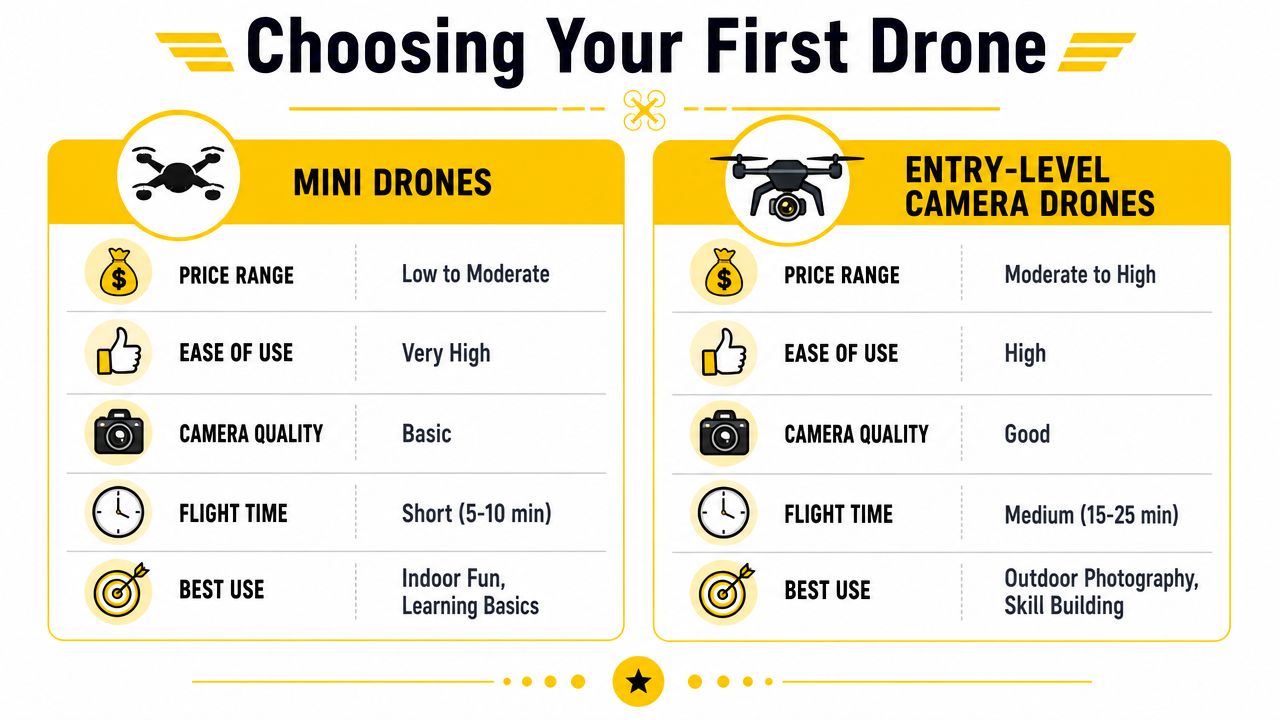
Three common starting points
A beginner will usually come across three broad categories.
Mini drones are small, light, and often simpler to manage. They suit basic handling practice and casual recreational use. They're often the least intimidating place to begin.
Entry-level camera drones add better stability, stronger positioning features, and more useful image quality. They're a practical choice for someone who wants to learn properly while also capturing usable footage.
FPV drones are a separate category. They're designed for immersive flying through goggles and can be fast and agile. They can be great aircraft in the right hands, but they're rarely the easiest starting point for someone still learning orientation and airspace awareness.
Comparing Drone Types for Beginners
| Drone Type | Primary Use | Typical Cost (AUD) | Key Features | Best For |
|---|---|---|---|---|
| Mini drones | Basic flight practice, casual fun, simple photography | Varies by brand and feature set | Compact size, simple controls, often portable | New pilots who want low-stress learning |
| Entry-level camera drones | Outdoor flying, photography, video, general skill building | Varies by brand and feature set | GPS stability, camera system, return-to-home, more refined controls | Beginners who want to learn and create content |
| FPV drones | Immersive flying, racing, dynamic video | Varies widely | Goggles, agile response, manual-style flying options | Pilots willing to accept a steeper learning curve |
Price matters, but feature balance matters more. A slightly more stable drone with reliable positioning can make early learning smoother than a cheaper aircraft that drifts constantly or responds unpredictably.
For someone who wants structured beginner training before moving toward licensed operations, ACE READY is an entry level drone training course covering drone fundamentals, aviation safety, CASA regulations, flight operations, and preparation for advanced Remote Pilot Licence training in Australia.
Features that matter most
Many specification sheets are crowded with terms that don't help a beginner decide. These features usually deserve the most attention:
- GPS stability: A drone with GPS support is generally easier to hold in position outdoors.
- Return-to-home: Useful as a backup function, especially if signal quality drops or the pilot becomes disoriented.
- Battery management: Beginners need clear battery status and sensible low-battery warnings.
- Controller quality: Responsive, comfortable controls matter more than cosmetic extras.
- Camera practicality: For many first-time buyers, a decent stabilised camera is enough. The most advanced camera system isn't necessary for learning.
- Spare parts availability: Propellers and batteries are consumable items. Easy replacement is worth considering.
A beginner should also think about where the drone will be flown. A small courtyard, a large oval, coastal wind, and inland open paddocks all place different demands on the aircraft. The best first choice is the drone that suits the intended learning environment, not the one with the flashiest brochure.
Buying for the mission beats buying for the image. A learner who wants calm, repeatable practice should choose stability over spectacle.
Your First Flight Basic Controls and Safety Essentials
A first flight should be uneventful. That's the standard to aim for. No dramatic climb, no rushed turns, no last-second landing. A quiet, controlled session in an open area is a successful beginning.
A proper location matters more than many beginners expect. Open ground with a clear buffer from people, vehicles, buildings, and trees gives the pilot time to think. Confined spaces force rushed decisions and make small control errors harder to recover from.
Readers looking for a practical overview of operational hazards near sensitive areas can review this guide to drone safety around airports and helicopter landing sites in Australia.
A simple pre-flight routine
Before take-off, a beginner should pause and work through a short checklist. That single habit prevents many common incidents.
- Check the site: Look for powerlines, trees, birds, vehicles, and people entering the area.
- Check the weather: Light wind can still affect a small drone. Gusts matter more than calm moments.
- Check the aircraft: Confirm propellers are secure, the battery is fitted correctly, and there's no visible damage.
- Check the controller and app: Ensure devices are charged, connected, and showing normal status.
- Check positioning and compass prompts: If the aircraft asks for calibration or indicates poor satellite status, sort that out before flight.
- Check the plan: Know the take-off point, intended flight area, and landing point before the motors start.
Understanding Mode 2 controls
Most hobby controllers in Australia use Mode 2. That means the left stick manages height and rotation, while the right stick manages movement across the ground.
A simple breakdown helps:
- Throttle: Left stick up and down. This controls climb and descent.
- Yaw: Left stick left and right. This rotates the nose left or right.
- Pitch: Right stick up and down. This moves the drone forward or backward.
- Roll: Right stick left and right. This moves the drone sideways.
Beginners often confuse yaw with turn. In a car, turning changes direction of travel through the steering wheels. In a drone hover, yaw rotates the aircraft. The drone can still remain roughly over the same point on the ground while it does that.
Small stick inputs are enough. Most early control problems come from over-correction, not under-correction.
First manoeuvres worth practising
The first few flights should focus on basic aircraft control, not camera work.
- Vertical take-off: Lift into a low hover smoothly. Don't rush to altitude.
- Stationary hover: Hold position and observe drift. Learn what a stable hover looks like.
- Gentle yaw turns: Rotate the aircraft slowly while keeping height constant.
- Short box pattern: Move forward, stop, move right, stop, move back, stop, move left, stop.
- Controlled descent: Reduce height gradually and land without dropping the aircraft.
A useful habit is to keep the drone close enough for orientation to remain obvious. When the nose faces the pilot, left and right inputs can feel reversed. That catches many first-time operators.
Short flights are better than one long, messy session. A beginner who finishes early while still calm will usually learn faster than one who keeps flying until concentration fades.
Flying Legally in Australia CASA Rules for Beginners
For recreational flying in Australia, the legal framework isn't optional background reading. It's part of basic airmanship. A person can be careful with the controls and still operate unsafely if the flight breaches CASA rules.
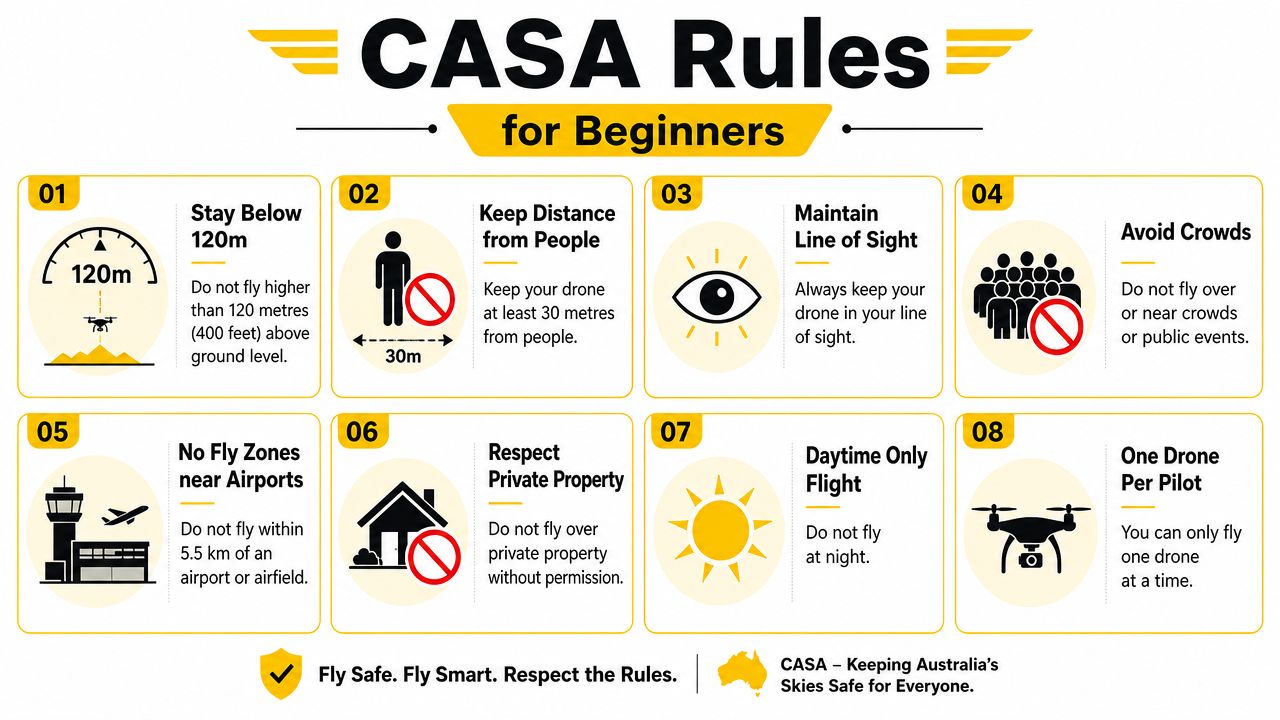
The infographic below captures several beginner rules often discussed in public guidance.
For readers who may later compare recreational flying with certain lower-complexity commercial pathways, this article on excluded category drone operations gives additional Australian context.
The core rules recreational pilots need to know
CASA's drone safety expectations for beginners are built around separation, visibility, and avoiding higher-risk areas. A recreational pilot should follow these core principles:
- Keep the drone within visual line of sight: The pilot must be able to see the aircraft directly, not only through a screen.
- Fly below the legal height limit: Recreational operations must stay below the maximum height permitted by CASA.
- Keep clear of people: A drone shouldn't be flown close to people who are not directly involved in the operation.
- Stay away from populous areas and crowds: Beaches, sporting events, busy parks, concerts, and packed public spaces create obvious risk.
- Don't fly near airports or in restricted airspace unless permitted: Airspace awareness is a basic safety obligation.
- Don't fly over emergency operations: Aircraft and ground crews need protected airspace to do their work.
- Fly in daylight and suitable conditions: Visibility and situational awareness matter.
- Only fly one drone at a time: A single pilot must be able to manage the operation properly.
Non-negotiable point: If the pilot can't maintain clear visual awareness of the drone and the surrounding airspace, the flight shouldn't continue.
Drone registration and accreditation requirements can change depending on how the aircraft is used and the category of operation. Because these rules can be updated, beginners should confirm current obligations directly with CASA before flying, especially if there is any plan to move beyond casual recreational use.
Why these rules matter in practice
A beginner might look at a wide open beach or sports field and assume it is ideal. Legally and operationally, that may not be true if people are nearby, if the area is busy, or if controlled airspace affects the location.
The same applies to altitude. New pilots often feel safer by climbing higher because obstacles look farther away. In reality, higher flight can increase separation issues, worsen orientation, and create conflict with other airspace users.
Privacy is another area where beginners can stumble. Even where an operation is technically possible, flying low over homes or private activity can create complaints quickly. Good judgement matters as much as rule knowledge.
A lawful flight is not only about avoiding penalties. It is about protecting other airspace users and maintaining public trust in drone operations.
The strongest beginner habit is simple. Check the location first, confirm the airspace and local conditions, and be willing to cancel the flight. In aviation, cancelling a poor flight is a competent decision.
Common Beginner Mistakes and How to Avoid Them
Most beginner errors don't begin with recklessness. They begin with small assumptions. The wind looks manageable. The battery seems fine. The automated features should sort it out. That line of thinking is what causes trouble.
Practical judgement improves when new pilots learn from typical scenarios before they experience them firsthand. This overview of the drone pilot emergency handbook and related reporting context is helpful for understanding why calm decision-making matters when things start to go wrong.
The pilot who trusted calm weather too quickly
The grass barely moved, so the flight looked safe. Once airborne, the drone climbed above the shelter of nearby trees and encountered stronger wind. The pilot then had to fight drift, lost confidence, and rushed the landing.
The fix is simple. Check for gusts, watch the tree line, and remember that conditions aloft can differ from conditions at ground level. If the drone is being pushed around during the hover, bring it back early.
The flight that started with a low battery
A new operator decides there's enough charge left for a quick launch. After take-off, battery warnings begin sooner than expected, and the flight becomes a race back to the landing point.
That problem is avoidable. Start with properly charged batteries and keep early flights short. Battery stress, temperature, and wind can reduce practical flying time, so a conservative approach is smarter than trying to squeeze in one more circuit.
The operator who relied on automation alone
A drone with return-to-home, position hold, and obstacle sensing can create false confidence. A beginner may stop thinking like a pilot and start assuming the aircraft will correct every mistake automatically.
Those features are useful, but they are not judgement. Sensors have limits. GPS can be affected by surroundings. Return-to-home is only helpful if the settings and environment support it. Every learner should practise basic manual positioning and smooth landings without leaning entirely on automated functions.
The avoidable legal mistake
Someone takes a new drone to a scenic public location, launches without checking the airspace, and only later realises the site is unsuitable. That can happen even to careful people because the location looked open and harmless.
The answer is preparation. Check CASA guidance, verify the location, and don't assume that a quiet area is automatically legal or safe. A few minutes on the ground is better than dealing with an avoidable breach after the flight.
From Hobbyist to Professional Your Drone Pilot Learning Path
A recreational pilot flies for enjoyment. A professional operator flies as part of work, service delivery, contracted activity, or business operations. That distinction matters in Australia because the regulatory expectations change once the purpose of the flight changes.
Someone who starts with weekend practice may later want to shoot real estate content, inspect assets, support agriculture, or work in surveying and media production. At that point, informal skills alone aren't enough. Professional work requires formal understanding of operations, risk, and compliance.
Readers considering operator certification pathways can review this guide to the ReOC in Australia.
When recreational flying becomes professional work
The change usually happens earlier than beginners expect. The moment a drone is used for hire, reward, or organised business activity, the operation moves into a different regulatory setting.
That is where the Remote Pilot Licence (RePL) becomes relevant. The RePL is a key qualification for commercial drone work in Australia and forms part of the recognised pathway into professional operations. It gives pilots structured training in aviation knowledge, practical flight standards, and operational discipline.
For some work, radio procedures matter as well. The Aeronautical Radio Operator Certificate (AROC) becomes important when operations involve controlled airspace or situations where correct aeronautical radio use is required.
Qualifications that matter
A person moving from beginner status toward professional work should think in layers:
- Foundational skills: safe handling, planning, battery discipline, location assessment
- Regulatory understanding: knowing what changes when the purpose of flight changes
- Formal training: completing relevant drone qualifications such as the RePL
- Operational growth: learning how clients, airspace, risk management, and documentation intersect
For structured progression in Australia, one training option is Ace Aviation Aerospace Academy, an Australian aviation training provider that offers courses directly relevant to this path, including the Remote Pilot Licence (RePL) and Aeronautical Radio Operator Certificate (AROC). For organisations managing drone capability internally, related offerings can include Enterprise Drone Training, Corporate Drone Training, and ReOC Consulting where operational requirements call for them.
A beginner doesn't need to commit to a professional pathway on day one. It is useful, though, to learn from the start in a way that won't need to be unlearned later. Safe habits, accurate terminology, and respect for CASA compliance all transfer directly into commercial standards.
Frequently Asked Questions
Is a drone difficult to learn for a complete beginner
Not usually, if the first aircraft is appropriate and the practice area is open and quiet. The hardest part is often orientation and resisting the urge to over-control the sticks.
Should a beginner start with FPV flying
Usually not. FPV can be rewarding, but many beginners learn faster on a stable camera drone or mini drone before moving into more demanding flight styles.
Does a beginner need to use the camera on the first flight
No. Early flights are better spent learning take-off, hover, yaw, gentle movement, and landing. Camera work can wait until aircraft control feels natural.
What weather is best for first practice
Calm, clear conditions with good visibility are best. Wind is one of the main factors that catches out new pilots, especially with smaller drones.
When should a recreational pilot look into a RePL
That step becomes relevant when the pilot wants to operate professionally, work for clients, or build a more formal pathway into commercial drone operations in Australia.
Ace Aviation Aerospace Academy provides Australian drone and aviation education for learners who want a structured pathway from beginner knowledge into professional qualifications. Readers exploring formal training can review its beginner and CASA-related course options at Ace Aviation Aerospace Academy.