A site manager in regional Australia needs progress imagery by Friday. A grain operation wants crop health data before the next spray window. A mining team has assets spread across a vast lease and can't justify putting people in the field for every inspection. In each case, the problem isn't only the drone. It's the cost, the logistics, the data workflow, and the legal framework around commercial operations.
That's where Drone as a Service becomes useful. Instead of buying aircraft, maintaining batteries, training staff, building procedures, and managing compliance from scratch, organisations can buy the outcome they need. That might be a map, a thermal inspection report, a crop analysis layer, or a recurring aerial data service tied to an operational schedule.
In Australia, that decision sits inside a very specific environment. CASA rules matter. Airspace matters. Pilot qualifications matter. So does the difference between hiring a licensed operator and hiring an individual who owns a drone. For businesses and aspiring pilots alike, the Australian DaaS market rewards practical thinking more than gadget enthusiasm. Why Ace Aviation explains that broader professional training context.
Table of Contents
- Introduction From High Costs to High Value with DaaS
- What Is Drone as a Service DaaS
- Australian Industry Applications and Real-World ROI
- Navigating Australian Drone Regulations and Licensing
- The DaaS Technology Stack and Service Offerings
- Implementing DaaS and Choosing a Vetted Partner
- Frequently Asked Questions about Drone as a Service
- Is drone as a service legal for commercial work in Australia
- Does a pilot with a RePL automatically cover a company's compliance needs
- When is an AROC relevant in drone operations
- Is DaaS better than building an in-house drone team
- What should a business ask before hiring a DaaS provider
- What is a sensible starting point for an aspiring commercial drone pilot
Introduction From High Costs to High Value with DaaS
For many Australian organisations, the first barrier to drone adoption isn't interest. It's the business case. Buying aircraft, sensors, software, training, insurance, and internal procedures can feel sensible until someone has to manage them all after purchase.
That's why drone as a service keeps gaining attention. It shifts the conversation from hardware ownership to operational value. A council can order flood imagery. A construction firm can request stockpile or progress data. A farming business can engage a provider for crop monitoring or spraying support without building a drone department from the ground up.
The practical change is simple. Instead of asking, “Which drone should be bought?”, decision-makers ask, “What data, response time, and compliance outcome does the business need?”
Practical rule: If the operation is occasional, specialised, geographically dispersed, or data-heavy, a service model often makes more sense than ownership.
For aspiring drone professionals, DaaS changes the career picture too. Commercial work no longer sits only with large aviation businesses. Work can come through direct client contracts, operator networks, specialist inspection firms, agricultural service providers, or enterprise support teams.
Three realities shape the Australian market:
- Compliance comes first. Commercial activity has to align with CASA requirements, not just client expectations.
- The deliverable matters more than the aircraft. Clients usually pay for reports, maps, imagery, analytics, or inspections.
- Specialisation creates value. Thermal work, agricultural operations, infrastructure inspections, and emergency support all demand different skills.
What Is Drone as a Service DaaS
Drone as a Service, often shortened to DaaS, is a commercial model where a client pays for drone-enabled work without owning and operating the entire system themselves. The closest business analogy is Software as a Service. A company doesn't build its own software platform for every task. It subscribes to a service that solves a problem. DaaS works in much the same way.
A client might pay per inspection, per site visit, per mapping job, or under a recurring service agreement. The provider typically supplies the aircraft, sensors, pilot capability, operational planning, data capture, and some level of processing or reporting.
Why businesses choose service over ownership
The appeal is not hard to understand. Ownership creates hidden work. Someone has to maintain aircraft, monitor batteries, update procedures, manage pilot currency, review risk, and keep pace with changing operational needs.
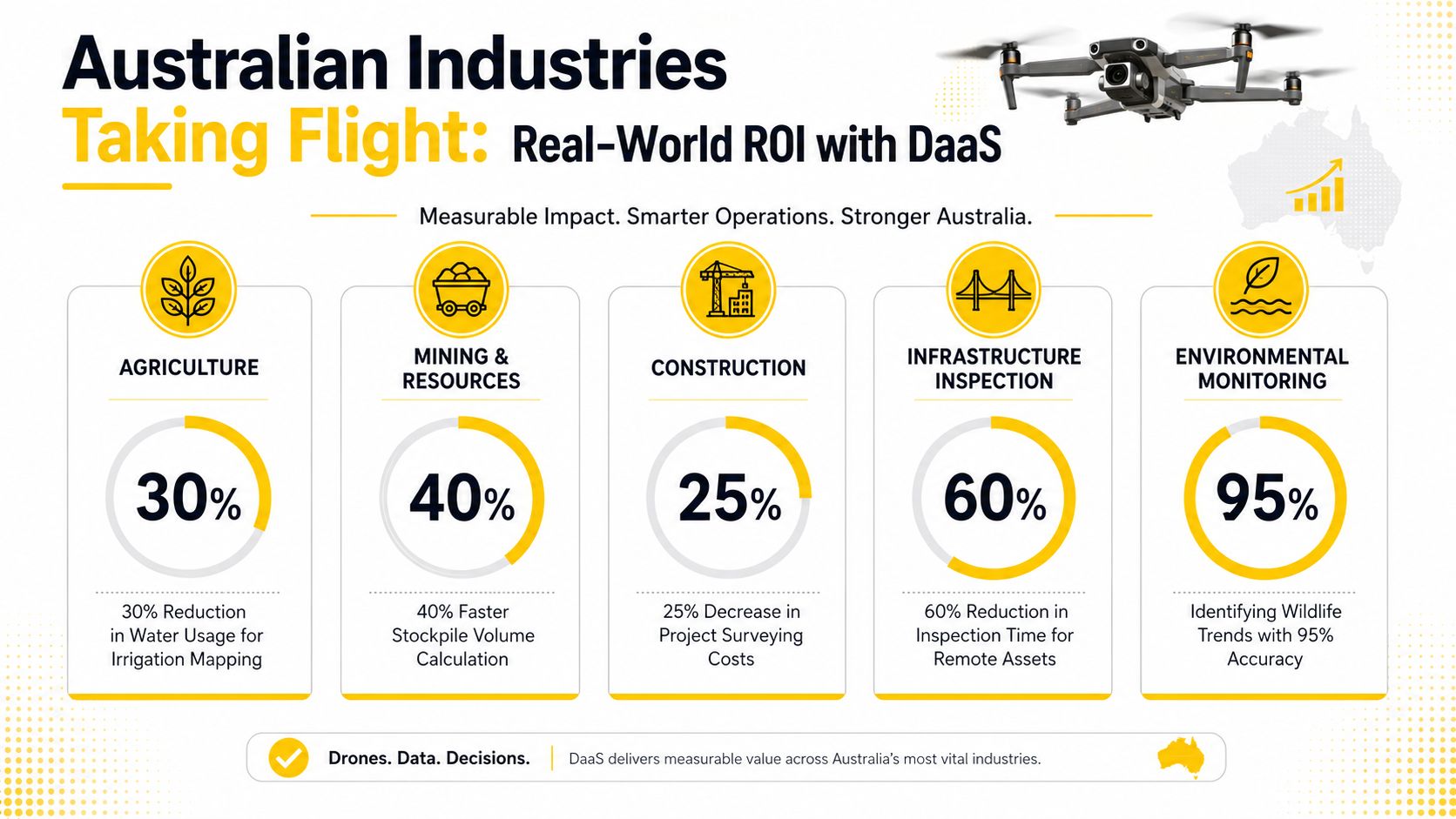
DaaS turns those overheads into an outsourced function. In Australian agriculture, that shift can be significant. A Leher guide to the drone service model reports that DaaS enables agricultural enterprises to reduce capital expenditure by up to 65% when accessing precision spraying and crop health monitoring. The same source states that large-scale farming operations outsourcing drone data collection have seen a 30% average reduction in operational time, with real-time aerial analytics improving crop yield accuracy. It also notes that high-resolution LiDAR and multispectral cameras can provide sub-5cm resolution data, which matters for data fidelity and compliance requirements.
For a beginner considering this sector, ACE READY is an entry level drone training course that covers drone fundamentals, aviation safety, CASA regulations, flight operations, and preparation for advanced Remote Pilot Licence training in Australia.
Drone as a Service vs In-House Drone Program
| Consideration | Drone as a Service (DaaS) | In-House Drone Program |
|---|---|---|
| Upfront investment | Lower upfront commitment because the provider supplies aircraft, sensors, and operational systems | Higher commitment because the business must acquire equipment and build capability |
| Speed to deployment | Faster when a vetted operator can mobilise quickly | Slower if pilots, procedures, and approvals still need to be organised |
| Technical depth | Access to specialist payloads and processing when needed | Depends on what the business buys and maintains internally |
| Regulatory burden | Much of the operational compliance sits with the provider, subject to contract and scope | The business carries direct responsibility for its own approvals, systems, and oversight |
| Best fit | Intermittent, specialist, or multi-site work | Frequent, repeatable operations with enough internal demand to justify a program |
| Data integration | Varies by provider. Some deliver polished outputs, others deliver raw data | Can be tailored closely to internal systems if the business has capability |
| Control over scheduling | Shared with the service provider's availability and terms | Greater internal control once the program is established |
| Workforce development | Limited internal pilot growth unless staff are involved in oversight | Builds internal aviation capability over time |
DaaS is not just “hiring a drone”. It's hiring a compliant aerial work capability and, in many cases, a data pipeline.
Australian Industry Applications and Real-World ROI
Australia's geography makes DaaS practical in ways that are easy to overlook. Sites are remote, assets are spread out, and travel time is expensive even before a single image is captured. That's why strong DaaS use cases usually begin with a field problem, not a technology preference.
Agriculture and broadacre operations
Agriculture is one of the clearest Australian examples because aerial work often has to happen inside narrow operational windows. A grower may need crop health monitoring, spray planning support, or high-resolution field data without pausing to purchase and maintain a fleet.
The value comes from both cost structure and speed. As noted earlier, the agricultural service model can reduce capital expenditure by up to 65% and cut operational time by an average of 30% through outsourced drone data collection and real-time analytics, according to the Leher DaaS guide for agriculture. For businesses that want to understand how that commercial opportunity is developing, this EOFY drone business opportunity article gives useful Australian market context.
Mining, infrastructure, and asset inspection
Mining and infrastructure produce a different kind of value case. These sites need repeatable inspections, defect identification, thermal analysis, and documentation that can be compared over time.
A DataM Intelligence market report on Drone as a Service states that in Australia's mining and infrastructure sectors, DaaS platforms using thermal scanning and AI-powered analytics reduce manual inspection time by 70% while increasing defect detection accuracy to 95%. The same source says adoption correlates with a 40% cost reduction in aerial surveying compared with traditional manned aircraft.
Those numbers explain why many industrial buyers don't judge DaaS by flight time alone. They judge it by avoided shutdowns, fewer manual inspections, and faster access to usable data.
A drone flight has little business value on its own. The value sits in what the inspection allows a team to decide next.
Where value appears in other sectors
Construction, local government, utilities, and environmental work often use DaaS differently:
- Construction projects may need orthomosaics, site progress records, and visual communication for stakeholders.
- Councils and utilities often need asset visibility across large areas without repeatedly sending teams into the field.
- Emergency and disaster contexts need rapid aerial awareness, though access and legal pathways for non-military agencies are still not well explained in much commercial material.
- Property and development teams may use drone services for site understanding, planning support, and visual documentation.
The pattern is consistent. The strongest return appears when drone services are tied to a specific operational decision, not treated as a standalone novelty.
Navigating Australian Drone Regulations and Licensing
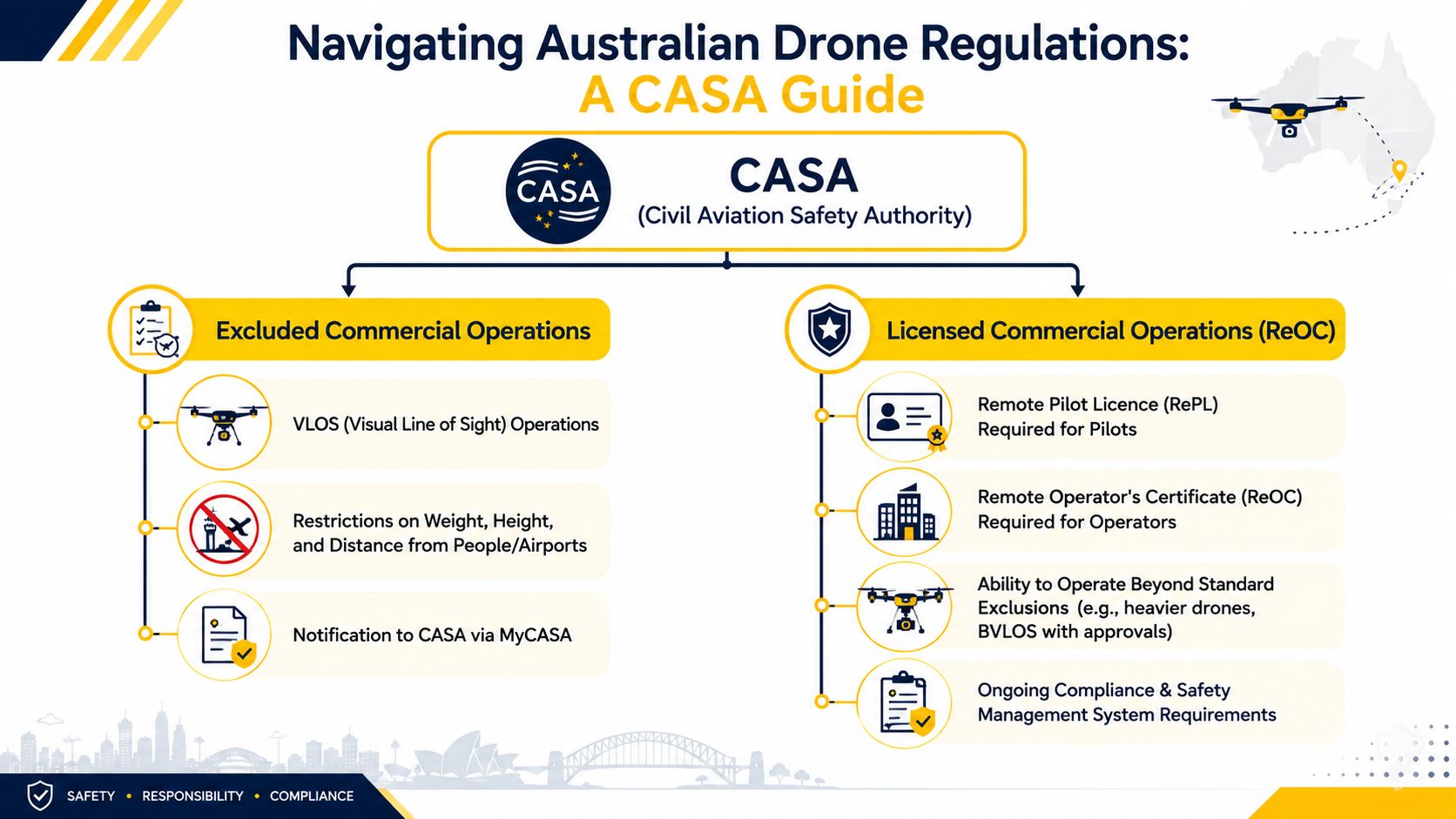
In Australia, commercial drone work sits under CASA's regulatory framework. That means a DaaS model isn't merely a business arrangement. It's an aviation activity with legal obligations attached to the operator, the pilot, and the type of operation being conducted.
What CASA controls in commercial drone work
CASA's role is to regulate civil aviation safety. For commercial drone operations, that means the rules around where and how a remotely piloted aircraft may be flown, under what approvals, and by whom.
Some operations may fall within excluded categories, while others require licensed operator structures and more formal oversight. Businesses often get confused here because they assume a competent pilot is enough. It isn't. The legal position depends on the operation, aircraft, procedures, and organisational setup.
A useful first step is a CASA licence finder tool provided by Ace, because many new entrants don't know whether they need an individual pilot qualification, an operator certificate, or both.
What RePL, AROC, and ReOC actually do
The Remote Pilot Licence (RePL) is the core pilot qualification for many commercial drone roles in Australia. It shows that a pilot has completed formal training and has been assessed to conduct relevant operations within the scope of that training and applicable rules.
The Aeronautical Radio Operator Certificate (AROC) becomes relevant when a pilot needs to use aviation radio in controlled airspace or in procedures that require radio communication. Not every job needs it, but some commercial environments do.
The Remote Operator's Certificate (ReOC) is different. It applies to the operator, usually the business or entity conducting commercial operations under that certificate. A ReOC is about organisational responsibility, operational control, manuals, systems, and ongoing compliance.
A practical way to think about it is this:
- RePL relates to the pilot.
- AROC relates to lawful radio use where required.
- ReOC relates to the operating organisation.
Compliance note: A business hiring pilots regularly for commercial work shouldn't assume that a pilot's licence alone covers the organisation's obligations.
For people entering the field, a Remote Pilot Licence (RePL) is often the starting point. For organisations building internal capability, ReOC Consulting, Enterprise Drone Training, or Corporate Drone Training may become relevant once the business moves beyond occasional outsourced jobs.
Why platform work still needs proper certification
Online marketplaces and app-based job allocation can make DaaS look simple. The legal reality is less simple. An SBS article on drone delivery and platform models notes that platforms such as Aerologix function as an “Uber for drones”, integrate CASA weather updates, and can take 20–40% of pilot fees. The same report highlights a persistent gap in explaining the specific RePL/ReOC certification pathways needed for pilots to operate legally under that model, especially for specialised work such as medical supply delivery to remote Australian communities.
That matters for two reasons. First, marketplace access doesn't replace regulatory compliance. Second, specialised missions often involve operational factors that go well beyond basic image capture.
For aspiring professionals, the safer path is to build credentials in the right order, understand the operational category being entered, and avoid assuming that an app-based work source simplifies CASA obligations.
The DaaS Technology Stack and Service Offerings
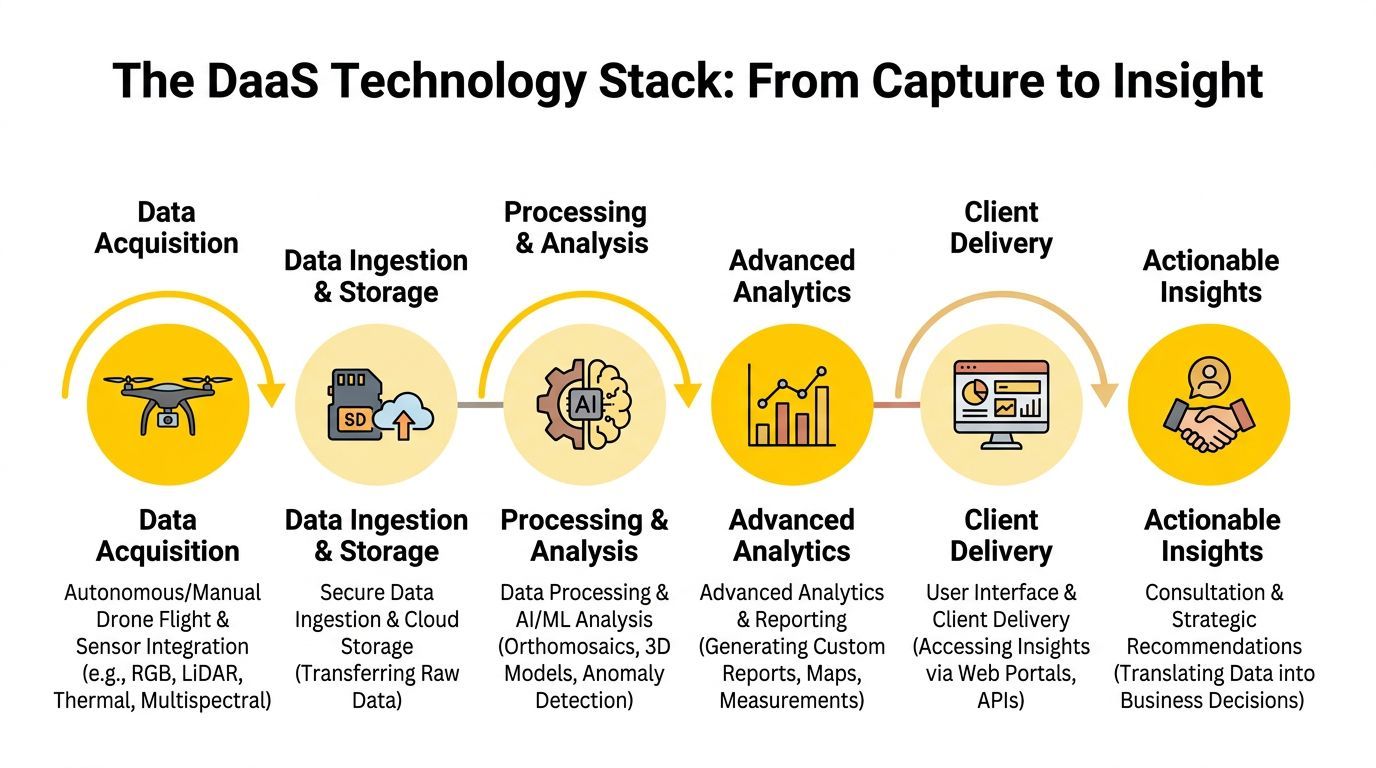
A client rarely buys DaaS because of a brand of aircraft. The client buys a workflow that turns aerial capture into a usable output. That's why the technology stack matters.
The aircraft is only one layer
Most DaaS offerings combine several technical components:
- Aircraft and payloads such as RGB cameras, thermal sensors, LiDAR, or multispectral systems
- Flight planning tools that define route structure, overlap, altitude, and capture quality
- Data transfer and storage so raw files are preserved and organised
- Processing software that turns imagery into maps, models, measurements, or anomaly detections
- Delivery systems such as dashboards, reports, GIS-ready files, or API-based outputs
In other words, the service is usually more important than the drone itself. The provider's value often sits in sensor selection, repeatable workflows, and report quality. In agricultural settings, the role of specialised equipment is especially clear. The earlier agricultural source noted the importance of LiDAR and multispectral payloads at sub-5cm resolution for high-fidelity outputs. Businesses exploring that area may also find it useful to read about the XAG P150 Max in Australian agriculture, because equipment capability affects what can be offered commercially.
What clients should ask for in deliverables
A business evaluating DaaS should focus less on pilot language and more on output language. Useful questions include:
- What is the final deliverable. Raw imagery, orthomosaic, thermal report, 3D model, defect log, or GIS layer?
- How is data quality controlled. Ground control, flight repeatability, review steps, and reporting standards matter.
- Who owns the data after capture, and in what format is it returned?
- Can the output fit existing systems such as engineering workflows, asset management tools, or farm software?
A mature DaaS provider talks confidently about deliverables, data handling, and decision support. A weak provider mostly talks about the drone.
For pilots, this is commercially important. The strongest operators aren't only safe flyers. They understand sensors, processing, client reporting, and how to present data in a form that a non-pilot can use.
Implementing DaaS and Choosing a Vetted Partner
The easiest way to waste money on DaaS is to buy flights instead of outcomes. The right provider relationship starts with scope, legal fit, and data requirements.
A practical checklist for buyers
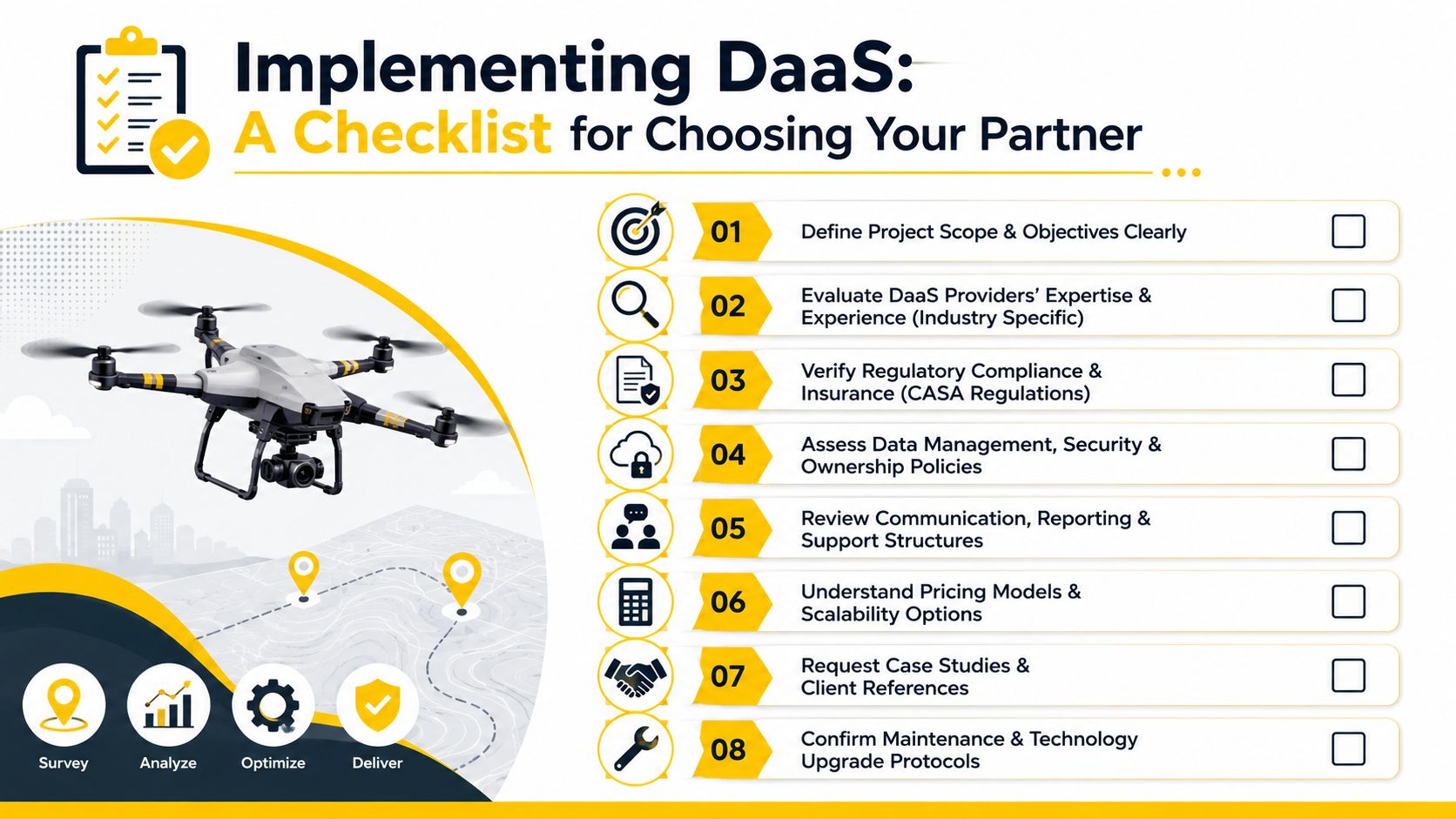
When assessing a provider, decision-makers should work through a short but disciplined checklist:
- Start with the operational question. Is the need inspection, mapping, thermal scanning, spraying support, emergency visibility, or recurring progress capture?
- Check the provider's legal structure. Ask what approvals and operating arrangements apply to the intended work.
- Review industry fit. A construction imaging provider may not be the right choice for agriculture or remote infrastructure.
- Clarify data ownership and reporting. A polished PDF may suit one client, while another needs files that slot into GIS or engineering platforms.
- Test communication discipline. Good operators explain risk controls, access limits, weather impacts, and deliverables clearly.
A useful Australian context piece for buyers and operators is this overview of the Dronework Australia ecosystem, because partner quality often depends on how well the provider fits the local commercial conditions.
When internal capability still matters
Some organisations will still want internal capability even when using DaaS. That can make sense for oversight, procurement confidence, or future transition to an in-house model.
Emergency use is a good example of where procurement can become difficult. A South Australia SES video on new remotely piloted aircraft highlights expanding emergency service drone fleets, yet commercial guidance still rarely explains how small businesses or local councils can legally and operationally access similar support during catastrophes. That gap matters because disaster operations create pressure to act quickly, but urgency doesn't remove legal responsibilities.
One option among others is Ace Aviation Aerospace Academy, which provides CASA-compliant drone training, including RePL, AROC, ReOC Consulting, Enterprise Drone Training, and Corporate Drone Training for organisations that need internal capability alongside outsourced services.
Frequently Asked Questions about Drone as a Service
Is drone as a service legal for commercial work in Australia
Yes, provided the operation is conducted within the relevant CASA framework. The key issue isn't the business model. It's whether the pilot, operator, aircraft, and operation meet the legal requirements that apply to that job.
Does a pilot with a RePL automatically cover a company's compliance needs
No. A RePL relates to the pilot. A ReOC relates to the operator organisation. Many businesses confuse the two, but they serve different legal and operational purposes.
When is an AROC relevant in drone operations
An AROC matters when a pilot needs to use aviation radio lawfully in environments or procedures where radio communication is required. It isn't universal for every job, but it becomes important in some commercial settings.
Is DaaS better than building an in-house drone team
It depends on frequency, complexity, geography, and internal capability. DaaS is often attractive for specialist, occasional, or multi-site work. An in-house program may suit organisations with constant operational demand and the capacity to manage compliance and training.
What should a business ask before hiring a DaaS provider
The business should ask about legal operating arrangements, relevant experience in that industry, insurance, data ownership, reporting format, and whether the deliverables fit existing workflows.
What is a sensible starting point for an aspiring commercial drone pilot
A structured training pathway that leads toward a Remote Pilot Licence (RePL) is usually the most sensible starting point. That gives the pilot a formal base before moving into more specialised commercial work.
Ace Aviation Aerospace Academy offers Australian aviation and drone training for individuals and organisations that need formal pathways into commercial operations, including Remote Pilot Licence training, AROC training, and ReOC consulting through Ace Aviation Aerospace Academy.