A drone pilot often reaches the same point. The basic flying skills are there, the first paid jobs have happened, and clients start asking for more than simple imagery. They want reliable procedures, stronger documentation, radio use, mapping outputs, and confidence that the operator understands Australian aviation rules at a professional level.
Employers hit a similar ceiling. A team might already hold a Remote Pilot Licence, but that alone doesn't always show the depth of training needed for repeatable commercial operations across surveying, agriculture, infrastructure inspection, or government work. Hiring managers then start looking for a qualification that means more than “licensed to fly”.
That's where Cert 3 Aviation usually enters the conversation. In the drone context, that means the Certificate III in Aviation (Remote Pilot), formally coded AVI30419. It sits between a basic entry point and more advanced operational responsibility, and it gives both individual pilots and organisations a clearer pathway into structured, compliant commercial drone work.
Table of Contents
- Introduction From Hobbyist to Professional
- What Is the Certificate III in Aviation for Remote Pilots
- Inside the Curriculum Core Units and Specialisations
- Career Pathways and Industry Roles
- Cert III vs Other Aviation Qualifications
- Your Guide to Enrolment Costs and Funding
- Achieving Your Cert 3 with Ace Aviation Aerospace Academy
- Frequently Asked Questions
- Does a student need to own a drone before starting
- Is Cert 3 Aviation the same as a RePL
- Is the remote pilot Certificate III the same as other Certificate III aviation courses
- Can high school students study this qualification
- Does this qualification help with business operations as well as flying
- Is a ReOC the same thing as a Certificate III
Introduction From Hobbyist to Professional
A common Australian pathway starts with enthusiasm. Someone buys a drone, learns to fly safely, completes a basic commercial licence, and begins taking on simple work. At first, that's enough. Then the work changes.
A real turning point often comes when a client asks for more formal mission planning, clearer airspace communication, or a deliverable that goes beyond basic footage. A farmer may want mapping support. A construction firm may want repeatable site capture. A council may want an operator who understands operational discipline, not just stick skills.
Practical rule: A licence shows permission to operate. A qualification shows broader vocational capability.
That distinction matters. A standard RePL is important, but many pilots eventually want a recognised aviation qualification that reflects structured training and stronger job readiness. Employers want the same thing when they're building internal drone capability instead of relying on ad hoc outsourcing.
The Certificate III in Aviation for remote pilots gives that next step a shape. It connects CASA compliance, practical flying, operational planning, and workplace-ready skills into one recognised credential. For a student, that can mean a clearer route into paid drone work. For an employer, it can mean a more dependable way to train staff for regulated operations.
What Is the Certificate III in Aviation for Remote Pilots
A typical turning point looks like this. A pilot who started with basic drone work is now being asked to plan jobs properly, brief clients clearly, document operations, and fly within a business process rather than as a solo operator. That is the gap the Certificate III in Aviation (Remote Pilot) is designed to fill.
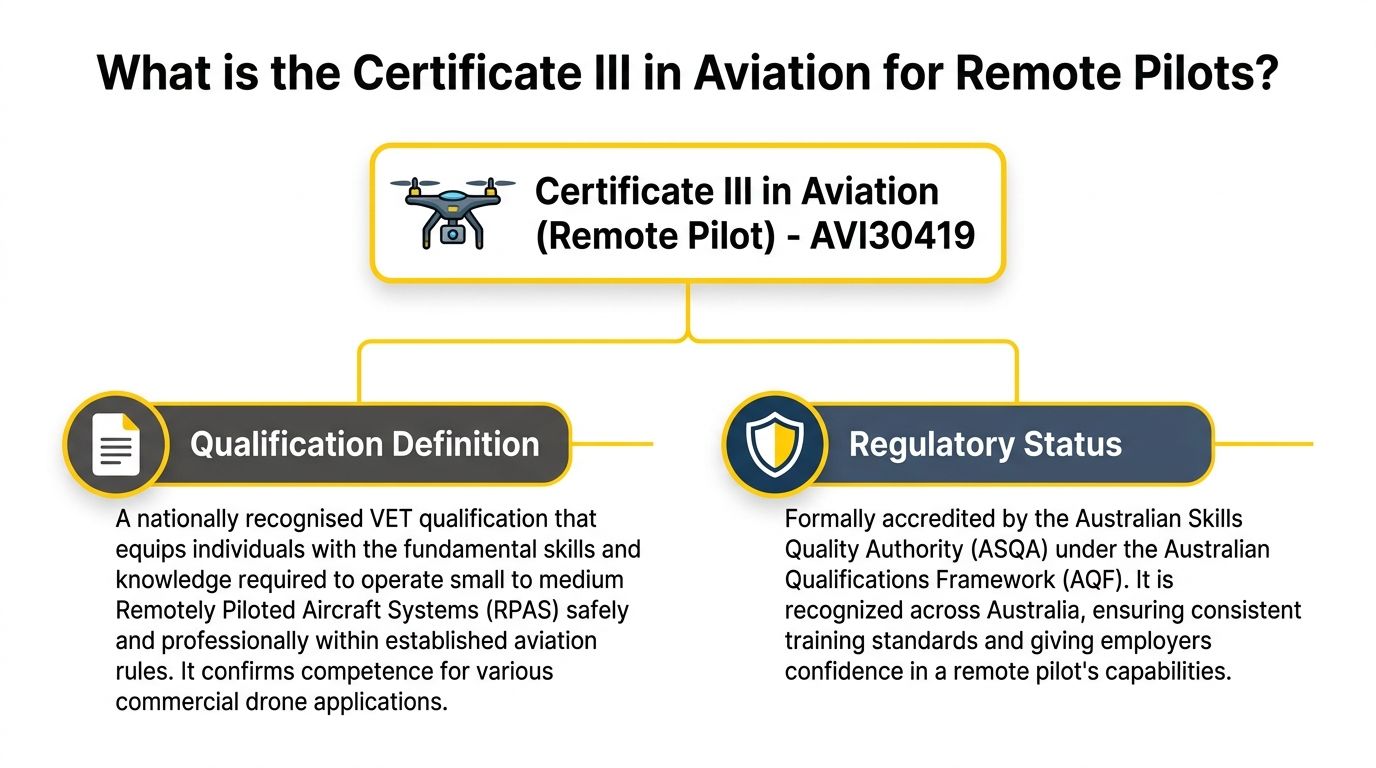
The Certificate III in Aviation (Remote Pilot), qualification code AVI30419, is a nationally recognised vocational qualification for commercial drone operations in Australia. It sits within the Australian Qualifications Framework and combines formal training with the licensing outcome many students are seeking. As outlined by SUA SROV's AVI30419 course overview, successful completion leads to the Certificate III and includes the CASA Remote Pilot Licence within the course pathway.
Why employers treat it differently from a basic licence
A RePL gives legal authority to conduct certain drone operations. The Certificate III goes further by showing that the pilot has been trained in a broader operational framework.
A simple way to understand the difference is to compare a driver's licence with trade training. A licence shows you can be authorised to operate. A qualification shows you have been taught how to work to a standard, follow procedures, and perform consistently in a workplace. In drone operations, that difference shows up before the aircraft even leaves the ground.
For employers, this changes the hiring conversation. They are often looking for someone who can assess a site, follow aviation procedures, communicate with a team, complete records properly, and carry out repeatable tasks under supervision or within company systems. The qualification helps signal that wider job readiness.
It also helps individual pilots who want a clearer path from entry-level flying into sectors such as mapping, inspection, agriculture, construction, public safety support, and internal enterprise drone programs.
What the qualification includes in practice
The course structure is broader than many new pilots expect. Students complete 14 units of competency, including core and elective units, and the training is commonly delivered through a mix of theory, practical flight work, and guided study. The AQF recognises it as a qualification that may be delivered over a longer period, but many providers offer it in a shorter blended format for working adults and school leavers.
That structure reflects how commercial drone work happens in practice. A paid job rarely begins with take-off. It usually begins with a task brief, a risk check, airspace considerations, equipment preparation, and clear documentation. The qualification is built around that full workflow, not only stick skills.
For students coming from a basic licence or no aviation background, that is often the biggest shift. You are learning to operate like a professional remote pilot, not solely to fly a drone safely for a few minutes at a time.
A practical way to read the value of Cert III is this:
- It formalises your skills: employers can see a recognised training outcome, not just informal flying experience.
- It builds workplace habits: planning, documentation, communication, and procedural discipline are part of the training.
- It supports career progression: the qualification gives individual pilots and employer-sponsored staff a stronger foundation for commercial operations.
Some students and employers prefer bundled pathways instead of arranging each step separately. One example is ACE PLATINUM, which is presented as an enterprise drone training package that can include RePL, AROC, Aviation English, Express ReOC, Certificate III in Aviation, advanced operations training, and business preparation.
A useful question to ask is not "Can I already fly?" but "Can I deliver drone work to a professional standard, inside a regulated business environment?" For many Australian pilots and teams, the Certificate III is the qualification that starts answering yes.
Inside the Curriculum Core Units and Specialisations
A good way to understand the curriculum is to compare it with driver training for heavy vehicles. Passing a basic car test does not prepare someone to run freight for a business. The same principle applies here. A remote pilot working commercially needs more than flight control. They need to plan the job, assess the site, follow aviation procedures, manage records, and complete the task in a way an employer or client can rely on.
That is why the nationally accredited AVI30419 course is built around the wider duties of a professional remote pilot. Aviation Australia notes on its Certificate III course page that the program aligns with Civil Aviation Safety Regulation Part 101 and includes online study, practical training, and operational tasks such as mission planning and NOTAM-related work through AVIE0005.
How the training is structured
Students often expect the course to revolve around hours on the controls. The actual structure is broader, and that is usually where the qualification starts to make sense. Employers are not only paying for someone who can launch, manoeuvre, and land a drone. They are paying for someone who can prepare a legal, safe, repeatable operation.
The curriculum usually develops capability in three connected layers:
- Aviation foundation skills: airspace knowledge, operational rules, safety responsibilities, and pre-flight planning.
- Remote pilot application: preparing the aircraft and payload, conducting missions in field conditions, and adjusting to weather, site, and task requirements.
- Workplace capability: documenting operations, communicating clearly, and following procedures that make team-based work consistent.
A commercial drone task rarely starts with take-off. It starts with a brief, a site check, and a series of decisions about risk, permissions, airspace, equipment, and reporting.
That is the shift from a basic drone licence to a formal qualification. A basic licence shows you can meet an entry-level operational standard. Certificate III trains you to perform inside a real business workflow.
What core and elective units mean on the job
Core units set the baseline. They are the parts every trained operator should be able to handle, regardless of whether they end up flying for construction, agriculture, utilities, media, or internal enterprise teams.
Take AVIE0005 Complete a notice to airmen (NOTAM). The unit title can sound administrative, but the job outcome is straightforward. The pilot learns how planned activity is communicated within the aviation system so other airspace users have the information they need. For a new student, that can feel distant from drone flying. In practice, it is part of operating professionally in shared airspace.
The same pattern applies across the rest of the course. Unit names can look technical or formal on paper, so it helps to translate them into the work they support:
- Mission planning: checking the task, site, weather, airspace, and equipment before the team arrives.
- Operational communication: using recognised aviation and workplace communication methods instead of relying on casual verbal instructions.
- Field execution: setting up correctly, completing checks, managing the payload, and shutting down in a controlled way.
- Documentation: recording what was done, what conditions were present, and what issues need follow-up.
Electives are where the qualification starts to fit different industries and team needs. For an individual pilot, electives can help move you from general flight competence into specific job functions such as imagery capture, mapping support, or more advanced operational tasks. For an employer, electives are the adjustment points that make training more useful for the work your staff perform.
A pilot trained only in basic flight can collect footage. A pilot trained in mapping workflows, payload use, and operational procedure can contribute to a survey program, an inspection schedule, or an asset management process.
That is also why provider choice matters. The stronger question is not merely which unit codes appear on the brochure. The better question is how those units are taught, practised, and connected to real job outcomes. If your goal is to match training to operational needs, specialised drone training pathways can help align electives and advanced skills with the type of work a pilot or team is expected to deliver.
Workplace note: Employers often place high value on planning, communication, and documentation skills because those are the habits that make drone operations consistent across multiple pilots, sites, and clients.
Career Pathways and Industry Roles
A common turning point looks like this. Someone starts with a basic drone licence, gets comfortable flying, then real work starts asking harder questions. Can you plan repeatable missions, follow company procedures, document what happened on site, and hand over usable results to a client or manager? The Certificate III in Aviation matters because it helps close that gap between being allowed to fly and being ready to operate as part of a business.
That difference shapes the kinds of roles this qualification supports. A hobby pilot usually focuses on the aircraft. A qualified remote pilot is trained to support the whole job, including planning, safety, communication, and reporting. For employers, that means a more useful team member. For individual pilots, it opens the door to work that depends on consistency rather than one-off flying ability.
Where the qualification is used
The same qualification can lead to very different work depending on the industry. In agriculture, a remote pilot may help monitor crops, check conditions across large properties, and collect imagery that supports farm decisions. In mining and construction, the role often links to progress tracking, stockpile measurement, mapping support, or site inspection. In utilities and infrastructure, the work is often more procedure-driven, with planned flights, repeatable capture methods, and clear reporting requirements.
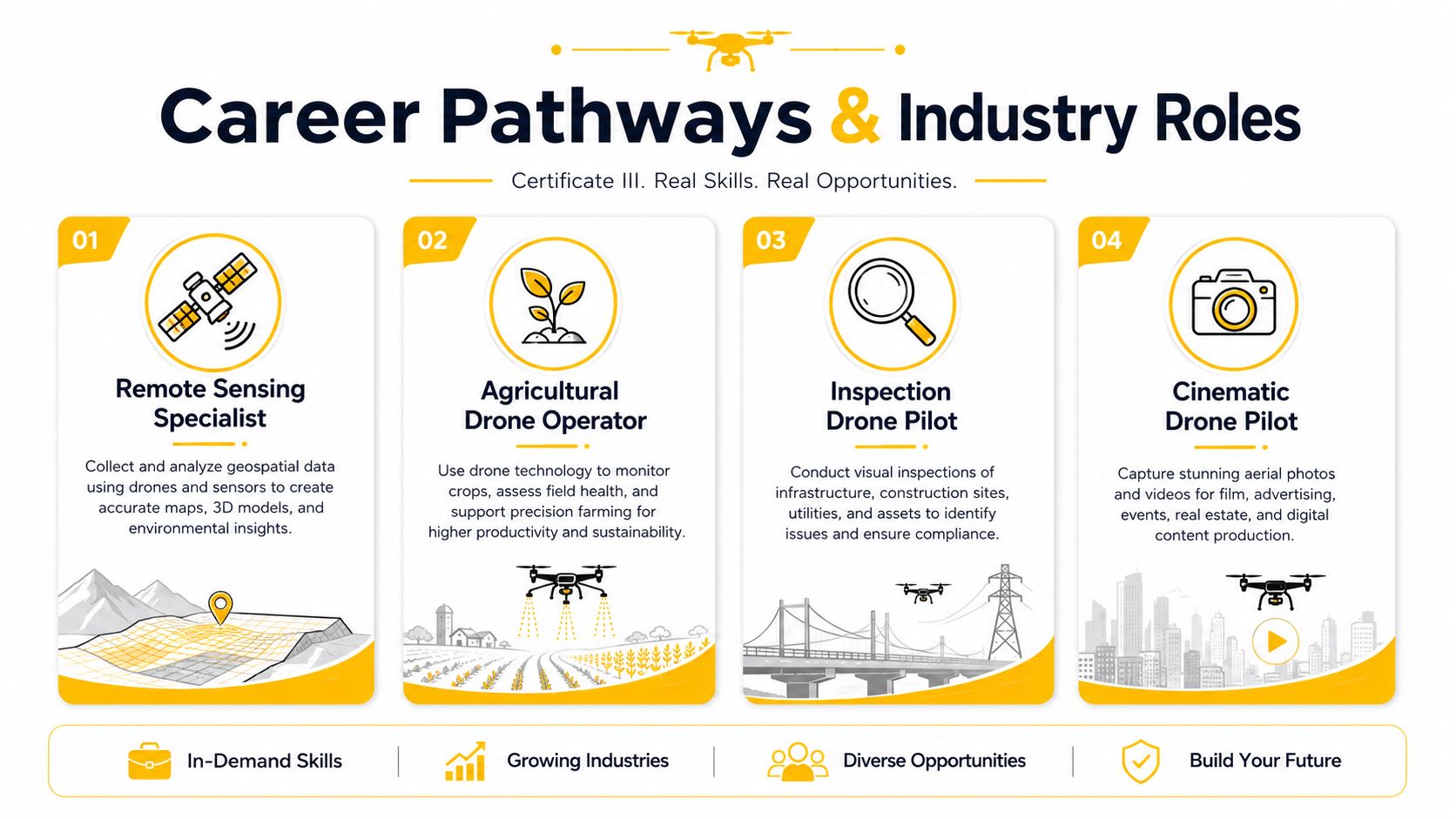
Job boards regularly show a steady mix of drone roles across these sectors. Titles vary, which can confuse new entrants. One employer may advertise for a remote pilot, another for an inspection officer, field technician, survey support operator, or asset inspection specialist. The underlying skill set is often similar. The pilot is expected to fly safely, collect reliable data, and work within an operational process. Job seekers can compare how employers describe these opportunities through drone and aviation job resources.
Common role directions include:
- RPAS survey support operator: assisting with mapping-style capture and repeatable site data collection.
- Agricultural drone specialist: supporting farm operations with aerial observation and mission planning.
- Inspection drone pilot: carrying out structured flights for assets, facilities, or infrastructure.
- Enterprise remote pilot: working inside a business, council, or government team with documented procedures and reporting obligations.
One way to understand these roles is to compare them with trades. The certificate does not lock you into one narrow job title. It gives you a recognised base skill set, then the industry context decides how that skill is applied.
How employers benefit from upskilling staff
For employers, the qualification helps standardise capability across a team. That matters when drone work moves from occasional use to part of normal operations. A business with one enthusiastic flyer has a useful tool. A business with trained staff, documented procedures, and consistent reporting has an operational function it can rely on.
That is why employers often value the qualification for more than flight time alone. A qualified team member can contribute to:
- Operational planning: preparing missions before arriving on site.
- Internal governance: working within procedures that management can review and approve.
- Client-facing delivery: producing outputs that align with contract requirements.
- Cross-functional support: helping engineers, survey teams, asset managers, or emergency personnel use drone-collected information properly.
The career shift is often from pilot to operator who can support a workflow from start to finish.
For someone moving up from a basic drone licence, that is the practical value of Certificate III. It gives structure to skills you may already be using informally and turns them into a qualification employers can recognise. For a business, it creates a clearer benchmark for staff who need to operate safely, communicate professionally, and produce field outcomes that other teams can use.
Cert III vs Other Aviation Qualifications
Aviation qualifications can look similar on paper, especially when they share the same Certificate level. In practice, they serve different purposes. The Certificate III in Aviation for remote pilots is built for commercial RPAS work. Other Certificate II, III, or IV pathways may suit different stages of learning or different aviation occupations altogether.
Comparison of Australian Aviation Qualifications
The simplest way to compare them is by role, focus, and likely outcome.
| Qualification | Target Role / Level | Core Focus | Typical Outcome |
|---|---|---|---|
| Certificate II in Aviation | Foundation or entry-level learner | Introductory aviation knowledge and pathway development | Early-stage exposure to aviation skills and training readiness |
| Certificate III in Aviation (Remote Pilot) AVI30419 | Commercial remote pilot and operational team member | Drone operations, mission planning, practical field work, aviation procedures | Formal vocational qualification for commercial RPAS work with RePL outcome |
| Certificate IV in Aviation | More advanced or supervisory pathway | Broader operational responsibility, leadership, or higher complexity training depending on stream | Preparation for roles with greater responsibility or specialised scope |
This table is intentionally broad because aviation qualifications vary by stream. A Certificate IV isn't automatically “better” for every person. It may be less relevant than Cert 3 Aviation for someone whose real goal is to become a capable commercial drone operator first.
For students who aren't sure which licence or qualification matches their current stage, a decision tool such as the AAA licence finder can help narrow the options.
Avoiding confusion with other Certificate III streams
Another source of confusion is that “Certificate III in Aviation” doesn't refer only to drones. The qualification title appears in multiple streams.
One example is AVI30219 Certificate III in Aviation (Cabin Crew). Civil and military cabin crew seeking certification for that alternate Certificate III must verify their specific requirements directly with CASA because occupational rules vary by sector, as noted on Your Career's AVI30219 course page.
That distinction matters. Someone searching for “cert 3 aviation” may find cabin crew, ground operations, or remote pilot pathways in the same search results. The remote pilot qualification is AVI30419, and that code is the clearest way to identify the drone-specific course.
A practical filter helps:
- If the goal is drone operations, look for AVI30419.
- If the goal is cabin crew, the stream is different.
- If the goal is management or supervisory depth, a higher qualification may be the next step after operational competence is established.
Decision point: The right qualification isn't the highest one available. It's the one aligned with the work the student or employer actually needs done.
Your Guide to Enrolment Costs and Funding
A common scenario looks like this. Someone already has a basic drone licence, or has flown recreationally, and now needs a qualification that an employer can recognise and a business can build procedures around. The question usually is not only "Can I fly?" It is "What will it take to turn that skill into a formal training outcome, and what will it cost?"
The enrolment path is usually easier to follow once you separate licensing from qualification. A licence gives permission to perform certain operations. A qualification documents broader vocational competence, including the operational habits, safety thinking, and workplace skills that matter once flying becomes part of a job.
What the entry pathway looks like
For an individual learner, the process often starts with a quick check that the course is the remote pilot stream and that the delivery format suits work or family commitments. For an employer, the starting point is slightly different. The focus is usually on whether the program can train several staff consistently and fit around operational downtime.
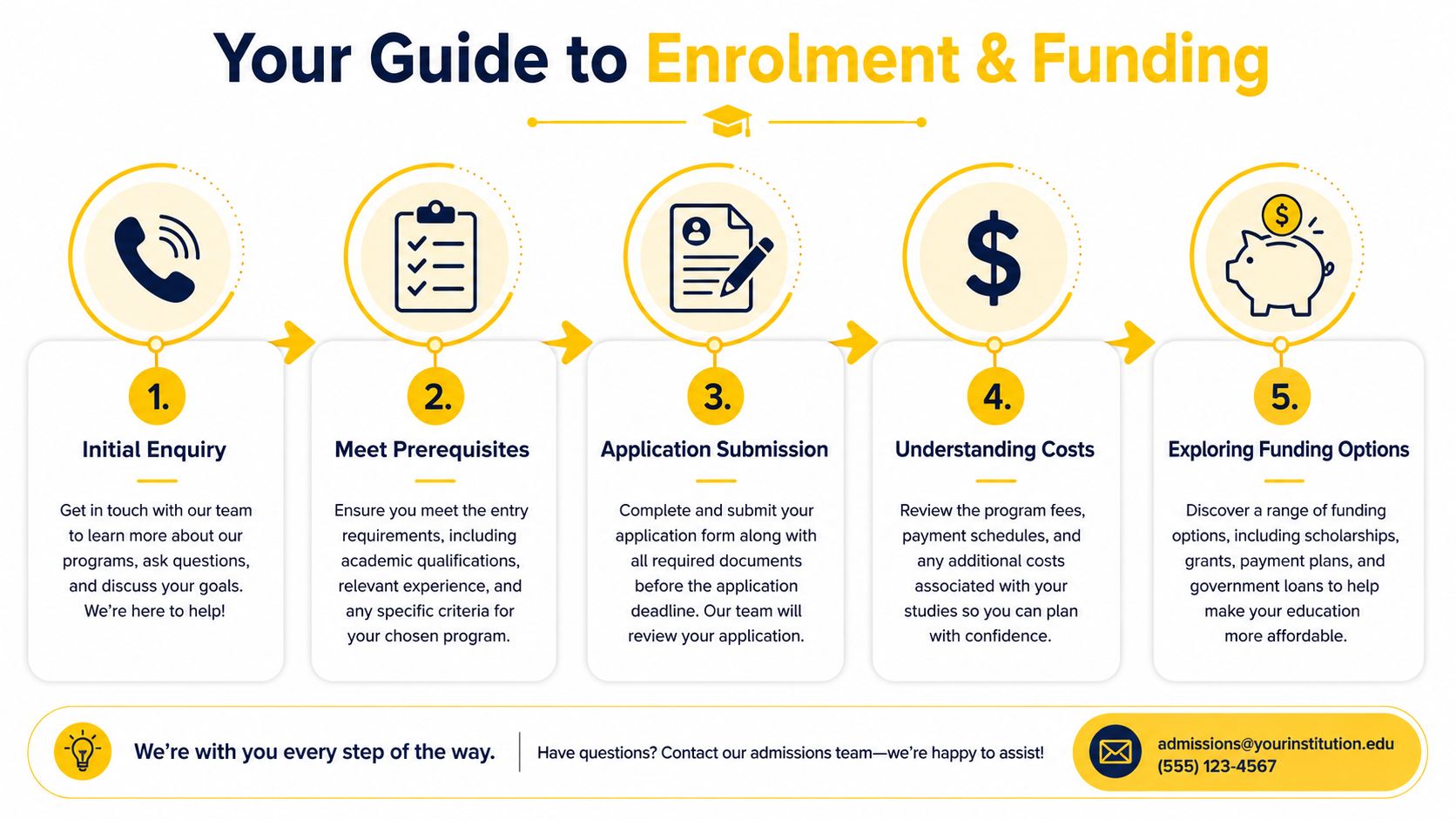
A practical enrolment process often looks like this:
Initial enquiry
Confirm that the course is the remote pilot qualification and ask what is included in the training package, assessment, and scheduling.Eligibility check
Providers will explain entry requirements, beginner suitability, and any age or identification requirements. As noted earlier, some pathways accept learners with no prior RPAS experience.Application and timetable planning
The learner is booked into the theory, pre-course study, practical training, and assessment stages.Training and assessment
While prior flying experience helps, it does not replace assessment evidence. The course still needs to confirm competence against the required units.Qualification outcome
After successful completion, the student receives the formal qualification outcome. In some training pathways, this may sit alongside licensing outcomes such as RePL, depending on what the provider includes.
Costs funding and practical planning
Course pricing varies because providers package different things together. One provider may price the qualification alone. Another may include practical flight components, licensing-related training, learner support, or extra administration. That is why a low headline fee can create confusion. It may not reflect the full cost of becoming job-ready.
For school students, there may be funded pathways available through school-based vocational programs where eligibility rules and provider arrangements allow. For employers, the funding question is often less about subsidies and more about total implementation cost. That includes time away from normal duties, the number of staff being trained, and whether the course aligns with the organisation's operating procedures.
Before enrolling, check four areas closely:
- What is included in the fee. Ask whether the price covers training only, or also assessment, practical components, and related licence outcomes where applicable.
- How the course is delivered. Blended delivery can work well for employed adults. School-based delivery may suit eligible secondary students.
- Whether the training matches the job. A person flying occasionally for asset photos needs a different setup from a team building a repeatable drone service inside a business.
- What support exists after training. Some learners need only the qualification. Others need help planning the next step, such as integrating drone operations into a business or understanding later pathways such as ReOC support.
If you are comparing providers or planning team training, a budgeting tool such as the drone training quote calculator can help frame the actual cost of different delivery options.
Recognition of Prior Learning can also affect cost and duration. An experienced operator may not need to repeat learning they can already prove with strong evidence. But RPL is not automatic. It works like a skills audit. The provider still needs documents, records, and other proof that the learner already meets the required standard.
That last point matters for both students and employers. If the goal is to move from a basic drone licence into a formal aviation qualification, the cheapest course is not always the best fit. The better question is whether the training closes the gap between "licensed to fly" and "qualified to operate professionally."
Achieving Your Cert 3 with Ace Aviation Aerospace Academy
A training provider matters because the qualification is practical by nature. Students need clear delivery, current operational context, and instructors who can connect CASA compliance with what occurs in the field.
What an integrated training pathway should include
For Cert 3 Aviation, the strongest training pathways usually combine theory, practical flight operations, and the surrounding aviation skills that employers expect. That often includes the Remote Pilot Licence (RePL) and may also include the Aeronautical Radio Operator Certificate (AROC) when radio operations form part of the training pathway.
Ace Aviation Aerospace Academy provides Australian drone and aviation training focused on professional operations, including Certificate III in Aviation, RePL, AROC, and related training pathways. Students comparing providers can review why Ace structures its training this way and compare that model with other Australian options.
A business or government buyer should look for a provider that can support more than one learner profile. A beginner needs clarity and structure. An existing operator needs efficient progression. An employer may need a pathway that aligns with internal procedures, field safety, and future Corporate Drone Training or Enterprise Drone Training needs.
How the course fits business and enterprise goals
This matters most when the qualification is being used to build a repeatable drone capability, not just to certify one person. In those cases, the Certificate III can sit inside a broader operational plan that includes training, radio competency, and support for operator-level permissions.
A short overview of that broader context is useful here:
For some students, the qualification is the start of a career. For some employers, it is part of workforce development. In both cases, the practical question stays the same. Does the training produce a person who can contribute safely, compliantly, and usefully in the field? That is the benchmark that matters.
Frequently Asked Questions
Does a student need to own a drone before starting
Not necessarily. Course entry requirements depend on the provider, but the verified course information for AVI30419 states that no prior RPAS flying experience is required. A prospective student should still confirm whether training aircraft are supplied and what equipment, if any, they need to bring.
Is Cert 3 Aviation the same as a RePL
No. The Remote Pilot Licence is a licence outcome. The Certificate III in Aviation (Remote Pilot) is a broader vocational qualification that includes formal training across multiple units of competency and leads to the RePL on successful completion.
Is the remote pilot Certificate III the same as other Certificate III aviation courses
No. “Certificate III in Aviation” can refer to different streams. The drone qualification is AVI30419. Other streams, such as cabin crew, have different codes and different occupational purposes.
Can high school students study this qualification
Yes, in some circumstances. Verified course information states that eligible school students may access the qualification through government-supported pathways such as VET in Schools (VETiS), depending on the program and provider arrangements.
Does this qualification help with business operations as well as flying
Yes, in a practical sense. The qualification covers more than aircraft handling. It includes operational planning, field procedures, and units connected to aviation communication and mission preparation. For students who intend to build a commercial drone service, those broader competencies matter.
Is a ReOC the same thing as a Certificate III
No. A Remote Operator Certificate (ReOC) is an operator-level approval related to conducting commercial drone operations as an organisation or business. The Certificate III is an individual vocational qualification for the pilot. They work together in some commercial settings, but they are not interchangeable.
Ace Aviation Aerospace Academy offers Australian drone training pathways that include the Certificate III in Aviation, RePL, AROC, and related business support for commercial operations. Readers comparing options can review the academy's programs and training approach at Ace Aviation Aerospace Academy.