
A large share of new drone operators in Australia start in the same place. They've bought a drone, they've got a job in mind, and then the licensing question stops them cold.
The confusion usually isn't about flying itself. It's about categories. A small drone used for simple commercial work can fall into one set of rules, while the same operator can need a full licence the moment the job, location, or aircraft changes. That's why learning how to get a drone licence starts with a decision, not an application form.
For businesses, contractors, and aspiring professional pilots, getting that decision right matters. It prevents wasted training, avoids non-compliance, and sets up the correct pathway from the beginning.
Table of Contents
- Do You Really Need a Drone Licence? RePL vs Accreditation
- Eligibility and Pre-Training Requirements
- Choosing Your Path The RePL Training Breakdown
- Assessment, Paperwork, and Expected Costs
- Beyond the Licence Operating Commercially with a ReOC
- Common Pitfalls and Advanced Qualifications
- Frequently Asked Questions
Do You Really Need a Drone Licence? RePL vs Accreditation
A new operator books a paid real estate shoot, packs a sub-2 kg drone, and assumes a full licence is the next step. Sometimes it is. Sometimes it is not. The first job is to sort out which approval path matches the operation before spending time and money on the wrong training.
In Australia, that decision usually turns on four questions: Are you flying for recreation or for work? How much does the drone weigh? Will you stay within standard operating conditions? Are you just piloting, or are you setting up a business that conducts drone operations? Getting this decision right prevents a very common mistake. Operators either overcomplicate a simple excluded category job, or they assume accreditation covers commercial work that needs a RePL, and sometimes a ReOC as well.
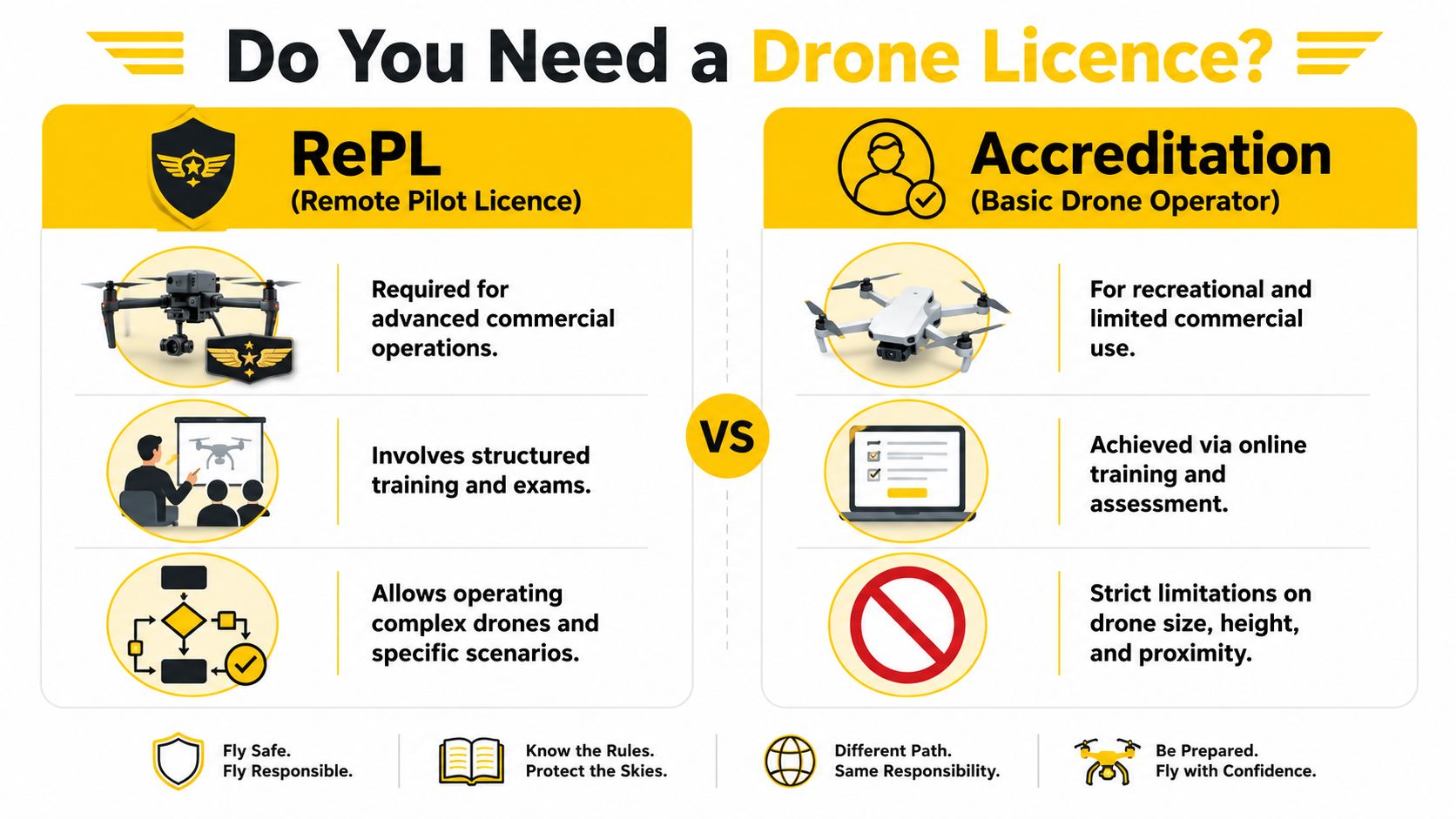
The fastest way to identify the right category
Use this simple filter.
If you fly only for fun, you do not hold a RePL or operator accreditation just to be recreational. You still have to follow CASA safety rules. The same basic operating limits still shape what is safe and legal, much like road rules apply even when you are not driving for work.
If you fly for business with a drone in the smaller weight range and stay inside standard conditions, operator accreditation may be enough. This is the area that causes the most confusion. The law does not treat every paid job the same way. Some sub-2 kg commercial operations fall into the excluded category, which means the pilot may not need a full RePL, but still needs the right approvals and must keep the operation inside the standard rule set. If you want a clearer explanation of that pathway, see excluded category drone operations in Australia.
If the drone is heavier, or the operation becomes more complex, the licensing threshold changes. A RePL is generally the point where CASA expects formal pilot training because the risk profile has changed. Heavier aircraft carry more energy. Flights closer to people, higher than standard limits, or in controlled airspace leave less room for error. The approval framework becomes stricter for the same reason larger aircraft demand more from their pilots.
Practical rule: Accreditation suits lower-risk commercial work with eligible small drones under standard conditions. A RePL suits operations that are heavier or operationally more demanding.
There is one more layer that many first-time operators miss. A RePL is a pilot qualification. It tells CASA you have been trained to operate at that level. A ReOC is an operator certificate for the business or organisation running the operation. In plain terms, the RePL is about the person at the controls. The ReOC is about the system behind the flight, including procedures, oversight, and organisational responsibility. That distinction becomes important once drone work moves beyond simple excluded category jobs.
Drone operation categories in Australia
| Category | Licence/Accreditation Needed | Key Rules & Limitations |
|---|---|---|
| Recreational flying | No formal licence | CASA safety rules still apply, including the standard operating limits for separation, height, and airspace |
| Commercial operations, small drones under standard operating conditions | RPA Operator Accreditation, drone registration, ARN | A full RePL may not be required if the operation fits the excluded category framework and stays within standard conditions |
| Commercial operations with heavier drones | RePL | Formal remote pilot training is generally required once the aircraft and operation move beyond the lower-risk excluded category pathway |
| Commercial operations outside standard conditions | RePL, and sometimes additional operational approvals | Operations such as flying higher, closer to people, or in controlled airspace can trigger stricter approval requirements |
| Ongoing business operations under an operator's certificate | RePL for pilots, plus a ReOC for the organisation where required | The pilot qualification alone may not cover the business structure conducting the work |
A good way to remember it is to separate the questions. First ask, “What am I flying, and under what conditions?” That points you toward accreditation or a RePL. Then ask, “Am I piloting, or am I running commercial operations as an operator?” That is where the ReOC question starts to matter.
Eligibility and Pre-Training Requirements
By the time someone reaches this stage, the big question should already be settled. They need a RePL, not just accreditation. Now the job becomes simpler. Get the admin right first, then start training.
The first item is an Aviation Reference Number, or ARN. It is the personal identifier CASA uses across its systems, much like a student number that follows you through enrolment, records, and licence issue. If the ARN details do not match the person's identity documents exactly, training paperwork can slow down later.
Start with the ARN
Applicants usually set up their ARN through the myCASA portal before enrolling with a training provider. CASA uses the ARN to link identity, training records, and licence processing, so providers will often ask for it early in the enrolment process.
A good habit is to complete this step before comparing course dates. It saves time, and it avoids the common problem of a student booking training first, then discovering their name or date of birth does not align across documents.
The cleanest workflow is simple. Get the ARN first, check that every identity detail matches, then book training.
If there is still any uncertainty about whether the job really calls for accreditation, a RePL, or a broader commercial pathway, AAA's drone licence finder tool can help narrow the right training route before enrolment.
What should be ready before enrolment
The paperwork is not difficult, but aviation training rewards orderly preparation. New students often spend weeks comparing drones and almost no time checking whether they are administratively ready to start. In practice, the second part causes more delays.
A sensible pre-training checklist looks like this:
- Identity documents: Have the documents needed for your ARN application ready, such as a passport, birth certificate, or driver's licence, and make sure the details are consistent.
- A clear operating goal: A training provider may ask what kind of work you plan to do, because the answer affects the aircraft category, training scope, and whether a ReOC conversation may follow later.
- Basic familiarity with aviation terms: You do not need prior flying experience, but it helps to understand simple concepts like airspace, weather, checklists, and standard operating conditions before day one.
For complete beginners, ACE READY is an entry level drone training course covering drone fundamentals, aviation safety, CASA regulations, flight operations, and preparation for advanced RePL training in Australia.
Language matters too. Training involves briefings, procedures, and safety terminology. A student does not need polished aviation phraseology, but they do need to understand instructions clearly, ask questions when unsure, and communicate accurately enough to operate safely.
That last point matters more than many first-time applicants expect. A RePL course is not only about flying the aircraft. It teaches judgement, compliance, and safe decision-making under rules that exist to protect people on the ground and other airspace users. Students who arrive organised, identified correctly, and ready to learn usually have a much smoother start.
Choosing Your Path The RePL Training Breakdown
You have decided that accreditation alone will not cover the work you want to do. Maybe you plan to fly heavier aircraft, operate outside the excluded category, or build a proper drone service instead of taking on the occasional simple job. That is the point where RePL training stops being optional and becomes the right next step.
A RePL course works like driver training for aviation. The goal is not just to show that you can make the aircraft move. The goal is to prove that you can plan, judge risk, follow procedure, and fly safely when conditions are less than perfect.
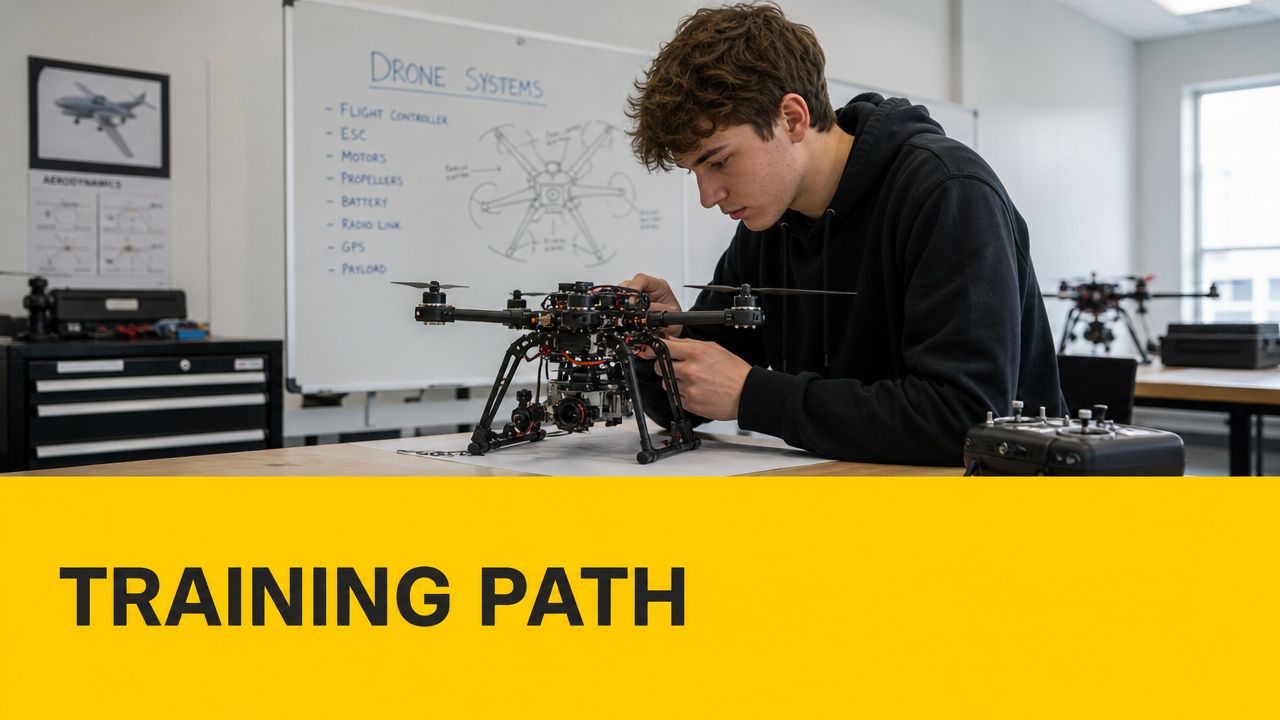
Theory training builds aviation judgement
Students are often surprised by how much of RePL training happens before the first take-off. That is deliberate. A commercial remote pilot is making aviation decisions, not just operating camera gear.
Theory lessons usually cover the subjects that shape safe flights in practice:
- Airspace: where you can fly, where you need approval, and why certain areas are protected
- Weather: how wind, temperature, visibility, and changing conditions affect aircraft performance
- Human factors: how fatigue, distraction, and overconfidence lead to poor decisions
- Aviation law: the operating rules behind separation distances, height limits, and standard procedures
- Emergency actions: what to do if you lose GPS, battery margin, control link, or situational awareness
That knowledge matters because commercial flying is rarely just "launch and record." A site may sit near controlled airspace. Wind at ground level may feel manageable while gusts higher up are not. A simple battery warning can become a forced landing problem if the pilot has not planned an exit.
Practical training turns the rules into habits
Flight training is where judgement becomes repeatable action. An instructor is looking for calm, methodical flying and good decision-making under routine pressure.
You can expect practical sessions to focus on skills such as:
- Pre-flight preparation: site survey, aircraft inspection, airspace and hazard checks, and mission setup
- Core manoeuvres: take-off, hover control, orientation changes, circuits, and accurate landing
- Operational discipline: maintaining separation, staying within the brief, and keeping the aircraft predictable
- Abnormal and emergency response: recovering safely from common problems without rushing or improvising badly
A lot of first-time students assume the hardest part is hand control. Usually, it is consistency. The pilot who slows down, uses the checklist, and keeps the aircraft stable will often perform better than the pilot who is confident on the sticks but skips steps.
A short overview of professional drone training can help visualise that progression:
Strong RePL candidates do not look flashy. They look predictable, prepared, and safe.
Choosing the right training pathway
The training standard is set by CASA requirements, but providers package courses differently. Some are suited to complete beginners. Others are better for operators who already know they want to move into larger aircraft categories or commercial workflows that may later require a ReOC as well.
That is why your course choice should match your end use. A pilot planning basic excluded category work has very different needs from a pilot aiming for surveying, inspections, or repeat client jobs under an operator certificate structure.
If you want to compare formats and course types, AAA's drone training course options give a useful view of entry-level and more advanced pathways. For example, ACE SILVER sits above beginner preparation and is aimed at students progressing toward professional drone operations, while advanced training can then build on that base depending on aircraft category and operational scope.
One final point causes confusion. Getting a RePL is a pilot qualification. It does not automatically cover the business side of commercial operations in every scenario. If your work moves beyond the excluded category settings, or your operating model requires an operator certificate, the RePL is one part of the structure, not the whole structure.
Assessment, Paperwork, and Expected Costs
Training is the part students remember. The assessment and paperwork are the part that turns training into a licence.
A good way to understand this stage is to separate it into three steps. First, you show the training provider that you can meet the required standard. Second, the provider completes the documentation that supports your application. Third, CASA issues the RePL after reviewing the submission. New pilots often expect to sit a separate CASA test on their own, but that is usually not how the process works.
What happens after training
For a RePL course, the theory assessment and practical flight assessment are generally conducted through the training provider. CASA then receives the application package for licence issue after you have successfully completed the course requirements. In other words, your school assesses whether you are ready, and CASA decides whether to issue the qualification.
That distinction matters because it explains what the examiner is looking for. They are not scoring you on style. They are checking whether you can operate like a safe commercial pilot who follows procedure under pressure.
The practical assessment will vary with the aircraft category you trained in, but the same pattern shows up across providers. Students usually come unstuck on basics, not advanced manoeuvres. A missed pre-flight check, a rushed site assessment, weak control in hover, or an uncertain response to a simulated problem will raise concerns quickly. Flight examiners want calm, repeatable actions. A pilot who works methodically is easier to trust than a pilot who tries to impress.
Assessment mindset: Safe, predictable, and procedural beats flashy every time.
Paperwork you should expect
The administration side is usually simpler if you prepare early. You will generally need an ARN, proof of identity details, your training records, and the application documents your provider asks you to complete. If anything is missing or inconsistent, the application can slow down while it is corrected.
That is why experienced instructors tell students to treat paperwork like a pre-flight checklist. It is rarely difficult, but it does need to be complete. A small omission on the ground can delay you just as easily as a small mistake in the air.
If you are planning to operate commercially soon after getting the RePL, keep the bigger picture in mind. The licence qualifies you as a remote pilot. It does not automatically cover every business model. If your intended work will sit outside the excluded category, or you will need to operate under your own business approvals, this is the point where many applicants realise they also need to prepare for the operator side, not just the pilot side.
Time and budget planning
Course delivery is often run as an intensive block over several days, followed by provider administration and CASA processing. The exact timing depends on course format, provider scheduling, and how quickly your documents are submitted correctly. Some students move through it quickly. Others wait longer because they are fitting training around work or need to fix paperwork issues.
Cost follows the same pattern. There is no single figure that suits every applicant because providers bundle different things into their course fees. One course may cover only the RePL training and assessment. Another may include preparation for business operations, radio components, or support with post-course compliance steps. Before enrolling, it helps to compare what is included rather than judging by headline price alone. AAA's drone training quote calculator is a practical way to compare likely training pathways and avoid under-budgeting.
You should also allow for operating costs that begin after the licence is issued. Depending on how you plan to work, that may include registration, insurance, and business compliance requirements tied to commercial use. At this point, the RePL versus accreditation decision becomes relevant again. The cheaper entry path is not always the cheaper long-term path if your real goal is client work under a structure that requires more than pilot qualification alone.
Beyond the Licence Operating Commercially with a ReOC
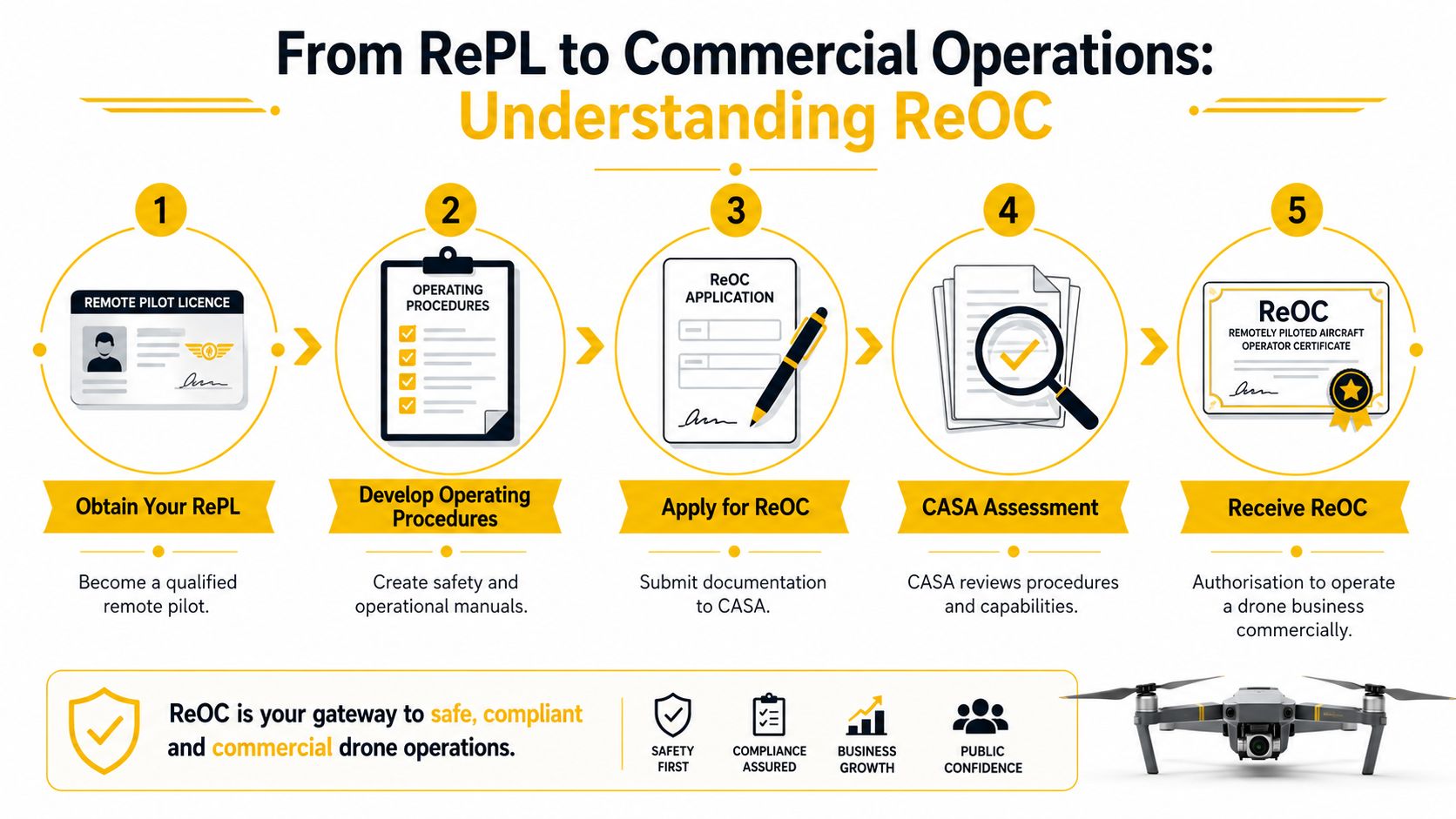
A RePL gives the individual pilot permission to fly in the categories they are trained for. A ReOC gives the business permission to run drone operations as an organisation. That difference causes a lot of confusion.
A simple way to read it is this. The RePL covers the person at the controls. The ReOC covers the operating system around that person: procedures, supervision, records, risk controls, and business accountability. If you plan to offer drone services under your own business name, manage other pilots, or build repeatable commercial operations, pilot qualification alone is often only one part of the legal setup.
Why a RePL alone may not be enough
This question usually appears after someone has already sorted out training. They assume the licence is the finish line, then discover CASA separates pilot competence from operator responsibility.
For an employee, the arrangement can be straightforward. You may fly under your employer's existing ReOC if the business holds one and authorises the operation properly. For a sole trader, contractor, or company selling aerial work to clients, the picture changes. The moment you are running the operation rather than piloting within someone else's approved system, CASA may expect the operator certification side to be in place as well.
That is why the RePL versus accreditation decision at the start of this article matters so much. Many sub-2kg operators enter through the excluded category and assume that commercial work stays simple forever. It often does not. Excluded category operations can suit limited work under standard conditions, but they do not replace a ReOC for businesses that need broader operational authority, formal systems, or room to scale.
What the ReOC changes
The ReOC is CASA's approval for the operator. In practice, that means CASA is looking beyond whether a pilot can fly and asking whether the business can run safe, repeatable operations.
A good analogy is the difference between holding a driver licence and operating a transport company. One proves personal skill. The other requires systems, oversight, and documented responsibility.
A ReOC application usually involves setting up:
- Operating procedures: How flights are planned, approved, conducted, and reviewed
- Documentation: Manuals, checklists, risk controls, maintenance records, and incident reporting
- People and oversight: Clear responsibility for pilots, chief remote pilot functions, and management decisions
- Compliance discipline: A way to show CASA that the business can follow the rules consistently, not just on a good day
This matters most in sectors where drone work becomes routine rather than occasional, such as agriculture, construction, surveying, infrastructure inspection, and internal enterprise programs. Once a business is booking jobs, assigning pilots, storing records, and managing client risk, the operator framework starts to matter as much as the aircraft itself.
For operators who want a clearer picture of the operator-certificate pathway, AAA's ultimate guide to the ReOC in Australia explains the application process and business obligations in more detail. For businesses preparing for larger-scale operations, AAA also offers enterprise-level training pathways that may include RePL, AROC, Aviation English, ReOC support, Certificate III in Aviation, and advanced operational training.
Common Pitfalls and Advanced Qualifications
A pilot finishes a paid roof inspection with a sub-2 kg drone and assumes the hard part is over because the aircraft is small. In practice, that is often the point where licensing confusion starts. Small drones reduce some requirements, but they do not remove the need to choose the right approval path.
Mistakes that cause compliance problems
The first trap is treating the excluded category as a free pass. It is better understood as a narrow lane on the road. If you are using a drone between 250 g and 2 kg for business under standard operating conditions, accreditation may be enough for the pilot. The moment the job, aircraft, or operating conditions move outside that lane, the question shifts back to whether a RePL, and sometimes a ReOC, is required.
Another common mistake is mixing up pilot privileges with business permissions. A pilot may be properly accredited or licensed and still be working inside an organisation that needs operator-level approval for the way it conducts jobs. That distinction matters most once work becomes repeatable, client-facing, or managed across several people.
Landholder operations create confusion for the same reason. Flying on your own land for your own business activity can sit in a different category from flying on someone else's property for hire or reward. Operators often drift into ReOC-related obligations because the commercial arrangement changes before their paperwork does.
FPV deserves special care too. Habit and internet advice are poor substitutes for checking the current CASA position. If you fly outdoors using FPV equipment, confirm the present rules before the job, especially if your operation crosses over between recreational practice and professional work.
The safest habit is simple. Before each new type of job, ask whether the aircraft weight, location, purpose, and client arrangement still fit the approval path you started with.
When advanced qualifications matter
A RePL shows that the pilot can operate the aircraft safely within the privileges of that licence. Some jobs ask for more than that because the operating environment is more complex.
The clearest example is the Aeronautical Radio Operator Certificate (AROC). If you plan to work near controlled aerodromes, in coordinated airspace environments, or alongside crewed aviation in sectors such as mining, emergency support, or specialised operations, radio competence can become part of doing the job properly. The skill is not just pressing the transmit button. It is using standard phraseology, understanding timing, and communicating clearly when other aircraft are sharing the same piece of sky.
Broader aviation training can also make sense for pilots moving into enterprise, government, or multi-role operational work. A Certificate III in Aviation may help build the discipline behind documentation, procedures, and aviation communication standards, especially for pilots who are stepping into larger teams rather than flying solo jobs.
For pilots who need both RePL training and radio capability, ACE SILVER includes Commercial Remote Pilot Licence training, practical flight training, CASA compliant certification, AROC, and aviation English proficiency for professional drone pilots.
Frequently Asked Questions
These are the questions new pilots usually ask once they realise the issue is not "how do I get a licence?" but "do I need a licence at all for the work I want to do?" That decision comes first. It affects your training path, your paperwork, and whether you can legally take paid jobs under your own business name.
| Question | Answer |
|---|---|
| Does every commercial drone pilot need a RePL? | No. The first check is the aircraft weight and the type of operation. If you are doing commercial work with a drone in the sub-2 kg excluded category, you may be able to operate with RPA Operator Accreditation, registration, and an ARN instead of a RePL, provided the flight stays within the relevant operating limits. The point that catches people is this. Accreditation can cover some lower-risk commercial work, but it does not replace a RePL for every job or every aircraft. |
| What is the first step in getting a RePL? | Start by getting an ARN through myCASA and confirming your identity. That ARN works like your student file number in aviation. It lets CASA and your training provider connect your course, assessment, and licence records to the right person. |
| How is the RePL assessed? | RePL assessment usually has two parts. One checks your theory knowledge, such as airspace, weather, human factors, and rules. The other checks whether you can prepare, fly, and recover the aircraft safely in a practical assessment. Training providers run both parts before submitting the successful result to CASA. |
| How long does the process usually take? | It depends on two queues. One is your training provider's course schedule. The other is CASA processing after the provider submits your paperwork. If you need the licence for upcoming contract work, ask about both timelines before you book training. |
| Is a ReOC the same as a RePL? | No. A RePL is for the pilot. A ReOC is for the operator, usually a business or organisation. A simple way to separate them is this. The RePL says you are qualified to fly. The ReOC says the organisation has the systems, procedures, and approvals to run commercial operations under its own name. |
| Can recreational pilots fly without a licence? | Recreational pilots do not hold a RePL just to fly for fun, but they still have to follow CASA's operating rules. Those rules cover matters such as height limits, distance from people, and staying clear of restricted or controlled areas unless permitted. The absence of a licence does not mean the absence of rules. |
A final point causes confusion in real jobs. A sole trader with a small drone might start in the excluded category and assume that is enough for all paid work. Then a client asks for operations near a built-up area, closer to people, with a heavier aircraft, or under the company's own operating certificate requirements. That is often where a RePL, and sometimes a ReOC, becomes necessary.
Ace Aviation Aerospace Academy provides Australian drone and aviation education for individuals, businesses, and government operators seeking structured pathways in RePL training, AROC, Certificate III in Aviation, ReOC consulting, and enterprise-focused drone operations. More information is available through Ace Aviation Aerospace Academy.