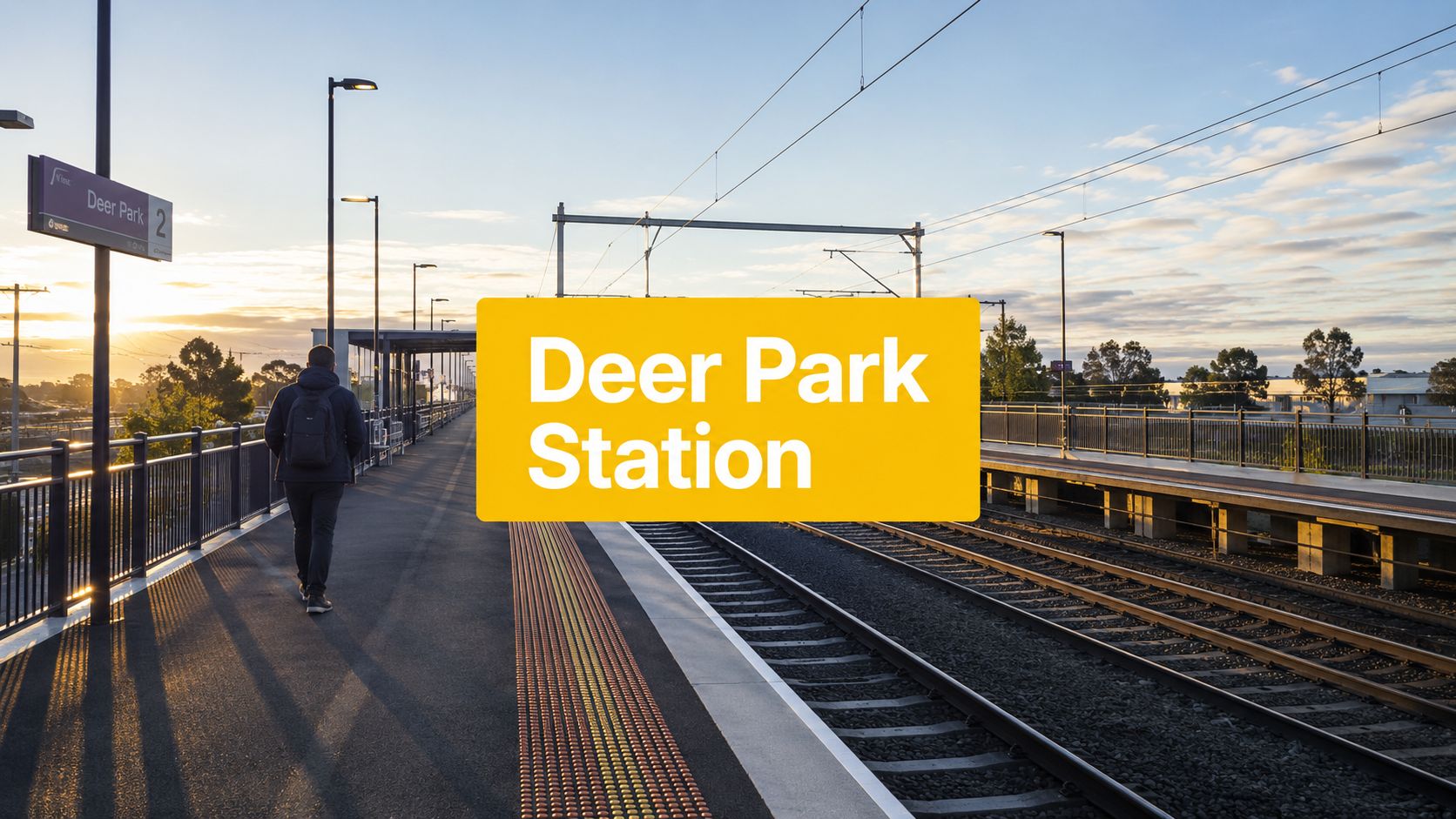
A passenger arriving at Deer Park Station for the first time may expect a modest suburban stop, then find a raised platform, lifts, buses, parking and regional trains converging above Station Road. That contrast explains the station's current role. It's no longer a place to board a train in Melbourne's west. It's a rebuilt interchange where accessibility, connections and future capacity shape the journey as much as the rail service itself.
For a commuter travelling towards Southern Cross, a student changing from a bus, or a regional passenger moving between the Ballarat and Geelong corridors, the useful question isn't only whether a train stops there. It's whether the station makes the complete trip straightforward, from the car park or footpath to the correct platform and onward connection.
Table of Contents
- What Deer Park Station Is and Why It Matters
- History of Deer Park Station from 1884 to Today
- Location and Layout of the Rebuilt Station
- Patronage Growth on Melbourne's Western Lines
- Getting to Deer Park Station by Car, Bus and Bike
- Accessibility and Interchange Usability
- Practical Travel Tips Before You Go
- Frequently Asked Questions About Deer Park Station
What Deer Park Station Is and Why It Matters
If you step off a Ballarat service at Deer Park, the station's vertical layout becomes clear immediately. The train arrives at a raised platform, while lifts and stairs lead down towards the concourse, bus interchange and surrounding streets. Like an interchange built in layers, it brings rail, bus, walking and cycling movements into one connected place.
Deer Park Station is in Brimbank, between Deer Park and Caroline Springs, on Melbourne's western rail corridor. V/Line services stop here on the Ballarat and Geelong lines, connecting western-suburban passengers with regional trains towards Bacchus Marsh, Ballarat, Wendouree and Geelong. Passengers travelling into central Melbourne may continue directly or make a broader connection at Sunshine, depending on their service.
Why the interchange matters locally
The station has to work for several kinds of passenger:
- Regional commuters travelling to Melbourne's central business district or western regional destinations.
- Students and workers arriving by bus from nearby residential areas.
- Local residents combining road, bus, bicycle and rail travel.
- Passengers with mobility needs who require lifts, ramps and clear routes to the platforms.
That combination makes everyday usability more important than the station's most visible engineering feature. A modern building can still create delays if passengers cannot find the right lift, understand the transfer route, access parking easily or board during a crowded platform period.
The Deer Park project removed the road and rail conflict at Mount Derrimut Road by carrying the railway above it. It also created a station intended to serve a growing catchment, with two accessible raised platforms, a bus interchange and pedestrian and cycling links as part of the Mt Derrimut Road project.
For a daily passenger, these features shape the complete trip. The raised railway is the headline change, while reliable transfers, step-free access and room for future demand determine whether the rebuild works well in practice.
History of Deer Park Station from 1884 to Today
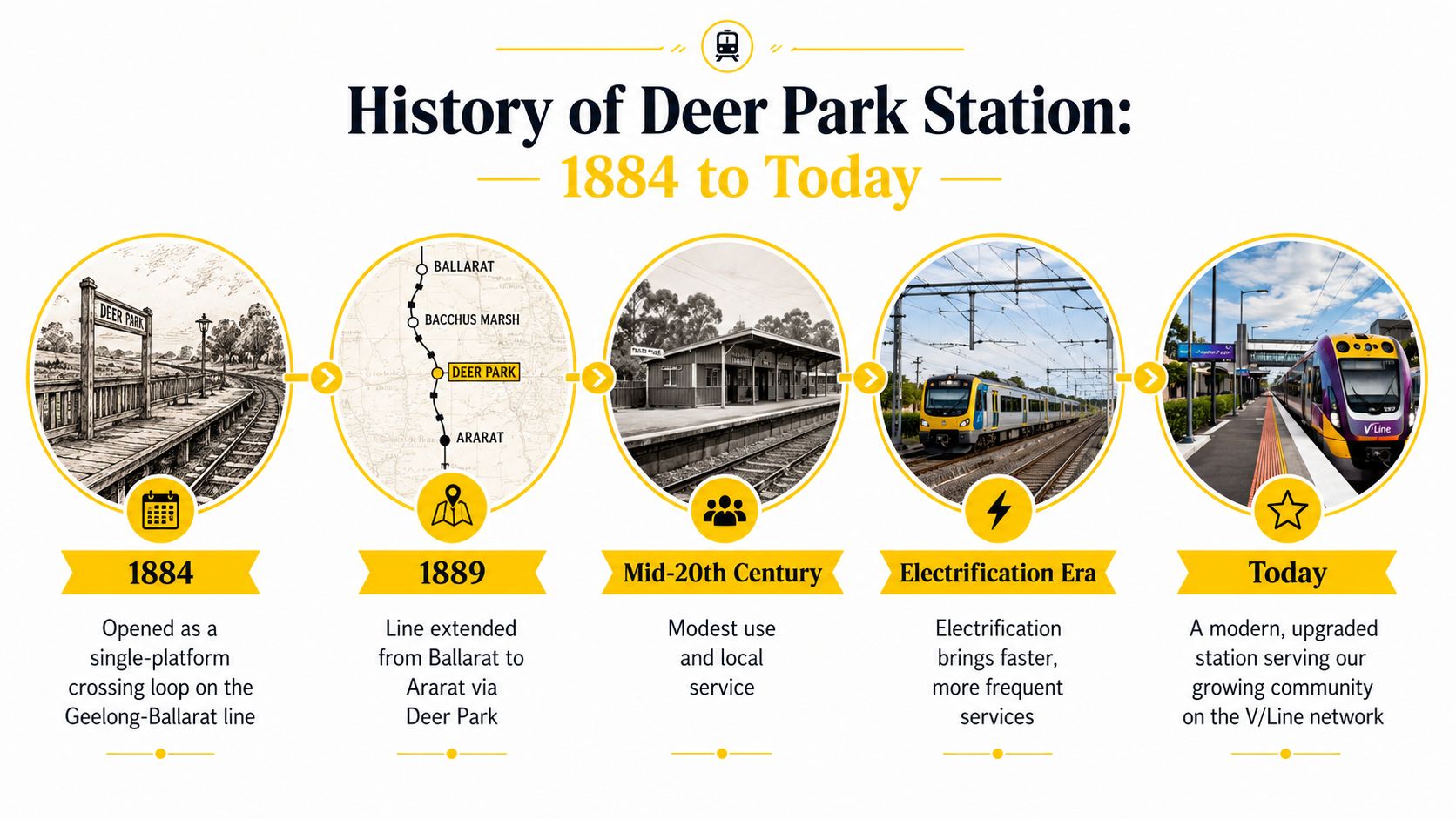
Deer Park Station began as a small railway stop rather than a major interchange. It opened on 2 April 1884 as Kororoit, serving the developing route through Melbourne's west. The station was renamed Deer Park on 3 December 1889, a change that established the name still used today in the station's recorded history.
The early station belonged to a very different railway system. It functioned as a crossing-loop stop on the Geelong to Ballarat route, with modest local demand and a rural or semi-rural setting around it. Over time, the surrounding suburbs expanded, and the station's role gradually shifted from a lightly used local stop towards a regional-commuter access point.
From crossing loop to elevated station
The station's long history includes the extension of the railway towards Ararat, later electrification discussions and decades in which passenger use remained comparatively limited. A significant change came when Deer Park was integrated into Melbourne's metropolitan ticketing arrangements in 2009, making the station more practical for passengers travelling from the western suburbs.
The physical transformation arrived in 2023. The Level Crossing Removal Project replaced the Mount Derrimut Road crossing with a 1.2-kilometre rail bridge and delivered a new station. The rebuild removed the road and rail interface that had constrained movement around the crossing, while also creating a more substantial interchange for passengers.
This sequence spans more than 139 years, from the 1884 opening to the 2023 redevelopment according to the station history record. The dates show why the modern station shouldn't be judged as an isolated construction project. It represents the latest stage in a long change from a nineteenth-century crossing-loop stop into a suburban and regional interchange.
Location and Layout of the Rebuilt Station
Arriving at Deer Park by bus, bicycle or car now means entering a raised station precinct rather than approaching trains beside a road crossing. The station sits near the Western Highway and the retail activity around Station Road. Its layout works like a three-level interchange:
- Street and interchange level, where buses, pedestrians and cyclists arrive.
- Concourse level, where passengers find entrances, lifts, stairs and waiting facilities.
- Platform level, where regional trains stop on the raised tracks.
The rebuild provided two accessible raised platforms. Lifts and stairs connect both platforms with the concourse, while ramps, an air-conditioned waiting room and other passenger facilities support people using mobility aids, prams or luggage in the project's opening update. For daily users, these connections matter as much as the removal of the level crossing. They determine whether changing between a bus, car, bicycle and train feels straightforward.
Finding the right train
Platform choice depends on the service direction and the operating pattern on the day. Ballarat corridor trains may continue to Bacchus Marsh, Ballarat or Wendouree. Geelong corridor trains run towards Geelong and intermediate destinations. Check the electronic signs and listen for announcements before boarding, especially during altered services.
The surrounding precinct includes an integrated bus interchange, pedestrian and cycling links, bicycle storage and upgraded car parking. These features give the rebuilt station room to function as a regional interchange, rather than only as a stop beside the tracks. Future passenger growth will also depend on how well this space handles transfers during busy periods.
Readers combining a station visit with aviation or transport study can consult Ace Aviation Aerospace Academy's Melbourne location. For introductory commercial drone education, ACE BRONZE covers drone operations, flight safety, aviation theory and practical skills as a foundation towards becoming a licensed drone pilot in Australia.
Patronage Growth on Melbourne's Western Lines
Deer Park's importance becomes clearer through its passenger numbers. Independent analysis of V/Line station data recorded fewer than 80 weekday passengers in 2008–09, compared with 326,000 passengers in 2022–23. That made Deer Park the 7th busiest station on the V/Line network that year in the published station analysis.
The later figures continued the same pattern. Deer Park recorded 518,750 annual boardings in 2023–24, again ranking 7th statewide, and 636,300 boardings in 2024–25, still ranked 7th in the same analysis. Taken from the 2022–23 annual total to 2024–25, that represents growth of more than eight times.
What drives the demand
Several forces work together:
- Residential expansion has increased the number of potential passengers in Melbourne's west.
- Regional service improvements have made the station more useful for journeys beyond the immediate suburb.
- Ticketing integration has lowered a practical barrier for some metropolitan passengers.
- The rebuilt corridor has changed how passengers approach and use the station.
The figures don't mean every train is equally crowded. Weekday peaks generally create the strongest pressure because commuters travel at similar times. Inter-peak services can feel more manageable, while weekends bring a different pattern influenced by leisure, family and regional travel.
The station's ranking also explains why future capacity matters. The rebuild wasn't only a response to an old level crossing. It prepared a busy western corridor for additional demand, including longer V/Line trains and planned capacity changes on the Melton line. Passengers should expect demand to remain an important part of the Deer Park travel experience rather than assuming the new station will always feel spacious.
Getting to Deer Park Station by Car, Bus and Bike
The best approach depends on the final destination and the time of day. A passenger from Caroline Springs or Burnside may find a local bus or car trip more direct than walking, while someone already near Station Road can use the pedestrian and cycling connections around the precinct.
Drivers should follow current signs for the commuter car park, drop-off areas and restrictions. The rebuild delivered 150 new or upgraded car parks in the project information. Spaces can be more difficult to find during busy weekday periods, so arriving close to departure time creates unnecessary risk.
Choosing the connection
- Car: Use the signed approaches around Tilts Road and Railway Parade, then allow time to walk from the parking area to the station entrance.
- Bus: Check the live journey planner for services connecting Deer Park with Caroline Springs, Burnside, Sunshine and neighbouring suburbs. Routes and stopping patterns can change, so a remembered route isn't a substitute for a current departure search.
- Bicycle: Use the station's bicycle parking and secure the bicycle properly. Cyclists should also allow for the final approach through shared pedestrian and cycling paths.
- Walking: Station Road and the surrounding precinct provide the most direct access for nearby residents, but passengers with luggage or mobility needs should check the route before leaving.
There's no reliable reason to promise a fixed driving time from Caroline Springs, Burnside or central Sunshine. Traffic, school activity, roadworks and peak rail demand can alter the journey. Passengers who need to improve their local driving confidence can find a Deerpark driving instructor before relying on a car-to-rail commute.
Accessibility and Interchange Usability
The rebuilt station's most important everyday improvement is the ability to move between transport modes without confronting the old road-level crossing. Lifts, ramps, accessible platforms, tactile indicators, hearing support features and accessible toilets all matter because passengers experience a station through movement, not architectural plans.
A parent with a pram needs a clear route from the footpath to the platform. A passenger using a wheelchair needs lifts that connect the required platform with the concourse and bus interchange. Someone carrying heavy luggage needs weather protection, readable signs and enough time to identify the correct departure before boarding.
The practical test for transfers
Deer Park compares favourably with older V/Line stops that may have fewer interchange facilities, but usability still depends on how well the whole journey works. The most common pressure points are likely to involve:
- Lift reliance: A lift outage can affect the entire trip for passengers unable to use stairs.
- Platform movement: Peak boarding can make narrow or busy areas feel less comfortable, especially for prams and luggage.
- Bus transfers: A physically accessible interchange still needs clear real-time information.
- Construction and service changes: Temporary instructions can override the normal route through the station.
During the 2023 works, Platform 2 was stair-only for a period, and passengers unable to use stairs had to use shuttle services to nearby stations. Later project updates described lifts, ramps, an air-conditioned waiting room, a bus interchange and upgraded parking, but the earlier disruption shows why accessibility should be assessed as a day-to-day operational issue, not just a list of installed features.
Transport operators also work in environments where communication and safety procedures matter. For aviation-related roles, CASA states that an Aeronautical Radio Operator Certificate, or AROC, is required for people who need to communicate on aviation air-band radio frequencies and aren't already qualified under CASA's radio operator guidance. That qualification is relevant to aviation and drone operations, not a requirement for ordinary train passengers.
Practical rule: Passengers who need step-free travel should confirm the current platform, lift access and assistance arrangements before departure, especially when a timetable or construction notice has changed.
Practical Travel Tips Before You Go
Deer Park Station is easier to use when the trip is planned around the actual service rather than a general assumption about the corridor. Ballarat and Geelong trains can follow different stopping patterns, and maintenance, weather or works elsewhere may affect the journey.
The V/Line journey planner should be checked before leaving. It can help confirm the departure, platform information, connecting bus and any disruption notice. Passengers travelling on weekends, public holidays or weekday peaks should be especially careful because service patterns and demand may differ.
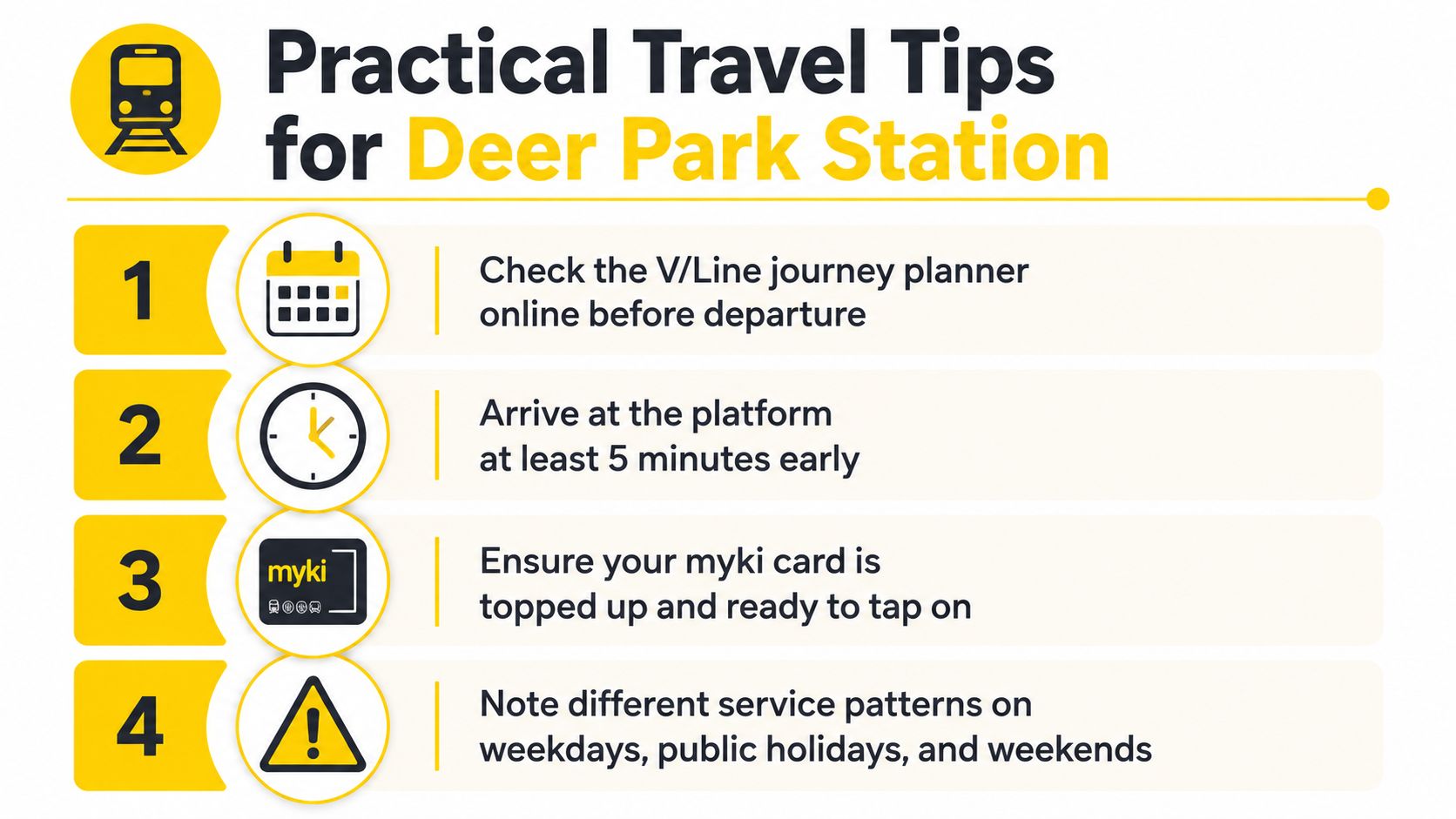
A simple departure checklist
- Ticket first: Arrange a valid Myki or paper ticket before boarding, and confirm the fare and regional-zone conditions for the complete journey.
- Allow a buffer: Arrive early enough to park, walk to the concourse, check the signs and reach the platform without rushing.
- Check the station status: Deer Park Station isn't staffed, so passengers shouldn't depend on an on-site ticket office for last-minute help.
- Respect access areas: Keep clear of bus lanes, emergency access points and signed restrictions. Parking rules can change.
- Prepare bicycles: Use the available bicycle parking and bring suitable security equipment.
- Request assistance: Passengers who need boarding or interchange support should contact V/Line in advance and allow extra time.
- Coordinate the next leg: Check the connecting bus in the same journey search. Regional trains and local buses aren't always timed as a single coordinated connection.
A passenger who treats the station as an interchange, rather than just a platform, will usually make better decisions. The key details are the service pattern, ticket, access route and onward connection.
Frequently Asked Questions About Deer Park Station
Where is Deer Park Station?
Deer Park Station is in Melbourne's western suburb of Deer Park, near the Western Highway and Station Road. It serves passengers from Deer Park, Caroline Springs, Burnside and nearby communities in Brimbank and the wider western metropolitan area.
Which train lines serve Deer Park Station?
V/Line trains serve Deer Park on the Ballarat and Geelong lines. Depending on the service, passengers may travel towards Bacchus Marsh, Ballarat, Wendouree, Geelong or intermediate stations. The current V/Line timetable remains the reliable source for stopping patterns.
Does Deer Park Station have lifts and accessible facilities?
Yes. The rebuilt station has accessible raised platforms connected by lifts and stairs, along with ramps, an air-conditioned waiting room and accessible facilities. Passengers who need assistance should contact V/Line before travelling because temporary changes or operational issues can affect the normal interchange route.
Do trains from Deer Park go directly to central Melbourne?
Passengers shouldn't assume that every Deer Park journey runs directly to the City Loop or a central Melbourne destination. Many travellers use a connection at Sunshine for metro services and suburban destinations. The required transfer depends on the timetable, destination and service pattern on the day.
Is Deer Park Station staffed?
The station isn't staffed, so tickets should be arranged before boarding or through approved digital and retail channels. Passengers should also allow time to find the correct platform and confirm the departure information without relying on an on-site ticket office.
Can passengers connect from Deer Park Station to aviation or radio training?
Yes, passengers can use rail, bus or car connections to reach training locations, but travel time should be checked with a live navigation tool on the day. People pursuing drone operations may need to understand CASA requirements separately, including when a Remote Pilot Licence is required. CASA says a RePL is required for remote pilots working for an operator holding a ReOC, and for flying an RPA over 25 kilograms and up to 150 kilograms over the pilot's own land; it isn't required for micro RPAs of 250 grams or less or excluded-category RPAs under CASA's RePL guidance.
Ace Aviation Aerospace Academy provides training connected to professional drone operations, including the Remote Pilot Licence and Aeronautical Radio Operator Certificate, as well as ReOC consulting and enterprise or corporate drone training. Readers planning aviation study around Deer Park Station can visit Ace Aviation Aerospace Academy to review the relevant Australian training pathways and requirements.