You're staring at airline careers pages, a training quote in another tab, and a list of acronyms that all seem to blur together. Some programs look like a straight path to the right seat, others look like expensive guesswork, and the word cadet itself can leave new applicants wondering whether the training is paid for, partially subsidised, or just a marketing label.
Pilot cadetships Australia is a broad phrase, but in practice it means a structured airline-aligned training pathway for an ab-initio candidate, usually someone with little or no flying experience. The clearest current benchmark is the Qantas Group Pilot Academy, which is designed to qualify trainees for CASA licences and ratings including the Commercial Pilot Licence (CPL), Multi-Engine Command Instrument Rating (ME IR), ATPL theory, and Multi-Crew Cooperation (MCC), with a 55-week full course duration (Qantas Pilot Academy FAQs). A separate 2024 industry feature on the pilot shortage found vacancies at seven airlines across jet and turboprop roles, which helps explain why airlines keep building cadet pipelines (Aviation Business News feature).
The useful question isn't whether cadetships exist. It's whether they're the right route for a specific applicant compared with self-funded flight training, defence pathways, or other entry points. That's where the fine print matters, especially the medical, the paperwork, and the application channel. For readers comparing training options across aviation and drone pathways, a starting point on Ace Aviation Aerospace Academy's approach to training is why Ace Aviation Aerospace Academy structures learning the way it does.
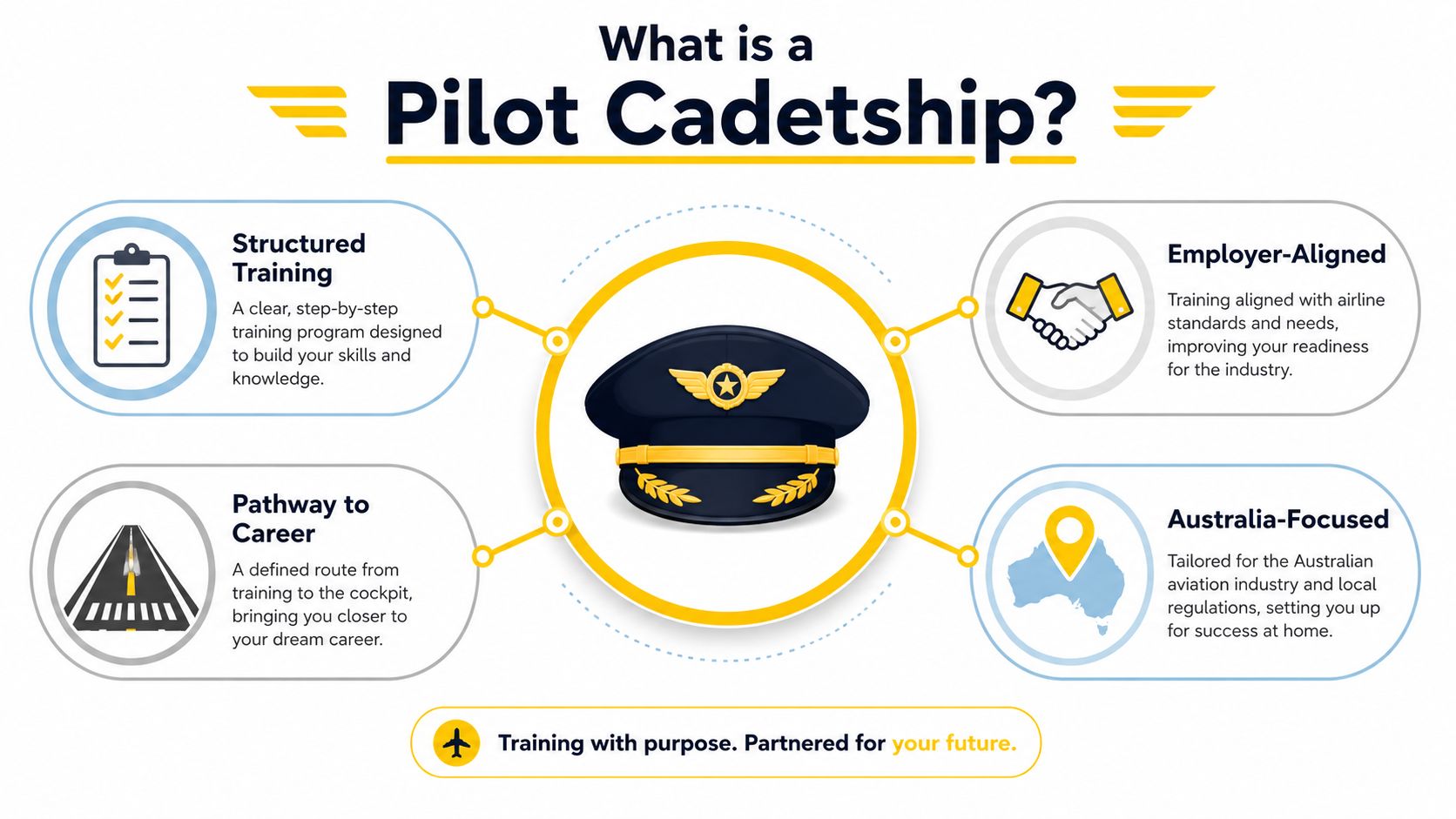
Table of Contents
- What a Pilot Cadetship Actually Means in Australia
- How Cadetships Differ From Other Pathways to the Right Seat
- Eligibility and CASA Prerequisites You Need Before You Apply
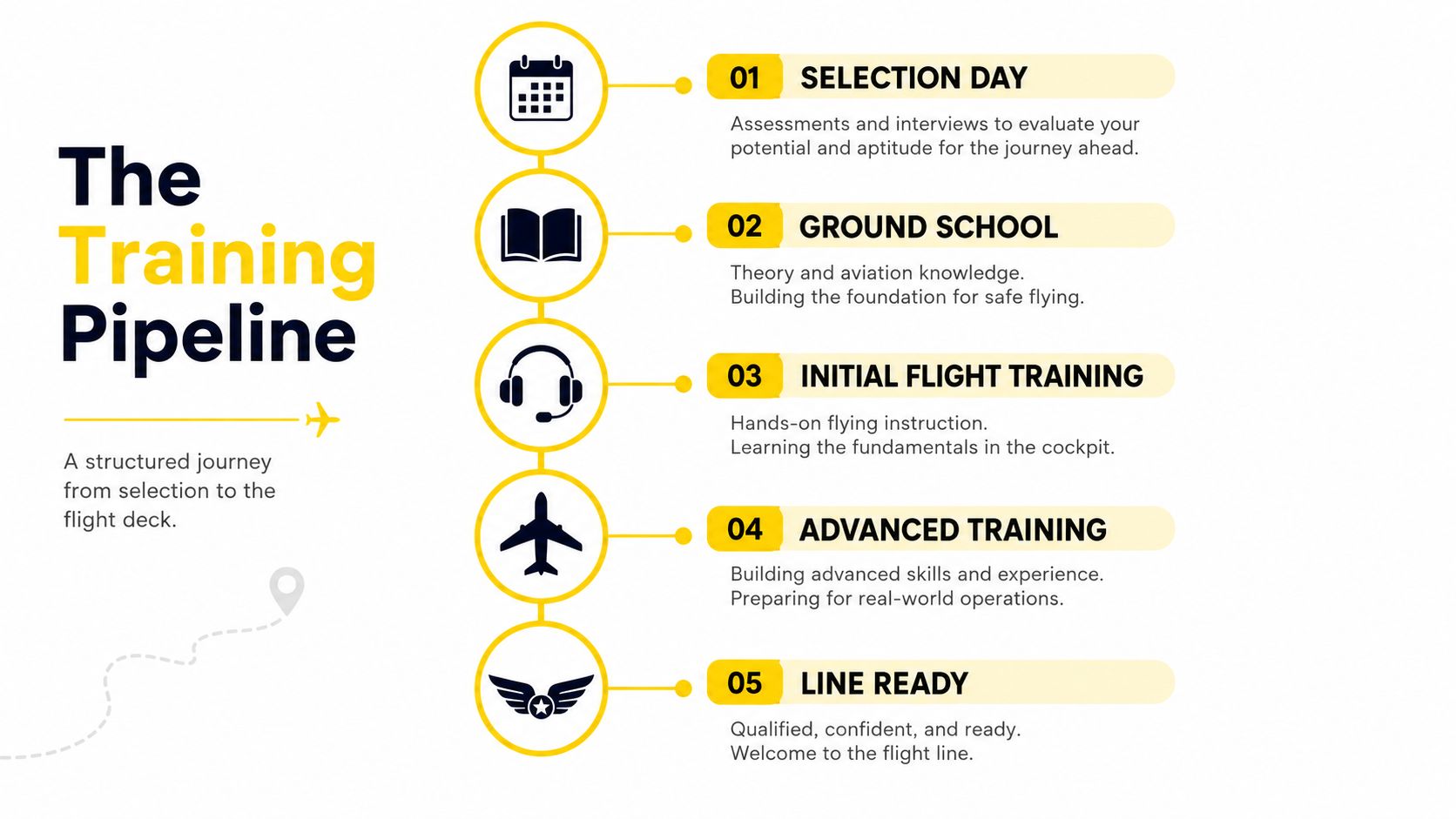
- Inside the Training Pipeline From Zero Hours to Line Ready
- Major Airline and Industry Cadetship Examples You Can Apply To
- Step by Step Application Guide for Australian Pilot Cadetships
- Adjacent Skills and Alternative Routes Worth Considering
- Frequently Asked Questions About Pilot Cadetships in Australia
What a Pilot Cadetship Actually Means in Australia
A pilot cadetship in Australia is best understood as a structured training agreement, not a casual “learn to fly and see what happens” pathway. The candidate enters as an ab-initio trainee, and the program is built to take that person through the licences and ratings needed for airline-style work, often with a pathway into the operator's own network.
The practical meaning of cadetship training
For a Year 12 student reading airline careers pages, the first point of confusion is usually whether “cadet” means “free”. It does not automatically mean that. Some cadet-style programs are employer-linked, some are delivered through partner academies, and some sit closer to an airline-branded entry path than a fully sponsored job.
What they usually share is a defined syllabus and a recruitment process that filters for people who can complete the training and fit a commercial cockpit environment. The Qantas Group Pilot Academy is a clear example of that structure, because its public FAQ describes an ab-initio course that leads toward CASA licences and ratings including the CPL, ME IR, ATPL theory, and MCC (Qantas Pilot Academy FAQs).
Cadetship is also easy to mix up with scholarships and sponsorships. A scholarship usually means financial support with no direct airline training pipeline attached. A sponsorship can reduce cost or tie training to a future employer. A cadetship is broader than both, because it links training, selection, and workforce planning.
Why airlines keep using cadet pipelines
Airlines do not build cadet programs for branding alone. They use them to create a more predictable flow of trained pilots into a market where vacancies are still visible across multiple carriers. In a 2024 industry scan, airline careers pages showed vacancies at seven airlines in Australia, covering jet and turboprop roles, which is a strong sign of demand for new entrants (Aviation Business News feature).
Practical rule: If a program describes itself as a cadetship, read it as a training pipeline first and a job promise second.
That matters because many applicants chase the label without checking the mechanics. A serious comparison starts with the training outcome, the medical requirements, the selection standard, and any commitment after graduation. It also helps to compare cadetships with other legitimate entry routes, including the kind of pathway outlined in Ace Aviation's explanation of its training model, so you can see where an airline-linked program fits beside independent training.
For broader background on how training pathways can be designed around commercial outcomes, a useful external perspective is strategic investment in pilot training.
How Cadetships Differ From Other Pathways to the Right Seat
Cadetships sit beside other legitimate entry routes, not above them. A self-funded CPL, a Multi-Pilot Licence route through a partner academy, or a defence force program can all lead to a flying career, but they differ in who pays, who controls the pipeline, and how tightly the training is tied to one employer.
The decision criteria that matter most
The first question is simple. Who pays? If the answer is “the student”, the route is self-funded and usually more flexible. If the answer is “the operator, partly or fully”, the route usually comes with tighter selection, stronger obligations, and a more direct link to a specific airline or partner school.
The second question is how locked in is the trainee? Cadetships often come with a service obligation, bonded period, or a strong expectation of joining the operator's operation after training. Self-funded training gives more freedom, but also more risk, because the graduate still has to compete for the first flying job.
The third question is how directly does the route target an airline cockpit? A cadetship is designed around commercial operations from the start. The Qantas Group Pilot Academy's 55-week full training course is a useful benchmark for that airline-style structure (Qantas Pilot Academy FAQs). That doesn't make it “better” than other routes, but it shows how tightly the training is sequenced.
A cadetship is useful when the applicant wants structure and employer alignment. It's less useful when flexibility and training independence matter more.
Comparing common pilot training pathways in Australia
| Pathway | Who pays | Typical duration | Service obligation |
|---|---|---|---|
| Airline cadetship | Often employer-linked, sometimes student contribution applies | 55 weeks is a documented benchmark for one airline-style academy (Qantas Pilot Academy FAQs) | Often yes, depending on the operator |
| Self-funded CPL | Student | Varies by school and pace | Usually no formal obligation |
| MPL through partner academy | Usually student or operator-linked, depending on arrangement | Varies by provider | Can be tied to a specific operator |
| Defence force pilot program | Defence force | Varies by service pathway | Yes, through service commitment |
The table is the comparison most applicants need. It cuts through the marketing and prompts the core question. Is the applicant buying flexibility, or buying a structured route into one employer's pipeline?
Eligibility and CASA Prerequisites You Need Before You Apply
A cadetship application can look simple from the outside, then the paperwork starts to split into small but important pieces. Rex's published cadet pilot FAQ gives a clearer picture than the usual “good grades and an interest in flying” advice, and it is the right place to start before you invest time in forms, references, and document scans.
What the Australian cadet checklist usually includes
For Rex's cadet pilot program, applicants must be at least 18 years old at the time of application, must have completed Year 12 or an equivalent qualification such as a diploma, and should have good results in mathematics or physics (Rex cadet pilot FAQ). Applicants also need to be Australian citizens or residents when they register, and the registration process asks for proof of that status (Rex Cadet Registration).
The application pack is more specific than many candidates expect. Rex asks for a single PDF containing a cover letter, resume, proof of citizenship or residency, Year 12 or equivalent academic results, and any licence held, with a maximum file size of 8 MB (Rex Cadet Registration). That detail sends a clear signal. Cadet programs assess how well you can present yourself, not just whether you want to fly.
Before you submit anything, check where your current aviation status sits using a neutral reference like AAA's licence finder tool. That gives you a cleaner view of whether you are starting from zero, already holding a student or private-level licence, or applying with prior aviation exposure.
Why the medical and ASIC matter early
Rex also requires a CASA Class 1 Medical Certificate and an Aviation Security Identification Card (ASIC) before training begins, and both are at the cadet's own expense (Rex cadet pilot FAQ). That matters because a lot of applicants treat the paperwork as a last-minute admin job, then find the medical process takes time or raises questions that need follow-up.
A Class 1 medical checks whether an applicant meets CASA's standards for professional pilot duties. An ASIC is used for secure airside access. Both sit at the front gate of the process, not near the end.
Practical advice: The Class 1 medical is the document most likely to change your plan. Strong school results do not help if the medical does not clear.
A medical issue does not always end an aviation path, but it can stop a cadetship application from progressing. That is why the medical should be handled early, before you commit energy to interview prep and document assembly. For readers who are still trying to work out what qualifications they already hold and what they still need, this licence finder helps you compare your current position with the usual entry points.
Inside the Training Pipeline From Zero Hours to Line Ready
A cadetship can look like a straight shot from application to airline cockpit, but the training path is usually a series of gates. Each gate checks a different skill, from theory to handling, from solo confidence to crew discipline. The clearest public example is the Qantas Group Pilot Academy, because its documentation shows the structure more openly than many airline notices do. The academy is aimed at ab-initio students and is built around a training course that leads toward the licences and ratings airline operators expect, as outlined in the Qantas Pilot Academy FAQs.
How the training arc is usually structured
The first stage is ground school. Cadets work through aviation theory before they spend serious time in the cockpit, which helps prevent a common beginner mistake, trying to learn aircraft handling before understanding why the aircraft behaves the way it does. After that, the program moves into flight training, where single-engine handling, circuit work, navigation and test preparation build the skills needed for the Commercial Pilot Licence.
The sequence matters. A cadet does not skip straight to airline-style multi-crew flying. The training stack usually runs from theory to practical solo competence, then toward more advanced instrument work and crew preparation. In the Qantas framework, the named milestones include the CPL, ME IR, ATPL theory, and MCC (Qantas Pilot Academy FAQs).
For readers trying to visualise the simulator side of training, the practical requirements are easier to follow once the basic stages are clear. A useful external explainer on essential flight simulator requirements shows how simulator environments are usually discussed in aviation training, including the kinds of setup details candidates are often asked about before they start.
What each licence and rating adds
The CPL is the first major step because it allows professional flying work under CASA rules. The ME IR matters because airline flying often involves multi-engine aircraft and instrument procedures that are harder to learn than basic visual flying. ATPL theory provides the academic layer for higher-level airline knowledge, while MCC teaches the discipline of operating as part of a cockpit crew.
New applicants often confuse “line ready” with a final exam. It is not one test. It means a cadet has gathered the right mix of licences, theory passes, and operational readiness to move toward airline duties. The name sounds simple, but the process behind it is layered, like building a house in stages rather than putting up the roof first.
Short version: cadet training is a ladder, not a single exam.
For readers comparing structured aviation training options, the relevant overview is the academy course list. It gives a useful starting point for seeing how different training paths are organised before you commit to an application route.
Major Airline and Industry Cadetship Examples You Can Apply To
A cadetship search in Australia works best when you treat it like choosing a training route, not a single doorway. The airline name on the brochure matters less than the way applications are handled, because each program asks for different documents, follows a different intake path, and sometimes sends you through a partner school rather than straight to the airline.
How the main Australian programs differ
Qantas Group Pilot Academy is the clearest public example of an ab-initio pathway. Its FAQ presents the academy as a place for students with little or no flying experience and describes a course built around airline-style outcomes, including the CPL, ME IR, ATPL theory, and MCC (Qantas Pilot Academy FAQs). For someone comparing entry routes, it gives a useful picture of how a cadet program can be structured from the start.
Jetstar's Ab Initio Cadet Pilot Program uses the CAE Oxford Aviation Academy portal rather than a direct Jetstar application channel, and the program notice names CAE OAA, Jetstar, and Swinburne University of Technology as contacts for further information (Jetstar program notice). That matters because a candidate can miss the right intake route even when they are otherwise eligible.
Virgin Australia had an earlier cadetship announcement with a 50:50 gender target, but the public material in the provided sources is dated and does not show current outcome data. It is useful as a historical marker, not as a current guide to selection.
Rex offers a regional pipeline with a clearly documented registration and medical process, which helps applicants who want to see the practical steps more clearly than some airline careers pages allow. The program material gives a more direct picture of what the airline expects from candidates and what paperwork needs to be in order (Rex Cadet Registration, Rex cadet pilot FAQ).
Sharp Airlines stands out because it runs a cadetship through a CASA-approved school in Victoria, which shows that cadet-style entry is not limited to the big jet airline model (Sharp Airlines cadetship program).

Which application channel fits which applicant
Applicants who want a direct airline academy model will usually start with a Qantas-style intake structure. Applicants who prefer an externally managed training path need to pay close attention to the portal and partner school, as Jetstar's CAE OAA pathway shows. Regional candidates may find Rex or Sharp Airlines more relevant, especially if they want a clearer link between the application process and the training provider.
For readers comparing aviation entry points more broadly, Ace Aviation Aerospace Academy's jobs page is a useful place to see how pilot-adjacent roles are presented alongside training opportunities. It does not replace airline cadet selection, but it helps applicants understand the wider employment field around aviation.
The common thread is straightforward. Cadetship titles can sound alike, but the application mechanics are not. The portal, partner school, and intake model tell a candidate far more than the headline banner does. Before submitting anything, candidates should also get your Australian student ID, because training providers often expect that detail to be ready once a place is offered.
Step by Step Application Guide for Australian Pilot Cadetships
A strong application is usually boring in the best possible way. It's complete, organised, and easy for a recruiter to assess. The candidates who struggle most usually have one of two problems, either they under-prepare the documents or they send something that looks copied from a generic job application.
How to prepare a competitive file
Rex's registration process shows the level of order expected in a serious cadetship application. The file needs to be a single PDF, contain a cover letter, resume, proof of Australian citizenship or residency, Year 12 or equivalent results, and any existing licence, and it must stay within 8 MB (Rex Cadet Registration). That is more than a formatting detail. It shows that aviation recruiters want applicants who can follow instructions exactly.
A cover letter should do three jobs. It should state the applicant's interest in the specific program, show that the applicant has read the entry conditions, and explain why the candidate is ready for a disciplined training environment. A pilot-style resume should emphasise education, any technical or teamwork experience, and anything that shows reliability, such as customer-facing work, sports captaincy, volunteering, or structured study habits.
When applicants are gathering identity documents, a clean reference point for digital student identity preparation is TP Training's guide to getting your Australian student ID. That sort of administrative accuracy matters in aviation, even before the flight training starts.
What usually happens after submission
Most Australian cadetship selections go beyond a document check. Applicants should expect some mix of aptitude screening, psychometric testing, interviews, and simulator assessment. The exact mix varies by operator, but the logic is consistent. Recruiters want to know whether the person can process information, stay calm under pressure, and work inside a procedure-heavy environment.
Preparation should match that reality.
- Cover Letter: Keep it specific to the program, not a generic aviation statement.
- Resume: Keep the layout clean and readable, with aviation-relevant strengths near the top.
- Aptitude Tests: Practise mental maths, pattern recognition, multi-tasking and spatial awareness.
- Interview: Be ready to explain why this route, why now, and why that airline or academy.
- Referees: Brief them early so they expect structured questions about reliability and teamwork.
A practical note on the application stage is worth remembering. If a candidate can't present a tidy file, recruiters will question how that person will handle cockpit documentation, training schedules and checklists.
Adjacent Skills and Alternative Routes Worth Considering
Not every strong aviation candidate gets a cadetship on the first attempt. That doesn't mean the candidate is off the path. It often means the next smart move is to build complementary aeronautical skills, show discipline, and stay active in the industry while reapplying.
Why complementary aviation and drone skills help
Pilot training rewards people who already understand procedure, airspace, communication and risk management. That's why drone and aviation credentials can sit alongside a pilot ambition rather than competing with it. A candidate who already understands CASA requirements, airspace discipline and operational planning has less to learn when stepping into professional aviation training.
For some readers, the more practical fallback is to build a commercial drone profile while waiting for a cadetship result. Ace Aviation Aerospace Academy offers ACE READY, an entry-level drone training course for beginners that covers drone fundamentals, aviation safety, CASA regulations, flight operations, and preparation for advanced Remote Pilot Licence training in Australia. It also offers ACE BRONZE, a foundation commercial drone course covering drone operations, flight safety, aviation theory, and practical skills for students beginning their journey toward becoming licensed drone pilots in Australia.
Those courses are not pilot cadetships, and they shouldn't be confused with airline pathways. They are adjacent qualifications that help build aviation habits, technical vocabulary and operational discipline.
Where Ace Aviation fits beside cadetships
For readers who want a more direct professional drone pathway, Ace Aviation Aerospace Academy also trains to the Remote Pilot Licence (RePL) and Aeronautical Radio Operator Certificate (AROC), and provides ReOC Consulting, Enterprise Drone Training, and Corporate Drone Training as part of its broader aviation education offering. Those are relevant for applicants who want a commercial fallback, or who want to stay active in aviation while aiming for a pilot seat.
Useful mindset: A cadetship is one entry point into aviation, not the whole map.
That is the part many applicants miss. A candidate can build credibility through drone work, radio certification, and structured aviation study, then keep applying for cadet programs with a stronger profile and a clearer sense of the industry.
Frequently Asked Questions About Pilot Cadetships in Australia
A cadetship can look like the fastest way into an airline cockpit, but the right route depends on the applicant, the program terms, and the evidence you can provide. Some cadet programs carry most of the training burden, while others still expect the student to fund a meaningful part of the pathway. The safer approach is to read the rules carefully, then compare them with other entry routes rather than assuming every cadetship works the same way. For a plain-English checklist of common entry questions, see the AAA FAQ page.
Who pays for a pilot cadetship in Australia
It depends on the program. Some cadetships are employer-linked and may cover a large part of the pathway, while others are closer to a branded training route where the student still carries meaningful cost. The Qantas Group Pilot Academy is a structured ab-initio pathway, but applicants still need to read the current program terms carefully rather than assuming it is fully funded.
How competitive are cadetship applications right now
They are competitive because the pathway attracts a lot of interest and vacancies still appear across the market. An industry feature that noted openings at several airlines is a reminder that demand exists, but it does not mean every applicant will get through quickly or on the first attempt. Strong documents, sound medical fitness, and a clear interview performance still matter.
What happens if the Class 1 medical fails
A failed Class 1 medical can stop a cadetship application before training begins, because some programs require it at the point of entry. That is the case with Rex's cadet process, which asks for the medical up front. It does not close every aviation option, but it does change the route and may make non-flying aviation roles or drone pathways more realistic.
Does completing a cadetship guarantee an airline career
No. It usually gives a strong first step into airline-style flying, but it does not guarantee a lifetime seat in one airline. Hiring conditions can change, fleets can change, and pilots still have to keep meeting medical, competency, and operational standards.
Is a cadetship better than starting with drones or other aviation training
Not always. A cadetship is the right fit for some applicants, but others benefit from building aviation discipline first through related qualifications such as drone training, radio certification, or other structured aviation study. That extra preparation can make later applications stronger and more informed.
A candidate who wants more context can also review the broader training questions on the Ace Aviation Aerospace Academy FAQ page, then compare that information with airline cadet requirements before applying.