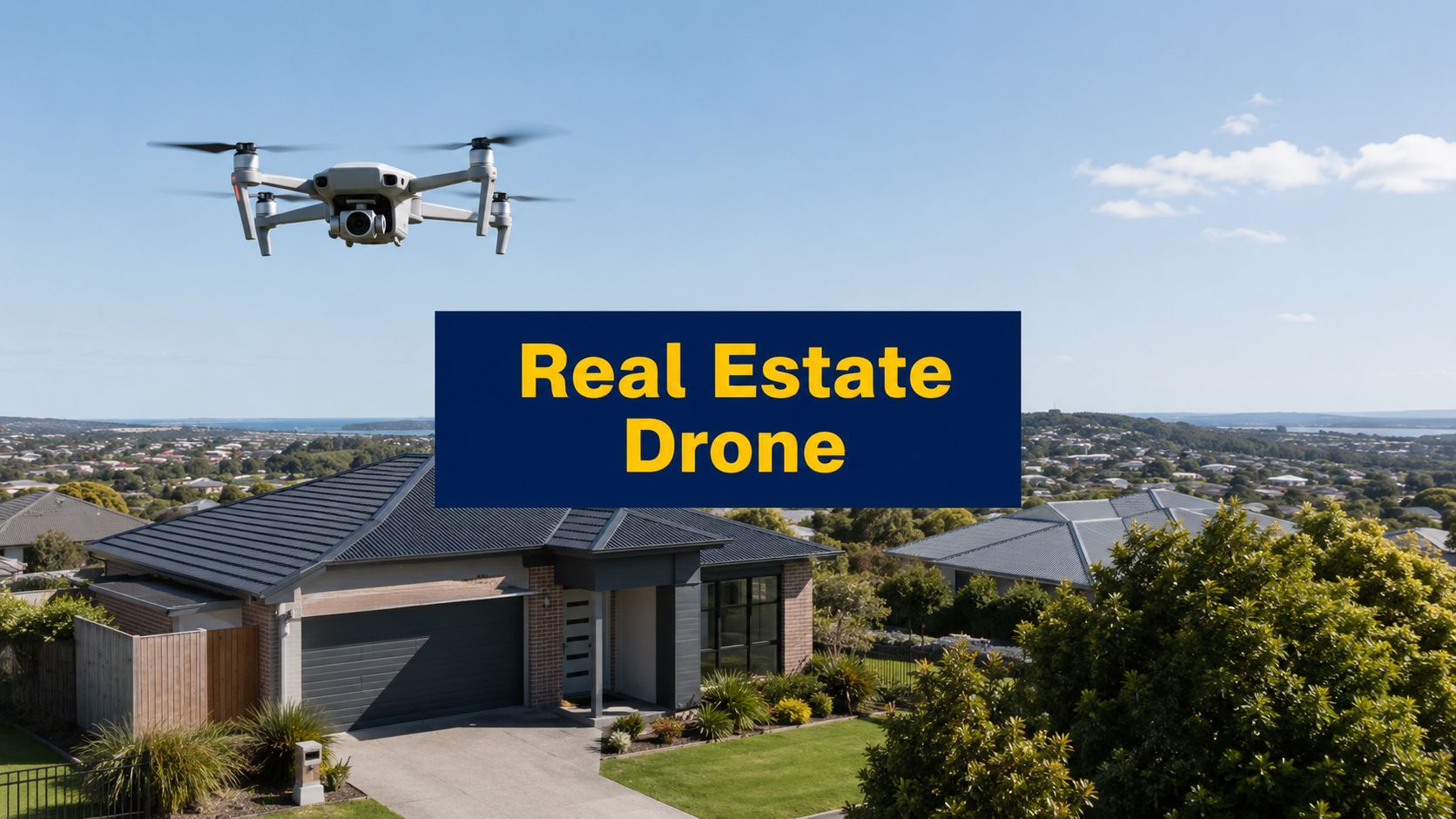
An agent has a new Sydney listing, an open home approaching, and a simple request: deliver twelve usable exterior views, not twelve nearly identical frames. The drone must produce level, detailed images, avoid neighbouring homes and hazards, comply with Australian aviation rules, and return files that an editor can process quickly.
That is the definitive buying test for a drone for real estate photography. A larger sensor helps, but it can't compensate for poor flight planning, weak data management, or an operator who misunderstands commercial obligations. Australian real-estate commentary says 82% of agencies incorporated drone technology by 2025, while 43% of drone-using agencies hired professional operators (Australian guidance on drone photography for real estate). Aerial work is mainstream, so the defensible purchase is the one that matches workload, deliverables and compliance.
Table of Contents
- Choosing a Real Estate Photography Drone
- Camera, Gimbal and Flight Performance
- Comparing the DJI Mini 2 and Air 2S
- Recommended Drones by Budget and Workload
- Accessories and Pre-Flight Preparation
- Planning and Capturing Property Views
- CASA Rules and Australian Privacy Duties
- Final Buying Decision and Key Questions
Choosing a Real Estate Photography Drone
The Sydney shoot starts before the aircraft leaves its case. The agent wants a hero view of the façade, a wide frame showing the block and street relationship, several oblique angles, a rear-yard composition, roof detail and images that support the listing's video edit. The pilot needs to know which views are essential, which flight paths are safe and which files the client expects.
A capable aircraft can still fail this job. A low-quality image may look acceptable on a phone but lose detail when the agent crops it for a banner. A rushed flight may produce attractive footage while missing the pool, driveway or boundary context that makes the property marketable. The aircraft, pilot checklist and delivery folder must be designed as one workflow.
| Decision area | What the buyer should assess | Why it matters |
|---|---|---|
| Image quality | Sensor size, resolution, dynamic range and gimbal stability | Determines detail, cropping room and level horizons |
| Flight performance | Battery management, wind handling, navigation and transmission | Affects coverage and repeatable composition |
| Compliance | Registration, pilot qualifications, approvals and operating limits | A paid shoot is commercial work |
| Workflow readiness | File transfer, backup, editing and client delivery | Controls turnaround and avoidable rework |
Start with deliverables
The operator should ask the agent for the final shot list before choosing a model. Stills-only work has different demands from a package containing aerial video, twilight content, roof imagery and repeated passes over a large block. The operator also needs to establish whether the work will be occasional or part of a recurring paid service.
Australian package benchmarks place 8–15 edited aerial stills at AUD $220–$500, while photo-plus-video packages commonly sit at AUD $450–$900 (Australian drone photography cost guide). Those figures make the commercial logic clear. A drone must support efficient capture and reliable delivery, but the purchase budget also has to leave room for training, batteries, storage, insurance and editing time.
A useful independent perspective on the marketing role of aerial imagery is Stage AI's guide to sell faster with drone shots. Agents and photographers can also review AAA's aviation training and course information before selecting a pathway.
Practical rule: Buy for the number of usable views delivered per job, not for the most impressive specification printed on the box.
Camera, Gimbal and Flight Performance
Real-estate buyers don't purchase specifications. They purchase images that show a building clearly, hold a straight horizon and provide enough surrounding context to make the listing understandable. Each specification should therefore be translated into a result on the agent's website, brochure or social media edit.
Sensor and resolution
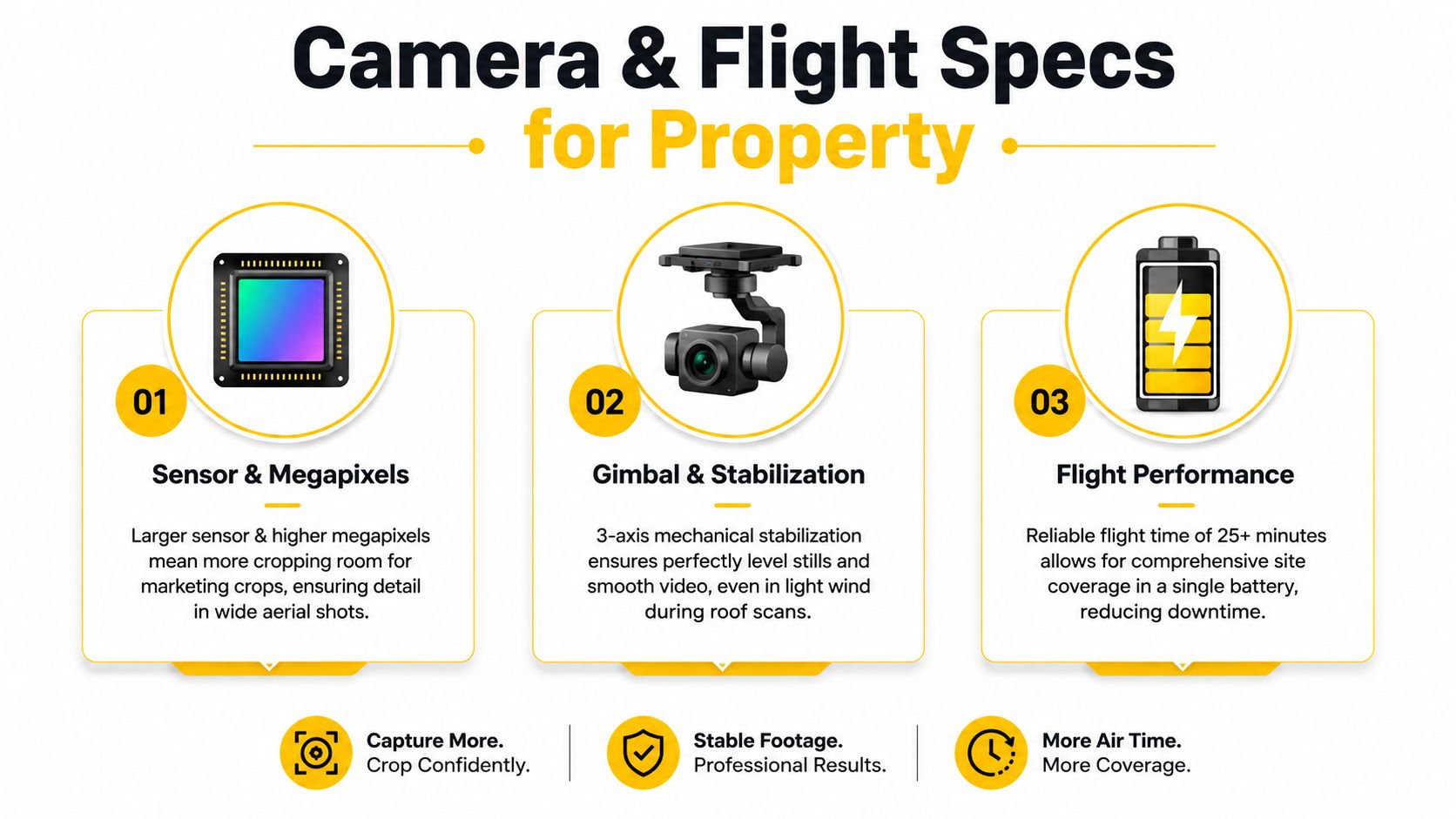
Sensor size is the most important image-quality distinction in the common comparison between the DJI Mini 2 and DJI Air 2S. The DJI Mini 2 uses a 12 MP 1/2.3-inch sensor, while the DJI Air 2S uses a 20 MP 1-inch sensor (local drone comparison). The larger sensor generally provides better low-light handling, detail retention and cropping flexibility for façades and wide compositions.
That advantage matters when a broad establishing frame also needs to work as a tighter crop. It matters during shaded winter mornings, when the operator must preserve exterior detail without making the image excessively noisy. It doesn't remove the need for correct exposure, careful composition or competent editing.
Gimbal and stabilisation
A mechanical gimbal keeps the horizon credible while the aircraft moves. For property work, that means rooflines remain level, verticals are easier to correct and video transitions don't look as though the camera is rolling in the wind. A stable gimbal is particularly valuable during lateral passes and slow orbits around a façade.
The buyer should inspect sample stills and video rather than relying only on a feature label. Stabilisation can protect a sequence from small aircraft movements, but it can't fix an unsafe flight, excessive wind or an operator who changes direction abruptly.
Flight endurance and transmission
Flight time affects the number of completed compositions, not just how long the aircraft remains airborne. A pilot may need separate passes for the front, rear, high-overhead view, roof detail and video. Battery planning should preserve a safe reserve rather than treating the published maximum as usable capture time.
Transmission performance becomes more important on acreage, coastal blocks and sites with trees or structures between the pilot and aircraft. Strong connectivity gives the pilot more confidence, but visual line of sight remains the governing operating condition. A transmission system isn't permission to fly beyond what CASA allows.
For professional training that combines classroom instruction, practical flight training, CASA compliant certification, AROC and aviation English proficiency, ACE SILVER is directly relevant to commercial media operators.
Comparing the DJI Mini 2 and Air 2S
The DJI Mini 2 remains a practical entry point for simple suburban stills. The Air 2S is the stronger image-making choice when the listing needs cropping flexibility, difficult light or more polished video. Neither aircraft turns an inexperienced pilot into a commercial operator.
| Criterion | DJI Mini 2 | DJI Air 2S |
|---|---|---|
| Still camera | 12 MP, 1/2.3-inch sensor | 20 MP, 1-inch sensor |
| Video | 4K at 30 fps | 5.4K at 30 fps |
| Transmission | OcuSync 2.0 | OcuSync 3.0 |
| Published flight time | 31 minutes | 31 minutes |
| Real-estate implication | Portable entry option for straightforward daylight stills | Better low-light handling, detail retention and cropping flexibility |
The specification difference is documented in the Australian comparison referenced above. The Air 2S's 1-inch sensor is the decisive technical benefit, particularly for wide views where the house occupies a smaller part of the frame. More resolution also gives an editor greater freedom to reframe without making the façade look soft.
When the Mini 2 is enough
The Mini 2 can make sense for an operator who photographs uncomplicated suburban properties, works in good daylight and delivers edited stills without demanding heavy crops. Its 4K/30 fps video, compact format and 31-minute published flight time support a modest listing workflow (DJI Mini 2 and Air 2S comparison).
That doesn't make it suitable for every commercial assignment. The operator should be cautious where low light, strong wind, complex obstacles or premium video expectations form part of the brief.
When the Air 2S earns its place
The Air 2S is the better purchase for a photographer who routinely needs polished stills and video, works around shaded façades or expects the client to crop images for multiple marketing formats. Its larger sensor provides useful headroom, but it doesn't replace a proper site assessment or sound flying technique.
Price should be considered alongside the complete workflow. A cheaper aircraft that produces repeated unusable frames can cost more through reshoots and editing time than a better-matched model.
Recommended Drones by Budget and Workload
The right tier depends on how often the aircraft flies and what the client receives. A solo agent who arranges occasional aerial content has different needs from a studio producing stills, video and recurring commercial work. The figures below are decision categories, not verified retail prices. Current pricing varies by supplier, kit and availability, so buyers should obtain a live quote before committing.
| Workload Tier | Recommended Model | Sensor / Camera | Approx. Price (AUD) | Best Fit Scenario |
|---|---|---|---|---|
| Solo agent listings, under five per month | DJI Mini 4 Pro | Compact camera system, selected for portability and sub-250 g format | Confirm current market price | Occasional suburban listing stills |
| Active listing volume, five to fifteen per month | DJI Air 3 or Autel Evo Lite+ | Mid-range camera systems with stronger coverage and workflow capability | Confirm current market price | Regular stills and video across varied properties |
| Specialist or marketing studio | DJI Mavic 3 Classic or Mavic 3 Pro | Premium camera systems designed for demanding stills and video | Confirm current market price | High-end marketing, repeat contracts and complex deliverables |
Solo agents
A sub-250 g aircraft such as the DJI Mini 4 Pro is attractive because it reduces transport burden and can suit straightforward listing content. It still requires the operator to understand the conditions attached to the relevant category. Small size doesn't make the flight automatically lawful, safe or private.
The kit should include spare batteries, storage, a reliable transfer process and time for editing. A low purchase price is not the same as a low operating cost.
Active listing volume
The DJI Air 3 or Autel Evo Lite+ is more appropriate when an operator needs consistent output across different sites. Mid-range systems can provide more camera flexibility, stronger obstacle-awareness features and a workflow that better supports a mixture of stills and video.
Coastal heat, exposed ridgelines and cold early-morning conditions place practical demands on batteries, screens and pilot concentration. Weather resilience should be assessed from the manufacturer's operating guidance, not assumed from the aircraft's price.
Specialist studios
A DJI Mavic 3 Classic or Mavic 3 Pro belongs in a studio workflow where image quality, repeatability and premium video justify the additional investment. A larger sensor can preserve detail and provide more flexibility, but it won't compensate for weak colour management, poor flight paths or late delivery.
More than fifteen paid shoots monthly, recurring commercial contracts or regular twilight video work should trigger a review. The operator may need a higher tier, a second battery kit or a licensed subcontractor. Outsourcing can protect margin and reduce pilot fatigue when the workload exceeds what one person can safely manage.
Accessories and Pre-Flight Preparation
A dependable kit is built around continuity. Batteries, charging, storage and site assessment matter more than novelty accessories because a property shoot usually fails through a missing file, dirty lens, flat controller or overlooked hazard.
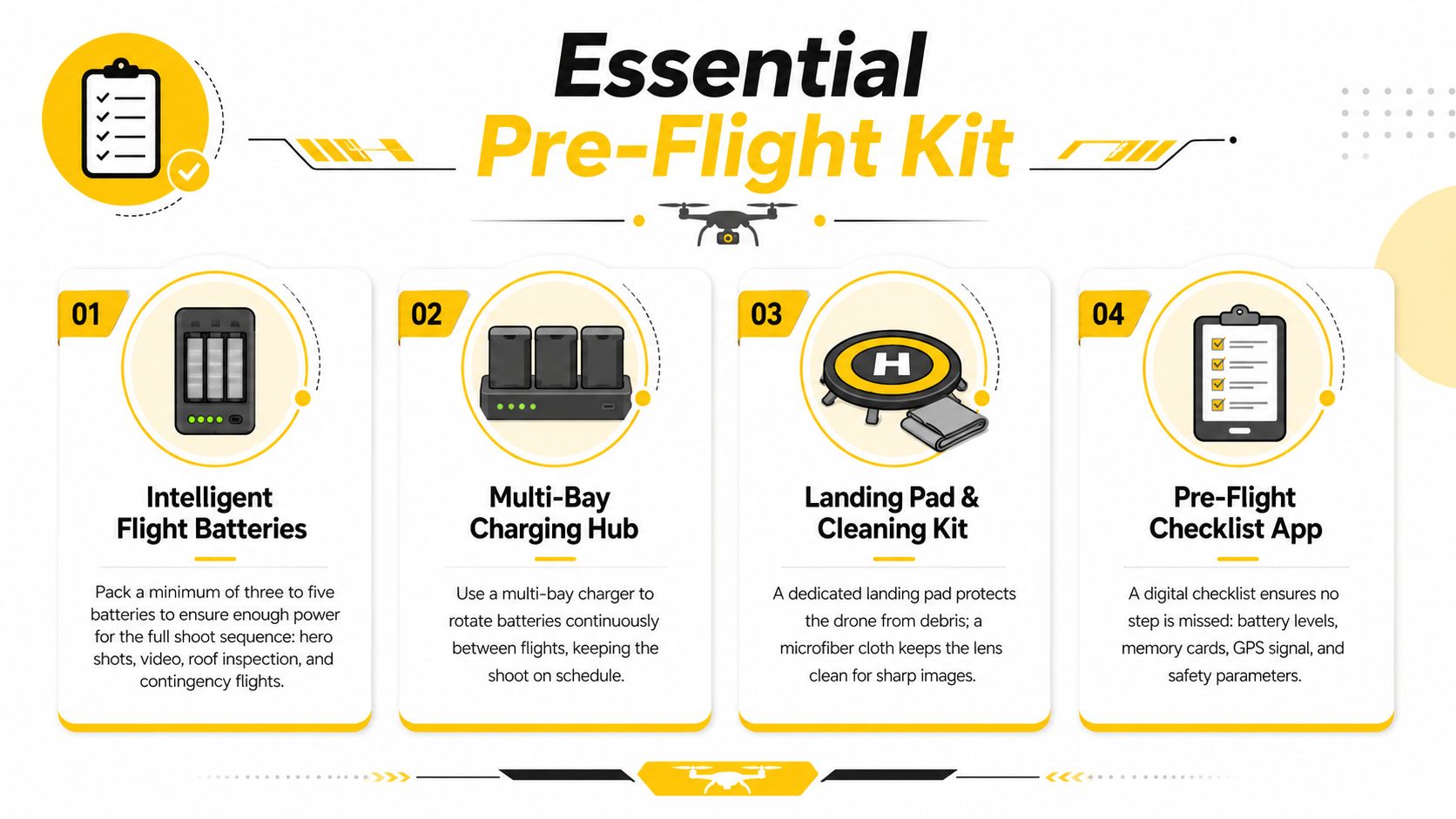
For large homes and multi-angle coverage, operators should carry three to five intelligent flight batteries, a multi-bay charging hub and a USB-C cable for direct offload. A calibrated ND filter set, including ND8, ND16 and ND64, helps manage bright exterior exposures. A tablet hood reduces glare during live monitoring, particularly on exposed sites.
Build the data kit
The camera needs reliable media and a clear archive method. Operators should use 128 GB or 256 GB V30/U3-rated microSD cards, a card reader capable of reading and writing at practical speeds, and a small external SSD for client archiving. A second copy should be created before leaving the site whenever the schedule allows.
The folder name should identify the property and date, with separate folders for stills, video, selects and exports. That structure prevents an editor from confusing raw footage with client-ready files.
Complete the preparation cycle
Firmware updates belong on the night-before checklist, not at the launch point. The operator should charge the controller and display, inspect props, pack spares, clean the lens, carry polarised sunglasses and bring a compact weather meter. A printed checklist remains useful when phone batteries, connectivity or software create distractions.
- Site assessment: Check airspace, neighbouring properties, power lines, trees, reflective surfaces and emergency landing areas.
- Aircraft condition: Inspect arms, propellers, gimbal movement, battery condition and storage media.
- Client readiness: Confirm the shot list, access arrangements, privacy expectations and delivery format.
- Contingency planning: Identify a safe recovery area and a clear abort point before take-off.
Operators handling abnormal events should keep a practical reference such as the drone pilot emergency handbook with their operating material. Preparation doesn't eliminate risk, but it makes decisions faster when conditions change.
Planning and Capturing Property Views
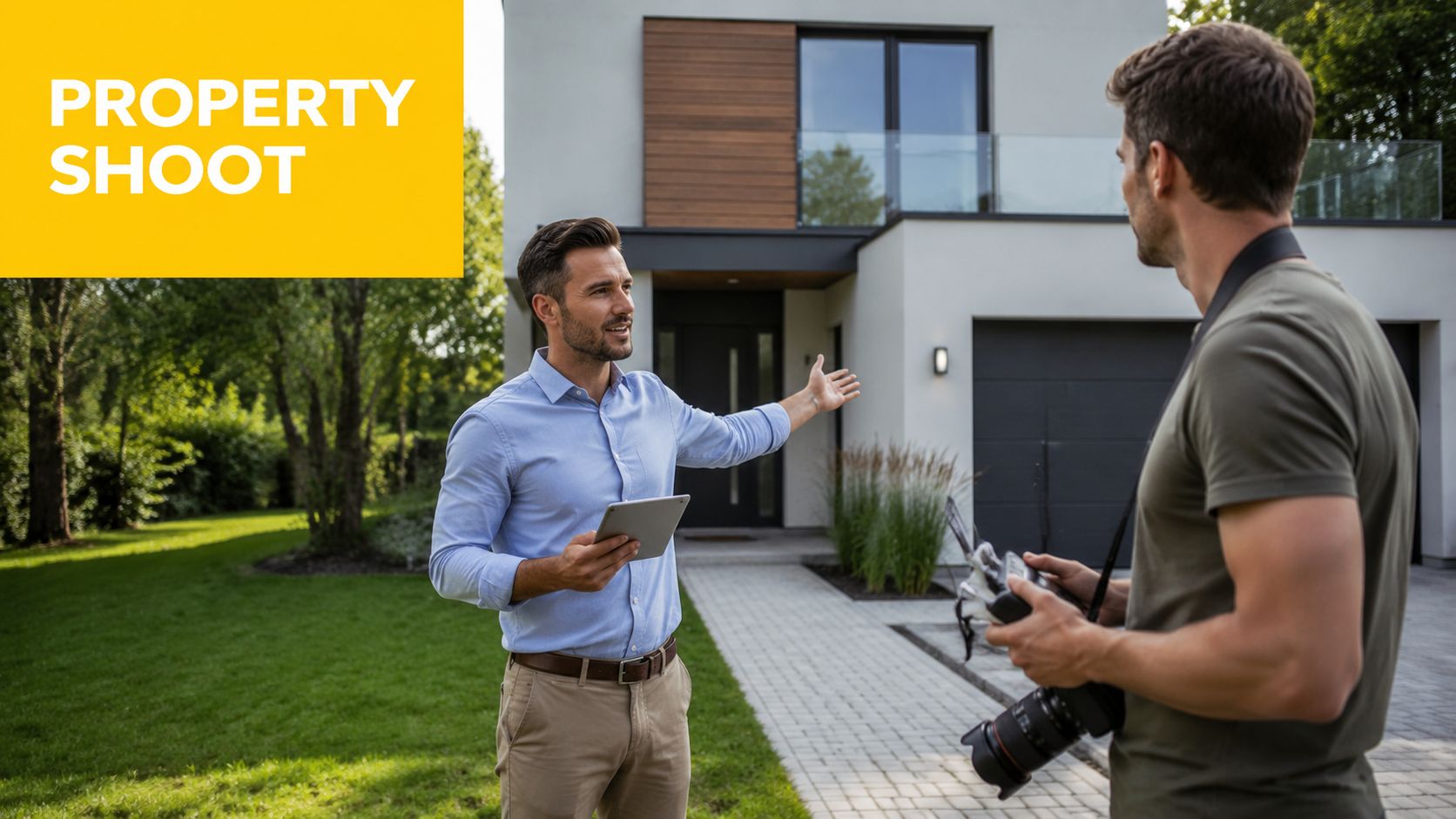
A repeatable property shoot begins with the agent briefing. The operator should confirm whether the package requires a hero still, a twilight bracket, a video walkthrough, roof inspection stills or only a defined set of exterior images. The owner's permission should be documented, but access permission isn't a substitute for aviation compliance or consent issues affecting other people.
The pilot should verify the address against an authorised aerodrome chart, check the relevant CASA RPAS portal requirements and record the aircraft and site details. Power lines, trees, reflective windows, antennas and narrow emergency landing areas belong on the site plan before the aircraft is powered on.
Use a controlled capture sequence
A useful sequence starts with the establishing frame, followed by front and rear oblique views, a high-overhead composition, lateral passes and a controlled orbit. The operator should vary altitude and direction deliberately, rather than collecting multiple versions of the same angle. Focal length must suit the building, block and surrounding context.
For stills, shutter priority can help maintain consistent exposure during changing movement. Exterior highlights should be protected so bright walls, roofs and sky retain detail. A level horizon and uncluttered frame are more valuable than an aggressive flight path.
After landing, the operator should immediately label folders by property, copy the files to the working drive and back up the shoot before leaving. A short post-flight debrief should record defects, unusual weather, firmware notes and any shot that needs a reshoot.
For practical editing support, how MyImageUpscaler enhances listings can help operators evaluate where careful enhancement may support a final property image. It shouldn't be used to disguise defects or create a misleading view of the property.
The AAA drone safety guide for airports and controlled airspace provides another useful reference for site planning. National parks, coastal reserves and council-managed locations may also impose permit requirements. A landlord's approval doesn't automatically cover neighbours, strata bodies or public land managers.
CASA Rules and Australian Privacy Duties
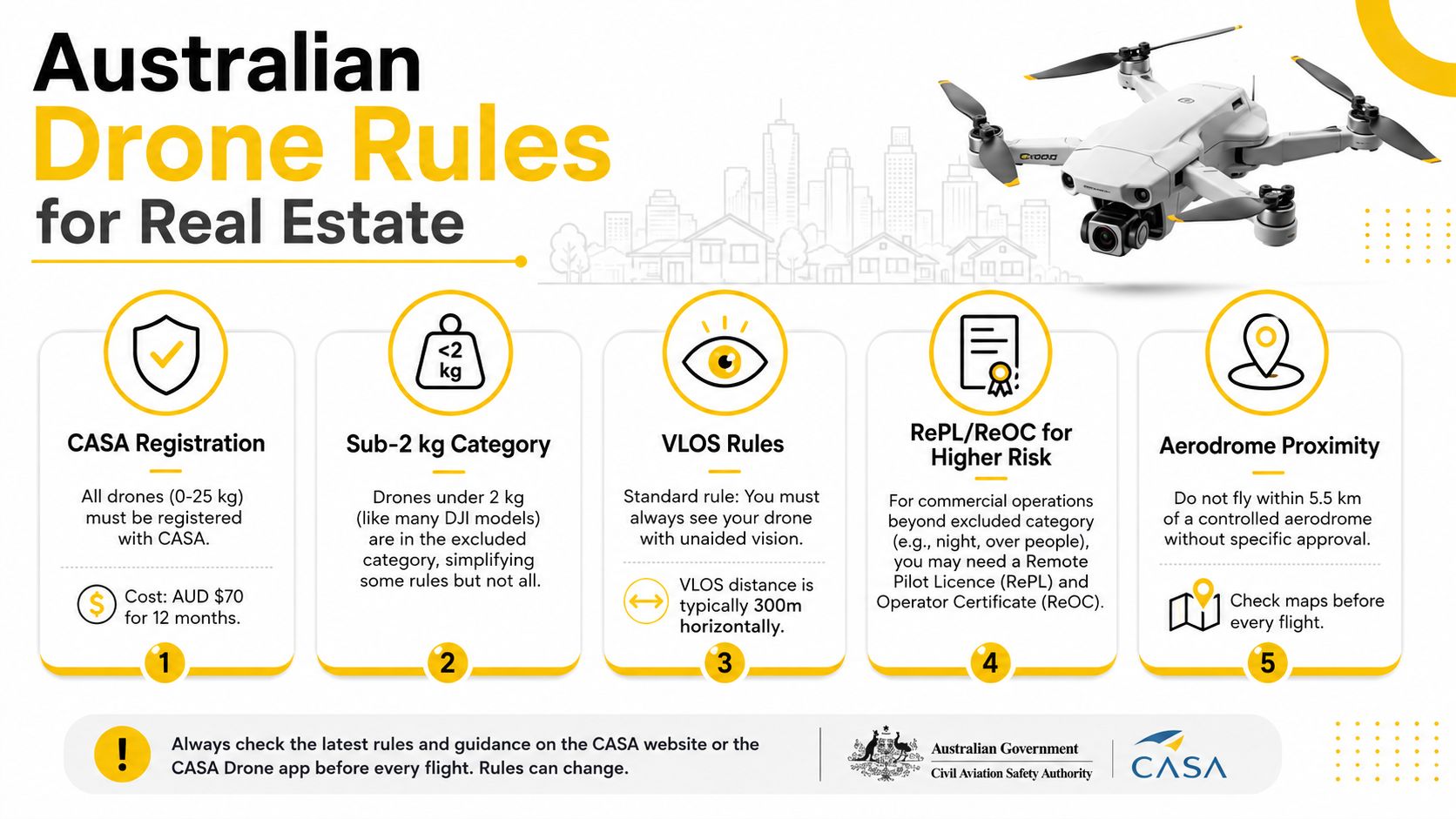
A paid property shoot is a commercial operation, not hobby flying. CASA guidance treats paid real-estate work as commercial use, with registration and operating requirements that must be assessed before the aircraft leaves the ground. The sub-250 g format can simplify some conditions in narrow excluded-category situations, but aircraft weight alone does not settle compliance. Use this Australian drone-laws guide for 2026 to check the current framework before accepting a job.
The practical decision tree is:
- Is the work paid property marketing? Treat it as commercial use and assess registration, operator and pilot requirements.
- Does the flight fit an excluded category? Check every condition, rather than relying on the aircraft's weight.
- Does the operation fall outside those conditions or involve higher risk? A RePL and suitable ReOC structure may be required.
- Does the site or flight profile require approval? Apply before the job where the relevant restriction applies.
- Could people be identified? Set privacy controls before capture and publication.
Qualifications and operating authority
CASA states that a pilot operating under a ReOC needs a Remote Pilot Licence. A ReOC is not a pilot licence. It authorises a business to provide drone services for hire or reward and to employ licensed remote pilots for aircraft within the applicable weight and certification framework (CASA ReOC requirements).
Every flight must remain within visual line of sight. The pilot must continually see, orient and control the aircraft with unaided vision, apart from corrective lenses. Binoculars, telescopes and similar devices do not meet that requirement (CASA visual-line-of-sight consultation material). Operations beyond visual line of sight, or extended visual line of sight, generally require CASA approval and are generally conducted by a ReOC holder.
CASA authorisation is required for flights above 120 m, or 400 ft, AGL, within 5.5 km, or 3 nautical miles, of a controlled aerodrome, in an aerodrome movement area or approach and departure path, and in Sydney Harbour and surrounding areas identified as R407 A/B (CASA flight approvals and permissions).
Privacy and neighbouring properties
The Office of the Australian Information Commissioner states that organisations and agencies covered by the Privacy Act must follow the Australian Privacy Principles when drone footage identifies people (OAIC guidance on drones and privacy). Australia has no dedicated drone-specific privacy law, so a dispute may involve broader privacy, surveillance, trespass or other legal principles.
Keep the camera directed at the listing. Avoid unnecessary capture of neighbours, identifiable people, vehicles and number plates. Crop or obscure incidental identifying material before publication. Explain to sellers, neighbours and strata communities what the shoot will capture and why.
A seller's permission authorises access to the seller's property. It does not grant unrestricted authority over neighbouring people, land or privacy interests.
Final Buying Decision and Key Questions
The defensible purchase follows a simple order. First, define the deliverables. Then match the camera to the required cropping and light conditions, the aircraft to the site and weather, and the operating model to CASA requirements. Finally, budget for batteries, storage, training, editing and backup time.
A Mini-class aircraft suits occasional, straightforward work when the operator understands its limits. An Air 2S-class camera is the more sensible choice where image quality, low-light performance and cropping flexibility affect the listing. A premium Mavic-class system becomes easier to justify when a studio produces demanding stills and video or manages recurring commercial contracts.
Before the first paid job, the buyer should be able to answer these questions:
Can a sub-250 g drone be used commercially?
Yes, commercial use is possible, but the applicable excluded-category conditions must be checked carefully. The aircraft's weight doesn't remove the need to assess registration, privacy, airspace, visual line of sight and safe operating conditions.
Who needs a RePL and who needs a ReOC?
A RePL relates to the remote pilot. A ReOC relates to the business operating as a drone service provider for hire or reward. CASA states that a pilot operating under a ReOC needs a RePL, while the ReOC itself isn't a licence to fly. Operators can use the AAA licence finder to identify a relevant training pathway.
What should happen near an aerodrome?
The operator should check the location before every flight and apply for authorisation where CASA's restrictions require it. The aircraft shouldn't launch because the property owner has approved the shoot.
How can privacy complaints be reduced?
Keep the camera directed at the listing, minimise incidental capture, explain the operation to affected parties and remove or obscure identifiable material before publication. The final purchase checklist should include aircraft suitability, pilot competence, commercial compliance, airspace, privacy, batteries, storage, backup and client deliverables.
Ace Aviation Aerospace Academy provides relevant pathways including Remote Pilot Licence and Aeronautical Radio Operator Certificate training, as well as ReOC consulting and enterprise or corporate drone training for organisations building compliant operations. Visit Ace Aviation Aerospace Academy to review training and aviation education options before taking a drone for real estate photography into paid service.
Frequently asked questions
Is aerial photography suitable for every property?
No. It provides the most value where the block, surroundings, architecture, roofline, landscaping or location context helps explain the property. A constrained site may need only a small number of carefully chosen views.
Does a larger sensor guarantee better listing images?
No. A larger sensor can improve low-light handling, detail retention and cropping flexibility, but composition, exposure, gimbal control, weather assessment and editing remain decisive.
Can a landlord's permission cover the whole flight?
No. Permission to access or photograph the listing doesn't automatically resolve aviation restrictions, neighbour concerns, council or reserve permits, strata issues or privacy obligations.
Must the drone remain within visual line of sight?
Yes, under CASA's visual-line-of-sight operating conditions, the pilot must continually see, orient and guide the aircraft with unaided vision, apart from corrective lenses. Binoculars and similar devices don't satisfy that requirement.
What should a photographer deliver after a shoot?
The agreed edited stills, video files or other outputs should be organised by property and clearly separated from working files. A reliable operator also maintains a backup and records any defects or limitations before closing the job.