
A training provider can have a full calendar and still lose control of the operation. Enrolments sit in email, invoices live in accounting software, instructor availability is tracked in a spreadsheet, and student evidence is scattered across folders. The problem becomes visible when a RePL cohort changes dates, an AROC booking needs coordination, or a CASA-related record has to be located quickly.
Practice management software for aviation training should bring those workflows into a controlled operating system. The right platform won't just book appointments. It will connect student enrolments, training evidence, instructor rosters, compliance documentation, billing, and reporting without forcing an academy to rebuild its processes around software designed for another industry.
Australian buyers also need to separate operator approvals from pilot qualifications. A Remote Operator Certificate, or ReOC, is an operator-level approval, not a drone pilot licence. CASA states that a pilot operating remotely piloted aircraft under a ReOC must hold a Remote Pilot Licence, or RePL. The CASA ReOC guidance makes that distinction clear.
Table of Contents
- What Practice Management Software Means for Aviation Training
- Three Main Categories of Practice Management Software
- Comparing Features, Pricing, and CASA Alignment
- How a Growing Australian Drone Training Academy Uses Each Option
- True Cost Beyond the Subscription Fee
- Decision Criteria for Selecting Practice Management Software
- Matching the Right Platform to Your Aviation Business
- Common Questions About Practice Management Software
What Practice Management Software Means for Aviation Training
A training manager needs one operational record when a student changes course dates, an instructor becomes unavailable, or assessment evidence must be found quickly. For an aviation academy, practice management software is the system that connects the student and operating lifecycle. It should organise enrolments, prerequisites, training records, instructor assignments, attendance, assessment evidence, invoices, payments, and management reporting.
The term means something different in allied health and legal services. In Australia, the Digital Health Agency describes practice management software through functions such as patient records, reporting, performance tracking, bookings, prescribing, referrals, billing, and claims processing. Its description of practice management software explains why generalist products often prioritise appointments, client records, billing, and reports. Those capabilities can help an aviation provider, but they do not automatically manage aviation evidence or CASA-aligned processes.
The aviation workflow is different
A drone or aviation training provider may need to control:
- Student onboarding: Record identity details, prerequisites, course selection, and relevant aviation documentation.
- Training evidence: Store theory progress, practical outcomes, assessment records, instructor sign-offs, and renewal information.
- Instructor control: Match instructors with cohorts, locations, aircraft or drones, classroom sessions, and practical activities.
- Radio training: Coordinate AROC-related bookings and evidence as a defined training workflow, not merely a calendar appointment.
- Regulatory records: Maintain an organised audit trail that can be exported and reviewed when required.
The software does not replace operator obligations, approved procedures, instructor competence, or recordkeeping responsibilities. A platform can support those controls without being CASA-approved. Treat a compliance field as a recordkeeping aid, not proof that the operator has met a regulatory requirement.
Australian buyers should also check data hosting and interoperability independently. A healthcare software audit cited by the Australian practice management software market overview concerned healthcare products, not aviation systems, so its findings should not be applied to aviation platform selection. The useful lesson is narrower: verify data residency, integrations, access controls, and export capability for the specific product under review.
Evaluate four points before signing: workflow fit, CASA-related recordkeeping support, total cost as the team grows, and migration risk. A low subscription fee does not solve an operation where instructors still rely on spreadsheets and administrators re-enter the same information.
Providers can publish public course dates through the academy's training calendar, while keeping enrolment records, training evidence, and operational controls inside the selected system.
Three Main Categories of Practice Management Software
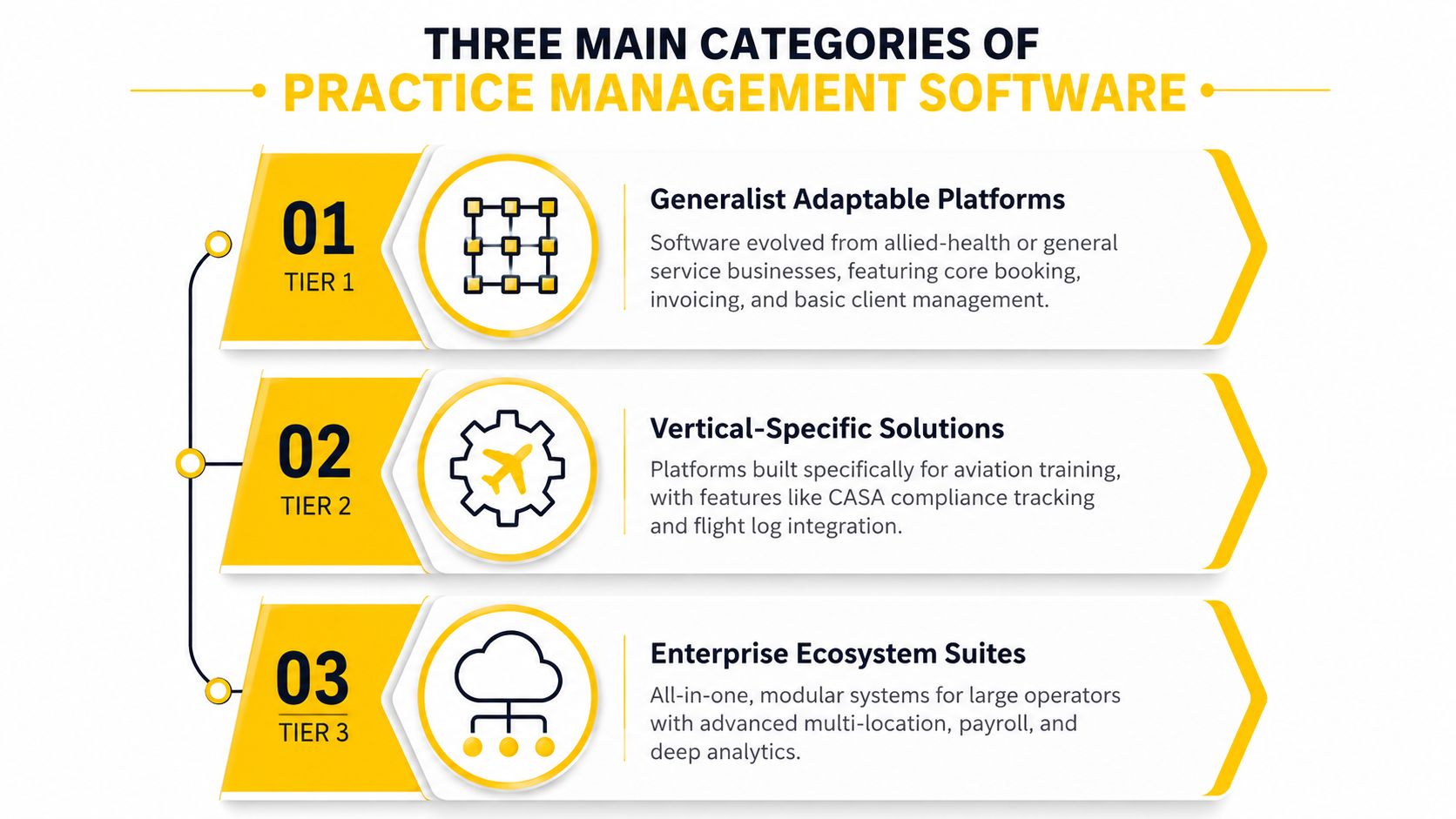
Australian aviation businesses usually cross-shop three categories rather than one. Each category solves a different operational problem, and none should be selected from a feature list alone.
Tier one generalist adaptable platforms
Generalist practice management software evolved from allied health, professional services, and other appointment-led businesses. Products such as Cliniko, Nookal, and coreplus demonstrate the kind of cloud subscription model Australian buyers commonly encounter. They generally handle booking, client records, invoices, online forms, reminders, and basic reporting well.
Their weakness is aviation context. A generalist calendar may schedule a practical session, but it won't necessarily understand instructor credentials, AROC pathways, aircraft or drone resources, flight evidence, or the relationship between a prerequisite and a course outcome. The academy ends up adding custom fields, spreadsheets, or separate storage.
Tier two vertical-specific aviation platforms
Aviation-specific platforms are built around flight schools, aircraft operations, maintenance records, flight logs, and instructor workflows. Their strengths include resource allocation, flight-time tracking, aviation terminology, and a better understanding of how operational records relate to training.
The trade-off is weight. A small drone school may not need aircraft maintenance modules, complex fleet controls, or enterprise reporting. A system designed for a large flight operation can introduce configuration, training, and administration that outweigh its value for a focused RePL provider.
Tier three training-provider systems
Training-provider systems are usually LMS-first or vocational-style platforms. They tend to perform strongly on enrolment workflows, cohort management, online theory, learner portals, prerequisites, evidence collection, and compliance reporting.
They may be weaker at live operational scheduling. A training system can know that a student has enrolled in a course, yet still struggle to assign an instructor, reserve a practical resource, handle weather-driven changes, or coordinate an AROC session. Providers comparing aviation administration with other structured workforce operations may find a separate resource such as volunteer software useful for understanding roster, onboarding, and role-based coordination patterns, although volunteer management isn't a substitute for aviation training software.
For businesses delivering corporate drone training, the decision often depends on whether the priority is learner administration, aviation operations, or both. Generalist software is adaptable, aviation platforms are operationally deep, and training systems are strongest across the learner journey. The buyer should choose the category that matches the academy's most expensive failure point.
Comparing Features, Pricing, and CASA Alignment
The comparison becomes clearer when each platform is tested against the same operating requirements. Generalist products often win on simplicity, aviation platforms win on operational depth, and training systems win on structured learner administration.
| Capability | Generalist PMS | Aviation-Specific Platform | Training-Provider System |
|---|---|---|---|
| Student records | Strong for contact, booking, and billing data | Strong, with aviation fields and operational history | Strong for enrolment, prerequisites, and evidence |
| Scheduling | Good for appointments and basic resources | Strong for instructors, aircraft, flight activity, and resources | Good for cohorts and classrooms, often weaker for live operations |
| Billing | Usually mature, with invoices and payment integrations | Varies, sometimes secondary to operations | Often strong for course fees and enrolment payments |
| Training record storage | Usually custom fields or attachments | Strong for flight and operational logs | Strong for assessments, theory, and learner evidence |
| Reporting | General business reports | Operational and aviation reports | Compliance, progress, and cohort reports |
| RePL and ReOC documentation | Usually manual configuration | More likely to support aviation-specific records | Often supports document collection, but not operator workflows |
| AROC bookings | Calendar entry or external process | More likely to be native or integrated | Usually requires configuration or another booking workflow |
| Instructor credentials | Basic staff profiles | Detailed aviation credentials and endorsements | Trainer profiles and evidence, with variable operational depth |
| Multi-instructor rostering | Adequate at small scale | Strong, particularly for operational resources | Strong for cohorts, less consistent for flying activities |
| Pricing approach | Commonly per user, account, or practitioner | Often account, module, or operational scale based | Commonly per student, user, cohort, or account |
Australian comparisons illustrate the pricing spread without establishing a universal market rate. One Australian roundup lists Cliniko at AUD $45 per month for a single practitioner, Nookal at AUD $55 per practitioner per month, and coreplus from about AUD $35 per practitioner, with trial periods also noted in the Australian practice management software comparison. Another allied-health comparison lists entry-level examples from approximately AUD $19 to AUD $55 per practitioner or user per month, including Zanda, Splose, coreplus, Cliniko, and Nookal, as reported by Payly's Australian software comparison.
Those figures don't translate directly to aviation. A platform may charge per instructor, per administrator, per student, per account, or by module. Payment gateways, SMS reminders, document storage, e-learning, integrations, and additional locations can alter the bill.
CASA alignment also needs careful wording. CASA says an RePL is required for flying for an individual or business that holds a ReOC, and for certain commercial operations involving heavier RPA. CASA also identifies micro and excluded RPA categories where an RePL isn't required, subject to the stated conditions. The CASA licensing and regulatory requirements should be checked alongside the provider's operating procedures.
For beginners, ACE READY is an entry-level drone training course covering drone fundamentals, aviation safety, CASA regulations, flight operations, and preparation for advanced RePL training in Australia. A PMS should record that progression clearly, without treating course completion as an automatic licence or approval.
Providers should also read the academy's drone laws guidance for Australia before configuring compliance fields. Software should reflect current requirements, but the provider remains responsible for checking CASA rules and maintaining accurate procedures.
How a Growing Australian Drone Training Academy Uses Each Option
Consider a Brisbane-based drone academy that begins with one RePL-rated chief instructor. The academy runs weekly cohorts for sub-7 kg operations, AROC training, and RePL renewals. At the beginning, a generalist PMS appears sufficient because the owner can create bookings, issue invoices, and email students from one dashboard.
The limits surface as soon as the operation adds instructors. The generalist system can store each student's contact information and payment status, but the chief instructor still maintains a spreadsheet for instructor availability, practical allocations, equipment, and replacement sessions. AROC bookings may sit in a shared calendar, while RePL evidence is stored as attachments with inconsistent naming.
What changes as instructors are added
An aviation-specific platform handles the operational relationship more naturally. It can connect instructors to practical activities, preserve flight or training logs, and provide a more relevant view of aviation resources. AROC bookings and instructor credentials are more likely to fit the platform's design rather than requiring a workaround.
A training-provider system takes a different approach. It can automate enrolment forms, prerequisites, student access, cohort dates, learning content, assessment evidence, and recurring course administration. For a provider running frequent theory-led cohorts, that learner lifecycle may matter more than flight-log depth.
The break point usually arrives when the second instructor joins. The owner no longer sees every schedule change, and a spreadsheet becomes a shared operational dependency rather than a personal reminder. One missed update can allocate a student to an unavailable instructor or leave evidence disconnected from the relevant course.
A growing provider should map the workflow before buying:
- Lead to enrolment: How is an enquiry converted into a confirmed student?
- Prerequisite to training: Where are RePL, AROC, identity, and prior-learning checks recorded?
- Cohort to roster: Can the platform assign instructors and resources without duplicate entry?
- Training to evidence: Can assessors sign off records and export a complete history?
- Completion to renewal: Does the system prompt the business to review future training needs?
The academy should also consider the operational opportunities created by demand cycles, including the issues discussed in its EOFY drone business opportunity article. A platform that handles only today's bookings won't support a provider that needs reliable forecasting, repeat cohorts, and auditable records.
True Cost Beyond the Subscription Fee
A training provider can select an affordable subscription and still make an expensive operational decision. The first-year burden includes setup, data preparation, staff training, payment processing, integrations, and the management time required to redesign workflows. For an Australian aviation business, those costs matter because enrolments, instructor availability, assessment records, and finance rarely sit in one system.
A PMS is rarely a standalone purchase. Generalist platforms may handle contacts, invoices, and appointments well, while aviation-specific systems usually require configuration around operational records. Training-enrolment systems can fit cohorts and learner evidence more closely, but may need separate tools for flight activity or business administration.
Cost items buyers routinely miss
Price the complete operating model:
- Subscription structure: Per-user pricing increases with each instructor, administrator, and contractor. Account-based pricing may be easier to forecast, but check user limits, permissions, storage, and included modules.
- Implementation: Setting up courses, forms, permissions, reports, and workflows consumes management time, even when vendor onboarding is included.
- Migration: Spreadsheet cleanup can take longer than the upload. Duplicate student records, inconsistent dates, missing evidence, and unclear status fields must be resolved before import.
- Training: Staff need hands-on practice with enrolments, roster changes, evidence capture, reporting, and access control.
- Integrations: Accounting, payment gateways, learning content, flight tracking, SMS, and document storage may each add a charge or configuration task.
- Exit risk: A low subscription is poor value if the provider cannot export usable student and operational records when it changes platforms.
| Cost Component | Generalist PMS | Aviation-Specific Platform | Training-Enrolment System |
|---|---|---|---|
| Subscription basis | Often user, practitioner, or account based | Often account, module, or operational scale based | Often student, user, cohort, or account based |
| Core cost pressure | Additional staff and integrations | Configuration, modules, and operational scope | Student volume, content, and assessment features |
| Implementation workload | Moderate, especially with custom fields | High when aviation workflows and resources are configured | Moderate to high for course structures and evidence |
| Migration risk | Records may transfer, aviation history often needs mapping | Better fit for operational history, but legacy data still needs review | Strong for learner records, variable for flight records |
| Training requirement | Staff learn a broad administrative system | Staff learn aviation and operational functions | Staff learn learner, assessment, and reporting workflows |
| Expansion impact | Can become expensive as users and sites grow | Can become valuable as operational complexity grows | Can become expensive with high student or cohort volume |
Do not rely on generic pricing bands. Request a written proposal that itemises onboarding, migration, integrations, payment charges, storage, support, and cancellation terms. Use the practice management software quote calculator for internal planning, then test the vendor's assumptions against actual instructor numbers, cohort frequency, locations, and administrative roles.
The migration decision deserves particular attention. A generalist PMS may import contact details and invoices but leave training evidence, instructor history, or aviation records in a structure that staff cannot audit easily. An aviation-specific platform may preserve operational context while demanding more setup. A training system may provide the clearest learner pathway, yet require a separate process for flight records and finance.
For students beginning commercial drone training, ACE BRONZE is described as a foundation course covering drone operations, flight safety, aviation theory, and practical skills. The academy should record that course pathway distinctly from payment status and any later licence or operational requirement. That separation keeps learner progress, finance, and compliance records easier to review.
Cost rule: Choose the platform that keeps the full workflow predictable after the academy adds staff, cohorts, locations, and compliance tasks, not the one with the lowest advertised subscription.
Decision Criteria for Selecting Practice Management Software
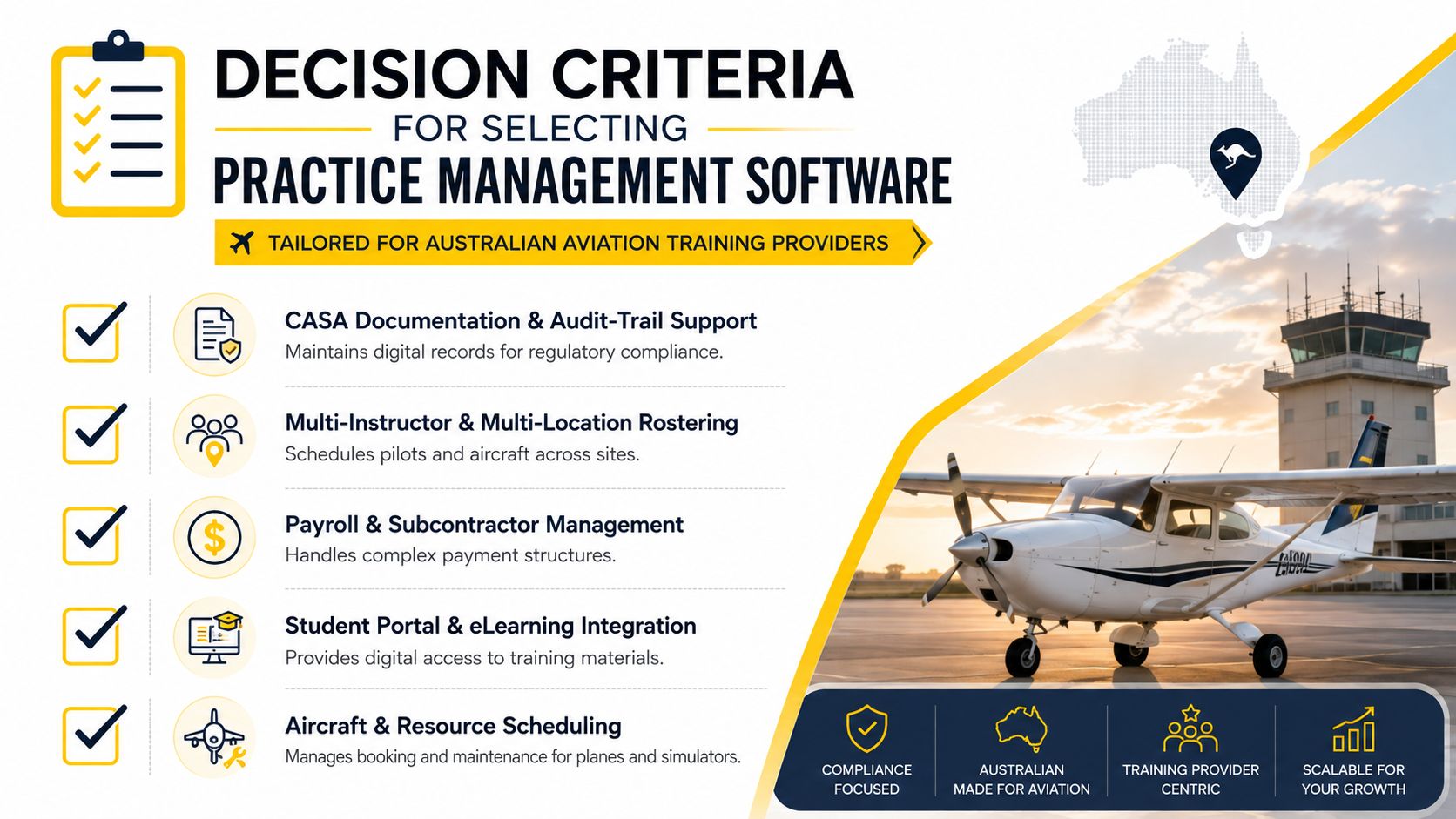
The strongest selection process starts with operational risk, not a software demonstration. Vendors will show dashboards and automated reminders. The academy needs to test whether the platform can preserve a defensible training record when dates change, instructors rotate, or a student pauses and returns.
Documentation comes before convenience
A CASA-aligned operator should first test documentation and audit trails. The system should distinguish an enrolment from a completed assessment, preserve the identity of the person making a change, retain relevant dates, and export records in a readable format.
CASA also states that an ReOC authorises RPAS aerial work but doesn't remove the need to comply with Commonwealth, state, territory, and local laws. Initial ReOC issue is usually for up to 12 months, while the period after the first renewal is typically 3 years, with the term depending on operational complexity and compliance history, according to CASA's licensing and operations guidance. A PMS can't manage that regulatory responsibility by itself, but it can make review dates, documents, and evidence easier to control.
Roster complexity determines the next priority
Roster automation matters most once more than one instructor is regularly involved. The platform should manage instructor availability, course sessions, locations, resources, cancellations, substitutions, and conflicts in one place. If instructors still need a parallel spreadsheet, the academy hasn't solved its core scheduling problem.
For larger teams, payroll and subcontractor management also matter. The system may not interpret every award or contract arrangement, so finance staff should confirm exactly what the product calculates and what remains manual.
Student onboarding becomes the priority for academies running weekly cohorts. The platform should capture USI information where relevant to the provider's obligations, confirm prerequisites, issue access to theory material, and prevent an incomplete record from being treated as a completed pathway.
Data residency and API access deserve written answers. Australian providers should ask where data is hosted, which subprocessors can access it, how backups are handled, and whether flight-tracking or booking tools can connect through a documented API.
Teams assessing training technology can use a structured resource to select the right training platform, but the final test should use the academy's own enrolment, roster, and evidence examples.
Selection test: Give each vendor a changed cohort, an unavailable instructor, an incomplete prerequisite, and a record export request. The response reveals more than a polished product tour.
Matching the Right Platform to Your Aviation Business
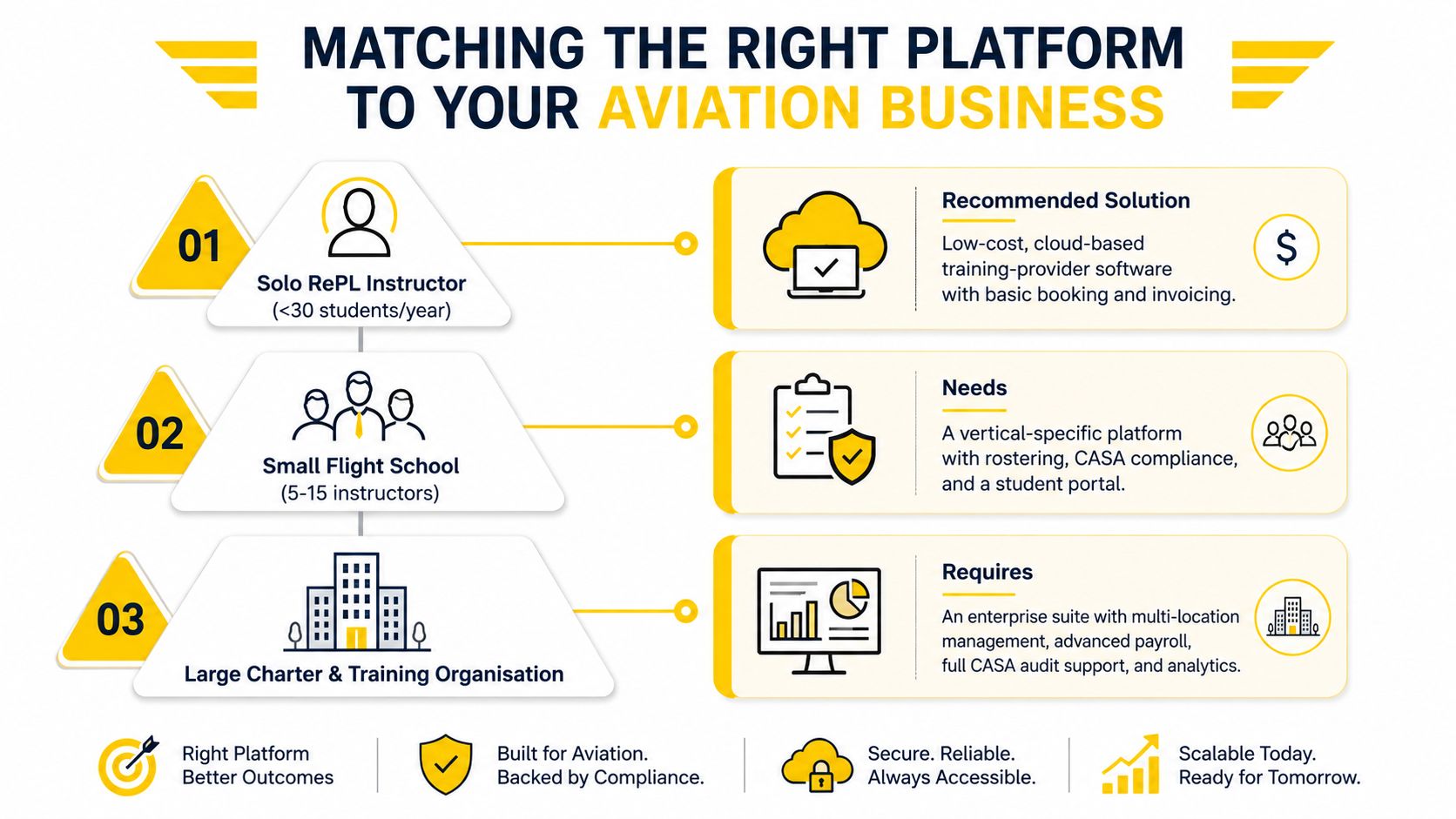
A solo instructor doesn't need the same system as a multi-state aviation organisation. The correct choice follows operational complexity, not ambition.
Solo RePL instructor
A solo RePL instructor with a small annual student base usually fits a low-cost training-provider system with basic booking, invoicing, learner records, and document storage. CASA logbooks, AROC booking handling, and operational records may need separate controls if the platform lacks aviation depth.
The key is disciplined separation. One system should remain the source of truth for student status, while external records must use consistent naming, access controls, and backup processes.
Growing drone academy
A drone academy with several instructors, multiple cohorts, and payment plans should favour an aviation-specific operations platform. Rostering, compliance records, billing, and resource allocation become too interdependent for disconnected tools.
The academy should confirm that the platform supports the actual operating model, including practical training, weather changes, instructor substitutions, AROC sessions, and evidence exports. A generalist PMS can work during the early phase, but it shouldn't be retained merely because staff are familiar with it.
Multi-state organisation
A multi-state enterprise with a broad student base and multiple aviation pathways needs a configurable enterprise ecosystem. A generalist PMS integrated with a CASA-aligned LMS, accounting platform, and operational tools may provide greater flexibility than a narrow product.
That configuration requires governance. Data permissions, location structures, reporting definitions, integration ownership, and audit responsibilities must be assigned to named staff. AI product roundups such as Truespeak's lists of AI tools for 2026 may help identify automation categories, but no AI feature should be adopted without testing data handling, human review, and traceability.
Ace Aviation Aerospace Academy offers relevant pathways including RePL, AROC, Certificate III in Aviation, ReOC Consulting, Enterprise Drone Training, and Corporate Drone Training. Structured course pathways and operational templates can help new entrants define the records and workflows a PMS must support before implementation begins.
Common Questions About Practice Management Software
What makes switching practice management software difficult?
Switching is difficult when the existing platform stores more context than the export reveals. Before signing a new contract, the provider should confirm the exit clause, export formats, attachment handling, audit history, invoices, enrolment status, training evidence, and AROC booking information.
A sensible migration process starts with a field inventory. The provider should identify which records move directly, which need transformation, and which must remain in an archived system. A trial import using representative records should happen before the final migration, with instructors checking whether the new structure remains understandable.
Should Australian training records be hosted in Australia?
Data residency should be treated as a procurement question, not an assumption. Some platforms may host data in Australia, while others may use infrastructure in the United States, the European Union, or another jurisdiction.
The provider should ask where primary data, backups, support access, and analytics processing occur. Contractual privacy terms, breach processes, retention, deletion, access permissions, and subcontractors also require review. CASA compliance alone doesn't automatically answer every privacy or data-hosting question, so the operator should obtain appropriate legal and regulatory advice.
How should an academy assess AI features?
AI should be tested against a defined administrative task. Useful candidates may include syllabus tracking, roster suggestions, enquiry classification, document checks, and cohort demand forecasting, but the system must show what data it used and allow a competent person to review the result.
A vendor demonstration isn't evidence of operational value. The academy should run sample records, test incorrect or incomplete inputs, examine whether outputs can be corrected, and confirm whether AI-generated actions are logged. AI must not approve a student, certify a competency, or replace an instructor's judgement.
When does a custom internal system make sense?
A custom system may outperform third-party software when an established academy has unusual workflows, strong internal technical capability, and enough operational scale to justify ongoing ownership. It can connect bespoke booking, student, finance, and compliance processes more precisely than a generic PMS.
The burden is substantial. The organisation must fund development, security, support, testing, backups, access control, documentation, change management, and regulatory review. A custom build also becomes an internal aviation system that needs accountable owners. If those responsibilities aren't resourced, a configurable commercial platform is usually safer.
Does practice management software replace CASA compliance work?
No. It can organise evidence, reminders, records, and reports, but it doesn't grant an RePL, issue an ReOC, approve an operator's procedures, or remove other legal obligations. CASA's training-provider guidance states that an organisation providing RePL training must hold a ReOC authorising remote pilot training, and the course must be submitted to CASA for review. The CASA guidance for RePL training providers also explains that micro and excluded RPA may be operated without an RePL or ReOC in the specified circumstances, while registration and RPA operator accreditation through myCASA still apply.
Ace Aviation Aerospace Academy provides structured aviation and drone education covering relevant pathways such as RePL, AROC, Certificate III in Aviation, ReOC Consulting, Enterprise Drone Training, and Corporate Drone Training. Providers choosing practice management software can visit Ace Aviation Aerospace Academy to review training pathways and identify the operational records, prerequisites, and compliance workflows their platform must support.