A lot of people searching for a drone pilot course in Perth are in the same position. They can already see where drones fit into work in photography, surveying, inspection, agriculture, mining, or local government, but the path from interest to legal commercial flying often looks far more complicated than it should.
The confusion usually starts with the acronyms. RePL, AROC, ReOC, CASA, MOS. Then come the practical questions. Which licence is needed? How long does training take? Is a Perth course valid interstate? Of greatest relevance for Western Australia, does getting licensed make someone job-ready for site work in mining and resources?
That last question matters more than many course pages admit. A licence is the foundation, but it isn't always the whole employability picture.
Table of Contents
- Your Guide to Becoming a Licensed Drone Pilot in Perth
- Understanding Your Core CASA Drone Licences
- What to Expect from a Perth RePL Course Structure
- Career Pathways for Licensed Drone Pilots in WA
- How to Choose the Right Drone Training Provider in Perth
- Why Perth Students Choose Ace Aviation Aerospace Academy
- Frequently Asked Questions About Perth Drone Courses
- Does a student need to buy a drone before starting training
- How long does it usually take to get through a Perth RePL course
- Is a Perth-issued RePL valid in other Australian states
- Are there extra requirements for mining or resources work after licensing
- Is AROC always needed with a RePL
- What should a beginner do before enrolling in a commercial course
Your Guide to Becoming a Licensed Drone Pilot in Perth
A professional drone pathway in Perth usually starts with a simple goal. Someone wants to move beyond recreational flying and use drones for paid work, for an employer, or inside an existing business. The challenge is that CASA rules sit alongside local industry expectations, and those are not always explained in one place.
The first decision is usually not which drone to buy. It is which qualification path matches the type of work planned. A person aiming for media work may need a different progression from someone targeting mine sites, infrastructure inspection, or enterprise operations.
For readers still sorting out where they fit, the AAA licence finder can help narrow down which licence pathway is relevant before comparing schools.
Starting with the right question
The most useful question isn't “Which drone pilot course Perth providers offer?” It is “What type of commercial work is the licence meant to enable?”
That changes the answer.
- Media and content work often starts with core licensing and controlled operating procedures.
- Mining and resources work usually demands licensing plus site readiness and stronger safety documentation habits.
- Business owners may need pilot qualifications as well as an operator framework for their company.
Practical rule: Choose the training path backwards from the job, not forwards from the drone.
What usually causes confusion
New students often mix up three separate issues:
| Issue | What it means in practice |
|---|---|
| Legal authority to fly | The licence or certificate required under CASA rules |
| Operational capability | The actual flying, planning, safety, and radio skills |
| Employment readiness | Site inductions, industry expectations, and workplace compliance |
A good Perth guide needs to deal with all three. Otherwise, a student may finish training with a valid qualification but still be unsure how to enter real work in WA sectors that use drones every day.
Understanding Your Core CASA Drone Licences
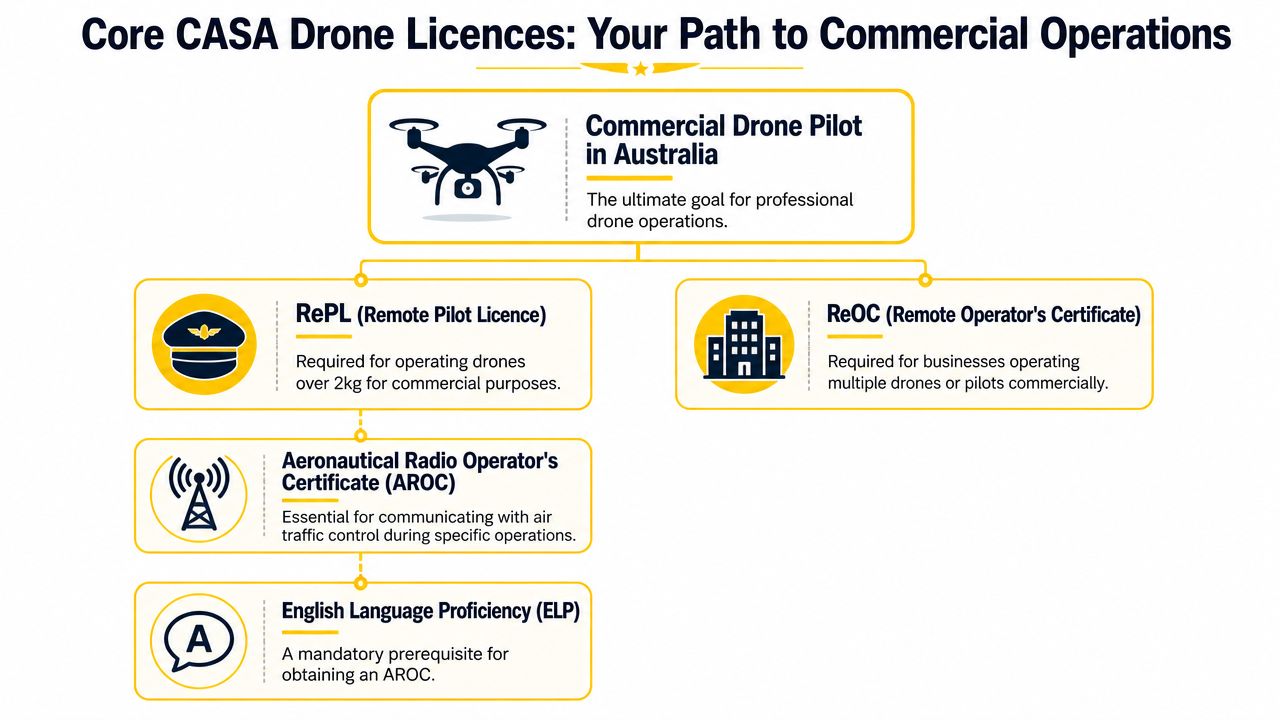
Commercial drone regulation becomes much easier to understand once each acronym is separated by function. One licence is for the pilot. One certificate is often needed for radio use. Another certificate applies to the business or operation.
The RePL as the starting point
The Remote Pilot Licence, or RePL, is the core credential for many commercial operators. CASA states that to operate a drone commercially in Australia weighing more than 2 kg, the pilot must hold a RePL, and the training typically takes 5 days, with candidates needing at least 70% in the CASA theory exam and a pass in the practical test (CASA student drone guide).
That makes the RePL the main legal entry point for a large share of commercial work. It is best thought of as the pilot licence itself. It shows that the holder has been assessed on theory and practical competency, not just general familiarity with drones.
A beginner who isn't ready to jump straight into licence training may first look at an entry-level course such as ACE READY, which covers drone fundamentals, aviation safety, CASA regulations, and flight operations as preparation for advanced RePL training.
Where AROC and ReOC fit
The AROC, or Aeronautical Radio Operator Certificate, is separate from the RePL. It becomes relevant when the operation involves controlled airspace or communication with crewed aircraft. In plain terms, this is the qualification that authorises legal radio use when the operation requires it.
The ReOC, or Remote Operator's Certificate, is different again. This one applies to an organisation running drone operations, not just the individual at the controls. Businesses that want structured, compliant commercial operations often need to understand how the ReOC framework fits their workflow. A broader explanation is set out in AAA's guide to the ReOC in Australia.
A simple way to think about the three is this:
- RePL means the person can act as a licensed remote pilot.
- AROC means the person can legally use aviation radio when the operation requires it.
- ReOC means the business has an approved operator framework for certain commercial operations.
The pilot qualification and the business approval are not the same thing. Many new operators only discover that after licensing.
What to Expect from a Perth RePL Course Structure
A Perth student can finish a licence course and still feel unsure about day-one industry work. That happens because a RePL course is designed to prove safe pilot competency under CASA rules. It is not the same as site-ready preparation for WA mining, resources, or large contractor environments.
How the course is usually organised
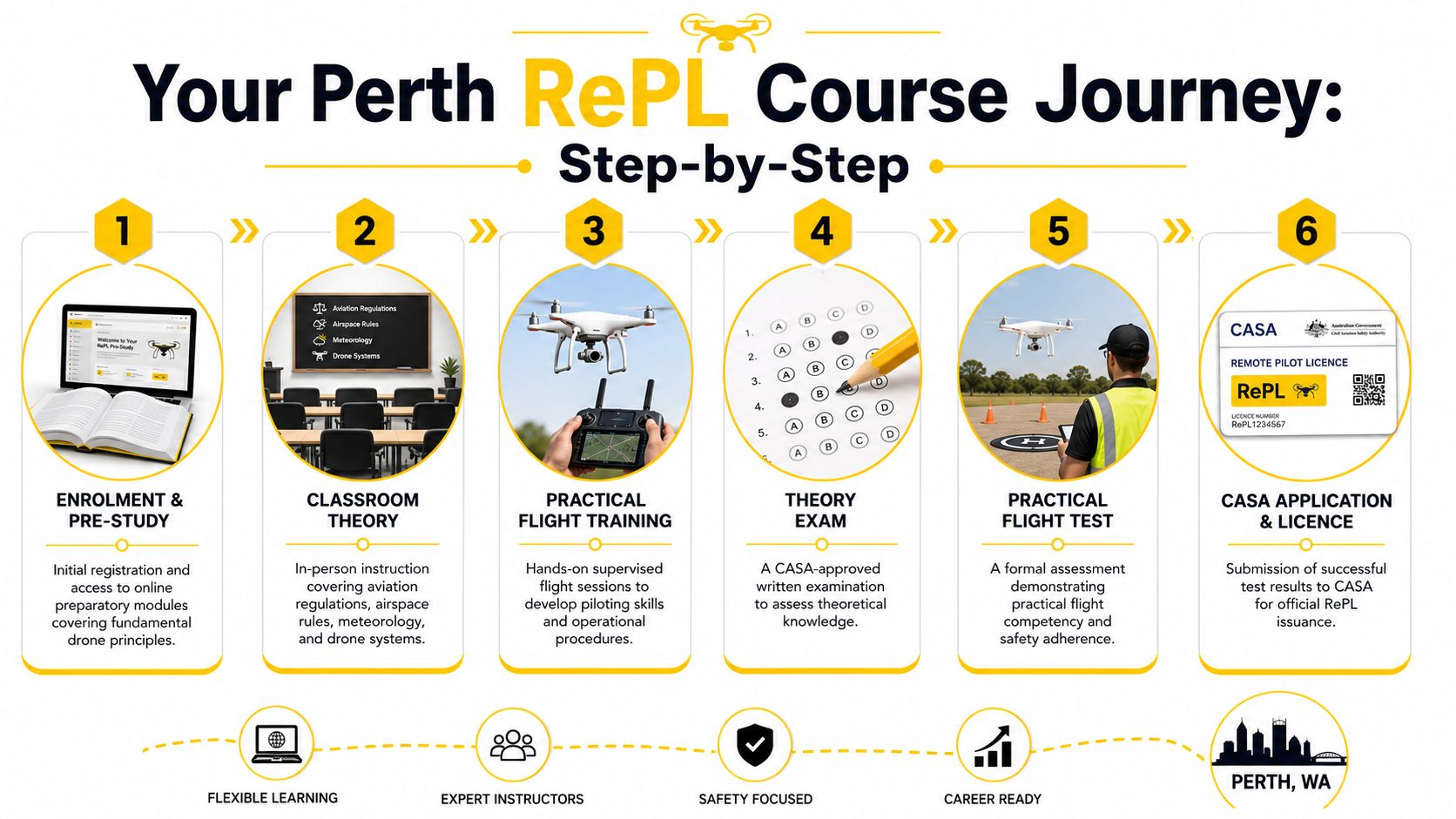
A strong RePL course follows a clear sequence. Students first build the rule set, then practise applying it, then demonstrate they can fly and make decisions safely under supervision. It works much like flight training in crewed aviation. You learn the map before you are expected to handle the route.
In Perth, RePL training is commonly delivered over five days. The early part of the course usually focuses on theory and exam preparation. The later part shifts to practical flight training and competency assessment. If radio operations are included, students may also complete AROC-related study and testing as part of the program.
Typical theory topics include:
- Airspace and operating rules, so you can tell where approval, radio use, or extra planning may be needed
- Meteorology, so weather is assessed as an operational risk, not a guess based on wind alone
- Aircraft systems and limitations, so battery management, performance, and failure points are understood properly
- Human factors and emergency procedures, so mistakes are caught early and abnormal events are handled calmly
For students comparing providers, AAA lists its current commercial drone training courses in Perth in one place.
What instructors are really assessing
Students often expect the hardest part to be flying the drone itself. In practice, instructors are watching the habits around the flight just as closely. A pilot who can hover neatly but skips checks, misses airspace issues, or reacts poorly to change is not ready for commercial work.
The practical assessment usually looks at four areas:
| Assessment area | What the assessor is looking for |
|---|---|
| Pre-flight preparation | Safe setup, methodical checks, site awareness, and correct documentation habits |
| Flight control | Stable manoeuvres, orientation control, accurate take-off and landing, and safe spacing |
| Operational judgement | Sound decisions about hazards, weather, people, and operating limits |
| Emergency handling | Correct, controlled responses when the plan changes or a fault appears |
That distinction matters in WA. Employers in mining and resources often care less about flashy stick skills and more about whether a pilot can follow procedures, brief clearly, and work inside a controlled safety system. A RePL course gives you the licence foundation. Getting hired often depends on how well you build on that foundation after the course.
Students who perform well in practical training are usually the ones who stay organised before the motors start.
Career Pathways for Licensed Drone Pilots in WA
Western Australia offers one of the clearest reasons to take commercial drone training seriously. The state's geography, industrial footprint, and remote operating environments create practical demand for drone capability across several sectors.
Where licensed pilots typically find work
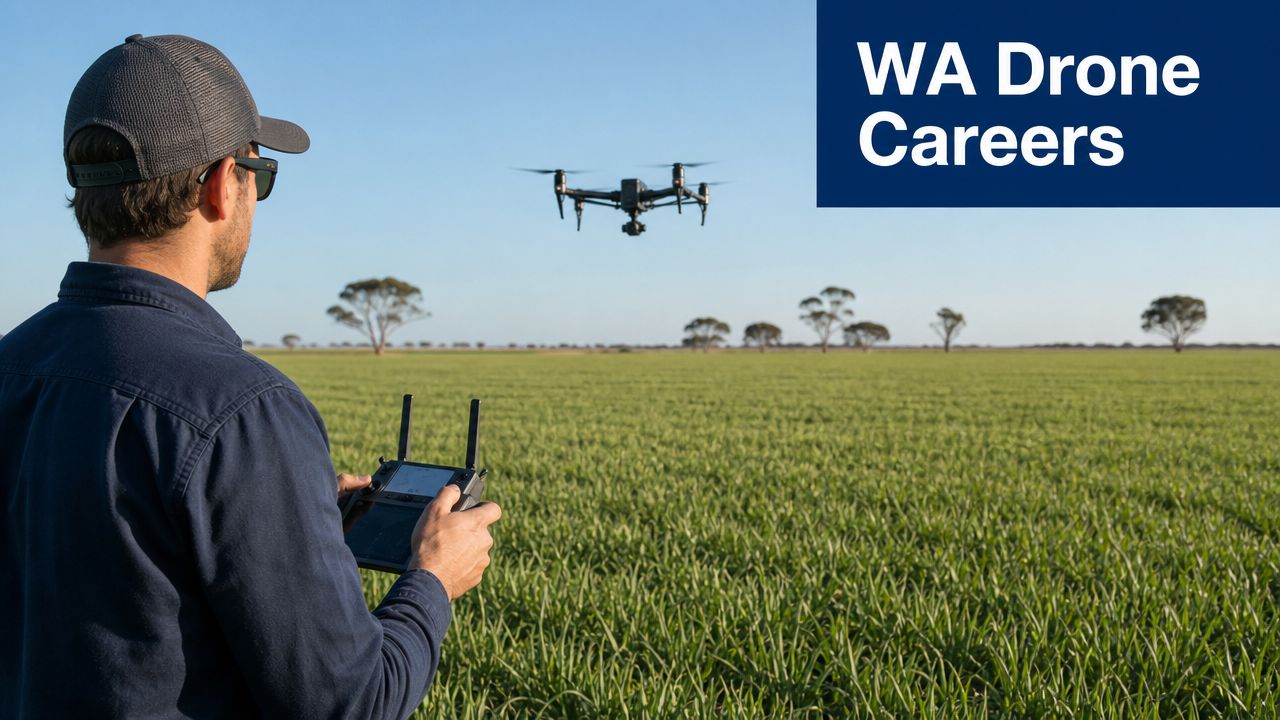
Licensed drone pilots in WA commonly target roles or contract work connected to:
- Mining and resources for inspections, mapping, stockpile work, and operational support
- Agriculture for property monitoring and aerial observation
- Construction and infrastructure for progress capture and asset inspection
- Government and emergency support where compliant aerial operations matter
These pathways don't all ask for the same operational maturity. A media job may focus on planning, positioning, and footage quality. A resources role may place much more weight on safety systems, communication discipline, and procedural compliance.
Why some graduates still struggle to get hired
This is the gap that many generic course guides miss. Data shows that WA's mining and resources sectors are “hungry for qualified drone operators”, but there is still a significant gap between new RePL holders and employment because site induction and mine-specific safety requirements are often left unaddressed (AAA Perth training and industry context).
That means a new pilot can be fully licensed and still not be immediately useful on site.
Common friction points include:
- Site inductions that must be completed before access is granted
- Safety credentials such as White Card or mine-specific compliance training
- Operational paperwork expected by larger organisations
- Workplace communication standards for integration into field teams
A licence proves baseline aviation competency. Employers in mining often need proof that the pilot can also fit safely into a site system.
For anyone planning a drone pilot course in Perth with mining or resources in mind, the strongest question is not “Will this get a licence issued?” It is “Will this leave the graduate ready for the operational environment where WA jobs exist?”
How to Choose the Right Drone Training Provider in Perth
Price matters, but it's rarely the best first filter. In aviation training, the cheaper course isn't always the better value if it leaves gaps in judgement, confidence, or employability.
The right provider should help a student become safe, compliant, and credible in front of employers or clients. That requires more than ticking off the minimum syllabus.
A practical provider checklist
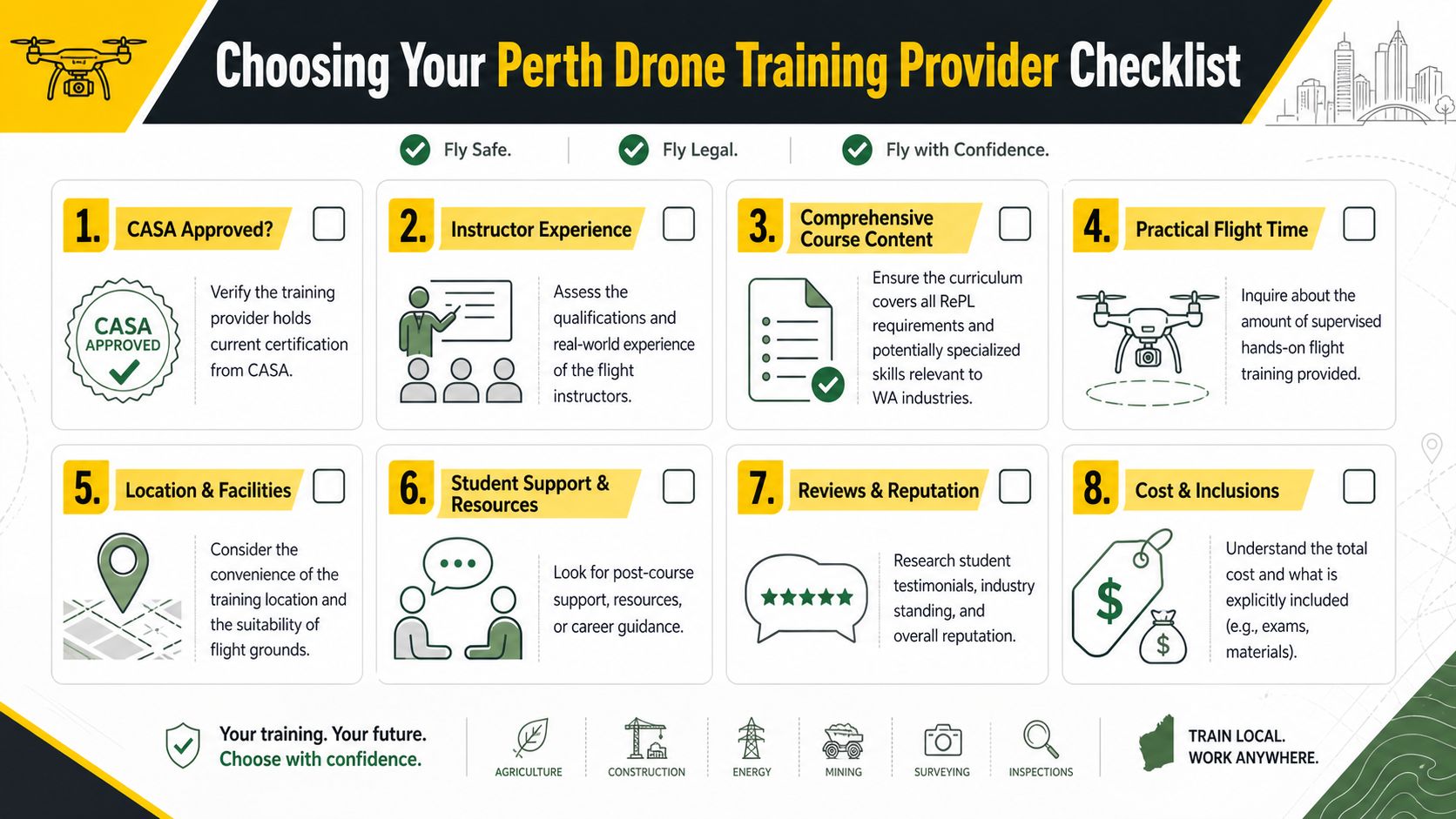
When comparing schools, these factors are worth checking carefully:
- CASA approval status. The provider should be properly authorised to deliver the relevant training and assessments.
- Instructor background. An instructor with broader aviation, airspace, or operational experience often explains risk more clearly than someone who only knows the drone hardware.
- Assessment transparency. Students should understand how theory and practical competency will be judged.
- Operational relevance. The course should connect the licence to real work, especially if the student wants entry into mining, agriculture, or infrastructure.
- Post-course support. Good training providers don't disappear at licence issue. They help students understand next steps.
Questions worth asking before enrolling
A simple shortlist of questions can reveal a lot.
| Question | Why it matters |
|---|---|
| Who teaches the course, and what is their aviation background? | Instruction quality affects safety judgement and confidence |
| How is practical training delivered? | Students need clarity on supervision, flight exposure, and competency standards |
| Is AROC included where relevant? | Some commercial pathways need radio competence |
| How does the provider address WA industry readiness? | This is where many courses stay too generic |
| What support exists after licensing? | Graduates often need guidance on next certifications or business setup |
A provider doesn't need to promise employment to be useful. It does need to show that it understands the difference between issuing a licence and preparing someone for operational work.
Why Perth Students Choose Ace Aviation Aerospace Academy
A student comparing providers often ends up looking for one thing above all. Training that links licensing to actual operations, rather than treating the licence as the finish line.
Training that connects licensing to operations
For commercial drone operations in Australia, a Remote Pilot Licence is mandatory for drones weighing between 2 kg and 7 kg, while drones in the 7 to 25 kg category require both an RePL and additional certification under CASA regulations (CASA drone certification overview). That alone shows why course selection needs to align with intended aircraft and mission type.
Ace Aviation Aerospace Academy offers training and related support in areas directly connected to that pathway, including Remote Pilot Licence (RePL) training, Aeronautical Radio Operator Certificate (AROC) training, Certificate III in Aviation, ReOC Consulting, Enterprise Drone Training, and Corporate Drone Training. For Perth students, that matters when the goal extends beyond basic licensing into business operations, team deployment, or industry-specific readiness.
When broader support matters
The WA employment gap discussed earlier changes what “good training” means. It isn't just about passing the course. It's about whether the graduate can move into a company workflow, a contract environment, or a business operation with fewer unknowns.
A provider becomes more useful when it can support different stages of that progression, such as:
- Beginner entry into regulated drone operations
- Pilot licensing for commercial flying
- Radio qualification where controlled airspace work is relevant
- Operational consulting for organisations building compliant drone programs
That broader view is often what separates a simple course purchase from a workable career plan.
Frequently Asked Questions About Perth Drone Courses
Does a student need to buy a drone before starting training
Usually, no. Most formal training is built around the provider's equipment and assessment process. Buying a drone too early can confuse the learning process if the student chooses an aircraft that doesn't match the intended commercial pathway.
How long does it usually take to get through a Perth RePL course
The standard licensed training pathway covered earlier is structured over a set five-day format in WA. Students should still confirm whether any pre-study, theory preparation, or additional operational modules sit around that core schedule.
Is a Perth-issued RePL valid in other Australian states
Yes. A CASA-issued RePL is nationally recognised and does not expire, so a pilot trained in Perth can conduct commercial drone operations elsewhere in Australia, subject to local airspace rules, as noted in the earlier course structure section. General student questions are also addressed in AAA's drone training FAQ page.
Are there extra requirements for mining or resources work after licensing
Often, yes. A licence is the aviation foundation, but many site-based roles also expect inductions, safety compliance, and an understanding of workplace systems before a pilot can start operational work.
Is AROC always needed with a RePL
Not always. It depends on the operation. AROC becomes important when the pilot needs to use aviation radio legally, especially in controlled airspace or where communication with other aircraft is required.
What should a beginner do before enrolling in a commercial course
A beginner should first define the intended outcome. Recreational confidence, paid media work, enterprise operations, and mining-related field work don't all require the same next step. Choosing the course based on the target role usually prevents wasted time and duplicated training.
Ace Aviation Aerospace Academy provides Australian drone and aviation training for students, operators, and organisations that need structured pathways into commercial drone work. Readers comparing Perth options can review its RePL, AROC, Certificate III in Aviation, ReOC consulting, and business training pathways at Ace Aviation Aerospace Academy.