Short answer
Draft Annex B to AC 101-06 sets out CASA’s proposed guidance for broad area BVLOS operations under four pathways. CASA’s consultation opened on 9 November 2026 and closes on 7 December 2026.
Drone licence Australia: what the draft Annex B changes
CASA’s Draft Annex B to Advisory Circular AC 101-06 v1.0, “Broad area BVLOS operations,” was issued for consultation in November 2026. Its CASA file reference is D26/427048.
The draft builds on pathways introduced as a trial through Temporary Management Instruction (TMI) 2025-03. CASA says that trial showed broad area approvals are practical, so it has established them as an ongoing process in the draft guidance.
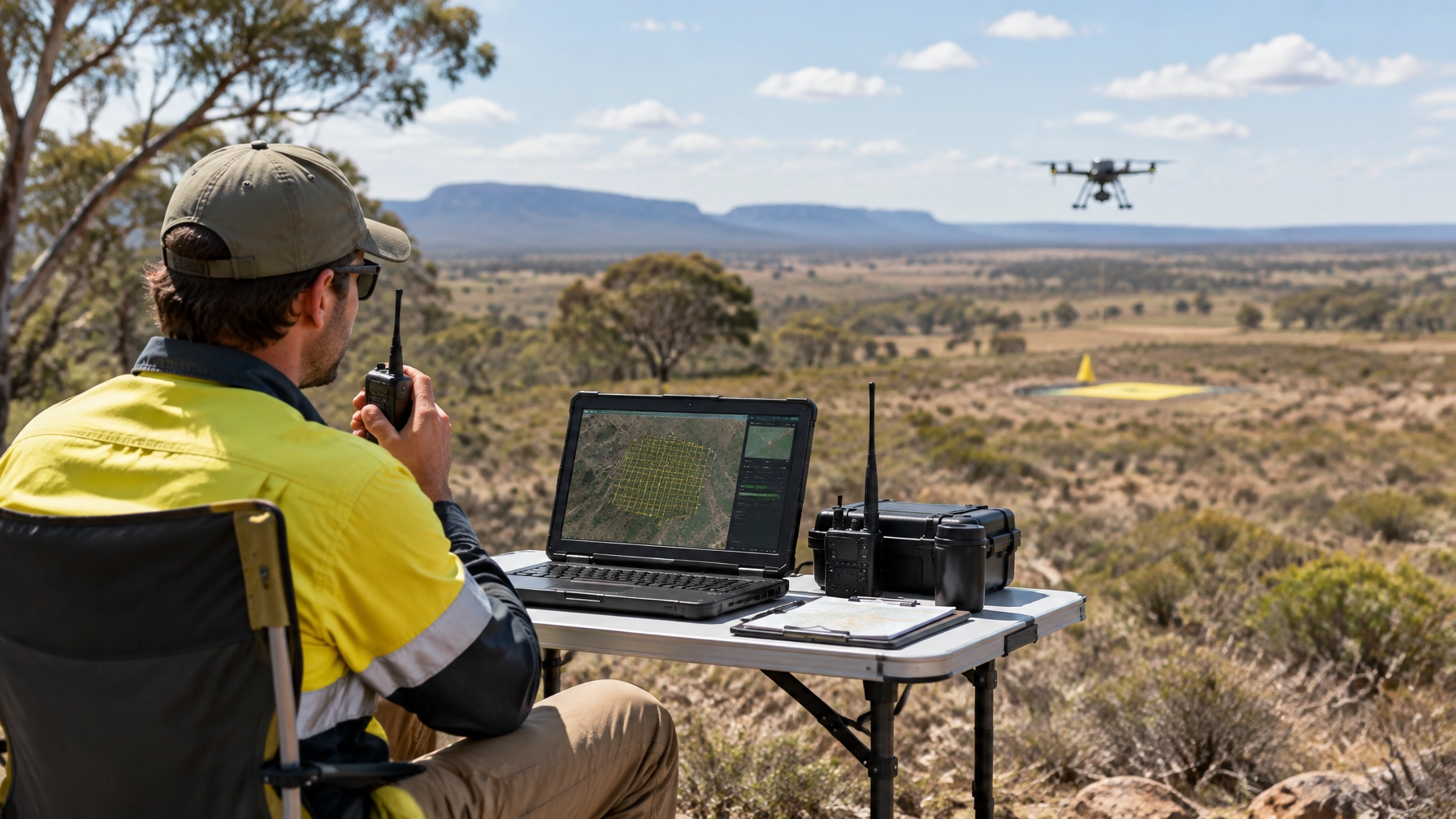
A broad area approval lets a ReOC holder conduct BVLOS operations across multiple operating areas under one authorisation. The holder then self-assesses residual air and ground risk for each area inside the approved envelope.
However, this is not an automatic permission to fly anywhere. The draft sets out pathways, eligibility limits, operational conditions and duties for operators. It applies only to operations conducted under a ReOC, not model aircraft, excluded RPA operations or micro RPA operations.
The draft refers to approvals under regulations 101.029 or 101.030 of CASR. It is also relevant to CASA 20/25 and regulations 101.073, 101.085, 101.095, 101.245 and 101.300. For the current consultation documents, see CASA’s Draft Annex B consultation page.

Key facts about the consultation
| Item | Draft consultation detail |
|---|---|
| Document | Draft Annex B to Advisory Circular AC 101-06 v1.0, “Broad area BVLOS operations” |
| CASA file reference | D26/427048 |
| Consultation opened | 9 November 2026 |
| Consultation closes | 7 December 2026 |
| Feedback methods | Online survey on CASA’s Consultation Hub or email to regulatoryconsultation@casa.gov.au |
| How feedback is handled | CASA will publish responses unless submitted as confidential, then publish a Summary of Consultation |
| Who the pathways cover | ReOC holders conducting eligible BVLOS operations |
| Pathway options | A, B and C prescribe routes; D is for operations outside those routes |
The four broad area pathways
Pathways A, B and C set aircraft size and speed limits, population-density limits and minimum ground risk mitigations. The number after a pathway letter indicates the minimum number of ground risk mitigations required.
Pathways A, B and C: limits and mitigations
| Pathway | Maximum characteristic dimension and airspeed | Population-density limit | Minimum ground risk mitigations |
|---|---|---|---|
| A0 | Under 1 m; under 25 m/s | Lightly populated: under 50 people/km² | Optional; no weight limit |
| A1 | Under 1 m; under 25 m/s | Up to sparsely populated: under 500 people/km² | One: qualifying structures or a CASA-listed parachute recovery system (PRS) accepted for M2 at medium or high robustness |
| A2 | Under 1 m; under 25 m/s | Up to suburban: under 5,000 people/km² | Both mitigations; RPA must be under 25 kg |
| B0 | Between 1 and 3 m; under 35 m/s | Scarcely populated: under 5 people/km² | None; no weight limit |
| B1 | Between 1 and 3 m; under 35 m/s | Lightly populated: under 50 people/km² | One mitigation |
| B2 | Between 1 and 3 m; under 35 m/s | Sparsely populated: under 500 people/km² | Both mitigations; RPA must be under 25 kg |
| C0 | Between 3 and 8 m; under 75 m/s | Isolated: under 0.5 people/km² | None; no weight limit |
| C1 | Between 3 and 8 m; under 75 m/s | Scarcely populated: under 5 people/km² | One mitigation |
| C2 | Between 3 and 8 m; under 75 m/s | Lightly populated: under 50 people/km² | Both mitigations; RPA must be under 25 kg |
The two ground risk mitigations are structures expected to shelter more than 90% of non-active participants, and a qualifying PRS. For A1, when the structures option is used, the RPA must be under 25 kg. The draft lists the under-25-kg requirement for A2, B2 and C2.
“Maximum characteristic dimension” means wingspan for fixed-wing RPA, blade diameter for rotorcraft, and maximum distance between blade tips for a multirotor. In addition, CASA may publish a list of RPA with an equivalent ground risk profile that can use a lower pathway.

Pathway D
Pathway D covers operations outside the prescribed A, B and C pathways. It requires a safety case and a pre-application meeting with CASA.
Operators already assessed above SAIL II may apply through Pathway D. Therefore, operators whose aircraft, operating proposal or risk profile does not fit a prescribed route should consider this pathway and discuss their proposal with CASA.
Operational requirements for every pathway
The chosen pathway does not remove the common operating conditions in the draft. Operators need to consider the full operational volume, including the contingency volume and ground risk buffer.
Aerodromes and restricted airspace. The operational volume must sit outside 5 NM of the measurement point of a controlled aerodrome, including a military aerodrome. In controlled airspace, operations must remain below 400 ft above ground level (AGL). The volume must also stay outside a non-controlled aerodrome or helicopter landing site no-fly zone, unless the operator coordinates with the aerodrome representative, has ADS-B in the aircraft or a ground receiver covering 10 NM, keeps a high-intensity anti-collision strobe on throughout the flight, and makes aeronautical radio broadcasts. Restricted airspace is also out of bounds unless the controlling authority permits the operation under regulation 101.065.
Height and routes. The day ceiling is 400 ft (120 m) AGL, subject to stated exceptions. These include operations over or within 1 km of the excavated area of an active mine, up to 1,000 ft above the natural surface at the pit edge closest to the aircraft; a dedicated ADS-B receiver at the launch site covering 10 NM with a live feed; or an area inside CASA’s geospatial file, “Broad Area BVLOS up to 1000 ft AGL – conditional area,” published on 26 October 2026.
The volume must stay outside 1 NM either side of a published VFR route centreline and 300 ft below its minimum route altitude. Also, it must stay below 300 ft AGL inside a designated danger area used for flying training.
Night operations and air traffic monitoring. At night, an aircraft with an ADS-B OUT transponder must remain at least 500 ft below the lower limit of overlying controlled airspace. Without a transponder, the ceiling is the lowest safe altitude for the area. Night operations above 400 ft need a 1 NM lateral buffer from the controlled airspace boundary. Airspace within 10 NM of the aircraft must be monitored continuously for ADS-B traffic, and VHF radio broadcasts must meet the air risk assessment.
Aircraft safeguards and buffers. The aircraft needs a technical means of ending the flight before it enters the ground risk buffer. It also needs an active geofence that prevents entry into the contingency volume. If there is no contingency volume, a flight termination system must end the flight no later than entry into the ground risk buffer. The minimum buffer uses a maximum 1:1 height-to-horizontal-distance ratio; at 400 ft (120 m), that means a buffer of at least 400 ft (120 m).
Weather and contingency volume. Forecast visibility in the planned area must be either under 600 m or over 5,000 m. When cloud cover exceeds 4 octas, forecast cloud base must be at least 1,000 ft AGL. Neither limit applies to an emergency services organisation on an emergency services operation.
The contingency volume is based on 15 seconds at maximum possible commanded airspeed. Operators can use the prescribed distances of 375 m, 525 m and 1,125 m for the three RPA columns, calculate a distance, or omit the contingency volume entirely if automatic flight termination occurs at the ground risk buffer.
Population assessment. Assess population across the entire operational volume on a 1 km by 1 km grid and use the highest grid-cell density. In addition, check when local numbers may rise, including school pickup, weekend sport, markets, beaches and mine site shift changeover.
Recording and reporting under a broad area approval
The instrument of approval sets the records an operator must keep, and the draft is specific about holding them for 7 years. Expect to record the aircraft type and model, any excursion outside the flight geography, collisions and their consequences, flight termination activations, and every site the responsible person authorised.
An excursion outside the flight geography must be reported to rpas.reporting@casa.gov.au within 7 days of the operation. Keep a copy of each BVLOS area authorisation form with the operational release for at least 7 years after the flight day.
The “responsible person” role
Every ReOC holder must nominate an employee as its responsible person. The nominee is responsible for BVLOS area feasibility assessments and may hold this role for only one ReOC.
For pathways other than A0, B0 and C0, CASA interviews the nominee and conducts a scenario-based assessment. A0, B0 and C0 still require a nominated responsible person, but CASA does not assess that nominee. A further interview is not needed if the nominee held the role for another ReOC holder and left within the previous six months.
The ReOC holder must adopt CASA’s Appendix A feasibility assessment procedures unchanged in intent. The responsible person’s duties include:
- Assessing each proposed area and applying its contingency volume and ground risk buffer.
- Verifying compliance and documenting every assessment and outcome.
- Engaging with airspace users.
- Reviewing every operational area at least every 12 months.
If the role becomes vacant, the ReOC holder must notify CASA within 21 days. Until CASA approves a replacement, operations may continue only in areas already assessed and approved by the former responsible person. No new area assessments may be completed.
How a ReOC holder applies
-
Confirm the intended pathway and scope. Check the aircraft, density, mitigations and operations against the draft. If the operation falls outside the prescribed pathways, consider Pathway D and its safety case and pre-application meeting.
-
Nominate the responsible person. The nominee must be an employee of the ReOC holder. Prepare for CASA’s interview and scenario-based assessment when required.
-
Prepare the application package. Send the completed form and supporting documentation to rpas.pac@casa.gov.au. Include documented practices and procedures with Appendix A incorporated, and any changes needed to establish the responsible person role.
-
Add first-time applicant documents where needed. First-time BVLOS applicants also submit the BVLOS application form and the SORA checklist.
-
Pay the fees and allow for assessment. CASA’s base estimate is 12 hours of assessment. First-time applicants are likely to need more. Fees must be paid before assessment begins.
-
Check whether an existing application can be varied. Applicants already in CASA’s queue can email to request a variation and keep their queue position. Applicants with an assigned inspector can also vary their application; this may change the assessment time and fee estimate.
-
Plan renewal before expiry. Apply before the authorisation expires. If the responsible person remains unchanged, CASA will generally not interview again. Renewal keeps pathways already approved under TMI 2025-03 while allowing requests for more. An authorisation is issued to the expiry date requested, or generally to the same date as the ReOC.
A remote operations centre receives a separate assessment. A separate assessment is also required if one remote pilot operates more than one RPA at a time. Operations within 30 m of a non-active participant, or below the minimum safe deployment height of a required parachute, sit outside the annex and go through existing policy.
Lowest-risk A0, B0 and C0 routes compared with assessed pathways
| Feature | A0, B0 and C0 | Assessed pathways |
|---|---|---|
| Population profile | A0: under 50; B0: under 5; C0: under 0.5 people/km² | Higher-density routes, up to the pathway’s stated limit |
| Minimum ground risk mitigations | Optional for A0; none for B0 and C0 | One or both, depending on pathway |
| Responsible person | Required; no CASA assessment for these three routes | Required; CASA interview and scenario-based assessment for pathways other than A0, B0 and C0 |
| Pilot knowledge requirement | IREX or BVLOS OCTA pass, unless the specified EX 63/26 supervision applies | IREX or BVLOS OCTA pass |
| Application duties | Common application and operating requirements still apply | Common application and operating requirements still apply |
The lower-risk routes do not remove the other operating requirements. For example, the ReOC holder still needs an approved process, a responsible person and assessments for each operating area.
What this means for licensed pilots and people still training
A RePL is not the same as a broad area authorisation. The draft assigns the approval and area-assessment duties to the ReOC holder and its responsible person. Remote pilots must also have a pass in the IREX or BVLOS OCTA, unless operating under A0, B0 or C0 with a supervising remote pilot under CASA EX 63/26.
Therefore, pilots should understand both their own qualification requirements and the operator’s approval. People still training can use the consultation period to ask what their intended work requires, rather than assume a pilot licence alone covers a broad area operation.
Ace Aviation provides RePL, AROC and Chief Remote Pilot training plus ReOC setup support for operators building capability. Its CASA.ReOC.1421 experience, more than 4,000 students trained, global footprint across Australia, Singapore, Dubai, Korea and Malaysia, and Altitude+ student program support a pathway from learning to professional operations. See why students choose Ace Aviation and student reviews.
Ace Aviation’s Australian training footprint includes Brisbane, Sydney, Melbourne, Perth and Hobart. Once qualified, pilots can also explore roles and opportunities through the DroneWork job board and Ace Aviation’s jobs information.

Common mistakes operators make when preparing a broad area application
- Treating the consultation draft as an approval. The document is draft guidance. It does not itself authorise a flight.
- Choosing a pathway from density alone. Aircraft dimension, maximum airspeed, mitigations and weight conditions also matter.
- Using an average population figure. The draft requires a 1 km grid across the whole operational volume and assessment against its highest cell.
- Ignoring time-based population changes. School pickup, weekend sport, markets, beaches and mine shift changes can alter the people exposed.
- Forgetting areas around the route. The volume includes the contingency volume and ground risk buffer, not just the intended flight path.
- Assuming all applicants face the same assessment. Pathways A0, B0 and C0 do not require the CASA nominee assessment described for other pathways. First-time BVLOS applicants also have extra documents.
- Leaving renewal or recordkeeping too late. Applications must precede expiry, and records must be retained for seven years.
CASA considerations
Before commenting, read the draft and consultation material on CASA’s Consultation Hub. CASA asks whether the guidance is clear, gives enough detail to support applications and adequately supports the pathways, and whether it misses significant safety issues.
Make feedback specific. For example, identify the relevant pathway, requirement or application step, explain what is unclear or incomplete, and describe the safety or practical effect. Submit through the online survey or email regulatoryconsultation@casa.gov.au by 7 December 2026. CASA will publish responses unless they are submitted as confidential, then publish a Summary of Consultation.
For background on CASA’s drone information, consult its drones hub. For training and operational preparation, Ace Aviation’s course information can help pilots and organisations identify relevant learning.
Frequently asked questions
1. What is Draft Annex B to AC 101-06?
It is CASA’s November 2026 draft guidance for broad area BVLOS operations. It describes pathways, eligibility, operating conditions, applications, responsible persons and renewals.
2. When does the consultation close?
The consultation closes on 7 December 2026. It opened on 9 November 2026.
3. Does the draft itself authorise a flight?
No. It is draft guidance for broad area approvals. Operations must be conducted under an applicable ReOC and authorisation.
4. Who can use the broad area pathways?
They apply to eligible operations conducted under a ReOC. They do not apply to model aircraft, excluded RPA operations or micro RPA operations.
5. What does the number after a pathway letter mean?
It indicates the minimum number of ground risk mitigations required. For example, pathway A2 requires both mitigations.
6. What are the two ground risk mitigations?
One is suitable structures expected to shelter more than 90% of non-active participants. The other is a CASA-listed PRS accepted for M2 at medium or high robustness.
7. What is maximum characteristic dimension?
It means wingspan for fixed-wing RPA, blade diameter for rotorcraft, or the maximum distance between blade tips for a multirotor.
8. Who should consider Pathway D?
Operators whose operations fall outside the prescribed pathways may apply through D. It requires a safety case and a pre-application meeting with CASA.
9. Does a RePL alone meet the pilot knowledge requirement?
Not necessarily. The draft requires an IREX or BVLOS OCTA pass, except for the specified A0, B0 or C0 supervision arrangement under CASA EX 63/26.
10. Does every ReOC holder need a responsible person?
Yes. Each ReOC holder must nominate an employee for the role. That person may hold the role for only one ReOC.
11. Does CASA assess every responsible person?
CASA interviews and assesses nominees for pathways other than A0, B0 and C0. Those three pathways still need a nominee, but no CASA assessment.
12. How must an operator assess population density?
Use a 1 km by 1 km grid across the whole operational volume and use the highest grid cell. Also check periods when population may rise.
13. What is the usual day ceiling in the draft?
The day ceiling is 400 ft (120 m) AGL, subject to the stated active-mining, ADS-B receiver and published conditional-area exceptions.
14. What does a first-time BVLOS applicant submit?
The applicant submits the application form and supporting documents. First-time BVLOS applicants also submit the BVLOS application form and SORA checklist.
15. When does CASA begin assessment?
Fees must be paid before assessment begins. CASA’s base estimate is 12 hours, while first-time applicants are likely to need more.
16. Can an existing applicant change an application?
Applicants in CASA’s queue can email for a variation and keep their queue position. Those with an assigned inspector can also vary, though timing and fee estimates may change.
17. How do I submit consultation feedback?
Use the survey on CASA’s Consultation Hub or email regulatoryconsultation@casa.gov.au by 7 December 2026. CASA will publish responses unless submitted as confidential.
Training locations
Ace Aviation provides training across Australia. Explore sessions and location information for Brisbane, Sydney, Melbourne, Perth and Hobart.
Summary
Draft Annex B turns the broad area BVLOS trial pathways into proposed ongoing guidance. Its four routes set different thresholds for RPA dimensions, airspeed, population density and ground risk mitigations. However, all pathways also carry operating conditions, application duties and recordkeeping requirements.
ReOC holders should review the complete draft, confirm which route fits their operation and nominate a responsible person. Pilots should check their IREX or BVLOS OCTA requirement, while people still training can plan for the qualification and operational responsibilities ahead. To discuss training, visit Ace Aviation or book a training session.
Ready to start? Book your training at aaa.edu.au or call 1300 336 366.
{“@graph”:[{“@type”:”Article”,”author”:{“name”:”Ace Aviation Aerospace Academy”,”@type”:”Organization”},”headline”:”Drone Licence Australia 2026: CASA’s Broad Area BVLOS Draft Guidance, Explained Pathway by Pathway”,”publisher”:{“url”:”https://aaa.edu.au/”,”name”:”Ace Aviation Aerospace Academy”,”@type”:”Organization”},”description”:”Drone licence australia: Review CASA’s draft broad area BVLOS pathways, key duties and deadline. Read the guide and submit feedback by 7 December.”,”datePublished”:”2026-11-16″,”mainEntityOfPage”:”https://aaa.edu.au/”},{“url”:”https://aaa.edu.au/”,”name”:”Ace Aviation Aerospace Academy”,”@type”:”Organization”},{“@type”:”FAQPage”,”mainEntity”:[{“name”:”What is Draft Annex B to AC 101-06?”,”@type”:”Question”,”acceptedAnswer”:{“text”:”It is CASA’s November 2026 draft guidance for broad area BVLOS operations. It describes pathways, eligibility, operating conditions, applications, responsible persons and renewals.”,”@type”:”Answer”}},{“name”:”When does the consultation close?”,”@type”:”Question”,”acceptedAnswer”:{“text”:”The consultation closes on 7 December 2026. It opened on 9 November 2026.”,”@type”:”Answer”}},{“name”:”Does the draft itself authorise a flight?”,”@type”:”Question”,”acceptedAnswer”:{“text”:”No. It is draft guidance for broad area approvals. Operations must be conducted under an applicable ReOC and authorisation.”,”@type”:”Answer”}},{“name”:”Who can use the broad area pathways?”,”@type”:”Question”,”acceptedAnswer”:{“text”:”They apply to eligible operations conducted under a ReOC. They do not apply to model aircraft, excluded RPA operations or micro RPA operations.”,”@type”:”Answer”}},{“name”:”What does the number after a pathway letter mean?”,”@type”:”Question”,”acceptedAnswer”:{“text”:”It indicates the minimum number of ground risk mitigations required. For example, pathway A2 requires both mitigations.”,”@type”:”Answer”}},{“name”:”What are the two ground risk mitigations?”,”@type”:”Question”,”acceptedAnswer”:{“text”:”One is suitable structures expected to shelter more than 90% of non-active participants. The other is a CASA-listed PRS accepted for M2 at medium or high robustness.”,”@type”:”Answer”}},{“name”:”What is maximum characteristic dimension?”,”@type”:”Question”,”acceptedAnswer”:{“text”:”It means wingspan for fixed-wing RPA, blade diameter for rotorcraft, or the maximum distance between blade tips for a multirotor.”,”@type”:”Answer”}},{“name”:”Who should consider Pathway D?”,”@type”:”Question”,”acceptedAnswer”:{“text”:”Operators whose operations fall outside the prescribed pathways may apply through D. It requires a safety case and a pre-application meeting with CASA.”,”@type”:”Answer”}},{“name”:”Does a RePL alone meet the pilot knowledge requirement?”,”@type”:”Question”,”acceptedAnswer”:{“text”:”Not necessarily. The draft requires an IREX or BVLOS OCTA pass, except for the specified A0, B0 or C0 supervision arrangement under CASA EX 63/26.”,”@type”:”Answer”}},{“name”:”Does every ReOC holder need a responsible person?”,”@type”:”Question”,”acceptedAnswer”:{“text”:”Yes. Each ReOC holder must nominate an employee for the role. That person may hold the role for only one ReOC.”,”@type”:”Answer”}},{“name”:”Does CASA assess every responsible person?”,”@type”:”Question”,”acceptedAnswer”:{“text”:”CASA interviews and assesses nominees for pathways other than A0, B0 and C0. Those three pathways still need a nominee, but no CASA assessment.”,”@type”:”Answer”}},{“name”:”How must an operator assess population density?”,”@type”:”Question”,”acceptedAnswer”:{“text”:”Use a 1 km by 1 km grid across the whole operational volume and use the highest grid cell. Also check periods when population may rise.”,”@type”:”Answer”}},{“name”:”What is the usual day ceiling in the draft?”,”@type”:”Question”,”acceptedAnswer”:{“text”:”The day ceiling is 400 ft (120 m) AGL, subject to the stated active-mining, ADS-B receiver and published conditional-area exceptions.”,”@type”:”Answer”}},{“name”:”What does a first-time BVLOS applicant submit?”,”@type”:”Question”,”acceptedAnswer”:{“text”:”The applicant submits the application form and supporting documents. First-time BVLOS applicants also submit the BVLOS application form and SORA checklist.”,”@type”:”Answer”}},{“name”:”When does CASA begin assessment?”,”@type”:”Question”,”acceptedAnswer”:{“text”:”Fees must be paid before assessment begins. CASA’s base estimate is 12 hours, while first-time applicants are likely to need more.”,”@type”:”Answer”}},{“name”:”Can an existing applicant change an application?”,”@type”:”Question”,”acceptedAnswer”:{“text”:”Applicants in CASA’s queue can email for a variation and keep their queue position. Those with an assigned inspector can also vary, though timing and fee estimates may change.”,”@type”:”Answer”}},{“name”:”How do I submit consultation feedback?”,”@type”:”Question”,”acceptedAnswer”:{“text”:”Use the survey on CASA’s Consultation Hub or email regulatoryconsultation@casa.gov.au by 7 December 2026. CASA will publish responses unless submitted as confidential.”,”@type”:”Answer”}}]}],”@context”:”https://schema.org”}