Short direct answer
A drone licence Australia graduates hold opens pilot work in agriculture, surveying, construction and media. Others build drone businesses, or move into RPAS engineering and maintenance. That technical route is the one most students miss, and it is where the skills shortage bites hardest.
Drone licence Australia: where graduates actually end up
Key facts at a glance
| Fact | Detail |
|---|---|
| ACE approval | CASA-approved training organisation, CASA.ReOC.1421 |
| Graduate experience | ACE has trained 4,000+ students |
| Five graduate outcomes | Agriculture, construction surveying, job offers, ReOC operations and media |
| RePL learning format | Online modules, live webinars and virtual classroom days |
| RePL practical training | Two in-person days for flight training, exams and flight assessment |
| Foundation engineering course | Five days at ACE NextLab in Melbourne |
| Foundation engineering price | $5,600 |
| Advanced engineering course | Two weeks in Melbourne, $8,999 |
| ACE student network | DroneWork access for ACE students at no cost |
| Global training footprint | Australia, Singapore, Dubai, Korea and Malaysia |
ACE has trained 4,000+ students over 10+ years, placed 250+ of them into jobs and now runs eight training bases. Every graduate below came through our CASA-approved programs under CASA.ReOC.1421. None of them took the same route out.
Their own words are published on our ACE graduate reviews page. Read them for the pattern, not for a guarantee. Each one points to a sector, a skill and a first move. Behind all five sits the same machinery: ACE’s training approach plus a course pathway that matches the work.
Industry evidence: why technician and systems-operator roles are growing
Australia needs more than remote pilots. A market study projects annual uncrewed flights will climb from 1.5 million to more than 60 million by 2043. Somebody has to build, configure, test and repair the aircraft making those flights.
Aviation Australia chief executive Glenn Ryan put that point on the table on 9 November 2026. He spoke at the Global Drone Show. He said training models must scale fast to avoid a severe skills bottleneck. He named advanced software engineers, complex systems operators and maintenance technicians alongside pilots.
Global Drone 2026 ran 11 to 13 November at Cbus Super Stadium on the Gold Coast. It drew 200 brands, 120+ live demos and 2,000+ students to its Future Careers Day. That show was built around the pilot who can also trace a fault and read a flight log.
So what does that person do on a Tuesday? They swap a failed speed controller. They recalibrate a compass. They review a log for a voltage sag, rebuild a gimbal mount and sign off a bench test. A fleet of twenty aircraft generates that work every week.
Five ACE graduates, five different moves
Each of these is a published review from a real graduate. Read the second sentence of each one, because that is where the actual work starts.
Sarah Mitchell: agricultural contract work
Sarah trained on our XAG agriculture platforms, not on a generic trainer aircraft. That was the difference. She landed her first agricultural contract three weeks after graduating.
“Completed my RePL with ACE and landed my first agricultural contract within three weeks of graduating. The XAG training was invaluable, no other school offers anything close to that level of practical experience.”
The lesson for a new student is blunt. Choose training that fits your intended sector. A client hiring a spray operator wants to see heavy-lift hours, not a certificate with a quadcopter on it. Agricultural work across the Darling Downs and the WA wheatbelt runs on these platforms. The skills travel with the aircraft.
James Thornton: construction survey work
James arrived with zero aviation background, which is the majority profile in our intake. He passed his flight assessment first time. He now does survey work for a major construction firm in Queensland.
“I came in with zero aviation background. The instructors broke everything down into plain English and never made me feel behind. Passed first attempt and I'm now doing survey work for a major construction firm in Queensland.”
Notice what he did not do. He did not buy an expensive aircraft first. He learned the airspace rules, the mission planning and the data handover, then let the employer supply the fleet. Construction survey work around Brisbane and the Gold Coast is a team job beside a surveyor. It is not a solo operator with a hard case.
That is the cheapest way into the industry and the least talked about. A licence plus site experience beats a $20,000 aircraft and no licence, every time.
Luke Patterson: Gold package and DroneWork
Luke finished our Gold package and had three job offers inside a month. He credits DroneWork rather than the certificate.
“The DroneWork platform alone is worth the course fee. Had three job offers within a month of completing my Gold package. ACE genuinely invests in your career beyond just the licence.”
DroneWork works because it removes the guesswork. Pilots see the offered payout before they apply. Qualifications get verified before approval, so a client is not gambling on an unlicensed operator. Account holders work as an individual pilot or as an Operator and ReOC holder.
Every ACE student gets lifetime network access at no cost. That matters in month one, when a new pilot has a licence, a thin profile and no clients. A completed, verified profile gets seen. An empty one gets skipped by the matching, and the pilot never learns which jobs went past.
Daniel O'Brien: moving from RePL to ReOC
Daniel already held a RePL from another provider. He came to us for the operator side, which is a different job entirely.
“Did my ReOC through ACE after already having a RePL from another provider. Night and day difference in quality. The support team answered my CASA questions faster than CASA themselves.”
This distinction trips up more students than any other. A RePL qualifies one person to fly. A ReOC authorises an organisation to run drone operations, employ pilots, hold multiple aircraft and pursue advanced approvals. Buying a RePL does not give you a business. ReOC setup is its own piece of work. Behind it sit a manual, a Chief Remote Pilot and a compliance system.
Daniel's advice lands harder than any brochure line: get the regulatory questions answered early. Our support team fields exactly those questions every week, and 4,000+ graduates have gone through the same process.
Priya Nair: drone operations in media
Priya moved from a corporate career into running drone operations for a media production company. It took her 18 months.
“I now run drone operations for a media production company, something I genuinely didn't think was possible 18 months ago. ACE gave me the confidence, the credentials, and the connections to make it happen.”
She runs operations now, not just flights. That means permits, crew, risk assessments, client liaison and a compliant record set. Media work in Sydney and Melbourne is competitive, so the person holding the paperwork becomes the person running the job.
Her trajectory is the strongest argument for treating the licence as a floor rather than a finish line. Pair it with a speciality and an operations skill, and the ceiling moves.

The path most students miss: RPAS engineering and maintenance
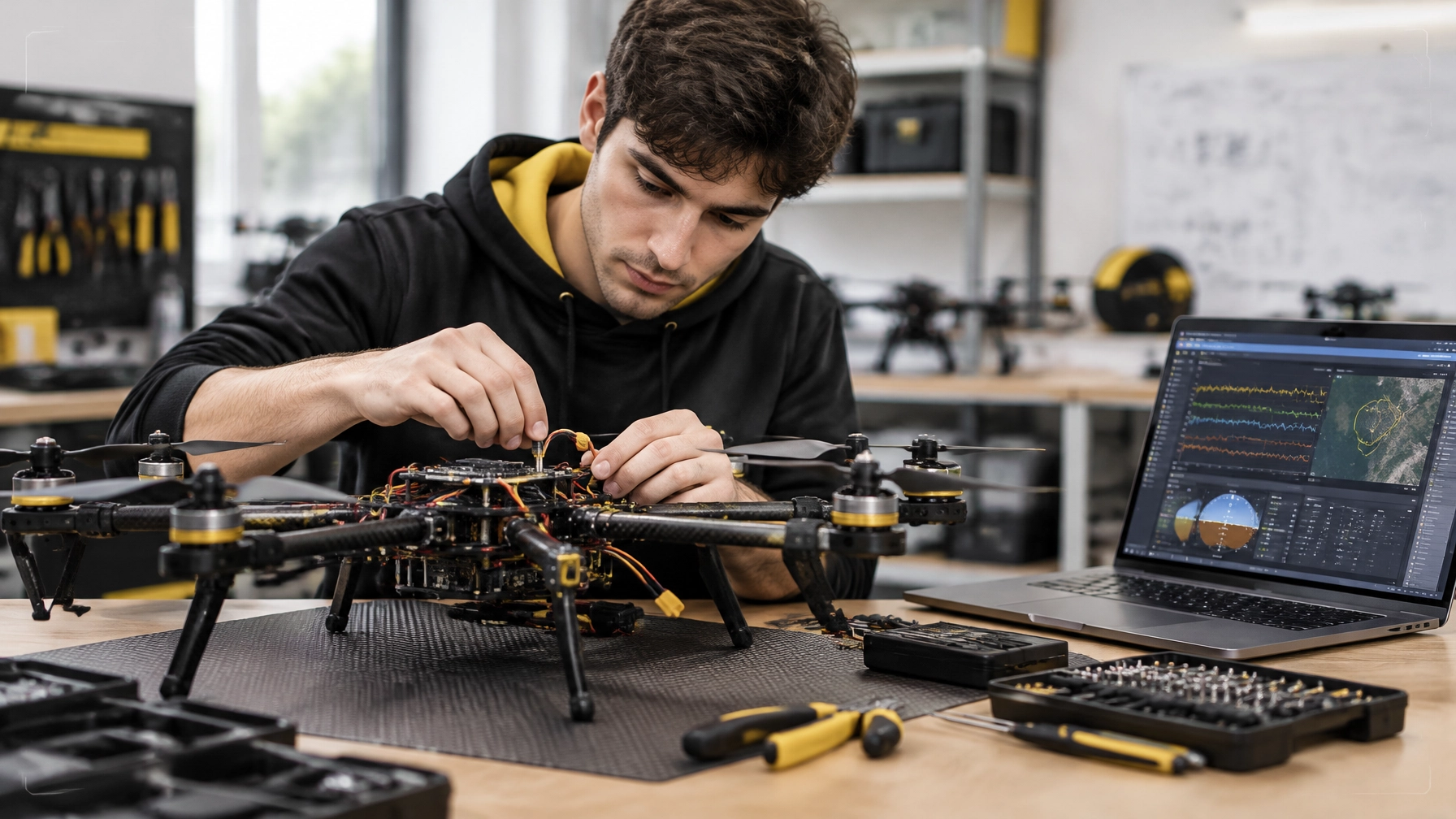
Most students we train never consider the bench. That is a mistake, and it costs money. A pilot who can diagnose a fault, replace a component and sign off a repair works more days. That pilot also stays hard to replace.
ACE NextLab runs that training in a working aviation electronics lab in Melbourne. The foundation program, RPAS Engineering & Maintenance, takes five days and costs $5,600. Intakes run monthly from 1 November 2026.
You build a quadcopter from individual components. You set up and calibrate a Pixhawk 6C or equivalent autopilot, then configure its failsafes. You diagnose faults, review flight logs, replace motors, ESCs and wiring, and run propeller-off bench tests against documented flight-test cards. One station serves up to four learners, so nobody spectates.
A 25% deposit holds your place. Training aircraft and shared hardware stay ACE property, and the course ends with an ACE NextLab Certificate of Completion. Be clear on one point: this is engineering training, not a CASA RePL. See ACE NextLab for the lab itself.

Ready for more? Advanced RPAS Engineering & AI runs two weeks in Melbourne for $8,999. Entry needs the foundation program or equivalent prior knowledge.
You move onto a larger modular platform with Pixhawk Cube-class avionics. The program adds redundant power systems, long-range telemetry, payload and sensor integration, plus NVIDIA Jetson Orin and computer-vision exercises. Graduates leave with an ACE NextLab Advanced Certificate of Completion.
That opens fleet maintenance, integration work and technical support roles. Those are the jobs Glenn Ryan described. They exist in Brisbane, Perth and Sydney as much as in Melbourne. Which raises the practical question: which path suits you?
Which path fits you
Pick the path by the job you want in 12 months, not by price. Then check the package that gets you there with the fewest gaps.
| Path | ACE product | Published price | What it gives you |
|---|---|---|---|
| Pilot | Silver Pilot | $1,199 | Sub-7 kg RePL and AROC for hire and reward work |
| Operator or ReOC | Silver Operator | $2,999 | RePL, AROC, ReOC application setup and the CASA fee |
| Technician | RPAS Engineering & Maintenance | $5,600 | Build, configure, diagnose and test a full platform |
| Enterprise | Platinum Enterprise | $5,999 | Full pathway for an organisation building a drone capability |
Silver Operator is the value pick for anyone going into business. It bundles a sub-7 kg RePL, AROC, ReOC application setup and the CASA application fee. It also carries DroneWork access, UAMP compliance software access, training aircraft, refresher access and career pathway guidance.
The foundation engineering program sits alongside the pilot ladder, not above it. A technician who also holds a RePL is far more employable than either alone. Ask for a tailored course quote if your plan spans both.
A step-by-step route from student to technician
- Decide the job, not the course. Write down the role you want. Pilot, operator, technician or a mix.
- Start with the RePL. Book a RePL package so you can legally fly for hire or reward. Ten self-paced online modules come first, then live trainer-led webinars.
- Get the flight time done. Three live virtual classroom days come first. Then two in-person practical days follow: one for flight training, one for exams and the flight assessment.
- Add the operator layer if you plan to trade. ReOC setup covers the manual, the Chief Remote Pilot appointment and the compliance system.
- Book the engineering foundation. A 25% deposit reserves your RPAS Engineering & Maintenance intake in Melbourne.
- Learn the bench properly. Follow the checklists. Run propeller-off tests. Review logs on real faults, not textbook ones.
- Go advanced if the work demands it. The two-week specialist program adds Jetson Orin, edge AI and larger airframes.
- Work the network. Keep your DroneWork profile complete and verified, then apply where your skills fit.
Our theory runs through ten self-paced online modules, live trainer-led webinars and three live virtual classroom days. Students finish with two in-person practical days. That sequence means you arrive at the engineering bench already knowing how an aircraft behaves in the air.

Where this happens around Australia
Eight training bases and a delivery network across Australia sit behind these five cities. The engineering lab is fixed, so plan travel around it.
- Brisbane. RePL and AROC practical days run here, and construction survey and agriculture work is thick on the ground. See drone courses in Brisbane.
- Sydney. Media, property and infrastructure inspection work suits a pilot with a compliance head on. Start with drone training in Sydney.
- Melbourne. Home base for ACE NextLab engineering intakes and our specialist programs. Check drone courses in Melbourne.
- Perth. Mining and resources work rewards the technician who can keep a fleet flying in a remote camp. See drone training in Perth.
- Hobart. Smaller market, tighter airspace, and a small pool of certified operators. Start with drone training in Hobart.
Perth is where the engineering skill pays most obviously. A resources site two hours from town cannot wait three weeks for a factory repair. Melbourne and Sydney employers usually hold spares and staff.
The same logic applies in Hobart on a smaller scale. Fewer operators mean each one carries more of the maintenance load. Brisbane sits somewhere in between, with strong agricultural demand west of the ranges.
Common mistakes graduates make in their first year
- Treating the licence as the whole plan. A RePL is a floor. Pick a sector and build the skills that sector pays for.
- Confusing pilot and operator roles. A RePL lets you fly. A ReOC lets a business trade. Buying one does not give you the other.
- Ignoring the hardware. Basic airframe checks, prop inspection and logged maintenance prevent the failures that ground a job.
- Leaving the DroneWork profile half-finished. Incomplete profiles get skipped by the matching, and you never see the jobs you missed.
- Taking complex work too early. Build experience inside your training and approval limits before chasing night, BVLOS or heavy-lift jobs.
- Keeping no records. Log your flights, your faults and your fixes. Employers and auditors both ask for them. Keep the log dated, and record the fault you found and the fix you applied. That record becomes your strongest job reference.
CASA considerations for graduates moving into technical work
Three credentials get muddled constantly, so separate them now. A RePL licences a person to fly remotely piloted aircraft. A ReOC authorises an organisation to run drone operations. An AROC certifies radio operating competence.
RPAS Engineering & Maintenance is none of the three. It is engineering training with an ACE NextLab Certificate of Completion. It does not replace a RePL when you fly for work, and it does not create an operating authority.
So if you plan to fly commercially, hold a RePL first. If you plan to trade, wrap a ReOC around it. If you plan to fly into controlled airspace or coordinate with other aircraft, settle the AROC question with your employer. Read the current rules on CASA's drone guidance before you accept a job.
ACE is a CASA-approved training organisation under CASA.ReOC.1421. The Certificate III in Aviation AVI30419 costs $1,899 on top of an ACE RePL package, or $3,299 standalone with a sub-7 kg RePL and AROC. We deliver it with Reach Community College, RTO 40747, whose record sits on training.gov.au.
Frequently asked questions
-
What do people do after getting a commercial drone licence in Australia?
They work in fields such as agriculture, surveying, construction and media. Some manage operations or add technical skills. -
Is RPAS engineering a CASA licence?
No. The ACE NextLab program provides engineering training and a Certificate of Completion, not a CASA RePL. -
Do I need a RePL to do maintenance work?
No. NextLab does not list a RePL as a prerequisite. You need one the moment you fly an aircraft for hire or reward. -
Can I charge for drone repair without a ReOC?
A ReOC covers drone operations, not repair work. Confirm your own legal and business obligations, and hold a RePL if the repair job includes test flights. -
Does a Certificate III help with a drone career?
Certificate III in Aviation AVI30419 is a formal qualification delivered with Reach Community College. It adds structured aviation study to an ACE RePL package or can be taken standalone. -
How long does the RPAS Engineering & Maintenance course take?
Five days, run as a practical workshop at ACE NextLab in Melbourne. Intakes run monthly. -
What does RPAS Engineering & Maintenance cost?
The published price is $5,600. A 25% deposit secures a place. -
What does Advanced RPAS Engineering & AI cost?
The two-week specialist program costs $8,999. Entry requires the foundation program or equivalent prior knowledge. -
Do I need an AROC?
It is a separate radio operator certificate. Roles that use aviation radio frequencies usually need it, so confirm with the employer before you enrol. -
Is NextLab in my city?
NextLab’s RPAS engineering programs run in Melbourne. The listed monthly intakes begin from 1 November 2026. -
Can I take the advanced course first?
Not normally. Entry needs the foundation program or equivalent prior knowledge, and our team will assess your background first. -
What does a Silver Operator package include?
It bundles a sub-7 kg RePL, AROC, ReOC application setup and CASA application fee. It also includes DroneWork access, UAMP compliance software access and career pathway guidance. -
Can I use DroneWork as an individual pilot?
Yes. Account holders can operate as an individual pilot or as an Operator/ReOC holder. DroneWork verifies qualifications before approval. -
Do I need an aviation background to start RePL training?
James Thornton’s review says he started with zero aviation background and passed his first attempt. ACE’s training uses self-paced study, live teaching and practical days. -
Where does ACE deliver training?
ACE has eight training bases and a global footprint across Australia, Singapore, Dubai, Korea and Malaysia. Check the location pages for current arrangements. -
Can technical training help a pilot move into systems work?
Yes. The NextLab foundation course covers autopilot setup, fault diagnosis, flight logs, component replacement and testing. -
How do I choose the right ACE course?
Match the course to the role you want, then check what it leaves out. Compare the course options or ask our team to map it for you. -
Does a drone licence Australia employers recognise cover engineering work?
No. A RePL covers flight. Engineering and maintenance sit outside it, so treat them as two separate investments.
Summary
Commercial drone careers include field piloting, business operations, surveying, media and technical work. The five ACE graduate reviews show several routes, while industry projections point to rising demand for systems and maintenance skills.
ACE has trained 4,000+ students and trains across Australia, Singapore, Dubai, Korea and Malaysia. Our Altitude+ student program and the DroneWork paid-work network both keep working after the course ends. For anyone drawn to the technical side, ACE NextLab runs a five-day engineering and maintenance foundation in Melbourne.
Start with the role you want. Then pick the training that closes the gap fastest, and book your training with ACE when you are ready.
Ready to start? Book your training at aaa.edu.au or call 1300 336 366.
{“@graph”:[{“@id”:”https://aaa.edu.au/#organization”,”url”:”https://aaa.edu.au/”,”name”:”Ace Aviation Aerospace Academy”,”@type”:”Organization”},{“@type”:”Article”,”image”:”https://cdn.marblism.com/4xjsFdBWl80.webp”,”author”:{“name”:”Ace Aviation Aerospace Academy”,”@type”:”Organization”},”headline”:”Drone Licence Australia 2026: What Five ACE Graduates Did Next, and the RPAS Technician Path Most Students Miss”,”publisher”:{“@id”:”https://aaa.edu.au/#organization”},”description”:”Explore five graduate outcomes and the RPAS technician path after a drone licence Australia course. Discover your next step and book with ACE.”,”datePublished”:”2026-11-19″,”mainEntityOfPage”:”https://aaa.edu.au/”},{“@type”:”FAQPage”,”mainEntity”:[{“name”:”What do people do after getting a commercial drone licence in Australia?”,”@type”:”Question”,”acceptedAnswer”:{“text”:”They work in fields such as agriculture, surveying, construction and media. Some manage operations or add technical skills.”,”@type”:”Answer”}},{“name”:”Is RPAS engineering a CASA licence?”,”@type”:”Question”,”acceptedAnswer”:{“text”:”No. The ACE NextLab program provides engineering training and a Certificate of Completion, not a CASA RePL.”,”@type”:”Answer”}},{“name”:”Do I need a RePL to do maintenance work?”,”@type”:”Question”,”acceptedAnswer”:{“text”:”A RePL qualifies a person to pilot remotely piloted aircraft. The NextLab engineering course does not list a RePL as a prerequisite.”,”@type”:”Answer”}},{“name”:”Can I charge for drone repair without a ReOC?”,”@type”:”Question”,”acceptedAnswer”:{“text”:”A ReOC concerns an organisation’s drone operations, not maintenance training. Check your specific work and any other legal or business requirements before offering repairs.”,”@type”:”Answer”}},{“name”:”Does a Certificate III help with a drone career?”,”@type”:”Question”,”acceptedAnswer”:{“text”:”Certificate III in Aviation AVI30419 is a formal qualification delivered with Reach Community College. It adds structured aviation study to an ACE RePL package or can be taken standalone.”,”@type”:”Answer”}},{“name”:”How long does the RPAS Engineering & Maintenance course take?”,”@type”:”Question”,”acceptedAnswer”:{“text”:”It runs for five days as a practical workshop at ACE NextLab in Melbourne.”,”@type”:”Answer”}},{“name”:”What does RPAS Engineering & Maintenance cost?”,”@type”:”Question”,”acceptedAnswer”:{“text”:”The published price is $5,600. A 25% deposit secures a place.”,”@type”:”Answer”}},{“name”:”What does Advanced RPAS Engineering & AI cost?”,”@type”:”Question”,”acceptedAnswer”:{“text”:”The two-week specialist program costs $8,999. Entry requires the foundation program or equivalent prior knowledge.”,”@type”:”Answer”}},{“name”:”Do I need an AROC?”,”@type”:”Question”,”acceptedAnswer”:{“text”:”AROC is a separate radio operator certificate. Check whether your duties and operating context require it.”,”@type”:”Answer”}},{“name”:”Is NextLab in my city?”,”@type”:”Question”,”acceptedAnswer”:{“text”:”NextLab’s RPAS engineering programs run in Melbourne. The listed monthly intakes begin from 1 November 2026.”,”@type”:”Answer”}},{“name”:”Can I take the advanced course first?”,”@type”:”Question”,”acceptedAnswer”:{“text”:”Entry requires the foundation program or equivalent prior knowledge. Contact ACE to discuss how your experience meets that requirement.”,”@type”:”Answer”}},{“name”:”What does a Silver Operator package include?”,”@type”:”Question”,”acceptedAnswer”:{“text”:”It bundles a sub-7 kg RePL, AROC, ReOC application setup and CASA application fee. It also includes DroneWork access, UAMP compliance software access and career pathway guidance.”,”@type”:”Answer”}},{“name”:”Can I use DroneWork as an individual pilot?”,”@type”:”Question”,”acceptedAnswer”:{“text”:”Yes. Account holders can operate as an individual pilot or as an Operator/ReOC holder. DroneWork verifies qualifications before approval.”,”@type”:”Answer”}},{“name”:”Do I need an aviation background to start RePL training?”,”@type”:”Question”,”acceptedAnswer”:{“text”:”James Thornton’s review says he started with zero aviation background and passed his first attempt. ACE’s training uses self-paced study, live teaching and practical days.”,”@type”:”Answer”}},{“name”:”Where does ACE deliver training?”,”@type”:”Question”,”acceptedAnswer”:{“text”:”ACE has eight training bases and a global footprint across Australia, Singapore, Dubai, Korea and Malaysia. Check the location pages for current arrangements.”,”@type”:”Answer”}},{“name”:”Can technical training help a pilot move into systems work?”,”@type”:”Question”,”acceptedAnswer”:{“text”:”Yes. The NextLab foundation course covers autopilot setup, fault diagnosis, flight logs, component replacement and testing.”,”@type”:”Answer”}},{“name”:”How do I choose the right ACE course?”,”@type”:”Question”,”acceptedAnswer”:{“text”:”Match the course to your intended role, existing experience and operating needs. Compare the course options and ask ACE for guidance.”,”@type”:”Answer”}}]}],”@context”:”https://schema.org”}