Meta description: Discover how a drone licence Australia can lead to roof inspection, thermal imaging and cleaning work. Explore training and book today.
Short Direct Answer
A drone licence Australia pathway can lead to high-value work in roof inspection, thermal imaging, façade cleaning and solar maintenance. In most commercial cases, pilots need a RePL, registered aircraft and a compliant business operator framework. Complex work may also require ReOC, OONP approvals or AusSORA-based CASA approval.
Why Inspection and Maintenance Drones Matter in 2026
The commercial drone industry is moving beyond photography and basic mapping. Property owners now want one aerial platform to inspect, diagnose and maintain assets.
A roof inspection drone can identify damaged tiles, blocked gutters and storm impacts. A thermal imaging drone can detect heat loss, moisture patterns and electrical faults. A commercial cleaning drone can then help maintain façades, windows and solar panels.
This convergence creates more useful services for clients. It also creates broader career options for trained pilots.
Industry estimates place the Australian commercial drone market at about $612.4 million in 2026. The market is estimated to grow at roughly 16.8% CAGR through 2035. Meanwhile, the façade cleaning segment is projected to grow at about 6.54% CAGR from 2026 to 2034.
These are market estimates, not official CASA figures. However, they show why asset owners are testing faster and safer maintenance methods.
Search interest also reflects this shift. “Roof inspection drone” receives an estimated 320 monthly searches, while “thermal imaging drone” receives about 170. These search signals show growing demand from property managers, builders, solar operators and facility teams.

Drone Licence Australia: The New Commercial Maintenance Career
A modern drone pilot may do more than fly. They may also:
- Plan an inspection route.
- Capture high-resolution visual data.
- Interpret thermal images.
- Identify defects for a client.
- Operate cleaning payloads.
- Maintain flight and maintenance records.
- Prepare safety documentation.
- Support a CASA approval application.
That means the strongest operators combine flying skills with industry knowledge.
For example, a roof inspection pilot who understands building materials can produce more useful reports. A thermal imaging pilot who understands electrical systems can identify patterns that a general camera operator may miss.
Similarly, a façade cleaning pilot must understand wind, spray drift, fluid weight, surface materials and exclusion zones. The aircraft is only one part of the service.
Key Market Facts
| Market or career indicator | 2026 estimate or example | Why it matters |
|---|---|---|
| Australian commercial drone market | Approximately $612.4 million | Shows strong commercial adoption |
| Market growth estimate | About 16.8% CAGR to 2035 | Suggests continued demand for skilled operators |
| Façade cleaning growth estimate | About 6.54% CAGR, 2026–2034 | Supports building maintenance opportunities |
| Roof inspection search volume | About 320 monthly searches | Indicates strong property-service interest |
| Thermal imaging search volume | About 170 monthly searches | Highlights demand for specialist data |
| Solar capacity under cleaning contract | More than 0.6 GW as of Q1 2026 | Shows the scale of renewable maintenance |
| Entry-level pilot earnings | Approximately $60,000–$90,000 | Common starting range across general roles |
| Experienced industrial specialists | Approximately $110,000–$160,000+ | Reflects specialist skills and responsibility |
| Contractor day rates | Approximately $800–$2,500 | Depends on equipment, risk and contract scope |
Salary figures vary by location, employment type, equipment and experience. They are useful market ranges, not guaranteed outcomes.
How Inspection and Cleaning Drones Work Together
Roof Inspection Drones
A roof inspection drone captures images without requiring immediate access to the roof. This can reduce ladder use, travel time and exposure to fragile surfaces.
Typical services include:
- Storm damage assessments.
- Commercial roof condition reports.
- Gutter and drainage inspections.
- Construction progress checks.
- Insurance documentation.
- Asset inspections after severe weather.
A pilot may use a standard RGB camera for visible defects. More advanced work may include zoom cameras, LiDAR or thermal sensors.
Thermal Imaging Drones
A thermal imaging drone records infrared temperature differences. These images can help identify moisture, missing insulation, overheating equipment and solar panel faults.
Thermal results require careful interpretation. A warm area does not automatically prove a defect. Sun angle, wind, surface material and weather can all affect readings.
Therefore, thermal pilots need both flight training and strong reporting practices. Clients want clear evidence, not simply colourful images.
Commercial Cleaning Drones
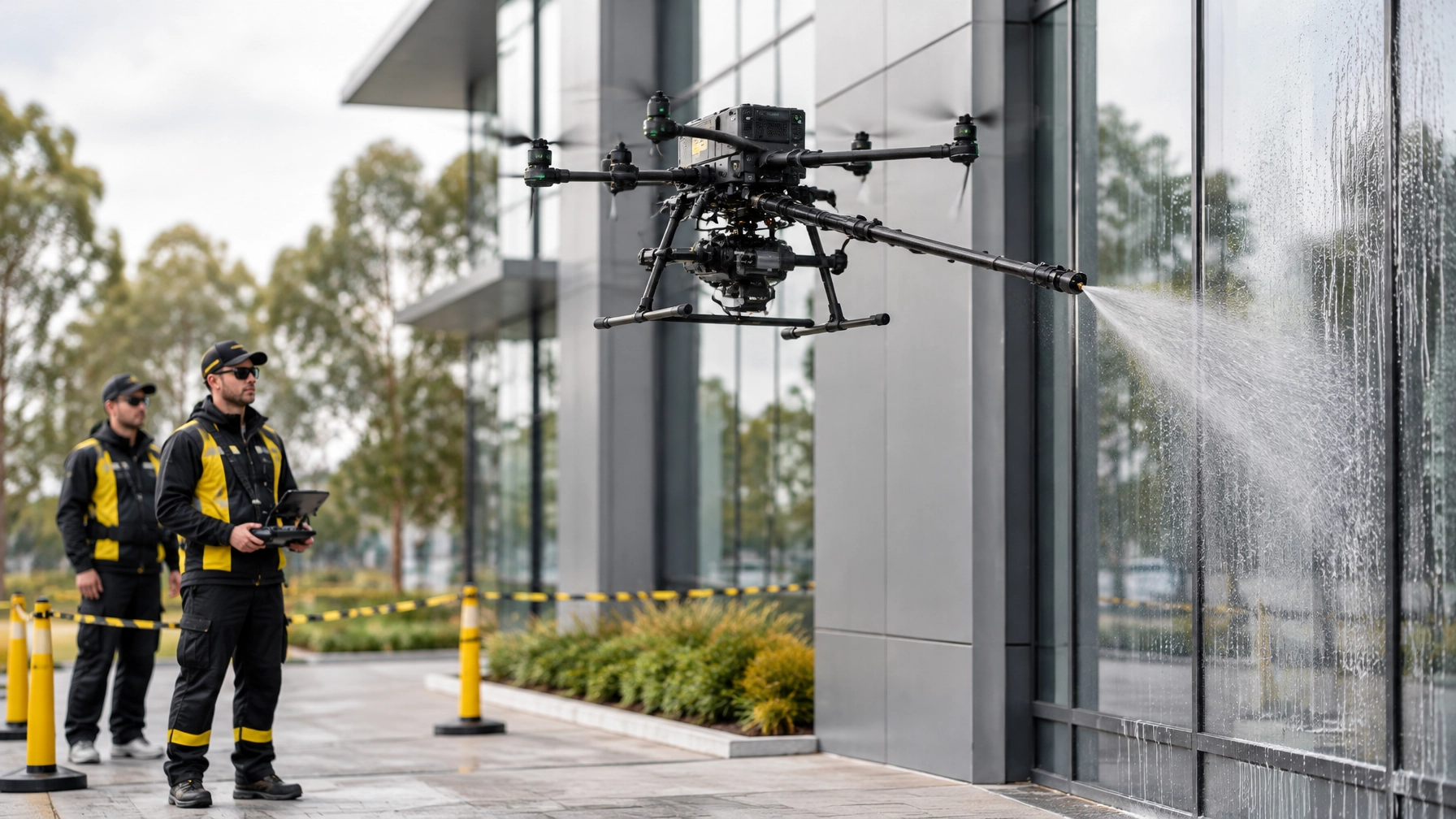
A commercial cleaning drone carries equipment for washing or treating a surface. Some systems use a tethered water line. Others carry a limited fluid payload.
Common applications include:
- High-rise windows.
- Building façades.
- Solar panels.
- Industrial tanks.
- Warehouses.
- Difficult-to-access structures.
Cleaning is not simply a flight task. It combines aviation, pressure control, chemical handling, weather assessment and site safety.
Façade Cleaning Drones
A façade cleaning drone can reduce the need for scaffolding, elevated work platforms or rope-access crews in some situations. However, it does not remove the need for a site assessment.
Operators must consider:
- Falling water and debris.
- Wind gusts and spray drift.
- Windows, seals and cladding materials.
- Public footpaths and vehicles.
- Emergency landing areas.
- Workers and bystanders.
A Sydney window-cleaning trial involving approximately 150 buildings can be treated as a market scenario that illustrates potential urban demand. It should not be presented as a confirmed government program.
Solar Panel Cleaning Drones
Dust, bird droppings and industrial residue can reduce solar output. Large solar sites also create repetitive maintenance work across wide areas.
As of Q1 2026, more than 0.6 GW of utility-scale solar capacity was reported to be under contract for drone or robotic cleaning. This figure is an industry estimate, but it signals a major opportunity for specialised operators.
A solar panel cleaning drone must apply the right pressure and flow. Too much force can damage panels, seals or surface coatings.
Example Platform: ACE AIR ORION
The ACE AIR ORION, from sister company ACE AIR, illustrates how specialised cleaning platforms are developing.
The platform is described with the following specifications:
- 23.9 kg maximum take-off weight, placing it below the 25 kg CASA category threshold.
- Up to 42 MPa cleaning pressure.
- Up to 20 litres per minute flow.
- Dual RTK positioning for precise navigation.
- Wall-following radar.
- Up to 45 minutes of endurance.
- Folded dimensions of approximately 50 × 40 × 53 cm.
These specifications describe a platform example. They do not automatically determine whether a particular operation is approved.
The pilot, business, site, airspace and operating method still matter. A heavy cleaning aircraft also requires stronger procedures than a small camera drone.

Step-by-Step Pathway into Commercial Drone Maintenance
1. Choose Your Target Service
Start with one main service. Roof inspection, thermal imaging and cleaning each require different equipment and client expectations.
A focused service makes it easier to build a portfolio and price jobs correctly.
2. Complete Professional Training
A commercial drone licence Australia pathway normally starts with CASA-aligned RePL training for operations that require a licensed pilot.
Review the available Ace Aviation courses to compare suitable training pathways. New pilots may begin with a foundational course, while experienced operators may need specialised or advanced training.
3. Learn the Relevant Payload
Flying a camera drone is different from managing a thermal sensor or cleaning system.
Training should cover:
- Payload limits.
- Battery and power management.
- Sensor limitations.
- Flight planning.
- Weather conditions.
- Emergency procedures.
- Data handling and reporting.
4. Register Commercial Aircraft
Business-use drones must be registered with CASA. Registration requirements apply even when the aircraft is small.
Operators should confirm current requirements through CASA’s official drone guidance.
5. Build the Business Compliance Framework
A pilot licence applies to the individual. A ReOC applies to the business operator where required.
Commercial maintenance work may also require:
- An operations manual.
- Risk assessments.
- Maintenance records.
- Public liability insurance.
- Job-specific safety plans.
- Client and site inductions.
Ace Aviation operates under CASA.ReOC.1421, giving students exposure to a training environment built around professional compliance.
6. Plan for Complex Operations
For new complex operations applications from 11 May 2026, AusSORA is mandatory where the application falls within its scope.
AusSORA supports structured risk assessment for complex missions. It may be relevant to BVLOS work, urban maintenance, large-area solar inspections or operations near people and infrastructure.
Operations over or near non-participants may also require OONP approvals and additional controls.
7. Build Industry Connections
Qualified pilots need work experience, references and commercial contacts. Ace Aviation has trained more than 4,000 students across Australia, Singapore, Dubai, Korea and Malaysia.
The Altitude+ program adds ongoing student benefits and industry support. Graduates can also explore opportunities through the DroneWork jobs board.
City Opportunities Across Australia
Brisbane
Brisbane offers opportunities across construction, property maintenance, logistics and industrial services. High-rise cleaning and commercial roof inspection may suit pilots who understand built-up environments.
Sydney
Sydney has dense commercial districts, apartment towers and extensive infrastructure. This creates demand for façade inspection, window cleaning scenarios and thermal surveys.
Urban density also increases compliance requirements. Pilots must plan exclusion zones, pedestrian controls and airspace carefully.
Melbourne
Melbourne combines commercial buildings, heritage assets, solar installations and large construction projects. Thermal imaging and façade condition reporting may offer strong specialist pathways.
Perth
Perth connects urban maintenance with mining, energy and remote industrial work. Pilots may support solar farms, processing facilities, warehouses and large roof assets.
Hobart
Hobart presents opportunities across tourism, construction, renewable energy and property maintenance. Weather planning is particularly important because wind and changing conditions affect cleaning operations.

Common Mistakes to Avoid
Treating Every Drone Job as the Same
A roof survey and a high-pressure cleaning flight have different risks. Use a job-specific assessment instead of copying an old checklist.
Assuming a Light Drone Removes Every Requirement
Weight is important, but it is not the only factor. Airspace, people, distance, night operations and BVLOS requirements also matter.
Ignoring Weather
Wind affects aircraft control, thermal readings, water flow and spray drift. Set clear operating limits before arriving on site.
Using Thermal Images Without Context
Thermal data can be misleading when captured at the wrong time. Record weather, surface conditions and camera settings.
Flying Too Close to People
Cleaning work often occurs near roads, footpaths and occupied buildings. Plan exclusion zones and consider OONP requirements where relevant.
Underpricing Specialist Work
A $2,000 day rate may reflect expensive equipment, insurance, transport, compliance preparation and operational risk. Do not price specialist work like a basic photography job.
CASA Considerations for 2026
All drone operations must follow CASR Part 101. The exact pathway depends on the aircraft and operation.
Key requirements may include:
- RePL for the remote pilot.
- ReOC for the business operator.
- Registration for business-use aircraft.
- VLOS unless an approved alternative applies.
- Height and separation limits.
- Controlled airspace permissions.
- OONP approvals near people.
- AusSORA for relevant complex applications from 11 May 2026.
- AROC where aviation radio operations require it.
A commercial drone licence Australia holder must also follow the operator’s procedures. A licence alone does not authorise every job.
Before accepting work, assess the aircraft weight, location, operating height, people nearby, airspace, weather, payload and emergency plan.
Frequently Asked Questions
1. Do I need a drone licence for commercial roof inspections?
Many commercial roof inspection jobs require a RePL, especially when using larger aircraft or operating outside standard conditions. Always assess the specific operation under Part 101.
2. What is a roof inspection drone?
A roof inspection drone is an aircraft fitted with a camera or sensor payload for assessing roofs, gutters, cladding and related structures.
3. What does a thermal imaging drone detect?
It can show temperature differences linked to moisture, insulation gaps, electrical faults or equipment overheating. Results still require professional interpretation.
4. Is a thermal imaging drone worth the investment?
It can be valuable for building diagnostics, solar inspections and industrial maintenance. The return depends on sensor quality, reporting skill and client demand.
5. What is a commercial cleaning drone?
It is a drone designed to apply water, cleaning solutions or other treatments to structures and surfaces.
6. What is a façade cleaning drone used for?
A façade cleaning drone may wash windows, cladding and difficult-to-reach building surfaces. It can reduce work at height in suitable situations.
7. Can drones clean high-rise buildings?
Some specialised systems can clean high-rise surfaces. However, the operation needs careful assessment of wind, water, people, structures and emergency procedures.
8. What is a solar panel cleaning drone?
It is a drone or robotic aircraft designed to remove dust and debris from photovoltaic panels using controlled water or cleaning methods.
9. Do commercial cleaning drones need RePL training?
Commercial cleaning operations commonly require licensed pilots because the aircraft is often heavy and operates close to structures or people.
10. Does the cleaning business need a ReOC?
A business may need a ReOC when conducting operations that require a certified operator. The requirement depends on the aircraft and operating conditions.
11. What is AusSORA?
AusSORA is Australia’s specific operations risk assessment framework for relevant complex drone operations. It supports applications involving increased operational risk.
12. When did AusSORA become important?
AusSORA became mandatory for new complex operations applications within scope from 11 May 2026.
13. What are OONP approvals?
OONP approvals relate to operations over or near non-participants. They may be relevant in busy urban environments and maintenance sites.
14. Do commercial drones need registration?
Yes. Business-use drones must be registered with CASA, subject to current CASA requirements.
15. Is an AROC useful for maintenance pilots?
An AROC can support pilots who need aviation radio operating skills. It is particularly relevant when radio procedures form part of the operational environment.
16. How much can a drone pilot earn in Australia?
Entry-level roles may pay about $60,000–$90,000. Experienced inspection and industrial specialists may earn $110,000–$160,000 or more.
17. How much are contractor drone day rates?
Specialist contractors may charge approximately $800–$2,500 per day. Rates depend on equipment, insurance, travel, risk and deliverables.
18. Where can I find drone pilot jobs in Australia?
Start with specialist employers, facilities companies and the DroneWork jobs board. A strong portfolio and clear compliance record can improve your prospects.
19. How can I compare training options?
Use the licence finder tool to identify a suitable pathway. You can also review the quote calculator for training costs.
20. Why choose Ace Aviation for this pathway?
Ace Aviation is CASA.ReOC.1421, has trained more than 4,000 students and supports training across Australia and international locations. Students also receive access to Altitude+ benefits and industry-focused career support.
Summary
Roof inspection, thermal imaging and commercial cleaning drones are bringing aviation into everyday asset maintenance. The strongest opportunities will go to pilots who combine flight skills, technical payload knowledge and CASA compliance.
The market is expanding across Brisbane, Sydney, Melbourne, Perth and Hobart. However, professional work demands more than buying a drone. It requires training, planning, documentation and a clear understanding of operational risk.
Ace Aviation Aerospace Academy helps students build that foundation through professional courses, CASA-focused training, Altitude+ support and access to DroneWork career opportunities.
Ready to start? Book your training at aaa.edu.au or call 1300 336 366.
{“@graph”:[{“@id”:”https://aaa.edu.au/#organization”,”url”:”https://aaa.edu.au/”,”logo”:{“url”:”https://blog.aaa.edu.au/wp-content/uploads/2026/05/ace-logo-black.png”,”@type”:”ImageObject”},”name”:”Ace Aviation Aerospace Academy”,”@type”:”Organization”,”sameAs”:[“https://aaa.edu.au/”],”telephone”:”+61-1300-336-366″},{“@id”:”https://aaa.edu.au/#drone-licence-australia-maintenance-drones”,”@type”:”Article”,”image”:”https://cdn.marblism.com/A-nD0b_Crjn.webp”,”author”:{“name”:”Ace Aviation Aerospace Academy”,”@type”:”Organization”},”headline”:”Drone Licence Australia 2026: How Roof Inspection, Thermal Imaging and Cleaning Drones Are Reshaping Maintenance”,”keywords”:[“drone licence australia”,”commercial cleaning drone”,”façade cleaning drone”,”solar panel cleaning drone”,”roof inspection drone”,”thermal imaging drone”,”commercial drone licence australia”,”drone pilot jobs australia”],”publisher”:{“@id”:”https://aaa.edu.au/#organization”},”description”:”Discover how a drone licence Australia can lead to roof inspection, thermal imaging and cleaning work. Explore training and book today.”,”dateModified”:”2026-09-16″,”datePublished”:”2026-09-16″,”articleSection”:[“Drone Training”,”Commercial Drone Operations”,”Drone Maintenance Technology”],”mainEntityOfPage”:”https://aaa.edu.au/”},{“@type”:”FAQPage”,”mainEntity”:[{“name”:”Do I need a drone licence for commercial roof inspections?”,”@type”:”Question”,”acceptedAnswer”:{“text”:”Many commercial roof inspection jobs require a RePL, especially when using larger aircraft or operating outside standard conditions. Always assess the specific operation under Part 101.”,”@type”:”Answer”}},{“name”:”What is a roof inspection drone?”,”@type”:”Question”,”acceptedAnswer”:{“text”:”A roof inspection drone is an aircraft fitted with a camera or sensor payload for assessing roofs, gutters, cladding and related structures.”,”@type”:”Answer”}},{“name”:”What does a thermal imaging drone detect?”,”@type”:”Question”,”acceptedAnswer”:{“text”:”It can show temperature differences linked to moisture, insulation gaps, electrical faults or equipment overheating. Results still require professional interpretation.”,”@type”:”Answer”}},{“name”:”Is a thermal imaging drone worth the investment?”,”@type”:”Question”,”acceptedAnswer”:{“text”:”It can be valuable for building diagnostics, solar inspections and industrial maintenance. The return depends on sensor quality, reporting skill and client demand.”,”@type”:”Answer”}},{“name”:”What is a commercial cleaning drone?”,”@type”:”Question”,”acceptedAnswer”:{“text”:”It is a drone designed to apply water, cleaning solutions or other treatments to structures and surfaces.”,”@type”:”Answer”}},{“name”:”What is a façade cleaning drone used for?”,”@type”:”Question”,”acceptedAnswer”:{“text”:”A façade cleaning drone may wash windows, cladding and difficult-to-reach building surfaces. It can reduce work at height in suitable situations.”,”@type”:”Answer”}},{“name”:”Can drones clean high-rise buildings?”,”@type”:”Question”,”acceptedAnswer”:{“text”:”Some specialised systems can clean high-rise surfaces. However, the operation needs careful assessment of wind, water, people, structures and emergency procedures.”,”@type”:”Answer”}},{“name”:”What is a solar panel cleaning drone?”,”@type”:”Question”,”acceptedAnswer”:{“text”:”It is a drone or robotic aircraft designed to remove dust and debris from photovoltaic panels using controlled water or cleaning methods.”,”@type”:”Answer”}},{“name”:”Do commercial cleaning drones need RePL training?”,”@type”:”Question”,”acceptedAnswer”:{“text”:”Commercial cleaning operations commonly require licensed pilots because the aircraft is often heavy and operates close to structures or people.”,”@type”:”Answer”}},{“name”:”Does the cleaning business need a ReOC?”,”@type”:”Question”,”acceptedAnswer”:{“text”:”A business may need a ReOC when conducting operations that require a certified operator. The requirement depends on the aircraft and operating conditions.”,”@type”:”Answer”}},{“name”:”What is AusSORA?”,”@type”:”Question”,”acceptedAnswer”:{“text”:”AusSORA is Australia’s specific operations risk assessment framework for relevant complex drone operations. It supports applications involving increased operational risk.”,”@type”:”Answer”}},{“name”:”When did AusSORA become important?”,”@type”:”Question”,”acceptedAnswer”:{“text”:”AusSORA became mandatory for new complex operations applications within scope from 11 May 2026.”,”@type”:”Answer”}},{“name”:”What are OONP approvals?”,”@type”:”Question”,”acceptedAnswer”:{“text”:”OONP approvals relate to operations over or near non-participants. They may be relevant in busy urban environments and maintenance sites.”,”@type”:”Answer”}},{“name”:”Do commercial drones need registration?”,”@type”:”Question”,”acceptedAnswer”:{“text”:”Yes. Business-use drones must be registered with CASA, subject to current CASA requirements.”,”@type”:”Answer”}},{“name”:”Is an AROC useful for maintenance pilots?”,”@type”:”Question”,”acceptedAnswer”:{“text”:”An AROC can support pilots who need aviation radio operating skills. It is particularly relevant when radio procedures form part of the operational environment.”,”@type”:”Answer”}},{“name”:”How much can a drone pilot earn in Australia?”,”@type”:”Question”,”acceptedAnswer”:{“text”:”Entry-level roles may pay about $60,000–$90,000. Experienced inspection and industrial specialists may earn $110,000–$160,000 or more.”,”@type”:”Answer”}},{“name”:”How much are contractor drone day rates?”,”@type”:”Question”,”acceptedAnswer”:{“text”:”Specialist contractors may charge approximately $800–$2,500 per day. Rates depend on equipment, insurance, travel, risk and deliverables.”,”@type”:”Answer”}},{“name”:”Where can I find drone pilot jobs in Australia?”,”@type”:”Question”,”acceptedAnswer”:{“text”:”Start with specialist employers, facilities companies and the DroneWork jobs board. A strong portfolio and clear compliance record can improve your prospects.”,”@type”:”Answer”}},{“name”:”Why choose Ace Aviation for this pathway?”,”@type”:”Question”,”acceptedAnswer”:{“text”:”Ace Aviation is CASA.ReOC.1421, has trained more than 4,000 students and supports training across Australia and international locations. Students also receive access to Altitude+ benefits and industry-focused career support.”,”@type”:”Answer”}}]}],”@context”:”https://schema.org”}