Meta description: Drone licence Australia guide for film and TV careers. Learn RePL, ReOC, camera drone rules and training options. Start today.
Short Direct Answer
A drone licence Australia pathway usually starts with a CASA Remote Pilot Licence (RePL), aircraft registration and commercial operating approval. Basic filming may fit the excluded category, but night work, crowds, controlled airspace and complex productions usually require a RePL, ReOC and specific CASA approvals.
Why Camera Drones Are Changing Australian Production
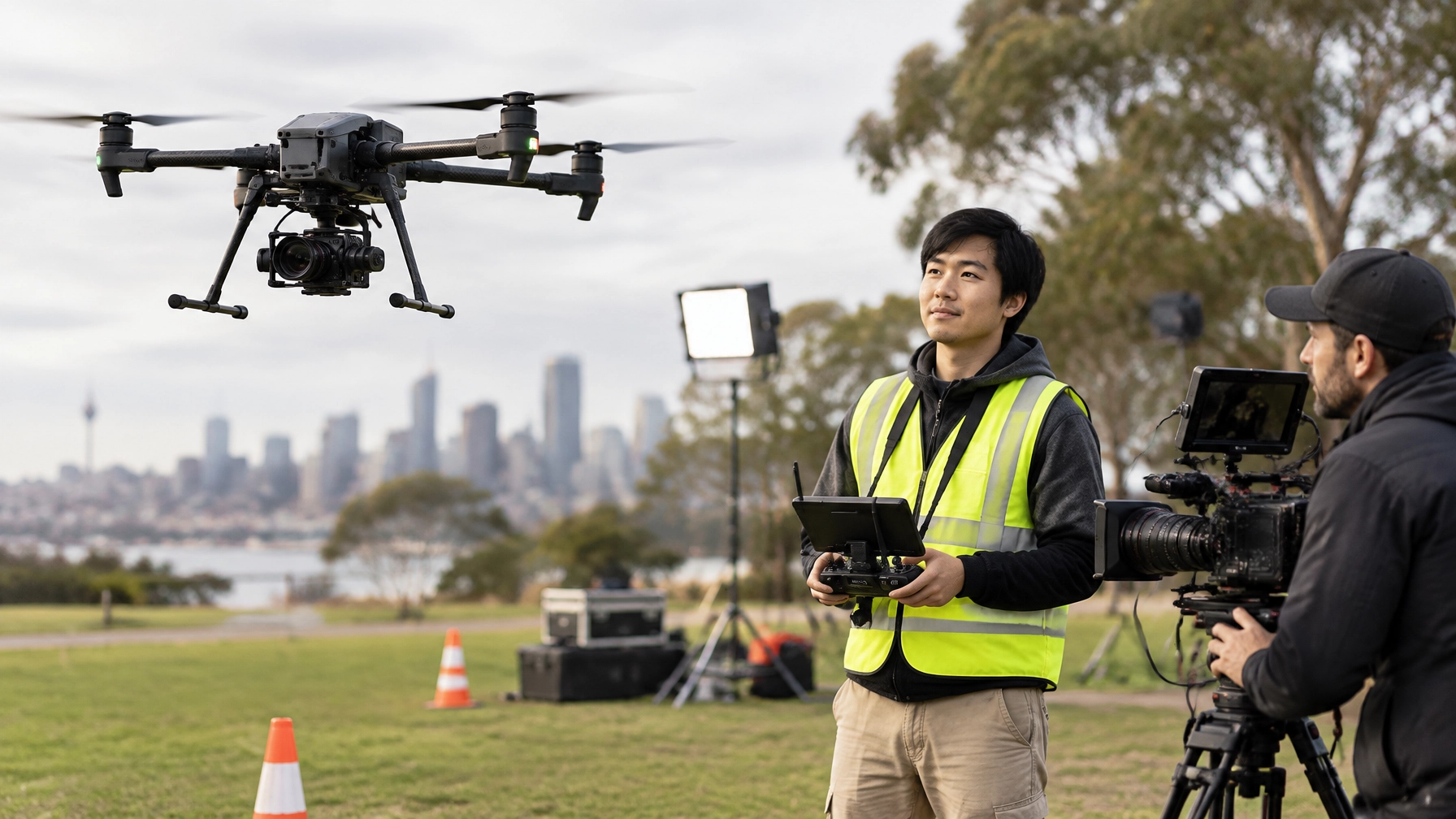
Camera drones have changed how directors, cinematographers and production companies plan aerial shots. A small crew can now capture moving landscapes, tracking shots and dramatic establishing footage without hiring a helicopter.
However, professional drone cinematography is more than flying a camera. It combines aviation knowledge, risk management, image-making and set discipline.
Australia’s screen production sector is also active. Screen Australia reported record drama production expenditure in 2024–25, supported by major productions in Queensland, New South Wales and Victoria. That growth creates opportunities for pilots who can work safely inside professional production systems.
Brisbane and the Gold Coast remain major production centres. Queensland hosted large international and domestic projects, while Sydney continues to support television, advertising, factual content and feature production.
Melbourne also has strong activity across drama, commercials and location work. Perth is developing its studio and production infrastructure, while Hobart and wider Tasmania attract location-based film, television, tourism and documentary projects.
These cities do not create an automatic demand for unqualified pilots. Instead, they create demand for people who understand camera movement, aviation rules, location safety and production schedules.

What Does a Commercial Drone Cinematographer Do?
A drone cinematographer operates an aircraft to capture footage for film, television, advertising, sport, documentaries and online productions.
The role may include:
- Reviewing the director’s shot list.
- Planning flight paths and camera movement.
- Checking airspace and local restrictions.
- Completing a site risk assessment.
- Inspecting the aircraft, batteries and payload.
- Coordinating with the first assistant director and safety team.
- Briefing cast, crew and nearby workers.
- Capturing repeatable shots.
- Managing media cards and footage backups.
- Completing flight and maintenance records.
- Delivering footage in the required production format.
On larger shoots, the pilot may work with a separate camera operator. This is common with cinema platforms such as the DJI Inspire series.
The pilot flies the aircraft. The camera operator manages framing, lens choice and camera movement. Together, they create smoother and more complex shots while keeping flight control separate from image composition.
Why Production Companies Value Licensed Pilots
A production company is not only buying attractive footage. It is also buying confidence.
A qualified pilot can help reduce:
- Delays caused by poor planning.
- Safety risks around cast and crew.
- Airspace mistakes.
- Equipment damage.
- Insurance concerns.
- Problems with councils, landowners and location managers.
- Reputational damage from unsafe flying.
That is why professional production teams often prefer a pilot with a commercial drone licence Australia pathway, relevant experience and access to a compliant operator.
RePL, Operator Accreditation and ReOC Explained
The correct pathway depends on the aircraft and the operation.
| Credential or approval | What it means | Relevance to film and television |
|---|---|---|
| RePL | Remote Pilot Licence for an individual pilot and aircraft category | Useful for professional and complex operations |
| Operator accreditation | Commercial accreditation for certain lower-risk operations | May suit some small camera-drone work |
| ReOC | Remotely Piloted Aircraft Operator’s Certificate for a business or organisation | Often required for complex production work |
| AROC | Aeronautical Radio Operator Certificate | Relevant when aviation radio operations are required |
| Aircraft registration | Registration of a drone used commercially | Required for applicable commercial operations |
| CASA approval | Permission or authorisation for operations outside standard conditions | May apply to night, controlled-airspace or higher-risk work |
A RePL belongs to the pilot. A ReOC belongs to the operator or business.
Therefore, you do not always need your own ReOC to get a drone pilot job. You may work under a production company, aerial services company or other ReOC holder.
If you want to run your own film-drone business, you may need your own ReOC, operations manual, Chief Remote Pilot and compliance system.
Ace Aviation operates within the CASA-approved training environment and highlights CASA.ReOC.1421 as part of its industry credentials. Always confirm current regulatory requirements with CASA’s official drone guidance.
Key Facts: CASA Rules for Camera Drone Operations
| Filming situation | What usually applies |
|---|---|
| Paid filming | Treat the work as commercial aviation activity |
| Drone registration | Commercially used drones generally need registration |
| Standard altitude | Up to 120 metres above ground level unless approved otherwise |
| Visual line of sight | Required for standard operations |
| People not involved | Keep at least the required separation distance |
| Flying over people | Not allowed under standard conditions |
| Crowds and populous areas | Not permitted under standard conditions |
| Night filming | Requires a suitable approved operating framework |
| Controlled airspace | Requires authorisation and careful coordination |
| BVLOS filming | Requires specific approval and operational capability |
| Insurance | Usually expected by production companies and locations |
| Local permissions | May be required from councils, landowners or site managers |
These are general planning principles. The exact rules depend on the aircraft, location, operating category and approvals.
RePL vs Excluded Operations for Camera Drones
Some camera work may be possible in the excluded category. This can apply to smaller aircraft operated under standard conditions.
For example, a small drone may be used for a daytime location shot when:
- The drone is within the applicable weight limit.
- The aircraft is registered for commercial use.
- The pilot holds the required accreditation or licence.
- The drone remains within visual line of sight.
- The flight stays below 120 metres.
- The pilot maintains the required separation from people.
- The operation is not over a crowd or populous area.
- The operation remains outside restricted or controlled airspace unless authorised.
However, the excluded category is restrictive for professional film work.
Many production briefs request:
- Night scenes.
- Urban locations.
- Tracking shots near actors.
- Shots near roads or public spaces.
- Work near airports.
- Flights above controlled sets.
- Longer-range or BVLOS shots.
- Multiple aircraft.
- Large cinema cameras.
Those requirements can move the work beyond standard conditions. At that point, you need a properly structured operation rather than a simple small-drone shoot.
What Drones Do Film Crews Use?
Australian aerial cinematography providers commonly use DJI Inspire 2 and Inspire 3 platforms for cinema work. These aircraft support high-quality imaging, interchangeable lenses and professional production workflows.
The Inspire series is popular because it can provide:
- High-resolution cinema footage.
- RAW or ProRes workflows, depending on the platform and configuration.
- Interchangeable lenses.
- A dual-operator setup.
- Smooth gimbal movement.
- A relatively compact production footprint.
Matrice aircraft and heavy-lift systems have different roles. They may be used for specialist sensors, larger cinema cameras, mapping or enterprise operations.
The right aircraft depends on the creative brief. A lightweight drone may suit a simple landscape shot. A cinema platform may be needed for a feature production. A heavy-lift aircraft may be required for a larger camera payload.
Do not buy an expensive drone before choosing your market. Training, approvals, insurance, maintenance and production capability may matter more than the aircraft itself.

How to Become a Drone Cinematographer in Australia
1. Choose Your Production Role
First, decide whether you want to become:
- A remote pilot.
- A camera operator.
- An aerial cinematography business owner.
- A production drone assistant.
- A drone safety or operations coordinator.
- A specialist pilot for night, heavy-lift or complex work.
A pilot does not need to be the director of photography. However, understanding composition and camera movement can make you more valuable on set.
2. Obtain an Aviation Reference Number
An Aviation Reference Number, or ARN, identifies you within Australia’s aviation system.
You may need it for CASA applications, licensing records and other aviation processes. Make sure your personal details match your training and identity documents.
3. Complete RePL Training
A professional pathway generally includes:
- Online theory and practice exams.
- Live classroom instruction.
- Practical flight training.
- A theory examination.
- A practical flight assessment.
- Required post-assessment administration.
You study subjects such as:
- Aviation law.
- Airspace.
- Meteorology.
- Human factors.
- Navigation.
- Flight planning.
- Aircraft systems.
- Battery safety.
- Emergency procedures.
- Risk management.
- Radio communication.
The goal is not only to pass an assessment. The goal is to make safe decisions on a busy set.
4. Add AROC Training
An AROC supports professional aviation radio operations.
It can be valuable for pilots working near controlled aerodromes or in complex aviation environments. It also shows production companies that you understand formal aviation communication.
AROC does not automatically give permission to fly in controlled airspace. You still need the correct operational approval and authorisation.
5. Gain Set Experience
Film sets operate to tight schedules. You need to understand:
- Lock-ups and exclusion zones.
- First assistant director instructions.
- Camera department workflows.
- Talent and crew movement.
- Location access.
- Weather holds.
- Radio discipline.
- Battery and media management.
- Resetting repeatable shots.
Start by assisting an experienced aerial operator where possible. This helps you learn production etiquette before taking responsibility for a major flight.
6. Build a Professional Showreel
Your showreel should demonstrate more than scenic footage.
Include examples of:
- Smooth reveals.
- Tracking shots.
- Orbiting moves.
- Safe proximity to structures.
- Controlled speed changes.
- Repeatable flight paths.
- Varied lighting conditions.
- Professional colour and editing.
Never create a showreel by breaking CASA rules. A risky flight may look impressive, but it can damage your reputation and future employability.
7. Work Under a ReOC or Establish Your Own
Many new pilots work under an existing ReOC. This can provide access to:
- Approved procedures.
- Insurance.
- Experienced supervision.
- Production clients.
- Operational documentation.
- More complex approvals.
Later, you may establish your own business. ACE’s Gold package includes ReOC setup support, Chief Remote Pilot training and UAMP compliance platform access.
City Pathways for Film and TV Drone Careers
Brisbane
Queensland has become one of Australia’s strongest screen production regions. Brisbane and the Gold Coast support major domestic and international productions, studios, commercials and location filming.
A drone course in Brisbane may suit pilots targeting media, construction, property, events or infrastructure work. Brisbane also offers access to agriculture and regional production opportunities across Queensland.
Sydney
Sydney remains a major centre for television, advertising, factual production and feature films. It also presents complex airspace and urban operating conditions.
A drone course in Sydney can help students build a foundation for media, real estate, infrastructure and corporate work. Pilots must pay close attention to controlled airspace and crowded locations.
Melbourne
Melbourne supports drama, commercials, television, sport and location production. Its urban environment creates demand for careful planning around buildings, roads, public spaces and events.
A drone course in Melbourne is suitable for students interested in media, construction, surveying and inspection pathways.
Perth
Perth is an important production and commercial centre in Western Australia. It also connects pilots with mining, resources, construction and remote-location work.
A drone pilot course in Perth can support students who want to combine cinematography with surveying, inspection or resources work.
Hobart
Hobart and wider Tasmania are known for distinctive landscapes, tourism content, documentaries and location-based production. The region also supports agriculture, forestry and environmental work.
Drone training in Hobart can suit students who want a broader commercial pathway rather than relying only on film work.
What Makes Ace Aviation Different?
Ace Aviation Aerospace Academy is built around more than a licence.
Its wider pathway includes:
- CASA-approved RePL and AROC training.
- ReOC support.
- More than 4,000 students trained.
- Training across eight Australian locations.
- A global footprint including Singapore, Dubai, Korea and Malaysia.
- Altitude+ student benefits.
- DroneWork access for job opportunities.
- UAMP compliance support.
- Certificate III in Aviation through Reach Community College.
- XAG agricultural specialisation.
- JTC30 and drone-cleaning specialisation.
- Night operations and advanced pathways.
- BVLOS and EVLOS theory options.
You can compare the Starter, Silver, Gold and Platinum options on the Ace Aviation courses page.
The academy’s focus is practical. Regulatory hurdles are easier to overcome when you understand why they exist and how to plan around them.
Common Mistakes in Drone Cinematography
Assuming a Small Drone Removes All Legal Duties
A small drone may fit an excluded pathway, but it still needs to be operated within strict conditions.
Flying Over Actors or Extras Without Checking the Rules
People on a set are not automatically treated as participants. You need proper briefings, controls and approvals.
Treating a Client’s Permission as CASA Approval
A producer or location manager cannot authorise a flight that CASA rules prohibit.
Ignoring Local Permissions
CASA regulates aviation safety. Councils, parks, private landowners and venue operators may impose separate conditions.
Planning the Shot Before Planning the Safety Controls
Start with the risk assessment. Then design the shot that can be flown safely.
Assuming Night VLOS Training Is a Blanket Approval
Training does not automatically authorise every night operation. The operator, aircraft, procedures and approvals must align.
Underestimating Weather
Wind, rain, heat, glare and low cloud can affect aircraft performance and image quality. Always follow the aircraft manufacturer’s limits and the operator’s procedures.
Failing to Carry Insurance
CASA may not require a specific insurance policy for every operation. However, production companies commonly request public liability insurance, often with substantial cover.
Buying Cinema Equipment Too Early
Build experience and client demand first. A cinema drone can involve major costs for batteries, lenses, transport, maintenance, insurance and crew.
CASA Considerations for Film and Television
Professional drone cinematography often requires additional planning because it combines aviation with people, vehicles, structures and public locations.
Before accepting a job, check:
- The aircraft’s take-off weight.
- Your RePL category and endorsements.
- The operator’s ReOC scope.
- Whether the aircraft is registered.
- Airspace classification.
- Distance from controlled aerodromes.
- People and crowd separation.
- Day or night operating conditions.
- Visual line of sight.
- BVLOS requirements.
- Radio requirements.
- Local land access and filming permits.
- Public liability insurance.
- Emergency procedures.
- Weather and lighting conditions.
If the shot cannot be completed safely and lawfully, change the shot. Professional cinematography rewards creative problem-solving, not regulatory shortcuts.
Frequently Asked Questions
Do I need a drone licence for commercial film work?
Not every small commercial flight requires a RePL. Some operations may fit the excluded category with operator accreditation. However, professional film work often involves conditions that make a RePL and ReOC pathway more suitable.
What is the difference between RePL and excluded operations for camera drones?
Excluded operations are limited to standard conditions. They generally require daylight, VLOS, separation from people and no flight over crowds. A RePL supports broader professional capability, but complex operations still need a ReOC and specific approvals.
Can I fly over people on a film set?
Not under standard operating conditions. Cast and crew may be treated as involved participants only when properly managed. Never assume that being on a film set makes someone part of the operation.
Do I need a ReOC for a film drone business?
You may need a ReOC if your business conducts operations that require certified operator approval. A pilot working for another operator may work under that operator’s ReOC instead.
How much do drone cinematographers earn?
Income varies widely. Entry-level media work may pay less than specialist infrastructure or mining work. Experienced cinematographers may charge professional day rates, but income depends on equipment, approvals, crew, insurance, editing and client demand.
What drone do film crews use?
DJI Inspire 2 and Inspire 3 aircraft are common choices for professional aerial cinematography. Matrice or heavy-lift systems may be used for specialist payloads or larger cinema cameras.
Can I fly at night for film shoots?
Night filming may be possible, but it is outside standard conditions. You may need a RePL, an appropriate ReOC, approved procedures and specific CASA authorisation.
How much does a drone licence cost?
ACE course prices vary by package and location. The Starter pathway is listed from $1,299, Silver from $1,799, Gold from $3,699 and Platinum from $5,999. Confirm current pricing before enrolment.
How long does RePL training take?
The ACE pathway includes online study, three live theory days, one practical flight day and one assessment day. The live theory days can be completed together or spread over time.
Can I fly near airports for film shoots?
Not without careful airspace planning and the required authorisation. Controlled airspace and aerodrome restrictions apply even when a production has permission from a landowner or client.
What insurance do I need for film drones?
Public liability insurance is the usual starting point. Production companies may also request hull, equipment or professional indemnity cover. The required level depends on the contract and operation.
What are CASA rules for camera drones over crowds?
Standard operations must not fly over crowds or populous areas. Complex operations require a certified operator, strong risk controls and the relevant CASA approvals.
Is an AROC needed for film drone operations?
An AROC may be needed when aviation radio operations are required. It is especially useful for work in controlled or complex airspace. An AROC does not replace a RePL, ReOC or flight approval.
Can international pilots fly drones in Australia?
International pilots must follow Australian aviation rules. An overseas qualification does not automatically replace CASA requirements. Check recognition, registration, licensing and operational approvals before arriving on set.
Do I need BVLOS approval for a long film shot?
If the aircraft leaves the pilot’s visual line of sight, the operation may be BVLOS. BVLOS requires specific approval and a suitable operational structure. A long shot does not automatically qualify as BVLOS if the aircraft remains visible.
What are the weather limits for filming?
There is no single universal wind limit for every drone. Follow the aircraft manufacturer’s limits, the operator’s procedures and the conditions in the risk assessment. Rain, gusts, heat, dust and low visibility can all stop a shoot.
Is operator accreditation enough for film work?
It may be enough for simple, small-drone work under standard conditions. However, accreditation does not allow night, BVLOS, crowd or controlled-airspace operations without the required approvals.
Where can I get drone training in Brisbane, Sydney, Melbourne, Perth or Hobart?
Ace Aviation provides location pathways for Brisbane, Sydney, Melbourne, Perth and Hobart. Course dates and venues can change, so check the relevant page before booking.
Summary
Camera drones are creating new opportunities across Australian film, television, advertising and location production. However, a professional career requires more than smooth footage.
Start with the right licence pathway. Add AROC where appropriate. Gain experience under a compliant operator. Learn set safety, airspace planning and production workflows. Then build a showreel that proves both creative skill and professional judgement.
Ace Aviation supports students through training, compliance, specialist capability and job pathways. With CASA.ReOC.1421, more than 4,000 students trained, eight Australian training locations, global delivery, Altitude+, UAMP, DroneWork and Certificate III options, the pathway extends beyond a basic certificate.
Ready to start? Book your training at aaa.edu.au or call 1300 336 366.
{“@graph”:[{“@id”:”https://aaa.edu.au/#drone-licence-australia-film-tv-2026″,”@type”:”Article”,”image”:”https://cdn.marblism.com/eUlWL349tuY.webp”,”author”:{“url”:”https://aaa.edu.au/”,”name”:”Ace Aviation Aerospace Academy”,”@type”:”Organization”},”headline”:”Drone Licence Australia 2026: How Camera Drones Are Transforming Film, TV and Cinematography Careers”,”keywords”:[“drone licence australia”,”commercial drone licence australia”,”drone pilot jobs australia”,”how to become a drone pilot australia”,”drone course brisbane”,”drone course sydney”,”drone course melbourne”,”drone pilot course perth”,”drone training hobart”,”drone cinematography”],”publisher”:{“url”:”https://aaa.edu.au/”,”logo”:{“url”:”https://aaa.edu.au/assets/ace-logo-transparent.png”,”@type”:”ImageObject”},”name”:”Ace Aviation Aerospace Academy”,”@type”:”Organization”},”description”:”Drone licence Australia guide for film and TV careers, covering RePL, ReOC, AROC, camera drone rules, equipment and training pathways.”,”dateModified”:”2026-09-13″,”datePublished”:”2026-09-13″,”mainEntityOfPage”:”https://aaa.edu.au/”},{“@id”:”https://aaa.edu.au/#organization”,”url”:”https://aaa.edu.au/”,”logo”:{“url”:”https://aaa.edu.au/assets/ace-logo-transparent.png”,”@type”:”ImageObject”},”name”:”Ace Aviation Aerospace Academy”,”@type”:”Organization”,”sameAs”:[“https://aaa.edu.au/why-ace”,”https://aaa.edu.au/reviews”,”https://dronework.com.au/”],”telephone”:”+61-1300-336-366″,”description”:”Ace Aviation Aerospace Academy provides CASA-approved drone pilot training, RePL, AROC, ReOC, specialist RPAS training and Certificate III in Aviation pathways.”},{“@id”:”https://aaa.edu.au/#drone-licence-australia-film-tv-faq”,”@type”:”FAQPage”,”mainEntity”:[{“name”:”Do I need a drone licence for commercial film work?”,”@type”:”Question”,”acceptedAnswer”:{“text”:”Not every small commercial flight requires a RePL. Some operations may fit the excluded category with operator accreditation. However, professional film work often involves conditions that make a RePL and ReOC pathway more suitable.”,”@type”:”Answer”}},{“name”:”What is the difference between RePL and excluded operations for camera drones?”,”@type”:”Question”,”acceptedAnswer”:{“text”:”Excluded operations are limited to standard conditions. They generally require daylight, VLOS, separation from people and no flight over crowds. A RePL supports broader professional capability, but complex operations still need a ReOC and specific approvals.”,”@type”:”Answer”}},{“name”:”Can I fly over people on a film set?”,”@type”:”Question”,”acceptedAnswer”:{“text”:”Not under standard operating conditions. Cast and crew may be treated as involved participants only when properly managed. Never assume that being on a film set makes someone part of the operation.”,”@type”:”Answer”}},{“name”:”Do I need a ReOC for a film drone business?”,”@type”:”Question”,”acceptedAnswer”:{“text”:”You may need a ReOC if your business conducts operations that require certified operator approval. A pilot working for another operator may work under that operator’s ReOC instead.”,”@type”:”Answer”}},{“name”:”How much do drone cinematographers earn?”,”@type”:”Question”,”acceptedAnswer”:{“text”:”Income varies widely. Entry-level media work may pay less than specialist infrastructure or mining work. Experienced cinematographers may charge professional day rates, but income depends on equipment, approvals, crew, insurance, editing and client demand.”,”@type”:”Answer”}},{“name”:”What drone do film crews use?”,”@type”:”Question”,”acceptedAnswer”:{“text”:”DJI Inspire 2 and Inspire 3 aircraft are common choices for professional aerial cinematography. Matrice or heavy-lift systems may be used for specialist payloads or larger cinema cameras.”,”@type”:”Answer”}},{“name”:”Can I fly at night for film shoots?”,”@type”:”Question”,”acceptedAnswer”:{“text”:”Night filming may be possible, but it is outside standard conditions. You may need a RePL, an appropriate ReOC, approved procedures and specific CASA authorisation.”,”@type”:”Answer”}},{“name”:”How much does a drone licence cost?”,”@type”:”Question”,”acceptedAnswer”:{“text”:”ACE course prices vary by package and location. The Starter pathway is listed from $1,299, Silver from $1,799, Gold from $3,699 and Platinum from $5,999. Confirm current pricing before enrolment.”,”@type”:”Answer”}},{“name”:”How long does RePL training take?”,”@type”:”Question”,”acceptedAnswer”:{“text”:”The ACE pathway includes online study, three live theory days, one practical flight day and one assessment day. The live theory days can be completed together or spread over time.”,”@type”:”Answer”}},{“name”:”Can I fly near airports for film shoots?”,”@type”:”Question”,”acceptedAnswer”:{“text”:”Not without careful airspace planning and the required authorisation. Controlled airspace and aerodrome restrictions apply even when a production has permission from a landowner or client.”,”@type”:”Answer”}},{“name”:”What insurance do I need for film drones?”,”@type”:”Question”,”acceptedAnswer”:{“text”:”Public liability insurance is the usual starting point. Production companies may also request hull, equipment or professional indemnity cover. The required level depends on the contract and operation.”,”@type”:”Answer”}},{“name”:”What are CASA rules for camera drones over crowds?”,”@type”:”Question”,”acceptedAnswer”:{“text”:”Standard operations must not fly over crowds or populous areas. Complex operations require a certified operator, strong risk controls and the relevant CASA approvals.”,”@type”:”Answer”}},{“name”:”Is an AROC needed for film drone operations?”,”@type”:”Question”,”acceptedAnswer”:{“text”:”An AROC may be needed when aviation radio operations are required. It is especially useful for work in controlled or complex airspace. An AROC does not replace a RePL, ReOC or flight approval.”,”@type”:”Answer”}},{“name”:”Can international pilots fly drones in Australia?”,”@type”:”Question”,”acceptedAnswer”:{“text”:”International pilots must follow Australian aviation rules. An overseas qualification does not automatically replace CASA requirements. Check recognition, registration, licensing and operational approvals before arriving on set.”,”@type”:”Answer”}},{“name”:”Do I need BVLOS approval for a long film shot?”,”@type”:”Question”,”acceptedAnswer”:{“text”:”If the aircraft leaves the pilot’s visual line of sight, the operation may be BVLOS. BVLOS requires specific approval and a suitable operational structure.”,”@type”:”Answer”}},{“name”:”What are the weather limits for filming?”,”@type”:”Question”,”acceptedAnswer”:{“text”:”There is no single universal wind limit for every drone. Follow the aircraft manufacturer’s limits, the operator’s procedures and the conditions in the risk assessment.”,”@type”:”Answer”}},{“name”:”Is operator accreditation enough for film work?”,”@type”:”Question”,”acceptedAnswer”:{“text”:”It may be enough for simple, small-drone work under standard conditions. However, accreditation does not allow night, BVLOS, crowd or controlled-airspace operations without the required approvals.”,”@type”:”Answer”}},{“name”:”Where can I get drone training in Brisbane, Sydney, Melbourne, Perth or Hobart?”,”@type”:”Question”,”acceptedAnswer”:{“text”:”Ace Aviation provides location pathways for Brisbane, Sydney, Melbourne, Perth and Hobart. Course dates and venues can change, so check the relevant location page before booking.”,”@type”:”Answer”}}]}],”@context”:”https://schema.org”}