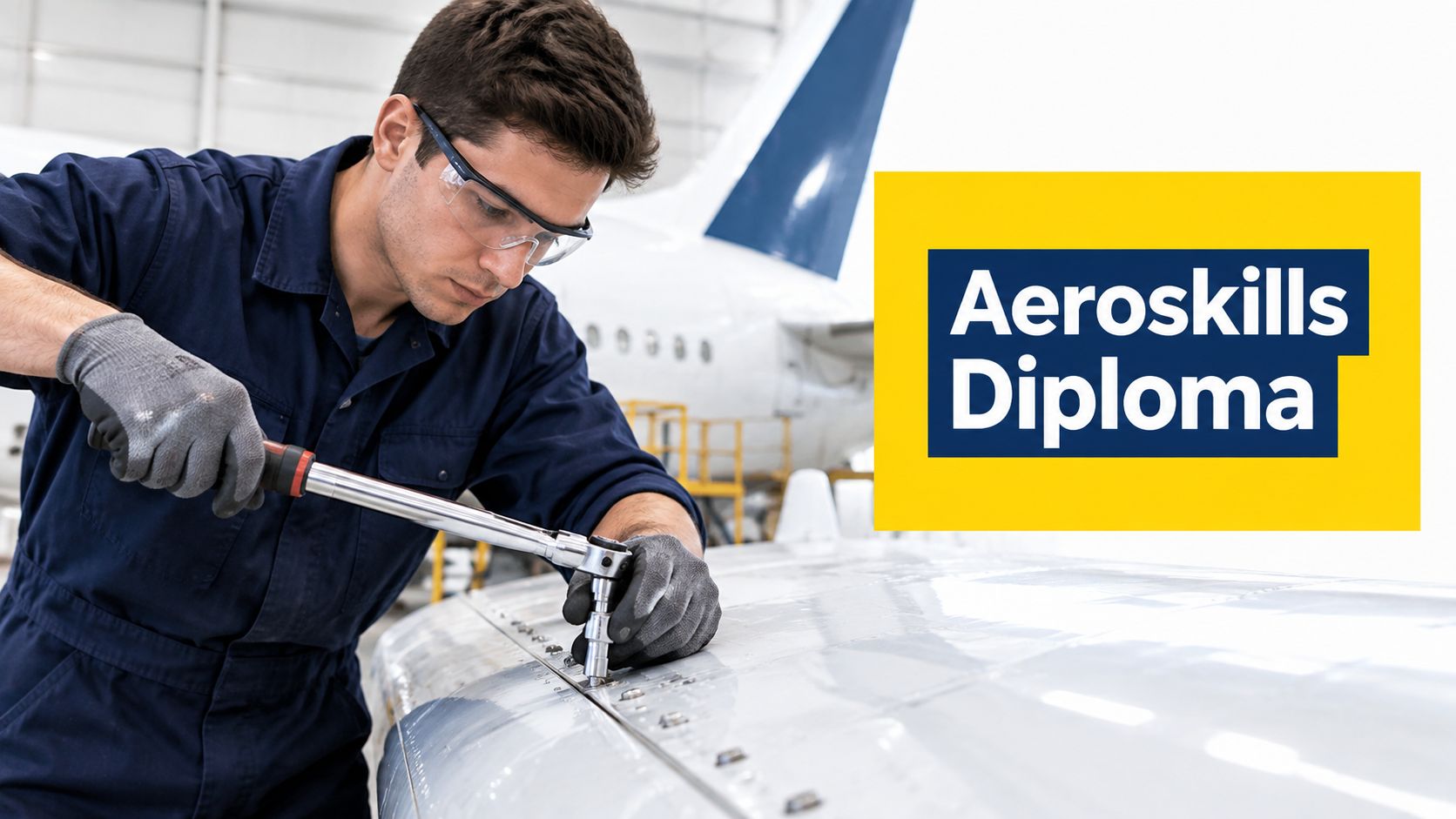
A career-switcher may start with a clear interest in drones, then discover that aircraft maintenance offers a different kind of responsibility and professional pathway. The choice isn't between two aircraft types. It's a choice between operational training for remotely piloted aircraft and a much deeper maintenance qualification connected to Australia's aircraft licensing system.
The Diploma of Aeroskills suits people who want to understand, maintain and progressively take responsibility for aircraft systems. It can support pathways towards CASA B1 mechanical or B2 avionics licensing, but the diploma itself isn't an automatic aircraft maintenance engineer licence. The important questions are which stream fits the intended work, which sub-category units are required, and whether the training is delivered through the appropriate Part 147 pathway.
The qualification also matters to aviation professionals who already work around drones, engineering support, technical records or aircraft operations. A drone pilot may need a Remote Pilot Licence, an Aeronautical Radio Operator Certificate or business compliance support, while an aircraft maintenance engineer follows a separate competency ladder. Ace Aviation Aerospace Academy provides aviation and drone education for people comparing those options.
Table of Contents
- Introduction to the Diploma of Aeroskills in Australia
- What the Diploma of Aeroskills Is and How It Fits the Australian System
- Unit Breakdown and Workload Across Avionics and Mechanical Streams
- How Theory and Practical Training Work Together
- Career Pathways and Industry Recognition in Australian Aviation
- Entry Requirements and Choosing the Right Licence Pathway
- Conclusion and Frequently Asked Questions
Introduction to the Diploma of Aeroskills in Australia
A person moving from a technical trade into aviation maintenance often expects to find one course with one obvious result. The Diploma of Aeroskills doesn't work that way. It's better understood as a structured pathway that combines trade-level knowledge, higher-level technical units and licence-relevant competencies.
That distinction matters because aircraft maintenance isn't only about repairing a component. A maintenance professional must understand aircraft systems, interpret approved technical information, follow maintenance procedures and demonstrate competence in work that sits within a regulated aviation environment. The qualification is designed around that broader responsibility.
The MEA Aeroskills Training Package identifies the diploma as part of Australia's nationally recognised vocational education and training system. In the 2011 release, the package included five diploma-level qualifications, covering avionics, mechanical maintenance, aviation maintenance management in avionics and mechanical streams, and non-destructive testing. The official MEA Training Package release describes the avionics and mechanical diplomas as pathways combining Certificate IV and diploma-level units with CASA B2 and B1 licensing architecture under Part 66.
Practical rule: A course title can indicate direction, but the provider's licence alignment and chosen units determine whether the pathway matches the intended aircraft maintenance outcome.
The diploma therefore suits a different career goal from a short drone course. Drone training focuses on operating remotely piloted aircraft safely and lawfully. Aeroskills training focuses on the technical systems, maintenance practices and competency evidence required in aircraft maintenance work.
A prospective student should assess the qualification against a specific destination:
- Aircraft maintenance engineering: The mechanical and avionics streams are the most directly relevant.
- Technical supervision: Management streams may suit people progressing towards broader maintenance responsibility.
- Specialist technical work: Non-destructive testing provides a distinct specialist direction.
- Drone operations: A Remote Pilot Licence and related aviation training may be more direct than an aircraft maintenance diploma.
The right decision depends on whether the learner wants to maintain aircraft, operate drones, manage aviation work or combine technical maintenance knowledge with another aviation role.
What the Diploma of Aeroskills Is and How It Fits the Australian System
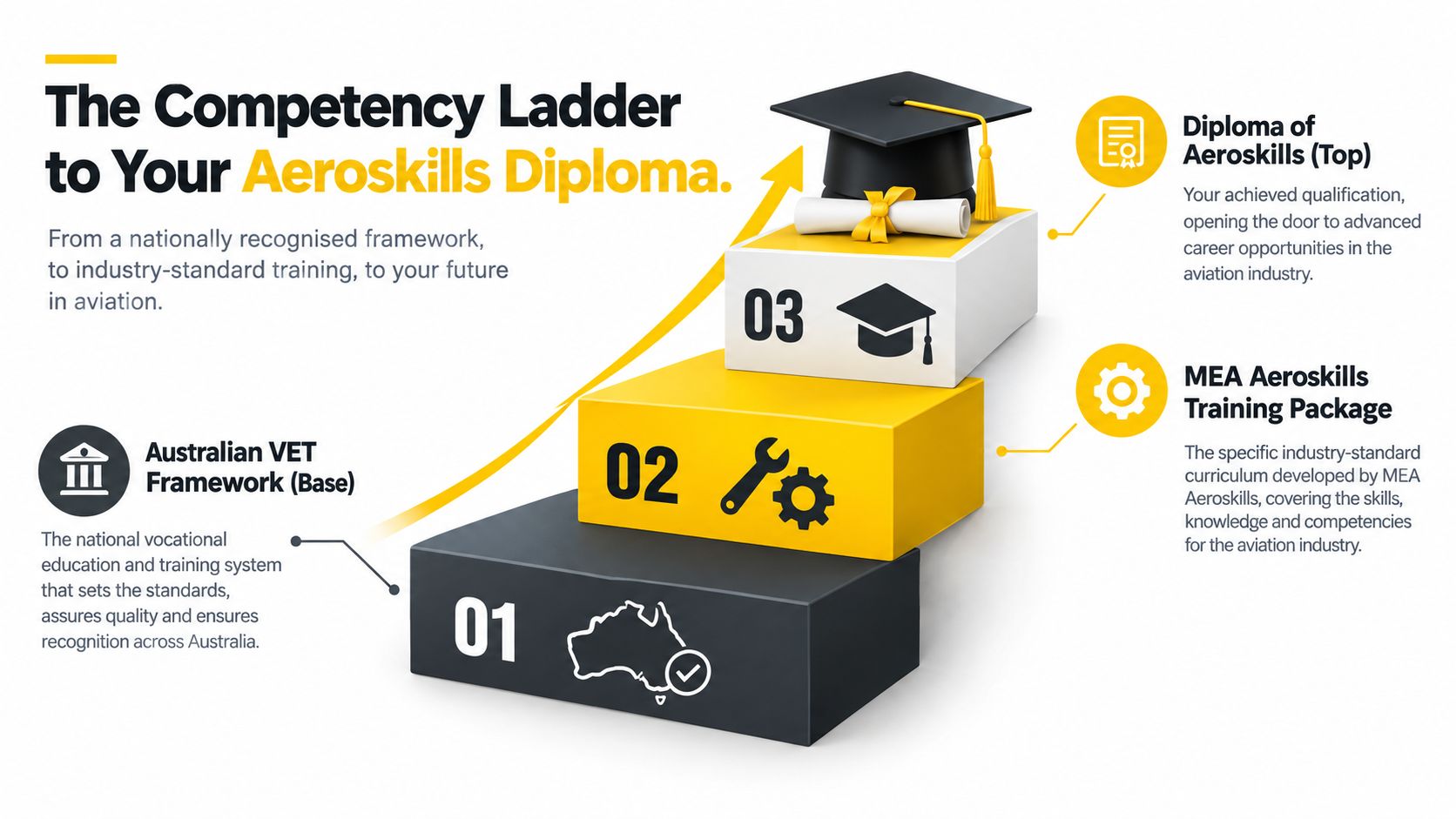
Australian vocational education works like a competency ladder. Each stage adds capability rather than adding academic theory.
At the base, a learner develops practical trade skills. Certificate-level training builds specific workplace competencies. A diploma then brings those skills together with broader technical and theoretical application. Training.gov.au describes the diploma level as preparing learners to apply integrated technical and theoretical concepts across a broad range of contexts for advanced skilled or paraprofessional work, as set out in the MEA qualification documentation.
The role of the MEA Training Package
The MEA Aeroskills Training Package is the industry framework that organises aviation maintenance qualifications and units of competency. It gives registered training organisations a common structure for teaching and assessing work in areas such as aircraft mechanical systems, avionics, maintenance management and non-destructive testing.
That structure makes the diploma different from a general engineering or aviation studies award. A general qualification may provide useful knowledge, but the MEA diploma is built around aviation maintenance competencies and the regulatory environment in which those competencies are used.
The mechanical and avionics diplomas are particularly important because they're designed as licensing pathways. The mechanical stream relates to the B1 aircraft maintenance engineer pathway, while the avionics stream relates to the B2 pathway. The qualification doesn't replace CASA licensing requirements, but it can organise the training needed to meet them when the course, units and delivery arrangements align correctly.
Diploma study compared with drone training
A drone professional considering a broader qualification should separate aviation operation from aircraft maintenance. A Certificate III in Aviation, RePL or AROC can support drone and aviation operations, but none of those automatically converts into the Diploma of Aeroskills.
For example, ACE PLATINUM is described as an enterprise drone training package including RePL, AROC, Aviation English, Express ReOC, Certificate III in Aviation, advanced operations training and preparation to operate and manage a commercial drone business. That package addresses commercial drone operations, while the diploma follows the aircraft maintenance competency ladder.
The drone pilot careers and Certificate III in Aviation guide can help readers compare those operational qualifications with a maintenance-focused pathway.
Unit Breakdown and Workload Across Avionics and Mechanical Streams
The Diploma of Aeroskills is substantial because it combines several layers of learning. Students don't study only the final diploma-level units. The pathway can include Certificate IV common units, technical-stream units and additional units selected for a CASA licence sub-category.
Official guidance describes diploma volume of learning as typically one to two years, or about 1,200 to 2,400 hours. State training guidance gives a more detailed view of nominal delivery, listing 2,020 hours for MEA50118 Diploma of Aeroskills Avionics and 2,475 hours for MEA50219 Diploma of Aeroskills Mechanical in Western Australia, as recorded in the WA nominal-hours guide.
The figures aren't interchangeable. Nominal hours provide a training planning reference, while an individual's actual completion time depends on the provider, delivery model, prior experience, assessment evidence and selected pathway.
Mechanical stream
The mechanical qualification is built around the B1 pathway. Under the implementation guidance, MEA50219 Diploma of Aeroskills Mechanical requires 35 to 43 units, depending on the selected CASA licence sub-category. Twenty-eight units form the core requirement for B1 licence pathways, with a further seven to 15 units added for particular sub-categories. These unit figures are set out in the MEA implementation guide.
The mechanical stream covers a broad practical field involving airframe and engine maintenance. Its heavier nominal load reflects the breadth of that work, rather than indicating that every student follows an identical timetable.
Avionics stream
The avionics pathway supports B2-related licensing. The MEA documentation identifies 32 or 33 units, depending on electives, with eight core diploma-level licensing units and 23 Certificate IV common and technical-stream units forming the relevant B2 structure. The MEA avionics qualification documentation explains how those units create a staged competency pathway.
| Stream | Nominal Hours | Total Units | Licence Pathway |
|---|---|---|---|
| Avionics | About 2,020 hours | 32 or 33 units | CASA B2 pathway |
| Mechanical | About 2,475 hours | 35 to 43 units | CASA B1 pathway |
The table is a planning summary, not a licence guarantee. A student should confirm the current qualification code, elective rules, sub-category requirements and Part 147 status directly with the training provider. The Certificate III in Aviation information can also help drone-focused learners understand where aviation foundation training sits, although it isn't a substitute for the aeroskills diploma pathway.
How Theory and Practical Training Work Together
Aeroskills training works best when theory and practical activity reinforce each other. Classroom learning explains why a system behaves in a certain way. Practical work tests whether the learner can apply that understanding safely and consistently.
Classroom theory and technical understanding
Theory may cover aeronautical principles, aircraft systems, materials, electrical concepts, regulations and maintenance requirements. That knowledge helps a learner understand system relationships instead of memorising isolated steps.
For example, an avionics learner needs more than familiarity with a component name. The learner must understand how electrical and electronic systems interact, how technical information directs maintenance and how documentation supports an authorised task. Mechanical learners face the same principle across airframe, engine and related systems.
Documentation and practical work
Maintenance documentation sits between theory and physical work. Aircraft manuals, maintenance instructions, technical records and task documentation tell the learner what information must be checked and how the work must be controlled.
Workshop or hangar practice then provides the setting for task-level performance. The learner may need to prepare tools, follow instructions, inspect a system, record findings and complete the activity in a controlled sequence. Assessment should look at both the result and the method used to reach it.
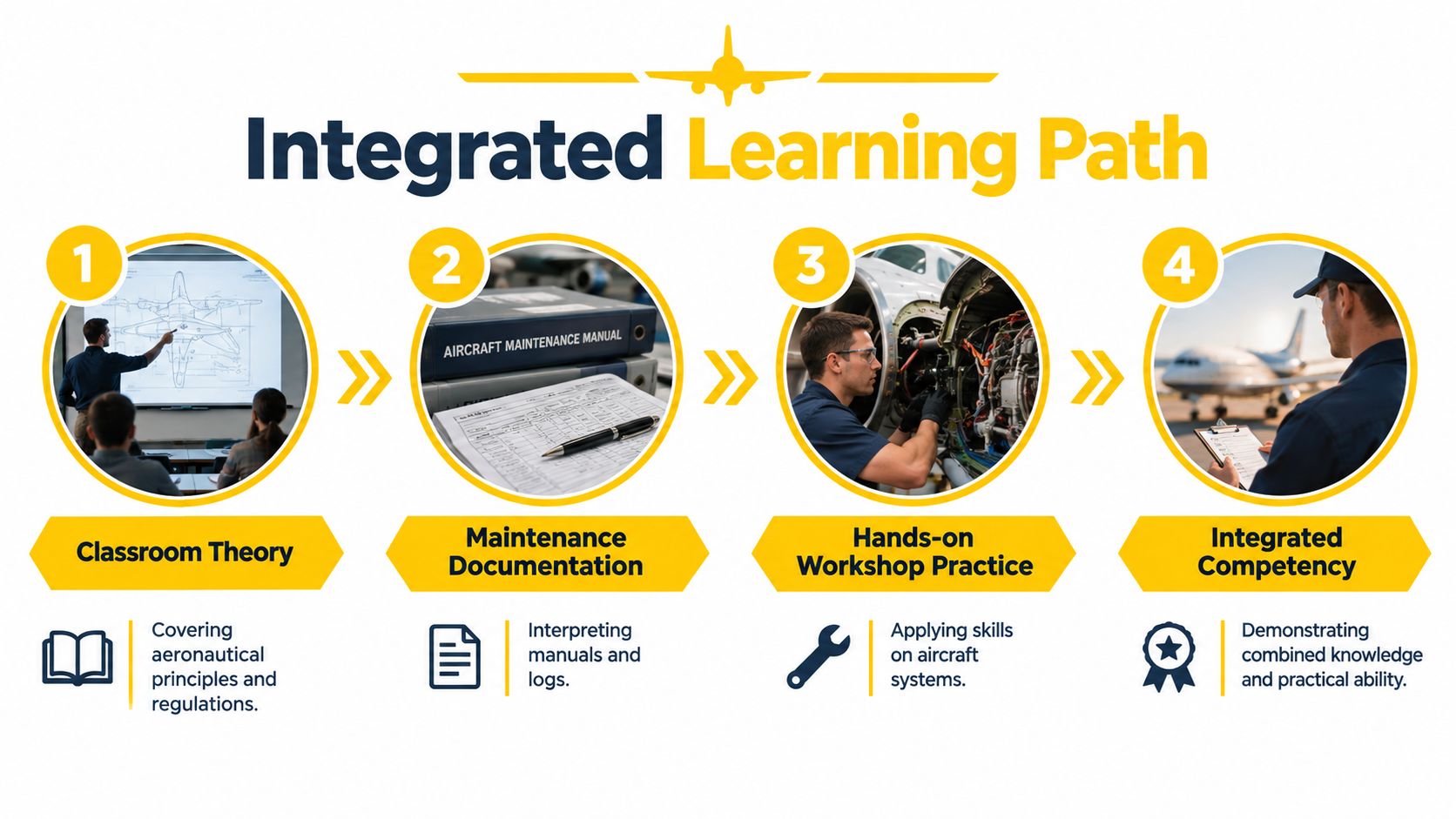
A useful way to compare the two learning environments is:
| Learning environment | Main purpose | What the student demonstrates |
|---|---|---|
| Classroom | Build technical and regulatory understanding | Explains systems, principles and requirements |
| Documentation tasks | Interpret approved maintenance information | Finds and applies relevant instructions |
| Workshop or hangar | Perform controlled maintenance activities | Completes practical tasks safely |
| Integrated assessment | Combine knowledge and performance | Demonstrates competency across contexts |
A student who prefers practical work shouldn't dismiss theory. A student who performs well in written tasks shouldn't assume that practical competency will follow automatically. Both forms of evidence matter because aircraft maintenance decisions affect safety, records and future work.
Someone starting in commercial drone operations may need a more introductory route. ACE BRONZE is described as a foundation commercial drone course covering drone operations, flight safety, aviation theory and practical skills for students beginning towards licensed drone pilot training in Australia. That kind of foundation has a different purpose from integrated aircraft maintenance training.
Career Pathways and Industry Recognition in Australian Aviation
A completed Diploma of Aeroskills can support several aviation directions, but the outcome depends on the stream, units, licensing arrangements and the role sought. The qualification is nationally recognised within the Australian VET system, while a CASA licence remains a separate regulatory outcome.
A mechanical graduate may work towards aircraft maintenance roles associated with the B1 pathway. An avionics graduate may progress towards B2-related work involving electrical, electronic and instrument systems. Other diploma-level qualifications point towards maintenance management or non-destructive testing, which can lead to different technical responsibilities.
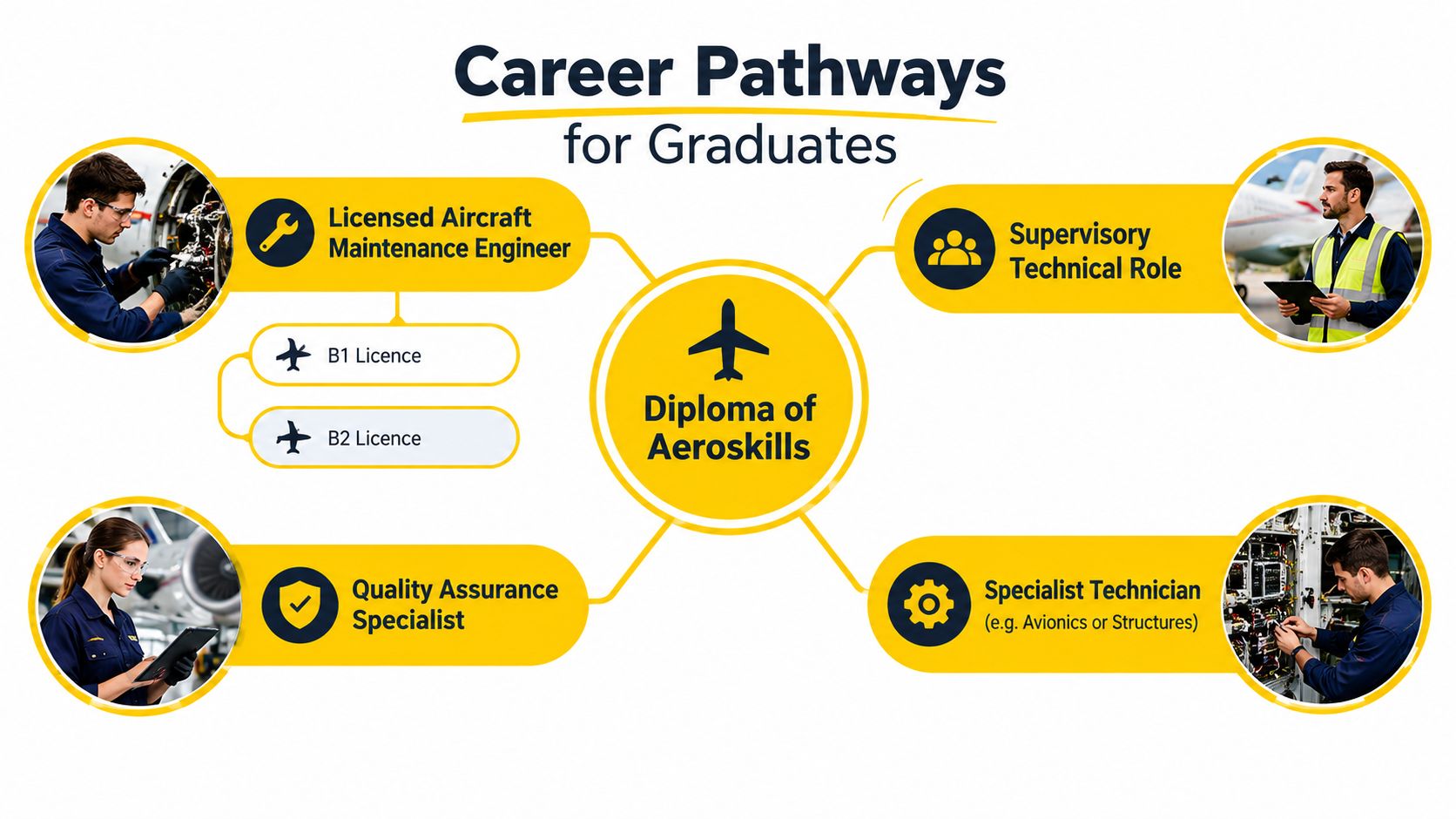
Matching the qualification to the role
A learner considering a maintenance career should ask what kind of responsibility is attractive:
- Licensed maintenance: The B1 and B2 pathways provide the clearest connection to aircraft maintenance engineer licensing, subject to CASA requirements.
- Technical supervision: Management-focused qualifications may suit a person moving from task execution into coordination, oversight and technical decision-making.
- Specialist work: Avionics, structures and non-destructive testing require different technical interests and unit choices.
- Quality and records: Maintenance documentation, compliance and quality functions may suit people who prefer controlled systems and verification.
A diploma can strengthen a long-term aviation profile, but employers still assess practical capability, workplace evidence, authorisations and role-specific experience. The qualification should therefore be treated as part of a professional pathway, not as a guaranteed job title.
How drone qualifications fit alongside aeroskills
Drone professionals may use aircraft maintenance knowledge in specialist roles involving unmanned aircraft fleets, technical support or equipment management. However, a diploma of aeroskills doesn't replace the operational requirements for commercial drone work.
A drone operator may instead need a RePL, an AROC or ReOC consulting, depending on the operation and responsibilities. Ace Aviation Aerospace Academy's jobs page can be used alongside provider and employer research when comparing aviation roles.
Candidates moving into technical interviews may also benefit from general preparation resources, including this interview prep for software engineers, particularly when preparing for structured competency questions, technical explanations and evidence-based responses. The subject matter differs, but the discipline of explaining decisions clearly transfers well across technical careers.
Entry Requirements and Choosing the Right Licence Pathway
A career-switcher can arrive with strong mechanical ability yet still need technical English, mathematics, science concepts and precise maintenance records. Entry planning therefore starts before enrolment. Ask the provider what academic skills it expects, how previous trade learning is assessed and which units remain outstanding.
The diploma may also take longer than its title suggests. TAFE NSW course information describes full-time delivery of up to 48 months and part-time delivery of up to 72 months, depending on the course and arrangement. Confirm the current timetable, workplace requirements and assessment schedule directly with the provider.
Choose the licence direction first
B1 generally leads towards mechanical maintenance, while B2 generally leads towards avionics. This choice should match the systems the learner wants to work on, existing experience and the intended aircraft maintenance role.
The sub-category works like the route selected on a map. It determines which knowledge and skill units support the eventual licence direction. Choosing a broad diploma without checking that map can leave gaps between graduation and the desired CASA outcome.
Use this checklist before signing an enrolment agreement:
- Identify the target role. Clarify whether the aim is mechanical maintenance, avionics, management, specialist testing or drone operations.
- Check the qualification code. Ask whether the provider delivers the current version and which electives apply to the selected stream.
- Verify Part 147 alignment. The qualification supports CASA requirements when the knowledge and skills align with CASA syllabus requirements and training is delivered under Part 147. Ask the provider to explain how its delivery meets those conditions.
- Map the sub-category. Request a written unit map showing how the selected stream supports the intended B1 or B2 direction.
- Plan supporting certificates. CASA requires an Aeronautical Radio Operator Certificate for a person who needs to communicate on an aviation air-band radio frequency and is not already licensed or qualified.
For unmanned aircraft operators, ABLIS guidance identifies the AROC requirement and lists conditions including being at least 17 years old, passing the required examinations, meeting Manual of Standards competency requirements and providing a current aviation English assessment. The ABLIS AROC guidance should be checked alongside current CASA information.
International applicants comparing Australian aviation careers can use this guide for international job seekers for general employment and visa research. It does not replace advice from the training provider, CASA or an authorised migration professional. Readers comparing drone credentials with maintenance qualifications can also use the AAA licence finder to identify the pathway that matches the intended work.
Conclusion and Frequently Asked Questions
The Diploma of Aeroskills is best viewed as a licence-aligned competency ladder, not a short standalone course. Its value comes from the relationship between the MEA Training Package, the selected stream, the required sub-category units, practical assessment and Part 147 delivery.
A mechanical learner may be working towards a B1 pathway, while an avionics learner may be following a B2 direction. Neither result is automatic because a diploma has been awarded. Before enrolling, the student should request the current unit map, confirm Part 147 arrangements and check how the qualification connects with the intended CASA outcome.
Frequently asked questions
Does the Diploma of Aeroskills automatically provide a CASA licence?
No. The diploma can support a B1 or B2 licensing pathway, but CASA requirements, syllabus alignment, relevant units, approved delivery and other licensing conditions still apply.
Is the mechanical stream longer than avionics?
The nominal workload is heavier for the mechanical stream in the cited WA guide, with about 2,475 hours compared with about 2,020 hours for avionics. Actual completion depends on delivery and the selected pathway.
Is the diploma suitable for a drone-focused career?
It can be relevant to technical drone maintenance or fleet support, but it isn't the usual direct route to commercial drone operation. Drone operators should assess RePL, AROC and business compliance requirements separately.
Can drone qualifications complement aeroskills training?
Yes. RePL, AROC, Certificate III in Aviation and enterprise drone training can support operational roles, while the Diploma of Aeroskills addresses aircraft maintenance competencies. They serve different purposes.
Should a student choose B1 or B2 first?
The choice should follow the intended technical work. B1 is associated with mechanical maintenance, while B2 is associated with avionics, electrical and electronic systems.
Ace Aviation Aerospace Academy offers relevant aviation and drone pathways including RePL, AROC, Certificate III in Aviation, enterprise drone training and ReOC consulting. Readers comparing operational drone training with the Diploma of Aeroskills can visit Ace Aviation Aerospace Academy to identify the course direction that matches their intended aviation role.