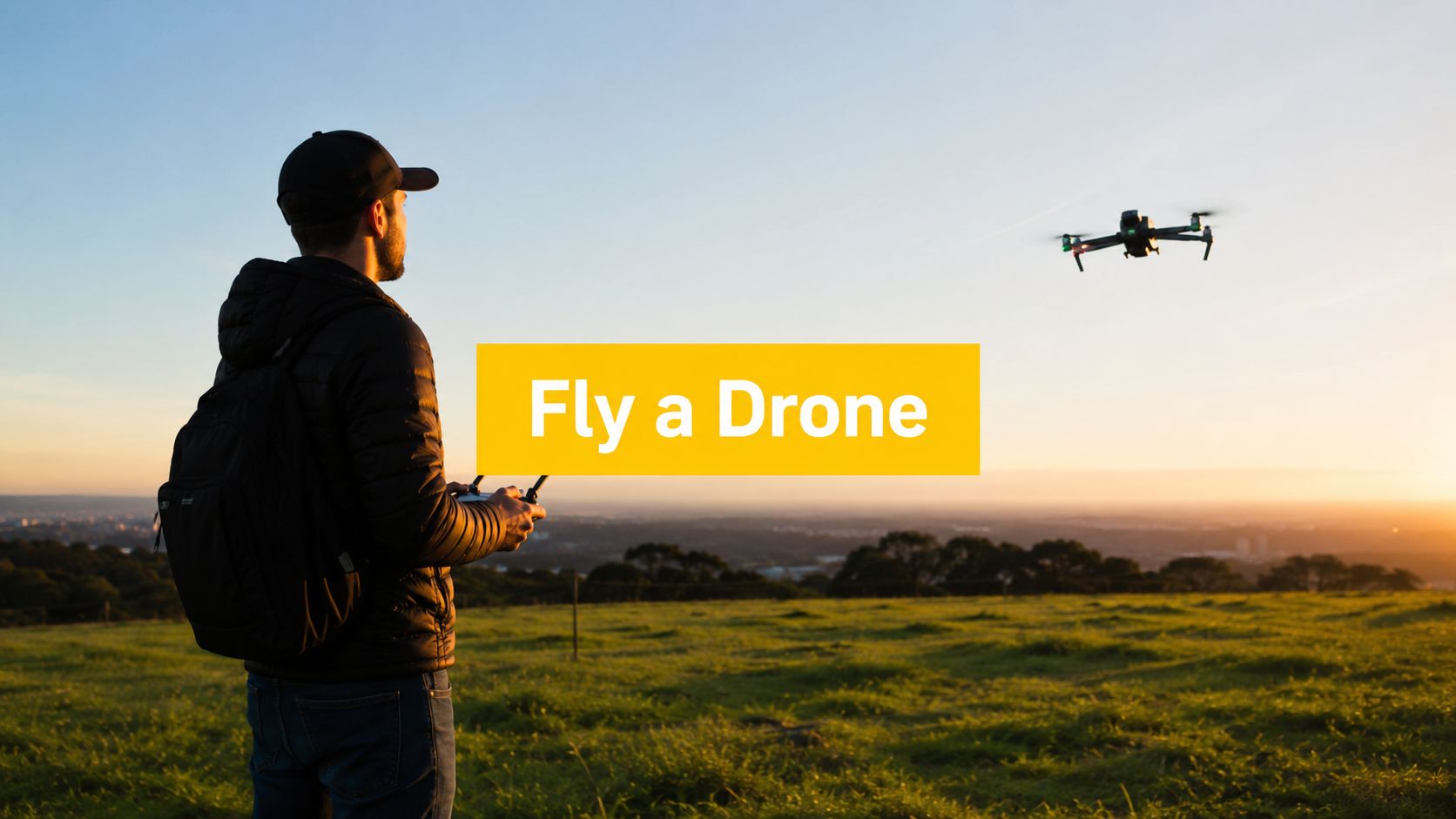
A new pilot often stands at the edge of an empty paddock with a charged battery, a clear camera view, and a long list of things that could still go wrong. That mix of excitement and caution is normal. To fly a drone well in Australia, the main job starts before take-off, because the aircraft, the airspace, and the weather all decide how forgiving the flight will be.
In Australia, drone flying moved from a niche activity to a formal aviation sector when CASA introduced the Remote Pilot Licence (RePL) and the commercial drone framework under Part 101. That foundation opened lawful commercial work across agriculture, surveying, construction, and infrastructure, while also creating the professional training market that now supports business use in Australia. For anyone planning a first commercial flight, the practical question is no longer just how to lift off and land. It is how to stay lawful, safe, and repeatable.
A structured approach matters because CASA rules draw a sharp line between recreational flying and aviation activity. The best reference point for many teams is not a random video tutorial, but a training pathway and operating checklist that matches the job. For businesses comparing training with wider project planning, the BIM-based cost reduction guide is a useful adjacent read because drone work often sits inside larger site, survey, and construction workflows.
Table of Contents
- Introduction to Flying a Drone
- Preflight Preparation and Regulatory Checklist
- Mastering Basic Drone Controls and Maneuvers
- Ensuring Safety and CASA Compliance
- Addressing Common Mistakes and Troubleshooting
- Practical Exercises for Skill Development
- Next Steps for Certification and Professional Training
Introduction to Flying a Drone
A first flight feels simple until the aircraft starts asking for discipline. The drone needs a healthy battery, the operator needs a clear view, and the mission needs to fit the rules that apply to that location and task. In Australia, that matters even more because the commercial side of the market has been formalised through CASA's licensing and operational framework, which is why professional training is now part of the normal path for serious work CASA and Part 101 context.
Recreational and commercial flying are not the same
A recreational flight is mainly about personal use, but commercial flying sits inside aviation compliance. CASA's structure means the pilot has to think about category, operating limits, and the type of work being done before the motors even spin up. That distinction is why business users often need a different mindset from hobbyists.
A practical example helps. A camera flight over a backyard is one thing, but a flight above a construction site, farm, or survey area usually raises more planning questions, more people exposure, and more airspace concerns. Those extra layers are where many new pilots get caught out.
Practical rule: if the mission is for work, treat it like aviation activity from the start, not like a casual hobby flight.
Why structure beats guesswork
People often want a single shortcut, but drone operations rarely work that way. A standard app can help with planning, yet it cannot replace category checks, visual line of sight decisions, or airspace approval where that's required. For commercial pilots, the value of training is that it turns scattered knowledge into a repeatable workflow.
For readers comparing beginner pathways, ACE READY is an entry-level option that covers drone fundamentals, aviation safety, CASA regulations, flight operations, and preparation for advanced RePL training in Australia. That sort of foundation matters because the first safe flight is usually the one that was planned carefully, not the one that felt spontaneous.
Preflight Preparation and Regulatory Checklist
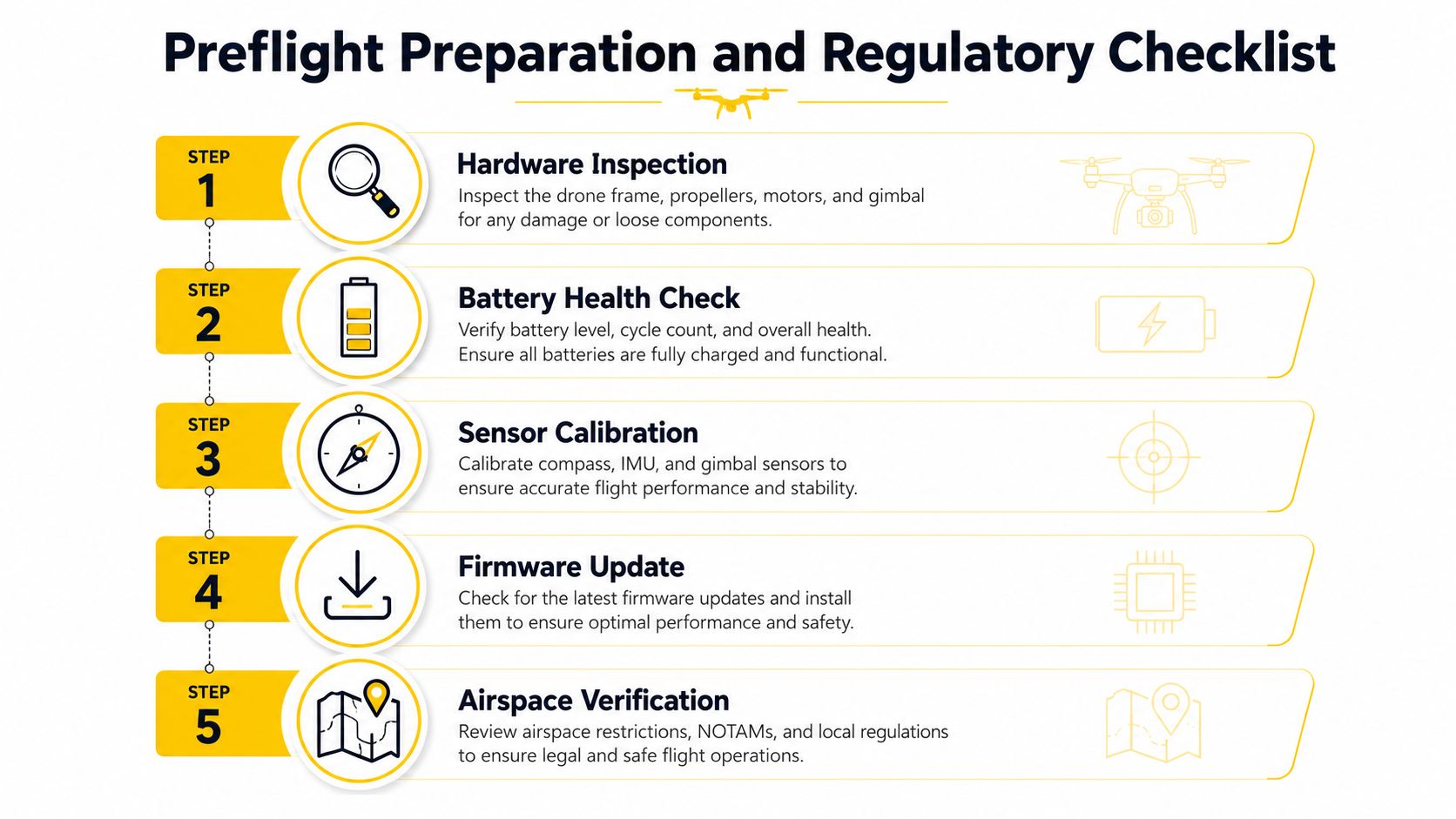
Preflight starts with the aircraft, not the app. A drone that looks ready can still fail if the battery is weak, the sensors need calibration, or the mission environment has changed since the last flight. In Australian operations, the regulatory check is just as important as the hardware check, because CASA limits are part of the launch decision, not an afterthought.
Hardware comes first
Before take-off, inspect the frame, propellers, controller link, camera mount, and landing gear. Check battery condition and make sure the pack is seated properly. If the payload includes a camera or other sensor, confirm it is attached securely and aligned correctly.
A good habit is to use the same order every time. Consistency reduces skipped steps, and skipped steps are where most avoidable problems begin.
- Inspect the airframe: Look for cracked arms, loose screws, damaged propellers, or anything that could shift in flight.
- Check battery health: Confirm the battery is charged, secure, and not showing obvious signs of damage.
- Calibrate sensors if needed: Do this before the flight, not after the drone starts behaving oddly.
- Update firmware when appropriate: Firmware problems are best found on the ground.
- Confirm payload fit: A loose camera or accessory can change balance and flight behaviour.
CASA category checks are part of launch planning
In Australia, CASA states that an excluded category drone operation can only proceed if the aircraft is under 2 kg, flown recreationally or for very small commercial work, kept within visual line of sight, flown below 120 m AGL, and kept at least 30 m horizontally from other people unless specific exceptions apply CASA excluded category limits. That means the operator has to know the category before launch.
Use a step-by-step order: confirm the mission category, confirm the distance from other people, then confirm the flight area and altitude envelope. That sequence is much more reliable than launching first and hoping the operation fits later.
If a pilot wants a simple reference tool for selecting an appropriate training path, the licence finder at https://aaa.edu.au/tools/licence-finder can help map the task to the right credential or course. For beginners, that's often the difference between guessing and choosing a realistic pathway.
Mastering Basic Drone Controls and Maneuvers
The basic controls are easier to learn when they're treated like movement, not buttons. Throttle changes altitude, pitch moves the aircraft forward or back, roll moves it side to side, and yaw rotates the nose. Once those inputs make sense together, the drone stops feeling twitchy and starts feeling responsive.
Learn the controls in pairs
New pilots usually overcorrect because each stick input feels separate. The cleaner approach is to pair movements gently. A slight throttle change with a small yaw adjustment can be smoother than trying to “fix” the aircraft with one large correction.
Steering and braking in a car simultaneously is a helpful comparison. The more abrupt the motion, the less graceful the result.
- Throttle: Use small inputs to hold altitude. Big jumps often create a bouncing hover.
- Pitch: Push forward slowly to build speed, then ease off before the drone starts dipping.
- Roll: Move sideways only as much as the line of sight and space allow.
- Yaw: Rotate slowly so the camera framing doesn't whip around and force a second correction.
Hovering is the first real skill
A stable hover teaches control far better than an aggressive circuit. Hold position, keep the nose steady, and watch for drift caused by wind or stick pressure. If the drone wanders, correct with the smallest movement that works.
After that, progress to straight-line movement and wide turns. Figure-eights are useful because they force the pilot to coordinate yaw, roll, and pitch without relying on one comfortable direction. That's where muscle memory starts to form.
The internal training pathway at https://aaa.edu.au/courses/starter is relevant here because a beginner course can help establish those basics before a pilot tries to handle more demanding commercial scenarios. For anyone aiming to build confidence quickly, repetition in an open area is far more valuable than trying to learn advanced manoeuvres too early.
The video reinforces a simple point, smooth inputs beat dramatic ones. Pilots who keep their hands light usually get cleaner footage, fewer oscillations, and much less fatigue.
Ensuring Safety and CASA Compliance
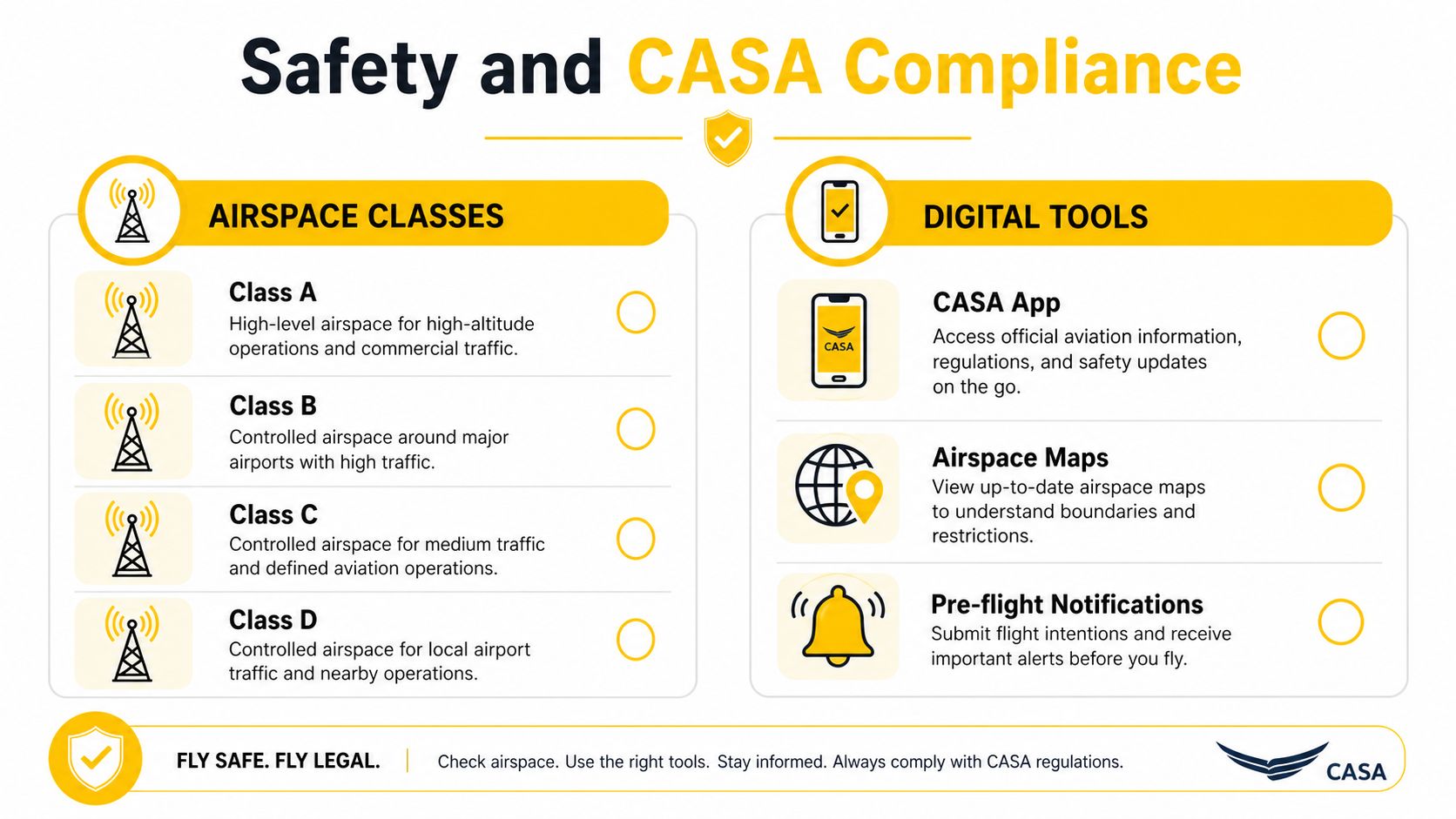
A safe flight in Australia starts before take-off. Check the airspace, nearby airports, helipads, and any restricted zones first, because those are not places to sort out later in the flight. CASA requires approval for controlled airspace, so planning is part of compliance, not just route choice controlled airspace planning.
Airspace checks come before convenience
A lot of drone advice online stops at “keep it in sight” or “stay under 400 ft”, but that misses the Australian reality. The first question is whether the flight area sits inside airspace that needs approval, and whether the operator has checked that with the right tool before launch. Near airports and other constrained sites, a quick assumption can create a compliance issue that is avoidable with basic planning.
The practical habit is simple. Treat airspace like a planning layer, not background detail. If the area is controlled, approval comes first. If the area is unclear, pause the flight until the map or authorisation tool gives a clear answer, including the kind of location-specific checks covered in the drone safety guide for airports and heliports in Australia.
Safety margins matter as much as regulations
Weather and visibility can change the risk profile fast. Australian drone-safety guidance also points to wind and battery reliability as recurring operational problems, so a safe flight plan needs more than legal compliance weather and battery risk guidance. A flight that looks legal can still be a poor decision if gusts are building or visibility is dropping.
Don't let the drone decide whether the flight continues. The pilot should cancel early when conditions start moving the wrong way.
For teams operating near airports or heliports, the practical SQA resource from Sheridan Technologies, https://sheridantech.io/2026/03/24/software-quality-assurance-testing/, is a useful reminder that disciplined checking reduces avoidable mistakes before they become incidents. In enterprise settings, that kind of location-aware discipline is often what separates a routine mission from a reportable one.
Addressing Common Mistakes and Troubleshooting
Most drone problems start small. A battery that is aging unevenly, a calibration that was rushed, or a shift in weather can turn an ordinary flight into a poor one quickly. Experienced operators look for those warning signs early and land before the issue affects the aircraft, the footage, or the safety plan.
Watch for the patterns that lead to avoidable failures
Australian guidance treats weather, visibility, and wind as real operational risks, and battery condition and situational awareness are common failure points in field work operational risk guidance. The lesson is straightforward. A problem is not always a hardware fault. Sometimes the conditions have stopped fitting the flight, and the right fix is to stop treating the sortie as routine.
Common field problems usually show up in a few familiar ways:
- GPS drops or drift appears: Reduce complexity, hold position, and avoid pushing the flight deeper into an uncertain area.
- Battery sag in heat: Land earlier than planned and inspect the pack before the next sortie.
- Footage looks unstable: Re-check gimbal settings and confirm the aircraft was trimmed correctly before launch.
- Situational awareness fades: Pause the task, regain orientation, and avoid trying to fix it while moving.
A useful habit is to separate the symptom from the cause. A drifting aircraft may need a fresh calibration, but it may also be dealing with wind or a poor take-off point. A battery warning may point to pack health, heat, or a flight that should have ended sooner. The practical response is to slow the situation down, confirm what changed, and make the smallest safe correction.
For pilots who want a wider safety reference, the internal handbook at drone pilot emergency handbook for ANCA, CANCA, and ATSB response planning is useful because it sits in the same risk-management space as troubleshooting. In practice, that kind of planning helps when a flight starts to go off script. The pilot who lands early usually keeps the aircraft, the data, and the day intact.
The practical SQA resource from Sheridan Technologies is a useful analogy for drone crews who prefer structured checks. Verify the system before release, because catching faults early costs far less than fixing them in the field.
Practical Exercises for Skill Development
Skill grows fastest when practice is deliberate. Random flights build familiarity, but structured drills build control. For a new pilot, that means repeating the same manoeuvres until altitude, position, and heading stop feeling fragile.
Start with a controlled hover
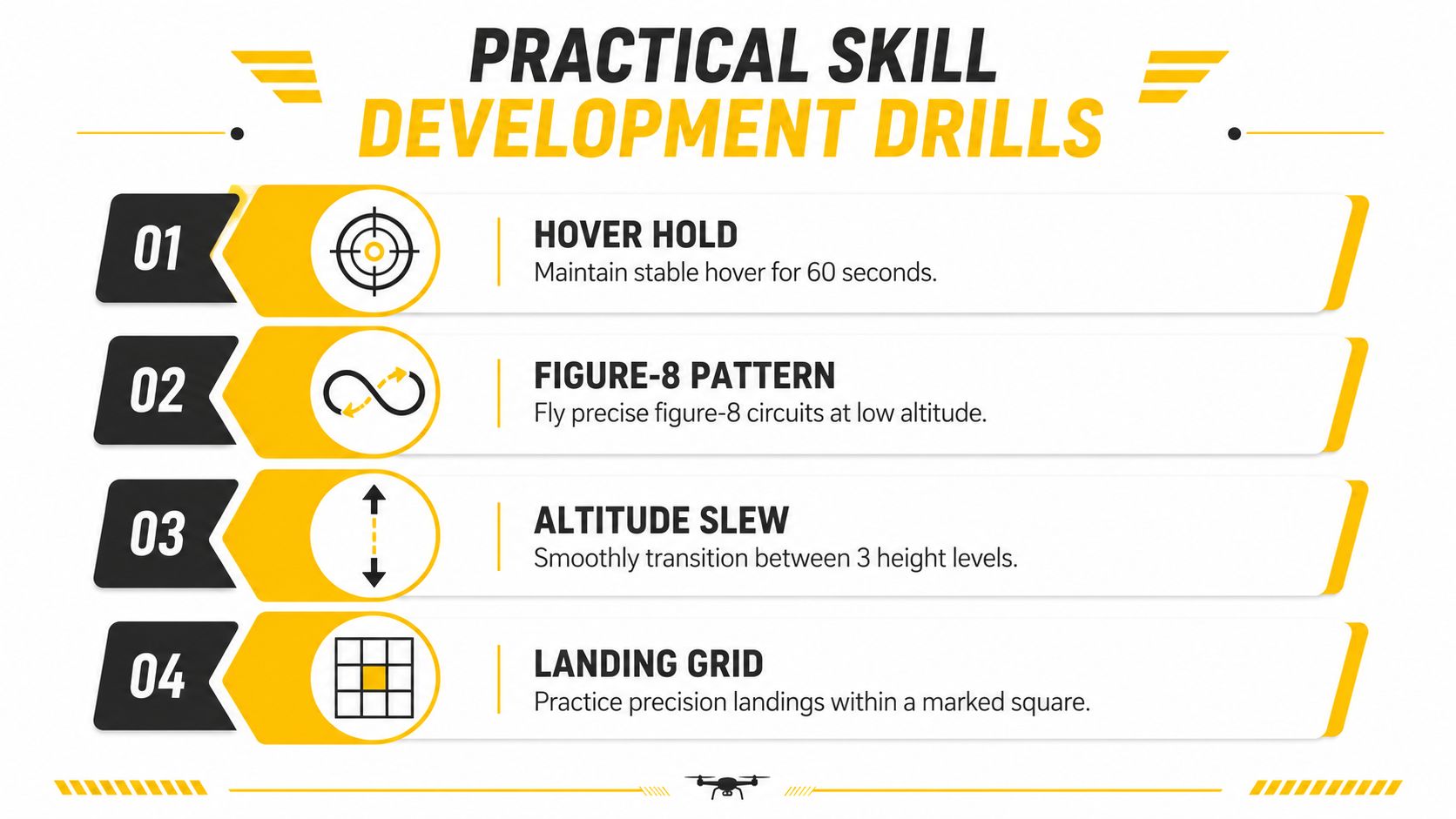
A hover hold teaches the pilot to manage drift, wind, and small corrections. Use an open park or sports field, keep the drone comfortably clear of people, and aim for a steady hover without chasing every wobble. Once the aircraft holds position reliably, add gentle yaw changes.
Move into pattern flying
Figure-eights, low-altitude circuits, and smooth altitude transitions force the hands and eyes to work together. These drills are especially useful because they expose weak stick coordination without putting the flight at unnecessary risk. A pilot who can keep the aircraft controlled through repeated shapes usually handles client work far better than someone who has only done straight-line flights.
Treat each flight like a logged lesson
After every practice session, note what drifted, what felt smooth, and what needs another run. That simple debrief creates a real improvement loop. It also shows whether the pilot is ready for more complex survey-style movement or whether more repetitions are still needed.
The key is not perfection on day one. It is repeatability. A pilot who can land consistently, hold altitude, and keep the aircraft where it belongs is already building the habits that commercial work depends on.
Next Steps for Certification and Professional Training
Once the basic flying skills are in place, the next decision is which credential fits the work. Some pilots need radio communications, some need commercial drone authority, and some need a broader aviation foundation. The right choice depends on the job, not on what sounds impressive on paper.
| Comparison of AAA Drone Training Courses | Focus |
|---|---|
| Remote Pilot Licence (RePL) | Commercial drone flying pathway for lawful business operations |
| Aeronautical Radio Operator Certificate (AROC) | Radio communications for aviation environments |
| Certificate III in Aviation | Broader aviation qualification for learners building a wider foundation |
| ReOC Consulting | Support for operators managing organisational compliance and approvals |
| Enterprise Drone Training | Tailored training for in-house teams using drones operationally |
| Corporate Drone Training | Structured training for organisations needing consistent staff capability |
For operators comparing compliance pathways, the internal guide at https://aaa.edu.au/blog/ultimate-guide-reoc-australia is relevant because it sits alongside operator certificate planning and commercial governance. In practice, that matters for businesses that want pilots trained, communication standards clear, and operating procedures aligned.
A sensible path for many beginners is to build the flying basics first, then move into the qualification that matches the job role. That sequence keeps training efficient and avoids paying for advanced capability before the pilot is ready to use it well.
If you're ready to turn basic control into lawful commercial capability, contact Ace Aviation Aerospace Academy and choose the pathway that matches your flying goals, whether that's RePL, AROC, broader aviation study, or team-based drone training.