Most advice about drone careers in Perth starts with the wrong assumption, that a Remote Pilot Licence is the finish line. In the local market, it usually isn't. Employers are far more likely to hire a surveyor, geophysicist, mapping technician, or operations specialist who can also fly a UAV than a pure pilot who can only collect footage.
That reality shows up in live job boards. Perth currently has a small but concentrated cluster of listings, including 6 “UAV, Drone” jobs on Indeed, 33 “UAV Operator” jobs on LinkedIn, and 56 drone-pilot jobs across Western Australia on Jora, which points to a niche professional market rather than broad-volume hiring in consumer drone work (Indeed Perth UAV jobs). The better question is not whether someone can fly. It's whether they can deliver usable survey, inspection, or geospatial outputs under Australian compliance rules.
Table of Contents
- Why a Drone Licence Alone Won't Get You Hired in Perth
- Essential Certifications and Training Pathways for WA Drone Work
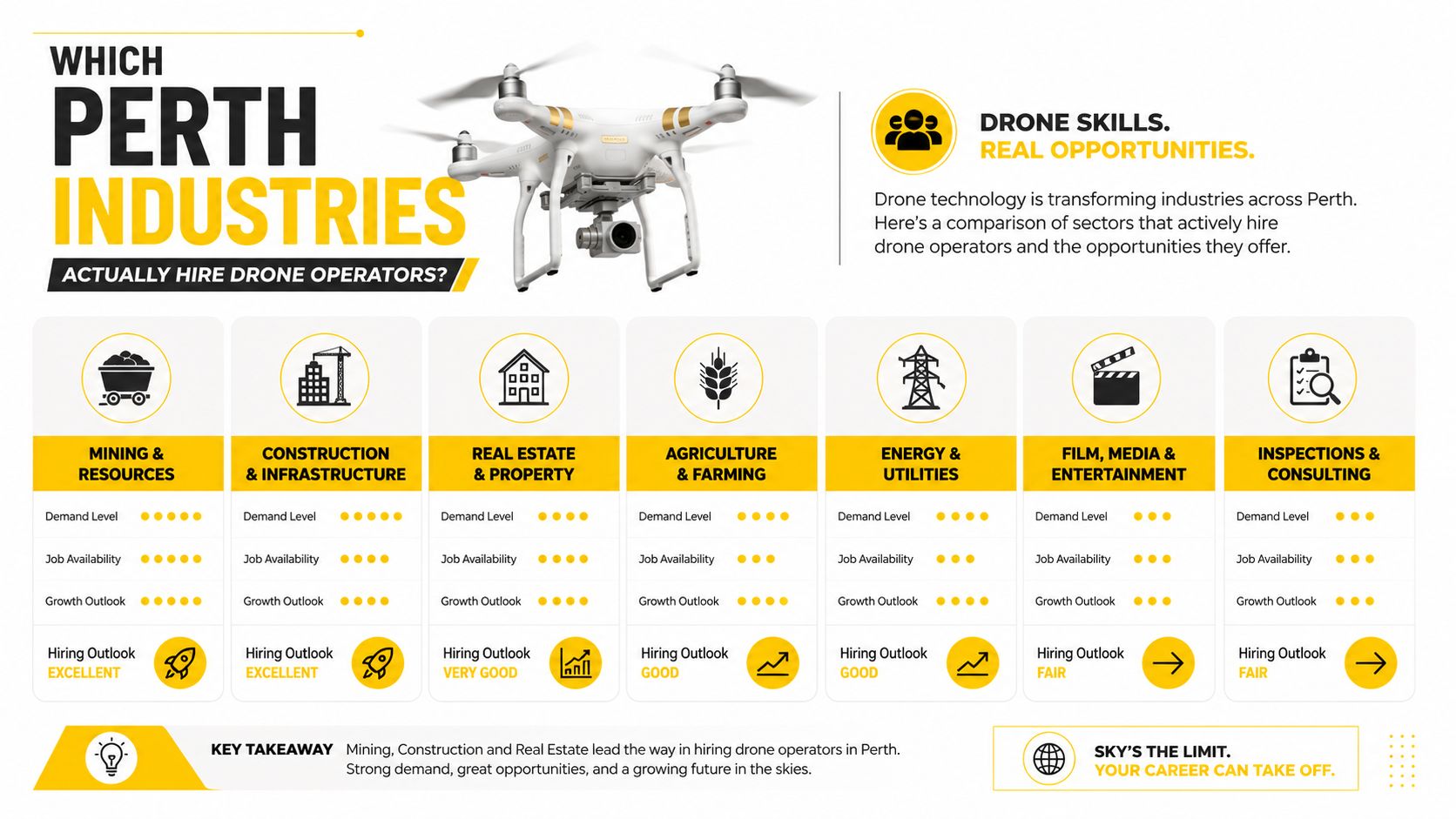
- Which Perth Industries Actually Hire Drone Operators
- Building a Portfolio and CV That Demonstrates Real Competence
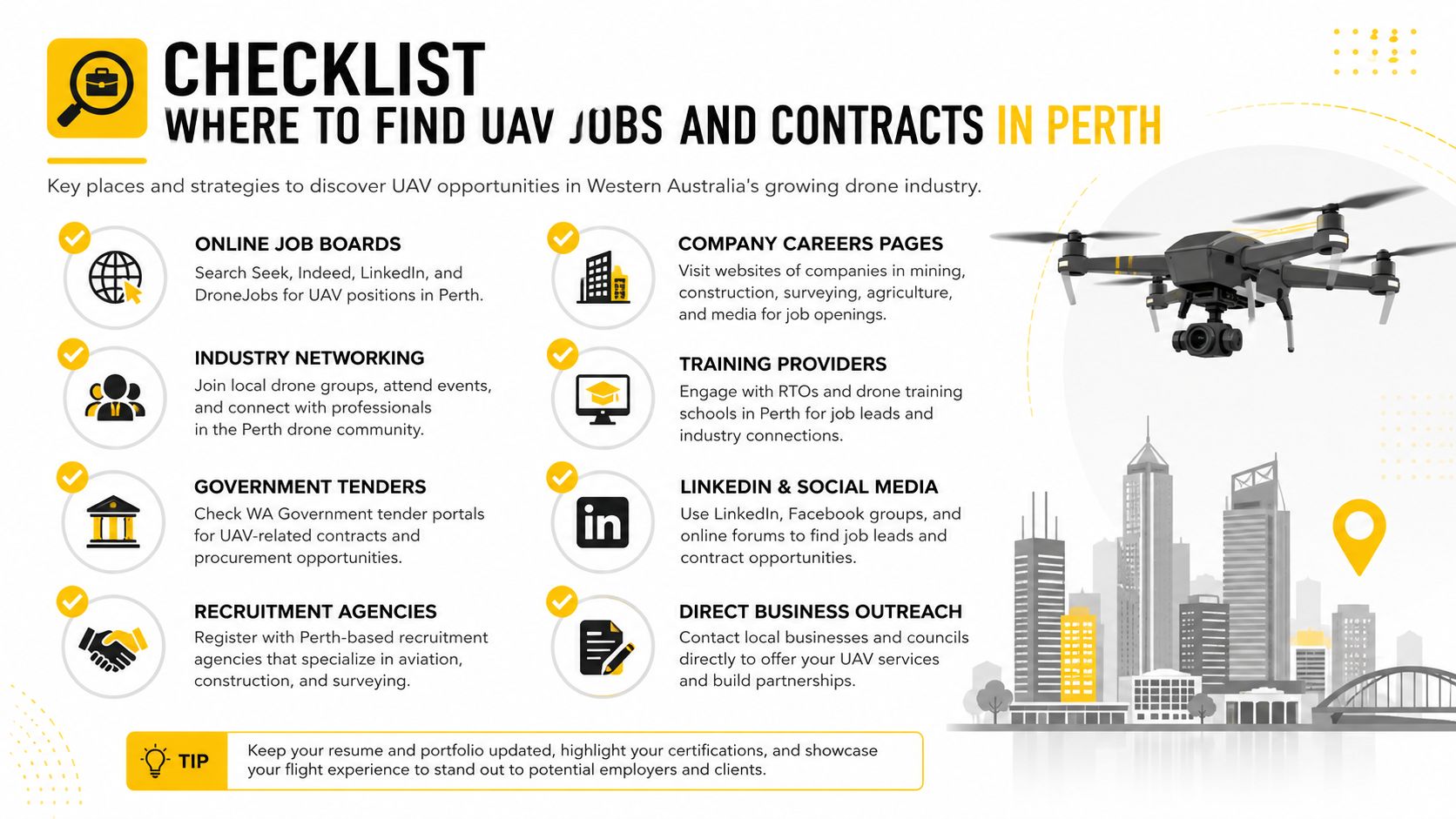
- Where to Find UAV Jobs and Contracts in Perth
- Pay Rates, Contracting Realities, and Negotiation Strategies
- Compliance, Safety, and the Professional Operator Mindset
- FAQ
Why a Drone Licence Alone Won't Get You Hired in Perth
Perth employers buy outputs, not airtime
A lot of candidates chase a RePL because it feels like the visible milestone. Perth employers, especially in mining, surveying, infrastructure, and field operations, are looking past that credential and asking whether the applicant can produce controlled, traceable, and project-ready data. A licence helps, but it rarely closes the deal on its own.
The strongest Perth listings frame UAV work as part of a broader technical workflow. One recent Perth-area ad asked for 8+ years of surveying experience alongside CASA-compliant RPAS operation, survey control, as-built reporting, design calculations, and familiarity with Leica GNSS, total stations, and Civil 3D (Indeed Perth UAV pilot roles). That combination matters because the drone is only one input in a larger deliverable chain.
Practical rule: if the job ad reads like a survey or mapping role with a drone attached, that's what the employer is buying.
A useful way to think about this is through the data-acquisition layer model. The pilot sets up the mission, captures imagery or point-cloud data, then checks outputs against ground control, design standards, and client expectations. Candidates who only talk about flight time usually lose out to people who can discuss QA/QC, control points, processing, and handover.
The mindset shift that gets candidates shortlisted
Many applicants miss the mark. They present themselves as drone pilots, while the employer wants someone who can support a surveyor, engineer, or field team. That distinction is sharper in Perth than in many casual drone markets because the region's work is tied to resource-sector and infrastructure-heavy projects (Regional CTE UAS labour statistics PDF).
If someone is starting out, an entry-level pathway such as ACE READY can make sense because it introduces drone fundamentals, aviation safety, CASA regulations, and flight operations before RePL training. That kind of grounding helps, but it's still only the foundation.
A licence gets attention. A licence plus survey literacy, software fluency, and client-ready outputs gets interviews. The candidate who can explain ground control, deliver repeatable mapping results, and hand over clean files will always look stronger than the candidate who only talks about stick time.
Essential Certifications and Training Pathways for WA Drone Work
Start with the credentials Perth employers keep asking for
For most commercial UAV roles in Western Australia, the first Remote Pilot Licence (RePL) is the starting point. It tells employers the operator has completed CASA-aligned remote piloting training, and in Perth it is usually treated as the minimum threshold rather than a standout credential. If the role involves site work, inspection, mapping, or survey support, the RePL gets you into the conversation. It does not finish it.
The next credential that appears often is the Aeronautical Radio Operator Certificate (AROC). That matters in controlled or coordinated work environments where clear radio discipline is part of the safety system, not a nice-to-have. In the Perth market, radio competence becomes more valuable as roles move toward mines, airports, infrastructure corridors, and enterprise operations.
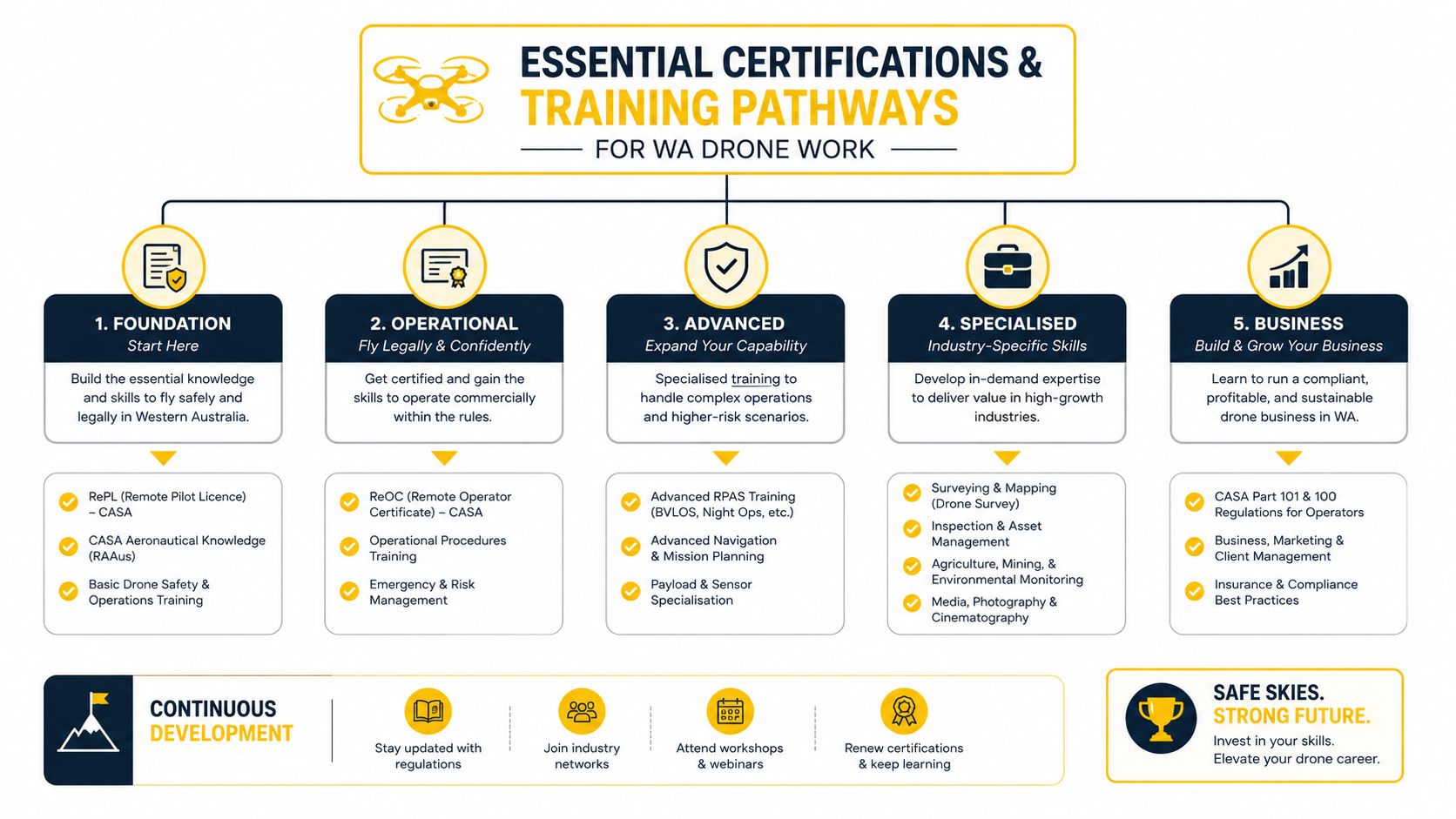
A 25 kg endorsement also appears in WA job ads because it widens the operational envelope for heavier aircraft and enterprise systems. Aviation Careers currently lists Western Australia drone roles that reference RePL Certification and a 25 kg Endorsement, including a posting advertised at A$95K–A$110K yearly (Aviation Careers drone roles). That kind of endorsement matters where employers are running specialised payloads or larger industrial platforms.
The practical way to check which entry credentials line up with your target role is to use the licence finder tool and match the licence path to the work on offer. Perth employers respond better to applicants who can explain why they chose a particular pathway than to people stacking certificates without a use case.
When advanced training starts to matter
For operators building toward more complex work, BVLOS capability changes the discussion. Perth and WA listings increasingly mention long-range RPAS work, remote operating centres, and enterprise or government deployments, which means the operator has to understand procedures, approvals, and mission discipline beyond standard visual-line-of-sight flying. Ace Aviation's ReOC Consulting is relevant here for businesses that need to structure their compliance pathway, not just their training.
Certificate III in Aviation can add value when the role sits closer to a broader aviation, operations, or workplace-safety pathway. It will not replace technical field knowledge, but it can strengthen a profile that already includes survey or engineering capability. For businesses, Enterprise Drone Training and Corporate Drone Training are the better fit when the goal is internal capability across multiple staff rather than a single-operator licence path.
A simple order of operations works best:
- RePL first for legal commercial flight competence.
- AROC next if the role involves radio coordination.
- 25 kg endorsement if the job postings or fleet mix call for it.
- Survey, mapping, or aviation systems training once the basics are solid.
- BVLOS and compliance support when the work shifts into regulated enterprise operations.
The candidates who succeed in Perth usually do not collect certificates at random. They build a pathway that matches the kind of employer they want to serve.
Which Perth Industries Actually Hire Drone Operators
Mining and surveying dominate the serious work
Perth's UAV labour market is not broad. It's concentrated around industries that need repeatable data and safe field access. Mining and resource exploration are obvious examples, because drone teams can support geophysical surveys, mapping, and site monitoring without sending people into difficult terrain. A current Aviation Careers listing for a Drone Pilot (Geophysical Surveys) in West Perth shows how specific the market can be (Aviation Careers drone roles).
Surveying and civil engineering are just as important. The jobs that appear in Perth often ask for CAD awareness, survey control, and as-built reporting, which means the UAV operator has to understand how field measurements become deliverables. That's why the strongest candidates speak the language of survey teams, not just aviation teams.
Perth employers are rarely hiring for “flight only”. They want a contributor who can slot into the project workflow without slowing the survey or engineering team down.
FIFO and site-based rosters are common in this space. An Indeed listing for Tropicana Gold Mine described an Underground Mine Surveyor role on an 8 days on / 6 days off FIFO roster from Perth and/or Kalgoorlie (Indeed Perth drone jobs). Even when a role isn't advertised as a drone job, it can still involve UAV work as part of the wider surveying function.
The smaller but growing niches
Infrastructure inspection, government geospatial work, and specialist RPAS companies all create different hiring patterns. Some roles are Perth-based and office-linked, others are tied to field deployments or remote operating centres. Independent job aggregators show Perth and WA postings connected to BVLOS operations, geospatial roles in Fremantle, and long-range enterprise RPAS work from Perth or Adelaide, which suggests the market is moving toward data, compliance, and multi-skilled aviation-adjacent positions (Jobsora WA drone roles).
For agricultural work, the opportunity set is more specialised than many expect. Drones in agriculture are often tied to spraying, spreading, mapping, or monitoring, not simple aerial photography. A helpful reference point for that sector is Ace Aviation's article on XAG P150 Max Australian agriculture, which sits closer to real operational use than generic consumer-drone advice.
The practical takeaway is straightforward:
- Mining and surveying reward data handling, site discipline, and roster tolerance.
- Infrastructure and government reward compliance, documentation, and process awareness.
- Agriculture rewards application knowledge and operational efficiency.
- Media work exists, but it's a much smaller slice of the Perth market.
Building a Portfolio and CV That Demonstrates Real Competence
Show the work, not the flight time
Perth employers scan for evidence that an applicant can deliver clean outputs under pressure. A portfolio should show more than aircraft photos or a licence badge. It should include photogrammetry outputs, survey control notes, point-cloud examples, and a short explanation of what problem each project solved.
A strong portfolio also shows that the applicant understands chain-of-custody and file management. That matters because a typical job can create a few gigabytes of data, and sometimes far more, which means backups, naming conventions, version control, and handover discipline become part of the job. Candidates who can't describe how they store, verify, and pass on data usually look unprepared for field work.
Portfolio rule: every sample should answer three questions, what was captured, what was processed, and what decision it supported.
What belongs on the CV
The CV should speak to both the technical recruiter and the chief remote pilot. That means listing Pix4D, Deswik, Surpac, Leica GNSS, total stations, Civil 3D, and any other workflow tools that align with the target role. It also means showing survey, engineering, aviation, or field experience in a way that explains relevance, not just chronology.
A candidate moving from another profession should translate experience instead of hiding it. Survey control, compliance administration, radio discipline, maintenance coordination, mine-site access, or GIS work can all strengthen a UAV application if they're framed around operational usefulness. The best applications make it obvious that the candidate can function inside a regulated team, not just pass a flight check.
A practical one-page format can help. A concise guide on how to build a one page portfolio is useful here because Perth recruiters often prefer a short, scannable summary that points to sample work, software skills, and relevant credentials.
A clean structure that works
- Professional summary: one paragraph focused on surveying, mapping, inspection, or field operations.
- Core skills: CASA compliance, photogrammetry, GNSS, processing software, reporting.
- Selected projects: brief project notes with role, tools, and outcome.
- Certifications: RePL, AROC, 25 kg endorsement, and any aviation or survey qualifications.
- Operational strengths: roster readiness, site travel, QA/QC, and client handover.
The strongest CVs in Perth don't read like pilot resumes. They read like technical operations resumes that happen to include flight competence. That's the difference employers notice.
Where to Find UAV Jobs and Contracts in Perth
Search where the niche market actually posts
Generic “drone pilot” searches miss a lot of Perth opportunities because the ads often use broader job titles. The clearest source is specialist aviation recruitment, and Aviation Careers is one of the better starting points because it currently shows roles such as a Drone Pilot (Geophysical Surveys) in West Perth, a Remote Pilot / Drone Pilot role in Perth, and a Flight Operations Coordinator (Drones) role in Jandakot (Aviation Careers drone roles). That mix tells the story, jobs are spread across operations, survey support, and coordination.
Mainstream platforms still matter, but only if the search terms are tight. Indeed and LinkedIn surface the broader volume, while Jora can help catch Western Australia-wide listings that don't show up under a pure “drone pilot” search. The internal Ace Aviation jobs page can also be useful for keeping an eye on role patterns and industry language.
What to search for
A lot of good roles are hidden under other titles. Use searches for:
- Geospatial officer
- Survey technician
- Remote pilot
- Drone pilot
- Field operations
- RPAS
- BVLOS
- Remote operating centre
That matters because Perth employers often hire for the project function first and the flight function second. A government or enterprise role may ask for compliance awareness, reporting, or GIS support rather than leading with “drone” in the title.
For subcontracting and business development, direct contact with ReOC holders still works. Many operators need short-term support for field campaigns, and they value candidates who understand mission planning, client communication, and documentation. Contractors who can show clean sample work and a stable process are easier to place than applicants who only send a generic CV.
If the role is tied to marketing or imagery delivery, a good SEO reference like SendPhoto's SEO guide for photographers can help explain how businesses think about discoverability and content even when the core job is technical. The principle is the same, the right search terms and descriptors change who sees the work.
Pay Rates, Contracting Realities, and Negotiation Strategies
Salary is only one part of the value equation
Perth listings can look generous on paper, but the actual value sits in the mix of salary, roster, compliance load, and how much of the workflow you are expected to own. A recent Perth-area listing advertised 3 fixed-term positions at Level 5 pay of $105,167–$114,938 p.a. + super, which is a strong public benchmark for upper-end government-linked UAV work in the region. Aviation Careers also shows a Perth-area drone role advertised at A$95K–$110K yearly with RePL and 25 kg endorsement language. Those figures matter, but they do not describe the whole package.
Permanent roles usually bring leave, superannuation, and more predictable access to training. Contracting works differently because the contractor carries insurance, equipment, downtime, and administrative overhead. In Perth, many UAV jobs sit inside surveying, mining, infrastructure, or aviation work, so the negotiation has to cover more than flight hours.
| Role Type | Sector | Salary Range | Additional Benefits |
|---|---|---|---|
| Fixed-term government-linked UAV work | Public sector | $105,167–$114,938 p.a. + super | Structured roster or project delivery, depending on the posting |
| Private sector drone operations role | Enterprise RPAS | A$95K–$110K yearly | RePL and 25 kg endorsement listed as desirable or required |
| Hybrid surveying and UAV role | Mining, surveying, infrastructure | Not publicly standardised | Often includes roster travel, site access, and technical workflow responsibility |
A salary line also hides how the job is run. A field-heavy role may put more value on workflow ownership, reporting quality, and client handover than on flying volume alone. For a candidate who can fly, process data, and communicate cleanly, that broader remit is where stronger offers tend to come from.
How to negotiate without underselling the role
The strongest negotiation anchor is capability, not ego. If the role includes photogrammetry, survey control, QA/QC, or remote operations, frame those as production skills that save time and reduce rework. If the posting asks for BVLOS awareness, 25 kg endorsement, or field travel, those are real business requirements and can justify a stronger package.
A few practical negotiation points matter in Perth:
- Clarify roster impact: FIFO or site-based work changes the value of the role.
- Ask about equipment responsibility: personal gear, batteries, software, and servicing affect take-home value.
- Check training support: refresher budgets and endorsement renewal support are worth more than they look.
- Confirm role scope: some jobs are UAV-heavy, others are mostly survey or coordination with a drone component.
The best candidates do not only ask what the salary is. They ask how the business measures output, what compliance burden comes with the role, and whether the package reflects the full operational load. For a useful reminder of how operating expectations affect safety and professional standards, see the AAA drone safety guide for airports and HLS in Australia.
Compliance, Safety, and the Professional Operator Mindset
The job sits inside a regulated system
Commercial RPAS work in Australia isn't informal flying with a business card attached. Perth employers expect people to understand aviation legislation, internal procedures, and the role of the chief remote pilot in maintaining compliance. A Terra.do posting for a senior UAV pilot specifically said the applicant needs knowledge of aviation legislation and must collaborate with the chief remote pilot to maintain compliance with aviation requirements (Terra.do senior UAV pilot).
That changes how a candidate should talk in interviews. The right answer is rarely “I can fly that platform”. It's closer to “I can plan the mission, check the operating environment, document the risk, and hand over a deliverable that stands up to review.”
A practical way to show professionalism is to maintain your own folder of operating examples, even before you're hired. Keep sample risk assessments, pre-flight checklists, site notes, maintenance logs, radio notes, and mission plans. Those documents show that the operator thinks in systems, not just in take-offs and landings.
Safety habits employers notice immediately
Perth employers value troubleshooting because the field rarely goes exactly to plan. Weather shifts, site access changes, control points move, batteries age, and data volumes stack up. Candidates who can explain how they would respond to those issues stand out fast.
For airport-adjacent or sensitive environments, a strong reference point is Ace Aviation's Drone safety guide for airports and HLS in Australia, which sits in the same compliance lane that enterprise employers care about. The broader lesson is simple, safety documentation is not paperwork for paperwork's sake. It's evidence that the operator can work inside a controlled aviation system without creating extra risk for the client.
As BVLOS operations and remote operating centres expand in WA, the compliance burden gets heavier, not lighter. That is why employers keep favouring candidates who understand process, reporting, and responsibility alongside flight skill.
If Perth is the target market, the smartest next step is to train for the role the employers hire, not the role the ads make sound simple. Ace Aviation Aerospace Academy offers pathways in RePL, AROC, and ReOC-related support that align with the survey, mining, and enterprise work dominating WA listings. Visit Ace Aviation Aerospace Academy to compare options and build a qualification path that matches the kind of UAV work Perth is really offering.
FAQ
Do you need a drone licence to get UAV jobs in Perth?
Yes, for most commercial roles a RePL is the baseline. Many Perth employers also want survey, mapping, or technical field experience, so the licence alone usually isn't enough.
Which industries hire the most UAV operators in Perth?
The main hiring areas are mining, surveying, infrastructure, and specialist RPAS operations. Government and geospatial work also appears, but the market is smaller and more specialised than many people expect.
Is AROC useful for Perth drone jobs?
Yes, especially where the role involves radio coordination, controlled operations, or larger field teams. It's not always mandatory, but it strengthens a commercial profile.
What skills do Perth employers want beyond flying?
They usually want photogrammetry, survey control, QA/QC, reporting, compliance awareness, and software skills like Pix4D, Deswik, or Surpac. That's the hybrid skill set that makes a candidate employable.
Are FIFO drone jobs common in WA?
Yes, especially in mining and surveying. Perth listings often connect UAV work to roster-based site operations rather than purely office-based roles.
What's the best way to start if you're new to the industry?
Start with foundation training, then move into RePL and job-specific technical skills. A beginner course like ACE READY can help build the base before advanced commercial training.