Scope and sequence is the structured mapping of what training covers and the order it is delivered, so learners build competence progressively. In Australian drone training, that structure matters because CASA expects training to follow a logical sequence rather than a random pile of lessons.
A new student usually feels the confusion first, not the syllabus. One week they're trying to learn airspace rules, the next they're handling flight controls, and somewhere in between they're expected to understand radio calls, registration, and operational limits. Good scope and sequence fixes that mess by turning a broad training problem into a clear learning pathway.
Table of Contents
- What Is Scope and Sequence in Drone Training
- The Core Components of Scope and Sequence
- How Scope and Sequence Maps Progression in Aviation Training
- Practical Examples and Templates for Lesson Planning
- Keeping Scope and Sequence Current in a Regulated Environment
- Conclusion and Next Steps for Training Providers
What Is Scope and Sequence in Drone Training
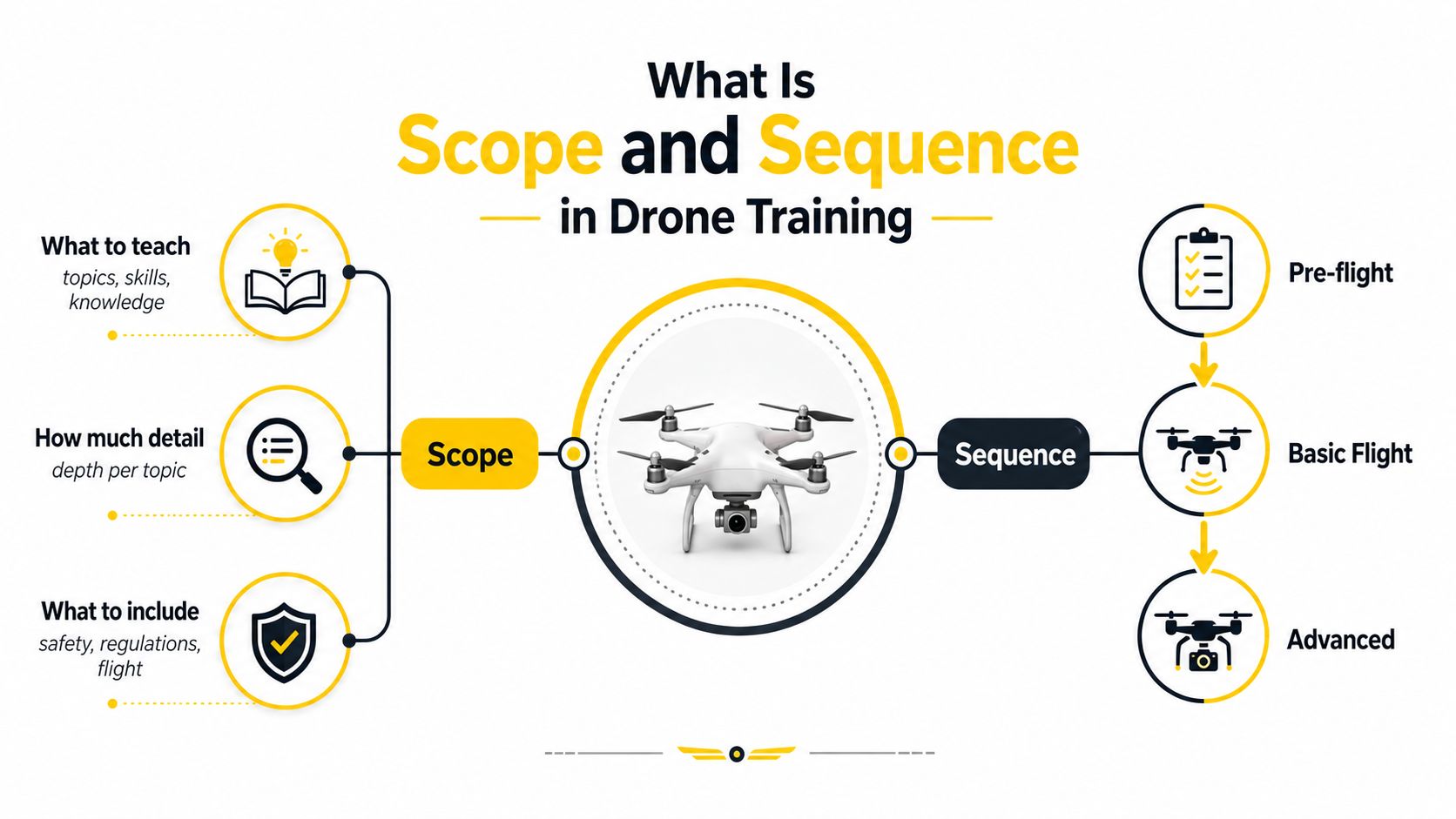
In plain English, scope is the full range of content a course needs to cover, and sequence is the order in which that content is taught. In aviation training, that order is not cosmetic. It's how a learner moves from basic knowledge to safe, independent operation without skipping the steps that make later tasks possible.
Australian curriculum language uses this idea in a formal way. ACARA describes the Australian Curriculum as a developmental sequence of learning from Foundation to Year 10, intended to give every student the same high-standard content regardless of location, and that matters because it shows how strongly Australia values ordered progression in learning design. NSW also defines a scope and sequence as a summary of what is taught, the sequence in which it is taught, and the syllabus outcomes addressed, and treats those documents as part of school evidence for policy and registration requirements.
For drone and aviation training, that same logic applies with even more force. A learner can't be expected to manage advanced flight tasks if they haven't first learned the rules, the aircraft, the safety habits, and the decision points that sit underneath the flight.
Practical rule: if a topic only makes sense after another topic has been mastered, it belongs later in the sequence.
A clear scope and sequence reduces cognitive load because the learner is never asked to solve too many new problems at once. It also supports skill transfer, since each lesson can attach to something already known instead of floating in isolation. That's why sequencing isn't a nice extra in professional training, it's the spine of the course.
For a provider that wants to compare course structures, the program overview at Ace Aviation Aerospace Academy is a useful starting point because it sits within the wider question of how training gets staged from entry-level learning to licence preparation.
The Core Components of Scope and Sequence
A strong scope and sequence document does more than list lesson topics. It identifies the learning outcomes, the knowledge areas, the skills, and the order in which those pieces should appear so that training builds in a sensible way. NSW's K–6 guidance describes these documents as flexible and fluid, but still specific enough to include unit titles, unit order, duration, syllabus outcomes, and cross-curriculum links.
Scope is the content boundary
Scope answers the question, “What must be taught?” In drone training, that usually means regulatory knowledge, airspace awareness, flight operations, safety practices, human factors, equipment handling, and assessment evidence. If the scope is too narrow, learners miss gaps. If it is too broad without structure, the course becomes difficult to teach and even harder to assess.
Sequence is the dependency map
Sequence answers the question, “What should come first?” CASA requires training to be delivered in a logical sequence and structured as a training plan, which is why a scope and sequence must show progression, not just coverage. A learner should not meet advanced operational tasks before the basic principles that support them.
A useful way to think about it is this:
- Unit titles tell the student what the block is about.
- Duration shows how much time is being allocated.
- Syllabus outcomes make the compliance link visible.
- Cross-curriculum links show where knowledge transfers across areas.
- Assessment alignment makes sure the check happens after the teaching, not before it.
For a curriculum planner, that structure is the difference between a course outline and a training system. A resource such as building a learning path is relevant here because it reflects the same planning logic, content should be assembled so one step prepares the next.
The same principle also shows up in vocational-style course design. The entry-level ACE READY course is described as beginner training that covers drone fundamentals, aviation safety, CASA regulations, flight operations, and preparation for advanced Remote Pilot Licence training in Australia. That kind of positioning makes sense because it sits at the front of a sequence, not in the middle of one.
For providers working through formal aviation pathways, the AVI30419 course page can be read through the same lens, as a qualification sits best when its learning elements are arranged in a dependency order that mirrors real operational readiness.
How Scope and Sequence Maps Progression in Aviation Training
A sensible drone pathway starts with rules and language, then moves into operating the aircraft, and only later asks the learner to handle more complex tasks. That progression matters because CASA training standards don't treat competence as a single moment, they treat it as a sequence of demonstrated capability. In practice, that means the order of instruction shapes whether the learner can apply what's being taught.
A student preparing for commercial work might begin with aeronautical knowledge, registration rules, and basic safety expectations. Once those ideas are stable, the trainer can introduce flight controls, pre-flight checks, and standard operating conditions. Later still, the student can be asked to plan missions, interpret data, manage communications, and work through more advanced operational scenarios.
A good sequence avoids the common error of teaching complex tasks too early. If mission planning appears before the learner understands the operating environment, the plan becomes a memory exercise instead of a judgement exercise. If radio procedures are introduced before the learner understands when and why communication is required, the radio skill stays detached from real operations.
Training breaks down when the lesson order asks for performance before understanding.
CASA's training-provider guidance says drone training should cover aeronautical knowledge standards, practical competency standards, an aeronautical knowledge exam, flight testing, and administrative requirements, all within a structured plan. That detail lines up with the way sequence should work in the classroom and on the flight line. Theory supports practice, practice supports assessment, and assessment should confirm a skill that has already been built.
The same logic helps explain why a commercial pathway for RePL and ReOC learners has to be staged. A learner first needs to understand the regulatory frame, then the aircraft, then the task environment, then the evidence required for independent operation. If any of those pieces arrives too late or too early, the whole sequence becomes harder to absorb.
A practical resource such as integrate training with HR records is useful for organisations that need to track where each learner sits in the pathway, because progression only works when training records reflect the order in which competence was built.
The Certificate III in Aviation career pathway article fits naturally into this same conversation, since structured progression is what separates a general interest in drones from a documented training pathway that supports aviation work.
Practical Examples and Templates for Lesson Planning
A usable scope and sequence document for RePL preparation shows how a learner moves through the course, not just which topics exist. For a training provider, that means setting out the module, the approximate duration, the key outcomes, and the prerequisites that should already be in place before the module begins.
A simple planning table gives the structure clearly.
| Module | Duration | Key Outcomes | Prerequisites |
|---|---|---|---|
| Drone fundamentals and safety | Intro block | Learner identifies parts of the aircraft, safety habits, and basic operational terms | None |
| CASA rules and operating limits | Early theory block | Learner understands registration, airspace awareness, and operational boundaries | Drone fundamentals and safety |
| Pre-flight checks and standard operations | Mid-course block | Learner completes routine checks and follows a safe start-up process | CASA rules and operating limits |
| Flight controls and manoeuvres | Mid-course block | Learner performs controlled flight tasks and basic handling | Pre-flight checks and standard operations |
| Mission planning and evidence | Later block | Learner plans a task and documents it properly | Flight controls and manoeuvres |
| Advanced operational scenarios | Final block | Learner applies knowledge in more demanding conditions | Mission planning and evidence |
That structure keeps the training logical. It also helps trainers place assessment after the skill has had time to settle, rather than halfway through the learning. A learner who is still trying to make sense of the basic steps is not ready for a final check.
For an entry-level commercial foundation, ACE STARTER gives a clear starting point for learners who need commercial drone basics before moving into more demanding aviation study. In sequencing terms, it belongs after beginner orientation and before licence-focused consolidation. ACE BRONZE sits in the same training conversation, because it is described as a foundation commercial drone course covering drone operations, flight safety, aviation theory, and practical skills for students beginning their journey toward licensed drone pilot work in Australia.
A provider can also use the same logic to compare sequencing choices. If regulatory content comes first, the learner understands the operating frame before touching the aircraft. If flight practice comes first, the learner may enjoy the lesson but still miss the reason behind the procedures. If data handling is introduced late, reporting tasks can feel disconnected from flight work. The better option is the one that makes each later module depend on an earlier one.
Australian drone registration rules show why the front of the sequence matters. CASA says drones used for business or as part of a job must be registered regardless of weight, free if the drone is 500 g or less, and subject to a $40 registration levy if it weighs more than 500 g. That is the kind of first-step compliance detail a learner needs before commercial use, not after it. CASA's registration requirements make that threshold explicit.
For organisations designing corporate or enterprise learning, the lesson plan should match the worksite reality. A trainee who will fly for inspection, mapping, or internal operations needs the sequence to mirror how those tasks are introduced in practice, starting with safety and regulatory boundaries, then system knowledge, then controlled flight, then task execution, then evidence and review.
Keeping Scope and Sequence Current in a Regulated Environment
A scope and sequence document should not be treated as a one-time file stored on a shared drive and forgotten. In drone training, the rules and use cases move often enough that the sequence needs regular review, especially when a provider is aligning training to CASA guidance and industry expectations. That is why version control matters.
CASA's training-provider page and licensing page are actively maintained, and that maintenance is a strong signal that providers need a living curriculum rather than a static snapshot. When a rule changes, the sequence may need to change too. When a new aircraft type or use case becomes relevant, the order of lessons may need to shift so the learner meets the right knowledge at the right time.
The practical question is not only “what should be taught?”, it's also “when should the course be revised?” A reasonable provider process usually includes:
- Scheduled review points so the document is checked regularly.
- Change logs so updates can be traced.
- Assessment audits so test items still match taught content.
- Regulatory watch habits so sequencing changes happen before confusion spreads.
- Trainer sign-off so the whole team knows which version is live.
CASA's requirements for standard operating conditions, equipment matching, and flight approvals make this especially important. The relevant rule set can change the way a module should be introduced, because a training sequence that worked well last year can become incomplete when the compliance environment shifts.
A curriculum is current only if the sequence still matches the rules the learner must operate under.
The same applies when a provider serves business clients. Enterprise programs and government training often need the sequence to reflect local operating realities, approval pathways, and internal compliance records. A version-controlled scope and sequence makes that easier to manage because the training team can show what changed, why it changed, and which learners were affected.
For a broader compliance reference, drone laws in Australia 2026 is useful context because it reinforces the need to keep training aligned with the current regulatory environment rather than treating regulations as background reading.
Conclusion and Next Steps for Training Providers
Scope and sequence is not a bureaucratic label. In Australian aviation training, it is the structure that turns content into progression, and progression into competence. A learner who sees the order clearly is more likely to understand the why behind each lesson, and a trainer who designs the order properly is more likely to produce safe, assessment-ready performance.
The strongest training pathways do three things well. They define what belongs in the course, they place the topics in a sensible order, and they keep that order aligned with current CASA requirements. That is why beginner content belongs before advanced tasks, why regulatory knowledge belongs before independent operation, and why assessment should follow, not lead, demonstrated learning.
For training providers, the next step is straightforward. Review the current scope and sequence document, check whether the lesson order still matches regulatory reality, and confirm that each module leads naturally into the next. If the front end of the course is weak, the rest of the pathway has to work too hard.
Providers building entry pathways can also look at structured starting points such as beginner drone training and foundation commercial training, then decide where their own learners need the most support before moving toward licence-level study. That approach is especially useful for RePL and ReOC planning, where sequencing is part of compliance as much as it is part of teaching.
Ace Aviation Aerospace Academy offers drone and aviation training in Australia, including RePL, AROC, ReOC consulting, enterprise drone training, and corporate drone training. For providers and learners who want a structured path into regulated aviation work, a clear training sequence is the right place to start, and Ace Aviation Aerospace Academy is one option for exploring that pathway.
FAQ
What does scope and sequence mean in drone training?
It means the course content is mapped by topic and ordered so learners build competence step by step.
Why does sequence matter for RePL training?
Because learners need foundational rules and skills before they can safely handle more complex operational tasks.
Should a scope and sequence document change over time?
Yes. It should be reviewed when regulations, aircraft types, or training requirements change.
Does a beginner drone course fit into scope and sequence planning?
Yes. Beginner content usually sits at the start of the pathway, before licence preparation and advanced operations.
How does scope and sequence help with compliance?
It makes the training order visible, which helps providers show that learners were taught the right things in the right order.