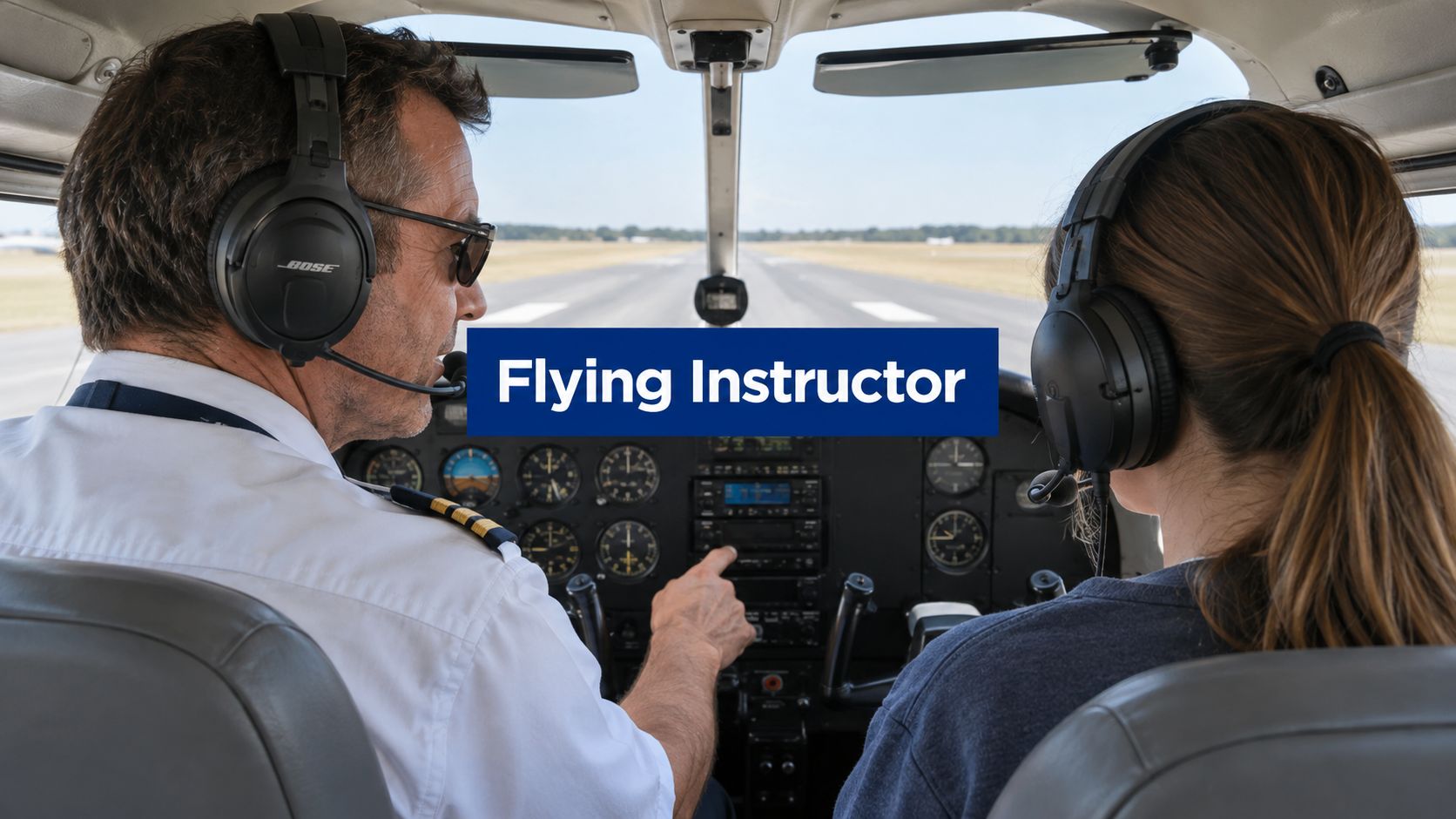
A licensed pilot often reaches the same crossroads. The flying is competent, the logbook is moving, but the next step isn't obvious. Airline recruitment may feel distant, charter work may be limited, and the pilot may already be the person newer students ask for help after a briefing or navigation exercise.
That's usually the moment a flying instructor course starts to look less like an add-on and more like a serious professional pathway. In Australia, CASA treats instructing that way for good reason. A flight instructor doesn't just demonstrate manoeuvres. An instructor teaches judgement, monitors student progress, and may authorise student solo flights once the legal and training standards are met.
Many applicants arrive at this point for different reasons:
- Hour-building pressure: Some commercial pilots want structured flying work rather than waiting for occasional charter or survey opportunities.
- Knowledge consolidation: Teaching often forces a pilot to sharpen weak areas that line flying can hide.
- Mentoring interest: Some pilots enjoy briefing, coaching, and watching a student become safe and independent.
- Career flexibility: Instructing can sit alongside other aviation work and can open doors into broader training roles later.
Table of Contents
- The Moment Pilots Start Thinking About Instructing
- What a Flying Instructor Course Actually Covers in Australia
- CASA Prerequisites You Must Meet Before Enrolling
- Inside the Course Syllabus and Training Structure
- Assessment Pathway From PIRC to Flight Test
- Career Outcomes and Where Instructors Actually Work
- How to Choose and Enrol in the Right Course
- Key Takeaways and Frequently Asked Questions
The Moment Pilots Start Thinking About Instructing
The first serious question isn't whether instructing sounds interesting. It's whether the applicant is ready for a regulated teaching role under CASA Part 61.
A common misunderstanding is that a flying instructor course is just another endorsement. It isn't. CASA places instructor ratings inside a tightly controlled licensing framework because instructors can influence whether a student is safe to fly alone, whether aeronautical experience has been properly completed, and whether a candidate is ready to be recommended for further testing.
Why CASA Treats It as a Professional Step
The Australian pathway starts from prior pilot competence, not from beginner training. CASA states that a person applying for a flight instructor rating must hold a PPL, CPL or ATPL, meet the aeronautical experience and education standards, pass the pilot instructor rating aeronautical knowledge exam, complete training with a flight training operator, and pass at least one flight test. CASA also says the operator conducting instructor training must hold a Part 141 or Part 142 certificate or equivalent approval and provide a detailed theoretical and airborne syllabus to CASA, as set out on the CASA flight instructor ratings page.
That framework tells a prospective applicant something important. Australia doesn't see instructing as casual hour-building. It sees instructing as a professional responsibility.
Practical rule: If a pilot isn't yet comfortable explaining normal and abnormal procedures clearly on the ground, the flying instructor course will feel harder than the flying itself.
What Usually Drives the Decision
The pilot who suits this pathway often has one of two mindsets.
One group wants to teach and is willing to accept that progress in instruction comes through repetition, supervision, and disciplined standardisation. The other group wants a job that keeps the logbook moving while deepening handling and decision-making skills.
Both reasons can be valid. The key is understanding the path before enrolling. That means checking CASA prerequisites, understanding what the syllabus contains, knowing how the PIRC exam and flight test fit together, and judging whether local employment patterns line up with the applicant's location and long-term aims.
What a Flying Instructor Course Actually Covers in Australia
A flying instructor course in Australia is training for a CASA flight instructor rating. It is not the same as a recreational add-on, an aerobatic endorsement, or ATPL theory study. The purpose is specific. It prepares a licensed pilot to conduct flight training within the privileges and limitations of the rating and grade held.
That distinction matters because many pilots compare unlike things. A type-related endorsement teaches a pilot to operate an aircraft or system. An instructor rating teaches a pilot to teach another person, assess progress, and operate inside a training organisation's approved system.
What the Rating Is Designed to Authorise
In plain terms, this course is about converting pilot skill into instructional competence. The candidate learns how to brief an exercise, demonstrate it, monitor student performance, correct mistakes safely, and debrief in a way that improves the next lesson.
CASA's requirements make it clear that this is a formal training function tied to approved operators and approved assessment. It's designed for pilots who already hold a licence and want to move into structured training work rather than general flying alone.
Who the Course Suits
The typical applicant already has operational flying experience and now needs a framework for teaching. That usually means a commercial pilot or a more advanced licence holder who wants to work in a flight school, an aeroclub, or another training environment.
A useful comparison sits outside crewed aviation. An entry-level drone course such as ACE READY introduces beginners to drone fundamentals, aviation safety, CASA regulations, and flight operations before more advanced training. A flying instructor course sits at the opposite end of the spectrum. It assumes existing pilot capability and then builds teaching, supervision, and assessment skills on top of it.
The course isn't about proving that the applicant can fly. It's about proving that the applicant can teach flying safely and consistently.
How the Course Fits Into a Career
The rating is modular because it attaches to an existing licence rather than replacing it. That structure lets a pilot move from line operations or general aviation work into training without starting over.
Typical reasons for adding the rating include:
- Flight school employment: Working in ab initio or licence training.
- Regional teaching roles: Supporting aeroclubs and local operators where student demand exists.
- Structured hour-building: Gaining regular flying and teaching exposure through dual instruction.
CASA Prerequisites You Must Meet Before Enrolling
Before paying a deposit, a pilot should check eligibility against CASA's actual entry gates. Many enquiries become clearer very quickly at this stage. Some applicants are ready now. Others still need more time in command, more paperwork, or a separate teaching qualification.
Licence and Experience Baseline
CASA's Part 61 guidance says an applicant for a flight instructor rating must hold a PPL, CPL or ATPL and must also have at least 200 hours of flight time as a pilot and 100 hours as pilot in command, unless the applicant completed a CPL integrated training course or already meets the licence requirements for that aircraft category, according to CASA's flight instructor training guidance.
That requirement reflects the underlying logic of instruction. CASA wants the person in the teaching seat to bring enough independent flying exposure to recognise developing errors early and intervene before a training flight becomes unstable or unsafe.
A pilot who wants a quick readiness check can compare current licence and experience details against a structured tool such as the AAA licence finder, then confirm the result with the training provider.
Teaching Qualification and Knowledge Exam
Flying skill isn't enough on its own. CASA also requires the applicant to complete an approved course in principles and methods of instruction or hold an equivalent qualification such as a Certificate IV in Training and Assessment or a tertiary teaching qualification, as outlined in the Part 61 guide for aeroplane category flight crew licensing.
That requirement often surprises pilots. It shouldn't. A good instructor has to sequence a lesson, identify why a student is struggling, adjust the explanation, and document training accurately. None of that is guaranteed by strong aircraft handling alone.
CASA's flight crew licensing material also says the applicant must have passed the instructor rating aeronautical knowledge examination, completed the flight training for the rating, and met the aeronautical experience requirements in Part 61, as stated in the flight crew licensing manual.
A Simple Pre-Enrolment Check
Before enrolment, a sensible applicant usually confirms:
- Licence status: The pilot licence must already be held at the required level.
- Logbook evidence: Command time and total time need to be clearly recorded.
- Instructional study: The principles and methods requirement must be completed or scheduled through an approved pathway.
- Training operator status: The course provider must be authorised to conduct instructor training.
Inside the Course Syllabus and Training Structure
A pilot often feels the shift into instructing during the first practice briefing. You know how to fly the exercise. Then you try to explain it to a beginner in the right order, using plain language, while leaving out nothing that keeps the lesson safe. That is usually the point where applicants realise the course is preparing them for a regulated teaching job, not polishing their own handling.
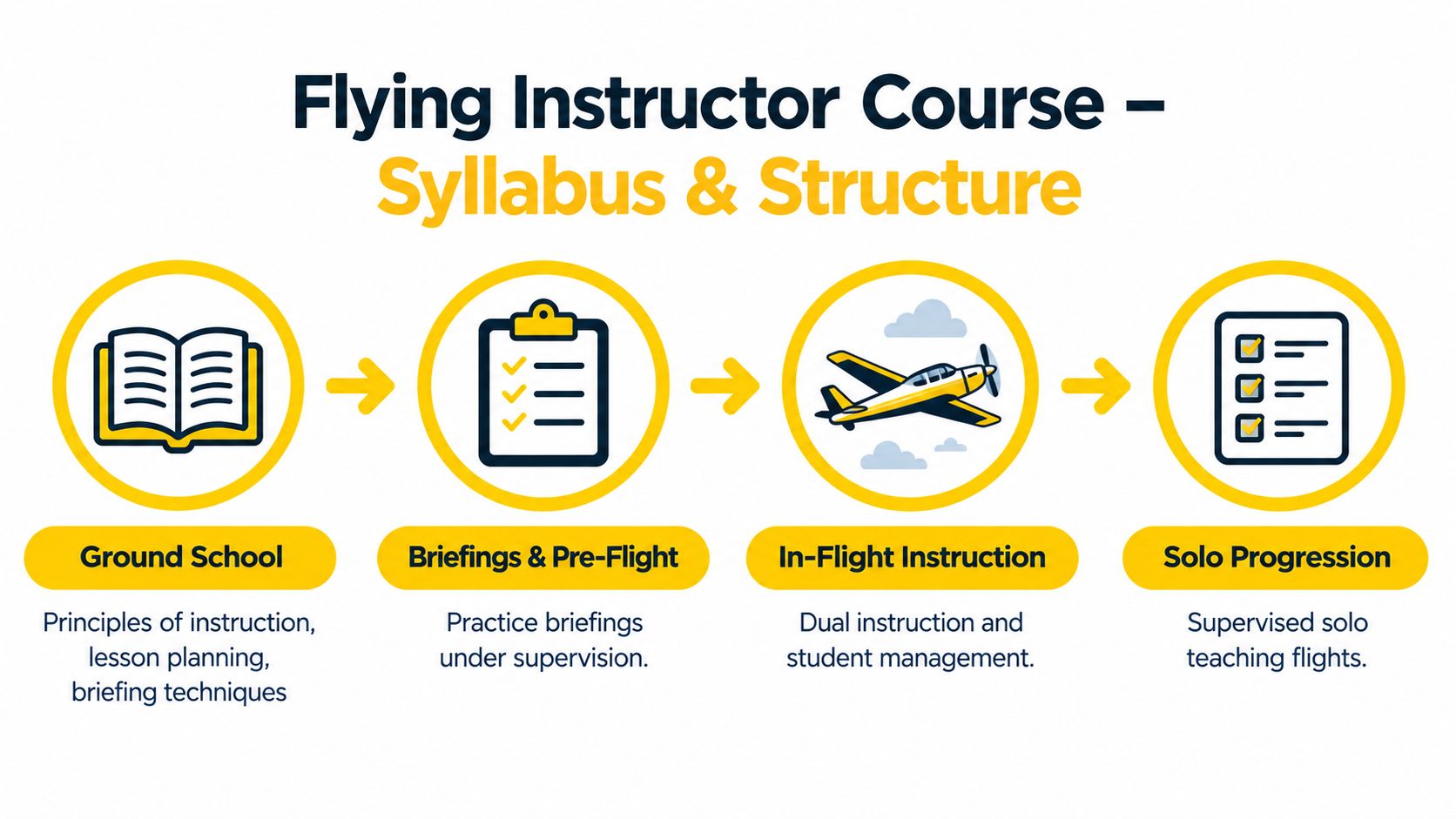
Most flying instructor courses in Australia are built like a staircase. Each step supports the next. You start with how students learn, move into how to brief and debrief, then practise teaching individual flight exercises, and only then put it all together in the aircraft under supervision.
Ground School and Instructional Method
For a new Grade 3 candidate, the ground phase matters more than many pilots expect. The course turns flying knowledge into teachable lessons. You work on lesson structure, sequencing, common student errors, briefing technique, and how to tell the difference between a student who does not understand and one who is overloaded.
That distinction matters in the cockpit. If a student keeps rounding out too high, the fix is not always "demonstrate it again." Sometimes the student missed the visual picture. Sometimes the briefing used too many technical terms. Sometimes the lesson was introduced before the earlier skill was stable enough. A good instructor learns to diagnose the reason, not just react to the result.
Briefings, Air Exercises, and Supervised Practice
Once the instructional theory is in place, training shifts into delivery. The candidate usually practises the same teaching cycle repeatedly until it becomes consistent:
- Pre-flight briefings: Explaining the aim of the exercise, the standard to be reached, and the errors a student is likely to make.
- Airborne demonstrations: Flying the exercise while talking through actions, lookouts, references, and safety limits in a way a beginner can follow.
- In-flight correction: Intervening early enough to keep the lesson safe while still letting the student learn from manageable mistakes.
- Debriefing: Turning the flight into clear takeaways, with specific corrections the student can apply on the next lesson.
A candidate usually discovers quickly that teaching a stall is harder than recovering from one. The harder part is explaining, demonstrating, monitoring and protecting the aircraft at the same time.
That is why supervised practice sits at the centre of the course. An instructor candidate is not judged only on whether the aircraft stays within tolerance. The training also looks at pacing, clarity, judgement, and whether the candidate can keep the student's workload at a level that supports learning rather than confusion.
A structured aviation program such as the Certificate III in Aviation can help readers compare how aviation training is organised and assessed across different pathways, even though the flight instructor rating follows its own CASA training and testing requirements.
Why the Training Is Sequenced This Way
The sequence is deliberate. A weak briefing usually creates a weak airborne lesson. A poor debrief often means the same error appears again on the next flight. Instructor training therefore builds from explanation, to demonstration, to observation, to correction.
That progression also reflects how the Part 61 instructor pathway works in practice. A new Grade 3 instructor starts at the supervised end of the profession because CASA treats instructing as a graded responsibility, not just another aircraft endorsement. The course structure mirrors that idea. First learn to teach one exercise properly. Then learn to manage a whole lesson. Then develop the judgement that later supports progression through the grades.
Readers coming from another aviation training environment may recognise the pattern. Technical knowledge, regulatory responsibility, and practical performance are taught together because an instructor is expected to do all three on the job, often in regional schools where one person may brief, fly, assess progress, and maintain training records for the same student on the same day.
Assessment Pathway From PIRC to Flight Test
A lot of pilots reach this stage assuming the hard part is over because the flying is done. Instructor assessment works differently. CASA is checking whether you can transfer skill, not just perform it yourself.
That is why the path runs from a knowledge exam to a practical test. It works much like checking a tradesperson before they supervise an apprentice. First, you confirm they understand the method and the rules. Then you watch whether they can teach the job safely, clearly, and in the right order.
The Knowledge Exam and the Flight Test
Before the rating can be granted, you must complete the pilot instructor rating aeronautical knowledge exam, usually called PIRC. This exam focuses on teaching method, instructor responsibilities, human factors, lesson delivery, and the judgement expected of someone who will be guiding lower-time pilots.
That distinction matters. A pilot can be competent at flying an exercise and still struggle to explain it, sequence it, or correct a student's mistake at the right moment. PIRC checks the theory behind instruction so the later flight test is not carrying the whole burden.
The flight test then puts that theory under pressure in a real training context. The examiner is looking for aircraft control, but also for something more professional than a normal licence test. Can you brief the exercise in plain language? Can you demonstrate it to a student standard, watch what the learner is doing, pick the right error to correct first, and keep the lesson safe without taking over too early?
Those are the habits schools pay for, and the regulator wants to see them before a new instructor starts teaching under supervision.
Grade Progression Under Part 61
The rating is part of a graded system, which tells you a lot about how Australia treats instruction as a profession. The usual entry point is Grade 3, where a newly qualified instructor teaches under oversight and builds experience in real student situations.
Progression then depends on time, judgement, and logged instructional work, not one good day on test. As noted earlier, moving up through the grades requires further experience and responsibility. Reaching Grade 1 sits at the senior end of that pathway, after substantial instructional time and a period already spent working as a Grade 2 instructor.
That structure often answers a question applicants do not ask early enough. "Will this course make me fully independent straight away?" Usually, no. It gets you to the supervised entry point of the profession. CASA sets it up that way because new instructors are still learning how to teach while they are teaching.
CASA Instructor Rating Assessment Stages
| Stage | Purpose | Typical Outcome |
|---|---|---|
| PIRC exam | Confirms knowledge of instructional theory, responsibilities, and training standards | Candidate meets the knowledge requirement that supports rating issue |
| Flight training with an approved operator | Develops briefing, demonstration, fault correction, and student management skills | Candidate reaches the practical standard needed for the instructor flight test |
| Instructor flight test | Assesses whether the candidate can teach safely in flight and on the ground | Successful candidate may be granted the relevant instructor rating and initial grade |
| Post-test grade progression | Builds supervised experience and broader teaching judgement | Instructor can progress through higher grades after meeting Part 61 experience requirements |
A simple self-check helps here. Pilots who like procedure, clear communication, and patient correction usually adapt well to this pathway. Pilots who mainly want quick hours often find the supervised structure, paperwork, and teaching discipline harder than they expected.
Career Outcomes and Where Instructors Actually Work
A new Grade 3 instructor usually enters the workforce the same way a newly licensed pilot enters line operations. The licence or rating is the entry ticket, not the end of development. In practice, that means early instruction work is concentrated in places that can support supervision, steady student flow, and standardised training. That is why many first jobs sit in flight schools, aeroclubs, and regional operators running ab initio, licence, and review flying.
What the Workforce Looks Like
Flying instruction in Australia is a regulated profession, but it is still a small employment market. The Jobs and Skills Australia flying instructors profile lists 970 employed flying instructors nationally, a median age of 39, 34% working part-time, and the strongest employment concentration in Queensland, New South Wales, and Victoria.
Those numbers matter for a prospective applicant because they shape the job you are likely to get first. A smaller workforce usually means schools hire for specific operational needs, not in large intake waves. Part-time work also appears often enough that some instructors piece together a week from several duties such as circuit training, pre-flight briefings, flight reviews, theory support, and club flying activity.
Where New Instructors Tend to Fit
The first role is often less glamorous than applicants expect, but it is where teaching judgement forms.
A busy training school gives a new instructor repeated exposure to the same lessons. That repetition works like circuit training for teaching skill. You brief the exercise, demonstrate it, watch a student try it, correct the errors, then do it again with a different student who struggles in a different way. Over time, the instructor stops merely reciting a lesson plan and starts diagnosing why a student is behind the aircraft.
That is one reason regional and suburban training environments matter so much. They are often the places where aircraft utilisation, student demand, and supervision line up well enough for a Grade 3 to build real teaching depth.
Pilots comparing openings can scan current aviation instructor job listings across Australia, then check whether the operator mainly needs trial instructional flights, ab initio training, navigation training, flight reviews, or theory support. That detail matters because the right first job is the one that matches your grade, endorsements, and tolerance for repetitive training work.
How Careers Usually Progress
A common pathway looks like this:
- Entry stage: Work as a supervised Grade 3 instructor in a school with regular student volume.
- Development stage: Build consistency in briefings, airborne demonstrations, and student correction, then progress to broader teaching responsibility as experience grows.
- Later stage: Move into senior instructional work, testing support, specialist endorsements, or management and standards roles, depending on grade progression and the operator's needs.
The key point is simple. A flying instructor course does not just prepare someone to get a rating. It starts a professional path under CASA's grading system, where early employment, supervision, and location all shape how quickly an instructor grows from competent teacher to trusted training captain.
How to Choose and Enrol in the Right Course
Choosing a flying instructor course is less about glossy messaging and more about matching the provider's structure to the applicant's logbook, schedule, and goals. The key question is whether the school can take an already licensed pilot and systematically turn that pilot into a safe, test-ready instructor.
What to Compare First
A practical comparison starts with provider approval and training structure.
Comparing Australian Flying Instructor Course Providers
| Criteria | Part 141 Operator | Part 142 Operator |
|---|---|---|
| Regulatory role | Conducts approved flight training under Part 141 | Conducts integrated or advanced flight training under Part 142 |
| Course structure | Often focused on a clear approved syllabus with school-based delivery | Often used for more integrated organisational training environments |
| Best fit | Suits applicants seeking structured instruction training in a conventional flight school setting | May suit applicants whose pathway sits inside a larger integrated training framework |
| Questions to ask | How are briefings, supervised teaching, and flight test prep scheduled? | How is instructor training integrated with the organisation's wider training system? |
The applicant should then look beyond the certificate category and ask direct operational questions.
- Syllabus transparency: The provider should show how theory, briefing practice, flight training, and test preparation are sequenced.
- Staffing and access: The applicant needs to know who delivers instructor training and how consistently that person is available.
- Training records: A strong provider tracks progress clearly and links each lesson to the syllabus outcome.
- Assessment preparation: Mock briefings and mock flight test items should appear before the actual test phase.
Enrolment Checks That Prevent Problems
Several problems appear before training even starts. Missing logbook evidence, incomplete teaching prerequisites, and uncertainty about CASA records can all delay commencement.
A sensible applicant usually prepares:
- Licence documents that match CASA records.
- Logbook totals that clearly support eligibility.
- Instructional qualification evidence for principles and methods of instruction.
- Exam planning for the PIRC requirement.
- Provider questions about scheduling, supervision, and flight test readiness.
When the paperwork is ready, the next practical step is submitting an enquiry or application through the provider's enrolment process, such as the AAA enrolment page, and then confirming any school-specific pre-course requirements.
Some applicants choose a school based only on aircraft type or location. A better filter is whether the school can explain exactly how it gets a candidate from entry check to flight test standard.
Key Takeaways and Frequently Asked Questions
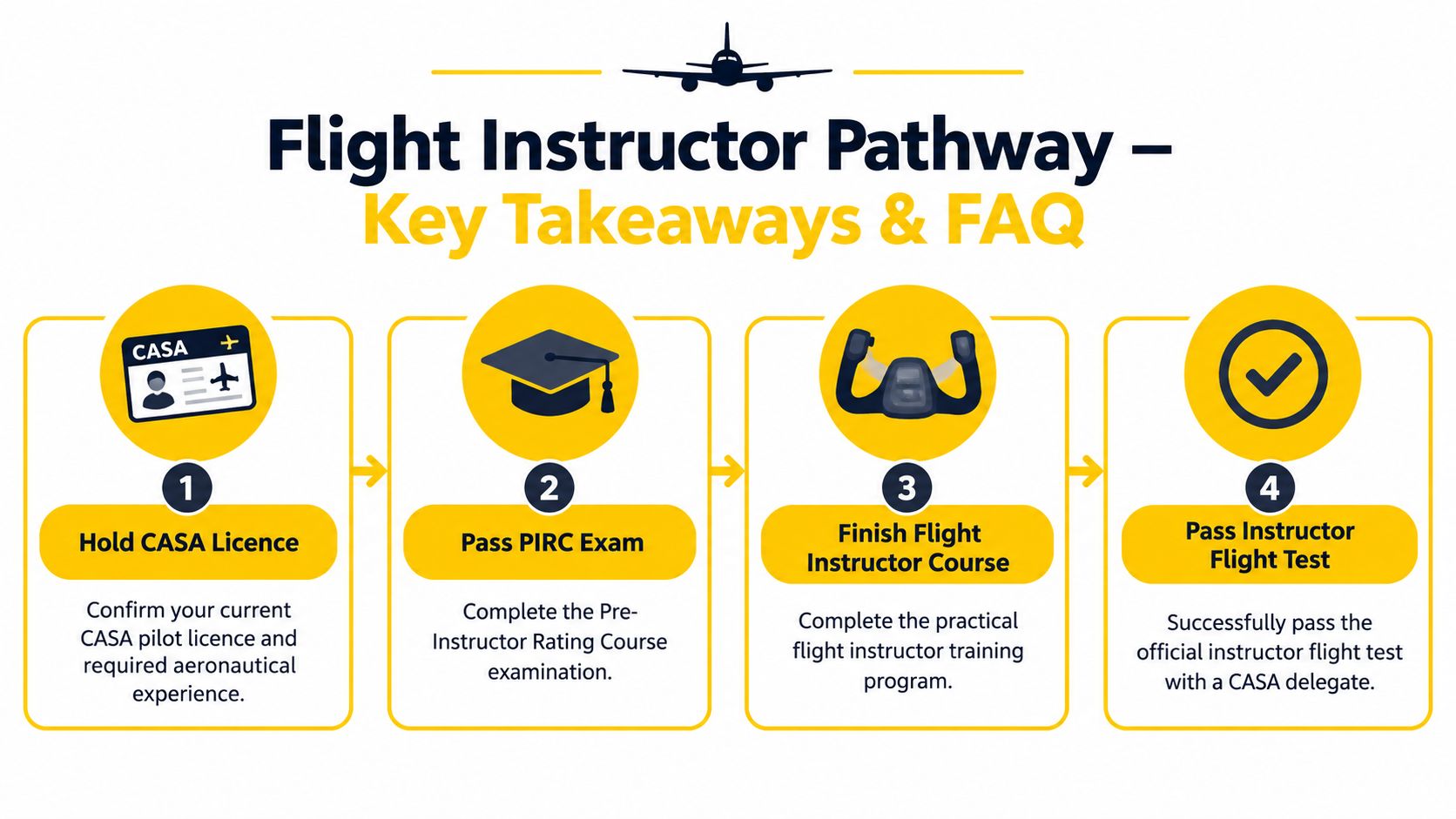
The Australian flight instructor pathway is best understood as a professional conversion from pilot competence to teaching competence. The rating sits under CASA Part 61, requires prior flight experience, requires instructional theory, and requires formal testing. It suits pilots who enjoy careful explanation, repeated student contact, and standardised training work.
The essential checkpoints are straightforward in concept even if the training itself is demanding. The applicant must hold the right licence, meet the aeronautical experience requirement, complete the instructional study requirement, pass the knowledge exam, complete the approved flying instructor course, and pass the instructor flight test.
For readers who are still comparing aviation training options more broadly, the AAA FAQ page can help with general training and enrolment questions across different aviation programs.
The course rewards patience and teaching instinct more than speed. Pilots who only want a fast shortcut to the next cockpit often underestimate that.
Frequently Asked Questions
Is an Australian flight instructor rating recognised internationally
Recognition depends on the other country's aviation authority. The rating itself is issued under Australian CASA rules, so a pilot planning to instruct overseas should check the conversion or recognition rules in that jurisdiction.
How long does supervised teaching last
There isn't a single universal timeframe. Supervised teaching continues through the graded instructor pathway and depends on the instructor's grade, operational setting, and progression toward higher privileges.
Does the rating require a separate teaching qualification
Yes, CASA requires an approved course in principles and methods of instruction or an equivalent qualification accepted under the regulations.
Can a Grade 3 instructor still build flying experience
Yes. Instructing is still flying work, but it is flying performed inside a training role with supervision and grade-based limitations.
Is a flight instructor rating the same as examiner approval
No. An instructor teaches and assesses student progress within training. An examiner or flight tester role is a separate authority with different approval requirements.
Does previous experience reduce the course workload
Previous flying experience helps with aircraft handling and judgement, but it doesn't remove the need to meet CASA's instructional training and assessment requirements.
Ace Aviation Aerospace Academy provides aviation and drone training across Australia, including programs such as the Remote Pilot Licence, Aeronautical Radio Operator Certificate, and Certificate III in Aviation for readers comparing broader aviation training pathways alongside instructor development. For current course information and training options, visit Ace Aviation Aerospace Academy.