
The Centrelink Relocation Scholarship is a yearly, non-taxable payment of $5,590 in the first year, $2,795 in years 2 and 3, and $1,396 from year 4 onward. It is only paid to students already receiving Youth Allowance or ABSTUDY Living Allowance.
That is the simple answer. The messy part is working out whether a move, a course, and a second payment can all align without leaving money on the table.
Table of Contents
- What the Centrelink Relocation Scholarship Actually Is
- Relocation Scholarship Payment Rates for 2025
- Who Is Eligible for the Relocation Scholarship
- How the Relocation Scholarship Stacks With Other Payments
- How to Apply and Check Your Entitlements
- A Relocation Scenario for an Ace Aviation Aerospace Academy Student
- Documentation Checklist and Funding Strategy
- Common Questions About the Centrelink Relocation Scholarship
What the Centrelink Relocation Scholarship Actually Is
A student accepts a course offer in another town, then discovers the move costs more than the course admin ever mentioned. That is exactly where the Centrelink Relocation Scholarship fits, but only if the student is already inside the right income-support system.
The scholarship is a yearly, non-taxable payment run through Services Australia, and it is designed to help with accommodation and relocation costs when a student needs to live away from home for higher education. It is not a stand-alone grant. It sits on top of Youth Allowance or ABSTUDY Living Allowance, which means the scholarship is part of the broader student-payment structure, not a separate pot of money. The Services Australia guide also shows the payment is made as a lump sum on commencement, then paid annually if eligibility continues, which is why it is treated as relocation support rather than general study income. Centrelink and student relocation payment rules

Why the payment exists
The policy purpose matters because it explains the structure. NSW's education department describes the scholarship as support for students who move to or from a regional or remote area for study, which makes the payment feel more like a regional access measure than a generic city-student benefit. That is also why the first year is the biggest. The payment is meant to absorb the shock of the move itself, not just chip in for ongoing living costs.
Practical rule: if the student is not already on Youth Allowance or ABSTUDY Living Allowance, the Relocation Scholarship is not the payment to chase first.
That distinction saves time. It also stops students from reading every Centrelink payment as if it were available on its own, which is where a lot of confusion starts. The smarter approach is to treat the scholarship as one moving part in a linked student-support package.
Relocation Scholarship Payment Rates for 2025
The 2025 rates are easy enough to read once they are split by family-home location. The first-year figure is the headline number because relocation costs are front-loaded, especially when rent bonds, upfront rent, travel, and moving expenses all land at once. Services Australia sets the rates for students whose family home is in a regional or remote area at $5,590 in year 1, $2,795 in years 2 and 3, and $1,396 from year 4 onward. If the family home is not regional or remote but the study location is, the first-year amount can still be $5,590, then fall to $1,396 in later years. Services Australia relocation scholarship rates
2025 rate comparison
| Year of Qualification | Regional or Remote Family Home | Non-Regional Family Home |
|---|---|---|
| Year 1 | $5,590 | $5,590 |
| Year 2 | $2,795 | $1,396 |
| Year 3 | $2,795 | $1,396 |
| Year 4 onward | $1,396 | $1,396 |
A student moving from a regional family home to a capital-city campus should read the table with one blunt question in mind, which column reflects the home address Centrelink uses for the claim. That answer determines whether the student stays on the higher year-2 and year-3 path or drops to the lower ongoing amount.
What the numbers actually mean
The first-year payment is deliberately higher because the first move costs the most. That is the year when students usually need to pay for the accommodation setup, not just ongoing rent.
The payment is built to soften the first relocation hit, not to fund an entire degree.
That is why it should be planned alongside other support, not in isolation. Students who treat the scholarship as the full funding answer usually underestimate what still needs to be covered after the move lands.
Who Is Eligible for the Relocation Scholarship
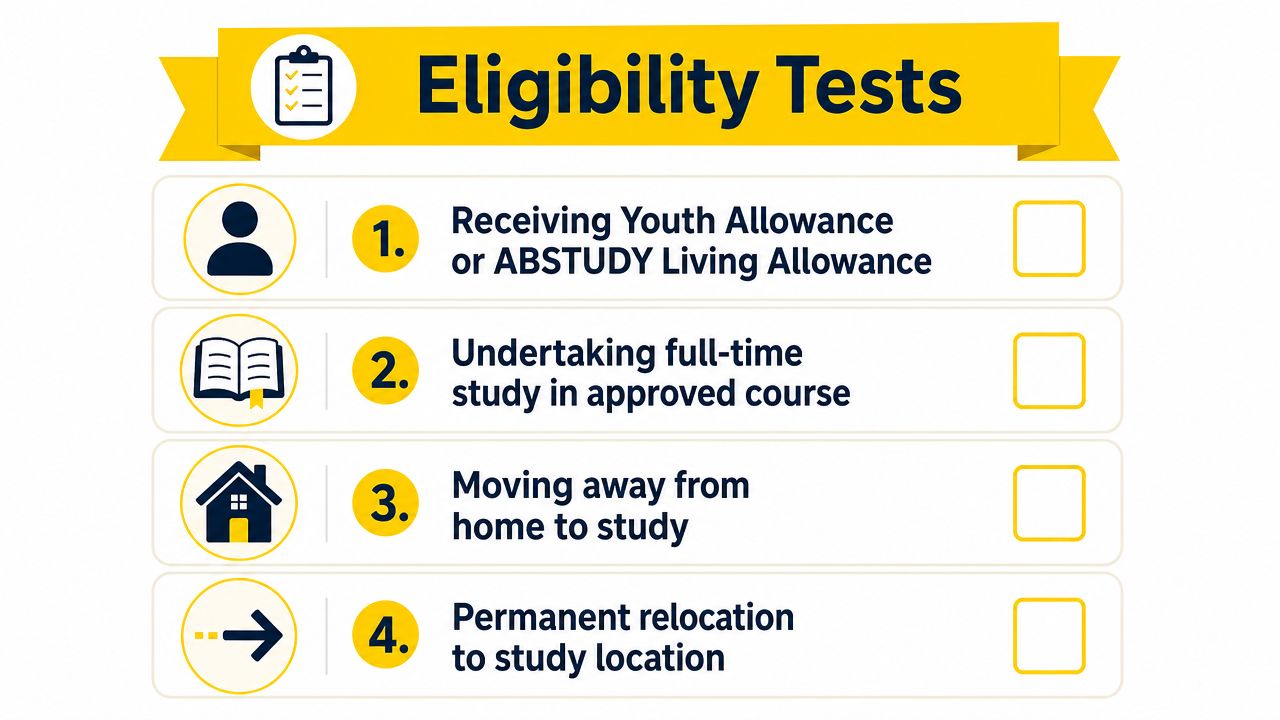
A student does not get the Relocation Scholarship just by needing help with rent. Centrelink looks for a specific set of tests, and the cleanest way to handle the claim is to work through them in order.
The four core tests
- Already receiving Youth Allowance or ABSTUDY Living Allowance. The scholarship sits on top of those payments, so this is the starting point.
- Studying full-time in an approved scholarship course. The course has to meet the scholarship rules, and the approved course list is the place to check whether the study you have picked qualifies. Youth Allowance and scholarship course rules You should also confirm the course itself, including your campus option, at approved scholarship courses.
- Needing to live away from the family home to study. The payment is for relocation costs, so a normal daily commute does not do the job.
- Starting the course or continuing it within the next 35 days. That timing rule is strict. Students get caught out when they delay after an offer, deferment, or enrolment change.
The exclusion most students miss
Overlap is where people make mistakes. The scholarship is excluded where a student is likely to receive a disqualifying accommodation scholarship within the next 12 months, and one university source also notes that students cannot receive it if they are already getting the Commonwealth Accommodation or Relocation Scholarship. That is the sort of detail that can easily break a funding plan if it is missed before accepting another offer.
The DVA pathway works differently. The Department of Veterans' Affairs says eligible students do not need to apply because eligibility is worked out automatically. DVA student support and relocation scholarship
The practical sequence is straightforward. Check the base payment first, then the study load, then the timing, then any scholarship conflict. If you skip one of those checks, you can end up relying on money that Centrelink will not pay.
How the Relocation Scholarship Stacks With Other Payments
Students either build a solid funding mix or accidentally cut off options they still needed. The Relocation Scholarship does not sit alone, and the primary question is not just whether it exists. The core inquiry is what can be received together, what replaces what, and what the student gives up by choosing one path over another.
The main payment mix
- Youth Allowance or ABSTUDY Living Allowance, which are the base payments the scholarship sits on top of.
- Relocation Scholarship, which adds the relocation support once the student is already on the right base payment.
- Tertiary Access Payment, which can be available to some regional students moving to study, and is noted as being up to $5,000.
- Student Start-up Loan, which is noted as $1,349 twice yearly.
- Commonwealth Accommodation Scholarship, which can block the relocation scholarship if the student already receives it.
The key comparison is not just amounts, it is function. The base payment helps with living costs. The relocation scholarship helps with the move. The Tertiary Access Payment is another relocation-linked support. The Student Start-up Loan is debt, not a grant, so students should be conservative before taking it on.
Side-by-side trade-offs
| Payment | What it does | Can it sit alongside the Relocation Scholarship? |
|---|---|---|
| Youth Allowance | Main student income support | Yes, it is the payment the scholarship depends on |
| ABSTUDY Living Allowance | Main student income support for eligible Aboriginal and Torres Strait Islander students | Yes, it is the payment the scholarship depends on |
| Tertiary Access Payment | Extra relocation support for some students, noted up to $5,000 | Students should compare eligibility, because it may be the better fit in some cases |
| Student Start-up Loan | Loan support, noted as $1,349 twice yearly | It can be part of the broader mix, but it is repayment-based |
| Commonwealth Accommodation Scholarship | Institutional accommodation support | Often a conflict, because guidance says it can block the relocation scholarship |
ACE PLATINUM is one example of an aviation training package that can sit inside a wider student-planning conversation because it includes RePL, AROC, Aviation English, Express ReOC, Certificate III in Aviation, advanced operations training, and preparation to operate and manage a commercial drone business.
If a student is eligible for more than one support route, the sensible move is to compare the stack before accepting anything. Once a conflicting scholarship is taken, the better Centrelink outcome may be gone.
How to Apply and Check Your Entitlements
Most students do not lodge a separate Relocation Scholarship claim. They claim the base payment first, then Services Australia assesses the relocation entitlement as part of that linked claim. That makes the process easier, but only if the student fills in the details carefully.
The practical claim path
- Apply for Youth Allowance or ABSTUDY through myGov.
- Link the Services Australia account.
- Complete the study details.
- Provide the relocation information.
- Submit the claim and wait for the outcome.
If a student gets stuck during the claim, the right move is to use the Services Australia account notes, then follow up by phone. The point is not to guess at the entitlement. It is to make the linked claim clean enough for the system to assess correctly.
What happens when a payment is missed
The Department of Veterans' Affairs says the scholarship is generally paid in February each year depending on when study commenced, and that eligible students do not need to apply because eligibility is determined automatically. DVA relocation scholarship payment timing
If the payment does not arrive when expected, the first job is to check the claim outcome letter and the linked payment status. Then the student should confirm that the study start date, relocation details, and base payment details all match what was lodged.
ACE BRONZE is a foundation commercial drone course covering drone operations, flight safety, aviation theory, and practical skills, and it suits students starting out toward licensed drone pilot work in Australia.
For direct help with a claim problem, the cleanest step is to use the Ace Aviation Aerospace Academy contact page and compare the training timeline against the Centrelink timing rules before enrolment gets too far along.
A Relocation Scenario for an Ace Aviation Aerospace Academy Student
A regional student enrols in the Remote Pilot Licence (RePL) course at Ace Aviation Aerospace Academy, then adds the Aeronautical Radio Operator Certificate (AROC) because the pathway needs both qualifications. The move is a short training relocation, not a multi-year degree move, so the student has to be tighter on dates, proof of study, and where the claim sits in the wider payment mix.
What still matters in a vocational aviation move
The Centrelink rules still sit at the centre of it. The student needs to be on Youth Allowance or ABSTUDY Living Allowance, studying full-time in an approved course, moving away from home to study, and starting the course or continuing it within the next 35 days. Vocational aviation training can be treated differently from a standard bachelor degree, so the student should confirm the course status before assuming the relocation payment will follow automatically.
A regional student heading to Melbourne should line up the study dates, relocation dates, and payment claim before the move is booked. If the course has an approved-provider pathway, that detail belongs in the claim file, not buried in a separate folder that never gets checked. For the academy location itself, the student should also check the Melbourne training site so the claim matches the actual place of study.
For the practical side of getting from a regional home to an urban training location, Freedom Cars student solutions can help students sort transport without locking themselves into a long vehicle hire arrangement.
Why timing beats optimism
Students often wait until they are packed before dealing with the payment. That is backwards. Lodge the claim first, then arrange transport, then sort the first week of accommodation.
The Melbourne training location forces the student to think like a relocation applicant, not just someone who has enrolled in a course. It also highlights the split between one-off moving costs and ongoing living costs, which is the gap the scholarship is meant to help cover. For students who are building a wider funding plan, the relocation payment sits alongside Youth Allowance or ABSTUDY, and it can be weighed against other support rather than chased in isolation.
Documentation Checklist and Funding Strategy
Students who keep weak records end up spending more time fixing Centrelink issues than they spent applying for the course. The clean approach is to keep the evidence in one place before the claim is lodged.
Keep these documents ready
- Proof of identity for the claimant.
- Evidence of the family home address.
- Enrolment confirmation for the course.
- Study-load evidence showing the full-time load.
- Lease or accommodation evidence for the new location.
- DVA documents, if the student is claiming through that pathway.
A move budget also needs a reality check. A practical guide to saving on your Move is useful when the relocation cost is starting to swallow the scholarship before the student has even unpacked.
Make the funding decision before lodging
The smart funding strategy is to compare the Relocation Scholarship, the Tertiary Access Payment, and the Student Start-up Loan before submitting anything. Once the claim is lodged, the student has less flexibility to reshuffle the support mix if another payment would have been the better fit.
The same discipline applies to aviation study choices. If the student is considering training pathways linked to Ace Aviation Aerospace Academy, the funding conversation should happen before travel and accommodation are locked in, not after.
Keep the paperwork tight, keep the dates tight, and keep the payment mix under review. That is how students avoid finding out too late that a different support route would have been better.
Common Questions About the Centrelink Relocation Scholarship
Is the Relocation Scholarship taxable?
No. The scholarship is a non-taxable payment.
Does part-time or online study qualify?
No. The Department of Social Services guidance points to full-time study in an approved course.
What if the student takes a gap year or defers?
The timing rule is the issue. The course must be starting or continuing within 35 days, so a long deferral usually breaks the entitlement path.
What if the student moves back home mid-year?
The payment is tied to relocation for study. If the living situation changes, the student should update Services Australia quickly, because the basis for the payment may no longer hold.
Does the scholarship have to be repaid if study stops?
The scholarship itself is not described as a loan, so it is not treated like debt. But the entitlement can stop if the study or relocation conditions stop, so the student should check the account outcome before assuming anything continues. For broader moving-cost planning, the Home Removals Sydney hidden costs guide is a useful reminder that the scholarship is only one part of the budget picture.
For more on study support questions that come up during enrolment and relocation, the Ace Aviation Aerospace Academy FAQ is the right place to check course-related details before the move is locked in.
Ace Aviation Aerospace Academy supports students planning practical aviation pathways, including RePL and AROC training, where relocation and study timing can affect the funding picture. If a student is weighing a move for drone training, the next step is to check the course details, line up the claim timing, and see how the payment mix fits the cost of getting started. Visit Ace Aviation Aerospace Academy and use the funding rules before the move becomes expensive.