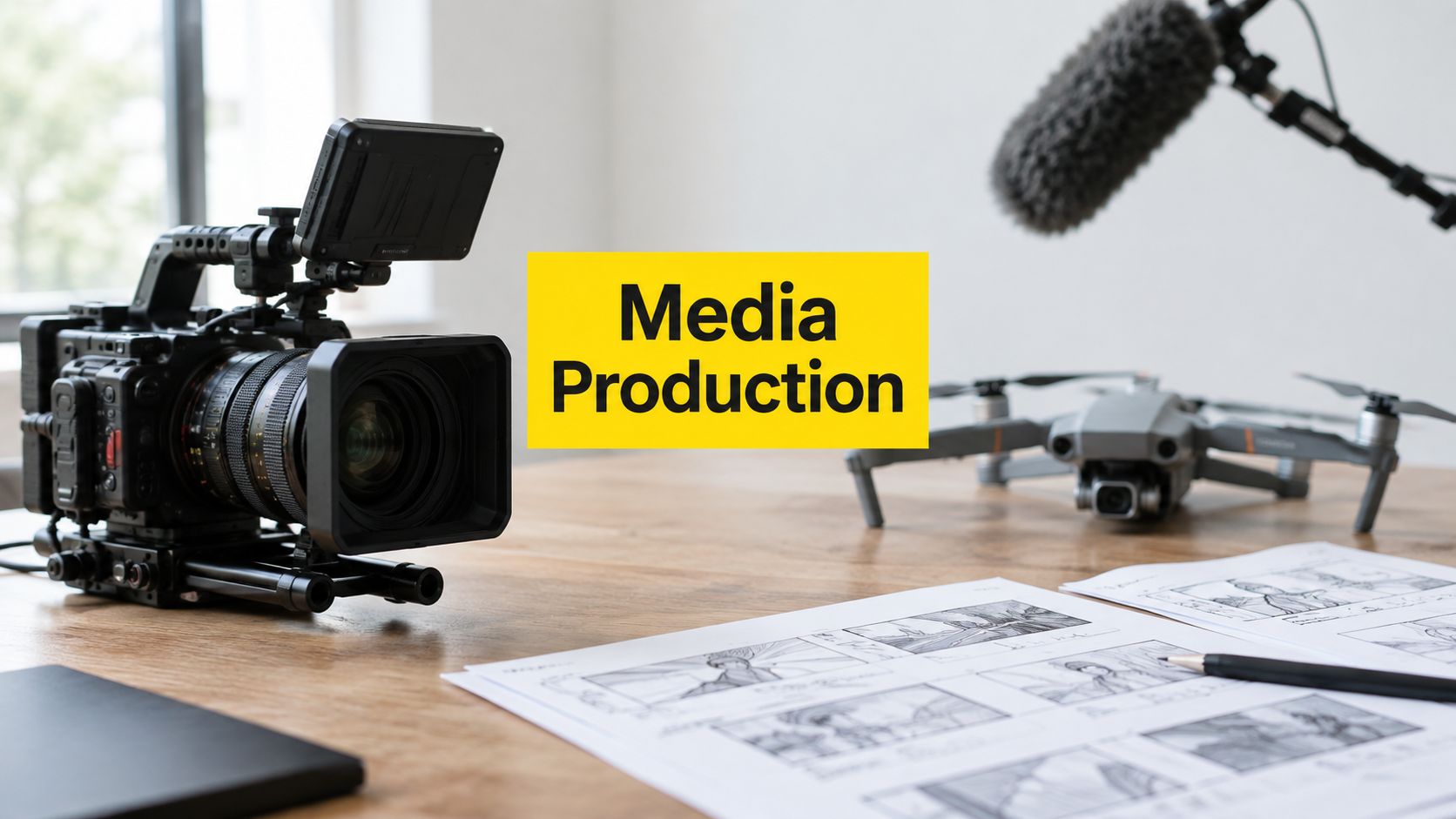
A four-person crew can arrive at a regional New South Wales property before sunrise and still have very little time to spare. The producer checks the shot list, the camera operator rigs the A-camera, the drone pilot reviews weather and operational requirements, and the sound recordist powers the boom. Everyone is working towards the same finished piece, but each person is managing a different part of the creative, technical, financial, and safety problem.
Table of Contents
- What Media Production Really Means in Practice
- The Three Production Phases and Where the Risk Sits
- The Main Types of Media Production Compared
- Key Roles and Equipment That Power a Production
- Real Australian Productions and a Drone Workflow Example
- Career Paths and Where CASA Training Fits
- Common Misconceptions and a First-Step Checklist
What Media Production Really Means in Practice
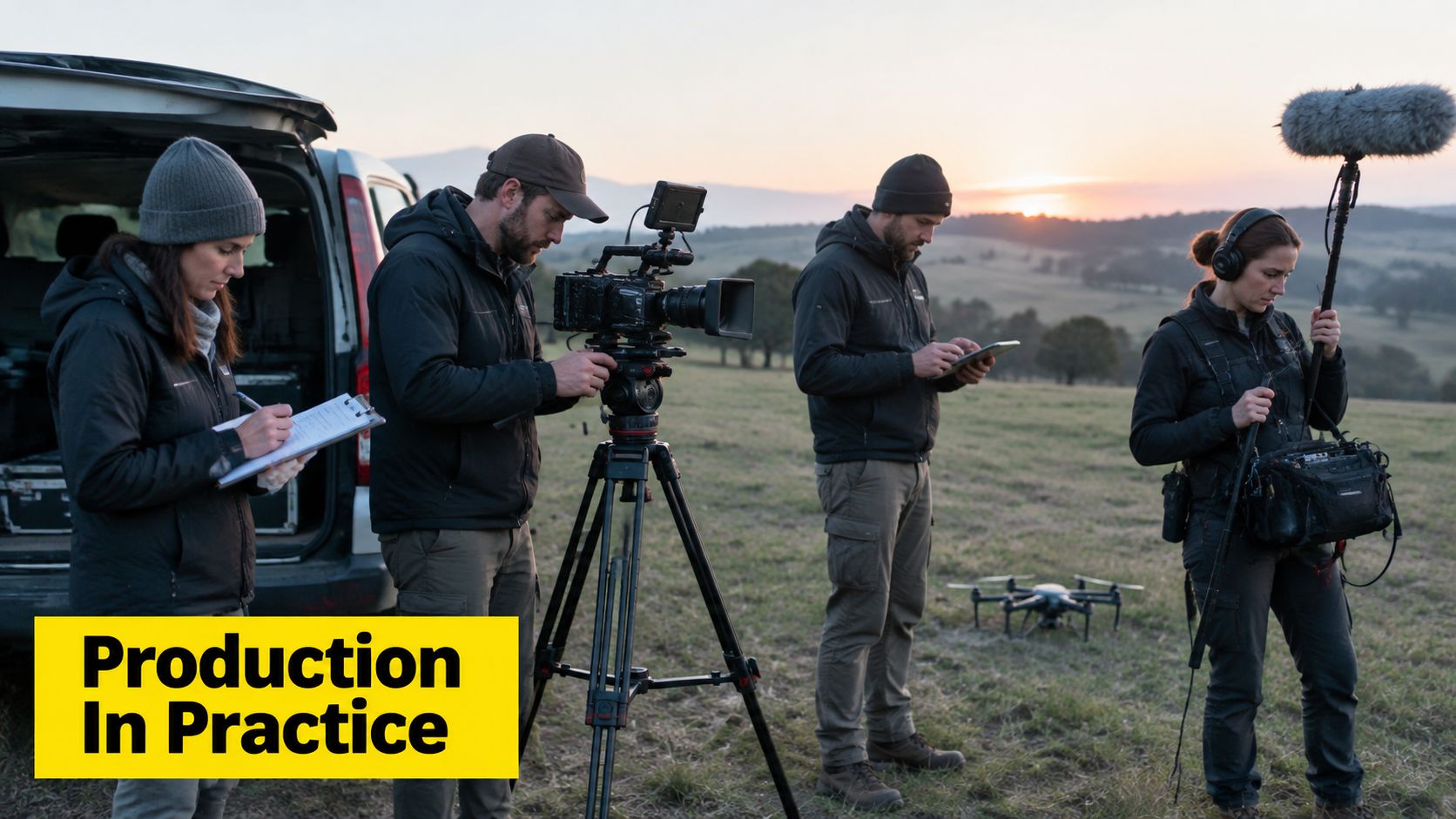
Media production is the coordinated process of turning a creative brief into a finished audio, screen, or interactive product. It includes the decisions made before recording, the work performed during capture, and the editing and delivery tasks that shape the final audience experience.
A useful working definition of what is media production therefore goes beyond filming. The process covers research, scripting, budgeting, scheduling, casting, location management, camera and sound recording, lighting, editing, colour, audio finishing, graphics, accessibility, distribution, and compliance. A short social video still needs a clear purpose, an approved message, suitable rights, a workable schedule, and files that meet the destination platform's requirements.
The production pipeline
Most projects move through three connected phases:
- Pre-production: The team defines the brief, script, storyboard, locations, permissions, crew, equipment, risks, and schedule.
- Production: The crew captures the planned images and sound, while adapting to real conditions such as weather, talent availability, noise, and location limitations.
- Post-production: Editors assemble the material, sound specialists clean and mix audio, colourists create visual consistency, and the team prepares final deliverables.
The phases aren't isolated. A weak location decision can create an expensive shoot problem, while incomplete coverage can force an editor to reshape the story. Drone work also crosses all three phases. The operator must scope the flight during planning, conduct it safely during production, and supply organised aerial media that can be matched with ground footage in post.
A team developing concepts with text-to-video tools can also find a text to video solution to test visual directions before committing crew, locations, or aircraft. Such tools support planning, but they don't replace permissions, flight checks, production judgement, or the original capture process.
The Three Production Phases and Where the Risk Sits
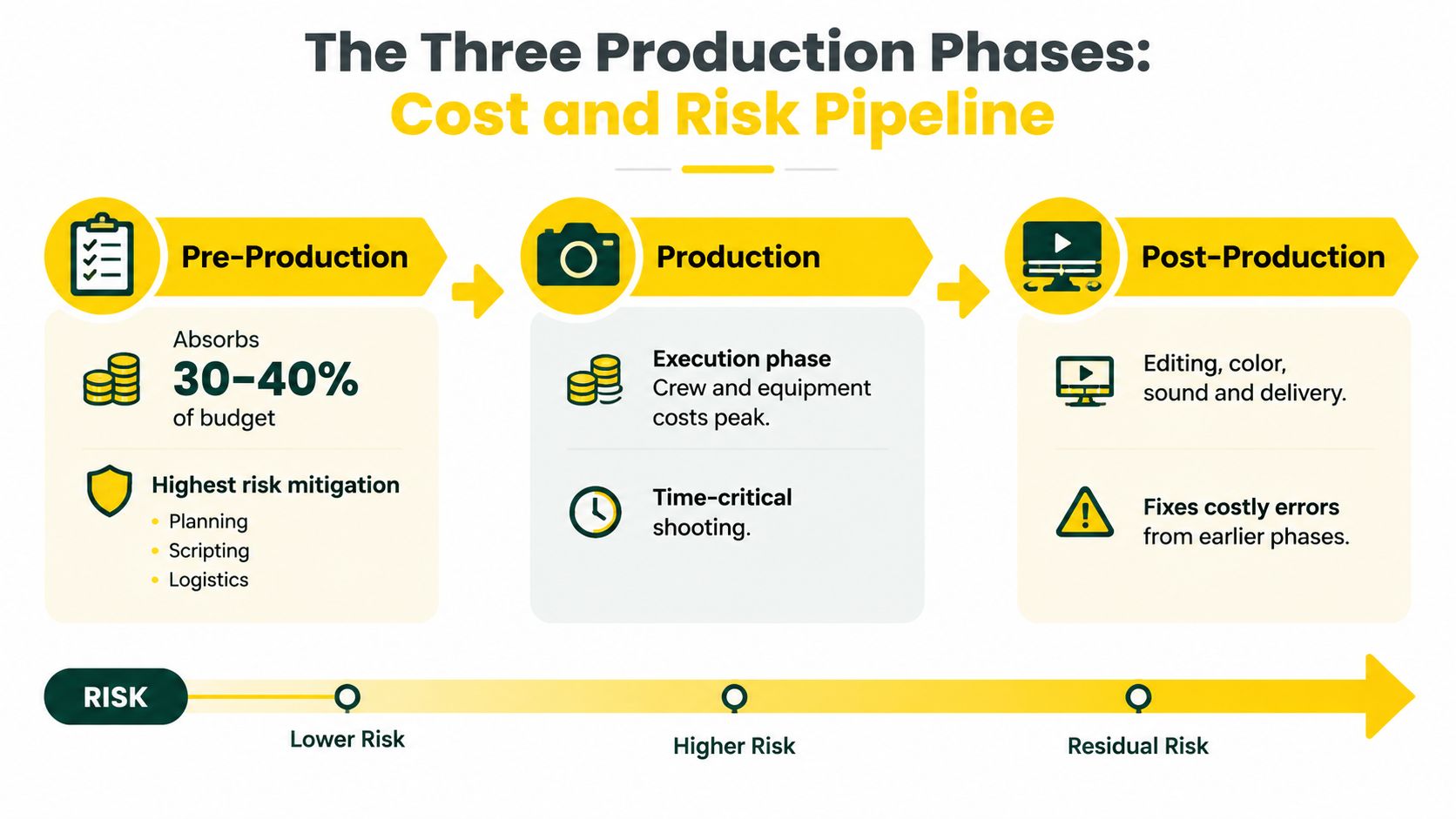
A production budget isn't just a list of purchases. It represents a chain of decisions, and risk moves forward whenever a decision is delayed or made without enough information. Australian benchmarking shows why the whole chain matters. The Australian Bureau of Statistics classified film, television, and video production costs across development, pre-production, shooting, and post-production, with total costs reaching A$3.436 billion in 2015–16 (ABS data).
Pre-production controls the choices
Pre-production establishes what the crew will attempt and what the project can afford. The producer and production manager develop the schedule, confirm locations, secure releases, assess safety issues, book equipment, and make sure the creative brief is specific enough for each department to act on it.
This phase often carries the greatest decision-making influence. If a drone shot is essential, the team needs to check the proposed location, operating conditions, people and property nearby, weather exposure, aircraft capability, pilot qualifications, operator responsibilities, insurance, and any additional approvals before the shoot is locked. A flight improvised on location can create a delay, an unusable shot, or a safety issue.
Production has the highest daily exposure
Production is where crew, talent, equipment, transport, and location costs operate at the same time. A weather change can remove an entire visual plan. A sound problem can make an otherwise strong take unusable. An injury, equipment failure, or access restriction can stop the day's work.
Practical rule: If a risk can be identified in the production office, it shouldn't be discovered for the first time on set.
Drone operations belong in this planning system, not in a separate technical silo. A crew preparing an Australian aerial shoot can use the drone safety guide for airports and HLS operations to support its early safety review. For operators building broader commercial capability, ACE GOLD combines RePL training, ReOC support, practical flight training, aviation compliance, and business readiness for commercial drone operations.
Post-production reveals earlier gaps
Post-production gives the project shape, but it can't always repair missing decisions. Editors can often restructure a scene, yet they can't reliably create a missing angle, restore clipped audio, or solve an unavailable location. Late changes also affect graphics, captions, music rights, colour matching, sound mixing, and delivery versions.
The cost-and-risk pipeline is therefore simple to state but difficult to practise: pre-production reduces uncertainty, production manages live exposure, and post-production converts captured material into a deliverable. The strongest teams protect all three phases instead of treating the edit suite as a rescue service.
The Main Types of Media Production Compared
A regional tourism campaign might need a polished 90-second film, vertical social edits, and aerial views of the same coastline. A podcast from that project would involve different pressures again, including room acoustics, microphone technique, editing, and consistent publishing. The audience, duration, platform, and turnaround determine how the production is designed, even when the client and location remain the same.
The practical difference between formats is the cost-and-risk pattern. A 10-part streaming series requires sustained coordination across scripts, cast, sets, continuity, camera, sound, and post-production. A branded social reel may be captured and edited quickly, but fast delivery leaves less time to correct weak audio, missing approvals, or unsuitable framing.
| Production Type | Typical Crew Size | Core Gear | Turnaround Pressure | Compliance or Training Load |
|---|---|---|---|---|
| Film | Small specialist unit to a large department-based crew | Cinema cameras, lenses, lighting, grip, sound, monitoring | Often schedule-driven, with extensive preparation | Rights, locations, safety, contracts, technical delivery |
| Television | Compact factual team to multi-department series crew | Broadcast or cinema cameras, sound, lighting, field production systems | Regular delivery cycles and strict editorial deadlines | Editorial standards, contributor permissions, safety, delivery specifications |
| Audio | Presenter, producer, sound recordist, or small studio team | Microphones, recorder or interface, headphones, acoustic treatment | Frequent publishing can create sustained editing pressure | Music and contributor rights, privacy, platform requirements |
| Digital and social | Often a small creative team, sometimes one operator | Mirrorless or cinema camera, gimbal, compact lighting, phone systems | Fast response to campaigns, events, and platform needs | Brand approvals, releases, copyright, platform rules |
| Aerial or drone | Pilot, visual observer, producer, or integrated production crew | CASA-compliant drone platform, batteries, controllers, safety equipment | Weather and operating conditions can narrow the usable window | CASA requirements, airspace checks, pilot competency, operator procedures |
Drone work adds a separate planning layer to any of these formats in Australia. Depending on the operation and the organisation conducting it, a commercial drone pilot may need a Remote Pilot Licence, an Aeronautical Radio Operator Certificate, or support from a Remote Operator Certificate holder. Those requirements sit alongside ordinary production planning, including location access, weather decisions, insurance, safety controls, and delivery needs.
A single commission can combine several types. The crew may need to capture widescreen material for a broadcast commercial, vertical footage for social platforms, audio for a behind-the-scenes podcast, and aerial establishing shots. The shot plan must allow different aspect ratios and durations while maintaining continuity and staying within the approved operating plan.
For a business with existing footage, guidance to unlock value from old content assets can help identify new formats before another shoot is commissioned. That review may reveal material for cutdowns, social versions, training content, or audio-led pieces, although the editor still needs to check rights, quality, and context.
A pilot entering this environment may consider ACE SILVER, which covers commercial RePL training, practical flight training, CASA-compliant certification, AROC, and aviation English proficiency for professional drone pilots. The training choice should match the intended operation, because a drone workflow is only useful when its flight permissions, crew responsibilities, and production requirements align.
Key Roles and Equipment That Power a Production
A crew works efficiently when decision ownership is clear. The producer controls the commercial frame, the director shapes the creative interpretation, and department leads translate those decisions into practical work. New crew members can progress faster when they understand not only how to operate equipment, but also who has authority over each choice.
Roles follow the decision chain
| Role | Owns | Primary Equipment | Decision Stage |
|---|---|---|---|
| Producer | Budget, schedule, client relationship, and overall delivery | Production documents, budget systems, communications tools | Brief and all major approvals |
| Director | Performance, storytelling, shot interpretation, and set direction | Script, shot list, monitor, communication systems | Creative planning and production |
| Production manager | Logistics, crew coordination, locations, transport, and timing | Call sheets, schedules, location documents, radios | Preparation and daily operations |
| Director of photography | Camera language, exposure, lenses, movement, and visual consistency | Cinema camera, lenses, tripod, gimbal, monitor | Visual planning and filming |
| Gaffer | Lighting execution and electrical coordination | Lighting fixtures, stands, modifiers, power distribution | Lighting preparation and production |
| Sound recordist | Location audio quality and recording approach | Boom microphone, lavalier microphones, recorder, headphones | Sound planning and capture |
| Drone pilot or planning specialist | Aerial capture planning and safe operation within the approved scope | CASA-compliant drone platform, batteries, controller, planning records | Pre-production, flight operations, and media handover |
Equipment should follow the story rather than dictate it. A gimbal can create movement, but a locked-off camera may communicate a more suitable mood. A lavalier can preserve dialogue in a moving scene, while a boom may provide a more natural sound when the environment permits. The drone platform must be selected for the shot, conditions, operating area, payload needs, and approved procedures.
Where a newcomer can fit
A production assistant may begin with call sheets, releases, equipment checks, and location coordination. A junior camera operator can develop framing, focus, exposure, and media-management skills. An aspiring editor needs disciplined file handling, dialogue editing, story judgement, and delivery knowledge. A drone specialist needs aviation training in addition to image-making ability.
Some small crews combine roles, but combination has limits. A director of photography may also hold a RePL and operate a drone on a simple production. A complex or higher-risk operation may need a separate pilot, visual observer, safety lead, or ReOC support. Organisations exploring aircraft and payload options can review XAG Australia as part of their equipment research, while keeping the production brief and aviation requirements at the centre of the decision.
Real Australian Productions and a Drone Workflow Example
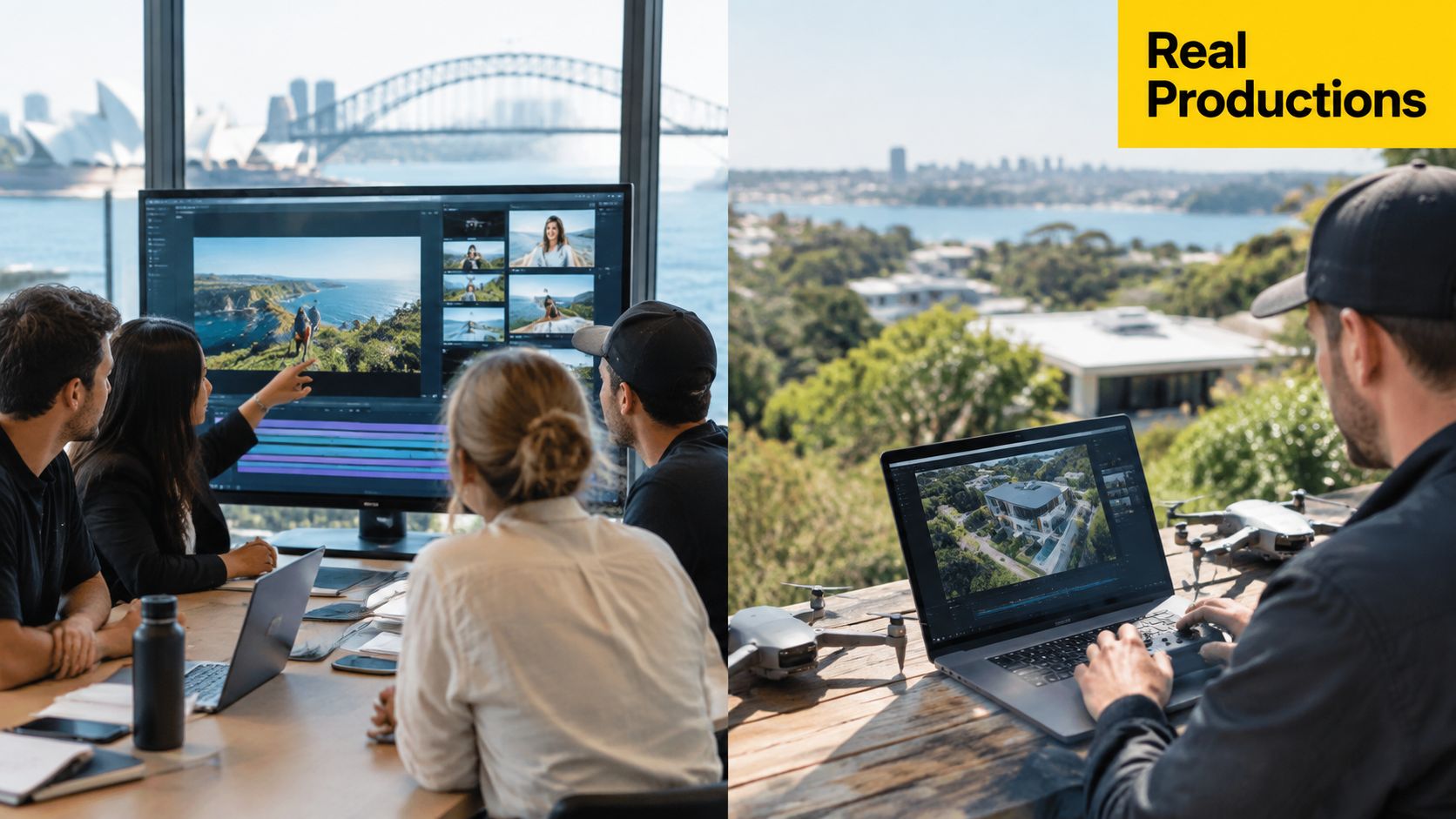
A Sydney brand agency might receive a tourism brief requiring a 30-second advertisement, horizontal cutdowns, and social versions. In the office, the producer clarifies the audience and message, the director prepares a storyboard, and the camera lead identifies the movement, lenses, and natural light needed for a coastal location.
On the shoot, a four-person team could divide responsibilities between production, camera, sound, and aerial work, provided the planned operation and safety arrangements support that structure. The ground crew captures interviews, walking sequences, and detail shots. The drone pilot works only within the approved scope and hands over labelled aerial files that the editor can match to the ground material.
A property marketing flight
A Melbourne property marketing business may need aerial footage for a commercial real estate listing. The production brief should identify the intended boundaries of the property, nearby people and structures, desired movement, time of day, and delivery format before anyone unpacks the aircraft.
The operator can then conduct airspace and location checks using CASA-approved applications, engage a ReOC consultant or appropriately qualified RePL pilot where needed, and prepare the flight plan. The team should also assess local restrictions and operational requirements, including any relevant NOTAM process, rather than assuming that a clear-looking sky means an unrestricted flight.
A dual-pilot arrangement may be appropriate where the operation requires closer control of separation distances or additional workload management. That decision belongs in the risk assessment and operating procedures, not in a last-minute adjustment on site. The pilot should record the flight details, confirm the area remains suitable, and stop if actual conditions no longer match the plan.
From aircraft to edit suite
After the flight, the aerial files need secure transfer, clear naming, metadata where relevant, and a handover note describing the usable takes. The editor can then balance exposure and colour with the ground footage, stabilise material where appropriate, select shots that support the property's communication goals, and prepare approved versions.
Australian operators developing their professional context can use the Australian drone ecosystem overview to place aerial production within the wider operating environment. The production outcome depends on more than an attractive view. It depends on a flight that was lawful, safe, repeatable, technically usable, and connected to the story.
Career Paths and Where CASA Training Fits
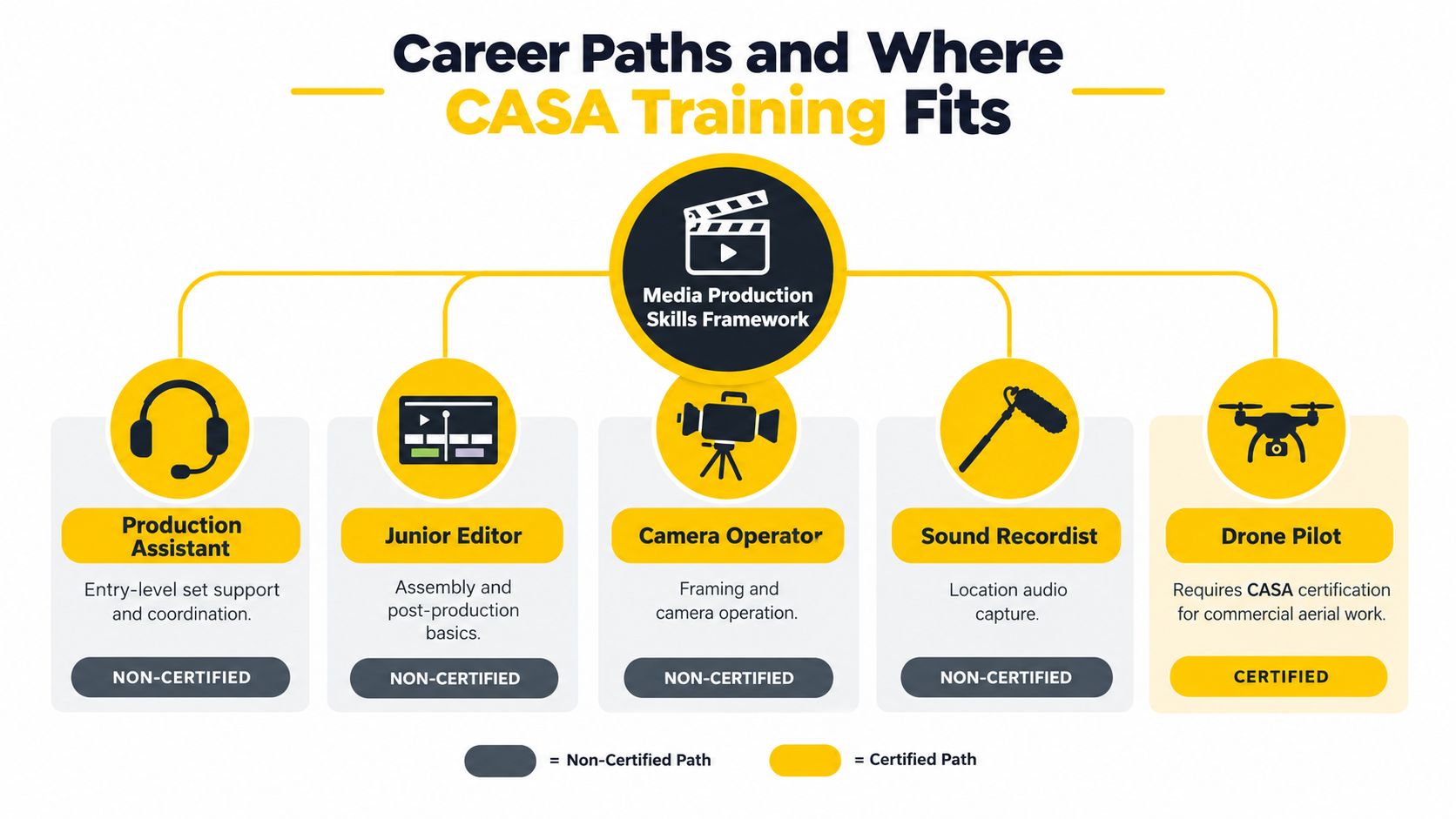
Media production offers several entry points, but each path develops a different kind of responsibility. A production assistant learns how a set functions through schedules, equipment movement, releases, and communication. A junior editor builds judgement through media organisation, assembly, sound cleanup, graphics, and version control. A camera operator develops visual control, while a sound recordist protects the material that audiences notice immediately when it fails.
The drone path adds aviation obligations to those creative and technical skills. Commercial aerial work may require a Remote Pilot Licence, an Aeronautical Radio Operator Certificate, and access to a compliant operator system, including ReOC support where the organisation's operation requires it. A RePL is an important qualification, but it doesn't automatically answer every operational, airspace, safety, or organisational question.
Matching skills to roles
| Path | Early capability | Further responsibility |
|---|---|---|
| Production assistant | Scheduling support, paperwork, set communication, basic logistics | Production coordination and department management |
| Junior editor | Ingest, organisation, rough assembly, basic audio and colour work | Story editing, finishing, version management, delivery |
| Camera operator | Framing, focus, exposure, movement, and media handling | Visual design, camera department leadership, specialist capture |
| Sound recordist | Microphone placement, recording levels, monitoring, and file management | Location sound leadership and post-production coordination |
| Drone pilot | Aviation knowledge, aircraft control, planning, and safe capture | Commercial aerial operations, workflow integration, and operator compliance |
Some roles pair naturally. A small production may use a camera operator who also holds a RePL, provided the person can perform both responsibilities without compromising safety or creative quality. Other assignments need separate specialists because the aircraft, location, people, time pressure, or production scale creates too much simultaneous workload.
Career principle: A qualification becomes valuable when it connects to a defined responsibility, not when it sits alone on a résumé.
The drone pilot careers and Certificate III in Aviation guide can help candidates compare broader aviation study with the narrower needs of a particular production role. The Australian Government's screen support system includes the Producer Offset, the Post, Digital and Visual Effects Offset, and the Location Offset (screen production funding and incentives fact sheet). Screen Australia supports the development, production, promotion, and distribution of culturally relevant Australian screen content across formats, platforms, and genres (Parliamentary reference on Screen Australia.
The broader sector employed 55,126 people in 2021–22, including 26,808 in film and video production, and contributed more than A$6 billion in value added, according to the ABS results published by Screen Australia (ABS film, television and digital games survey results). Those figures describe the sector, not a guaranteed pathway for any individual. The practical choice is to identify the production responsibility a candidate wants, then select training that directly supports it.
Common Misconceptions and a First-Step Checklist
Media production isn't just filming with an expensive camera. A camera records one part of the project. The producer still needs a workable brief, the director needs a story, the sound recordist needs clean audio, and the editor needs enough suitable coverage to build a coherent sequence.
Editing isn't a magic repair stage. Editors can improve structure and rhythm, but they can't reliably replace a missed interview answer, a poor location release, unusable sound, or an aerial shot that was never safely captured. Colour grading can create consistency, yet it can't turn every exposure problem into a professional image.
Drone footage isn't automatic. A flight involves aircraft selection, weather, airspace, people and property, pilot competency, operational procedures, recording, and media management. A visually impressive flight can still be unsuitable if it falls outside the approved operating conditions.
A RePL alone doesn't authorise every commercial scenario. The operation may also involve a ReOC holder, documented procedures, airspace requirements, radio capability, safety controls, and other applicable CASA obligations. The correct pathway depends on the proposed work, the aircraft, the location, and the organisation responsible for the operation.
Pre-production isn't optional paperwork. A missing release or unchecked access condition can stop a shoot. A location issue in a national park, a council restriction, or a weather change can force the producer to re-plan the day. The cost is not limited to administration. It can affect crew availability, equipment bookings, client approvals, and the editor's schedule.
A practical first-step checklist
A new producer, business, or operator can start with these questions:
- Define the brief: What must the audience understand, feel, or do after viewing or hearing the content?
- Confirm the deliverables: Which durations, aspect ratios, captions, audio versions, and platforms are required?
- Approve the storyboard: Can every planned shot be captured at the proposed location with the available crew and equipment?
- Review permissions and insurance: Are location access, talent releases, copyright, public liability, and client requirements properly addressed?
- Check CASA eligibility: Can the proposed drone operation be conducted by the selected pilot and operator under the applicable requirements? The licence finder can help identify a relevant training direction.
- Build redundancy: Is there spare media, power, audio capability, weather protection, and a fallback shot plan?
- Set a contingency: What happens if the location, aircraft, key contributor, or weather becomes unavailable?
The most useful first booking depends on the responsibility the person wants to take. A production assistant may book an introductory production placement or editing training. A commercial drone operator may need to book RePL or AROC training, while an organisation planning structured operations may need ReOC consulting. Ace Aviation Aerospace Academy provides CASA-compliant drone training and aviation qualifications, including relevant pathways for professional operators working across media and other commercial sectors. Visit Ace Aviation Aerospace Academy to review the training options and identify the next qualification or compliance step that matches the planned production work.
Frequently asked questions
What is media production?
Media production is the coordinated process of planning, capturing, editing, finishing, and distributing audio, video, film, television, digital, or interactive content. It includes creative, technical, financial, logistical, and compliance decisions.
What are the three main phases of media production?
The three main phases are pre-production, production, and post-production. Pre-production prepares the project, production captures the material, and post-production turns that material into approved deliverables.
Is drone filming part of media production?
Yes. Drone filming is an aerial production activity that must connect to the brief, schedule, safety plan, capture requirements, and post-production workflow. In Australia, the flight also needs to comply with applicable CASA requirements.
Does a RePL alone cover every commercial drone production?
No. A RePL doesn't automatically cover every commercial operation. The required qualifications, operator arrangements, procedures, and approvals depend on the proposed flight and the organisation conducting it.
Which media production roles are suitable for beginners?
Production assistant, junior editor, camera assistant, sound assistant, and supervised content-production roles can provide useful starting points. The best choice depends on whether the candidate prefers coordination, storytelling, image-making, sound, editing, or aviation operations.