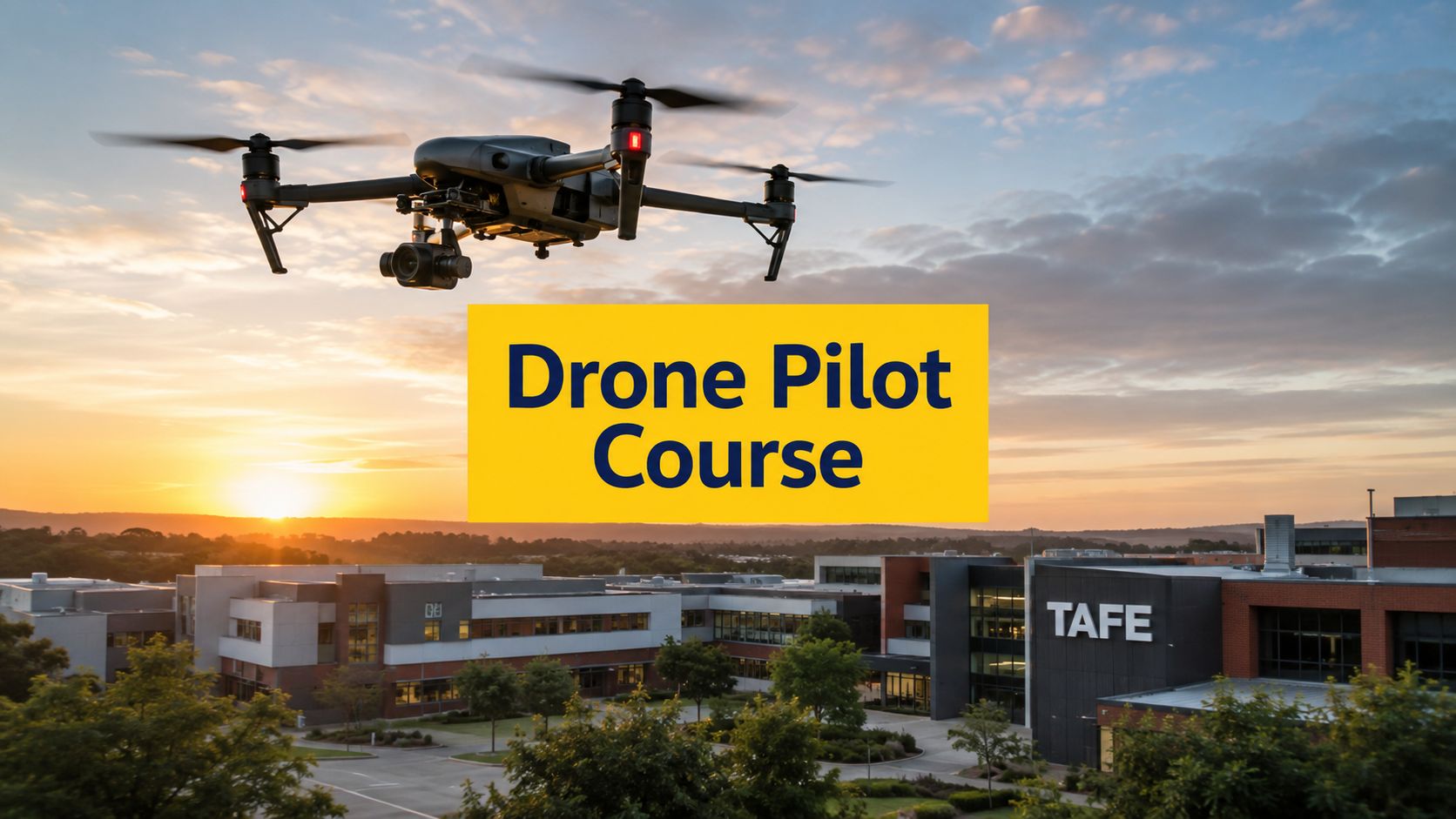
A common mistake sits at the centre of many enrolment decisions. A student sees a TAFE drone course, assumes it leads straight to legal commercial flying, and only later discovers that a vocational qualification and a CASA licence are not the same thing.
That gap matters because the Australian drone sector has expanded quickly. The number of Remote Pilot Licences has doubled since 2018, and drones now outnumber traditional aircraft in the national registry by more than two to one, according to the Australian Government report on increased drone uptake. For anyone comparing training options, the primary question isn't just which course looks professional. It's which pathway leads to the legal authority needed for paid operations.
Table of Contents
- Is a TAFE Drone Course Your Ticket to a Commercial Career
- Understanding the TAFE Certificate III in Aviation Remote Pilot
- CASA Licensing Explained RePL AROC and ReOC
- TAFE vs Private Academies A Detailed Comparison
- Your Pathway to Becoming a Licensed Drone Pilot
- Career Pathways and Industry Use Cases for Licensed Pilots
- Frequently Asked Questions
- Does a TAFE drone course automatically give a CASA RePL
- Is the TAFE Certificate III required before applying for an RePL
- What happens if someone does paid drone work without the right licence
- Do all commercial drone pilots need an AROC
- Can businesses train staff without sending them through TAFE
- Where can students check more detailed training and licensing questions
Is a TAFE Drone Course Your Ticket to a Commercial Career
For many people, TAFE feels like the safe choice. It has a strong reputation in vocational training, and a drone pilot course at TAFE sounds like the obvious first step for someone who wants to work in aerial surveying, inspection, media, or agriculture.
The problem is that a TAFE course and a commercial drone licence serve different purposes. One is an education pathway. The other is a regulatory permission issued under Australia's aviation system.
That distinction catches students off guard. The confusion between a TAFE qualification and a CASA licence is significant, and many TAFE materials promote the Certificate III in Aviation while not making it clear that it doesn't grant the Remote Pilot Licence required for most commercial work, as discussed in Sky Media Training's explanation of the TAFE versus CASA gap.
Practical rule: If a student wants to fly for payment or reward, the key question isn't whether the course sounds professional. It's whether the training results in the relevant CASA licence.
A simple analogy helps. A hospitality course can teach food handling, customer service, and venue operations. That doesn't automatically issue a liquor licence to the venue. In the same way, a drone qualification can teach planning, safety, and aviation knowledge, but it doesn't by itself authorise a person or business to conduct regulated commercial operations.
This is why the search term Drone Pilot Course TAFE often leads to the wrong assumption. Students think they're comparing one drone course against another. In reality, they're often comparing a broad vocational certificate against a direct licensing course.
The question to ask before enrolling
Before paying fees or committing time, a student should confirm three points:
- Final outcome: Does the course issue a qualification, a licence, or both?
- Legal use: Can the graduate legally perform paid drone work after completion?
- Next steps: Will extra CASA-approved training still be required?
When those answers are clear at the start, expensive detours become less likely.
Understanding the TAFE Certificate III in Aviation Remote Pilot
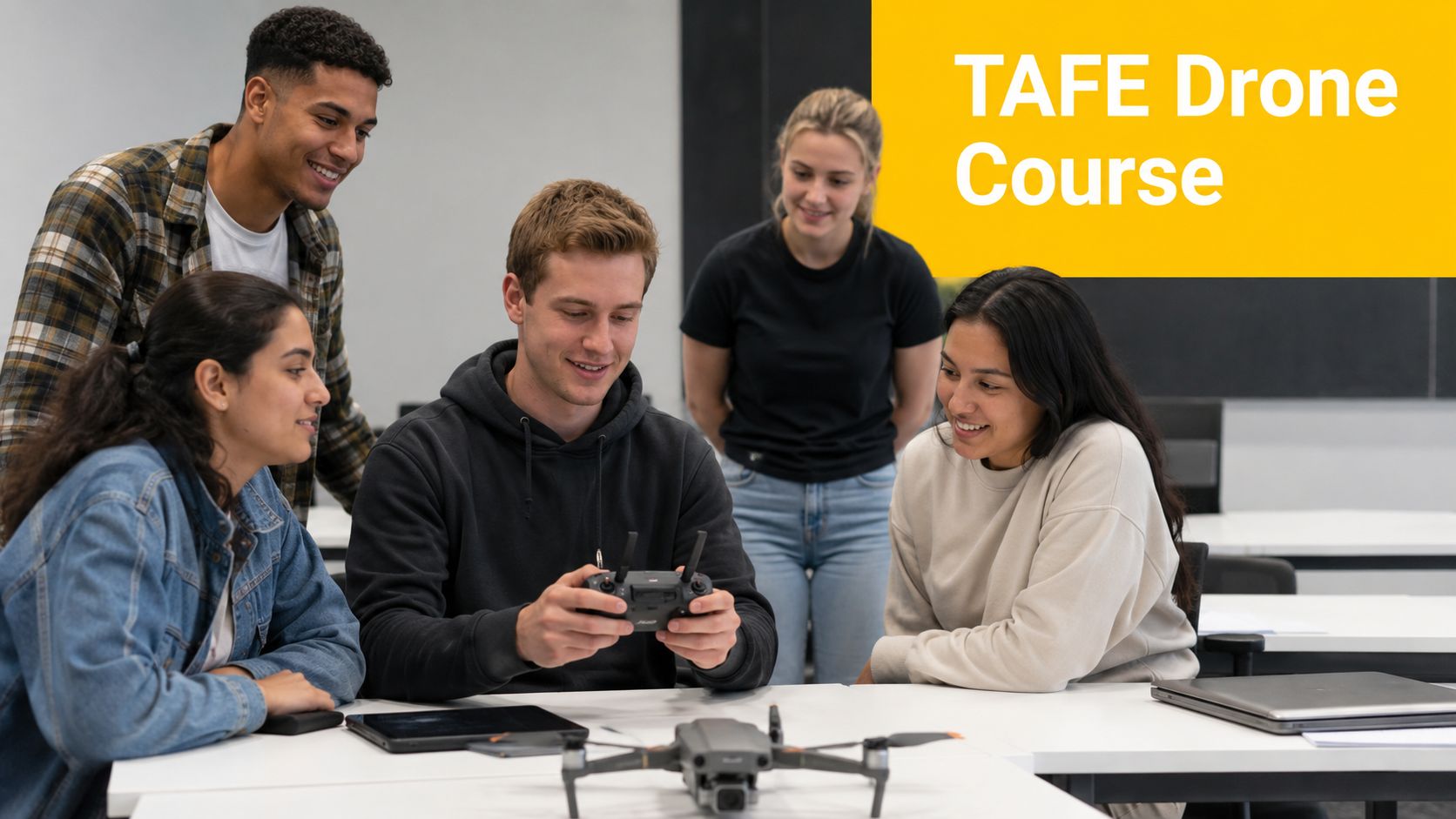
The TAFE course many students find first is the Certificate III in Aviation (Remote Pilot), or AVI30419. It is a nationally recognised vocational qualification that teaches the building blocks of drone operations and aviation practice.
What the TAFE Qualification Is
According to TAFE NSW's Certificate III in Aviation Remote Pilot course page, AVI30419 is a 14-unit qualification aligned with CASR Part 101. That alignment matters because it means the training sits inside the Australian drone regulatory framework, rather than treating drones as a hobby topic or a generic tech skill.
In plain terms, the certificate is designed to teach a student how to operate with aviation discipline. A good comparison is a trade pre-apprenticeship. It can give a student useful habits, technical knowledge, and a clearer sense of the job, but it does not automatically hand over the separate licence or approval needed to perform regulated work.
Students can expect training in areas such as:
- Flight planning: preparing missions, checking airspace, and assessing conditions before launch
- Operational safety: following procedures, identifying hazards, and reducing risk
- Aeronautical communication: using standard aviation communication practices
- Regulatory awareness: understanding the CASA rules that apply to drone operations
Some TAFE providers describe the course as preparation for commercial drone roles. South Regional TAFE also publishes indicative student fees on its Certificate III in Aviation Remote Pilot page. For a new student, that can create the impression that enrolment leads straight to legal commercial flying.
That is the gap that causes trouble.
A vocational certificate shows that a student has studied the subject. A CASA licence shows that the pilot or operator has the legal authorisation required under the aviation system. Those are related outcomes, but they are not the same outcome.
Students comparing starting points may also look at beginner pathways such as ACE READY, which introduces drone fundamentals, aviation safety, CASA regulations, flight operations, and preparation for later licence training. Other options can be viewed through the broader drone and aviation course catalogue.
What it does not give a student
The Certificate III in Aviation (Remote Pilot) does not automatically issue a CASA Remote Pilot Licence (RePL) or an Aeronautical Radio Operator Certificate (AROC). Many prospective students often misunderstand this aspect. They finish a recognised course, then discover they still need CASA-aligned licensing steps before they can carry out the kind of paid work they expected.
The easiest way to understand it is to separate education from authorisation. The certificate teaches knowledge and skills. The licence and operator approvals deal with permission under aviation law.
A bookkeeping course works in a similar way. A student may learn the work thoroughly, but regulated tax services still require the proper registration. Drone training follows the same logic. Study prepares the person. CASA licensing determines what regulated activities they can lawfully perform.
For anyone researching a drone pilot course at TAFE, this is the point to remember: the Certificate III can be useful preparation for industry, but commercial drone work usually requires additional CASA licensing steps after the course is complete.
CASA Licensing Explained RePL AROC and ReOC
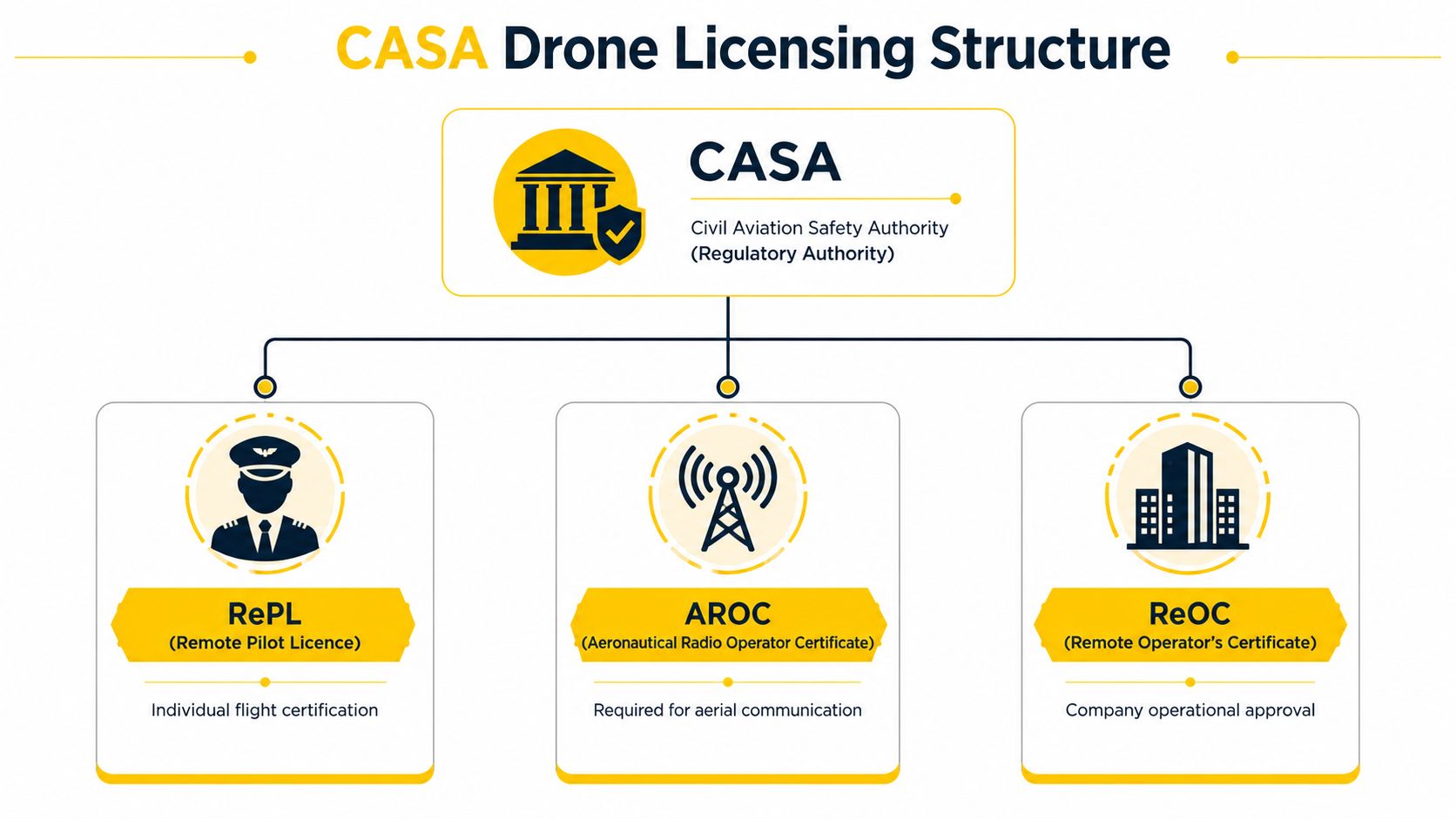
Once the distinction between education and licensing is clear, the CASA system becomes easier to follow. Most commercial drone confusion comes from three acronyms: RePL, AROC, and ReOC.
RePL for the individual pilot
The Remote Pilot Licence (RePL) is the core licence for the individual drone pilot. For anyone planning to carry out commercial work, this is usually the first regulatory milestone that matters.
In Australia, an RePL is required for any commercial drone work involving reward or payment. For drones weighing between 25 and 150 kilograms used for work, CASA requires an RePL even if the flying is done over the operator's own land, as explained in the UASNT guide to commercial drone licensing in Australia.
That rule clears up another common misunderstanding. Ownership of the land doesn't remove the licensing requirement when the operation falls within CASA's regulated commercial framework.
AROC for radio communication
The Aeronautical Radio Operator Certificate (AROC) sits in a different category. It isn't a substitute for an RePL. It covers the pilot's ability to use aeronautical radio communications where those communications are required.
In plain language, if a drone operation involves interaction with controlled airspace or other circumstances where formal radio procedures apply, the pilot may need an AROC in addition to the RePL. Students often assume radio training is bundled into any drone course. That isn't always the case, which is why course outcomes need to be checked carefully.
ReOC for the operating business
The Remotely Piloted Aircraft Operator's Certificate (ReOC) applies to the organisation conducting operations, not just the individual pilot. A sole trader may need to think about this differently from a larger company, but the core idea is the same. The pilot licence and the operator certificate are separate layers of approval.
A useful way to remember the structure is:
- RePL: The person is licensed to fly.
- AROC: The person is approved to use aeronautical radio where required.
- ReOC: The business or operation holds organisational approval.
Commercial drone compliance often works on two levels at once. One level concerns the pilot. The other concerns the operator.
For businesses building internal drone capability, that's where planning often becomes more complex. A company may have trained staff but still need operational approval, procedures, and documented systems before a compliant commercial program is in place. Readers wanting a deeper look at that operator side can review AAA's guide to the ReOC in Australia.
TAFE vs Private Academies A Detailed Comparison
A student choosing between TAFE and a specialist academy isn't choosing between a good option and a bad one. The fundamental choice is between different endpoints.
One pathway focuses on broad vocational education. The other usually focuses on the fastest route to the licence needed for commercial work.
The difference in outcome matters most
A TAFE pathway can suit someone who wants formal study in a vocational framework, or a learner who values a broader educational environment. That may be a sensible fit for school leavers, career changers exploring aviation, or students who want a recognised certificate on top of operational training later.
A specialist academy usually suits the person who already knows the goal: obtain the CASA licence required to start commercial drone work as directly as possible.
The cost and timing differences reflect that contrast. TAFE courses such as the Certificate III in Aviation can cost over $1,300 but don't include the RePL. By contrast, dedicated RePL courses from private providers typically range from $2,000 to $4,000 and are commonly completed in five to seven days, directly issuing the required CASA licence, according to the UASNT guide to Australian drone licence training.
That doesn't mean one route is universally better. It means the student should judge the option by the intended outcome.
TAFE Certificate vs Private Academy Licence Course
| Attribute | TAFE (e.g. AVI30419) | Private Academy (e.g. Ace Aviation) |
|---|---|---|
| Primary outcome | Vocational qualification | CASA licensing outcome |
| Typical focus | Broad training in remote pilot knowledge and aviation fundamentals | Targeted theory and practical training tied to licence issue |
| Commercial readiness | Usually still requires additional CASA-approved licensing steps | Built for students aiming to fly commercially |
| Time frame | Structured vocational study format | Often completed in a short, intensive format |
| Cost structure | Lower upfront course fee may appear attractive | Higher fee may reflect direct licensing outcome |
| Who it suits | Students seeking formal vocational study | Students seeking a direct pathway into regulated operations |
A second analogy helps. TAFE is often like studying automotive technology at trade school. A licensing-focused academy is more like completing the exact testing and certification needed to legally drive a commercial vehicle in a regulated category. Both have value. They solve different problems.
For organisations comparing training delivery models, a broader education technology perspective can also help. The Teachable and Thinkific comparison from Learniverse is useful for understanding how course platforms differ when evaluating online or blended learning experiences, especially for compliance-heavy training.
One example of a direct licensing option is ACE SILVER, a commercial Remote Pilot Licence training course that includes classroom instruction, practical flight training, CASA compliant certification, AROC, and aviation English proficiency for professional drone pilots. It sits in the licence-focused category rather than the general vocational category. Students assessing that type of route can also review why some learners choose Ace alongside other providers and compare outcomes rather than brand names.
A practical way to decide
A student can usually make the right decision by answering three questions:
- Is the goal exploration or immediate commercial flying? Exploration may suit a vocational certificate. Immediate commercial flying usually points toward CASA-approved licence training.
- Does the student need a recognised qualification for another reason? Some employers or education pathways value formal vocational credentials.
- What happens on graduation day? If the graduate still can't legally perform paid work, the pathway isn't complete.
That final question prevents most enrolment mistakes.
Your Pathway to Becoming a Licensed Drone Pilot
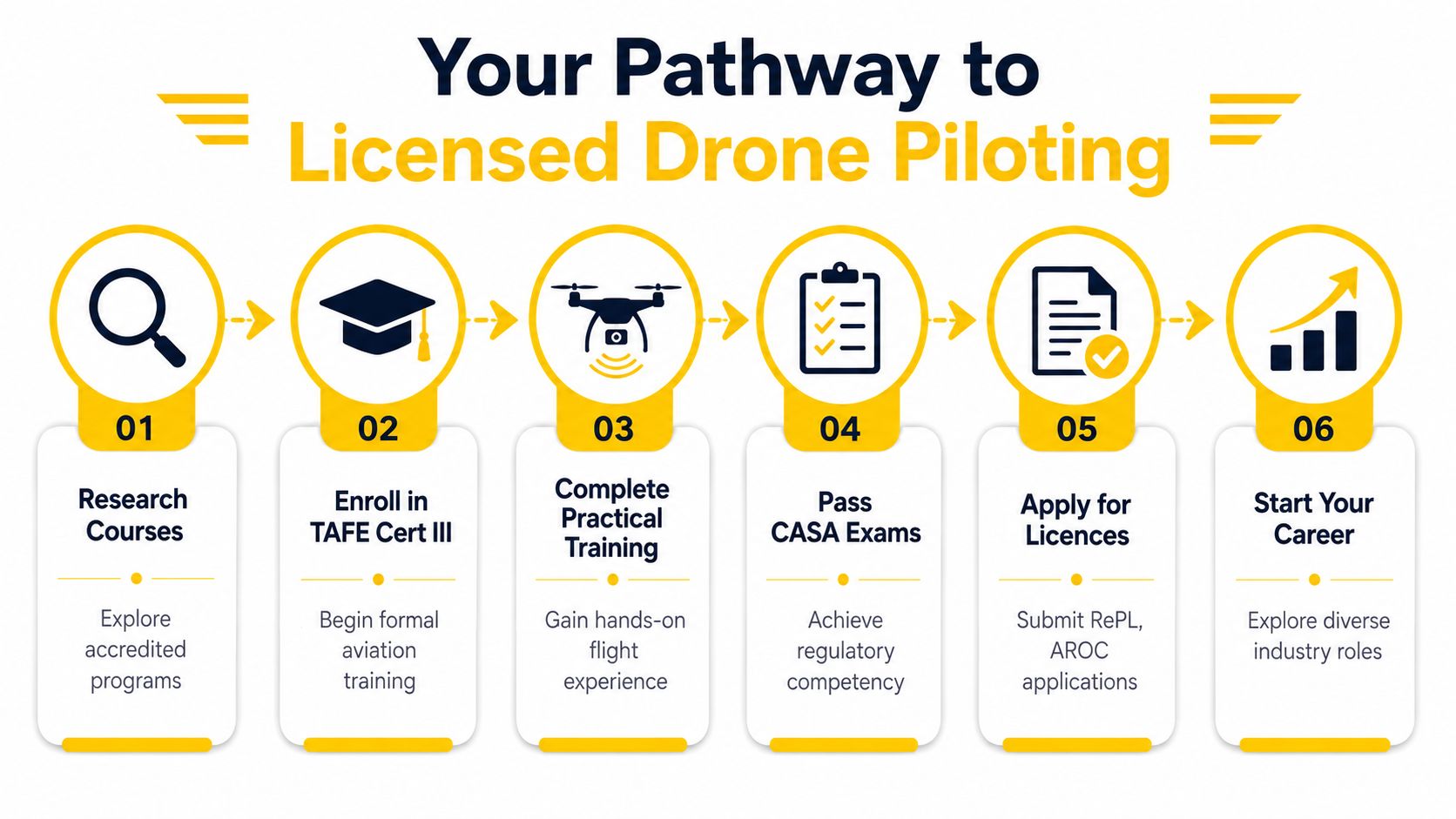
Once the TAFE versus licence issue is understood, the pathway becomes much easier to map. The aim is to line up training in the same order CASA requirements and career goals demand.
A practical sequence that avoids rework
The sequence below works well for most aspiring commercial pilots in Australia:
Define the operating goal
A hobby flyer, a sole trader doing paid aerial work, and a company building an internal drone unit won't need exactly the same approvals.Choose the correct training type
If the student wants vocational study, a TAFE certificate may be part of the journey. If the student wants commercial authority, a CASA-approved RePL pathway needs to be in the plan.Complete the required theory and practical training
RePL theory covers CASR Part 101 air law, weather, aerodynamics, drone hardware, battery management, and human performance issues such as fatigue and workload, followed by a closed-book theory exam, as detailed in the earlier licensing discussion.Log the required flight time
To obtain a Remote Pilot Licence, candidates must log a minimum of 5 hours of flight time operating a remotely piloted aircraft under standard conditions and submit that log as part of the CASA application, according to Remote Aviation's RePL requirements page.
Keep the flight log accurate from the start. Reconstructing hours later is harder than most students expect.
- Add any extra credential needed for the intended operation
A pilot working in radio environments may need an AROC. A business conducting operations may need organisational approvals.
For students unsure where they fit, a structured screening tool can help narrow the right pathway before enrolment. AAA provides a drone licence finder that helps match training choices to likely operating needs.
When to add business level approvals
Some people stop at the pilot licence because they only plan to work under another operator. Others need to think beyond the cockpit equivalent and into business compliance.
That often includes:
- Operating under a company structure: The business may need procedures and operator-level approvals.
- Managing multiple pilots: Standardisation, documentation, and oversight become part of compliance.
- Building internal capability: Enterprise or corporate teams may need specialised operational training beyond the initial licence.
Services such as ReOC Consulting, Enterprise Drone Training, and Corporate Drone Training become relevant. They aren't entry-level substitutes for the RePL. They are the next layer for organisations that need compliant operating systems around licensed personnel.
Career Pathways and Industry Use Cases for Licensed Pilots
A licence has practical value because it opens the door to real operating environments. That matters in a sector where demand for qualified pilots has grown alongside the broader expansion of drone use in Australia, as already noted in the opening government data.
Where licensed pilots are used
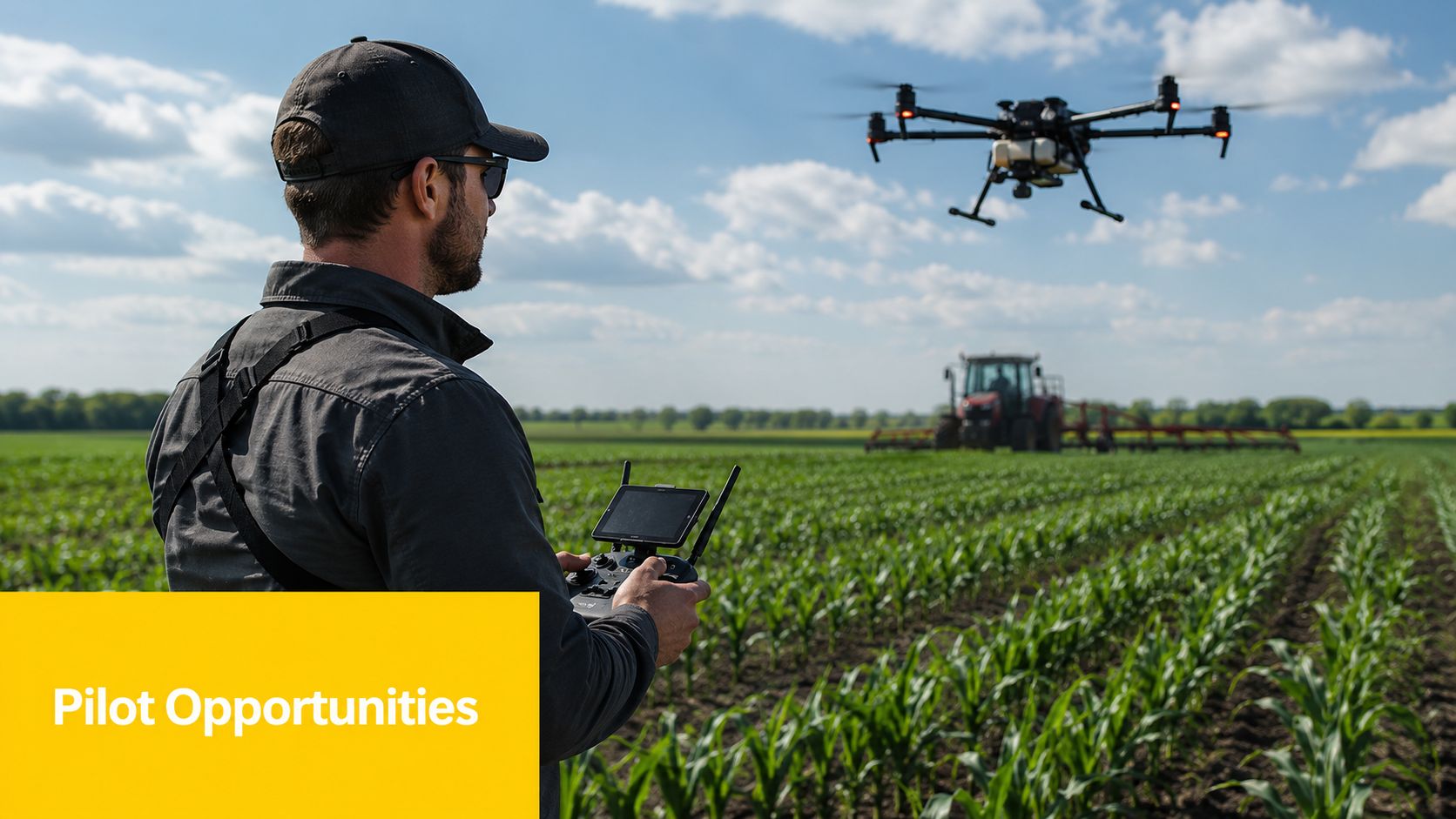
Licensed pilots work across a wide range of Australian industries:
- Agriculture: Monitoring crops, checking irrigation patterns, and assessing paddock conditions.
- Construction: Capturing site progress, producing aerial overviews, and supporting planning teams.
- Mining: Inspecting stockpiles, surveying large sites, and documenting infrastructure.
- Emergency services: Supporting situational awareness, search activity, and incident monitoring.
- Media production: Conducting aerial filming and photography under compliant procedures.
- Infrastructure inspection: Recording visual data on assets that are difficult to access safely from the ground.
In each of those settings, the difference between “trained” and “licensed” matters. A person may understand how to fly a drone well enough to capture footage or inspect a structure. That still doesn't answer the legal question of whether the operation is permitted in the intended commercial context.
This short video gives a useful visual sense of how drone roles are applied across sectors in practice.
For businesses, that's why licence planning should sit close to operational planning. The aircraft is only one part of the system. The pilot's authority, the communication requirements, and the operator's approvals all shape what work can be done legally.
Frequently Asked Questions
Does a TAFE drone course automatically give a CASA RePL
No. The Certificate III in Aviation (Remote Pilot) is a vocational qualification, not the automatic issue of a CASA Remote Pilot Licence. A student should always check whether the course outcome is education, licensing, or both.
Is the TAFE Certificate III required before applying for an RePL
No. A student doesn't need the TAFE certificate as a prerequisite for the RePL. The important requirement is completing training through a CASA-certified provider that can lead to the relevant licence outcome.
What happens if someone does paid drone work without the right licence
Commercial drone work involving payment or reward falls within CASA's regulatory framework. If the operation requires an RePL, flying without that licence creates a compliance risk. The sensible approach is to confirm the legal requirement before accepting any paid work.
Do all commercial drone pilots need an AROC
Not always. The need for an AROC depends on the type of operation and whether aeronautical radio communication is required. It is separate from the RePL, so students should check whether their intended flying environment calls for both.
Can businesses train staff without sending them through TAFE
Yes. Businesses often use direct licence training and then add operational support such as ReOC Consulting, Enterprise Drone Training, or Corporate Drone Training, depending on the nature of the drone program.
Where can students check more detailed training and licensing questions
AAA maintains an aviation and drone training FAQ that covers common questions about courses, licensing pathways, and student support.
Students comparing a drone pilot course at TAFE against a direct CASA pathway should start with the end goal, not the course title. Ace Aviation Aerospace Academy provides Australian drone and aviation training including the Remote Pilot Licence, AROC, Certificate III in Aviation, ReOC Consulting, and enterprise-focused training for individuals and organisations that need a compliant pathway into commercial operations.