A pilot has a client ready, batteries charged, and a drone packed for a paid shoot. Then the questions start. Does the drone need registration if it's tiny? Is operator accreditation enough, or is a Remote Pilot Licence required? Can the flight happen near people, near an airport, or after sunset?
That uncertainty is common because Australian drone regulations turn on two practical questions: what the drone weighs and why it's being flown. A flight that looks simple from the ground can sit in a very different legal category once money changes hands. That's where many new operators come unstuck, especially with micro drones used for paid work.
Table of Contents
- Introduction to Australian Drone Regulations
- Understanding Who Must Comply
- Navigating Registration and Certification Requirements
- Mastering Operational Limits and Airspace Rules
- Securing Approvals Exemptions and Notifications
- Avoiding Penalties Enforcement and Risks
- Ready-to-Use Compliance Checklist and Training Pathways
- Frequently Asked Questions
Introduction to Australian Drone Regulations
Australian drone regulations exist for the same reason every other aviation rule exists. They protect people on the ground, keep aircraft separated in shared airspace, and create a standard that commercial operators can work to consistently.
For a hobby flyer, the rules may feel fairly straightforward. For a business operator, the framework becomes more layered. A real estate photographer, asset inspector, farmer, or council staff member might all be flying similar equipment, but the legal obligations can differ sharply depending on aircraft weight, operating conditions, and whether the flight is recreational or for work.
That's why regulation needs to be understood before a job is booked, not while standing in a paddock or car park with a client waiting. A pilot who understands the categories can usually answer the most important questions quickly:
- Use case: Is the flight recreational or commercial?
- Weight: Is the drone under 250g, under 2kg, over 2kg, or heavier again?
- Operation type: Will the flight stay within standard conditions, or does it involve something more complex such as night flying or operations near controlled airspace?
- Documentation: Does the operator need registration, accreditation, a RePL, or a business-level approval pathway?
Practical rule: If a flight is being done for paid work, it should be treated as an aviation activity first and a camera job second.
The part that causes the most confusion is often the smallest aircraft. Many people assume a sub-250g drone is almost exempt from regulation. That assumption can be wrong the moment the drone is used for paid work. The rest of this guide works through the rules in the order a careful remote pilot would use them: who must comply, what paperwork is required, what limits apply in the field, when approvals are needed, and how to build a training pathway that matches the intended operation.
Understanding Who Must Comply
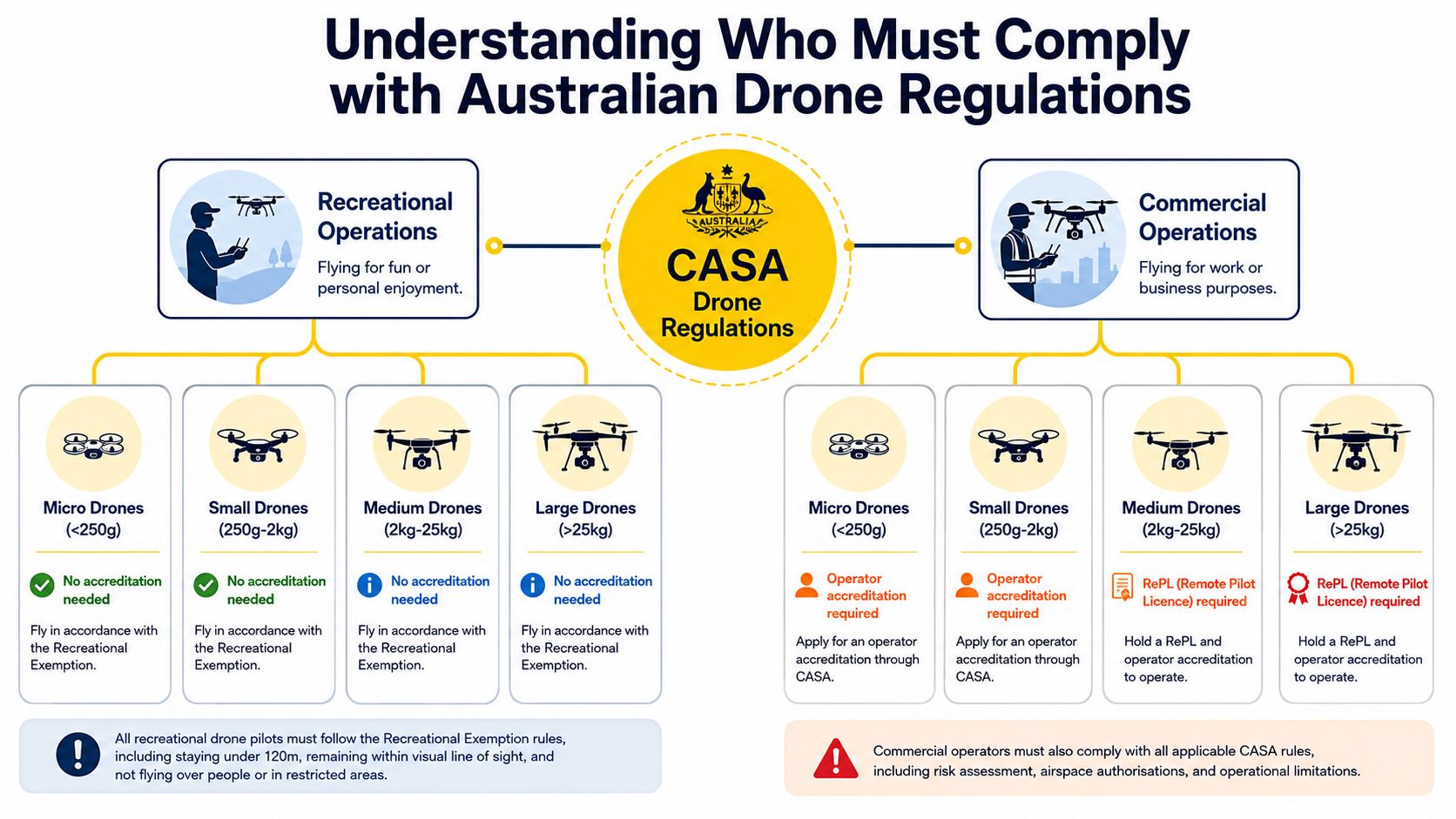
Australian drone regulations don't start with aircraft performance. They start with purpose. CASA draws a firm distinction between recreational use and commercial use, and that distinction changes what the pilot must do before take-off.
Why CASA separates recreational and commercial flying
A recreational pilot flying for enjoyment sits in a different category from a pilot capturing footage for a client, checking a roof for a builder, or surveying crops for a farm business. The aircraft may be identical, but the operation isn't.
That's why commercial drone operations involving aircraft weighing more than 250 grams require registration and either RPA Operator Accreditation for drones under 2kg or a Remote Pilot Licence for drones over 2kg, under the framework described in this Australian CASA rules guide. The same source notes that commercial drones over 500 grams incur an annual levy of AUD $40, while those 500 grams or less are free to register.
The confusion deepens with very small drones. CASA's safety rules make an important point that many simplified guides miss. Any drone used for paid work, including micro drones under 250g, must still be treated as a commercial operation. That means the pilot shouldn't assume “tiny” means “outside the system”.
Weight thresholds that change the rules
Three thresholds matter most in practice.
- Under 250g: These are often called micro drones. Recreational use is often simpler, but commercial use can still trigger compliance obligations.
- 250g to under 2kg: Drones in this category are a common starting point for many entry-level commercial operators. It often aligns with the excluded category framework when operations stay within standard conditions.
- Over 2kg: The licensing burden rises, and a RePL becomes central for commercial work with drones in this category.
- Over 25kg: The rules become more stringent again, including situations where even operating on private land doesn't remove the licensing requirement.
A drone's size doesn't decide everything. A small aircraft used for paid work can create more legal obligations than a larger aircraft used recreationally.
A quick category guide
| Operation type | Drone weight | Typical compliance direction |
|---|---|---|
| Recreational | Under 250g | Check current safety rules and operating conditions carefully |
| Recreational | 250g and above | Registration applies for sport and recreation under current CASA settings |
| Commercial | Under 250g | Commercial rules still apply. Don't assume exemption |
| Commercial | 250g to under 2kg | Registration plus operator accreditation when flown within standard conditions |
| Commercial | Over 2kg | RePL required |
| Commercial | Over 25kg | RePL requirement becomes absolute, with additional certification considerations |
Pilots who are working in the under-2kg commercial space often benefit from understanding the excluded category drone operations pathway because that's where many legal first jobs begin.
For someone starting from scratch, an entry-level course such as ACE READY can help build the fundamentals of drone operations, aviation safety, CASA regulations, and flight operations before progressing to RePL training.
Navigating Registration and Certification Requirements
A common first-job scenario catches many new operators out. A pilot buys a sub-250g drone for simple paid photo work and assumes the aircraft is too small to trigger much compliance. Then the questions start. Does it still count as commercial use? Is accreditation enough? When does the business itself need approval? That micro-drone gap is where mistakes happen, because aircraft size, pilot qualification, and business approvals sit on different tracks.
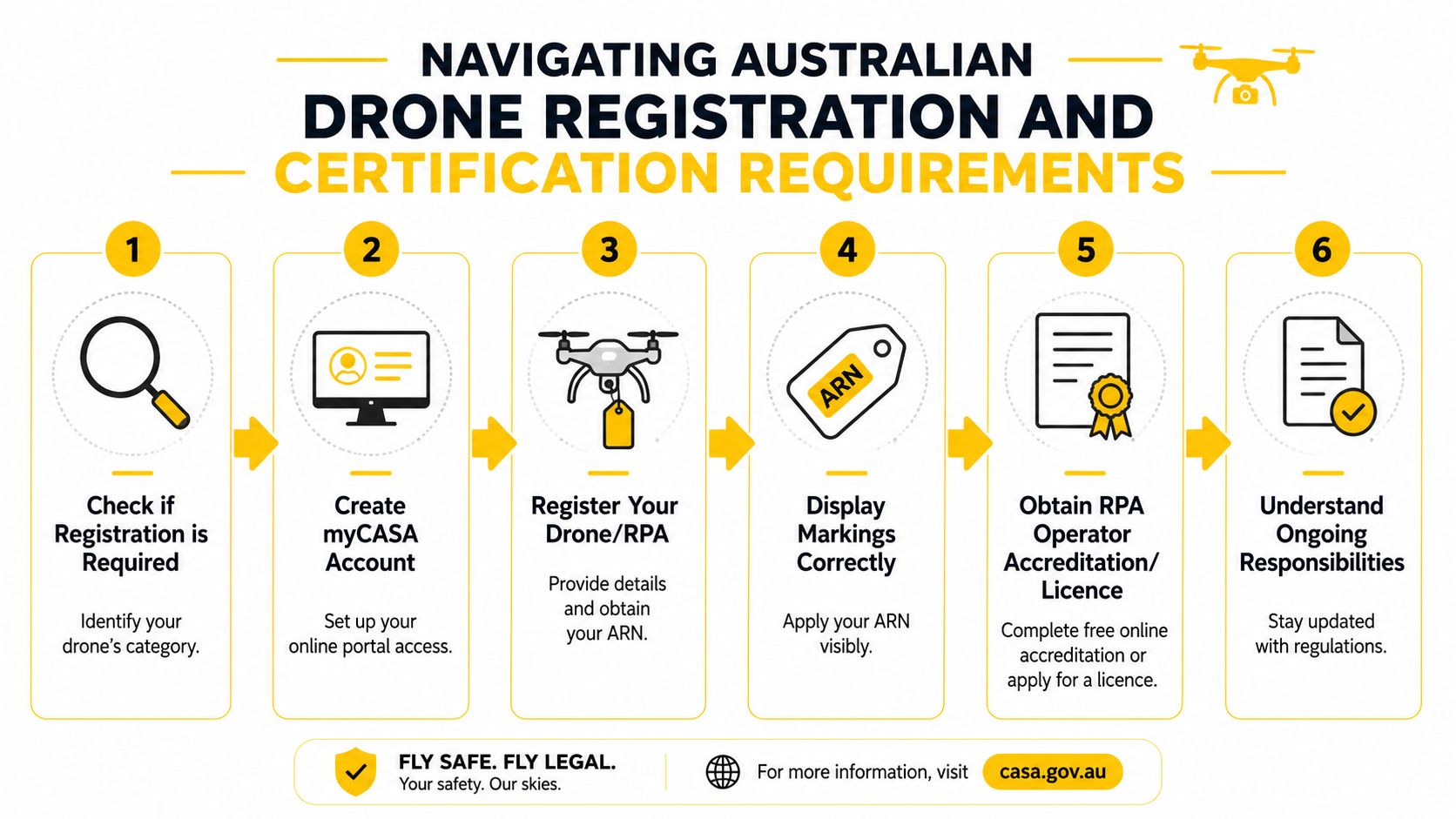
The easiest way to stay oriented is to treat compliance like a pre-flight sequence. First confirm what kind of operation you are doing. Then match the aircraft to the rule set. Then confirm the pilot qualification. Only after that should you ask whether the organisation needs a higher level approval.
A practical order for getting compliant
A clean process usually works in this order:
- Classify the operation. If the flight is part of paid work, business activity, or a client deliverable, start from the commercial rule set.
- Match the drone to the category. Weight still matters, but it does not answer every question by itself.
- Check whether CASA registration applies. For many business uses, registration is part of the setup before the first legal flight.
- Mark the aircraft correctly. Registration details need to be displayed in the required way.
- Confirm the pilot pathway. That may be operator accreditation for lower-risk work, or a RePL for heavier or more advanced operations.
- Check the business layer. If the operation is scaling up or moving beyond standard conditions, the organisation may need a ReOC.
CASA's current registration framework makes one point clear. Commercial operators cannot assume a small drone means no paperwork. That is why micro-drone pilots need a checklist tied to training decisions, not just a weight chart.
When accreditation is enough and when a RePL is required
Operator accreditation and a RePL solve different problems.
Accreditation is the entry pathway for lower-risk operations that fit within standard conditions. It suits many pilots doing straightforward commercial work with lighter aircraft.
A RePL is the pilot licence pathway for heavier drones and for operations that demand more aeronautical knowledge, planning, and accountability. CASA explains the broader licensing and accreditation framework on its remotely piloted aircraft and drone pilot licences page.
A simple comparison helps here. Accreditation works like a basic driving authority for predictable trips under set rules. A RePL is closer to a higher class of licence. It prepares the pilot for more capable aircraft and more demanding operational profiles.
That distinction matters in real jobs. A solo operator filming a daylight real-estate shoot with a light drone under standard conditions may sit in the accreditation pathway. A contractor planning heavier aircraft work, complex client operations, or flights that sit outside standard excluded conditions needs to assess the RePL route much earlier.
Where AROC and ReOC fit
Pilots often mix up pilot credentials with business approvals. CASA separates them for a reason.
An Aeronautical Radio Operator Certificate (AROC) becomes relevant when the operation requires radio communication in airspace where correct phraseology and radio procedure matter. It does not replace a RePL, because it addresses communication privileges, not drone pilot licensing.
A Remote Operator Certificate (ReOC) applies at the organisational level. It is the approval structure for businesses conducting certain kinds of drone operations. If a company is building repeatable commercial services, managing multiple pilots, or planning more advanced activities, the ReOC question usually arrives sooner than expected. Pilots who want that bigger-picture context can review this guide to ReOC in Australia.
The practical lesson is straightforward. The aircraft may need registration. The pilot may need accreditation or a RePL. The business may need a ReOC. For micro-drone operators, those layers are easy to overlook because the aircraft looks simple. The law does not judge only by size. It also looks at purpose, operating conditions, and who is conducting the work.
Mastering Operational Limits and Airspace Rules
A legally registered drone flown by a qualified operator can still be operated unlawfully if the mission profile breaches standard operating limits. In practice, field discipline is of utmost importance.
Core flight limits every operator should know
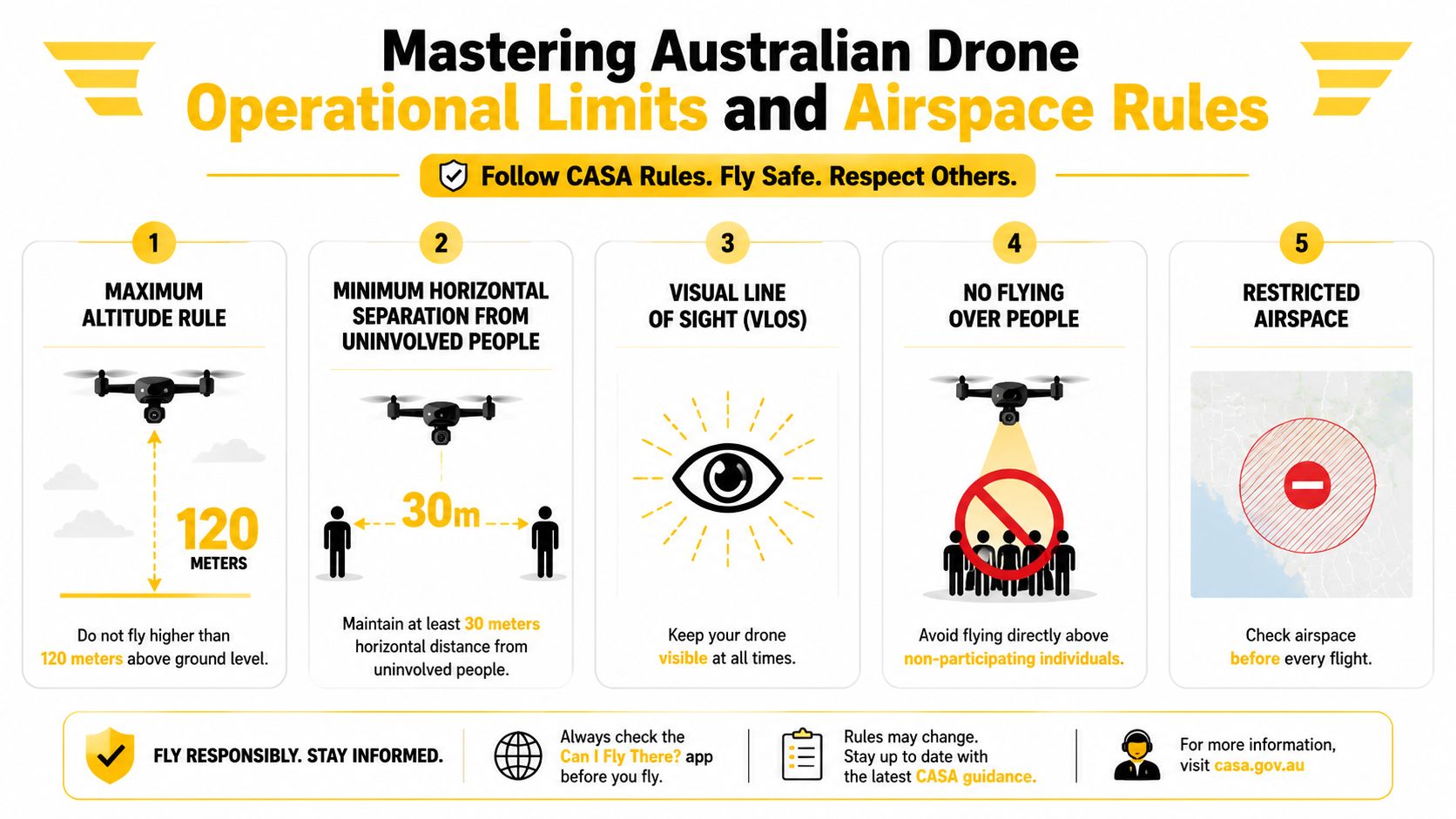
For micro and excluded RPA operations under Part 101, Australian drone regulations impose a maximum altitude of 120 metres above ground level, require visual line-of-sight, and generally prohibit night flying unless CASA approval and licensed pilot qualification are in place, according to this Australian regulation summary.
Another key separation rule is CASA's requirement to maintain 30 metres horizontally from people not involved in the operation, with a 5.5km buffer from controlled aerodromes for drones exceeding 250g without air traffic control approval, as explained in this CASA rules and certification guide.
These aren't abstract numbers. They shape every site assessment.
- Altitude limit: The aircraft cannot solely climb because the camera angle is better.
- People separation: A busy footpath can turn an otherwise suitable site into a no-go location.
- VLOS: If buildings, trees, terrain, or distance will hide the aircraft, the operation needs a different approval pathway.
- Aerodrome proximity: A site near controlled airspace requires more than enthusiasm and a clear weather forecast.
Field check: Before launch, a competent pilot should be able to point to the take-off area, likely flight path, nearby people, and nearby airspace constraints without guessing.
How the rules apply on real jobs
A rooftop inspection in an industrial estate may look simple, but the pilot still needs enough standoff from uninvolved people. If contractors, pedestrians, or delivery drivers can walk into the operating area, the mission setup may be poor even before the motors start.
A park survey creates a different problem. The aircraft may be light, but if members of the public are moving through the area, maintaining separation becomes difficult. That's why “it's only a quick flight” isn't a compliance defence.
Pilots operating near airports, helipads, or other sensitive airspace need a stronger grasp of location-based risk. A more detailed explanation of those issues appears in this drone safety guide for airports and HLS in Australia.
For students building commercial discipline from the ground up, ACE BRONZE fits this stage well because it covers drone operations, flight safety, aviation theory, and practical skills for those beginning the pathway toward licensed operations in Australia.
Securing Approvals Exemptions and Notifications
Standard operations cover a lot of entry-level commercial flying, but they don't cover everything. Once the mission moves outside ordinary conditions, operators need to think in terms of approvals, exemptions, and mandatory notifications.
The under-2kg hire-or-reward notification step
One of the least understood parts of Australian drone regulations sits in the under-2kg category. A critical regulatory milestone came on 30 May 2022, when CASA expanded mandatory registration requirements to include recreational drones 250 grams or more, and the framework also included a notification requirement for very small RPAs under 2kg used for hire or reward, which must be notified to CASA at least five business days before commencing such operations, as discussed in the NSW Productivity Commission report on drones.
That detail matters because many operators focus on licence questions and miss the notification step entirely. A pilot might have the right aircraft and understand the standard flight rules, yet still overlook a required administrative action before beginning paid work.
When standard operations are no longer enough
Some jobs don't fit inside the simplest operational envelope. Common examples include:
- Night work: Often requested for media, asset inspection, or emergency response support.
- Beyond visual line-of-sight: Relevant to larger-area inspection or monitoring tasks.
- Operations over people or in more complex environments: These generally need more than a basic excluded-category approach.
In those cases, a pilot should think like an aviation operator rather than a gadget user. CASA will expect a clear operational case, supporting documentation, and a safety logic that matches the risk of the mission.
A practical approval workflow often includes:
- Define the exact variation sought. A broad request is harder to assess than a specific operational need.
- Match the aircraft and pilot qualifications to the task. The paperwork should show that the crew and equipment fit the operation.
- Document risk controls clearly. Separation, communication, site control, and contingencies should be evident.
- Allow time before the job. Approval-related work should begin well before the planned launch date.
Operators planning advanced BVLOS activity often start by reviewing specialised training and capability pathways such as AAA's BVLOS training information.
A strong CASA submission usually reads like a risk-managed aviation operation, not a casual request for permission to fly somewhere inconvenient.
Avoiding Penalties Enforcement and Risks
A common enforcement story starts on an ordinary job. A pilot arrives at a worksite, sees open space, and assumes the flight will be low risk. The aircraft is small, the task looks simple, and the launch happens before anyone checks whether the drone is registered, whether the job counts as commercial, or whether the site conditions fit the rules. That is the compliance gap that catches many operators, especially with micro drones.
CASA enforcement is not only about dramatic incidents. It often begins with basic rule breaches that show weak planning. A short flight can still create a conflict with people on the ground, nearby air traffic, or the operator's own legal obligations.
What non-compliance can cost
The practical cost usually arrives in three layers. First comes the immediate breach, such as flying for business without meeting the required registration or accreditation pathway. Next comes the operational fallout, which may include a stopped job, client concern, and insurance questions. The final layer is the one many new operators miss. A record of poor compliance can make future approvals, contracts, and internal safety sign-off harder.
As noted earlier, commercial use changes the compliance picture even for very small aircraft. That point matters because many pilots still treat sub-250 g drones like harmless cameras rather than aircraft with job-specific legal duties.
How small mistakes turn into enforcement action
Drone compliance works like a pre-flight chain. If one link is weak, the strain moves to the next link. A pilot who mislabels paid work as recreational may also skip registration checks. The same pilot may then rush the site assessment and miss people separation or airspace limits. What looked like one small shortcut becomes a pattern of unsafe decision-making.
Common triggers for enforcement include:
- Treating a paid task as casual flying
- Assuming a micro drone has no commercial compliance duties
- Flying from a site without checking nearby airspace or ground risk
- Relying on aircraft size instead of the actual operating rules
- Sending inexperienced staff to jobs without a clear training pathway
The last point is often overlooked. A checklist helps prevent simple misses, but training helps a pilot recognise risk before it appears on the page. Operators who regularly switch between micro drones, larger aircraft, and different job types should pair their pre-flight process with structured pilot development, such as drone training courses for commercial operators.
A useful test is this. If CASA reviewed your planning after the flight, would your records show a deliberate aviation decision or a quick guess made on-site?
Reliable operators treat compliance as part of mission planning, not as paperwork added after the batteries are charged.
Ready-to-Use Compliance Checklist and Training Pathways
A common compliance failure starts with a simple job. A business sends a staff member to capture roof photos with a tiny drone, assumes the aircraft is too small to matter, and treats the task like casual flying. The aircraft may be small, but the legal questions are not. That is why the safest approach is to pair a field checklist with a training path that matches the work.
A practical compliance checklist
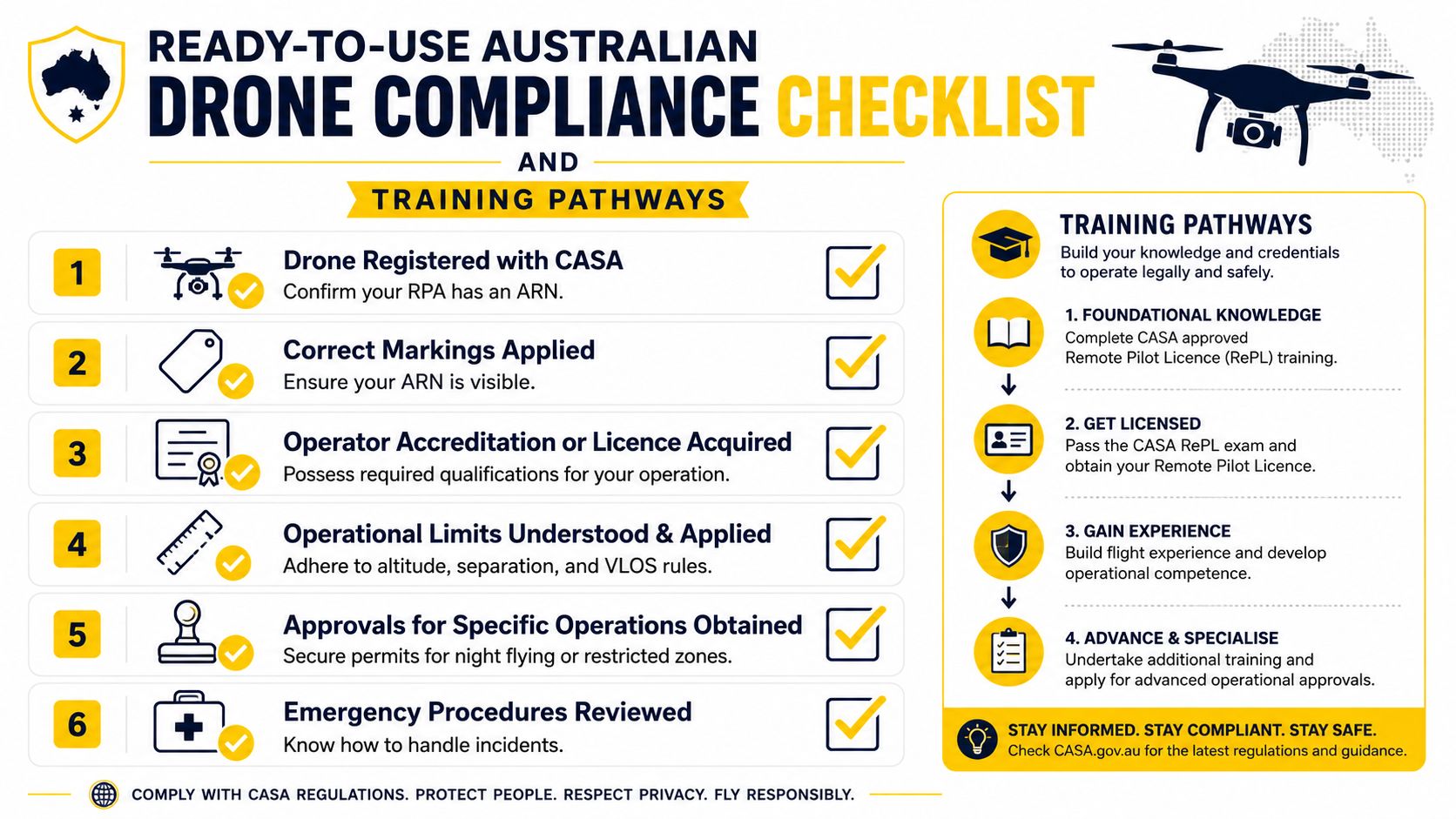
A good checklist works like a pre-takeoff inspection in a crewed aircraft. It turns memory into a process. That matters most in the micro-drone category, where operators often separate the aircraft size from the mission type and miss the compliance duty attached to paid work.
Use this list before each job, not after the client has arrived and the batteries are already fitted.
| Action | What to confirm | Why it matters |
|---|---|---|
| Confirm the flight purpose | Is the flight recreational, incidental to business, or paid work for a client | The purpose of the flight changes the compliance pathway |
| Check the drone category | Identify whether the aircraft is a micro drone, excluded category aircraft, or a larger platform | Aircraft size affects which qualification path may fit the job |
| Verify registration status | Confirm the aircraft is registered if the operation requires it | Registration gaps are easy to miss when teams use several drones |
| Check aircraft marking | Make sure the required identifying details are displayed correctly | A registered aircraft should also be marked correctly before deployment |
| Match the pilot to the mission | Confirm the pilot holds the right accreditation, licence, or company approval for that task | A qualified pilot for one job is not automatically cleared for every job |
| Review the site and airspace | Check location limits, nearby people, altitude, visual line of sight, and controlled airspace issues | Site risk often changes even when the task looks routine |
| Confirm approval needs | Ask whether this flight needs a notification, exemption, or other approval before launch | Standard rules do not cover every operation |
| Brief abnormal and emergency actions | Agree on lost link, fly-away, incursion, and landing responses | Teams perform better when the response is decided before the problem appears |
One point deserves extra emphasis. Micro drones can create the biggest compliance blind spot because operators often treat them as low-risk tools instead of aircraft with mission-dependent rules. The checklist closes that gap at the planning stage.
For the underlying safety rule set, use CASA's summary of standard operating conditions for drones.
Matching the rule to the right training pathway
Training should answer the question, "What kind of flying are you preparing this person to do?" A pilot capturing simple marketing footage at familiar sites needs a different pathway from a pilot working across varied locations, heavier aircraft, or airspace with tighter constraints.
A practical way to sort training is to match it to the decision load of the job:
- Operator accreditation: Suitable for pilots conducting lower-complexity operations where accreditation meets the legal requirement for that aircraft and mission type.
- Remote Pilot Licence RePL: Better suited to pilots flying aircraft or missions that call for a higher formal standard of training and assessment.
- Aeronautical Radio Operator Certificate AROC: Relevant for pilots who may need radio communication skills for controlled airspace operations.
- Certificate III in Aviation: Useful for organisations that want a broader aviation foundation, not just task-specific drone handling.
- ReOC consulting or enterprise training: Appropriate for businesses building repeatable systems across staff, sites, and aircraft types.
This is the overlooked link many operators miss. The checklist catches the immediate legal checks. Training builds judgment, so pilots can recognise when a "small, simple drone job" is a regulated commercial operation with extra conditions attached.
Teams that want a structured progression can review drone training courses for commercial operators. The best pathway is the one that matches the aircraft, the site, and the type of work the pilot will perform.
If you remember one idea from this section, use this one. Small drones do not remove the need for a serious compliance process. They increase the need for a clear one because people are more likely to underestimate them.
Frequently Asked Questions
Does a business need insurance for commercial drone work
Insurance can be an important risk control for commercial operations, but insurance arrangements sit outside the core CASA licensing and registration rules discussed here. Operators should confirm business, liability, and client contract requirements separately.
Can a landowner ignore the rules on private property
No. Private land ownership doesn't remove CASA obligations. Drone operations remain aviation activities, and the applicable category, licence, and operating rules still matter.
Does a client's permission override CASA separation rules
No. A client can approve access to a site, but a client can't waive CASA safety obligations. The pilot remains responsible for operating within the required limits and approvals.
How should operators keep qualifications current
Pilots should track their registration status, accreditation or licence status, aircraft records, and any approval conditions. A disciplined renewal and document review process helps prevent accidental non-compliance.
Are CASA safety rules the same as drone security laws
Not entirely. CASA safety rules deal with aviation safety. Separate Commonwealth security reform proposals have also been discussed for future years, which means some operators may eventually need to think about both safety compliance and security compliance as distinct issues.
For operators who want structured support, Ace Aviation Aerospace Academy provides Australian aviation and drone training pathways including RePL, AROC, ReOC consulting, and broader aviation education for commercial and enterprise drone operations.