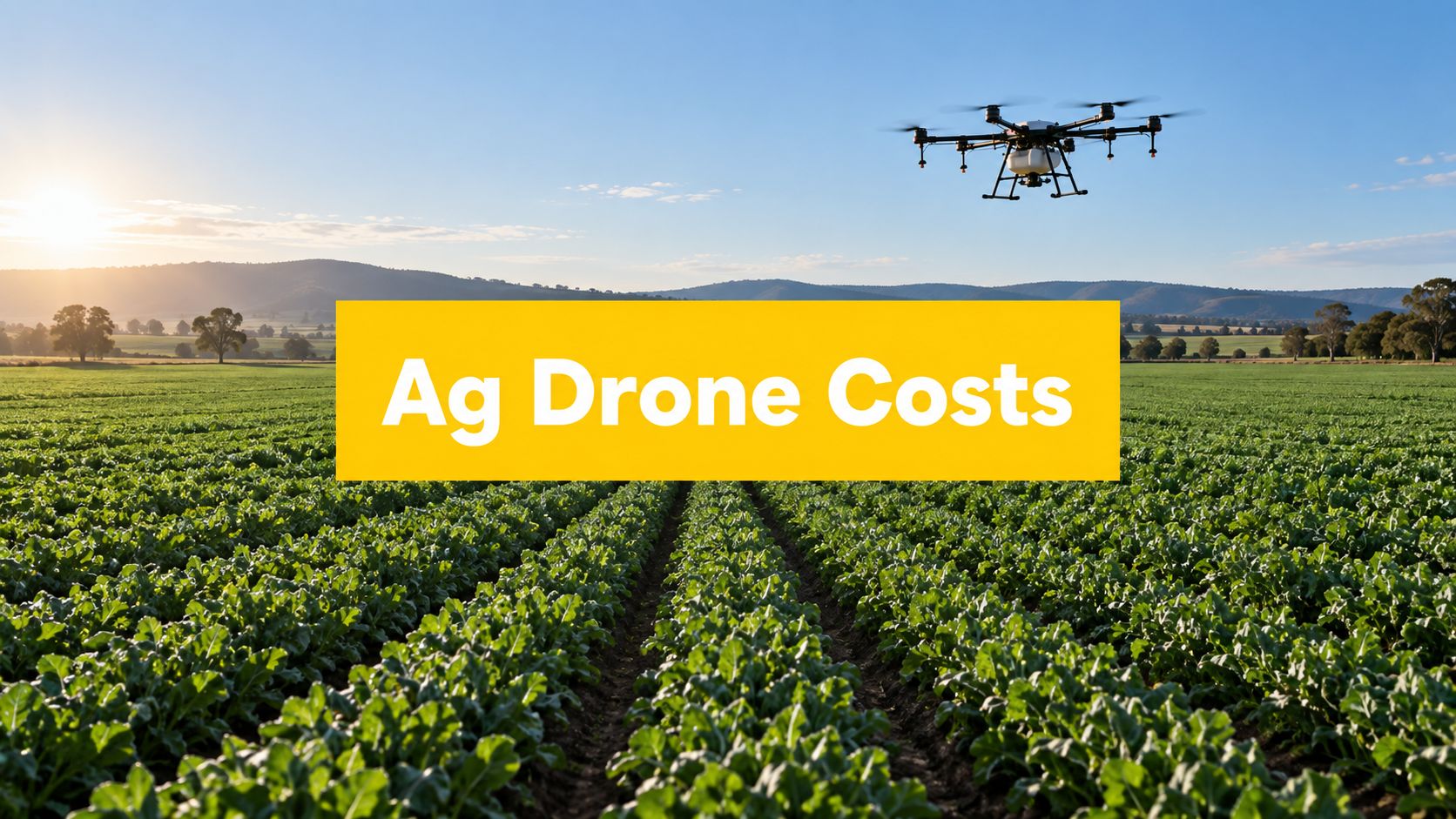
Australian agricultural spray drones currently list between roughly A$15,000 for discounted entry bundles and around A$55,717 for flagship spray packages. Mapping and multispectral platforms sit lower, at about A$6,700 to A$13,090, but those headline figures are only the starting point for a genuine farm budget.
The right drone for agriculture price depends on the job the aircraft must perform. A grower buying a spray platform for occasional scouting can overspend badly, while a commercial operator choosing a lightweight mapping drone for liquid application will discover that a lower purchase price doesn't solve the operational problem. The sensible decision starts with capability, then adds batteries, training, compliance, insurance, software, servicing and support.
Table of Contents
- What Agricultural Drones Actually Cost in Australia Right Now
- Spray Drones Versus Mapping and Multispectral Platforms
- What Drives the Price Tag Across Capability Tiers
- The Hidden Cost Stack Most Buyers Underestimate
- CASA Rules That Change Your Compliance Budget
- Working Out ROI on a Real Australian Farm
- Buying Rules and Where Training Fits In
- Frequently Asked Questions
- What is the current price of an agricultural spray drone in Australia?
- Are mapping drones cheaper than spray drones?
- Does a farmer need CASA authorisation to spray on private land?
- What costs should be added to the drone price?
- Should a farm buy a spray drone or a multispectral drone first?
- How can a farm calculate agricultural drone ROI?
What Agricultural Drones Actually Cost in Australia Right Now
Agricultural spray drones span roughly A$15,000 to A$55,717 in current Australian listings. That range covers discounted entry bundles, mid-tier packages and flagship systems, with the final price shaped by the aircraft, controller, tanks, batteries and included accessories, as shown in current Australian agricultural drone listings.
Mapping and multispectral platforms sit in a separate band, generally around A$6,700 to A$13,090. Systems such as the DJI Mavic 3 Multispectral, Matrice 4 Enterprise and Matrice 400 address sensing and analysis rather than liquid application. Positioning equipment, software and data processing can still add to the purchase and operating budget.
| Category | Entry Tier | Mid Tier | Flagship Tier |
|---|---|---|---|
| Agricultural spray drone | About A$15,000 | A$25,000 to A$35,000 | About A$55,717 |
| Mapping or multispectral drone | About A$6,700 | Within the A$6,700 to A$13,090 band | Upper end of the listing range, depending on platform |
| Complete operational setup | Varies by aircraft and configuration | Higher once batteries, charging and software are added | Highest capital and support commitment |
For a useful reference point, T50 and T100 packages range from a standard setup to a higher-capability ready-to-spray configuration, with the difference driven by tanks, pumps, RTK positioning, battery logistics and field workflow rather than the airframe alone.
Practical rule: A chassis-only quote is not a farm budget. Compare ready-to-operate packages built for the intended job.
The sticker price should frame supplier discussions, not approve the purchase. Use a drone quote calculator to organise equipment and operating assumptions before accepting a quote. Price the spray-versus-mapping decision first, then account for batteries, charging, training, compliance, insurance, software, servicing and local support. Those additions determine whether the aircraft becomes a productive farm tool or an expensive asset that spends more time parked than working.
Spray Drones Versus Mapping and Multispectral Platforms
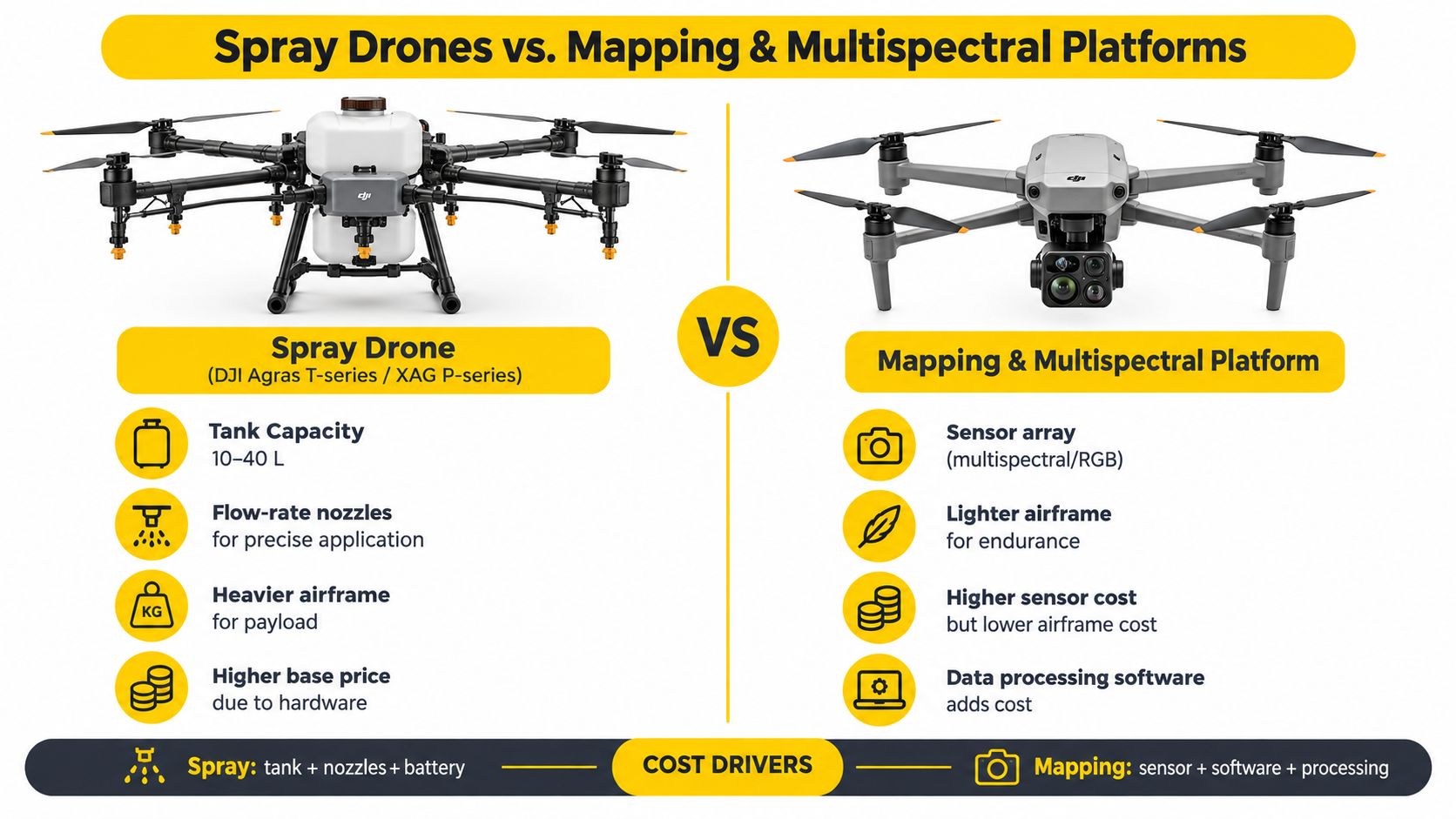
Spray drones and mapping platforms solve different farm problems. Choose the job first, then compare the aircraft and the full operating setup. The price bands from the previous section are useful context, but they do not make these platforms interchangeable.
A spray drone carries liquid or granular material. Its value comes from application hardware, repeatable flight paths and access to areas where ground equipment is slow, impractical or unable to operate. A mapping or multispectral drone carries sensors, producing imagery that helps locate crop stress, weed pressure, variability and zones needing inspection. Its output depends on flight planning, calibrated imagery and someone who can interpret the data.
Match the platform to the farm job
| Farm requirement | Better starting platform | Why |
|---|---|---|
| Applying liquid products | Spray drone | Designed around tanks, pumps, flow control and washdown |
| Spreading suitable granular material | Spray and spread drone | Uses dedicated spreading hardware and payload logistics |
| Crop scouting | Mapping drone | Produces aerial imagery for inspection and comparison |
| Multispectral crop analysis | Multispectral platform | Captures data beyond ordinary visible-light imagery |
| Paddock zoning | Mapping platform | Supports boundaries, variability and prescription workflows |
| Targeted treatment | Both, used as a workflow | Mapping identifies the area, spraying performs the application |
A practical workflow starts with a weed-pressure map. The mapping drone surveys the paddock, the processed imagery identifies a treatment zone, and the spray drone applies the product to that defined area. That sequence can justify owning or hiring both capabilities, while buying a spray drone alone leaves the operator without the same scouting and prescription information.
For scouting, zoning and prescription mapping, start with a mapping or multispectral platform. For repeated application work, assess a spray platform, especially on a large horticultural operation or where ground access is difficult. Do not choose the cheaper mapping aircraft and expect it to perform spraying.
The XAG P150 Max and Australian agricultural applications show why model comparisons should follow the work process, payload and field conditions rather than brand recognition. Beginners establishing aviation knowledge before progressing towards licensing can review ACE READY, which covers drone fundamentals, aviation safety, CASA regulations and flight operations.
What Drives the Price Tag Across Capability Tiers
Capability tiers reflect the operating system around the aircraft, not just the airframe. A larger tank reduces refill interruptions. Better flow control supports consistent application. RTK positioning helps maintain repeatable flight lines, while extra batteries and charging equipment determine whether the aircraft works through the day or waits between jobs.
Ask suppliers for an itemised quote. A package label can hide the difference between a ready-to-work system and a chassis with major equipment still to buy.
Payload and application hardware
Payload capacity is a direct price driver. A smaller tank may suit spot work or restricted access. A larger tank can reduce refilling when the farm has suitable water and mixing facilities. Pumps, nozzles, flow meters and spreading components also raise the price because they turn an aircraft into an application system.
Use the T50 and T100 packages introduced earlier as a comparison point, then ask the supplier to separate every included component. A useful quote should identify the aircraft, batteries, charger, controller, spray or spreading kit, installation, software, freight, GST and support. If the headline price covers only the chassis, the quote exposes the gap before purchase.
Positioning, sensing and resilience
RTK capability, obstacle sensing, terrain following and controller quality affect field confidence. A farm near trees, uneven ground, sheds or infrastructure needs different equipment from an open-area mapping job. Chemical exposure also makes sealing, washdown design and replacement parts more important than they are for an aircraft used only for imagery.
| Feature | Entry specification | Flagship specification | Price impact |
|---|---|---|---|
| Payload system | Smaller or basic application setup | Higher-capacity spray and spreading configuration | Raises aircraft, pump and logistics cost |
| Positioning | Standard satellite navigation | RTK-enabled positioning | Adds positioning hardware and correction requirements |
| Flow control | Basic monitoring | More precise pump, nozzle and flow management | Adds application hardware and service complexity |
| Obstacle awareness | Limited sensing | More comprehensive radar and terrain awareness | Increases safety-system cost |
| Battery package | Minimal working rotation | Larger battery pool with charging infrastructure | Adds substantial operational capital |
| Controller and support | Standard controller | Newer controller, display and field accessories | Increases bundle price |
| Protection and serviceability | Basic airframe protection | Greater environmental protection and support | Raises purchase and lifecycle cost |
Mapping platforms can carry their own cost tier. Positioning accessories and analytical tools may be required when the farm needs reliable georeferencing, repeatable datasets and a process for turning imagery into decisions. A cheaper airframe can therefore produce a more expensive project.
The XAG Australia agricultural drone range illustrates why buyers should compare the complete specification sheet. The most misleading quote is a low chassis price that leaves batteries, charger, application equipment, controller or service arrangements outside the package. Select the platform against the work it must complete, then price the full operating setup before comparing brands.
The Hidden Cost Stack Most Buyers Underestimate
The aircraft is only the visible part of the purchase. Approving the airframe before pricing the operating system can leave a farm with an expensive asset that cannot work when the season demands it. Decide first whether the platform will spray, map, or support both workflows, then price everything needed to keep it productive.
The cost stack normally includes:
- Training: A commercial operator may need appropriate pilot training, assessment and licensing before undertaking paid work.
- Registration and administration: Aircraft registration, operational records and business documentation belong in the budget.
- Insurance: The policy must match the operation, particularly where agricultural application creates risks beyond ordinary aerial photography.
- Batteries and charging: Spray work depends on battery rotation, charging capacity and safe transport.
- Software: Flight planning, mapping, analytics and application workflows may involve separate tools or subscriptions.
- Maintenance: Pumps, nozzles, flow meters, propellers and other exposed components require inspection and replacement.
- Logistics: Transport cases, vehicle racks, water, mixing equipment and suitable storage affect readiness.
Budget the system, not the aircraft
Australian costs vary by provider, aircraft and operating model, so a neat universal total is misleading. Obtain written quotes for each line and record whether GST, freight, installation and ongoing support are included.
| Cost item | Typical AUD range | Frequency |
|---|---|---|
| Spray or mapping aircraft | About A$6,700 to A$55,717, depending on category and configuration | Initial purchase |
| Training and licensing | Supplier quote required | Initial and, where applicable, ongoing |
| Insurance | Insurer quote required | Annual |
| Battery replacement cycle and charging equipment | Supplier quote required | Initial purchase and replacement cycle |
| Calibration and application-system servicing | Supplier quote required | Seasonal and as required |
| Software and analytics | Provider quote required | Subscription or renewal cycle |
| Parts and servicing | Supplier quote required | Seasonal and as required |
| Transport and storage | Farm-specific quote required | Initial purchase and ongoing |
Lifecycle risk deserves attention. Older models can become unavailable while newer bundles replace them, making parts availability, battery lead times, firmware support and resale value commercial questions rather than technical footnotes. Before committing, ask the supplier how long replacement batteries, pumps and controllers are expected to remain available, and what calibration support the farm can access locally. A low purchase quote becomes expensive if downtime arrives during a narrow application window.
Operating-cost test: If a quote does not state what happens when a pump, battery, nozzle or controller fails during the application window, it is not complete.
Consumables also affect the rate per hectare. Spray components wear through contact with chemicals and sediment, while multispectral workflows depend on consistent calibration and dependable data handling. Budget for those services and replacements before comparing ownership with hiring an operator. The right platform is the one that can complete the farm's actual work, with its batteries, support and maintenance accounted for.
CASA Rules That Change Your Compliance Budget
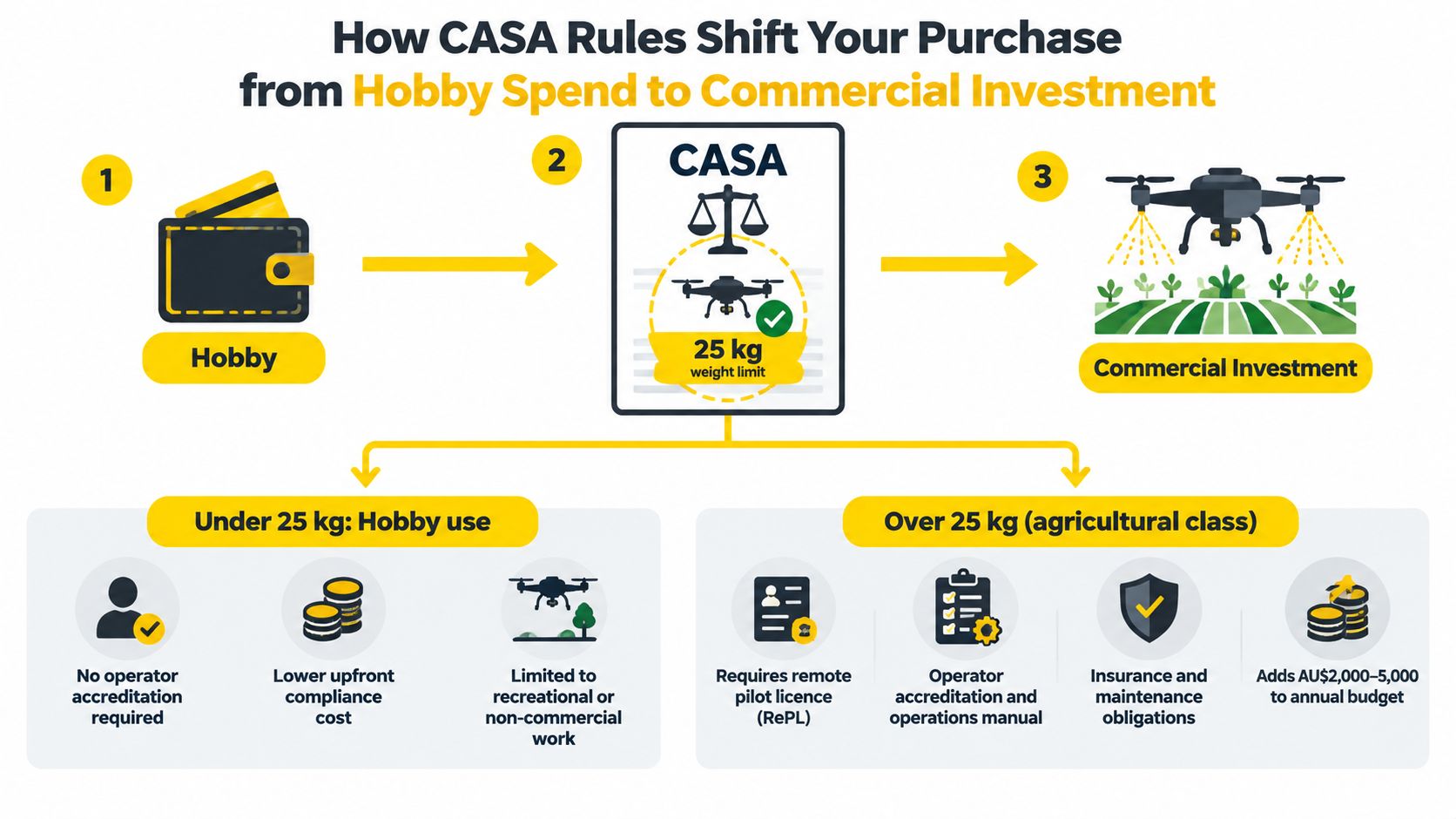
CASA compliance can change a drone purchase from farm equipment into a commercial aviation operation. The key tests are the aircraft's use, location, operating conditions and business structure. For agricultural spraying on their own land, CASA says a landholder does not need an authorisation when operating one drone on their own land. Registration and operator accreditation requirements still apply where relevant, and standard operating conditions remain in force. See CASA's guidance on drones used in agriculture.
That private-landholder position is narrow. A grower accepting jobs for neighbouring farms, operating beyond the applicable private-land limits or setting up a commercial service needs a compliance assessment before ordering equipment. Confirm the aircraft's weight and operating limits against the proposed work, rather than relying on a supplier's sales description.
Separate private use from commercial work
Commercial agricultural operations outside the private-landholder limits may require a Remote Pilot Licence, or RePL, and a remotely piloted aircraft operator's certificate, or ReOC, or operation under a current ReOC holder. That distinction matters before a spraying platform is priced as a revenue-generating asset.
Use this four-step check before placing an order:
- Confirm the operation: Decide whether the aircraft will serve one landholder's own property or perform work for clients.
- Confirm the aircraft and conditions: Check its weight, operating limits, location, airspace and proposed application task.
- Confirm the operator structure: Establish whether the pilot holds the required qualification and whether the business needs its own ReOC or will work under an existing holder.
- Confirm the documentation: Match the operation manual, risk controls, records and insurance to the actual work.
Use the current Australian drone-law guidance as a starting point, then confirm the exact operation with CASA or a qualified aviation adviser. Radio use may create a separate training requirement where the work involves relevant aviation communications.
Training, documentation, operational controls and insurance belong in the purchase decision. A cheaper aircraft that cannot legally and safely perform the intended work is not a cheaper farm asset. Compliance costs can also reshape the spray-versus-mapping choice, so price the lawful operating model before comparing platforms.
Working Out ROI on a Real Australian Farm
Return on investment should be calculated from productive work, not advertised flight capability. A farm needs to know what the aircraft can achieve in its own crop, paddock shape, terrain, weather window and refill arrangement.
The first calculation is straightforward:
Total ownership cost ÷ productive hectares treated or mapped = capital and operating cost per hectare.
Total ownership cost includes the aircraft, batteries, charger, training, insurance, software, servicing, transport and parts. The working figure should then be compared with the cost of hiring an operator and with the value of the farm problem being solved.
Use a conservative farm model
A 1,200-hectare mixed cropping block may have several different work profiles. Some paddocks may require targeted treatment, while others need crop scouting or mapping. The aircraft may be productive during a defined seasonal window rather than across the whole year.
| Line item | Value | Notes |
|---|---|---|
| Farm area | 1,200 ha | Mixed cropping block |
| Spray drone purchase | Select a current Australian quote | Use a complete operational package, not chassis-only pricing |
| Mapping platform alternative | About A$6,700 to A$13,090 | Australian listing range for mapping and multispectral platforms |
| Spray platform alternative | About A$15,000 to A$55,717 | Australian listing range for spray packages |
| Training and compliance | Obtain written quotes | Depends on operation, pilot and business structure |
| Annual insurance and support | Obtain written quotes | Match cover to the actual agricultural activity |
| Working hectares | Farm-specific | Use demonstrated sortie performance in the relevant crop |
| Comparison rate | Obtain local hire quotes | Compare ownership cost with contract application or mapping |
| Payback result | Do not assume | Calculate after seasonal work and downtime are known |
The Australian market reference for contract drone spraying provides a range of A$8 to A$25 per hectare for service pricing, but that figure should be treated as a comparison input rather than a guaranteed local rate, as shown in Australian contract drone-spraying pricing guidance. Field access, application type, travel, setup and minimum charges all affect the quote.
Test the purchase against the real alternative
A spray drone may justify itself where the farm needs timely application in wet or difficult areas, precise treatment of limited zones or work that a larger machine can't perform efficiently. A mapping drone may justify itself where early detection and better paddock decisions are the priority.
The farm manager should request a demonstration using the actual crop, paddock geometry and proposed workflow. The supplier should disclose refill time, battery rotation, setup time and usable output, not just maximum specifications. If those details aren't available, the ROI model remains promotional rather than operational.
A 1,200-hectare farm shouldn't assume payback within a fixed number of seasons. It should calculate several scenarios, including limited seasonal use, full internal use and contract work, then stress-test the result against downtime and parts delays.
Buying Rules and Where Training Fits In
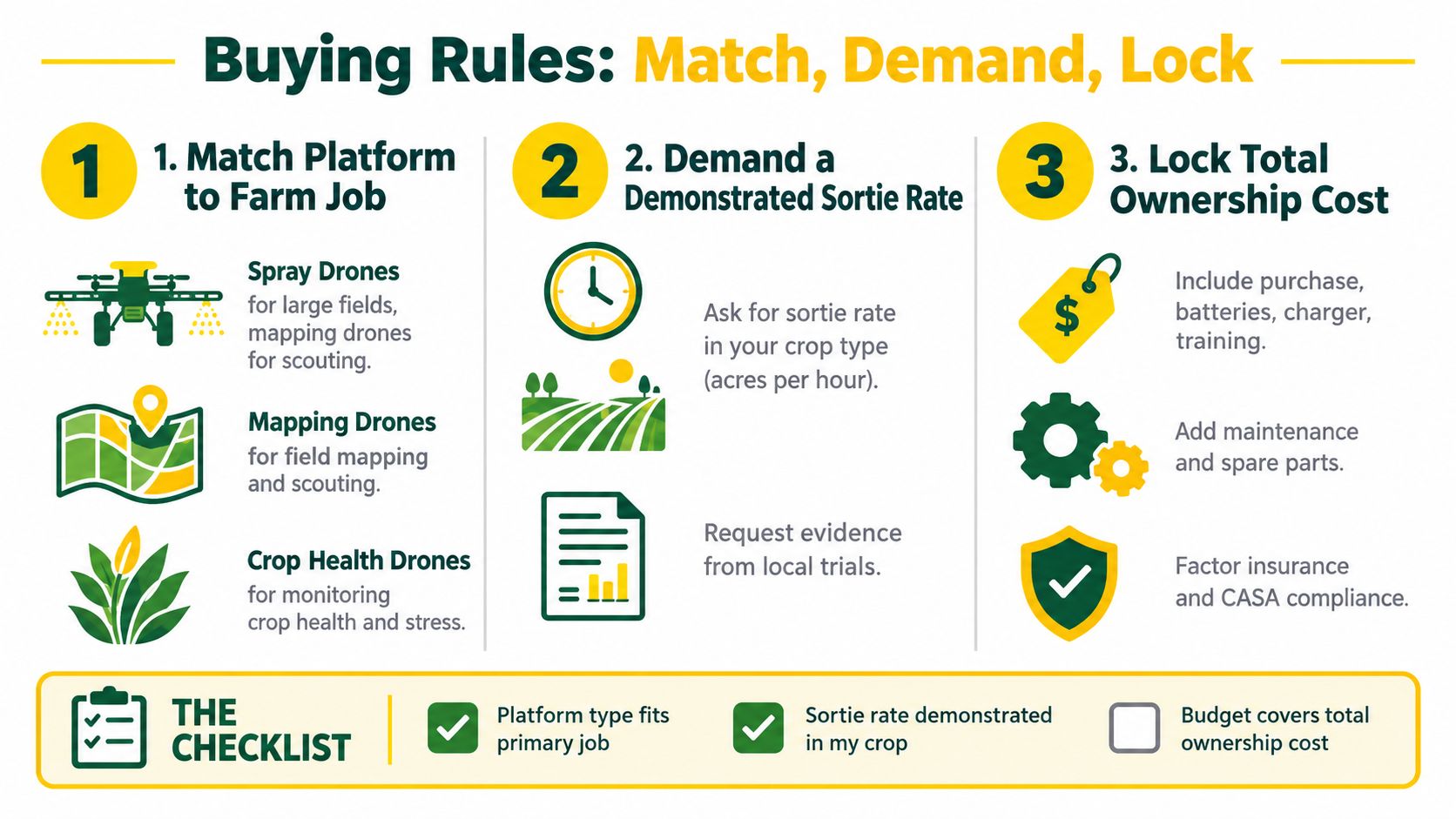
The buying decision becomes clearer when the farm applies a short set of essential rules.
Match the aircraft to the dominant task
Spraying, spreading, scouting and multispectral analysis require different hardware. A buyer should identify the task that creates the most value, then compare platforms within that category. Brand comparisons come later.
Demand a demonstrated sortie rate
A supplier should demonstrate the aircraft in the relevant crop and paddock conditions. The demonstration needs to include battery changes, refill logistics, field boundaries and the data or application output the farm will use.
Lock the total ownership cost
The accepted quote should identify:
- Equipment: Aircraft, controller, tanks, pumps, nozzles and spreading equipment.
- Energy: Batteries, chargers, generators and safe storage.
- Support: Parts, servicing, warranty conditions and local response.
- Compliance: Training, registration, records, operating documentation and insurance.
- Workflow: Mapping, analytics, application software and data management.
Training protects the investment because a stored aircraft produces no operational value. A relevant Remote Pilot Licence, or RePL, pathway can prepare a pilot for commercial drone work, while an Aeronautical Radio Operator Certificate, or AROC, may be relevant where aviation radio communication forms part of the operation. Businesses building a commercial agricultural service should also assess ReOC requirements, operations documentation and supervision arrangements.
Ace Aviation Aerospace Academy provides drone licence training information, including pathways relevant to pilots and commercial operators. Its broader aviation education offering includes RePL, AROC and ReOC consulting, but the exact course or advisory pathway should match the proposed operation and CASA requirements.
Final buying position: The cheapest airframe with an unprepared operator can cost more through downtime, unsuitable insurance and compliance failures than a properly specified mid-tier aircraft operated by a trained pilot.
The practical answer to “what is the drone for agriculture price?” is therefore not a single number. Australian spray drones currently span about A$15,000 to A$55,717, while mapping and multispectral platforms sit around A$6,700 to A$13,090, but the correct purchase is the one that solves the farm's dominant job and survives the full ownership calculation.
Ace Aviation Aerospace Academy provides CASA-focused drone education, including Remote Pilot Licence and Aeronautical Radio Operator Certificate pathways, alongside ReOC consulting for commercial operators. Visit Ace Aviation Aerospace Academy to match the proposed agricultural drone operation with an appropriate training and compliance pathway.
Frequently Asked Questions
What is the current price of an agricultural spray drone in Australia?
Australian listings currently range from about A$15,000 for discounted entry bundles to approximately A$55,717 for flagship spray packages, depending on configuration and included equipment. A DJI AGRAS T50 standard three-battery kit was listed at A$34,500 excluding GST, while T100-ready-to-spray packages were listed at A$45,000 to A$56,405.
Are mapping drones cheaper than spray drones?
Generally, yes. Australian listings place mapping and multispectral platforms such as the Mavic 3 Multispectral, Matrice 4 Enterprise and Matrice 400 around A$6,700 to A$13,090. They don't replace spray drones because they carry sensors and produce data rather than operating as liquid-application systems.
Does a farmer need CASA authorisation to spray on private land?
CASA says no authorisation is required when a landholder operates one drone on their own land, but standard operating conditions still apply. Registration and accreditation requirements may also apply. Commercial work beyond those limits can require a RePL and ReOC arrangements.
What costs should be added to the drone price?
The budget should include batteries, chargers, software, training, registration, insurance, transport, storage, maintenance and replacement parts. Spray components such as pumps, nozzles and flow meters need particular attention because they are exposed to operational wear.
Should a farm buy a spray drone or a multispectral drone first?
The dominant farm problem should decide. A farm focused on crop scouting, stress detection and paddock zoning may start with a mapping or multispectral platform, while an operation needing repeated liquid application should assess a spray drone and its complete logistics package.
How can a farm calculate agricultural drone ROI?
The farm should divide its complete ownership and operating cost by the hectares it can realistically work, then compare that result with local contract rates and the value of the task. Supplier demonstrations should include actual paddock conditions, refill time, battery rotation and seasonal operating constraints.