The private pilot licence cost in Australia is usually AUD$18,000 to AUD$28,000, once aircraft hire, instructor time, ground school, exams, and medical certification are all counted. The sticker price is often lower than the bill that lands in front of a student.
That gap surprises people because flight schools tend to quote the easiest number to advertise, not the full cost to finish. The better benchmark is the one that includes extra hours, slower progress, and the practical expenses that show up before a licence is issued.
Table of Contents
- Understanding the Real Private Pilot License Cost in Australia
- Breaking Down Every Cost Component
- Hidden Costs That Inflate Your Final Bill
- How Training Pace Affects Your Total Investment
- Financing and Saving Strategies for PPL Training
- Your PPL Timeline and Decision Checklist
- Private Pilot Licence versus Remote Pilot Licence Pathways
Understanding the Real Private Pilot License Cost in Australia
A realistic private pilot licence cost in Australia is best treated as a range, not a promise. For most students, the total usually sits around AUD$18,000 to AUD$28,000 because the licence is built from several parts that all add up, aircraft hire, instructor time, ground training, exams, and medical certification.
That range becomes easier to understand when compared with broader training markets. A 2025 survey found a median private licence cost of about US$14,000 and a median training time of 24 weeks, while also showing costs had risen 12% since 2022. A second 2025 survey summary reported that private pilot certificate costs had increased by an average of 16% year-over-year from 2020 to 2023, then sat at approximately US$14,000 with completion time near six months. Those figures are not Australian quotes, but they do show the same cost structure that Australian students encounter, with the final bill driven more by hours flown and pace than by a single advertised tuition number. Redbird's 2025 flight training survey summary and General Aviation News coverage of cost stabilisation
Practical rule: a low hourly rate doesn't mean a low finished cost if the student needs more months, more review flights, or extra dual instruction to stay current.
A common mistake is budgeting for the advertised “starting from” figure and stopping there. In practice, the actual cost is shaped by how fast the student learns, how often lessons are booked, and whether progress stays steady enough to avoid repetition. For that reason, a realistic quote should be read as a completed-training estimate, not a marketing headline.
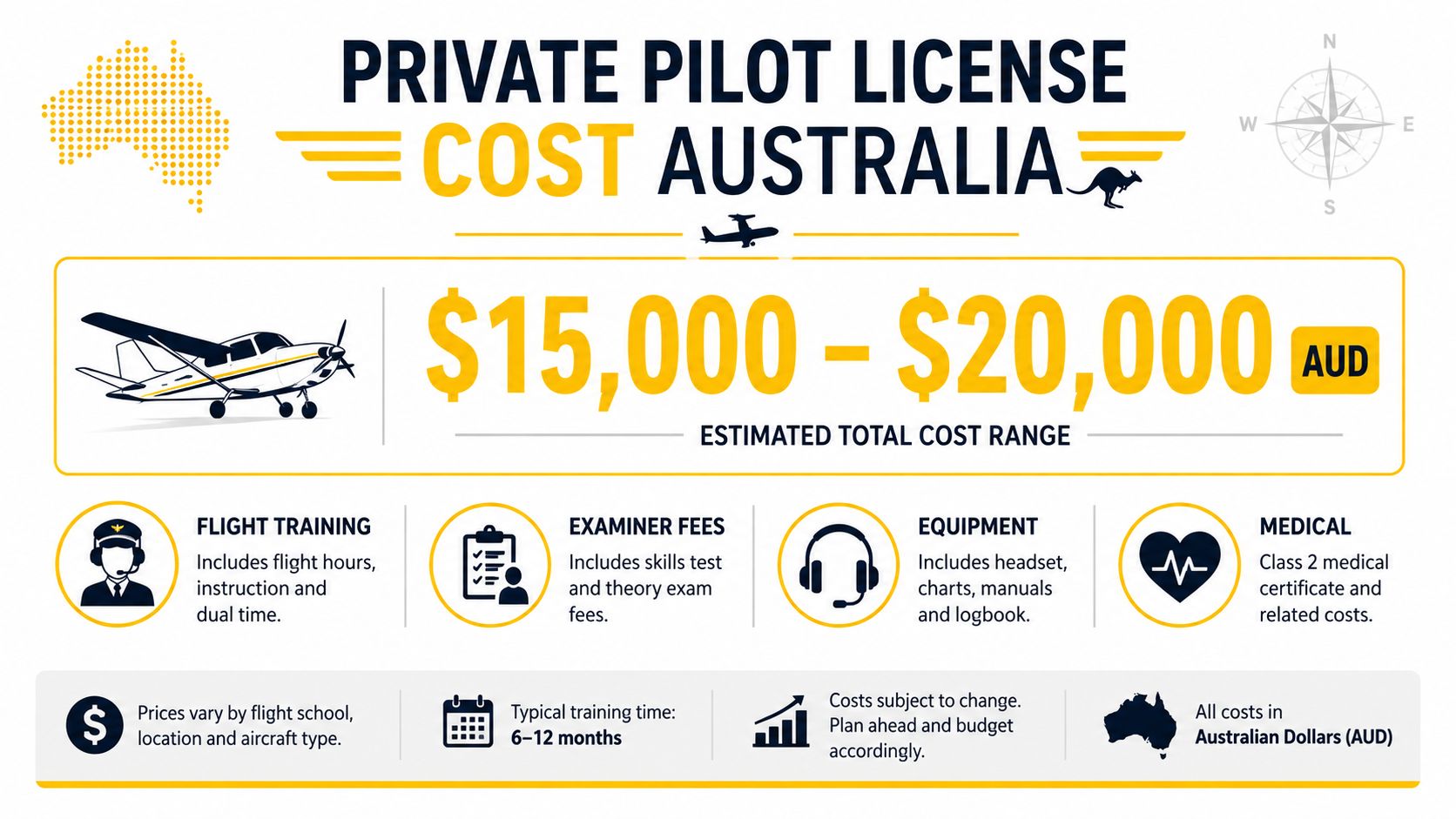
A school's pricing page may look tidy, but the actual budget only makes sense when all the moving parts are visible. The most useful local starting point is a full licence estimate, then a school-by-school comparison against the student's pace, aircraft choice, and schedule.
For readers comparing training pathways and local options, the licence finder tool is a useful place to narrow the right aviation pathway before requesting quotes.
Breaking Down Every Cost Component
The biggest share of the bill usually comes from flying, not paperwork. That pattern shows up across training guides because aircraft rental and instructor time do most of the damage to the final total, while fixed administrative items are smaller but still worth budgeting for.
Flight hours and instruction
The basic cost architecture is simple. One detailed breakdown places aircraft rental at US$5,000 to US$7,000, instructor fees at US$1,000 to US$2,500, medical at US$75 to US$200, ground school at US$250 to US$500, and exams at US$800 to US$1,000, with a total of about US$10,000. Another source notes that roughly 80% to 85% of total PPL cost comes from aircraft rental and instructor fees, which is why the hour count matters so much. Pilot training cost breakdown
A practical way to think about it is this, every extra hour in the aircraft usually pulls two cost levers at once, the machine and the instructor. That is why flight schools watch consistency so closely. Students who arrive rusty after a long gap often need extra dual time, and that extra time is rarely cheap.
Ground school, exams, and gear
The non-flying side still matters. A good training budget should include study materials, theory preparation, and the items needed to train efficiently, because missing gear usually creates delays or repeat purchases later.
The main categories are easy to compare in a line-item budget, and that's exactly how prospective students should review quotes. For a simple shopping-list mindset, it helps to track each item as a separate personal expense category, much like the approach used in this guide to personal expense categories to track.
| Component | Typical AUD Range |
|---|---|
| Aircraft hire | Varies by aircraft and school |
| Dual instruction | Varies by training pace |
| Ground school | Varies by delivery format |
| Theory exams | Varies by provider and test count |
| Aviation medical | Varies by examination type |
| Headset and training gear | Varies by brand and specification |
| Books and study materials | Varies by format |
| Flight test and retest buffer | Varies by outcome |
Some students also start with entry-level aviation or drone theory before moving into broader flight training. ACE READY is an entry level drone training course for beginners, so it sits naturally at the foundation stage for learners who want to build aviation awareness before more advanced remote pilot training.
A useful check is to ask any flight school for an all-in estimate, not just the hourly rate. The number is only meaningful if it includes the items that usually surprise students after enrolment. For a broader course overview, the AAA course list gives a clearer picture of how different aviation pathways are structured.
Hidden Costs That Inflate Your Final Bill
The hidden costs are the ones that catch students once training is already underway. They don't always look large on their own, but together they can push a manageable budget into a much tighter one.
The first surprise is usually the flight test fee. A student may be focused on training hours and miss the cost of the examiner, the aircraft on the day, and any retest if the standard isn't met first time. A second surprise is the way a busy aerodrome adds friction, landing fees, hangar access, and other location-specific charges can change the final outlay even when the hourly rate looks fine on paper.
Fuel surcharges can also move the bill. Schools that quote a neat hourly number sometimes rely on students not asking how much of that rate can change with fuel or operating conditions. Add in replacement gear, upgraded headsets, a new electronic flight bag, or extra books, and the “starter budget” starts to look optimistic.
A lower package price can still end up more expensive if the school charges for items that another provider includes, or if the student needs more time to finish.
Another cost that students underestimate is the buffer for re-testing and extra training. If a test isn't passed first time, the rework is rarely free in practice, because more review flights are needed before the next attempt. That's why full quotes matter more than promotional ads.
A disciplined quote request should ask for the whole stack, not just the sunny version. That means the flight test, landing-related charges, fuel extras, and likely retest exposure, all written down before enrolment. Students who want a clear place to start comparing schools can also use the AAA FAQ page to frame the right questions before they sign anything.
How Training Pace Affects Your Total Investment
The cheapest-looking package is not always the cheapest finished licence. The cost driver is often completion time, because more months in training usually mean more gaps, more repetition, and more extra flying to get back to standard.
Fast rhythm versus stretched-out rhythm
A student who flies frequently keeps the sequence fresh, which usually reduces the amount of relearning needed between lessons. A student who trains only occasionally can spend part of every lesson revisiting basics, and that is where costs creep.
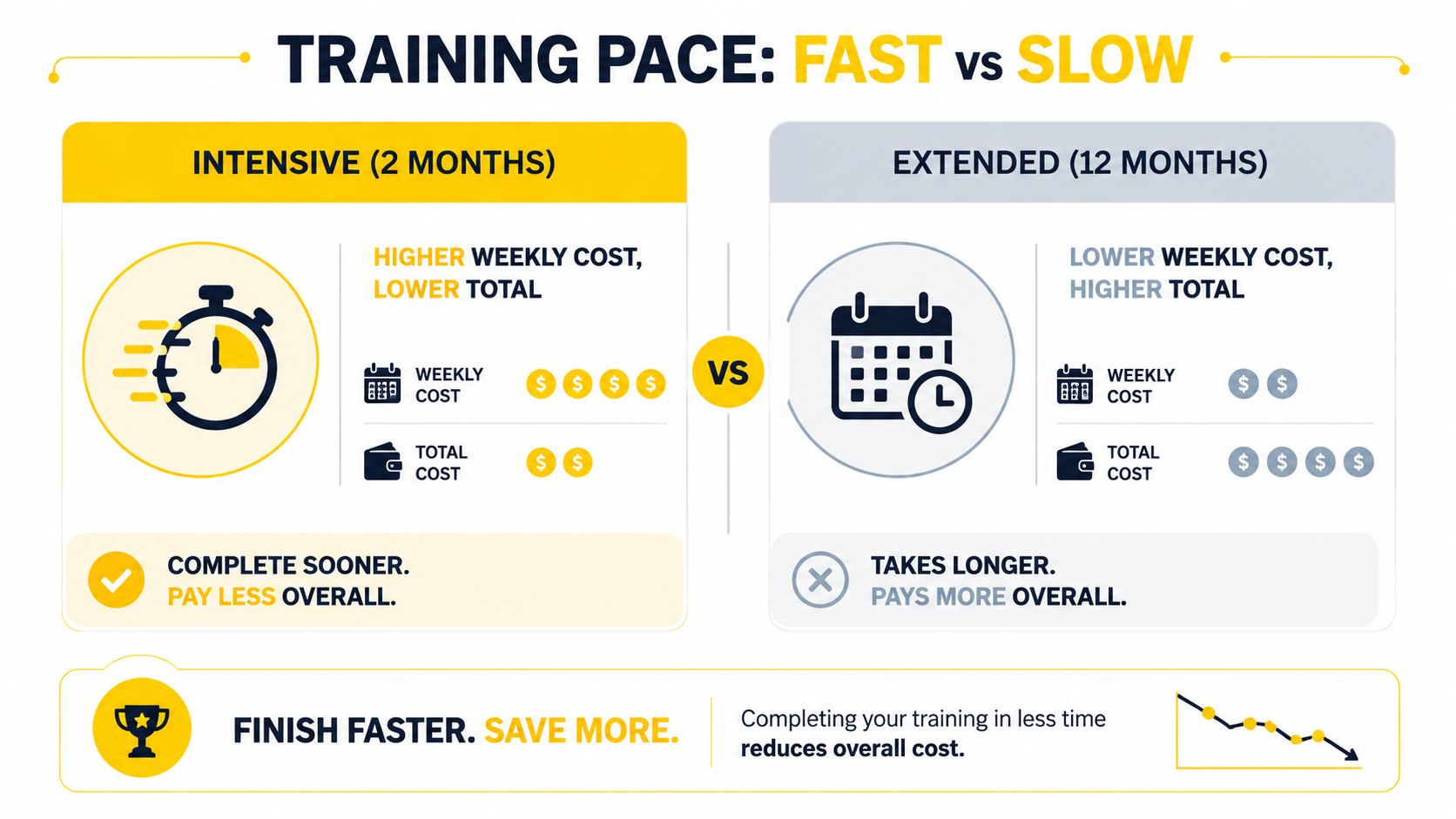
The trade-off is straightforward. Intensive training can feel more expensive week to week, but it often shortens the total journey. Extended training can feel gentler on cash flow, but it can become more expensive overall if skills fade between lessons or weather cancellations create long gaps.
What students should optimise for
The right choice depends on schedule, budget, and learning style, but consistency matters more than bargain hunting. A school with a slightly higher hourly rate can still be the more economical option if students progress smoothly and avoid repeat lessons.
A sensible decision checklist is:
- Training frequency: ask how easy it is to book multiple lessons each week.
- Aircraft availability: check whether the school's aircraft are often grounded, busy, or fully booked.
- Instructor continuity: consistent instruction usually reduces repeated explanations.
- Weather and location effects: local conditions can slow progress even when the school's price looks attractive.
- Completion support: ask how the school manages gaps, cancellations, and return-to-training briefings.
For people already planning a financial path into aviation training, the budgeting mindset used in how to build a successful financial life applies well here, because a licence is easier to finish when the funding plan matches the training rhythm.
The main lesson is simple. Budgeting for a licence is not just about how much cash is available at the start, it's about how long the student can keep moving without breaking momentum. That is where the savings usually appear.
Financing and Saving Strategies for PPL Training
The best saving strategy is not cutting corners, it's paying for the right things in the right order. Cheap decisions that create extra training later usually cost more than they save.
A practical starting point is to separate cash-flow management from training quality. Many flight schools offer payment plans, which can help spread the burden, but any plan should be judged against the total cost and the timing of required payments. Students should also ask whether any training expense might have tax implications based on their personal circumstances, because aviation-related costs can be treated differently depending on whether the training is recreational, employment-related, or part of a broader professional pathway.
There are also simple ways to reduce waste without undermining safety:
- Buy used gear carefully: second-hand headsets and other items can be cost-effective if they're serviceable and certified where relevant.
- Choose the right school, not just the cheapest quote: a school with better scheduling and stable aircraft access can reduce repeat flying.
- Do theory work early: self-study and ground preparation can reduce expensive airborne “teaching time” later.
- Avoid buying everything upfront: some equipment can wait until the student knows exactly what's needed.
- Compare complete quotes: the lowest headline number can hide the highest final bill.
A structured budget also helps students avoid stop-start training. That matters because inconsistency often forces extra review flights, which then pushes the total higher than expected. A finance plan should therefore protect lesson continuity, not just keep the first invoice manageable.
For students who want a more organised way to map the numbers, the quote calculator helps turn school pricing into a clearer training budget. That's useful before committing to deposits, gear purchases, or a timetable that looks affordable only on paper.
Your PPL Timeline and Decision Checklist
A private pilot journey usually begins with a medical check, then moves into ground study, regular flying, solo milestones, navigation work, and the flight test. The order matters because gaps in the sequence tend to cost money later.
A practical timeline
Early progress is usually fastest when the student finishes theory work alongside flying, not long after it. The reason is simple, each lesson builds on the last, and students who already understand the principles spend less airborne time relearning basics. Later stages usually demand more precision, especially once solo work and cross-country planning become part of the training flow.
The best school choice is rarely the one with the nicest brochure. It is usually the one that can keep the aircraft available, keep instruction consistent, and keep the student progressing without long interruptions.
A good comparison checklist looks like this:
- Instructor experience: ask who will teach the bulk of the course and how often that instructor changes.
- Maintenance standards: well-kept aircraft reduce delays and last-minute cancellations.
- Booking flexibility: if lessons are hard to schedule, the total cost usually rises.
- Test preparation: ask how the school handles oral preparation and mock checkouts.
- Student support: a school should explain how it helps students recover after gaps or setbacks.
What to ask before signing
Students should ask for the training sequence in plain language, not just the package title. They should also ask how the school handles weather interruptions, aircraft unavailability, and the timing of the practical flight test.
Good planning often saves more than bargain hunting because it avoids the false economy of slow progress. A school that keeps students moving at a steady pace usually proves cheaper in the end than a school that looks inexpensive only at the front desk.
For students who prefer to test their knowledge before committing to a training timetable, ace your tests with Cramberry is a useful example of how structured exam prep can support the ground side of aviation study.
Private Pilot Licence versus Remote Pilot Licence Pathways
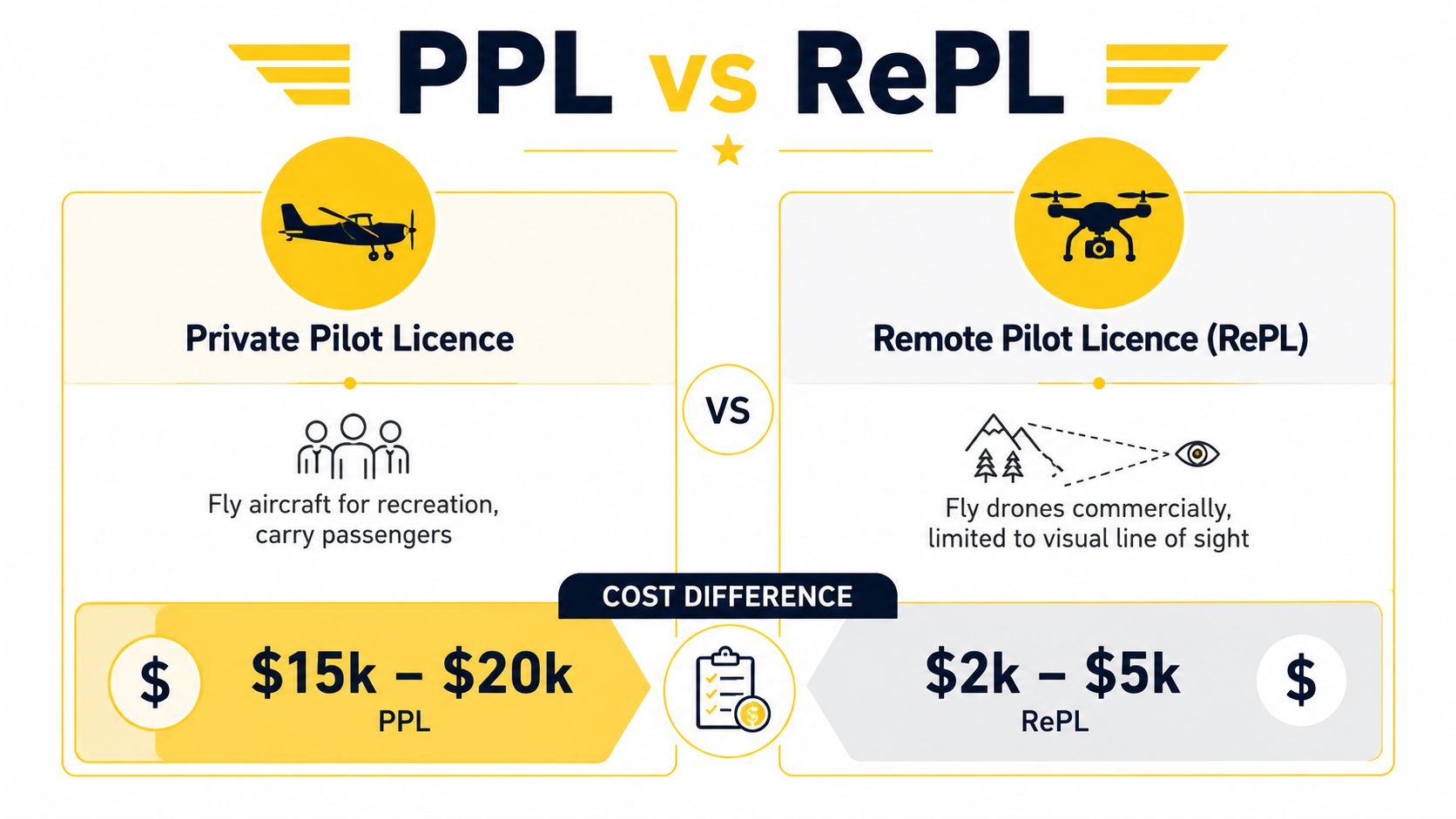
The right licence depends on what the student wants to do, not which course looks bigger on paper. A Private Pilot Licence suits manned aircraft flying, while a Remote Pilot Licence is the relevant pathway for commercial drone operations under CASA rules.
When the PPL makes sense
A PPL is the better fit when the goal is to fly aircraft for recreation, carry passengers, or build a foundation for future pilot ratings. It also suits people who want the broader experience of manned aviation, including aircraft handling, navigation, and flight planning.
The cost is higher because the operational training is deeper and the flying component is larger. That higher price is normal, but only if the student needs that licence path.
When the RePL makes more sense
A Remote Pilot Licence (RePL) is the right route for commercial drone work. It supports the sort of operations that businesses, government teams, and aviation professionals use in surveying, inspection, mapping, and other RPAS work, and it's the pathway offered through programs such as those at Ace Aviation Aerospace Academy.
Ace Aviation Aerospace Academy also offers the ReOC consulting guide for organisations that need a broader compliance framework around drone operations. That matters because many commercial operators need more than flight skill alone.
How to choose the right path
The decision is mostly practical:
- Choose PPL if the aim is to fly manned aircraft.
- Choose RePL if the aim is commercial drone operations.
- Avoid paying for the wrong licence if the objective is business drone work rather than aircraft flying.
- Match the pathway to the job so time and money go into the right qualification.
For many readers, that distinction saves a lot of wasted planning. A manned-aircraft licence and a drone licence solve different problems, so the right choice is the one that fits the actual operational goal, not the one with the bigger price tag.
Ace Aviation Aerospace Academy helps students and organisations work through the right aviation pathway, whether that means drone training, compliance support, or broader aviation education. If the goal is to compare options, understand the all-in costs, and choose a licence path that fits the mission, visit Ace Aviation Aerospace Academy and review the training route that matches the next step.