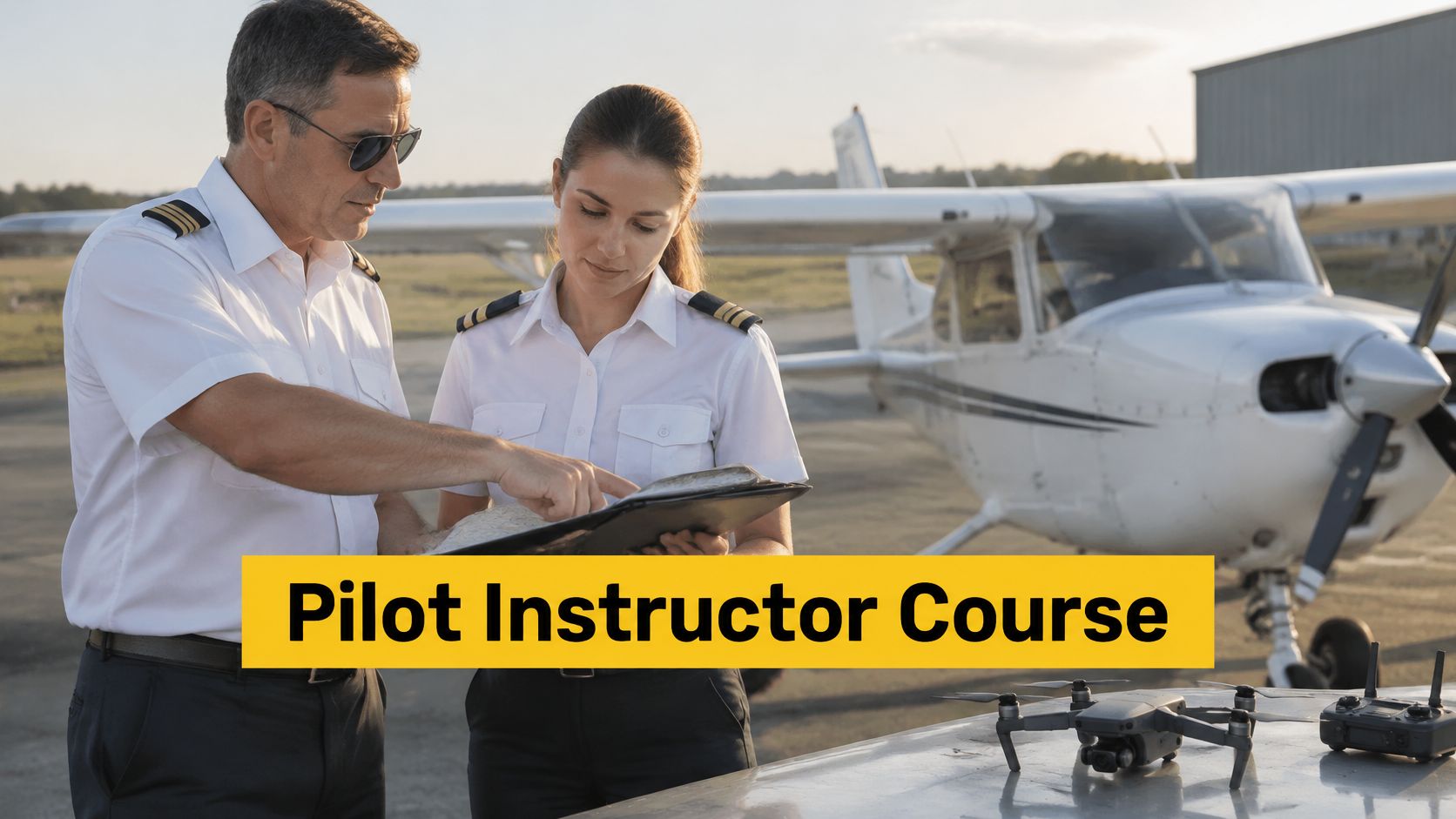
A pilot instructor course is the CASA-regulated route to qualifying as an instructor, with different requirements for manned and remotely piloted aircraft. Australia has two distinct regulatory tracks, so the right course depends on the aircraft and the instruction the candidate intends to deliver.
Does being able to fly an aircraft safely mean a pilot can teach someone else to do the same? Not necessarily. An instructor must recognise errors, explain decisions, supervise practice and assess learning without taking over every task. Flying competence and teaching competence are related, but they aren't interchangeable.
Table of Contents
- Two Pilot Instructor Pathways Under CASA Rules
- Curriculum and Competencies Every Course Covers
- Entry Requirements and Certifications You Need
- How Instructors Are Assessed in Practice
- Career Pathways and Progression Stages
- Choosing a Course That Meets CASA Standards
- Confirm Your Pathway Before You Enrol
- Frequently Asked Questions About Pilot Instructor Courses
Two Pilot Instructor Pathways Under CASA Rules
CASA separates instructor qualifications by aircraft type. A manned-aircraft instructor rating and an RPAS instructor role follow different requirements, so compare the duties each path authorises rather than relying on course names.
Pilot instructor pathways compared
| Pathway | Who It Suits | Minimum Experience | Teaching Qualification | Assessment |
|---|---|---|---|---|
| Aeroplane flight instructor rating | Licensed pilots who will teach in aeroplanes | 250 hours total, including 100 as pilot in command | Tertiary teaching qualification, Certificate IV in Training and Assessment, or approved principles and methods course | Instructor rating knowledge examination and flight test |
| Helicopter flight instructor rating | Licensed pilots who will teach in helicopters | 200 hours as a pilot, including 100 as pilot in command | Same educational options as the aeroplane route | Instructor rating knowledge examination and flight test |
| RPAS remote pilot instructor | Operators who will teach drone pilots under Part 101 | Confirm current experience requirements for the proposed instructor role and aircraft scope | Confirm current CASA instructor requirements, not an assumed manned-aircraft teaching qualification | Two or three observed practical lessons over approximately two to four hours |
For the aeroplane and helicopter routes, total flight time and pilot-in-command time are separate thresholds. Check both against the CASA flight instructor rating guidance.
The teaching qualification addresses instructional preparation; aviation experience addresses flying competence. One does not substitute for the other. RPAS candidates should confirm the current requirements for their intended role and aircraft scope, rather than assume a Remote Pilot Licence alone establishes instructor eligibility.
Choose the route by the intended teaching role
A licensed aeroplane pilot planning to teach cockpit handling belongs on the manned-aircraft pathway. A commercial drone operator planning to teach remote pilots belongs on the RPAS pathway, even if that operator also holds a manned-aircraft licence.
For operating context, the Australian drone laws guide explains how drone operating rules differ from instructor-development requirements.
Practical rule: Choose the regulatory pathway before comparing course names. A course title alone does not establish the privileges its graduate will hold.
Curriculum and Competencies Every Course Covers
A sound instructor-development curriculum combines teaching practice, regulatory interpretation, aircraft handling and error detection. The balance changes with the pathway, and the RPAS-specific subjects below shouldn't be mistaken for a universal manned-aircraft syllabus.
Desk-based preparation should connect directly to the practical lesson.
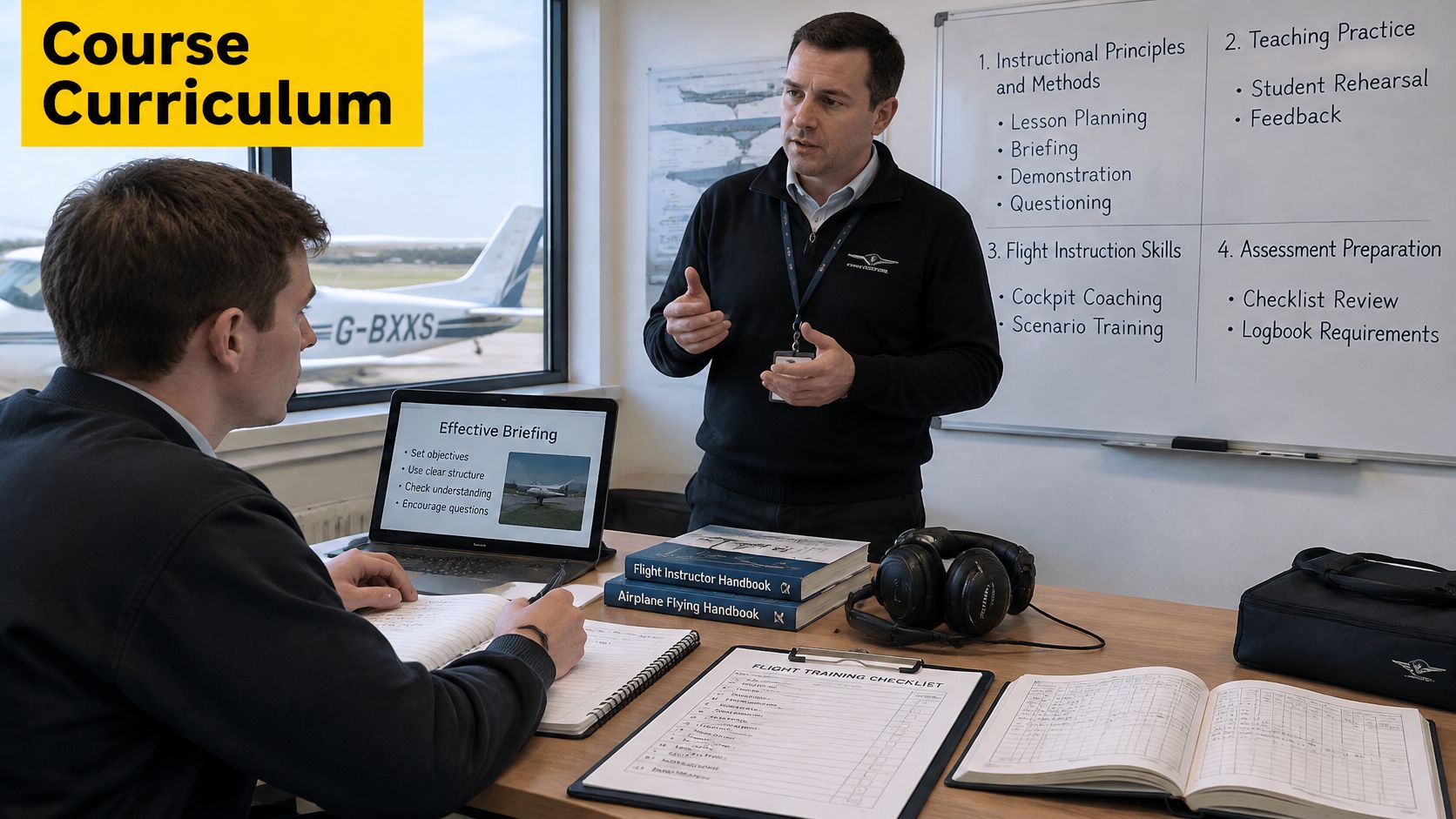
Instructional principles and methods
Candidates should practise lesson planning, briefing, demonstration, questioning and debriefing. They also need to recognise when a learner can repeat a procedure without understanding it.
For example, an instructor candidate might teach a pre-flight inspection, then ask the learner to explain why a damaged propeller changes the launch decision. That question reveals more than a memorised checklist response.
Regulatory interpretation
RPAS instructor preparation should connect the Part 101 Manual of Standards, airspace considerations and operational permissions to realistic decisions. Reading a rule aloud isn't the same as teaching someone to apply it.
A useful task is to review a proposed mapping operation and identify which permissions, aircraft competencies and organisational records need checking. Candidates should explain the decision, not merely name a document.
Aircraft handling and abnormal situations
An instructor must demonstrate aircraft-specific procedures and supervise someone else performing them. For drones, scenarios can include link loss, low battery warnings and unsuitable return-to-home settings.
These exercises need controlled conditions. Simulated faults can test judgement without deliberately creating an unsafe flight.
Data verification and human factors
The ATSB's remotely piloted aircraft occurrence material records occurrences averaging approximately 1.75 a year across 2006–2013, compared with 18.5 a year across 2014–2015, calculated from the respective period totals. These are occurrence averages, not accident rates adjusted for the amount of drone flying.
Associated loss-of-control recommendations emphasised coordinate verification, understanding coordinate values and signs, and enhanced pre-launch checks. The instructional lesson is practical: verification must be demonstrated, not merely discussed.
Candidates should teach learners to cross-check:
- Mission data: Coordinates, coordinate signs, geofence boundaries and flight-plan parameters.
- Aircraft readiness: Battery condition, command-link status and relevant aircraft indications.
- Operating environment: Airspace information and the suitability of emergency return settings.
A simulated mission brief can contain a deliberately incorrect coordinate or return setting. The learner must find the discrepancy and explain the correction.
For RPAS training, providers should map each lesson to the relevant named Part 101 competency and retain lesson plans and assessment evidence for audit.
Entry Requirements and Certifications You Need
For a manned-aircraft flight instructor rating, start by checking the eligibility requirements for the aircraft category. The RPAS instructor pathway follows a different framework.
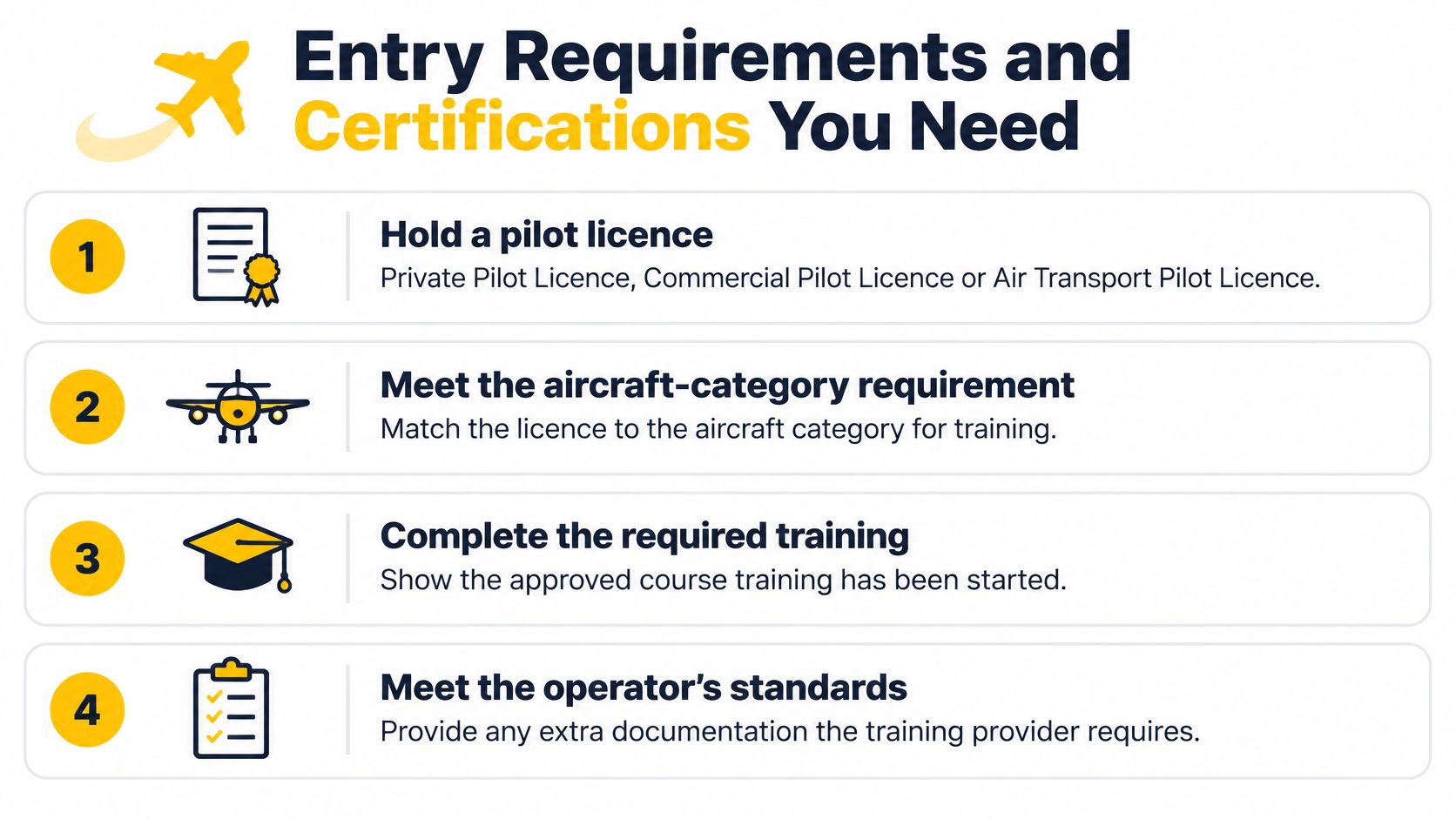
Check personal eligibility and completion gates
CASA's flight instructor requirements and guidance sets out the licence, experience, education and assessment framework. Use the applicable flight-time thresholds already outlined above as a logbook audit: check that each entry is recorded in the right aircraft category and that pilot-in-command time is clearly supported. An accurate reconciliation can reveal missing or misclassified time before you plan training.
Other requirements include:
- Existing licence: A Private Pilot Licence, Commercial Pilot Licence or Air Transport Pilot Licence is generally required.
- Medical fitness: CASA's flight instructor training guidance specifies a Class 1 or Class 2 medical certificate for the aircraft flight test. Arrange the medical early enough to identify any issue before committing to later stages.
- Instructional education: Complete an approved principles and methods of instruction course, a Certificate IV in Training and Assessment, or an accepted tertiary teaching qualification. This requirement concerns teaching preparation, which is distinct from demonstrating flying proficiency.
- Knowledge examination: Pass the Pilot Instructor Rating Common examination, known as PIRC.
- Practical assessment: Complete the relevant aircraft-category flight test and establish the scope of the training endorsement.
Separate the requirements for beginning training from those that must be met before the final assessment. Confirm the sequence with the provider so that each qualification and assessment is completed at the required stage.
Keep qualifications and jurisdictions separate
A Certificate III in Aviation has its own purpose and should not be assumed to replace the accepted instructional-education requirement for a flight instructor rating.
For a separate overseas perspective, DuBois Aviation outlines steps toward your flight instructor certificate. Its certificate terminology belongs to a different jurisdiction, so use Australian requirements when checking eligibility here.
Provider approval and personal eligibility are separate checks. A pilot who still needs to build qualifying experience can plan that flying before comparing instructor-course fees.
How Instructors Are Assessed in Practice
In the first minutes of an observed lesson, an assessor can record whether the candidate sets a clear objective, checks the learner's understanding and explains how safety will be managed. Those observations show teaching competence. Flight handling is assessed in context, alongside the candidate's ability to guide and judge a learner.
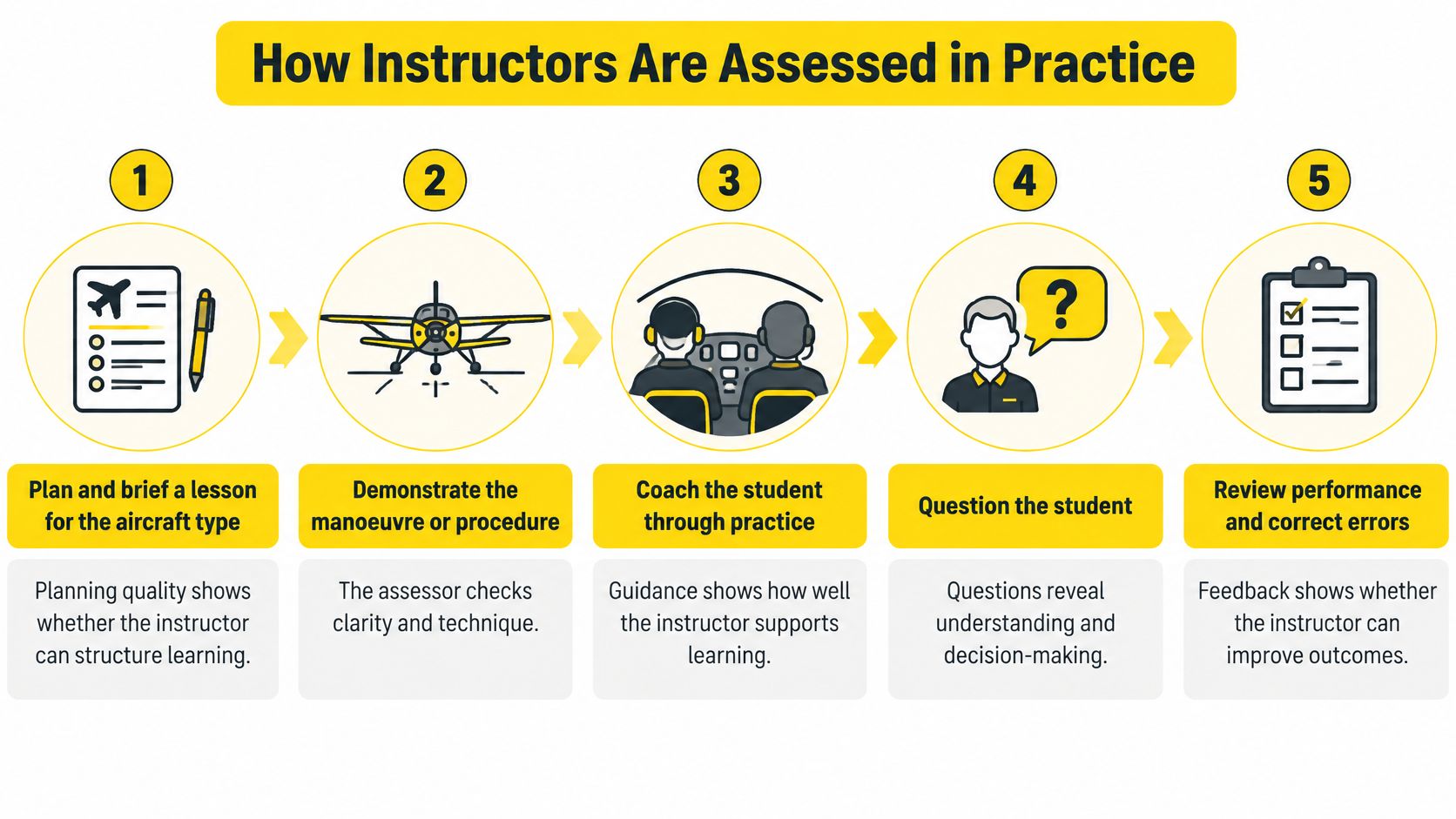
Follow an observable teaching process
Under CASA's guidance for becoming a RePL training provider, a nominated instructor demonstrates two or three practical RPAS lessons over approximately two to four hours, normally with someone acting as the student. The broader training framework also includes defined aeronautical knowledge, practical competencies, examinations, flight testing and administrative controls.
A practical preparation sequence is:
- Plan and brief the lesson. State the learning outcome, aircraft type, operating limits and conditions for intervention. This gives the assessor evidence of how the candidate structures instruction.
- Deliver the observed lessons. Demonstrate the procedure, explain key cues and allow the learner to practise. The assessor records whether explanations support the learner's performance.
- Supervise an abnormal scenario. A simulated low-battery warning or link-loss decision can show how the candidate manages risk while giving the learner room to identify and respond to the problem.
- Debrief against the outcome. Ask what happened, why it happened and what should change. Feedback should point to an observable behaviour, rather than label the learner as good or poor.
- Record a defensible judgement. Use written criteria for planning, briefing, supervision, handling, abnormal-situation management and debriefing. The record should make the evidence behind the result clear to another assessor.
- Keep final testing separate from coaching. RePL flight testing must remain distinct from normal training. Confirm the applicable independent assessment arrangements; an instructor demonstration does not replace a required test.
Check the scope of the assessment
The candidate's demonstrated competence must match the aircraft scope of the proposed teaching role. For another aircraft type, check the applicable requirements, including current generic-rating arrangements, rather than assuming the existing scope transfers.
An assessment record should explain what the candidate did, what the learner demonstrated and why the assessor accepted the performance.
Operator responsibilities sit alongside personal pilot competence. The ReOC guide for Australian operators explains the operator-certificate context.
Before enrolment, request written grading criteria, a sample assessment record, the documents assessors use and evidence of instructor currency and aircraft-type competence.
Career Pathways and Progression Stages
Pilot flight time and instructional flight time measure different experience. Flying a sequence yourself does not count as teaching it, so progression records need to show the instructional work completed at each grade.
The aeroplane grade structure illustrates one manned-aircraft progression. It is separate from drone career development.
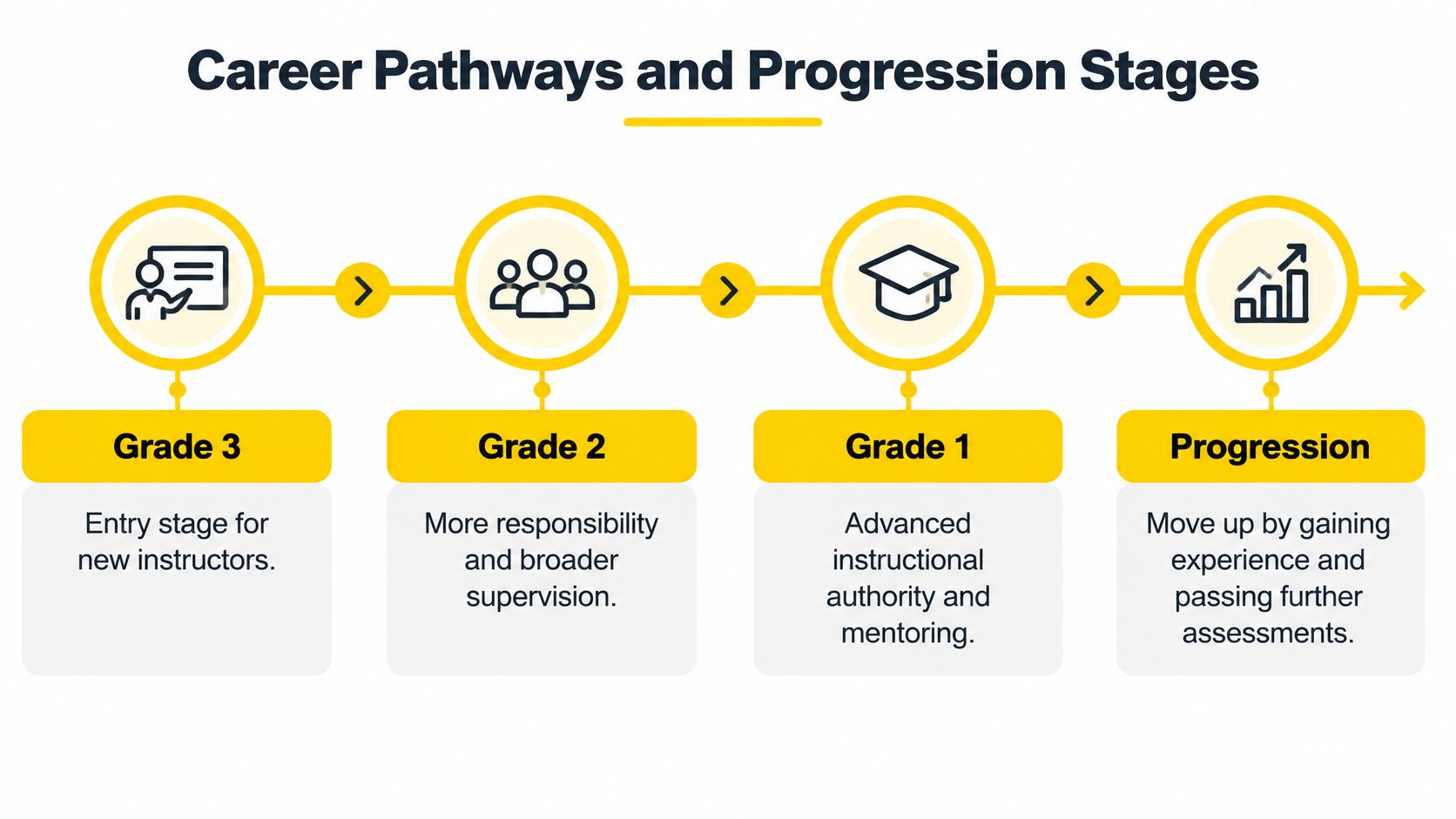
Instructor grade progression requirements
The historical CASA aeroplane instructor-rating syllabus describes entry preparation including 12 classroom hours, progression after at least six months at Grade 3 with 200 non-navigation and 50 navigation instructional hours, and at least 12 months at Grade 2 before Grade 1 progression. Treat these figures as syllabus milestones, not as a standalone eligibility decision.
| Stage | Time Before Progression | Instructing Hours | Requirements to Progress |
|---|---|---|---|
| Grade 3 (entry) | Initial qualification stage | No prior instructional-hour threshold stated in this syllabus summary | Approved flight-instruction course, 12 classroom hours, chief flying instructor recommendation and flight test |
| Grade 2 | At least 6 months as Grade 3 | 250 hours, comprising 200 non-navigation and 50 navigation | Recorded instructing experience on the relevant sequence types |
| Grade 1 | At least 12 months as Grade 2 | Confirm further experience requirements under the applicable framework | Further requirements assessed under the applicable regulatory framework |
The grade stages, time periods and instructional-hour figures in this table are from the historical CASA aeroplane instructor-rating syllabus.
Records should identify the sequence taught, instructional time and relevant grade dates. A single combined total can conceal a shortfall in navigation instruction.
Endorsements and drone career development
Grade progression does not by itself grant authority to train instructors or conduct flight tests. Instructor training generally calls for a Flight Instructor Rating Training Endorsement, while examiner duties generally require a Flight Examiner Rating.
Drone career progression follows a separate regulatory track. The rules for drone instructor privileges and any transition arrangements must be checked against the applicable framework; a drone qualification or career step alone does not establish those privileges. For wider context on qualifications and roles, see this guide to drone pilot careers and the Certificate III in Aviation.
Choosing a Course That Meets CASA Standards
Course selection should begin with evidence of approval and scope, not a promise of becoming an instructor. A provider may deliver legitimate pilot training without offering the specific instructor-development pathway a candidate needs.
Compare approval, curriculum and staff
A useful provider comparison includes:
- Training approval: For Part 61 training, confirm that delivery is through an organisation holding the required Part 141 or Part 142 certificate. Check the relevant scope, not merely the existence of an aviation business.
- Aircraft coverage: For RPAS, establish the relevant aircraft category, weight scope and type where applicable. Labels such as micro, very small, small and medium shouldn't be treated as interchangeable.
- Teaching documentation: Request lesson-to-competency mapping, written grading criteria and a clear description of the evidence retained.
- Instructor competence: Check current instructional authority, aircraft competence and recent operational experience relevant to the intended work.
- Change management: Establish how the provider updates training materials and informs enrolled students when requirements change.
The Chief Remote Pilot course information should be considered in the context of its stated role. A chief-pilot course title alone doesn't prove that it grants RePL instructor authority.
Treat regulatory currency as part of course value
CASA's 2026 RPAS update states that Chief RePL Instructors can apply for a generic rating rather than undertake a CASA flight test for every medium-drone model they fly. CASA's public material also identifies instructor-framework proposals and transition arrangements, so a proposal must be distinguished from an operative requirement.
This doesn't establish unrestricted authority across all aircraft or teaching roles. It makes transferable competence and clear records especially useful when approval arrangements change.
Buying criterion: A provider should explain both the qualification awarded and the privileges it does not award.
Agriculture, mining, infrastructure and emergency-service teams should test the course against their actual aircraft and missions. A change in equipment or operating context may require a fresh competence and authorisation check.
Confirm Your Pathway Before You Enrol
Before enrolling, define the teaching role you are preparing for and check that the course matches it. Manned-aircraft instruction and remote pilot instruction are separate regulatory pathways, with different approval requirements and evidence of competence.
Complete the pre-enrolment check
Start with your intended role and aircraft scope. Then gather the licences, logbooks, medical information where applicable, and instructional qualifications relevant to that pathway. Ask the provider to confirm its authority to deliver the course and show how teaching practice, regulatory application, abnormal-situation supervision, and assessment are covered.
A general aviation qualification or commercial pilot course may help you prepare, but it is not necessarily an instructor qualification. Get written confirmation of what the course awards before enrolling.
Place Ace Aviation Aerospace Academy in context
Ace Aviation Aerospace Academy provides RePL training and is a CASA Approved Training Provider (CASA.ReOC.1421). RePL training is a remote pilot qualification, not an instructor qualification.
For the Certificate III in Aviation, AVI30419 Remote Pilot, students must complete the required gap training and provide their RePL licence and AROC, or equivalent. This is a separate qualification pathway from pilot instructor training.
Choose a course only after confirming that it matches your intended teaching role, the relevant approval requirements, and your existing prerequisites.
Frequently Asked Questions About Pilot Instructor Courses
Do applicants need a pilot licence first?
For manned-aircraft instructor training, applicants generally need a Private Pilot Licence, Commercial Pilot Licence or Air Transport Pilot Licence. RPAS candidates should confirm which licence and instructor pathway apply to the role they want.
How can I check whether my logbook meets the experience requirements?
Use the experience figures in the first section as a starting point, then reconcile your logbook against the applicable aircraft-category requirements. Check that each entry records the details needed to establish the relevant flight time and pilot-in-command experience.
Is a Certificate IV in Training and Assessment compulsory?
No. An accepted alternative may be a tertiary teaching qualification or an approved principles and methods of instruction course. Confirm that your chosen qualification meets the requirements for the instructor pathway you intend to follow.
Must the training organisation hold a certificate?
Part 61 licence, rating and endorsement training must be delivered by an appropriately certificated Part 141 or Part 142 organisation. For RPAS training, check that the provider's approval covers the course and training role you are seeking.
How can I check for RPAS rule changes?
Check CASA's news page for updates and any announced transition arrangements, then ask the training provider how those arrangements apply to your intended teaching role. This helps distinguish requirements in force from proposed changes.
Is platform-specific training enough?
Aircraft-specific competence matters, but instructors also need transferable teaching skills. They must be able to brief a task clearly, identify errors, supervise practice and assess performance using evidence.
Ace Aviation Aerospace Academy offers RePL training and aviation education that can support preparation for further RPAS professional development. Visit Ace Aviation Aerospace Academy to discuss your existing qualifications, intended teaching role and whether an instructor-specific pathway is available before enrolling.