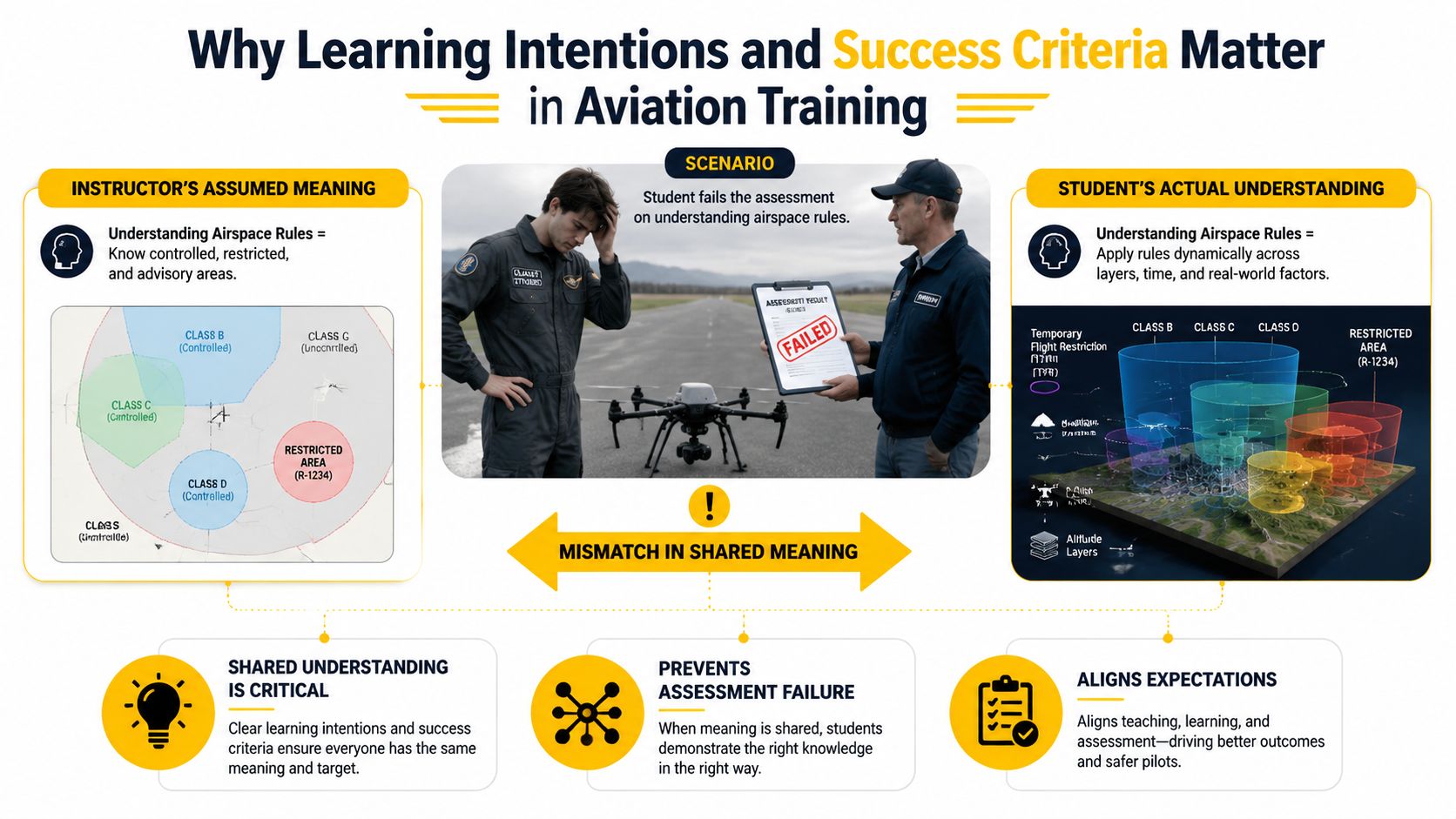
A drone student can arrive at a practical assessment believing they've met the lesson objective, then fail because the instructor meant something more precise by “understanding airspace rules”. The student may know that controlled and restricted areas exist, yet still be unable to interpret the relevant information, identify operational limits, or explain the decision before launch. Both people used the same words, but they didn't share the same meaning.
That problem appears in classrooms, simulators, hangars and field operations. Learning intentions and success criteria give trainers a disciplined way to state the destination and identify the evidence that confirms a learner has reached it. Australian guidance treats the two ideas as connected, particularly where teaching, feedback and assessment must align.
Table of Contents
- Why Learning Intentions and Success Criteria Matter in Aviation Training
- How to Write Clear Learning Intentions for Drone and Aviation Lessons
- Building Measurable Success Criteria That Actually Work
- Common Mistakes That Undermine Lesson Clarity
- Embedding Intentions and Criteria Into Lesson Delivery and Assessment
- Templates and Checklists for Aviation Trainers
- Frequently Asked Questions
Why Learning Intentions and Success Criteria Matter in Aviation Training
Turning an assumed outcome into shared meaning
A learning intention is a short statement of what students are expected to learn through a lesson or unit. The Australian Education Research Organisation, or AERO, describes learning objectives, also known as learning intentions, in those terms and explains that they work most effectively when paired with success criteria that divide the objective into observable steps. The definition is set out in AERO's practice guide on learning objectives, published on 26 February 2024.
For an aviation trainer, the distinction is practical:
- Learning intention: the knowledge or capability the student is developing.
- Success criteria: the observable measures used to judge whether, and how well, the student achieved it.
- Assessment evidence: the demonstration, explanation, record or decision that allows the trainer to make a consistent judgement.
“Students will learn airspace rules” is too broad for a flight lesson. “Students will interpret the operational airspace information for a planned drone mission, identify relevant restrictions, and justify whether the mission can proceed” gives the trainer and student a shared direction. The criteria then describe what the student must do, say or produce.
Why aviation needs sharper boundaries
Aviation training is compliance-heavy. A lesson may involve regulatory knowledge, operational judgement, communication, aircraft handling and risk controls. If those elements are bundled into an unclear objective, a student can complete the activity without demonstrating the required capability.
Australian state and national guidance now places learning intentions and success criteria within explicit-teaching practice rather than treating them as an optional classroom preference. NSW guidance says learning intentions should be shared first or early, remain visible during the learning period and be revisited for feedback and self-assessment. It also states that success criteria should link directly to the learning goal and be concrete, measurable and observable. Those principles transfer directly to drone training, where an assessor must identify the evidence behind a pass or a retraining decision.
Operational rule: If a criterion can't be observed in the cockpit, simulator, field or assessment record, it probably isn't yet a usable criterion.
Clear statements don't replace sound instruction, modelling or practice. They help those activities point towards the same outcome. They also give an auditor, chief instructor or training manager a visible line between the lesson plan, the exercise, the feedback and the assessment decision. Trainers reviewing broader lesson-design principles can also consult this learning intentions and success criteria guide for adaptable examples.
For information about Ace Aviation Aerospace Academy's training approach and organisation, readers can review why Ace Aviation Aerospace Academy. The central principle remains simple: the activity is not the learning. The learning is what the student can reliably demonstrate afterwards.
How to Write Clear Learning Intentions for Drone and Aviation Lessons
A useful learning intention starts with “We are learning to…” and finishes with a specific outcome. The wording should identify the capability, not merely name the lesson content or describe what the trainer plans to do.
Build the intention around the outcome
A trainer can test a draft intention with three questions:
- What will the student learn? Identify the knowledge, skill or judgement.
- Why does it matter operationally? Connect it to safe, lawful or effective performance.
- What could the student demonstrate by the end? Use an outcome that can later be assessed.
The verb matters. “Know”, “understand” and “learn about” may be useful in conversation, but they don't tell a trainer what evidence to seek. More precise verbs include identify, interpret, calculate, select, explain, demonstrate, configure, communicate, respond and justify.
| Weak Intention | Strong Intention | Improvement Reason |
|---|---|---|
| Learn about weather | We are learning to interpret available weather information and decide whether conditions support the planned operation | The stronger version requires interpretation and an operational decision |
| Understand pre-flight checks | We are learning to complete a pre-flight inspection using the aircraft manufacturer's checklist and report identified defects | The student must perform and communicate, not simply recall |
| Study emergency procedures | We are learning to select and carry out the appropriate response to a lost-link event in a controlled training scenario | The intention identifies a situation, response and context |
| Learn airspace classification | We are learning to identify the relevant airspace information for a proposed drone mission and explain the operating decision | The outcome connects knowledge to planning and judgement |
| Do a mission-planning exercise | We are learning to plan a drone mission that accounts for the task, operating area, hazards, aircraft limitations and required controls | The learning is planning quality, not completion of a worksheet |
A lesson intention shouldn't carry every competency in a training package. A pre-flight lesson may touch weather, batteries, aircraft condition and site assessment, but the primary intention should identify the main learning outcome. Secondary knowledge can support that outcome without turning the statement into a catalogue.
Connect the wording to aviation competency
CASA requirements and the relevant competency framework should shape the language, but the learning intention shouldn't pretend to replace the applicable regulation, approved training material or assessment instrument. For a RePL lesson, the intention might focus on a practical operating capability. For an aviation radio lesson, it might focus on accurate, timely communication in the relevant operating context.
A beginner course such as ACE READY is described as entry-level drone training covering drone fundamentals, aviation safety, CASA regulations and flight operations, while preparing learners for advanced RePL training in Australia. Its broad course purpose would still need to be translated into lesson-level intentions before a trainer delivers a specific activity.
The Certificate III in Aviation pathway is another example of why scope matters. A qualification or licence pathway contains many capabilities, but each lesson needs a manageable learning destination. A useful intention is narrow enough for the session, meaningful enough to support the broader competency and clear enough to guide assessment.
Building Measurable Success Criteria That Actually Work
A success criterion answers the student's practical question: “What will show that the learning intention has been achieved?” The answer should describe evidence, not effort. Attendance, completing a worksheet or flying for a set period may be activities, but they don't automatically prove the intended learning.
A four-step conversion process
Step 1, start with the learning intention.
Take one outcome only. For example: “We are learning to complete a pre-flight inspection using the manufacturer's checklist and report identified defects.”
Step 2, identify the essential performance indicators.
Ask what a competent demonstration must include. The indicators might cover using the correct checklist, inspecting the relevant aircraft systems, recognising an abnormal condition and communicating the finding through the required process.
Step 3, draft observable “I can…” statements.
Each statement should describe an action or explanation that another person can observe. A practical set could include:
- Checklist use: “I can use the manufacturer's checklist in the correct sequence.”
- Inspection quality: “I can identify and verify the critical aircraft and control checks required for the planned operation.”
- Defect reporting: “I can describe an identified defect accurately and state whether the aircraft is suitable to operate.”
- Operational reasoning: “I can explain how the inspection result affects the launch decision.”
Step 4, refine for objectivity.
Remove terms such as “properly”, “well”, “safely” or “with confidence” unless the assessment instrument defines how those qualities will be judged. Replace them with evidence, conditions and standards drawn from the applicable manufacturer's information, training material or competency requirements.
Keep criteria transferable
Task-level criteria can become too narrow. “I can press the return-to-home button on this aircraft” may confirm familiarity with one control, but it doesn't necessarily show that the learner can select and manage an appropriate response across different equipment or scenarios. Learning-level criteria are more useful when they identify the underlying capability.
For radio communication, a task-level criterion might be “I can repeat the sample call from the slide”. A learning-level criterion would be “I can make a clear, concise and correctly structured radio transmission appropriate to the operating situation”. The exact assessment standard still needs to come from the relevant training and operational requirements.
A three-tier model can help trainers check depth:
- Surface: The student identifies terminology, equipment or sequence.
- Deep: The student explains why the procedure matters and selects an appropriate action.
- Transfer: The student applies the capability in a changed operational situation, such as different weather, a new site or an unexpected emergency.
For an emergency response lesson, surface evidence could involve identifying the immediate actions. Deep evidence could involve explaining the risk being controlled. Transfer evidence could involve responding to a simulated failure while maintaining situational awareness and communicating the decision.
The ultimate guide to ReOC in Australia can support trainers considering how operational systems and evidence fit together. The same design discipline applies at lesson level. Criteria should make the required performance visible without turning the lesson into a script the student can recite without understanding.
Common Mistakes That Undermine Lesson Clarity
More detail doesn't automatically produce more clarity. In aviation training, an overloaded list can compete with the very information the learner needs to notice, remember and apply under pressure.
Australian guidance warns against criteria that aren't concrete, measurable or aligned to the learning goal. AERO's evidence guidance and research summaries provide stronger support for explicit teaching and well-constructed assessment or rubrics than for displaying a goal. That distinction matters. A visible statement can support a lesson, but the statement alone doesn't demonstrate learning.
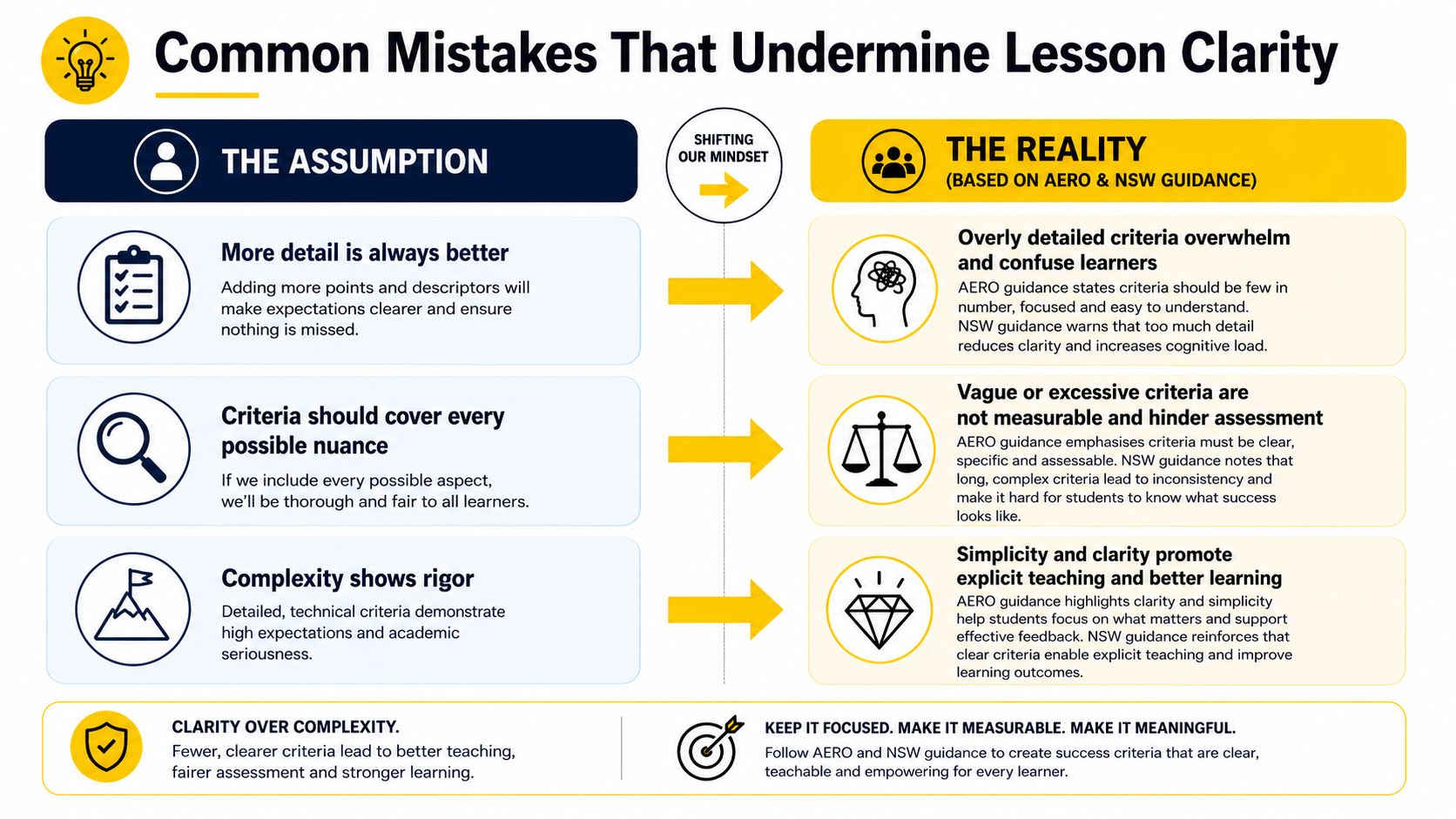
Four failure modes trainers should challenge
The activity masquerades as the outcome.
“Complete a drone mission-planning worksheet” describes paperwork. It doesn't say whether the learner can identify hazards, select controls or justify an operational decision.
One criterion hides several judgements.
“Demonstrate safe flight operations” may combine pre-flight inspection, airspace assessment, communication, aircraft handling and emergency response. A student may meet some elements and miss others, leaving the assessor with an unclear basis for feedback.
The intention is too broad for the session.
“Become a competent drone operator” belongs to a broader pathway, not a single lesson. A session needs an outcome that can be taught, practised and checked within its available conditions.
The list becomes a compliance inventory.
Exhaustive criteria can encourage students to tick boxes without seeing the operational relationship between actions. In a technical environment, that can weaken judgement rather than strengthen it.
NSW guidance emphasises that intentions should be shared early, remain visible and be revisited. It also requires criteria to connect directly to the learning goal. Those requirements don't favour maximum volume. They favour a small set of sharp, meaningful checkpoints supported by demonstration, questioning, practice and feedback.
Trainer's test: Remove a criterion and ask whether the essential capability becomes invisible. If not, the list may be carrying unnecessary detail.
Poorly constructed criteria also make self-assessment unreliable. A learner can't accurately judge progress against “fly safely” without a shared interpretation of what safe performance includes in that lesson. Fewer, better-aligned criteria create a more useful language for debriefing, particularly when the student must internalise procedures instead of memorising wording.
Embedding Intentions and Criteria Into Lesson Delivery and Assessment
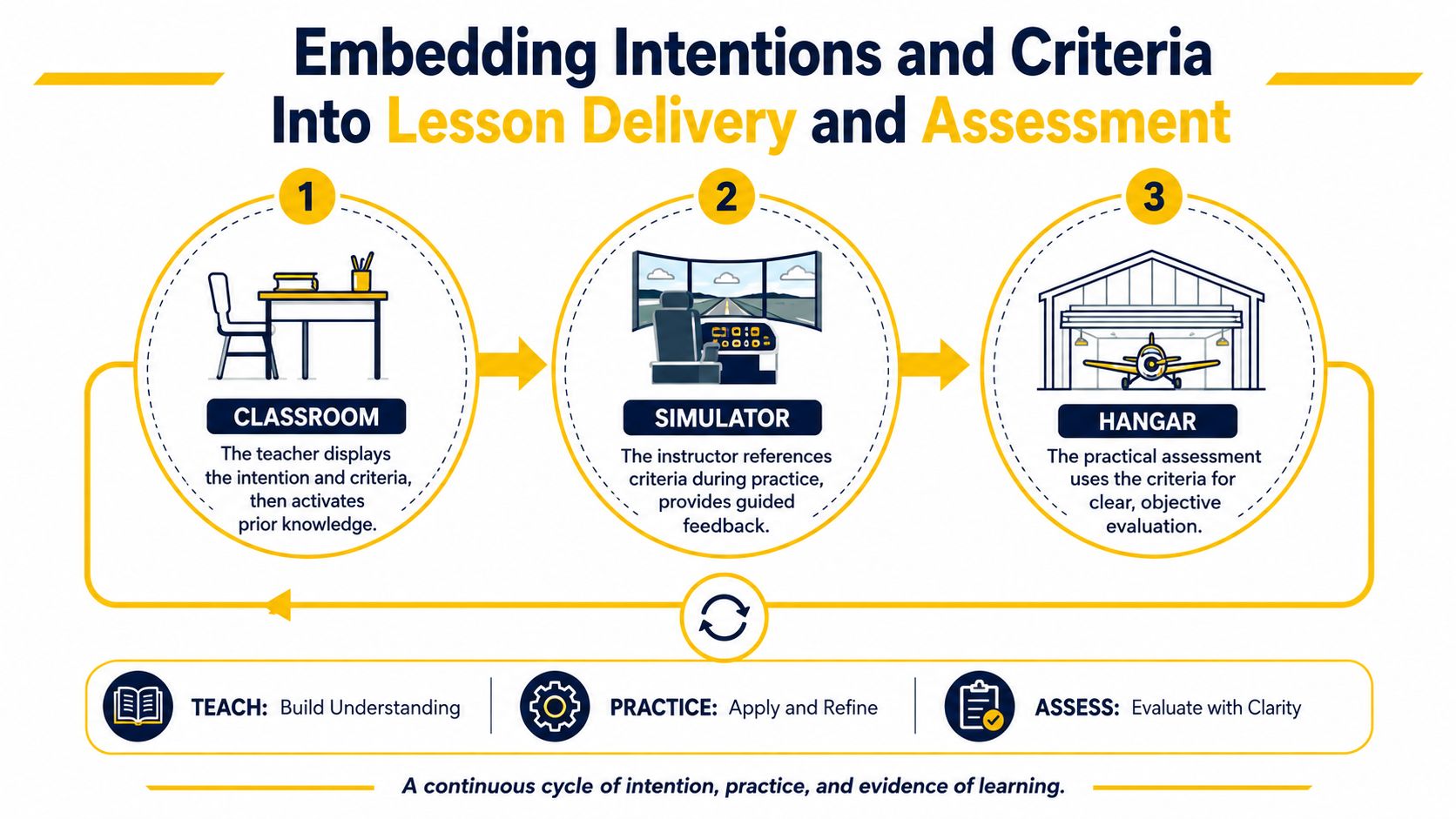
A learning intention has little value if it appears only in a plan that the student never sees. NSW guidance says effective intentions should be shared first or early, kept visible during the learning period, explained by the teacher and revisited for feedback and self-assessment. In aviation training, that visibility can be a briefing-room display, simulator screen, whiteboard, kneeboard card or digital lesson record.
Use the same language across three settings
Classroom: The trainer introduces the intention before the relevant topic, explains unfamiliar aviation terms and checks what students already know. The criteria are unpacked with examples, such as a model radio call, a completed planning record or a correctly sequenced response.
Simulator: The instructor points to the relevant criterion during practice. Rather than saying “that was poor”, the feedback identifies the evidence, such as a missed communication element, an incomplete scan or a decision that wasn't supported by the available information.
Hangar or field: The practical task is assessed against the same criteria used during instruction. During a drone waypoint mission, the trainer can observe planning, setup, communication, monitoring and response without introducing a new definition of success at the final checkpoint.
Make feedback point to evidence
A debrief becomes more useful when the instructor and student use the same criterion language. After an emergency descent exercise, “the descent was too fast” is less actionable than “the response began promptly, but the student didn't maintain the intended control sequence through the descent”. The exact standard should match the approved procedure and assessment tool, but the feedback structure remains consistent.
The criteria should also map to the formal assessment. A check flight, oral question, planning task or practical demonstration must test the stated intention rather than an unrelated detail. If weather, equipment or readiness changes the planned activity, the trainer can adapt the method while preserving the learning outcome. If the intention itself changes, the trainer should tell the student what changed, why it changed and how the revised outcome will be assessed.
Active participation supports this cycle. Trainers seeking additional ideas can review active learning methods for better grades, then adapt suitable techniques for aviation contexts, such as prediction before a scenario, paired checklist review, comparative analysis of two flight plans or a student-led radio briefing.
For vocational aviation delivery, the AVI30419 training information can provide relevant context for connecting lesson-level evidence with broader training expectations. Learning intentions and criteria don't replace the governing framework. They make the relationship between instruction and evidence easier to see.
Templates and Checklists for Aviation Trainers
A trainer can use the following tools during lesson planning, moderation and delivery. The templates are deliberately short. A useful statement should reduce ambiguity, not create another document that students and instructors must decode.
Learning intention template
We are learning to [specific knowledge, skill or judgement] so that [operational or safety purpose] when [relevant aviation context].
The prompt should cover three dimensions without forcing all three into one overloaded sentence:
- Knowledge: What rule, system, concept or information must the learner interpret?
- Skill: What must the learner perform, communicate, plan or control?
- Regulatory connection: Which approved competency, operational requirement, manufacturer instruction or assessment element gives the outcome its context?
Example:
We are learning to interpret the information relevant to a planned drone operation so that the operator can make and explain a lawful launch decision at the selected site.
Success criteria builder
| I can criterion | Evidence type | Performance standard |
|---|---|---|
| I can identify the information relevant to the planned operation | Oral explanation or planning record | Aligned to the applicable training material and operational requirements |
| I can explain how the information affects the launch decision | Questioning or written rationale | Reasoning is accurate, relevant and consistent with the stated scenario |
| I can communicate the decision and required controls | Briefing or radio demonstration | Uses the required communication procedure and terminology |
| I can review the decision when conditions change | Scenario response | Identifies the changed risk and explains the revised action |
The performance standard should come from the relevant CASR framework, approved training material, manufacturer information or Remotely Piloted Aircraft competency unit. Trainers shouldn't create regulatory thresholds from memory.
Pre-lesson review
Before delivery, the trainer can ask:
- Singular intention: Does the lesson have one primary learning destination?
- Observable criteria: Can another trainer see or hear the evidence?
- Direct alignment: Does every criterion connect to the intention?
- Manageable scope: Can the outcome be taught, practised and checked in the available conditions?
- Student language: Can the learner explain what success means without repeating jargon?
- Assessment match: Does the final task collect the evidence described?
- Operational flexibility: If weather or equipment changes the activity, is the revised path transparent?
During moderation, a peer reviewer can challenge each verb, locate the matching evidence and ask whether two trainers would make the same judgement from the same performance. The licence finder tool may also help direct learners towards an appropriate aviation training pathway, while the lesson plan still needs its own precise intention and criteria.
Ace Aviation Aerospace Academy offers aviation and drone education including RePL, AROC, Certificate III in Aviation, ReOC consulting, enterprise drone training and corporate drone training. Trainers and organisations can explore how these pathways connect with clearer lesson design by visiting Ace Aviation Aerospace Academy.
Frequently Asked Questions
What is a learning intention in aviation training?
A learning intention is a short statement describing what the learner is expected to learn through a lesson or unit. In aviation, it should identify a specific knowledge area, practical skill or operational judgement.
What are success criteria?
Success criteria describe the observable evidence that shows whether, and how well, the learner achieved the learning intention. They should be concrete, measurable, observable and directly linked to the stated goal.
Should success criteria list every step of a procedure?
Not always. Criteria should capture essential learning and performance, rather than reproduce every possible detail as a checklist. Detailed procedural steps may belong in a manufacturer checklist, standard operating procedure or assessment instrument.
How early should a trainer share the intention?
Australian explicit-teaching guidance recommends sharing the learning intention first or early in the lesson, keeping it visible and returning to it during explanation, practice, feedback and self-assessment.
Can a trainer change the criteria during a lesson?
A trainer can adapt the activity when weather, equipment or learner readiness requires it. Any change to the learning outcome or assessment basis should be explained clearly, including what changed and why.
Do learning intentions replace CASA requirements?
No. They translate the intended learning into a clear teaching and assessment focus. The applicable CASA requirements, approved training materials, competency standards, operational procedures and manufacturer instructions still govern the training and assessment.