Meta description: Learn how a commercial drone licence Australia pathway supports façade and solar cleaning work. Book CASA-aligned training today.
Short Direct Answer
A commercial drone licence Australia pathway usually starts with a CASA Remote Pilot Licence (RePL). Cleaning businesses may also need a ReOC, registered drones, risk controls and operational approvals. The technology can clean façades and solar panels, but the licence alone does not permit every operation.
Why Cleaning Drones Are Gaining Attention in Australia
Commercial cleaning drones are changing how businesses approach difficult surfaces. These systems can deliver water or cleaning solutions from a controlled aircraft. They may reduce the need for some scaffolding, elevated work platforms or rope-access activity.
However, the drone does not remove the need for planning. A façade cleaning drone still operates in Australian airspace. It may also work near workers, members of the public, traffic, buildings and electrical equipment.
Therefore, operators must treat drone cleaning as an aviation operation first. Cleaning capability comes second.
A professional operator must understand:
- CASA rules for remotely piloted aircraft
- Airspace and location restrictions
- Separation from people and property
- Water, chemical and tether management
- Weather limitations
- Emergency procedures
- Workplace health and safety duties
- Client and site-owner requirements
- Insurance and documented risk controls
This creates a strong need for trained remote pilots. It also creates opportunities for cleaning contractors, solar maintenance companies and facilities managers.
A RePL is the foundation. Yet commercial work often requires a wider operating system. That system can include a ReOC, an operations manual, a nominated Chief Remote Pilot and task-specific procedures.
Important: A drone’s technical ability is not the same as legal permission to use it. Each operation must be assessed against the current CASA framework and other applicable laws.
How a Façade Cleaning Drone Works
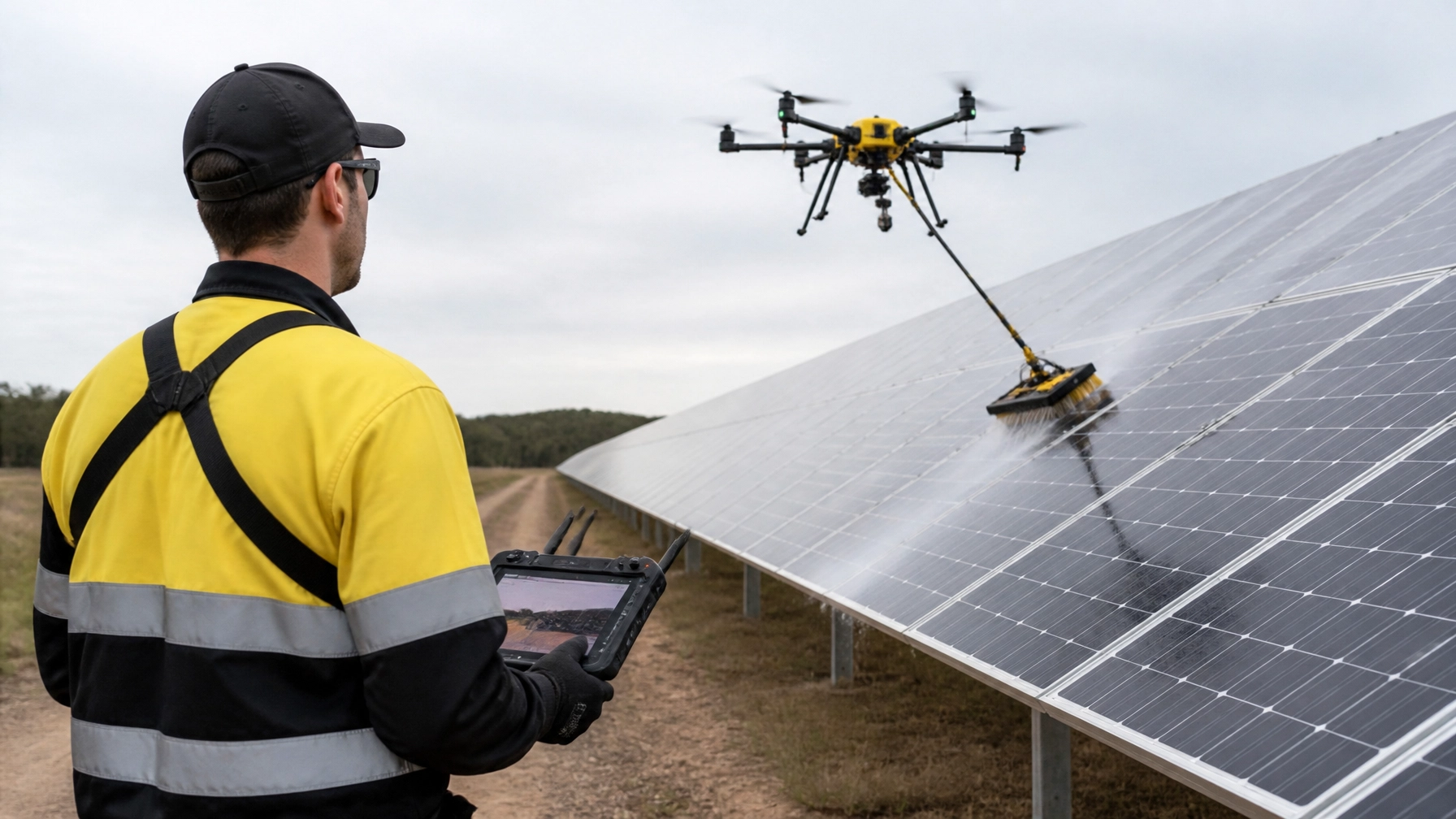
A façade cleaning drone usually combines an aircraft, cleaning payload and ground support system. The aircraft may carry a hose, nozzle, pump connection or a limited onboard tank. Some systems use a tethered water supply from the ground.
The payload directs water or cleaning fluid toward the surface. The pilot then controls the aircraft’s position, distance and movement. In some systems, a second person manages the hose, pump or ground equipment.
The operating team must control several risks at once. These include aircraft movement, water pressure, surface runoff, wind, communications and people entering the work area.
Common system components
A commercial cleaning drone may include:
- An enterprise-grade multirotor aircraft
- A high-pressure pump
- A water or chemical tank
- A hose or tether
- Spray bars or precision nozzles
- A ground control station
- Battery and charging equipment
- Emergency stop controls
- Barriers and exclusion-zone signs
- A site communication system
The final setup depends on the aircraft and cleaning method. Operators should follow the manufacturer’s instructions. They should also verify that the aircraft remains within its approved weight and performance limits.
A larger payload can change the aircraft’s handling. It may affect flight time, control response and safe operating distance. In addition, a hose can create drag and snag hazards.
For these reasons, cleaning training should cover more than basic drone control.

How a Solar Panel Cleaning Drone Works
A solar panel cleaning drone uses a similar principle. It applies water or a cleaning solution while the pilot follows a planned route over or beside the array.
The purpose may be to remove dust, pollen, bird residue or other surface contamination. The operator must consider the panel manufacturer’s cleaning guidance. Some panels may not tolerate certain chemicals, pressure levels or temperatures.
A solar panel cleaning drone can be useful at large sites. Solar farms may contain long rows of panels across uneven ground. A drone can access areas that are difficult to reach with conventional equipment.
Still, the work requires careful coordination. The team must protect:
- Panels and mounting structures
- Inverters and electrical cabinets
- Workers and contractors
- Livestock or members of the public
- Nearby roads and properties
- Water-management systems
- The aircraft and tether
The operator should also consider glare and visual reference. Large reflective surfaces can make orientation harder. Bright conditions may affect the visibility of screens and indicators.
As a result, a cleaning mission needs a site-specific plan. A successful test at one solar farm does not automatically approve the same method elsewhere.
Commercial Drone Licence Australia: What Qualification Comes First?
For most professional drone cleaning work, the first step is a Remote Pilot Licence. The RePL is the CASA credential for an individual remote pilot.
You can learn more about the qualification through Ace Aviation’s drone licence and RePL pathway. The training covers aviation knowledge, safe flight practices and practical assessment.
A typical pathway includes:
- Obtain or confirm your Aviation Reference Number.
- Complete approved RePL theory training.
- Attend practical flight training.
- Pass the required theory and practical assessments.
- Receive your RePL through the CASA process.
- Build specialised cleaning and operational skills.
- Work under an appropriate ReOC structure.
The RePL does not automatically give a business permission to provide every drone service. A company offering cleaning services to clients may need a ReOC or may need to operate under another ReOC holder.
The correct arrangement depends on the operation. It may involve the business, aircraft weight, location, flight profile and the specific service model.
Do you need an AROC?
An Aeronautical Radio Operator Certificate may be useful where radio procedures form part of the operation. It can support work in more complex aviation environments, subject to the applicable approvals and procedures.
Cleaning work near built-up areas may also involve airspace communication requirements. Operators should not assume that an AROC alone authorises flight in controlled airspace.
What about the CASA RePL cost?
The CASA RePL cost varies by training package, aircraft category, location and included services. Bundles may include theory, practical training, assessment and CASA-related administration.
Review the current Ace Aviation courses and pricing before enrolling. You can also use the licence finder tool to compare pathways.
Key Facts at a Glance
| Topic | What it means for cleaning operators |
|---|---|
| RePL | The individual remote pilot qualification used for most professional drone work |
| ReOC | An operator certificate for a business conducting approved drone operations |
| Drone registration | Commercially used drones must be registered under the applicable CASA requirements |
| Cleaning payload | Water, hose, pump and chemical systems can affect aircraft performance |
| Standard rules | Flights must meet applicable limits for height, people, airspace and visual line of sight |
| Operational approval | Some work may require approvals or permissions beyond standard operating rules |
| Risk management | Each site needs hazards, controls, emergency actions and responsibilities |
| Client consent | Operators should obtain written permission from the site owner or occupier |
| WHS planning | Aviation controls must work alongside cleaning and height-safety procedures |
| Insurance | Clients, councils and contractors may require suitable public liability cover |
| ReOC pathway | A business may obtain its own ReOC or operate under another approved operator |
| Training pathway | RePL is the starting point, followed by equipment and task-specific competence |
Step-by-Step Pathway to Commercial Drone Cleaning
1. Define the service before buying equipment
Start with the work, not the aircraft. Decide whether you want to clean:
- Commercial façades
- Warehouse roofs
- Solar farms
- Rooftop solar systems
- Signage
- Industrial structures
- Glass surfaces
- Building envelopes
Next, define the expected height, distance from people, water source and worksite layout. These details help determine the training and compliance pathway.
2. Complete a commercial drone licence pathway
The RePL gives you a professional foundation. It teaches air law, meteorology, human factors, aircraft systems and flight operations.
At Ace Aviation, students train through a CASA-approved program. More than 4,000 students have completed training across the academy’s network.
Practical training matters because cleaning work requires stable, deliberate aircraft control. The pilot must manage the payload while maintaining awareness of the aircraft and surrounding hazards.

3. Select a suitable aircraft and payload
Do not choose a platform based only on advertised pressure or cleaning speed. Consider:
- Maximum take-off weight
- Payload capacity
- Flight endurance
- Wind tolerance
- Water pressure
- Hose length
- Battery change time
- Emergency shut-off systems
- Noise
- Maintenance support
- Spare parts availability
The aircraft must remain within its approved limits. Adding water, a hose or a cleaning attachment can change the total operating weight.
4. Build a documented operating system
A professional business needs repeatable procedures. These should cover the full job, from client booking to equipment storage.
Key documents may include:
- Operations manual
- Site risk assessment
- Pre-start checklist
- Aircraft inspection checklist
- Payload inspection checklist
- Emergency response plan
- Chemical handling procedure
- Weather limits
- Exclusion-zone procedure
- Incident reporting process
- Maintenance records
- Pilot competency records
A ReOC holder may include these matters in its operations manual. If you work under another operator, you must follow that operator’s approved system.
5. Assess the site and airspace
Before each job, inspect the location. Review nearby roads, buildings, powerlines, helipads, airports and public areas.
Also identify:
- Building access points
- Windows and balconies
- Roof workers
- Pedestrians
- Traffic movement
- Water runoff
- Drainage systems
- Emergency landing areas
- Communication dead zones
- Wind channels around structures
Use official information and current procedures. The CASA drone and remote pilot guidance is an important starting point.
6. Obtain permissions and coordinate the worksite
The property owner’s consent is essential. You may also need permission from a building manager, facility operator, council or other authority.
However, client permission does not replace CASA permission. It only deals with access and property rights.
You may need additional arrangements for:
- Public land
- Footpaths
- Road closures
- Work near airports
- Controlled airspace
- Work near people
- Chemical use
- Wastewater disposal
- Construction sites
- Heritage buildings
7. Conduct a controlled test
Begin with a low-risk test. Use a simple surface, controlled access and favourable weather.
Test:
- Position holding
- Nozzle performance
- Water pressure
- Hose behaviour
- Radio communication
- Battery endurance
- Surface response
- Emergency stop function
- Recovery procedures
Record the results. Then update the method before accepting a larger contract.
Practical Examples Across Australia
Brisbane façade cleaning drone operations
A Brisbane drone course can support operators who want to work around commercial buildings, warehouses and transport facilities. Local conditions may include strong sun, storm activity and changing wind around high-rise structures.
A site plan should address pedestrians, busy roads and building access. It should also account for water runoff after cleaning.
Sydney façade and solar cleaning work
A Sydney RePL training pathway may suit operators targeting dense commercial areas and large facilities.
Urban work requires careful planning. Buildings can create wind turbulence and narrow operating areas. The operator may also need a dedicated spotter and a clear exclusion zone.
Melbourne commercial cleaning drone services
A Melbourne drone licence course can be a starting point for work across industrial estates and commercial properties.
Weather can change quickly. A cleaning procedure should define wind, rain and visibility limits. It should also set out when the team will stop work.
Perth solar panel cleaning drone operations
A Perth drone course may support operators interested in solar farms, warehouses and mining-related facilities.
Large sites can create long travel distances for ground teams. Battery planning, water logistics and reliable communication become especially important.
Hobart façade cleaning drone operations
A Hobart drone licence pathway can help operators build foundational skills before adding cleaning specialisation.
Hilly sites and coastal weather may affect access and wind. The operator should assess terrain, launch areas and nearby public activity before each flight.
These examples show why the same cleaning drone method cannot be copied between locations. The operating environment changes the risk profile.
Common Mistakes to Avoid
Mistake 1: Assuming a small drone needs no compliance
Weight does not remove all obligations. Commercial use can still require registration, accreditation or a RePL. The operating environment also matters.
Mistake 2: Treating a RePL as a business certificate
A RePL belongs to the individual pilot. It does not automatically authorise a company to sell drone cleaning services.
Review whether the business needs a ReOC or can work under another ReOC holder.
Mistake 3: Buying equipment before planning the operation
A high-pressure system may be unsuitable for a particular aircraft or surface. First define the service, then select equipment that fits the approved operating method.
Mistake 4: Ignoring the hose
A tether or hose can snag, swing or pull against the aircraft. It can also create risks for workers and property.
Include the full hose system in training and risk assessments.
Mistake 5: Cleaning too close to people
A building may look empty from the ground. Yet occupants can appear at windows, balconies or entrances.
Control access and set clear stop-work triggers.
Mistake 6: Using chemicals without a complete plan
Cleaning chemicals can affect people, surfaces, waterways and equipment. Confirm product instructions, storage rules, personal protective equipment and disposal requirements.
Mistake 7: Copying a method from social media
Online videos show capability. They do not prove that the same operation is legal or suitable in Australia.
Use videos for ideas, not as compliance evidence.
Mistake 8: Forgetting the client’s wider safety system
A drone team may work alongside rope-access crews, electricians, cleaners and construction workers. Coordinate responsibilities before the aircraft starts.
CASA Considerations for Cleaning Work
Cleaning drones often operate close to structures. They may also work near people, roads and controlled airspace. Therefore, the operator must assess whether standard rules are enough.
At a minimum, consider:
- Visual line of sight
- Maximum permitted operating height
- Distance from people
- Flight over people or crowds
- Controlled or restricted airspace
- Night operations
- Operations near roads
- Building and structure proximity
- Emergency landing areas
- Weather and visibility
- Aircraft registration
- Pilot qualifications
- Operator certification
- Client and landowner consent
Some operations may need specific CASA permissions or approvals. Examples can include work that cannot meet standard separation rules or operations in complex airspace.
The ReOC holder is responsible for operating within its approved privileges and procedures. A pilot must also follow the operator’s manual and site controls.
For current requirements, consult CASA’s official drone information. Regulatory settings can change. Professional operators should confirm the position before quoting or starting work.
Technology is not permission
A cleaning drone may fly close to a wall. That does not mean the operator may legally fly there.
A system may carry a hose. That does not mean the operation has approval to work near the public.
A building owner may welcome the service. That does not replace airspace or aviation requirements.
This distinction protects the operator, client and public. It also helps businesses quote honestly and avoid promising work before the compliance pathway is clear.
Why Train with Ace Aviation?
Ace Aviation Aerospace Academy supports more than the first licence step. Its published training and operational ecosystem includes:
- CASA-approved training
- CASA ReOC 1421 credentials
- RePL and AROC pathways
- Specialised drone cleaning training
- Enterprise and heavy-lift programs
- Certificate III in Aviation through Reach Community College
- Training delivery across Australia and internationally
- More than 4,000 students trained
- The Altitude+ student benefits program
- Industry relationships and practical equipment exposure
- DroneWork access for commercial opportunities
The academy’s specialised and enterprise drone training includes a dedicated pathway for starting a drone cleaning business. It covers cleaning workflows for façades, solar panels, roofs and signage.
Students can also explore the Certificate III in Aviation for a nationally recognised qualification. This may be useful for candidates seeking broader commercial and enterprise opportunities.
Through the global footprint, Ace Aviation supports students in Australia, Singapore, Dubai, Korea and Malaysia. Local rules still apply in each country. However, the aviation mindset remains consistent: plan carefully, manage risk and operate within approved privileges.
The academy also connects training with employment and business development. Its DroneWork job board helps qualified pilots explore commercial tasks and industry opportunities.
Frequently Asked Questions
1. What is a commercial drone licence in Australia?
For most professional operations, a commercial drone licence means a CASA Remote Pilot Licence, or RePL. The business may also need a ReOC or must work under another ReOC holder.
2. Do I need a RePL to operate a commercial cleaning drone?
In most professional cleaning operations, a RePL is the appropriate starting qualification. The exact requirement depends on the aircraft, operation and applicable CASA rules.
3. Do I need a ReOC for a façade cleaning business?
A business providing drone services for hire or reward will commonly need its own ReOC or an arrangement to operate under another ReOC holder. Confirm the correct structure before trading.
4. Is a commercial cleaning drone legal in Australia?
The technology can be used in Australia. However, each flight must comply with CASA rules and other applicable laws. Equipment capability does not create legal permission.
5. Can a solar panel cleaning drone fly over panels?
It may be possible, depending on the aircraft, operation, risk controls and approvals. The operator must assess people, structures, airspace, electrical equipment and manufacturer requirements.
6. Can a cleaning drone use chemicals?
Some systems may support cleaning solutions. The operator must follow the chemical label, safety data sheet, environmental rules and aircraft manufacturer instructions.
7. Do I need permission from the building owner?
Yes, obtain written consent from the property owner or occupier. You may also need council, facility or road authority arrangements.
8. Can I clean a high-rise building with a drone?
Possibly, but high-rise work is complex. Wind turbulence, pedestrians, roads, balconies, airspace and falling water require detailed planning.
9. Does a tethered drone avoid CASA requirements?
No. A tether may change aircraft behaviour and risk. It does not automatically remove aviation, WHS or airspace obligations.
10. What training helps with commercial drone cleaning?
Start with a RePL. Then add equipment-specific, cleaning-specific and operational training. Include payload handling, hose management, emergency procedures and site risk assessment.
11. Is AROC required for drone cleaning work?
Not for every job. AROC may be relevant where aviation radio procedures form part of the operation. It does not replace a RePL, ReOC or other required approval.
12. What is the CASA RePL cost?
There is no single national price. The CASA RePL cost depends on the training provider, aircraft category, location and package inclusions. Check current course pricing before enrolling.
13. Can I start with a small drone?
A small drone may suit testing, photography or limited tasks. Cleaning payloads can quickly increase weight and complexity. Assess the complete aircraft and payload system.
14. Can I operate on a client’s private property?
Private property access does not remove CASA rules. You still need to assess airspace, people, aircraft limits and the relevant operating permissions.
15. Can one pilot manage the aircraft and cleaning system?
Some systems may be designed for one operator. A second team member may still improve communication, ground safety and hose management. The risk assessment should determine staffing.
16. What cities offer drone licence training?
Ace Aviation lists training pathways in Brisbane, Sydney, Melbourne, Perth and Hobart, among other locations.
17. Can a RePL help me find drone cleaning work?
Yes, it can provide the foundational qualification many professional pathways require. Additional endorsements, practical skills, compliance experience and business development can improve your readiness.
18. Does Ace Aviation offer drone cleaning training?
Ace Aviation lists specialised training for starting a drone cleaning business. The pathway covers façade, solar panel, roof and signage cleaning operations.
19. Can I use a cleaning drone at night?
Night operations require careful planning and compliance with applicable CASA requirements. Do not assume that lighting alone makes a night operation acceptable.
20. How do I choose the correct pathway?
Consider your aircraft weight, cleaning method, client type, worksite, airspace and expected distance from people. Use the licence finder or speak with an Ace Aviation advisor.
Summary: Build the Right Pathway Before You Fly
A commercial cleaning drone can transform façade and solar maintenance. It may improve access and create new service opportunities. Yet professional results depend on more than aircraft technology.
The right pathway begins with a RePL. From there, operators should build specialised competence, a documented risk system and the correct business permissions.
For client work, investigate ReOC requirements early. Register the aircraft, obtain site consent and confirm all CASA permissions before quoting the job. Also coordinate cleaning, electrical and workplace safety controls.
Ace Aviation combines CASA-aligned training, practical instruction and commercial pathways. With CASA.ReOC.1421 credentials, more than 4,000 students, a global footprint, Altitude+ benefits and DroneWork opportunities, the academy helps students move beyond a licence.
Ready to start? Book your training at aaa.edu.au or call 1300 336 366.
{“@graph”:[{“@id”:”https://aaa.edu.au/#organization”,”url”:”https://aaa.edu.au/”,”logo”:{“url”:”https://aaa.edu.au/assets/ace-logo-transparent.png”,”@type”:”ImageObject”},”name”:”Ace Aviation Aerospace Academy”,”@type”:”Organization”,”telephone”:”+61-1300-336-366″,”areaServed”:[“Australia”,”Singapore”,”Dubai”,”Korea”,”Malaysia”],”description”:”Ace Aviation Aerospace Academy provides professional drone pilot training, RePL, AROC, Certificate III in Aviation and specialised enterprise drone training.”},{“@id”:”https://aaa.edu.au/blog/commercial-drone-licence-australia-cleaning-drones#article”,”@type”:”Article”,”image”:[“https://cdn.marblism.com/1Hoe6RM4AV1.webp”,”https://cdn.marblism.com/llOpyhmbeCx.webp”,”https://cdn.marblism.com/UjAn-Mkw4uU.jpeg”],”author”:{“url”:”https://aaa.edu.au/”,”name”:”Ace Aviation Aerospace Academy”,”@type”:”Organization”},”headline”:”Commercial Drone Licence Australia: How Cleaning Drones Are Transforming Façades and Solar Panels”,”keywords”:[“commercial drone licence australia”,”drone licence australia”,”commercial cleaning drone”,”façade cleaning drone”,”solar panel cleaning drone”,”drone course Brisbane”,”drone course Sydney”,”drone course Melbourne”,”drone course Perth”,”drone course Hobart”],”publisher”:{“@id”:”https://aaa.edu.au/#organization”},”description”:”Learn how a commercial drone licence Australia pathway supports compliant façade and solar panel cleaning operations.”,”dateModified”:”2026-08-27″,”datePublished”:”2026-08-27″,”articleSection”:[“Drone Training”,”Aviation Technology”,”Commercial Drone Operations”,”Drone Cleaning”],”mainEntityOfPage”:{“@id”:”https://aaa.edu.au/blog/commercial-drone-licence-australia-cleaning-drones”,”@type”:”WebPage”}},{“@id”:”https://aaa.edu.au/blog/commercial-drone-licence-australia-cleaning-drones#faq”,”@type”:”FAQPage”,”mainEntity”:[{“name”:”What is a commercial drone licence in Australia?”,”@type”:”Question”,”acceptedAnswer”:{“text”:”For most professional operations, a commercial drone licence means a CASA Remote Pilot Licence, or RePL. The business may also need a ReOC or must work under another ReOC holder.”,”@type”:”Answer”}},{“name”:”Do I need a RePL to operate a commercial cleaning drone?”,”@type”:”Question”,”acceptedAnswer”:{“text”:”In most professional cleaning operations, a RePL is the appropriate starting qualification. The exact requirement depends on the aircraft, operation and applicable CASA rules.”,”@type”:”Answer”}},{“name”:”Do I need a ReOC for a façade cleaning business?”,”@type”:”Question”,”acceptedAnswer”:{“text”:”A business providing drone services for hire or reward will commonly need its own ReOC or an arrangement to operate under another ReOC holder. Confirm the correct structure before trading.”,”@type”:”Answer”}},{“name”:”Is a commercial cleaning drone legal in Australia?”,”@type”:”Question”,”acceptedAnswer”:{“text”:”The technology can be used in Australia. However, each flight must comply with CASA rules and other applicable laws. Equipment capability does not create legal permission.”,”@type”:”Answer”}},{“name”:”Can a solar panel cleaning drone fly over panels?”,”@type”:”Question”,”acceptedAnswer”:{“text”:”It may be possible, depending on the aircraft, operation, risk controls and approvals. The operator must assess people, structures, airspace, electrical equipment and manufacturer requirements.”,”@type”:”Answer”}},{“name”:”Can a cleaning drone use chemicals?”,”@type”:”Question”,”acceptedAnswer”:{“text”:”Some systems may support cleaning solutions. The operator must follow the chemical label, safety data sheet, environmental rules and aircraft manufacturer instructions.”,”@type”:”Answer”}},{“name”:”Does a tethered drone avoid CASA requirements?”,”@type”:”Question”,”acceptedAnswer”:{“text”:”No. A tether may change aircraft behaviour and risk. It does not automatically remove aviation, WHS or airspace obligations.”,”@type”:”Answer”}},{“name”:”What training helps with commercial drone cleaning?”,”@type”:”Question”,”acceptedAnswer”:{“text”:”Start with a RePL. Then add equipment-specific, cleaning-specific and operational training. Include payload handling, hose management, emergency procedures and site risk assessment.”,”@type”:”Answer”}},{“name”:”Is AROC required for drone cleaning work?”,”@type”:”Question”,”acceptedAnswer”:{“text”:”Not for every job. AROC may be relevant where aviation radio procedures form part of the operation. It does not replace a RePL, ReOC or other required approval.”,”@type”:”Answer”}},{“name”:”What is the CASA RePL cost?”,”@type”:”Question”,”acceptedAnswer”:{“text”:”There is no single national price. The CASA RePL cost depends on the training provider, aircraft category, location and package inclusions.”,”@type”:”Answer”}},{“name”:”Can I start with a small drone?”,”@type”:”Question”,”acceptedAnswer”:{“text”:”A small drone may suit limited tasks. Cleaning payloads can quickly increase weight and complexity, so assess the complete aircraft and payload system.”,”@type”:”Answer”}},{“name”:”Can I operate on a client’s private property?”,”@type”:”Question”,”acceptedAnswer”:{“text”:”Private property access does not remove CASA rules. You still need to assess airspace, people, aircraft limits and the relevant operating permissions.”,”@type”:”Answer”}},{“name”:”Can one pilot manage the aircraft and cleaning system?”,”@type”:”Question”,”acceptedAnswer”:{“text”:”Some systems may be designed for one operator. A second team member may still improve communication, ground safety and hose management.”,”@type”:”Answer”}},{“name”:”What cities offer drone licence training?”,”@type”:”Question”,”acceptedAnswer”:{“text”:”Ace Aviation lists training pathways in Brisbane, Sydney, Melbourne, Perth and Hobart, among other Australian locations.”,”@type”:”Answer”}},{“name”:”Can a RePL help me find drone cleaning work?”,”@type”:”Question”,”acceptedAnswer”:{“text”:”Yes. It can provide the foundational qualification many professional pathways require. Additional endorsements, practical skills, compliance experience and business development can improve readiness.”,”@type”:”Answer”}},{“name”:”Does Ace Aviation offer drone cleaning training?”,”@type”:”Question”,”acceptedAnswer”:{“text”:”Ace Aviation lists specialised training for starting a drone cleaning business. The pathway covers façade, solar panel, roof and signage cleaning operations.”,”@type”:”Answer”}},{“name”:”Can I use a cleaning drone at night?”,”@type”:”Question”,”acceptedAnswer”:{“text”:”Night operations require careful planning and compliance with applicable CASA requirements. Lighting alone does not make a night operation acceptable.”,”@type”:”Answer”}},{“name”:”How do I choose the correct drone cleaning pathway?”,”@type”:”Question”,”acceptedAnswer”:{“text”:”Consider your aircraft weight, cleaning method, client type, worksite, airspace and expected distance from people. Use a licence finder or speak with an aviation training advisor.”,”@type”:”Answer”}}]}],”@context”:”https://schema.org”}