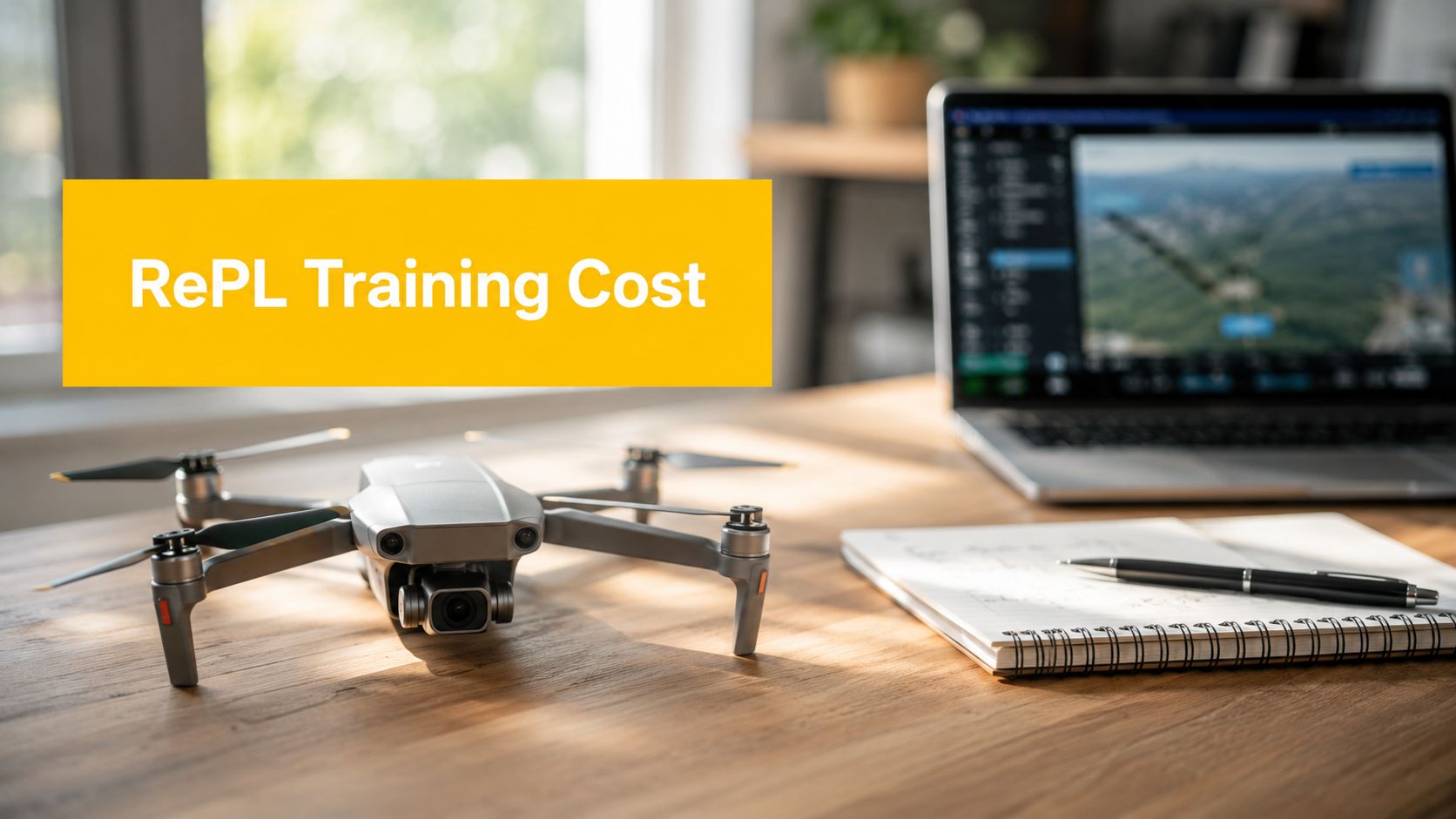
RePL training in Australia typically costs between A$1,500 and A$3,500 for the course itself, but the true all-in cost can be higher once CASA fees, AROC, travel, and add-ons are included. A low advertised price isn't automatically good value, because the final bill depends on what the provider includes and what the pilot still needs to purchase.
The most popular advice is to compare the headline course fee and choose the cheapest acceptable option. That approach is incomplete. A proper full landed cost comparison includes training, regulatory charges, travel, accommodation, additional practical time, resits, radio certification, and any operational support required after licensing.
For an initial estimate, prospective students can use the RePL quote calculator, then ask each provider to confirm every inclusion in writing.
Table of Contents
- Why the Advertised RePL Price Is Rarely What You Pay
- Breaking Down Typical RePL Training Costs
- How Delivery Format Affects Your Training Price
- CASA Regulatory Fees and AROC Add-Ons
- How to Evaluate Provider Quotes and Avoid Hidden Costs
- Connecting RePL Cost to Your Commercial Drone Pathway
- Choosing the Right RePL Training Path for Your Goals
- Frequently Asked Questions
Why the Advertised RePL Price Is Rarely What You Pay
The advertised RePL price usually describes the provider's training package, not the complete cost of becoming operational. The course commonly covers theory, practical flight training, and often the CASA theory exam, but other expenses can sit outside that invoice. CASA-related charges, AROC, travel to a training location, accommodation, resits, and extra flight time can all change the final amount.
That distinction matters most for students who live outside a major training centre. A course that looks cheaper online may require additional transport, accommodation, meals, or unpaid time away from work. A slightly more expensive local or blended option may produce a lower total cost once those practical expenses are counted.
The full landed cost framework
A useful quote comparison separates four layers:
- Training fee: Theory delivery, practical flight instruction, assessment, and stated course materials.
- Regulatory costs: CASA application or examination charges that aren't included in the provider invoice.
- Supporting qualifications: AROC where the pilot needs to communicate on an aviation air-band radio frequency.
- Logistical and contingency costs: Travel, accommodation, extra practical time, resits, and equipment or simulator requirements.
The provider's price is only one line in that calculation. Two courses with similar training outcomes can produce different landed costs because one includes practical supervision or radio training while the other charges separately.
Practical rule: A quote isn't comparable until every mandatory and likely extra cost has been listed beside it.
A low sticker price can still be appropriate for an experienced pilot who qualifies for a conversion pathway and doesn't need bundled services. It can be poor value for a beginner who needs more supervised flight time, AROC, or help preparing for commercial operations. The right question isn't “Which provider is cheapest?” It's “Which quote covers the requirements this pilot needs?”
Breaking Down Typical RePL Training Costs
The advertised RePL fee is only the starting point. Across the Australian market, the course component commonly sits between A$1,500 and A$3,500, with the final amount driven by provider structure, delivery format, endorsements, and the support included. Theory instruction, practical flight training, and often the CASA theory exam form the core package, as outlined in Australian RePL pricing guidance.
Published base packages can sit around A$1,895 to A$1,990 GST-free, while packages with extra training elements or endorsements may reach A$3,495 or more. Other Australian listings place standard sub-25 kg courses around A$1,350 to A$1,750. Blended or in-person options may reach about A$1,650 to A$2,400 or more plus GST. Treat these as market examples, not a quote for your circumstances.
What the course fee normally covers
A standard RePL package usually has three components:
- Theory instruction, covering the aviation knowledge required for the licence pathway.
- Practical flight training, where the student builds the operating skills needed for assessment.
- Assessment and examination elements, often including the CASA theory exam, although the provider must confirm this in writing.
The quote may also include a higher-weight-category endorsement, simulator access, extra practical days, AROC, or support for commercial operations. These additions can justify a higher fee, but they are not standard inclusions. Ask the provider to identify each one separately.
| Package Tier | Price Range (AUD) | Typical Inclusions |
|---|---|---|
| Base or lower-priced RePL | A$1,350 to A$1,750 | Core theory and practical training, with inclusions varying by provider |
| Standard RePL course | A$1,500 to A$3,500 | Theory, practical flight training, and often the CASA theory exam |
| Package with added services | A$3,495 or more | RePL training plus selected endorsements, extra practical support, or other bundled services |
GST treatment changes the comparison. A GST-free price should not be placed beside a price quoted plus GST without adjusting the totals.
Where beginners can reduce wasted spend
A beginner without basic drone or aviation knowledge may save money by studying before formal RePL training. ACE READY covers drone fundamentals, aviation safety, CASA regulations, flight operations, and preparation for advanced RePL training in Australia.
Budget for the full landed cost, including travel, accommodation, meals, unpaid time away from work, resits, AROC, and CASA charges where applicable. A cheaper course can become more expensive after those items are added.
Providers also need clear completion documents for learners. Organisations reviewing customizable training certificate designs can improve certificate presentation without treating a certificate as the regulatory licence.
Start with the AAA course catalogue, then request a written quote listing included services, exclusions, GST treatment, resit fees, and costs that depend on your experience or operating plans.
How Delivery Format Affects Your Training Price
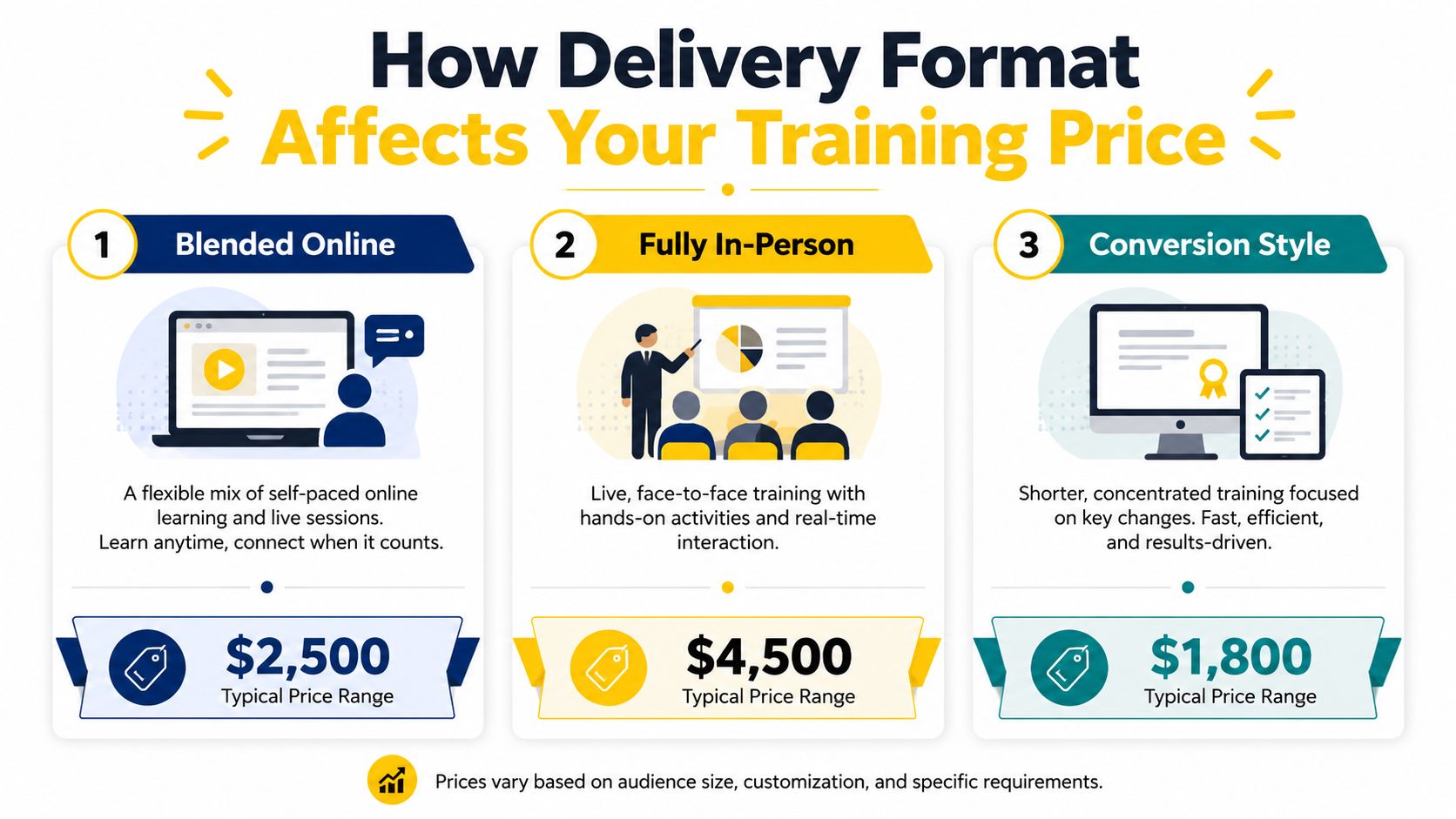
Delivery format is one of the clearest reasons RePL prices differ. Live classroom teaching, supervised flying, simulator access, venue costs, and instructor availability all add overhead. A learner paying for in-person support may spend more than someone using a blended pathway, but that higher price can be justified when the student needs structured instruction and direct feedback.
A side-by-side decision
| Delivery format | Published Australian pricing indication | Suitable for |
|---|---|---|
| Blended or online-supported | About A$1,250 inc GST in one published pathway | Students who can complete theory independently and attend practical training as required |
| Fully in-person or blended with substantial supervision | About A$1,650 to A$2,400 or more plus GST | Beginners who need classroom access, supervised flying, or simulator support |
| Conversion-style pathway | About A$890 | Already-qualified pilots whose prior knowledge can be credited |
The A$1,250 inc GST blended example and the A$1,650 to A$2,400 or more plus GST in-person range come from Australian provider pricing described by Drone Allowed's RePL cost guide. Conversion courses can fall to about A$890 because the provider may credit prior aviation knowledge and require fewer assessment hours, as reported in National Drones' pricing information.
Paying for the right level of support
A conversion pathway isn't a shortcut for a beginner. It makes financial sense only where the pilot's existing qualifications and experience satisfy the provider's conversion requirements. A beginner who chooses it purely because of the lower price may end up paying for additional support later.
The opposite mistake is paying for a high-contact course when the student already has the relevant knowledge and only needs a structured conversion or assessment pathway. The provider should explain exactly which prior learning is recognised and which practical competencies still need to be demonstrated.
For organisations training several staff, the economics can also change. Corporate drone training may allow a business to align instruction with its operating environment, but the quote still needs to identify participant requirements, practical supervision, and any separate qualifications.
ACE BRONZE is a foundation commercial drone course covering drone operations, flight safety, aviation theory, and practical skills for students beginning their journey towards becoming licensed drone pilots in Australia.
CASA Regulatory Fees and AROC Add-Ons
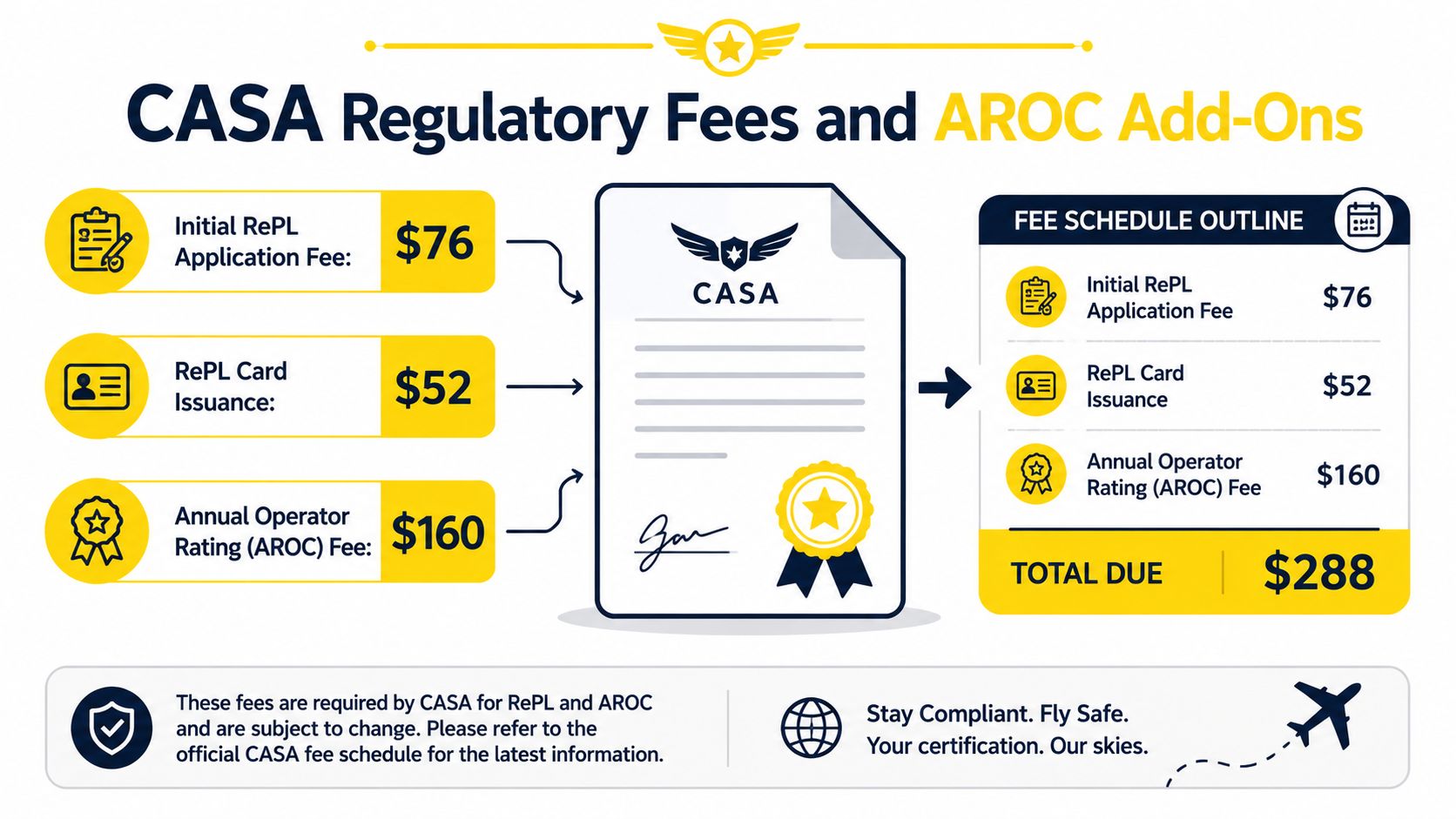
The provider's course invoice isn't the whole regulatory cost layer. CASA's RePL pathway includes formal application steps, and CASA's fee schedule includes charges connected with processing an initial issue or variation of a remote pilot licence application. The amount payable depends on the relevant CASA process and should be confirmed against the current fee schedule before enrolment.
Advanced operating privileges create further costs. CASA's published Beyond Visual Line-of-Sight ReB1 exam costs A$175.69 per exam attempt, comprising an A$110.69 examiner fee and a A$70 CASA regulatory fee, according to Total RPA's explanation of Australian drone certification costs. That expense sits beyond ordinary base RePL training.
When AROC belongs in the budget
CASA says an Aeronautical Radio Operator Certificate is required for anyone who needs to communicate on an aviation air-band radio frequency and isn't already licensed or qualified, including RePL holders. The requirement is operational, not a desirable add-on, so a pilot should assess the intended work before choosing a base RePL package.
A quote that excludes AROC may be perfectly suitable for a pilot whose intended operation doesn't require that radio communication capability. It may be incomplete for a commercial operator working in an environment where aviation radio communication is necessary.
AAA's drone licence information can help prospective students identify the relationship between RePL training and related aviation qualifications. The provider should still confirm the exact course inclusions and any separate CASA charges in the written quote.
Treat licensing as a staged investment
The cost pattern is staged rather than single-payment. The pilot first pays for the core training pathway, then adds regulatory processing, specialist examinations, radio qualifications, endorsements, or operational support as the intended mission becomes more complex.
A RePL quote should be tested against the planned operation, not against a competitor's headline price.
How to Evaluate Provider Quotes and Avoid Hidden Costs
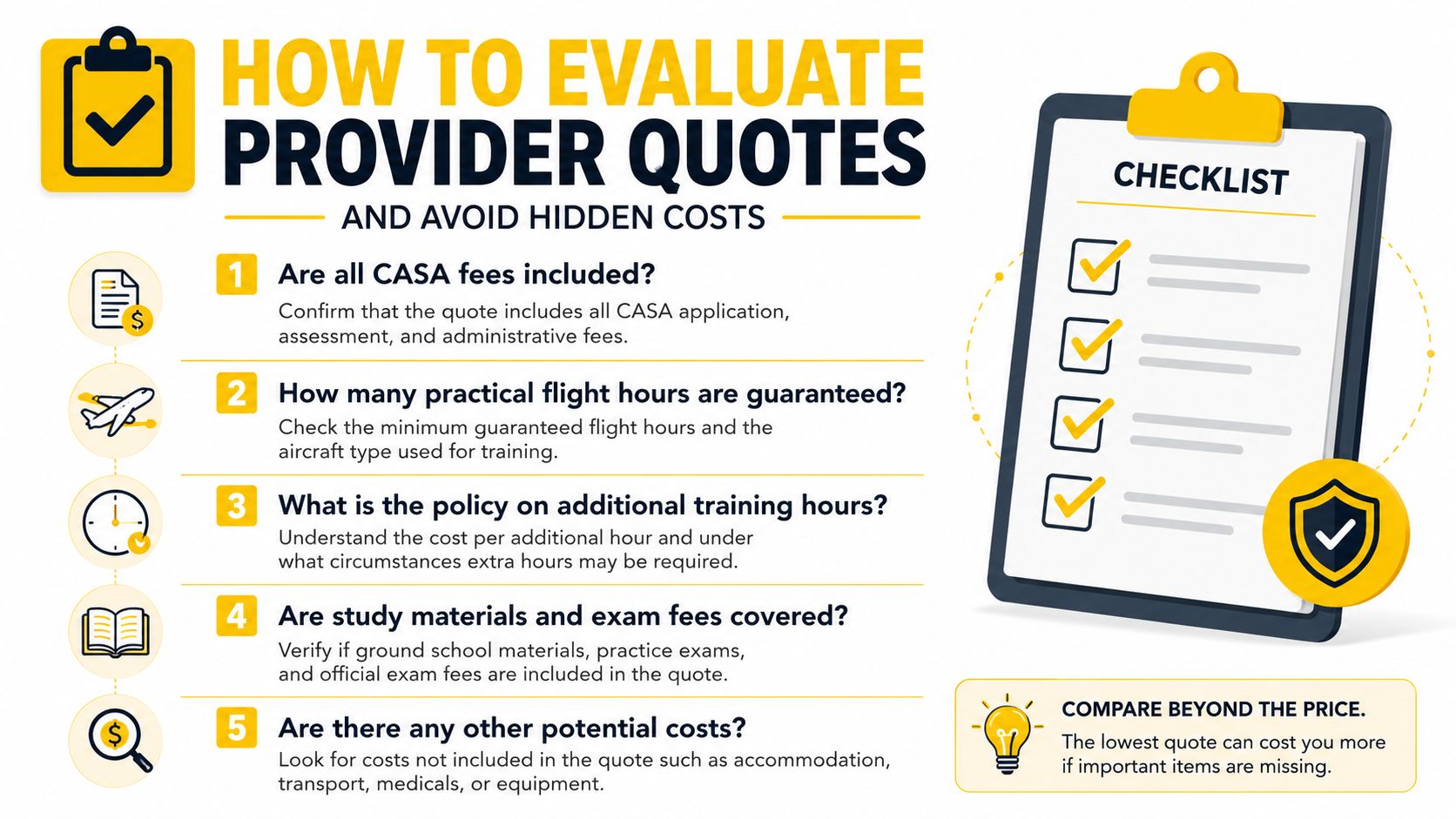
A useful provider quote should allow a buyer to reconstruct the final bill without guessing. If the document gives only one course price and a broad statement such as “all-inclusive”, the buyer should ask for a detailed inclusions schedule before paying a deposit.
Questions that expose the real price
- CASA charges: Ask which application, examination, or regulatory fees are included and which are paid directly to CASA.
- Practical training: Confirm the practical training included, the location, and whether additional supervised time attracts a separate charge.
- Resits: Request the resit policy for theory and practical assessments, including any instructor or examination fees.
- Travel requirements: Establish whether the student must attend another location and whether transport or accommodation is excluded.
- AROC status: Confirm whether AROC is included, separately available, or unnecessary for the intended operating environment.
- Endorsements: Check whether the package covers only the base RePL or includes additional operational privileges.
- Training materials: Ask whether manuals, simulator access, equipment, and assessment preparation are included.
The answer should be specific enough for a buyer to compare like with like. “Practical training included” doesn't explain how much supervision is available, while “extra training charged at the provider's hourly rate” identifies a potential contingency without fixing the final amount.
How to compare two apparently different quotes
Suppose one provider offers a low base course fee and another offers a higher package with AROC, simulator access, extra practical days, or business support. The higher quote isn't automatically excessive. It may reduce the number of separate purchases required later, particularly for a business preparing staff for commercial work.
Conversely, a bundle isn't automatically good value. A student who doesn't need a radio certificate, simulator access, or operational consulting may be paying for services that won't affect the intended role.
| Quote feature | Possible benefit | Risk to check |
|---|---|---|
| Lower base price | Lower upfront payment | Required extras may sit outside the invoice |
| AROC bundle | Fewer separate training arrangements | The qualification may not be needed for the intended operation |
| Extra practical support | More supervised preparation | The quote may still limit additional hours |
| ReOC assistance | Useful for an organisation building operating capability | Higher cost may be unnecessary for an individual pilot |
The buyer should record every price, inclusion, exclusion, and assumption in one comparison sheet. That process usually reveals whether the cheapest course remains cheapest after realistic travel, resit, and qualification requirements are added.
Connecting RePL Cost to Your Commercial Drone Pathway
A RePL is a pilot qualification, not a complete commercial operating system. CASA states that a person conducting commercial drone activities must hold a RePL and a CASA-issued operating certificate, or qualify under the excluded RPA provisions. The relevant ReOC and RePL requirements sit within subpart 101.F of the CASR, the Part 101 Manual of Standards, and AC 101-01, as explained in CASA's guidance on recreational, educational, and commercial drone activity.
That distinction changes the cost question for businesses. An individual seeking employment may need the licence and a supporting qualification. A company conducting its own drone work may also need an operational framework, documented procedures, governance, and ReOC capability. Include those requirements in the landed cost, rather than comparing course fees alone.
Basic pilot pathway or operating capability
Australian providers advertise basic RePL courses around A$1,350 to A$1,750, while packages that include ReOC assistance can reach A$3,350 or more, according to UASNT's commercial drone licence guide. The price difference reflects a wider scope, not merely a different teaching style.
For a business, compare the cost of building a compliant operating capability. A higher upfront package may reduce later documentation, procurement, and consulting work, but only when its support matches the organisation's operating model. An individual pilot should not pay for ReOC assistance without a clear commercial requirement. Review the broader ReOC requirements for Australian drone operations before adding that service to the budget.
Match the investment to the legal operating model
CASA also identifies excluded RPA operations. Small RPA over 2 kg and up to 25 kg operating in the landholder-excluded category do not require a ReOC or RePL. Medium RPA over 25 kg and up to 150 kg in that category do not require a ReOC, but do require a RePL for the intended type and model, according to CASA's licensing and operations guidance.
Your operating category, aircraft type, client requirements, and mission environment should determine the quote. Map those factors first. Then price the complete pathway, including any supporting qualifications, regulatory charges, travel, accommodation, and resits. That approach exposes whether a low advertised fee remains economical once the operation is ready to begin.
Choosing the Right RePL Training Path for Your Goals
The right RePL training cost depends on the pilot's starting point and intended work. Beginners generally need structured theory, practical supervision, and enough support to build safe operating habits. Experienced aviation personnel may qualify for a conversion-style pathway. Businesses need to assess whether they require only licensed pilots or a broader operating capability.
A practical decision framework is:
- Define the mission. Identify the aircraft category, operating environment, clients, and whether aviation radio communication will be required.
- Confirm the regulatory pathway. Check whether the intended work calls for RePL, ReOC capability, AROC, an endorsement, or a combination.
- Choose the delivery format. Select blended, in-person, or conversion training based on prior knowledge and the amount of supervision needed.
- Request an itemised quote. Separate course fees, CASA charges, AROC, travel, accommodation, practical extras, and resits.
- Compare readiness, not just price. A lower fee may be false economy if the pilot still needs additional flight time or separate compliance support.
The cheapest option is often sensible only when it already matches the learner's experience and operating plan. A beginner who needs local flight time or AROC may gain more value from a broader package, while an experienced pilot may overspend on classroom content already covered through prior qualifications.
Ace Aviation Aerospace Academy offers relevant pathways including RePL and AROC training, while businesses can also consider ReOC Consulting, Enterprise Drone Training, or Corporate Drone Training where the operating requirement extends beyond an individual pilot licence. The provider's ultimate guide to ReOC in Australia is a useful starting point for organisations assessing that wider pathway.
The strongest purchase decision follows the operation. Once the mission, regulatory category, experience level, and required qualifications are clear, the RePL training cost becomes easier to assess and hidden extras become much harder to overlook.
Frequently Asked Questions
How much does RePL training cost in Australia?
The course itself typically costs A$1,500 to A$3,500, with some base packages listed around A$1,895 to A$1,990 GST-free and packages reaching A$3,495 or more, based on Australian provider pricing at Droneit. The full landed cost can be higher after CASA charges, AROC, travel, accommodation, resits, and add-ons.
Does the RePL course fee include CASA fees?
Not always. Courses often include the CASA theory exam, but CASA application and advanced examination charges can sit separately. The quote should identify each CASA-related inclusion and exclusion.
Is AROC required with a RePL?
AROC is required for anyone who needs to communicate on an aviation air-band radio frequency and isn't already licensed or qualified, including RePL holders, according to CASA's radio operator guidance. It isn't automatically required for every RePL holder.
Can experienced pilots pay less for RePL training?
They may qualify for a conversion-style pathway. Published Australian pricing indicates conversion training can cost about A$890, because prior knowledge may be credited and assessment hours may be shorter, as noted by National Drones.
Does a business need more than a RePL?
Often, yes. CASA states that commercial drone activity generally involves a RePL and a CASA-issued operating certificate unless an excluded RPA provision applies. A business should assess whether ReOC capability, operating procedures, and related compliance support are needed.
What should a RePL quote include?
The quote should state the theory and practical components, assessment and exam inclusions, CASA charges, AROC status, practical training limits, resit policy, travel requirements, accommodation exclusions, endorsements, and fees for additional training time.
Ace Aviation Aerospace Academy provides RePL and AROC training, plus ReOC Consulting and business-focused drone training options for organisations assessing their full landed compliance cost. Visit Ace Aviation Aerospace Academy to compare relevant training pathways and request guidance based on the intended drone operation.