Short direct answer
Autonomous drones are not removing the need for pilots. They are creating new roles in remote operations, fleet supervision, mission planning, data analysis and compliance. A drone licence Australia pathway starts with a CASA-approved RePL, then adds BVLOS, systems and industry training.
Meta description: Drone licence Australia 2026 is evolving with autonomous BVLOS jobs. Learn the skills, CASA pathway and career options. Start training today.
Detailed explanation: why autonomous drones need more skilled people
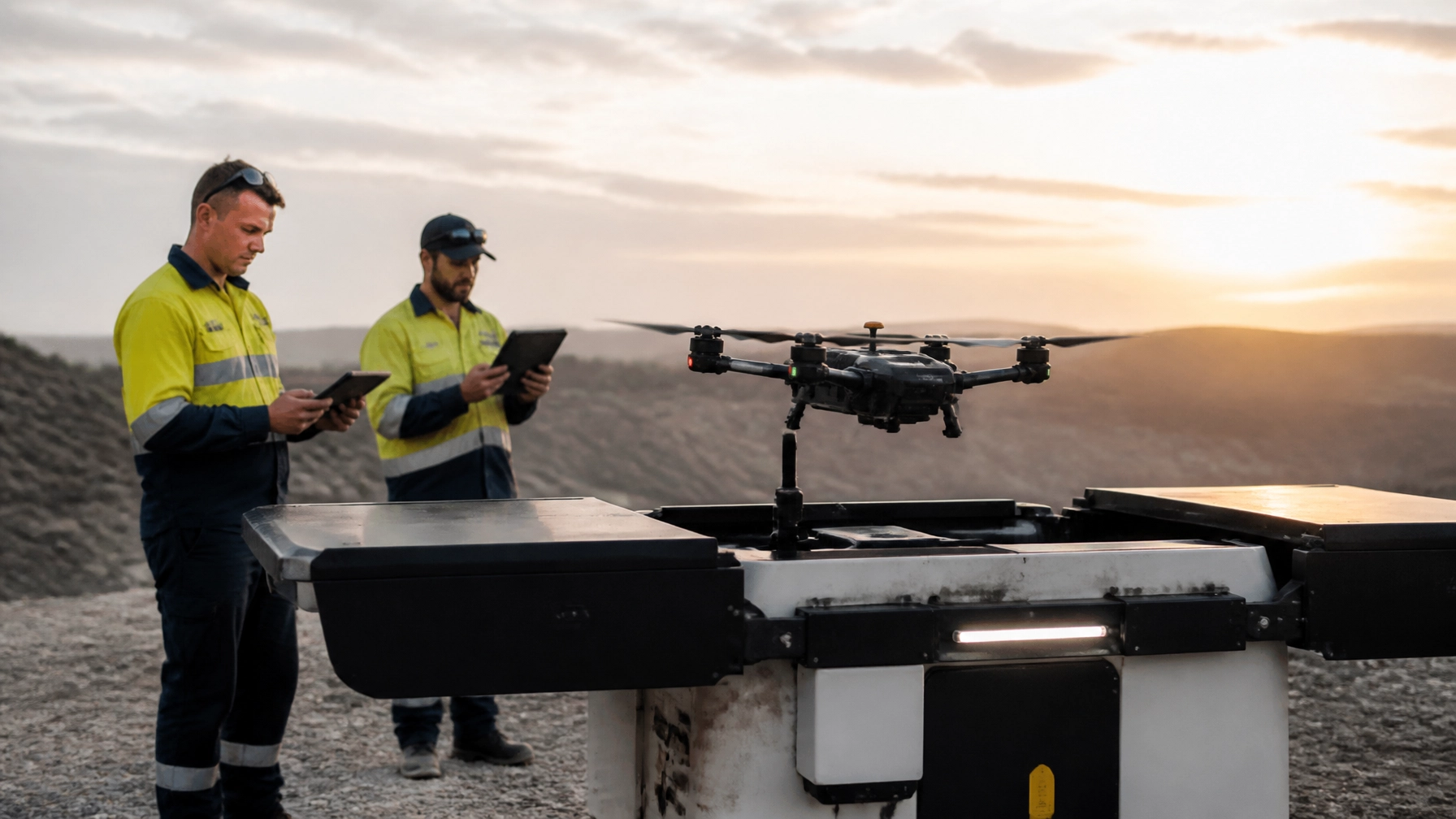
The Australian drone industry is moving from individual flights to connected fleets. In 2026, drone-in-a-box systems can launch, complete programmed missions, return to a dock and recharge with limited on-site support.
However, automation does not remove aviation responsibility. It changes where the work happens and which skills employers need.
A drone may fly itself, but people still design the mission. They assess the airspace, approve the operation, monitor telemetry and respond to alerts. They also check the data and maintain the aircraft, dock and communications links.
That is why the future of drone work is not “pilot versus automation”. Instead, it is pilot plus automation.
A remote pilot may supervise several aircraft from a remote operations centre. A mission planner may build routes for a mine, farm or pipeline. A compliance specialist may manage operating manuals, risk controls and CASA records.
Meanwhile, data specialists turn aerial imagery into useful decisions. They may identify a stockpile change, a crop health issue or a damaged powerline. These roles require aviation knowledge, technical judgement and industry context.
What is a drone-in-a-box system?
A drone-in-a-box system combines several components:
- An autonomous aircraft
- A secure launch and recovery dock
- Charging or battery management equipment
- Communications and telemetry links
- Mission-planning software
- Cameras, thermal sensors or other payloads
- A remote monitoring and control interface
- Maintenance and safety procedures
The system may operate at a fixed site, such as a mine, farm, solar facility or water asset. It can also support repeated missions along infrastructure corridors.
The pilot still has an important role. They monitor the operation, check weather and airspace conditions, confirm the mission remains within approval limits and take control when required.
What does BVLOS mean?
BVLOS means Beyond Visual Line of Sight. The remote pilot cannot continuously see the aircraft with their own eyes during the operation.
BVLOS makes large-area work possible. A drone can inspect kilometres of powerline, pipeline or mine infrastructure without moving a pilot beside the aircraft.
These operations also introduce greater risk. The operator must address command-and-control links, aircraft tracking, detect-and-avoid methods, emergency procedures and ground risk.
CASA regulates BVLOS as an advanced operation. Operators generally need a ReOC, appropriately qualified pilots and specific approval for the proposed activity. Review the CASA BVLOS operations guidance before planning an operation.
Why the job market is growing
The number of possible drone missions increases when automation makes flights more repeatable and affordable.
A single manual flight may provide one inspection. A dock-based system can run scheduled patrols every day. That creates more data, more maintenance needs and more decisions for trained professionals.
The growth is already visible in Australia:
- Australia has more than 43,200 RePL holders.
- There are approximately 3,100 ReOCs.
- The sector has recorded about 18% year-on-year growth.
- CASA reported 57% more BVLOS applications in 2025 than in 2024.
- The Broad Area BVLOS trial now covers more than 500,000 hectares across 19 broad areas.
These figures show an expanding operational ecosystem. They do not mean that every RePL holder will automatically find work. Employment still depends on experience, location, equipment knowledge and the ability to work safely within an approved system.
Key facts table: Australia’s autonomous drone sector in 2026
| Development | What it means for pilots |
|---|---|
| Broad Area BVLOS trial began in October 2025 | Eligible ReOC holders can assess suitable operating areas under the trial framework |
| TMI 2025-03 | Provides the temporary framework for broad-area BVLOS pathways |
| More than 500,000 hectares approved | Creates larger operating environments for remote and automated missions |
| 19 broad operating areas | Supports mining, agriculture, infrastructure and other wide-area applications |
| 57% rise in BVLOS applications in 2025 | Shows strong demand for advanced drone operations |
| AusSORA, effective 11 May 2026 | Replaces SORA 2.0 and provides an Australian risk-assessment framework |
| AusSORA adapts JARUS SORA 2.5 | Helps assess complex operations, including BVLOS |
| 43,200+ RePLs and about 3,100 ReOCs | Shows a growing professional and organisational base |
| 16-drone Queensland mining operation | Demonstrates fleet-scale autonomous operations |
| DJI Dock deployments | Supports repeatable missions in mining and agriculture |
| Carbonix autonomous approval | Shows a pathway for long-range, higher-complexity operations |
The Broad Area BVLOS trial is not a blanket permission to fly anywhere. Operators must meet the applicable criteria and follow their approval, procedures and operating limits.
How to become a drone pilot in Australia for autonomous work
The best pathway combines licensing with operational capability. A basic licence is a strong start, but autonomous employers often need more than manual flight skills.
Step 1: Obtain an Aviation Reference Number
An Aviation Reference Number, or ARN, identifies you within CASA systems. You generally need one before applying for an aviation licence or completing other regulatory processes.
Keep your personal details current. You may also need identity documents and other evidence during the application process.
Step 2: Complete a CASA-approved RePL course
The Remote Pilot Licence is the core commercial qualification for many professional drone jobs.
A quality RePL course should cover:
- Aviation law and CASA requirements
- Aeronautical knowledge
- Weather and operating conditions
- Airspace and flight planning
- Aircraft systems
- Human factors
- Emergency procedures
- Radio communication
- Practical flight skills
- Risk management and operational decision-making
Ace Aviation delivers CASA-approved drone training courses for beginners, working pilots and corporate teams.
The right aircraft category depends on your planned work. Many employers expect capability with sub-25 kg aircraft. Agriculture, industrial inspection and heavy-lift work may require broader training.
Step 3: Build supervised operational experience
Autonomous operations still rely on sound pilot judgement. Before supervising a fleet, you should understand normal and abnormal aircraft behaviour.
Build experience in:
- Pre-flight inspections
- Battery and charging procedures
- Mission planning
- Weather decisions
- Airspace checks
- Incident reporting
- Payload setup
- Data capture
- Lost-link and return-to-home procedures
- Maintenance records

Step 4: Add AROC and communications capability
An Aeronautical Radio Operator Certificate, or AROC, supports professional radio communication in aviation environments.
Clear communication becomes even more important when operations involve controlled airspace, other aircraft, ground teams or emergency services.
An AROC may be included in a broader commercial training package. Check the course inclusions and the requirements of your intended employer.
Step 5: Develop BVLOS capability
BVLOS training is an advanced step. It does not independently give you permission to conduct BVLOS flights.
A compliant BVLOS pathway may involve:
- A RePL
- A BVLOS or instrument rating examination
- Work under a ReOC
- An approved operations manual
- A documented safety case
- Risk assessments
- Communications and contingency procedures
- CASA approval for the operation
Ace Aviation’s BVLOS and EVLOS training pathway helps operators understand the approval process, safety case and operational documentation.
Step 6: Learn autonomous systems and data workflows
Employers need pilots who understand the complete operation, not only the flight controller.
Useful skills include:
- Dock setup and inspection
- Automated mission programming
- Fleet dashboards
- Telemetry monitoring
- Sensor and payload selection
- Photogrammetry
- Mapping and GIS workflows
- Thermal image review
- Defect identification
- Maintenance troubleshooting
- Cybersecurity awareness
- Digital recordkeeping
A pilot who can explain what the data means is more valuable than one who only captures images.
Step 7: Continue into an industry speciality
Choose an area where drones solve a clear business problem.
Common pathways include:
- Mining and resources
- Agriculture and spraying
- Surveying and mapping
- Construction
- Power and utilities
- Rail and road infrastructure
- Emergency services
- Environmental monitoring
- Defence and government
- Energy and pipeline inspection
For example, XAG agricultural drone training can support pilots interested in large-scale farm operations. A Certificate III in Aviation can also provide a broader formal qualification through the AVI30419 programme.
Real-world examples of autonomous drone jobs
1. Queensland mining fleets
A reported Queensland operation uses 16 autonomous drones across four BMA mining sites in the Bowen Basin.
The fleet operates from eight pads and supports more than 80 kilometres of mining activity. It reportedly completes about 1,500 missions per month.
The operation supports:
- Inspections
- Surveying
- Emergency response
- Geospatial intelligence
- Site monitoring
This is not a single-pilot model. It needs people to supervise the fleet, maintain the pads, manage approvals and review the information.
Read the RocketDNA and BMA case study for more detail.
2. Drone-in-a-box systems in mining and agriculture
DJI Dock systems are being positioned for repeatable missions in mining and agriculture.
A dock can support scheduled flights from a fixed location. This may include stockpile monitoring, crop observation, irrigation checks or perimeter patrols.
However, the dock does not eliminate the need for a pilot. It creates demand for:
- Remote mission supervisors
- Dock technicians
- Operations managers
- Compliance officers
- Data analysts
- Field response teams
The DJI mining automation information explains how dock-based systems fit into larger commercial operations.
3. Carbonix and long-range operations
Carbonix has been associated with long-range autonomous operations and a landmark SAIL III approval in Australia.
Its work demonstrates how aircraft can support inspection across large resource and infrastructure areas. These missions may cover gas networks, pipelines, energy assets and remote survey corridors.
Long-range operations require specialist knowledge. Pilots must understand operational volumes, aircraft performance, command links and contingency planning.
This creates roles for people who can connect aircraft capability with a defensible aviation safety case.
4. Regional and city-based work
Autonomous drone careers are not limited to remote mine sites.
In Brisbane, pilots may support Queensland mining, construction, agriculture and infrastructure projects.
In Sydney, opportunities may include surveying, utilities, construction, government and operations-centre roles.
In Melbourne, the construction, mapping, media and infrastructure sectors continue to use professional drone services.
In Perth, mining, resources, agriculture and surveying create strong demand for capable operators.
In Hobart, agriculture, forestry, environmental monitoring and infrastructure work provide specialist pathways.
The aircraft may operate remotely, but the people who plan and manage those missions can work from many locations.
Common mistakes when preparing for autonomous drone work
Mistake 1: Assuming “autonomous” means “unregulated”
Autonomous aircraft remain remotely piloted aircraft under Australian aviation regulation. A software-controlled mission still needs an accountable operator and suitable procedures.
Mistake 2: Treating a RePL as permission for BVLOS
A RePL does not automatically authorise BVLOS flight. BVLOS requires the correct operational structure, approval and competency.
Mistake 3: Focusing only on manual flying
Manual control remains important. Yet employers also value mission planning, data handling, risk assessment and technical troubleshooting.
Mistake 4: Ignoring the ReOC
A ReOC is the operator certificate held by an organisation. It is different from an individual RePL.
If you want to run your own commercial drone business, you may need ReOC support, an operations manual and a Chief Remote Pilot function.
Mistake 5: Buying equipment before defining the operation
A drone or dock should match the task, environment, payload and approval pathway.
First define the operation. Then select aircraft, sensors, communications and support equipment.
Mistake 6: Treating data as an afterthought
Clients rarely want aerial images alone. They want answers.
Train to produce useful outputs such as:
- Site maps
- Orthomosaics
- Inspection reports
- Change detection
- Thermal findings
- Stockpile volumes
- Crop health information
- Defect registers
CASA considerations for autonomous and BVLOS operations
CASA’s regulatory framework is developing quickly. You should confirm current requirements before each operation because approvals, instruments and guidance can change.
Broad Area BVLOS trial
CASA’s Broad Area BVLOS trial began in October 2025 under TMI 2025-03.
The trial allows eligible ReOC holders to assess suitable operating areas rather than requesting separate site approvals for every location. This can reduce approval time from months to weeks or days for suitable operators.
The trial does not remove responsibility. Operators must still:
- Meet eligibility requirements
- Use qualified personnel
- Follow approved procedures
- Complete area feasibility assessments
- Observe aircraft and population limits
- Apply ground-risk mitigations
- Maintain records
- Report and manage incidents
The trial is expected to inform future BVLOS policy. It should not be treated as a permanent rule or universal permission.
AusSORA and AC 101-06
From 11 May 2026, AusSORA under AC 101-06 replaces SORA 2.0 for relevant Australian operations.
AusSORA adapts JARUS SORA 2.5 to Australian conditions. It applies to complex operations, including many BVLOS activities.
The framework helps operators identify and manage:
- Air risk
- Ground risk
- Operational volume
- Contingency volume
- Strategic mitigations
- Tactical mitigations
- Technical safeguards
- Organisational controls
- Evidence for the approval application
Remote pilots may not write every part of a safety case. Still, they should understand how their decisions affect the risk assessment.
Aircraft, people and organisation
A compliant autonomous operation needs all three:
- Aircraft and technology that are suitable for the mission.
- Qualified people who can supervise, intervene and make decisions.
- An approved organisation with procedures, training, records and accountability.
If one part is weak, the operation may not be safe or approvable.
For authoritative updates, read CASA’s RPAS in Australian Skies 2026.
Why Ace Aviation prepares pilots for the autonomous era
Ace Aviation is a CASA-approved training provider operating under CASA.ReOC.1421. The academy has trained more than 4,000 students and supports training across Australia and internationally, including Singapore, Dubai, Korea and Malaysia.
The goal is not simply to help students pass an assessment. It is to prepare them for the systems surrounding professional drone work.
Ace supports that pathway through:
- CASA-approved RePL training
- AROC training
- ReOC and Chief Remote Pilot pathways
- BVLOS and EVLOS education
- Industry-focused courses
- Heavy-lift and agricultural training
- Certificate III in Aviation options
- Altitude+ student benefits
- Practical equipment experience
- Career support through DroneWork
- Ongoing operational and compliance guidance
National Drones, iDrone Train, Aviassist and Global Drone Solutions also operate in the broader Australian training and services market. Ace differentiates its offer by connecting training with compliance, equipment capability and employment pathways.
The Why Ace page explains the academy’s training, support and industry ecosystem.

16 frequently asked questions about drone licence Australia and autonomous jobs
1. Do I need a drone licence to work with autonomous drones?
Usually, yes. Professional operations commonly require a RePL-qualified remote pilot working under an approved operator. The exact requirements depend on the aircraft, operation and approval.
2. Is there a separate autonomous drone licence in Australia?
No. CASA does not issue a separate “autonomous drone licence”. The operation is assessed based on its risks, technology, people and organisational controls.
3. Can an autonomous drone fly without a pilot?
An aircraft may fly without a pilot physically standing beside it. However, a responsible remote pilot and operator remain part of the approved operation.
4. What is the difference between a RePL and a ReOC?
A RePL is an individual Remote Pilot Licence. A ReOC is an organisation’s Remotely Piloted Aircraft Operator’s Certificate.
5. Does a RePL allow me to fly BVLOS?
No. A RePL is not, by itself, BVLOS approval. You need the appropriate competency, operator structure and CASA authorisation.
6. What is the Broad Area BVLOS trial?
It is a CASA trial that allows eligible ReOC holders to assess suitable broad operating areas under defined pathways. It began in October 2025 under TMI 2025-03.
7. How much land does the Broad Area BVLOS trial cover?
The trial covers more than 500,000 hectares across 19 broad areas, based on CASA’s 2026 reporting.
8. What is AusSORA?
AusSORA is Australia’s risk-assessment framework for complex RPAS operations. Under AC 101-06, it replaces SORA 2.0 and adapts JARUS SORA 2.5 for Australian conditions.
9. What jobs can autonomous drone pilots do?
Possible roles include remote pilot, fleet supervisor, mission planner, operations manager, dock technician, data analyst, compliance officer and Chief Remote Pilot support.
10. Are drone pilots still needed if software controls the flight?
Yes. Pilots supervise missions, manage abnormal events, assess conditions and ensure the operation remains within its approval.
11. Which industries use drone-in-a-box systems?
Mining, agriculture, energy, utilities, construction, infrastructure inspection, emergency response and environmental monitoring are key areas.
12. Do I need coding skills to work with autonomous drones?
Coding is not always required. However, software confidence, mission planning, telemetry interpretation and data skills are increasingly valuable.
13. What qualifications help after a RePL?
Useful additions may include AROC, BVLOS or EVLOS training, night operations, heavy-lift aircraft training, agricultural endorsements, Certificate III in Aviation and ReOC or Chief Remote Pilot training.
14. What is the CASA RePL cost in Australia?
The total cost varies by aircraft category, training provider, location and included services. Compare the full package rather than looking only at the advertised course fee. It may include exams, practical assessment, CASA submission support and additional certificates.
15. Can I work in autonomous drone operations from a city?
Yes. Remote operations centres may be based in cities while aircraft operate at mines, farms, infrastructure corridors or regional sites. Training is available in Brisbane, Sydney, Melbourne, Perth and Hobart.
16. Will automation reduce entry-level drone work?
Some repetitive manual work may change. At the same time, automation can increase the number of missions and create entry-level roles in field support, data processing, maintenance and operations monitoring.
17. Can I start a drone business using autonomous systems?
Potentially, but you must first define the operation and regulatory pathway. You may need a ReOC, operations manual, qualified pilots, equipment controls and CASA approval.
18. Where can I find commercial drone work?
Ace graduates can access career support and opportunities through the DroneWork job board. Employment is not guaranteed, so continue building technical, aviation and industry skills.
19. Is autonomous drone work suitable for beginners?
Beginners can enter the industry. Start with a structured RePL course, then build experience before moving into BVLOS or fleet operations.
20. How can a company train several employees?
Companies can use structured corporate training for RePL, AROC, industry applications and operational procedures. Contact Ace Aviation to discuss a team pathway.
Summary: autonomous drones need capable pilots
Autonomous drones are changing the role of the pilot. They are not removing the human from the operation.
The strongest candidates in 2026 will combine a RePL with practical flight ability, risk awareness, mission planning, data skills and technology confidence. BVLOS knowledge will become more important as operators expand across large areas.
CASA’s Broad Area BVLOS trial, AusSORA and growing industry adoption are creating new operational possibilities. Mining, agriculture, surveying and infrastructure companies need people who can make those operations safe, useful and compliant.
Ace Aviation prepares students for that next stage through CASA.ReOC.1421, more than 4,000 trained students, Altitude+, global delivery and DroneWork career pathways.
Ready to start? Book your training at aaa.edu.au or call 1300 336 366.
{“@graph”:[{“@type”:”Article”,”about”:[“Drone licence Australia”,”Autonomous drones”,”BVLOS operations”,”Drone-in-a-box systems”,”Remote pilot careers”],”image”:”https://cdn.marblism.com/VSJ9ilbI-Ly.webp”,”author”:{“name”:”Ace Aviation Aerospace Academy”,”@type”:”Organization”},”headline”:”Drone Licence Australia 2026: How Autonomous Drones Are Creating More Pilot Jobs, Not Fewer”,”publisher”:{“logo”:{“url”:”https://aaa.edu.au/assets/ace-logo-transparent.png”,”@type”:”ImageObject”},”name”:”Ace Aviation Aerospace Academy”,”@type”:”Organization”},”description”:”Drone licence Australia 2026 is evolving with autonomous BVLOS jobs. Learn the skills, CASA pathway and career options.”,”dateModified”:”2026-08-30″,”datePublished”:”2026-08-30″},{“url”:”https://aaa.edu.au/”,”logo”:”https://aaa.edu.au/assets/ace-logo-transparent.png”,”name”:”Ace Aviation Aerospace Academy”,”@type”:”Organization”,”sameAs”:[“https://dronework.com.au/”],”telephone”:”+61-1300-336-366″,”description”:”CASA-approved drone pilot training provider offering RePL, AROC, ReOC, BVLOS, Certificate III in Aviation and specialised commercial drone training.”},{“@type”:”FAQPage”,”mainEntity”:[{“name”:”Do I need a drone licence to work with autonomous drones?”,”@type”:”Question”,”acceptedAnswer”:{“text”:”Usually, yes. Professional autonomous operations commonly require a RePL-qualified remote pilot working under an approved operator.”,”@type”:”Answer”}},{“name”:”Is there a separate autonomous drone licence in Australia?”,”@type”:”Question”,”acceptedAnswer”:{“text”:”No. CASA does not issue a separate autonomous drone licence. The operation is assessed based on its risks, technology, people and organisational controls.”,”@type”:”Answer”}},{“name”:”Can an autonomous drone fly without a pilot?”,”@type”:”Question”,”acceptedAnswer”:{“text”:”An aircraft may fly without a pilot physically standing beside it, but a responsible remote pilot and operator remain part of the approved operation.”,”@type”:”Answer”}},{“name”:”What is the difference between a RePL and a ReOC?”,”@type”:”Question”,”acceptedAnswer”:{“text”:”A RePL is an individual Remote Pilot Licence. A ReOC is an organisation’s Remotely Piloted Aircraft Operator’s Certificate.”,”@type”:”Answer”}},{“name”:”Does a RePL allow me to fly BVLOS?”,”@type”:”Question”,”acceptedAnswer”:{“text”:”No. A RePL is not, by itself, BVLOS approval. The operator also needs the appropriate competency, structure and CASA authorisation.”,”@type”:”Answer”}},{“name”:”What is the Broad Area BVLOS trial?”,”@type”:”Question”,”acceptedAnswer”:{“text”:”It is a CASA trial that allows eligible ReOC holders to assess suitable broad operating areas under defined pathways. It began in October 2025 under TMI 2025-03.”,”@type”:”Answer”}},{“name”:”How much land does the Broad Area BVLOS trial cover?”,”@type”:”Question”,”acceptedAnswer”:{“text”:”The trial covers more than 500,000 hectares across 19 broad areas, based on CASA’s 2026 reporting.”,”@type”:”Answer”}},{“name”:”What is AusSORA?”,”@type”:”Question”,”acceptedAnswer”:{“text”:”AusSORA is Australia’s risk-assessment framework for complex RPAS operations. Under AC 101-06, it replaces SORA 2.0 and adapts JARUS SORA 2.5 for Australian conditions.”,”@type”:”Answer”}},{“name”:”What jobs can autonomous drone pilots do?”,”@type”:”Question”,”acceptedAnswer”:{“text”:”Possible roles include remote pilot, fleet supervisor, mission planner, operations manager, dock technician, data analyst, compliance officer and Chief Remote Pilot support.”,”@type”:”Answer”}},{“name”:”Are drone pilots still needed if software controls the flight?”,”@type”:”Question”,”acceptedAnswer”:{“text”:”Yes. Pilots supervise missions, manage abnormal events, assess conditions and ensure the operation remains within its approval.”,”@type”:”Answer”}},{“name”:”Which industries use drone-in-a-box systems?”,”@type”:”Question”,”acceptedAnswer”:{“text”:”Mining, agriculture, energy, utilities, construction, infrastructure inspection, emergency response and environmental monitoring are key areas.”,”@type”:”Answer”}},{“name”:”Do I need coding skills to work with autonomous drones?”,”@type”:”Question”,”acceptedAnswer”:{“text”:”Coding is not always required. Software confidence, mission planning, telemetry interpretation and data skills are increasingly valuable.”,”@type”:”Answer”}},{“name”:”What qualifications help after a RePL?”,”@type”:”Question”,”acceptedAnswer”:{“text”:”Useful additions may include AROC, BVLOS or EVLOS training, night operations, heavy-lift aircraft training, agricultural endorsements, Certificate III in Aviation and ReOC or Chief Remote Pilot training.”,”@type”:”Answer”}},{“name”:”What is the CASA RePL cost in Australia?”,”@type”:”Question”,”acceptedAnswer”:{“text”:”The total cost varies by aircraft category, training provider, location and included services. Compare the full package, including exams, practical assessment, CASA submission support and additional certificates.”,”@type”:”Answer”}},{“name”:”Can I work in autonomous drone operations from a city?”,”@type”:”Question”,”acceptedAnswer”:{“text”:”Yes. Remote operations centres may be based in cities while aircraft operate at mines, farms, infrastructure corridors or regional sites.”,”@type”:”Answer”}},{“name”:”Will automation reduce entry-level drone work?”,”@type”:”Question”,”acceptedAnswer”:{“text”:”Some repetitive manual work may change. Automation can also increase mission volumes and create roles in field support, data processing, maintenance and operations monitoring.”,”@type”:”Answer”}},{“name”:”Can I start a drone business using autonomous systems?”,”@type”:”Question”,”acceptedAnswer”:{“text”:”Potentially, but you must define the operation and regulatory pathway first. You may need a ReOC, operations manual, qualified pilots, equipment controls and CASA approval.”,”@type”:”Answer”}},{“name”:”Where can I find commercial drone work?”,”@type”:”Question”,”acceptedAnswer”:{“text”:”Ace graduates can access career support and opportunities through the DroneWork job board. Employment is not guaranteed, so continue building technical, aviation and industry skills.”,”@type”:”Answer”}},{“name”:”Is autonomous drone work suitable for beginners?”,”@type”:”Question”,”acceptedAnswer”:{“text”:”Beginners can enter the industry by starting with a structured RePL course and building experience before moving into BVLOS or fleet operations.”,”@type”:”Answer”}},{“name”:”How can a company train several employees?”,”@type”:”Question”,”acceptedAnswer”:{“text”:”Companies can use structured corporate training for RePL, AROC, industry applications and operational procedures.”,”@type”:”Answer”}}]}],”@context”:”https://schema.org”}