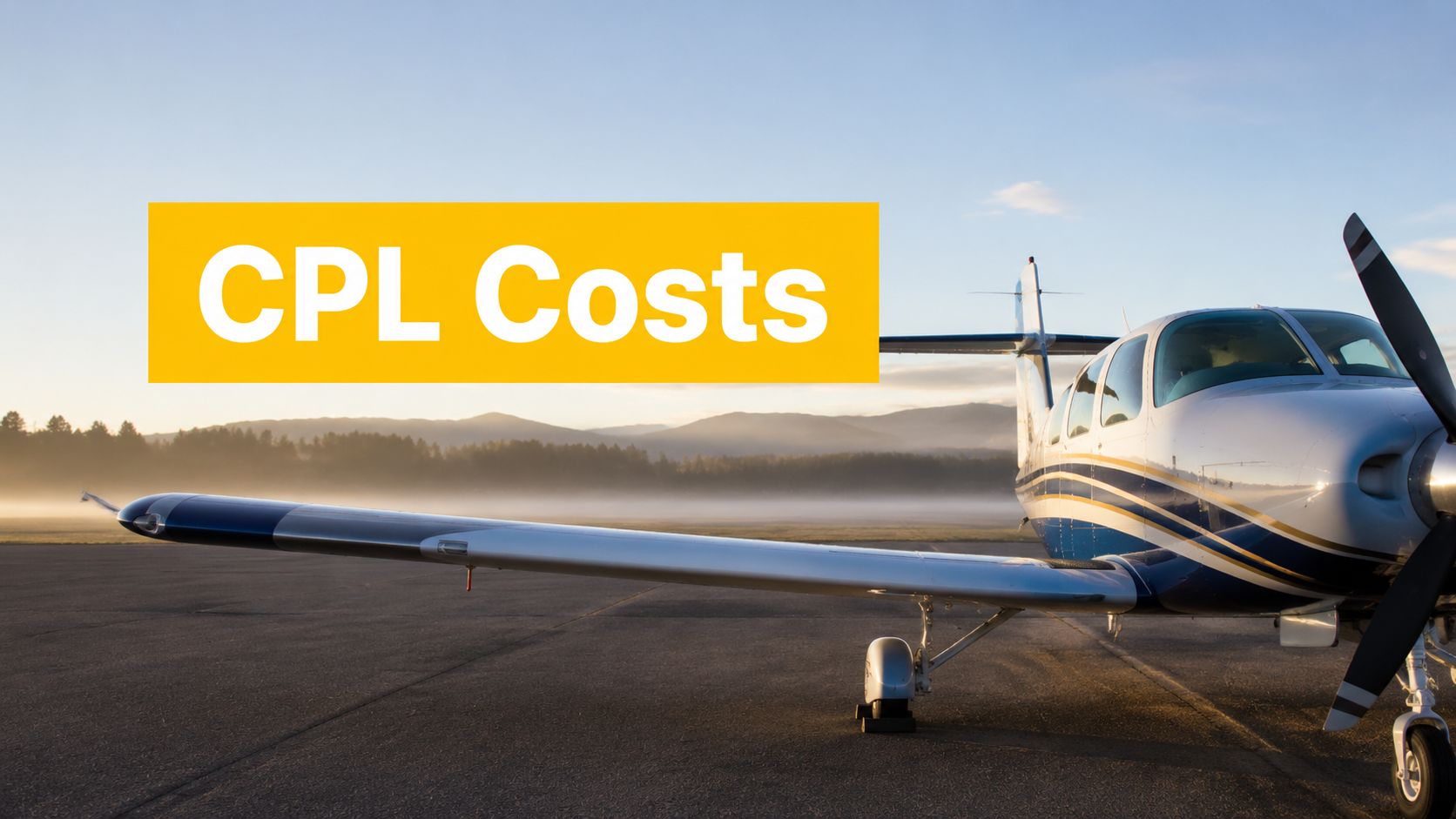
While the CASA administrative issue fee is only AUD 80, the realistic total cost to obtain a Commercial Pilot Licence in Australia typically ranges from AUD 65,000 to over AUD 110,000, depending on the training pathway. The licence fee is the smallest part of the budget, and treating it as the full CPL licence cost is the quickest way to underfund training.
A prospective commercial pilot needs an out-the-door budget, not a headline course price. Aircraft hire, instructor time, theory training, landing charges, simulator use, medical requirements, examinations, flight testing and hour-building all affect the final amount. The figures below are the practical starting point for anyone comparing Australian flight schools and deciding whether a CPL is financially achievable.
Table of Contents
- The Reality of CPL Training Expenses
- Integrated vs Modular Training Pathways
- Breakdown of CASA Regulatory Fees
- Hidden Costs and Medical Requirements
- Financing Your Aviation Career
- Frequently Asked Questions
The Reality of CPL Training Expenses
The AUD 80 CASA issue fee applies to an Australian-trained applicant and covers licence administration, not the training needed to qualify. CASA also lists CPL theory examination charges of AUD 175.69 to AUD 203.39 per exam, depending on the applicable invigilator fee. The regulatory bill therefore extends beyond the final licence application. Details are available in CASA's CPL aeroplane examination guidance.
Published Australian estimates put non-integrated CPL training at approximately AUD 65,000 to AUD 90,000, while integrated training is commonly estimated at AUD 80,000 to AUD 110,000, according to an Australian CPL cost and training guide. Other benchmarks place CPL-only training around AUD 40,000 to AUD 60,000, or broader commercial pathways at AUD 65,000 to AUD 110,000 or more, as outlined by Rotate Pilot's Australian pilot cost guide. The gap between the administrative fee and the out-the-door training budget is substantial.
Where the money goes
Operational flying takes the largest share. Aircraft hire covers access to the aircraft, fuel and operating costs reflected in the hourly rate. Dual lessons also include instructor time. Solo hour-building still carries aircraft and operating costs, even without an instructor onboard.
Build your budget from these line items:
- Aircraft hire: Aircraft type, availability and hourly charging method affect the total.
- Instructor time: Dual lessons cost more than solo flying because they include professional instruction.
- Theory training: Ground school, study materials and CASA examinations may sit outside flight-hour quotations.
- Landing and airport charges: Controlled or higher-cost airports can add charges to individual flights.
- Simulator use: Approved simulator sessions form a separate budget item where the school uses them.
- Flight testing: Examiner or provider charges for the final assessment may be excluded from advertised tuition.
A CPL training cost quote calculator can organise these line items, but it should not replace a written school quotation. Ask what the school includes, what remains excluded and which assumptions determine the estimate. The advertised course total means little without the aircraft-hour assumption and a clear list of additional charges.
Practical rule: Compare included aircraft hours and excluded charges before comparing course totals.
Set aside a contingency for extra training. Students reach test standard at different speeds, while weather, aircraft maintenance, instructor availability and long breaks can extend the pathway. Fund the CPL against the full published range, not the lowest promotional figure. That approach accounts for the costs that CASA's small administrative fee does not show.
Integrated vs Modular Training Pathways
The choice between integrated and modular training changes both the payment structure and the student's exposure to financial risk. An integrated course normally presents a structured commercial training programme with costs grouped into a defined pathway. A modular route breaks the journey into stages, allowing a student to pay as training progresses and make decisions after each qualification.
Neither pathway automatically produces a lower final bill. The result depends on aircraft use, training consistency, hour-building efficiency, school operations and the scope of the quoted programme.
| Feature | Integrated Pathway | Modular Pathway |
|---|---|---|
| Payment structure | Larger planned commitment, often quoted as a complete pathway | Staged payments as the student progresses |
| Training design | Structured sequence with a defined commercial objective | Flexible sequence built from individual qualifications and experience |
| Cash-flow profile | Higher early commitment | More manageable short-term payments |
| Flexibility | Less freedom to pause or change providers | Easier to adjust timing, location or training priorities |
| Budget visibility | A single estimate can make the pathway easier to plan | More responsibility falls on the student to track cumulative costs |
| Financial risk | Greater exposure if the student withdraws or changes direction | Greater exposure to price changes and delays between stages |
When integrated training makes sense
Integrated training suits a student who has a clear professional goal, reliable funding and the ability to train consistently. The structured environment can make scheduling, theory progression and flight planning easier to manage. It also gives the student a defined framework for monitoring progress.
The risk is assuming that a packaged price is unconditional. A student should ask whether the quote includes aircraft hire, instructor time, theory instruction, simulator sessions, landing fees, flight tests, medical requirements, examination charges and any required hour-building. If the school's estimate assumes a particular training pace or aircraft availability, those assumptions should appear in writing.
When modular training is safer
Modular training is usually the more practical option for someone who needs to work, stage payments or confirm suitability before committing to the entire commercial pathway. It allows the student to complete relevant stages separately, reassess finances and avoid paying for training that may no longer suit their goals.
The trade-off is administrative discipline. A modular student needs a written cost tracker, a realistic schedule and a clear understanding of which prior training counts toward the next stage. A long interruption can also reduce skill retention and create additional revision flying.
Students considering a broader aviation qualification can review the Certificate III in Aviation pathway alongside flight training, provided the qualification aligns with their career plan. Someone entering aviation from a beginner background may also consider ACE READY, an entry-level drone course covering drone fundamentals, aviation safety, CASA regulations and flight operations before advanced RePL training.
The recommendation is straightforward. Choose integrated training when funding, commitment and scheduling are secure. Choose modular training when cash flow, career certainty or flexibility matters more than a single structured package.
Breakdown of CASA Regulatory Fees
The phrase CPL licence cost often causes confusion because it can refer to the administrative fee paid to CASA, the fee for each examination, or the entire training investment. Those are separate costs, and a student needs to record each one independently.
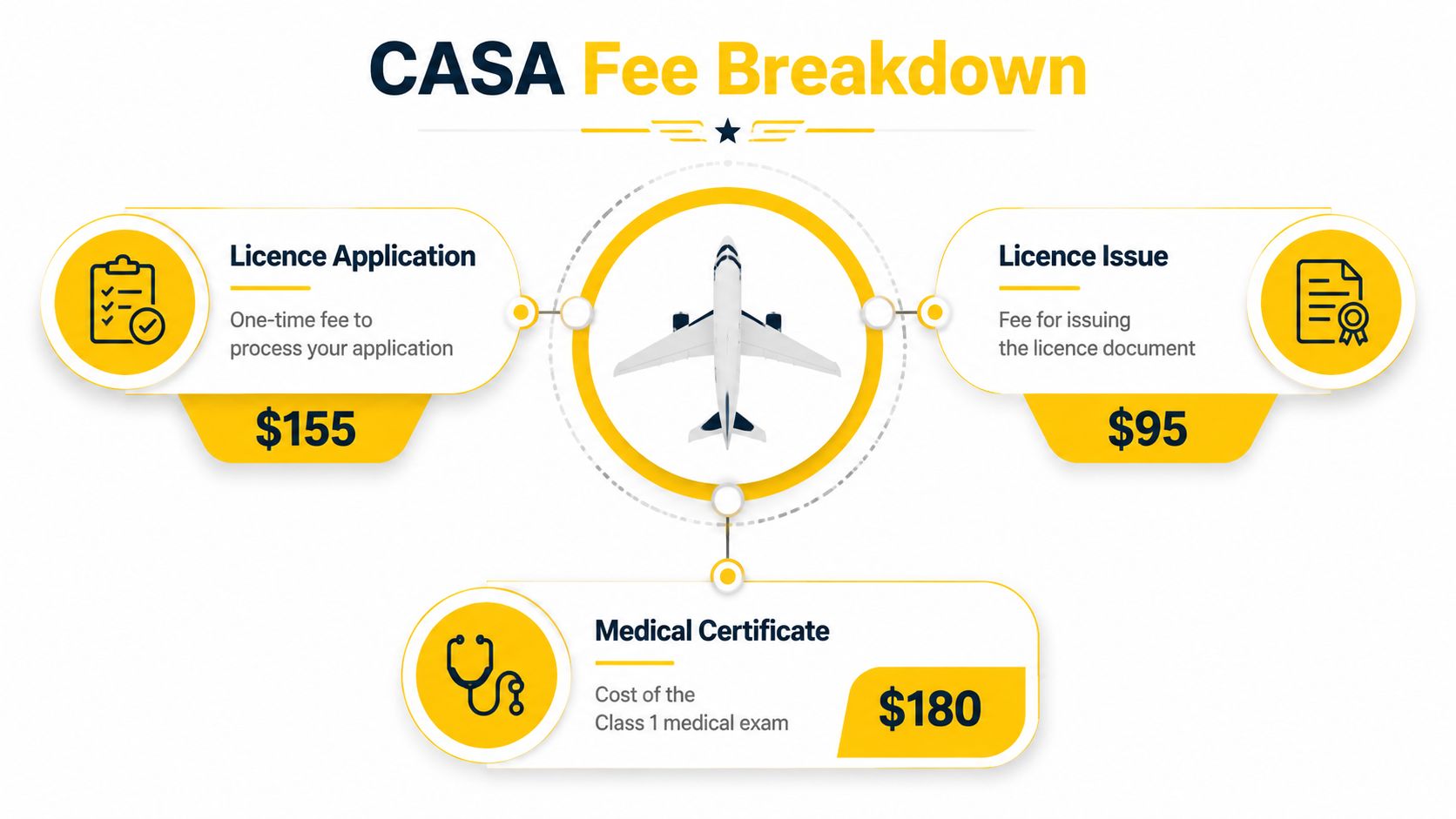
For an Australian-trained applicant, CASA lists an AUD 80 application and processing fee for issuing the Commercial Pilot Licence, as stated in CASA's Australian-trained CPL application information. That charge doesn't cover flight instruction, aircraft hire, medical certification, theory preparation, examinations or the flight test.
The examination component
CASA's published CPL examination pricing shows that each exam includes a AUD 65 CASA component, while the total charge can be AUD 175.69 or AUD 203.39, depending on the invigilator component and current fee schedule. One listed examination totals AUD 175.69, made up of an AUD 110.69 invigilator fee and the AUD 65 CASA fee. Another totals AUD 203.39, made up of an AUD 138.39 invigilator fee and the same CASA component.
The important budgeting point is that candidates generally sit multiple theory subjects. The total examination bill therefore depends on the required subject set and the number of attempts. A student who passes efficiently still needs to budget for each required assessment, rather than recording one generic “exam fee”.
Separate fees outside the CASA issue charge
The flight test and medical aren't interchangeable with the licence issue fee. An independent Australian provider schedule lists a CPL CASA flight test fee of about AUD 1,250 and an aviation medical of around AUD 650, as shown in this published Australian flight training fee schedule. Provider schedules can change, so students should confirm the current amount and whether a school collects or passes through the charge.
A CPL applicant must hold a Class 1 medical certificate, or a Class 2 certificate under EX32/24, according to CASA's CPL eligibility guidance. The medical decision should happen early, before substantial flight expenditure.
Students can also use a licence-finding tool to clarify the relevant aviation pathway through Ace Aviation's licence finder. It shouldn't be treated as a substitute for CASA advice or a formal medical assessment.
Hidden Costs and Medical Requirements
The most dangerous CPL budget is the one that includes aircraft hours but excludes everything surrounding them. A student may receive a neat course estimate and still face additional charges for medical certification, flight testing, airport use, equipment, security requirements and extra training.
The medical should come first. CASA's rule for a CPL applicant is a Class 1 medical certificate, or a Class 2 certificate under EX32/24. A student who delays the medical risks discovering a pathway issue after spending heavily on training, so medical eligibility belongs at the beginning of the financial plan, not near the end.

Costs that course brochures may separate
A student should request written clarification on the following items:
- Landing fees: Ask whether airport charges are included in the aircraft hourly rate or added to each relevant flight.
- Equipment: A suitable headset, charts, navigation materials and other study or flight equipment may sit outside tuition.
- Security requirements: An Aviation Security Identification Card, where required for the relevant operating environment, can involve a separate application cost and process.
- Flight test charges: Confirm whether the aircraft, instructor preparation and examiner or CASA-related charges are included.
- Repeat assessments: Ask how the school prices additional lessons, repeat tests and remedial theory support.
- Travel and accommodation: Students training away from home need to budget for transport and living costs, not just aviation expenses.
Hour-building is still a real expense
Hour-building is often described casually, but it can represent a major share of the operational budget. Solo flying doesn't include instructor time, yet the student still pays for aircraft use, fuel and associated operating charges. Poor scheduling, long gaps between lessons and unnecessary repositioning flights can make that time less efficient.
The best cost-control measure is consistent training. A student should choose a schedule that supports regular practice, maintain a detailed log of paid and completed activities, and ask the school to explain any difference between the initial estimate and actual progress.
Budget test: If a quotation doesn't state its assumptions for solo hours, dual hours, aircraft type, landing charges and assessment fees, it isn't a complete financial plan.
Prospective students can discuss entry requirements and training options through Ace Aviation's enrolment information. The useful outcome of that discussion is a documented pathway and an itemised estimate, not a verbal promise that the final bill will match the lowest advertised figure.
Financing Your Aviation Career
A CPL is a substantial financial commitment, so borrowing should follow a viability assessment rather than an emotional decision. A student needs to understand the full pathway, expected payment timing, personal living costs and the consequences of training interruptions before accepting finance.
Government student loans may apply to some approved aviation or vocational study arrangements, but eligibility depends on the specific provider, course and current government rules. A student shouldn't assume that every flight-training expense qualifies. The provider should identify what funding is available, while the student verifies the terms directly through the relevant government or finance body.
Private lending can bridge a funding gap, but it also introduces repayment obligations before a pilot has secured suitable employment. Comparing debt and equity funding can help a household or business understand the broader implications of different funding structures, although personal pilot training finance requires advice specific to the borrower's circumstances.
Build a funding plan before enrolment
A disciplined plan should answer four questions:
- What is the complete pathway? The plan should list prerequisites, theory, flying, medical certification, testing and licensing steps.
- When is each payment due? A total figure is less useful than a schedule showing deposits, staged tuition, aircraft charges and examination payments.
- What happens if training takes longer? The budget should allow for extra lessons and temporary interruptions without relying on emergency borrowing.
- What income will remain during training? Living expenses, transport, rent and existing commitments must stay separate from the flight account.
Cost reduction should focus on efficiency, not shortcuts. A student can compare schools based on aircraft availability, maintenance communication, instructor continuity, scheduling reliability and the transparency of their fee schedule. Regional training may offer a different cost environment, but any claimed saving needs to be checked against travel, accommodation and the actual aircraft-hour rate.
A modern aircraft isn't automatically cheaper. The relevant question is the total cost of reaching the required standard, including utilisation, lesson efficiency, simulator policy and aircraft availability. A lower hourly rate can become expensive if poor availability forces repeated revision or creates long gaps between flights.
Ace Aviation Aerospace Academy is relevant for students whose goal is commercial drone operations rather than an aeroplane CPL. Its training includes the Remote Pilot Licence, Aeronautical Radio Operator Certificate, aviation qualifications and services such as ReOC consulting, so the correct pathway depends on the intended aircraft and career outcome.
Frequently Asked Questions
Is the CASA CPL issue fee the total licence cost?
No. CASA's administrative issue fee for an Australian-trained applicant is AUD 80, but it excludes flight training, medical certification, theory examinations, flight testing and other operational expenses. The total Australian training investment is generally measured in tens of thousands of dollars, with published estimates reaching AUD 65,000 to AUD 110,000 or more depending on the pathway and inclusions. The regulatory fee should be recorded as one line in a larger budget, not used as the headline financial estimate.
Are CASA and flight school fees refundable?
Refund rules depend on the specific provider agreement, service already delivered and the nature of the charge. CASA charges and provider fees shouldn't be treated as automatically refundable. The student should request written terms covering deposits, unused prepaid training, cancelled lessons, examination bookings and withdrawal from an integrated programme before paying.
Is a helicopter CPL more expensive than an aeroplane CPL?
The cost structure is different because helicopter training uses different aircraft, operating arrangements and instructor resources. A reliable comparison requires current quotations for the exact helicopter pathway and inclusions. Students shouldn't transfer an aeroplane estimate to helicopter training or assume that a generic online figure applies to a particular school.
Can a student work while completing a CPL?
Part-time training can be possible, but the schedule must protect continuity. Long gaps may create extra revision flying, and employment can conflict with weather-dependent lessons, aircraft availability and examination preparation. A modular pathway often offers more scheduling flexibility, while an integrated course generally demands stronger time and funding commitment.
Should the medical happen before flight training?
Yes. CASA requires a CPL applicant to hold a Class 1 medical certificate, or a Class 2 certificate under EX32/24. Completing the medical early reduces the risk of spending heavily before discovering a restriction or eligibility issue. Further general questions can be reviewed through Ace Aviation's aviation FAQ, while medical decisions should come from the appropriate CASA-approved medical process.
Ace Aviation Aerospace Academy provides CASA-compliant drone training, including the Remote Pilot Licence, Aeronautical Radio Operator Certificate, enterprise and corporate drone training, and ReOC consulting for commercial operators. Prospective students should visit Ace Aviation Aerospace Academy to identify whether an aeroplane CPL or a professional drone pathway matches the intended aviation career and to request a clear training plan before committing funds.