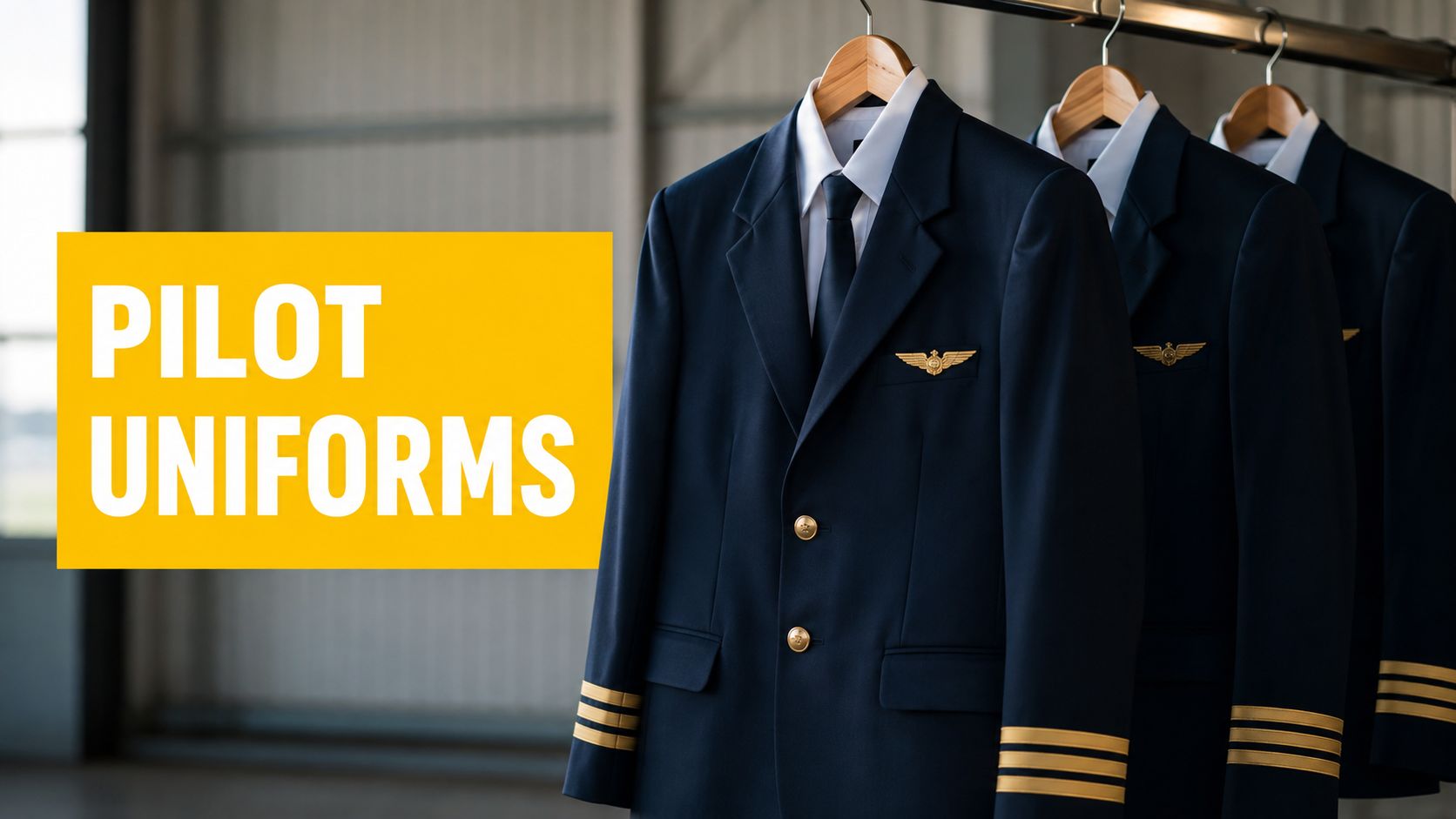
An airport visitor may recognise an air pilot uniform before seeing the aircraft. Shoulder stripes suggest rank, a wing or other insignia identifies a professional role, a cap completes the formal appearance, and polished footwear and tidy grooming signal that the wearer is prepared for a public-facing duty. Those details communicate professional presentation, role identification and employer policy, but they don't create universal authority.
Australian requirements vary between airlines, commercial operators, military organisations, flight schools and other aviation workplaces. CASA material, operator procedures and employment conditions must be checked separately rather than inferred from appearance. This guide compares four training pathways through the responsibility and operating context they support, then explains uniform components, role-based differences, commercial and military traditions, grooming, regulatory context and a practical verification checklist. For organisations ordering branded apparel, details such as uniform patch design and sizing should also be confirmed against the employer's identity standards.
Table of Contents
- 1. ACE READY
- 2. ACE BRONZE
- 3. ACE SILVER
- 4. ACE GOLD
- Air Pilot Uniform, ACE Tier Comparison
- Choose the Right Standard for the Operation
1. ACE READY
A beginner standing beside a training aircraft or preparing for an introductory drone flight doesn't need to imitate an airline captain. The useful standard at this stage is safe, identifiable and practical clothing, supported by an understanding of aviation responsibilities. ACE READY is positioned for beginners learning drone fundamentals, aviation safety, CASA regulations and flight operations before progressing towards advanced Remote Pilot Licence training in Australia.
That makes it a sensible starting point for readers who are interested in the appearance of an air pilot uniform but are entering remotely piloted aviation. A drone operator may not wear a white shirt, tie and epaulettes. The operator still needs clothing that supports concentration, movement, communication and safe work around equipment, vehicles, weather and other personnel.
What the uniform communicates at entry level
Traditional pilot clothing often includes a white shirt, dark trousers, shoulder boards and black footwear. Those features come from commercial and training conventions, not a universal rule that applies to every drone operation. A beginner should avoid treating stripes or a cap as evidence of a particular licence, permission or level of command.
At this level, the stronger signal comes from conduct. A student who arrives prepared, follows the training provider's dress and safety requirements, protects the equipment and uses the correct operational procedures demonstrates more than someone wearing a formal jacket without the relevant knowledge.
Practical rule: Clothing can support a professional impression, but it cannot replace training, supervision, a qualification or an approved operating procedure.
Comfort also matters. A drone training environment may involve standing, walking, checking launch areas, handling batteries and monitoring a flight rather than sitting in an airline cockpit. Clothing should therefore allow movement and suit the location. Closed, stable footwear may be appropriate where the site or employer requires it, while high-visibility clothing or other protective equipment may be required for particular workplaces.
Separate appearance from authority
The air pilot uniform has a strong visual language. Stripes, wings and name badges help colleagues or passengers identify a role within an airline. They don't automatically transfer to drone operations. A remote pilot's responsibilities arise from the applicable aviation rules, the operator's procedures, the task risk assessment and the pilot's training.
Beginners should check four practical points before buying branded clothing:
- Training provider requirements: Confirm whether the course specifies a shirt, footwear, high-visibility garment or other item.
- Site safety controls: Identify whether construction, agriculture, mining, infrastructure or public-sector sites impose additional PPE requirements.
- Identification: Use an approved name badge, company logo or access credential where the operator requires one.
- Operational practicality: Select clothing that won't interfere with controls, batteries, communications equipment or movement around the launch area.
The publisher's approach to aviation education can help a beginner understand why safe operating behaviour matters more than copying airline styling. The key lesson is simple. An air pilot uniform may be a useful cultural reference, but a drone operator should dress for the actual operating environment and follow the employer's documented standards.
2. ACE BRONZE
A student arriving at a worksite with a drone, batteries and safety equipment needs clothing that supports the task. ACE BRONZE provides a foundation in drone operations, flight safety, aviation theory and practical skills for students beginning the pathway towards becoming licensed drone pilots in Australia. At this stage, the uniform should reflect developing responsibility rather than imitate an airline cockpit.
Commercial work brings contact with clients, site managers, members of the public and other aviation participants. A consistent outfit can help a team identify its operators and separate them from contractors, visitors or observers. Its purpose is similar to a site access credential: it communicates who the wearer represents, while the operator's training and procedures determine what that person may do.
The foundation uniform is role-specific
A commercial drone team might use branded shirts, practical trousers, sturdy footwear and high-visibility clothing where the worksite requires it. The employer, training provider, site manager or task risk assessment should determine the combination. Airline styling is a visual convention, not a substitute for workplace instructions or aviation requirements.
Airline epaulettes often display stripes associated with rank or position, but their meaning varies between organisations. A flight school, charter operator, government agency and drone business may use different insignia systems, or none at all. A student should not add stripes that suggest a qualification or command position the organisation has not assigned.
Patches need the same care. A logo can identify an employer, project or team, but it should not imply regulatory approval, military status or a licence the wearer does not hold. Any patch, wing or badge should be approved internally before production and use. Organisations developing specialised operating standards can also refer to specialised aviation training options when deciding what knowledge and presentation their teams require.
Practical choices for a developing operator
A foundation wardrobe should support the operation rather than create a costume. Assess each item against the location, equipment and duties:
- Shirt: Choose a clean, comfortable garment that supports identification and suits the climate.
- Trousers: Select material that permits kneeling, walking and equipment checks without excessive bulk.
- Footwear: Use stable footwear appropriate to the surface and any site-specific safety requirement.
- Weather layer: Provide options for heat, cold, wind or rain where the operation demands them.
- PPE: Treat high-visibility garments, hearing protection, eye protection and other controls as safety equipment, not decorative uniform accessories.
Grooming expectations are usually workplace rules rather than aviation law. An employer may require tidy hair, restrained jewellery or a clean presentation for customer-facing work. Another operator may place greater emphasis on sun protection, weather resistance and compatibility with helmets or hearing equipment.
Uniform consistency helps a team look organised. It does not decide who may operate an aircraft or drone.
The historical record shows why aviation clothing can carry organisational meaning. Qantas describes a progression from practical open-cockpit clothing to service dress, including a khaki military-style tunic in 1935 when international services began using DH86 landplanes, followed by a nautical style in 1938 for flying-boat operations. For a developing drone operator, the lesson is not to reproduce those designs. Clothing should reflect technology, operating context, assigned responsibility and the organisation's approved standards.
3. ACE SILVER
A commercial drone operator demonstrates authority through documented training, operating capability and procedures. ACE SILVER provides a pathway for commercial Remote Pilot Licence training, with classroom instruction, practical flight training, CASA-compliant certification, Aeronautical Radio Operator Certificate training and aviation English proficiency for professional drone pilots. The commercial drone licence pathway places those credentials at the centre of the role.
Airline uniform offers a useful comparison because clothing can show a person's place within a flight-deck team at a glance. In RPAS work, qualifications, communication skills, practical competence and approved procedures carry that responsibility. A polished shirt may support client confidence, while training records establish what tasks the remote pilot is prepared and authorised to perform.
Stripes, insignia and the chain of command
Many readers associate four stripes with a captain and three with a first officer. That convention appears frequently in airline imagery, but it is not a universal Australian legal code. Airlines, schools and other organisations may assign stripes differently, use other symbols or avoid epaulettes. A student pilot may wear training insignia set by the relevant school, so the organisation's own standard should be checked before any meaning is assumed.
The historical record of Australian aviation shows how formally insignia can be defined. The Royal Australian Air Force historical record records that the flying badge was approved by King George V in February 1913 for the Royal Flying Corps and later adapted for the RAAF. It became the basis of the wings worn on the left breast of pilot jackets. The same record notes that the RAAF's distinctive winter uniform colour was set in 1922, when Air Marshal Sir Richard Williams specified a darker blue than the Royal Australian Navy.
A commercial drone team operates under a different arrangement. Its logo, name badge or shoulder marking identifies the employer and approved role. Military wings represent a formal service structure. A private operator's insignia should communicate only credentials and responsibilities that the organisation has authorised.
Professional presentation without overclaiming
Commercial RPAS work may take place at a mine, farm, construction site, emergency location or infrastructure corridor. A branded field shirt and suitable PPE may serve that environment better than a jacket and tie. Clothing should support the work being performed, including movement, sun protection, weather exposure and access to equipment.
Grooming standards also need to fit the operating context. Hair, facial hair, jewellery and loose clothing may need to work safely with helmets, eye protection, respiratory equipment or communication headsets. Customer-facing meetings may call for a tidier presentation, while field operations may prioritise weather resistance and equipment compatibility.
The operator should record the standard in a uniform policy. It can define:
- Approved insignia: Which logo, name badge or qualification marking may be worn.
- Communication equipment: How radios, headsets and identification credentials are carried.
- PPE compatibility: Which safety garments take priority over branded clothing.
- Public presentation: What applies during client meetings, site access and field operations.
- Maintenance: Who supplies, cleans, replaces and retires worn garments.
Aviation English and radio competence contribute more to operational authority than the number of stripes on a shirt. Uniform helps identify the responsible person. Training and procedures determine what that person can safely do.
4. ACE GOLD
A commercial RPAS operator may send a crew to a mine, construction site, farm, infrastructure corridor or emergency location. Each setting changes what the uniform must do. ACE GOLD combines advanced commercial drone pilot development with Remote Pilot Licence training, ReOC support, practical flight training, aviation compliance and business readiness for commercial drone operations. The ACE GOLD course provides the training pathway, while the related ACE Platinum programme supports operators seeking a higher level of business and operational preparation.
Uniform decisions at this level should start with responsibility and operating context. A client presentation may call for a branded shirt or jacket. A field inspection may require weather-resistant clothing, high-visibility garments, safety footwear and easy access to radios or identification. Work near machinery, roads, agriculture or emergency operations may place PPE ahead of brand presentation.
The policy should explain what each garment communicates and what the operator must be able to do. It should not assume that every drone professional needs to look like an airline captain.
Commercial, military and field contexts
Commercial airline uniforms are designed around passenger recognition, brand consistency and formal service presentation. Qantas' dress-code controls show how detailed that environment can become. Its pilot rules have addressed backpacks, chewing gum, alcohol use in uniform, visible facial jewellery, buttoned jackets and hats in public areas. The uniform is treated as part of a pilot's role as a trusted and experienced ambassador, as described in The Sydney Morning Herald's report on Qantas uniform standards.
Military uniforms add service identity, rank, insignia and institutional history. The RAAF introduced an all-seasons uniform in 1972 under Chief of Air Force Air Marshal Colin Hannah, then re-adopted its original colour and style from 1 January 2000 under Air Marshal Errol McCormack. This example shows how military dress can reflect rank, climate and institutional identity, rather than fashion alone.
A field RPAS operator has different requirements. Clothing must work with weather gear, high-visibility PPE, radio equipment and site controls. The RFDS industrial provisions offer a practical Australian benchmark. They state that uniforms should be supplied for summer and winter use, made wherever possible from flame-resistant material or natural fibre, worn on duty and kept in good order. They also address cleaning, maintenance and replacement responsibilities between the parties, as set out in The RFDS agreement published through AustLII.
Building a defensible uniform policy
A ReOC consulting engagement or internal compliance review should treat clothing as one part of the operating system. The policy can identify who approves insignia, how staff receive garments, what happens when clothing becomes unsafe and which PPE overrides branded clothing.
Visible details should connect to workplace expectations. Stripes may indicate an internal role or rank, but they do not create authority by themselves. Insignia should be approved and used consistently. Grooming rules should account for helmets, eye protection, respiratory equipment and communication headsets. Equipment should be carried in a way that keeps identification visible without obstructing movement or safety gear.
Qantas' later move away from gender-specific uniform rules also shows why policies need regular review. Coverage of its 2023 changes describes options including long hair in a ponytail or bun, makeup regardless of gender and flat shoes. In 2025, Qantas said it had surveyed more than 17,500 uniformed workers across pilots, cabin crew, engineering and airports while developing a programme focused on durability, functionality and comfort. The Point Guy's coverage of Qantas' uniform policy reports those developments.
A strong uniform policy tells workers what is required, why it matters and when safety equipment takes precedence.
Australian employers should also check cost recovery. The Air Pilots Award 2020 states that an employer must pay a uniform allowance of $284.97 upon employment and annually when a required uniform is not provided. It also provides $5.34 per week for pilots who are not required to wear a uniform but experience excessive wear and tear, while excluding aerial application operations from that clause. The Fair Work Commission's Air Pilots Award 2020 should be checked for the current award text and application.
For drone and agricultural operators, that exclusion matters. A uniform policy should be checked against the relevant employment instrument, contract and operating conditions, rather than copied from an airline handbook. Training, ReOC support and business readiness connect appearance with the systems that assign responsibility and control risk.
Air Pilot Uniform, ACE Tier Comparison
| Course | Implementation 🔄 | Resources & Time ⚡ | Expected outcomes ⭐ / 📊 | Ideal use cases 💡 | Key advantage ⭐ |
|---|---|---|---|---|---|
| ACE READY | Low 🔄, beginner-friendly | Minimal equipment; short duration ⚡ | Foundational drone knowledge; pathway to RePL ⭐ | New hobbyists; pre-RePL preparation | Accessible intro course |
| ACE BRONZE | Low–Moderate 🔄🔄, practical foundation | Basic drone + moderate training hours ⚡ | Operational skills for commercial entry; safety basics ⭐ | Aspiring commercial pilots starting training | Solid foundation in operations & safety |
| ACE SILVER | Moderate 🔄🔄, CASA-compliant RePL training | Classroom + practical flight training; moderate duration ⚡ | RePL certification, AROC, aviation English competency ⭐📊 | Candidates seeking professional pilot licensure | Full RePL with regulatory credentials |
| ACE GOLD | High 🔄🔄🔄, advanced + business focus | Extensive practical hours; ReOC support; higher resource needs ⚡⚡ | RePL plus ReOC support; business-ready commercial operations ⭐📊 | Commercial operators, business owners, advanced pilots | Advanced training with ReOC/business readiness |
Choose the Right Standard for the Operation
A well-presented air pilot uniform can signal professionalism, role identity and care. It cannot prove that a person holds a Remote Pilot Licence, has radio competence, operates under a ReOC or has permission to conduct a particular flight. Qualifications, permissions, operator procedures and risk controls determine authority. Clothing only supports communication and workplace presentation.
Australian aviation history reinforces that distinction. Qantas' uniform changed as aircraft technology, flying-boat operations, wartime service and national identity changed. Its modern navy uniform, designed by Martin Grant for the delivery of the first Boeing 787-9 Dreamliner in 2016, demonstrates how commercial uniform design can reflect a fleet and brand milestone, as described in Qantas' documented uniform history. That doesn't make the design a regulatory template for drone operators.
Before adopting or purchasing an air pilot uniform, an Australian operator should complete this checklist:
- Employer policy: Confirm the approved shirt, trousers, jacket, cap, tie, footwear and seasonal alternatives.
- Stripe convention: Record what each stripe, wing, patch and badge means within that organisation.
- Grooming standard: Clarify expectations for hair, facial hair, makeup, jewellery and visible accessories.
- Operational compatibility: Check that clothing works with radios, headsets, helmets, harnesses, PPE and aircraft controls.
- Climate and materials: Assess summer and winter options, weather exposure, durability and any flame-resistance requirement.
- Maintenance and replacement: State who supplies, cleans, repairs and replaces each garment.
- Regulatory separation: Verify current CASA requirements, operator procedures, training records and permissions independently of appearance.
- Employment conditions: Check the applicable award, agreement or contract, including any uniform allowance or exception.
CASA's Cabin safety bulletin 28 is a useful reminder that guidance and law aren't interchangeable. The bulletin says its uniform guidance is operator guidance, not a regulatory requirement or minimum standard, while applying to operators of Australian-registered aircraft and cabin crew assigned to those duties. (CASA's Cabin safety bulletin 28 should be read alongside current operator procedures and applicable rules.)
Frequently asked questions
What do pilot stripes mean?
Stripes commonly indicate rank or position, but the precise meaning varies between airlines, flight schools, military organisations and other employers. The organisation's uniform policy is the controlling reference.
What is the difference between a captain and a first officer uniform?
In airline convention, captains and first officers may wear different stripe patterns or insignia. Those distinctions aren't universal law, and they don't transfer automatically to drone operations.
How does a military uniform differ from a commercial pilot uniform?
A military uniform communicates service identity, rank and institutional membership. A commercial uniform usually supports employer branding, passenger recognition and workplace presentation, although both systems may use formal insignia.
What grooming standards apply to pilots?
Grooming requirements come from the employer, operator, training organisation or workplace safety system. Hair, facial hair, makeup and jewellery may need to remain compatible with PPE, communications equipment and public presentation.
Does CASA prescribe a complete air pilot uniform?
CASA doesn't prescribe one complete uniform for every pilot. CASA's cabin crew guidance is described as guidance rather than a regulatory requirement or minimum standard, so operators must check the applicable rules and procedures.
How should drone pilots interpret traditional airline uniform conventions?
Drone pilots should treat stripes, caps, ties and wings as conventions rather than proof of authority. The relevant evidence is the pilot's training, permissions, operator procedures, communication competence and site safety compliance.
Ace Aviation Aerospace Academy provides Australian drone and aviation education relevant to the responsibilities behind professional presentation, including entry-level learning, Remote Pilot Licence and Aeronautical Radio Operator Certificate pathways, and ReOC consulting. Visit Ace Aviation Aerospace Academy to identify the training pathway that matches the intended drone operation and workplace context.