

A solicitor is finalising a case reference, a student is checking a judgment, or an aviation professional is reviewing a regulatory document. The search is simple, “abbreviation for court”, but the answer depends on what the abbreviation is doing. FCA can identify the Federal Court of Australia in a neutral citation, while FCR identifies the Federal Court Reports, a law report series.
Using the wrong form can make a citation unclear, even when the court name seems obvious. Australian legal writing separates court names, neutral citation identifiers, and law report abbreviations, and each system serves a different purpose. The guide below provides a practical Australian lookup method, explains the relevant AGLC4 rules, and shows how to choose the correct abbreviation in citations, filings, transcripts, and legal research.
Table of Contents
- Introduction to Court Abbreviations in Australia
- Understanding the Three Types of Court Abbreviations
- Federal Court Abbreviations and Key Adoption Dates
- State and Territory Court and Report Abbreviations
- How Australian Citation Rules Handle Court Information
- Formatting and Style Rules for Court Abbreviations
- Common Mistakes and How to Choose the Right Abbreviation
- Quick Reference Lookup and Related Resources
Introduction to Court Abbreviations in Australia
A person preparing a case note might write “Federal Court” in full, copy an abbreviation from a database, and assume both forms are interchangeable. They aren't. The correct choice depends on whether the document needs the court's short name, a court-assigned identifier, or the title of the report series containing the decision.
Australian legal citation developed through formal publication systems and later adopted neutral citation identifiers. The Australian Guide to Legal Citation abbreviations guide lists the Federal Court of Australia as FCA for neutral citations from 1999 onward, while FCR refers to the Federal Court Reports. Those abbreviations look related because they point to the same broader court system, but they aren't performing the same job.
The distinction matters in more than law school exercises. Government agencies, businesses, aviation operators, and professionals may encounter court references in contracts, enforcement material, judicial review documents, procurement disputes, or regulatory correspondence. A reader who understands the citation structure can identify whether a reference points to the court itself, an unreported decision, or a published report.
Practical rule: Identify the citation system before selecting the abbreviation.
The lookup tables later in this guide group federal identifiers, report series, and jurisdiction codes separately. That arrangement helps a reader answer three questions quickly:
- Which court is named?
- Is the reference a neutral citation or a reported citation?
- Does the abbreviation identify a report series rather than a court?
The result is a more reliable approach than searching for one universal abbreviation for court. Australian practice uses controlled abbreviations linked to court structure, publication history, and citation conventions.
Understanding the Three Types of Court Abbreviations
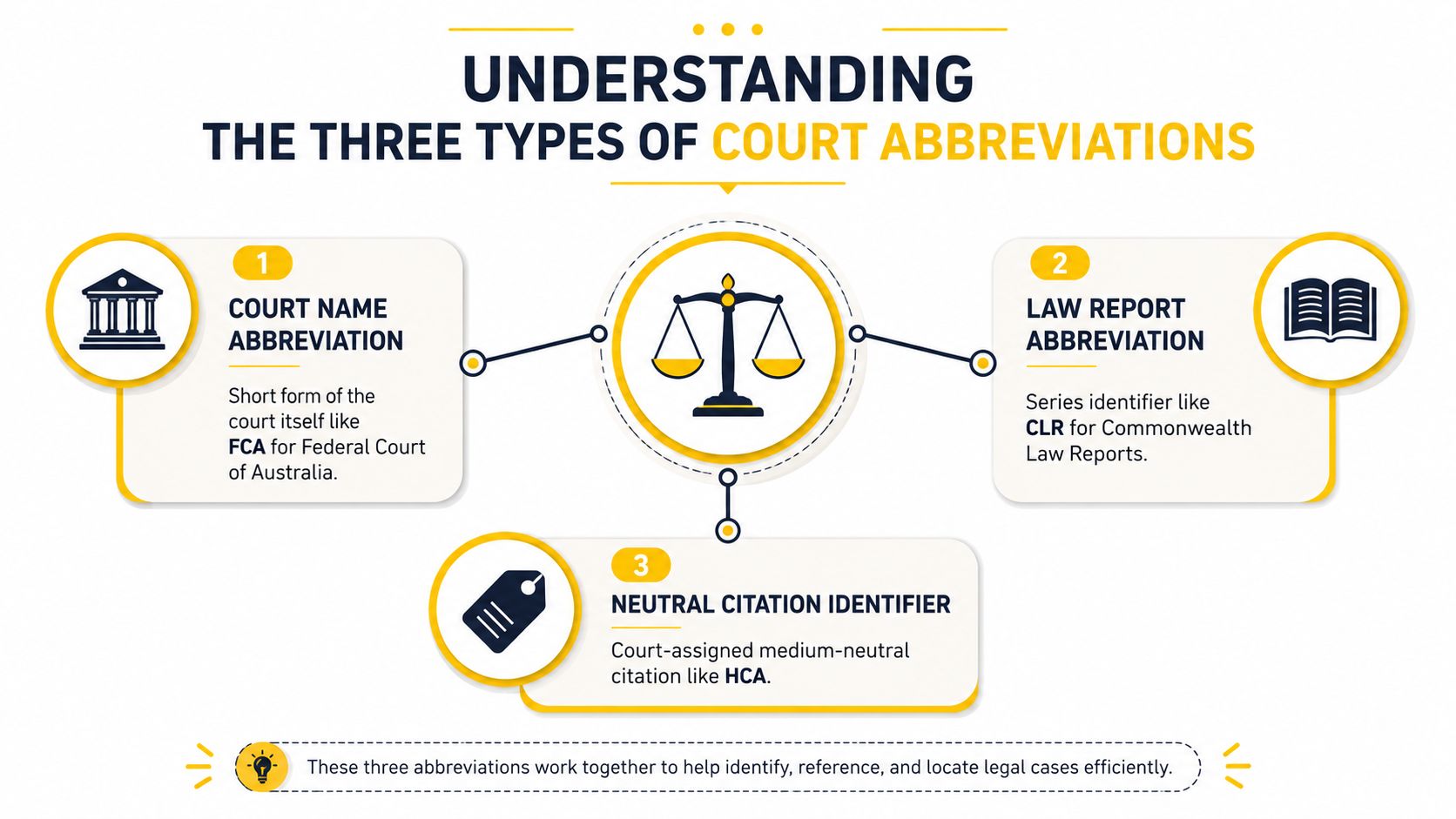
Australian legal references commonly contain three different abbreviation systems. Public lists often place them side by side, which creates confusion. A careful reader should classify the abbreviation before interpreting it.
Court name abbreviations
A court name abbreviation is a shortened form of the institution itself. For example, FCA can stand for the Federal Court of Australia, while HCA identifies the High Court of Australia. These forms are useful in explanatory writing, reference tables, database filters, and citations where the court identifier forms part of the neutral citation.
A court name abbreviation answers, “Which court is this?” It doesn't necessarily identify where a judgment was published.
Law report abbreviations
A law report abbreviation identifies a publication series. CLR means the Commonwealth Law Reports, and FCR means the Federal Court Reports. Other examples include NSWLR, Qd R, SASR, Tas R, and WAR.
A report abbreviation answers, “Which authorised or recognised report series contains this decision?” The series may identify the relevant jurisdiction or court, but it remains a publication reference rather than a direct substitute for the court's neutral identifier.
Neutral citation identifiers
A neutral citation identifier is assigned by the court and is independent of a commercial or authorised report series. A typical structure includes a year, a court identifier, and a decision number, such as [2023] HCA 5. The identifier HCA points to the High Court of Australia within that neutral citation.
The Southern Cross University legal research guide records the coordinated adoption of major Australian neutral citation identifiers, including HCA, FamCA, FCA, and FCAFC. The adoption history shows why these forms are standardised rather than casual shorthand.
Jurisdiction codes are separate again. Cth, ACT, NSW, Qld, Vic, WA, SA, Tas, and NT describe a Commonwealth, state, or territory context. They shouldn't automatically replace a court identifier or a report abbreviation.
A useful mental model is simple:
- Court name abbreviation: identifies the institution.
- Neutral citation identifier: identifies the court within a court-assigned citation.
- Law report abbreviation: identifies the publication series.
The same decision may appear with more than one reference because a neutral citation and a report citation serve different research functions.
Federal Court Abbreviations and Key Adoption Dates
A Federal Court reference can contain three different kinds of information. The court name identifies the institution, the neutral citation identifies the court within an official citation, and the report abbreviation identifies the publication series. The Federal Court of Australia uses FCA as its neutral citation identifier, the Full Court uses FCAFC, and the Federal Court Reports use FCR.
Federal Court identifiers
The AGLC4 abbreviations reference records FCA as the Federal Court's neutral citation identifier, adopted in January 1999. It records FCAFC for the Full Court, adopted in January 2002. These dates describe the development of Australia's neutral citation system. They are not alternative spellings of the court's name.
A neutral citation identifies the court without depending on a commercial report publisher. For format only, a fictional example is:
[year] FCA decision-number
Here, FCA occupies the court-identifier position. The example is not a real case citation, so the final reference must be checked against the judgment or database record.
The Full Court follows the same pattern:
[year] FCAFC decision-number
FCAFC signals an appellate decision of the Full Court. Replacing it with FCA would remove information supplied by the official neutral citation.
Report series and national modernisation
FCR identifies the Federal Court Reports. The series began in 1984, as recorded in the Australian legal-reference material cited above. A citation containing FCR points to that report series, rather than naming the court.
| Court or series | Abbreviation | Relevant adoption or start date |
|---|---|---|
| High Court of Australia | HCA | January 1998 |
| Family Court of Australia | FamCA | January 1998 |
| Federal Court of Australia | FCA | January 1999 |
| Full Court of the Federal Court | FCAFC | January 2002 |
| Federal Court Reports | FCR | 1984 |
The table shows the distinction between neutral citation identifiers and a report-series abbreviation. HCA, FamCA, FCA, and FCAFC identify courts or court formations in neutral citations. FCR identifies a publication series. The ACE READY course concerns aviation safety and CASA regulations rather than case citation, but those materials can still place professionals in legal and regulatory documents. The same method applies: identify the formal system before shortening a term.
How to read the forms
- FCA means Federal Court of Australia in the relevant court-identification context.
- FCAFC means the Full Court of the Federal Court.
- FCR means Federal Court Reports.
- HCA means High Court of Australia in a neutral citation.
- FamCA means Family Court of Australia in a neutral citation.
One judgment may appear with both a neutral citation and a report citation. Keep the two references separate, because each answers a different research question.
State and Territory Court and Report Abbreviations
A citation can point to three different things: the court's name, a neutral citation identifier, or a law report series. State and territory materials make the distinction especially clear. An abbreviation such as NSW identifies a jurisdictional context, while NSWLR identifies a publication series. The Southern Cross University case law guide places these abbreviations within Australia's broader system of courts and authorised reports.
Comparison table
| Court or Series | Abbreviation | System Type | Adoption or Start Date |
|---|---|---|---|
| Commonwealth Law Reports | CLR | Law report series | 1903 |
| New South Wales Law Reports | NSWLR | Law report series | 1971 |
| Federal Court Reports | FCR | Law report series | 1984 |
| Queensland Reports | Qd R | Law report series | Not specified |
| South Australian State Reports | SASR | Law report series | Not specified |
| Tasmanian Reports | Tas R | Law report series | Not specified |
| Western Australian Reports | WAR | Law report series | Not specified |
| New South Wales context | NSW | Jurisdiction code | Not applicable |
| Queensland context | Qld | Jurisdiction code | Not applicable |
| Victoria context | Vic | Jurisdiction code | Not applicable |
| Western Australia context | WA | Jurisdiction code | Not applicable |
| South Australia context | SA | Jurisdiction code | Not applicable |
| Tasmania context | Tas | Jurisdiction code | Not applicable |
| Australian Capital Territory context | ACT | Jurisdiction code | Not applicable |
| Northern Territory context | NT | Jurisdiction code | Not applicable |
| Commonwealth context | Cth | Jurisdiction code | Not applicable |
CLR and NSWLR name report series, not courts. The Commonwealth Law Reports began in 1903, and the New South Wales Law Reports began in 1971. These dates help place each abbreviation within the history of its continuing publication series, as reflected in AGLC4 guidance.
For example, (2021) 274 CLR 1 identifies a decision through its report publication. CLR tells the researcher that the decision appears in the Commonwealth Law Reports. Because the report series may already identify the relevant court, repeating the court name can add unnecessary information.
A neutral citation uses a different identifying method. In [year] NSWCA decision-number, NSWCA identifies the New South Wales Court of Appeal, while the year and decision number identify the citation assigned to that judgment. It is a court identifier, not a report abbreviation.
A report abbreviation tells a researcher where the decision is published. A neutral identifier tells the reader which court assigned the citation.
The two forms may appear together. A judgment can receive a neutral citation when the court issues it and later be published in a report series. Keep each reference in the form required by the applicable style guide. Before abbreviating, ask what the term identifies: the jurisdiction, the court, or the publication containing the decision. That question prevents NSW from being used as though it meant NSWLR, and prevents a report abbreviation from being treated as a neutral court identifier.
How Australian Citation Rules Handle Court Information
AGLC4 treats court information as structured citation data. The court isn't added merely because a writer knows it. It appears when the citation rules require it or when the report information doesn't make the court sufficiently clear.
Reported cases
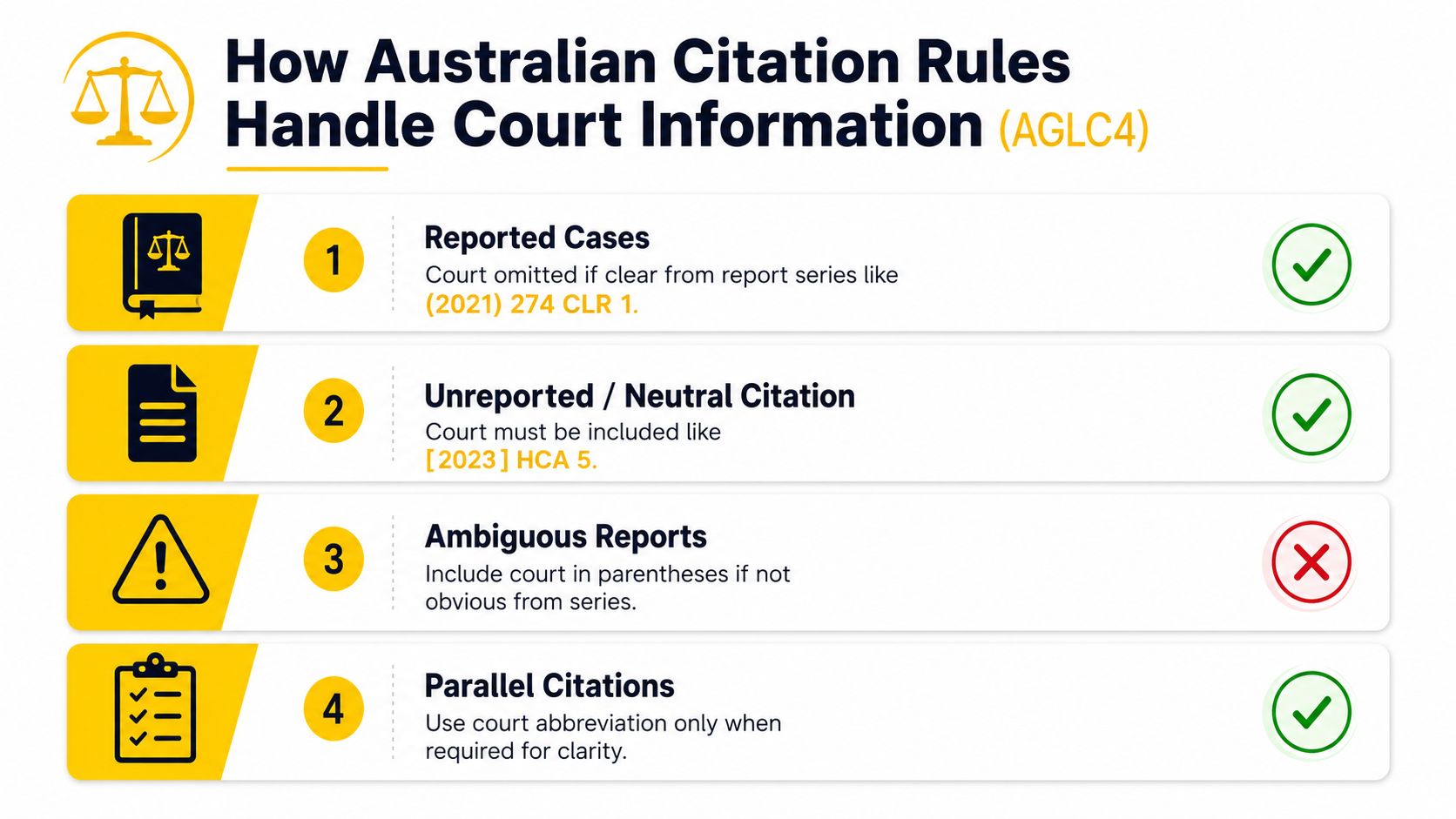
For a reported case, the court is usually omitted when the report series already identifies it. The AGLC4 guide from the University of Melbourne explains that, where a court is needed, it is placed in parentheses after pinpoint references and before a short title. The jurisdiction also isn't repeated when the report series already makes it clear.
A reported citation may therefore appear as:
(2021) 274 CLR 1
The abbreviation CLR identifies the Commonwealth Law Reports. Adding a separate court reference without a reason can make the citation longer without adding information.
Neutral and unclear references
A neutral citation carries its court identifier within the citation:
[2023] HCA 5
Here, HCA identifies the High Court of Australia. A writer shouldn't replace that identifier with the full court name inside the citation unless a particular document requires a different format.
Where a report or reference doesn't make the court apparent, the court may be included in parentheses. Placement matters. It should follow the relevant pinpoint reference and appear before a short title where the AGLC4 structure calls for it.
A checking workflow
A researcher can test a citation with three questions:
- Is the case reported? If yes, check whether the report series already identifies the court.
- Is the reference neutral? If yes, retain the court identifier assigned to the decision.
- Would a reader know the court from the citation? If no, add the court in the prescribed position.
Digital research tools can assist with locating judgments, but the citation still needs human review. For broader case retrieval and comparison, LegesGPT's case law AI may be considered alongside official judgments, recognised databases, and the applicable citation guide.
Aviation professionals dealing with legal material should also distinguish citation questions from operational compliance questions. CASA requirements and drone operating rules belong to a separate research task, such as the guidance available in drone laws in Australia, rather than being inferred from a case abbreviation.
Formatting and Style Rules for Court Abbreviations
Australian legal documents generally avoid full stops in abbreviations and acronyms. The CDPP Writing Style Guide reflects this style preference, so a writer should use the established form without inserting punctuation between letters.
That means FCA, FCAFC, HCA, FCR, and CLR appear without full stops. Informal forms such as “Ct.” should not be inserted into a formal citation merely because the writer wants a short form of “Court”. A recognised citation abbreviation should be used instead.
Separate courts from jurisdictions
Jurisdiction codes provide geographical or constitutional context, but they don't automatically identify a court. The common forms include:
- Cth, for Commonwealth context.
- ACT, for Australian Capital Territory.
- NSW, for New South Wales.
- Qld, for Queensland.
- Vic, for Victoria.
- WA, for Western Australia.
- SA, for South Australia.
- Tas, for Tasmania.
- NT, for Northern Territory.
A sentence might refer to a NSW matter in general terms, while a neutral citation uses a specific court identifier. A filing header may spell out the court, while a case citation uses its prescribed abbreviation. Those are different writing contexts.
Let the citation carry its metadata
Court names are often omitted from reported citations because the report series or unique identifier supplies the information. The AGLC4 bookmarked reference explains that the court can be structurally embedded in a neutral citation or made apparent by the report series.
A clean reference therefore avoids both under-identification and repetition. The writer should retain the abbreviation that carries necessary meaning and remove text that merely repeats information already present.
Style check: No full stops, no improvised shorthand, and no duplicated jurisdiction where the citation already makes it clear.
Common Mistakes and How to Choose the Right Abbreviation
Most errors arise from treating every abbreviation as a shortened court name. The safer approach is to ask what the document is trying to identify.
Decision matrix
| Context | Correct focus | Typical form |
|---|---|---|
| Neutral citation | Court-assigned identifier | [year] FCA decision-number |
| Full Court decision | Appellate court identifier | [year] FCAFC decision-number |
| High Court neutral citation | High Court identifier | [year] HCA decision-number |
| Reported Commonwealth case | Report series | (year) volume CLR page |
| Federal Court report | Report series | (year) volume FCR page |
| Filing header | Court's formal name or prescribed short form | Follow the court's document rules |
| Transcript reference | The reference format required by the transcript or court | Check the source record |
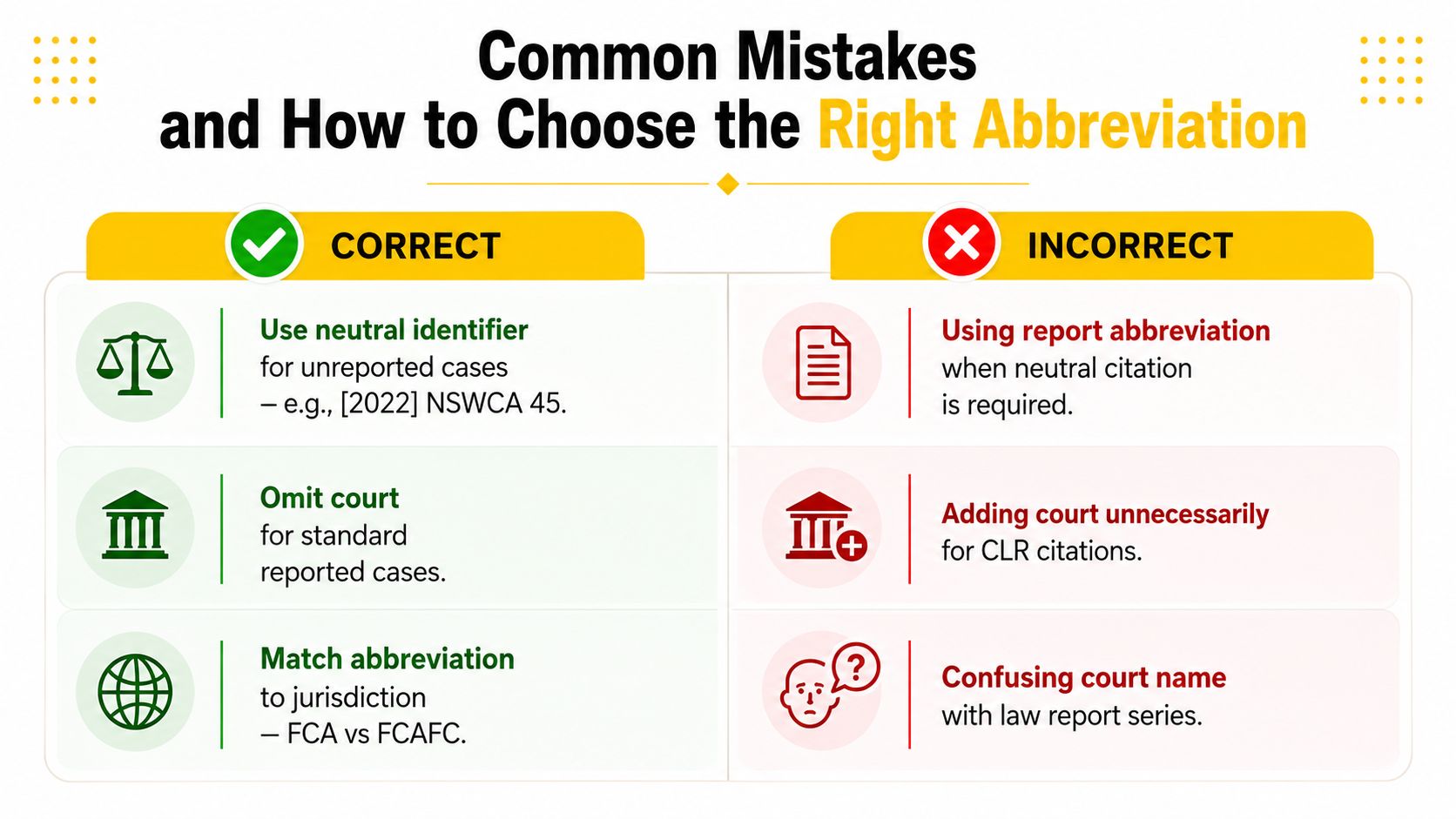
A common mistake is using FCR when a neutral citation requires FCA. FCR identifies the Federal Court Reports, while FCA identifies the Federal Court of Australia within the neutral citation system. Another is using FCA for a Full Court judgment that carries FCAFC.
The Queensland University of Technology legal abbreviations guide highlights the need to distinguish unique court identifiers from law report abbreviations. That distinction should guide the final check.
Four quick tests
- Identify the source: Is the reference drawn from a judgment, a report, a filing, or a transcript?
- Match the system: Use a neutral identifier for a neutral citation and a report abbreviation for a law report.
- Remove duplication: Don't repeat a jurisdiction or court where the series already supplies it.
- Verify the form: Check the current AGLC list or the relevant court and university legal research guide before filing.
Informal shorthand may be understandable in conversation, but formal legal documents require a recognised form. Accuracy matters more than making a citation as short as possible.
Quick Reference Lookup and Related Resources
The following lookup groups the principal forms by function rather than alphabetically. That makes it easier to choose the right abbreviation for court when a document gives only limited context.
Federal court identifiers
| Abbreviation | Meaning | Main use |
|---|---|---|
| HCA | High Court of Australia | Neutral citation identifier |
| FamCA | Family Court of Australia | Neutral citation identifier |
| FCA | Federal Court of Australia | Neutral citation identifier |
| FCAFC | Full Court of the Federal Court | Neutral citation identifier |
Report series
| Abbreviation | Meaning | Main use |
|---|---|---|
| CLR | Commonwealth Law Reports | Reported case citation |
| FCR | Federal Court Reports | Reported Federal Court decisions |
| NSWLR | New South Wales Law Reports | Reported New South Wales decisions |
| Qd R | Queensland Reports | Reported Queensland decisions |
| SASR | South Australian State Reports | Reported South Australian decisions |
| Tas R | Tasmanian Reports | Reported Tasmanian decisions |
| WAR | Western Australian Reports | Reported Western Australian decisions |
Jurisdiction codes
Cth, ACT, NSW, Qld, Vic, WA, SA, Tas, and NT identify Commonwealth, state, or territory context. They aren't interchangeable with HCA, FCA, FCAFC, or a report series abbreviation.
For final verification, researchers should consult the AGLC4 abbreviation materials, the relevant university law library guide, and the source judgment. The essential choice is always the same: identify whether the document needs a court name, a neutral citation identifier, or a law report abbreviation.
Frequently asked questions
What is the abbreviation for the Federal Court of Australia?
The commonly used neutral citation identifier is FCA. FCR refers to the Federal Court Reports, so it should be used only when the citation points to that report series.
What does FCAFC mean?
FCAFC identifies the Full Court of the Federal Court in the neutral citation system. It shouldn't be substituted with FCA when the official citation uses FCAFC.
Should court abbreviations include full stops?
Australian legal style guides commonly advise against full stops in abbreviations and acronyms. Forms such as FCA, HCA, and CLR are written without full stops.
Does every reported case need the court in the citation?
No. The court is usually omitted when the report series already makes it clear. It may be included when the court isn't otherwise apparent or when the applicable citation rule requires it.
Are NSW and NSWLR the same thing?
No. NSW is a jurisdiction code for New South Wales. NSWLR identifies the New South Wales Law Reports, a publication series.
Where should a final abbreviation be checked?
The source judgment, the current AGLC materials, and a reputable Australian legal research guide provide the appropriate verification points. A database abbreviation shouldn't be copied blindly if the citation context is different.
Ace Aviation Aerospace Academy provides Australian aviation education relevant to professionals who encounter legal, regulatory, and operational documentation, including Remote Pilot Licence and Aeronautical Radio Operator Certificate training. Visit Ace Aviation Aerospace Academy to review the available aviation training pathways and identify the course that matches the operator's role.