A first-time student may book an introductory flight after seeing an attractive hourly rate, then discover that the final invoice also includes instructor time, aircraft hire, membership, theory, testing, medical requirements and equipment. A drone operator can face the same problem from a different direction, with course fees sitting alongside mandatory training time, regulatory obligations and operational setup costs.
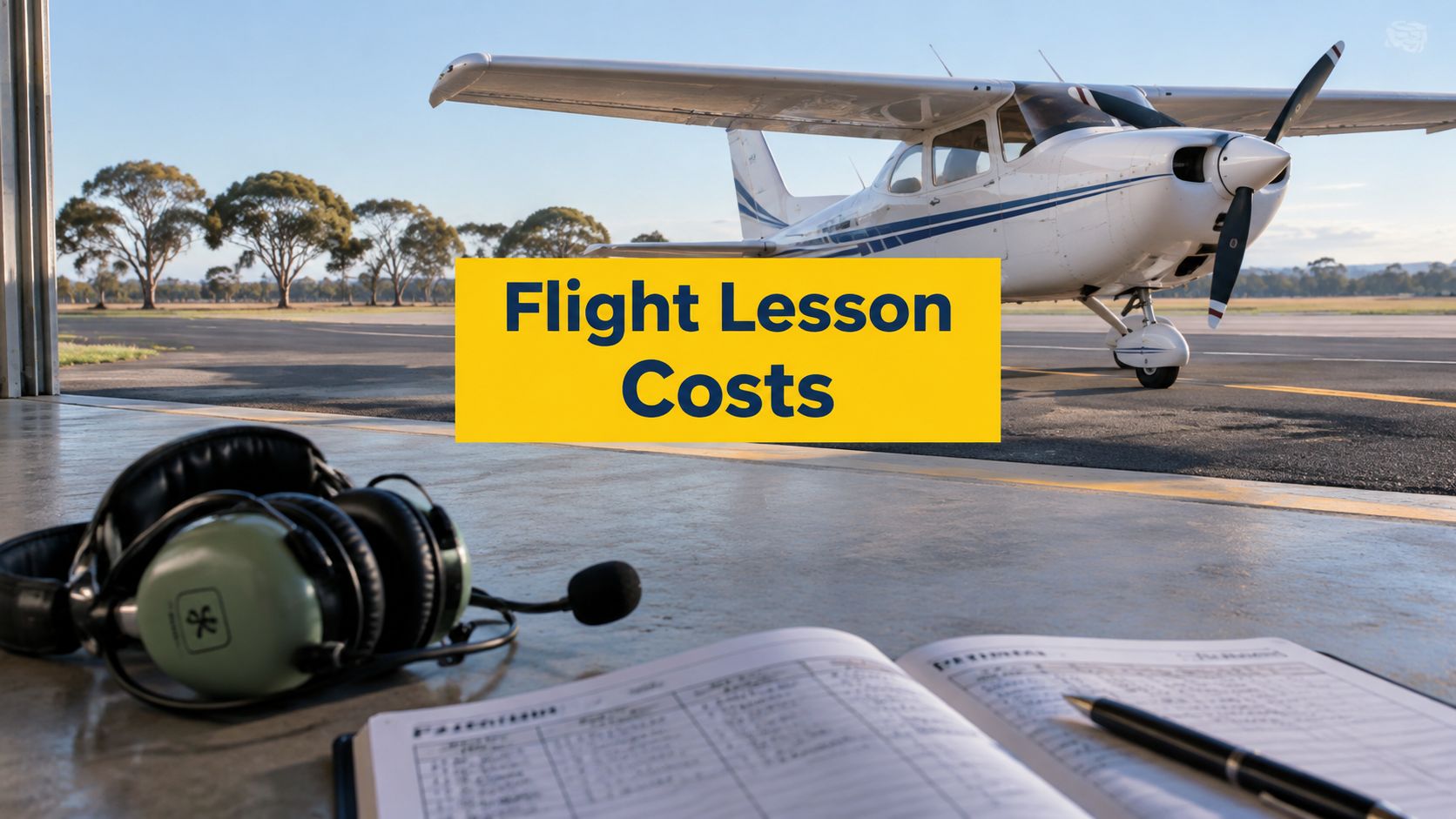
The useful question isn't only how much do flight lessons cost per hour. It's what does the complete pathway cost from enrolment to qualification and safe operation? Australian prices vary according to the licence, aircraft, training provider, location and student progress. A careful budget should therefore separate advertised lesson rates from the full investment and confirm every excluded charge before training begins.
Table of Contents
- Introduction to Flight Lesson Costs
- Typical Flight Lesson Costs in Australia
- Key Drivers of Flight Training Expenses
- Comparing Drone RePL and Manned Flight Training Costs
- Budgeting Tips and Cost Saving Strategies
- Conclusion and Next Steps
- Frequently Asked Questions
Introduction to Flight Lesson Costs
A prospective pilot might compare two schools, see similar aircraft rates and assume the cheaper-looking option will produce the lower final bill. That assumption can fail when one provider includes instructor time, landing charges and theory support while the other bills each item separately. A student who needs extra practice can also move well beyond an advertised minimum.
Drone training creates a similar budgeting trap. An initial Remote Pilot Licence, or RePL, has a defined training structure, but the course price may not answer every practical question about equipment, assessments, aviation communication or future operating needs. Businesses and government agencies also need to consider whether staff require additional operational training rather than only an individual licence.
Practical rule: A provider's hourly price is the starting point, not the budget.
Before booking, a student should ask for a written estimate covering aircraft or drone access, instructor time, theory, exams, flight tests, medical requirements, memberships, equipment, landing fees and likely additional hours. Anyone unsure which qualification matches the intended activity can use the licence finder tool before comparing prices.
Typical Flight Lesson Costs in Australia
Published Australian figures show why a single hourly rate can't answer the full cost question. A practical benchmark for a complete Private Pilot Licence pathway is about A$14,000 to A$22,000, based on approximately 55 flight hours, according to Australian PPL cost guidance. That estimate works out to an effective training cost of roughly A$255 to A$400 per flight hour before separate ground theory, exams, medicals, landing fees and additional competency hours are added.
Another Australian guide places a modular PPL-to-CPL pathway at A$80,000 to A$130,000, while an integrated zero-to-CPL program is estimated at A$100,000 to A$160,000. The same guide cites dual instruction at A$350 to A$500 per hour, solo hire at A$250 to A$380 per hour, ground-school materials at A$500 to A$2,000, and a CASA PPL flight-test fee of about A$950 to A$1,200. Those figures appear in this Australian aviation careers cost guide.
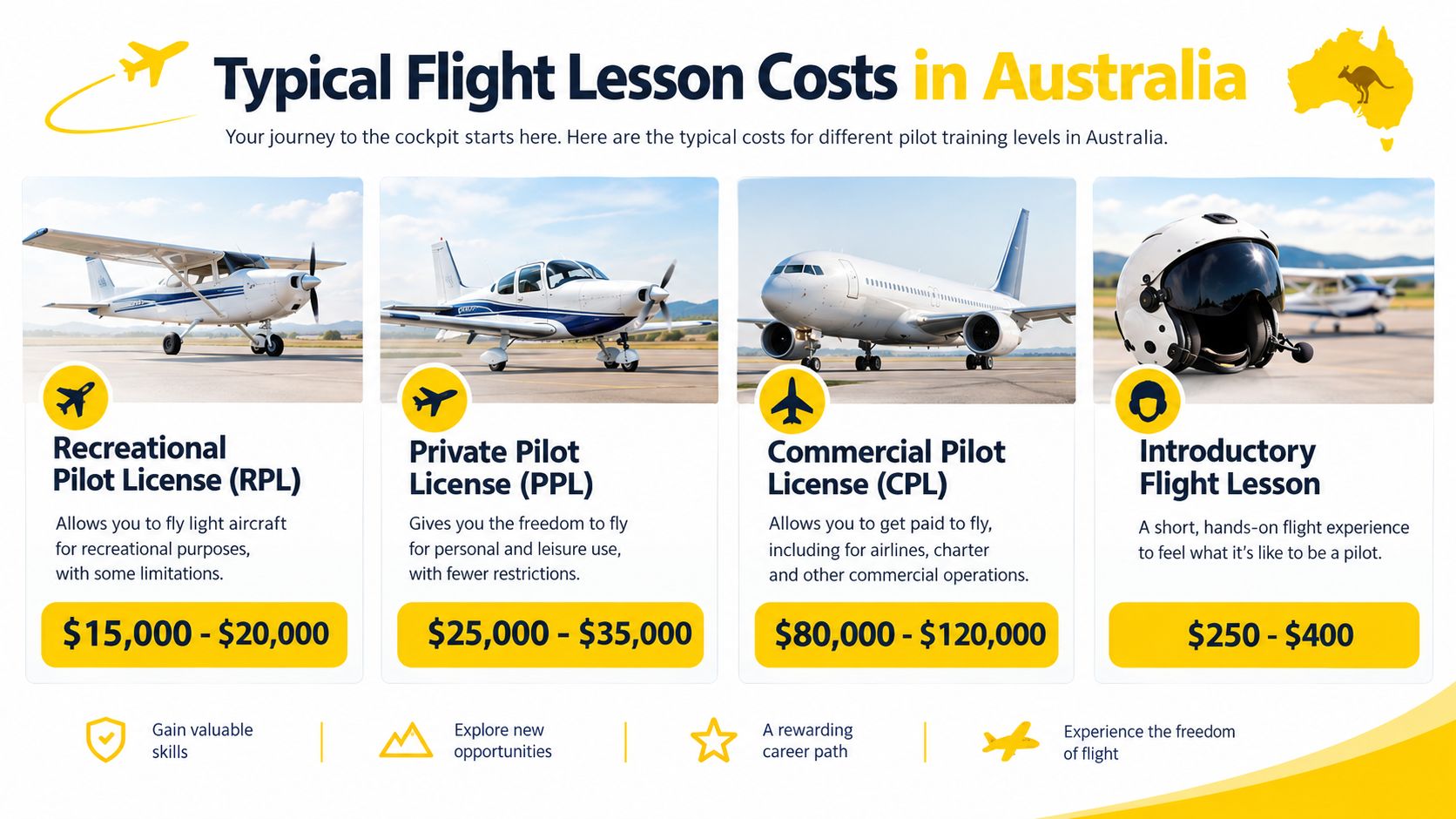
Swinburne University's published 2026 flying-training fees provide a further illustration. The listed Private Pilot Licence practicum is A$30,440, Commercial Pilot Licence Practicum 1 is A$36,170, and Commercial Pilot Licence Practicum 2 is A$47,990. The PPL and CPL practicum stages alone can therefore exceed A$75,000, before medicals, exams, books and equipment are included. Published Australian flight-training pricing also cites dual instruction around A$350 to A$500 per hour and solo flying around A$250 to A$380 per hour.
Rates differ by aircraft and provider. Current published pricing lists dual instruction at A$465 per hour for a Cessna 172 and A$485 per hour for a PA28 Archer, with solo or private hire commonly around A$330 to A$405 per hour, as shown in fixed-wing aircraft pricing from Honeybee Air. Students comparing providers through the Ace Aviation Aerospace Academy course catalogue should check whether each quoted figure includes the same components. For beginners considering drone fundamentals before advanced training, ACE READY covers drone fundamentals, aviation safety, CASA regulations and flight operations.
Key Drivers of Flight Training Expenses
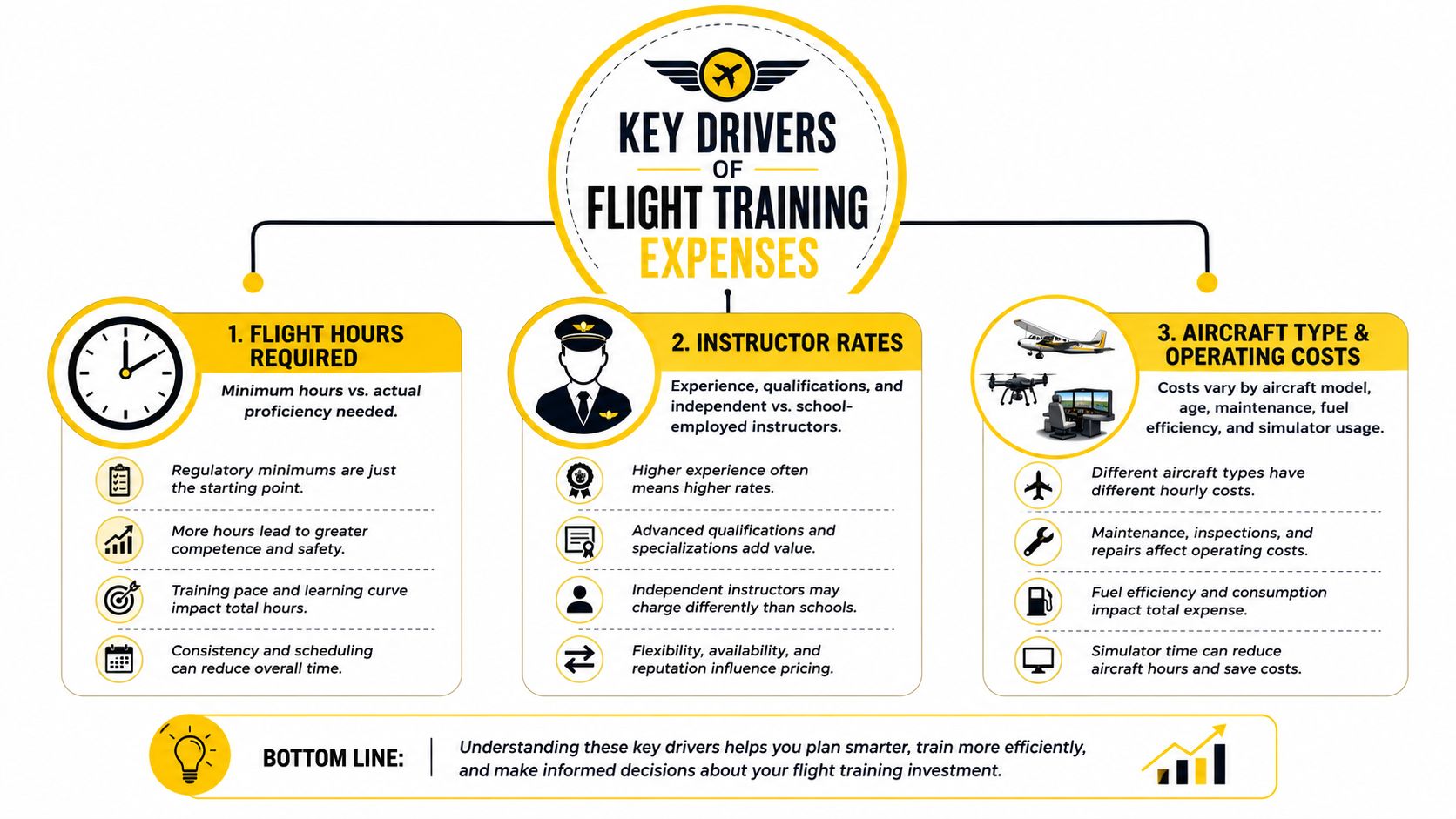
The final bill behaves more like a taxi meter than a fixed entry ticket. Every lesson adds aircraft access, and a dual lesson also adds instructor time. A student who progresses efficiently may spend less overall than another student paying a lower hourly rate but requiring repeated sessions.
Hours and instructor involvement
Published aircraft pricing demonstrates the difference between dual and solo flying. A dual lesson combines aircraft and instructor time, while supervised solo practice generally charges for aircraft access without the same instructor component. The current Cessna 172, PA28 Archer and solo-hire figures cited above show why students must compare like with like rather than treating every “hourly rate” as equivalent.
Required hours are another major variable. A regulator or syllabus may establish a minimum structure, but individual students still need to demonstrate competence. Weather, lesson cancellations, preparation, skill retention and the complexity of the aircraft can all affect the number of sessions required.
Aircraft, location and ancillary charges
A training aircraft carries operating costs associated with maintenance, fuel, insurance and availability. Fixed-wing aircraft, multicopters and simulators each support different learning tasks, so a drone pathway can't be priced using a manned-aircraft assumption. Metro airports may also create different landing, parking or operating charges from regional facilities.
Common additional charges include:
- Theory materials: Books, online learning access and classroom support may be billed separately.
- Testing: Flight tests, written examinations and administrative charges can sit outside the lesson package.
- Medical requirements: The relevant aviation medical assessment should be confirmed before training begins.
- Equipment: Headsets, radios, logbooks and other flight or operational equipment can become separate purchases.
- Membership and administration: Recreational pathways may include joining, club, association or membership charges.
For readers comparing regulated training expenses across aviation-related industries, a guide to traffic controller course fees can help demonstrate why course pricing should be assessed by inclusions, assessments and compliance requirements, not by the headline figure alone. Businesses planning aviation study can also review Certificate III in Aviation as a qualification pathway where it matches the intended role.
Comparing Drone RePL and Manned Flight Training Costs
Drone and manned-aircraft training serve different operational purposes, so the cheapest route depends on the activity the pilot needs to perform. A drone operator generally trains to control an RPA from the ground, while a manned-aircraft student develops the skills required to operate an aircraft with people on board.
CASA guidance for an initial RePL course specifies at least 15 hours of instructor contact time for theory and at least 5 hours of logged live flight time under standard RPA operating conditions on the relevant aircraft category. The CASA RePL training guidance makes clear that the live-flight component is only one part of the required training structure.
| Criteria | Drone RePL Training | Manned Flight Training |
|---|---|---|
| Training focus | RPA operations, aviation knowledge, safety and practical drone control | Aircraft handling, navigation, procedures and aviation knowledge |
| Minimum structure | At least 15 hours of theory contact and 5 hours of logged live flight for an initial course | Hours vary by licence, aircraft and demonstrated competency |
| Cost basis | Course delivery, instructor contact, aircraft category, assessment and related equipment | Aircraft hire, instructor time, theory, testing, medicals, equipment and possible extra hours |
| Equipment | Relevant RPA, control systems, batteries, radios or other operational equipment | Training aircraft, headset, navigation tools, books and related flight equipment |
| Best fit | Commercial drone work, business operations and RPA-specific roles | Recreational or professional piloting of manned aircraft |
The RePL pathway can be more proportionate for a business whose work involves aerial imaging, inspection, mapping or other drone operations. Manned training makes sense where the intended role requires aircraft piloting, manned aviation experience or progression through pilot licences.
People comparing drone pathways can review the Remote Pilot Licence course information, then ask the provider whether the quoted price covers the complete CASA-aligned training structure, assessment and any equipment or administrative charges.
Budgeting Tips and Cost Saving Strategies
Cost control starts with a complete inventory rather than a bargain hunt. A recreational Australian pathway illustrates the gap between a course quote and the final budget. One RAAus-aligned pathway quotes about A$7,925 for 15 hours dual, 5 hours supervised solo and 5 hours ground theory, while another provider lists A$6,800 for a comparable RPC pathway including RAAus fees and a flight test, according to published recreational pilot pathway pricing.
Those figures aren't interchangeable. The lower or higher quote may reflect different inclusions, and students still need to check membership, joining fees, theory materials, medicals, radios, headsets, landing charges and administration.
Build the budget before training starts
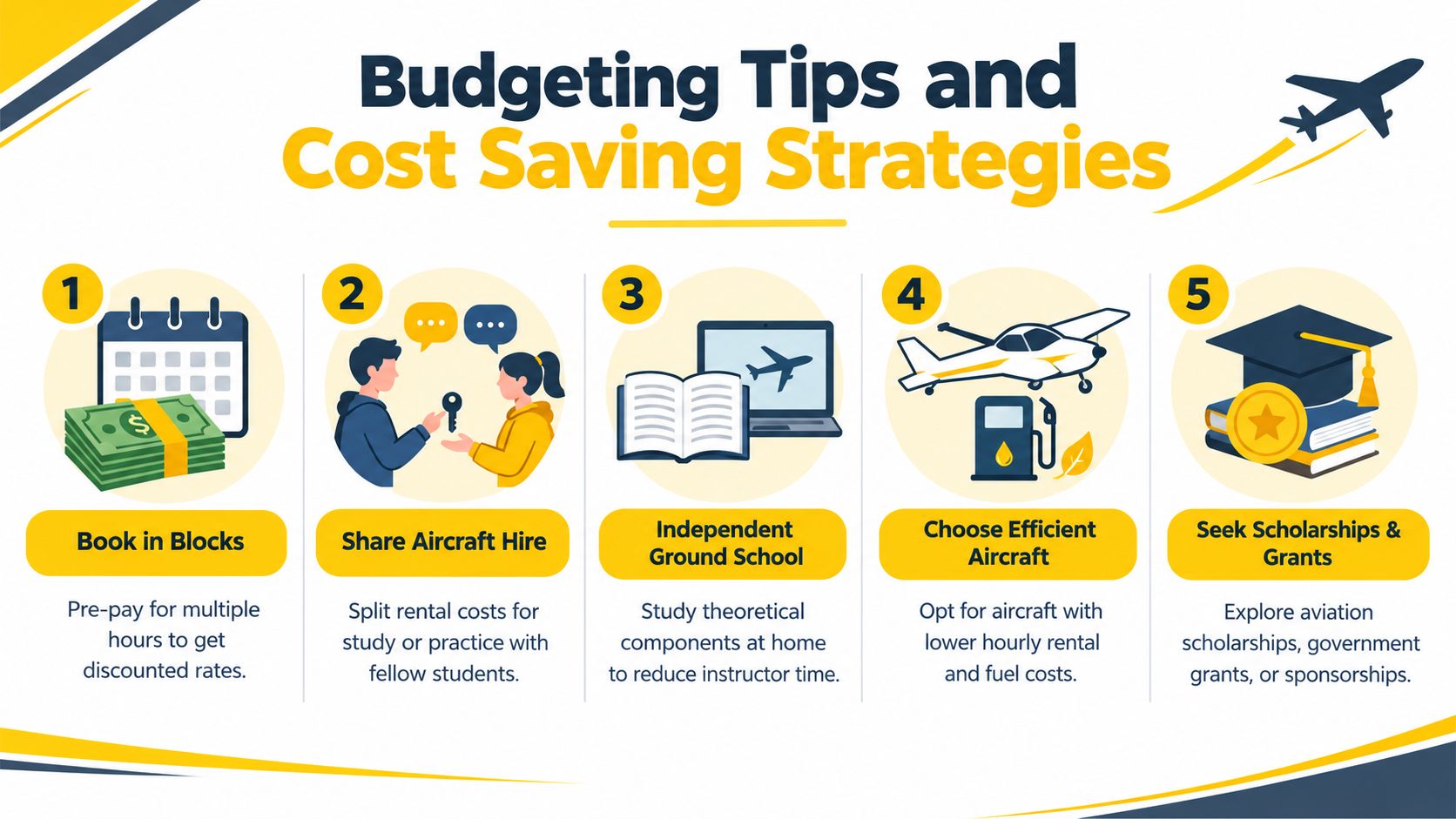
- Request an itemised quote. Ask the provider to separate aircraft hire, instructor time, theory, assessment, flight testing and administration.
- Compare the expected pathway. A package based on realistic training needs may be more useful than a minimum-hours promotion.
- Schedule consistently. Regular lessons can help students retain skills and avoid paying to repeat material after long gaps.
- Prepare between sessions. Completing assigned theory and planning before a lesson can reduce unproductive instructor time.
- Check equipment options. Students can ask whether equipment is supplied, hired or required for purchase, then compare suitable new and pre-owned options.
Budgeting insight: A cheaper aircraft hour can become expensive if scheduling, preparation or availability causes repeated training.
Block bookings may reduce the quoted rate where a provider offers them, but the terms should be read carefully before prepayment. Sharing study resources with peers can reduce duplicated material costs, while any aircraft-sharing arrangement must remain within the provider's safety and supervision rules. Regional training may offer different operating charges, but travel and accommodation can offset the apparent saving.
A personal spending framework can help separate essential training costs from optional purchases. Fintrack's guide to practical ways to manage your budget offers a broader approach to organising discretionary spending. For an aviation-specific estimate, students can use the flight-training quote calculator and then verify the result directly with the selected provider.
Conclusion and Next Steps
The answer to how much do flight lessons cost depends on the complete pathway, not only the displayed hourly rate. Australian PPL training can sit in the five-figure range, while commercial training can require a much larger investment. Drone RePL training has its own mandatory theory and practical structure, and both pathways can add costs for assessment, equipment, administration and extra competency hours.
Before enrolling, a student should ask what the quote includes, which charges are excluded, how additional hours are billed and whether the provider can explain the expected training sequence. Ace Aviation Aerospace Academy offers relevant aviation education including the Remote Pilot Licence, Aeronautical Radio Operator Certificate and Certificate III in Aviation, with ReOC consulting available for organisations that need operational support. The right next step is to match the qualification to the intended operation, then obtain a written, itemised estimate.
Frequently Asked Questions
Do recurrent training costs need to be included?
Yes. Operators should ask providers about refresher, recurrent or competency training costs where the role or organisation requires ongoing training. The exact requirement depends on the qualification, operation and applicable procedures.
Are simulators suitable for extra flight hours?
A simulator may support selected learning activities, but it doesn't automatically replace required live flight or practical assessment. The provider should confirm what training credit applies.
How long does a licence remain valid?
The answer depends on the licence, certificate, medical status and operational requirements. Students should confirm currency and refresher expectations with the training provider and CASA.
Can Australian students access funding?
Possible funding sources vary by student, provider and course. Students should ask directly about payment arrangements, scholarships, grants or employer support rather than assuming a programme qualifies.
Should a student choose drone or manned training?
The intended work should decide. RePL training suits commercial RPA operations, while PPL or CPL training suits piloting manned aircraft.
Ace Aviation Aerospace Academy provides CASA-compliant drone and aviation education, including RePL and AROC training, to help students and organisations budget for the qualifications their operations require. Visit Ace Aviation Aerospace Academy to review relevant training pathways and take the next step with a clearer cost plan.