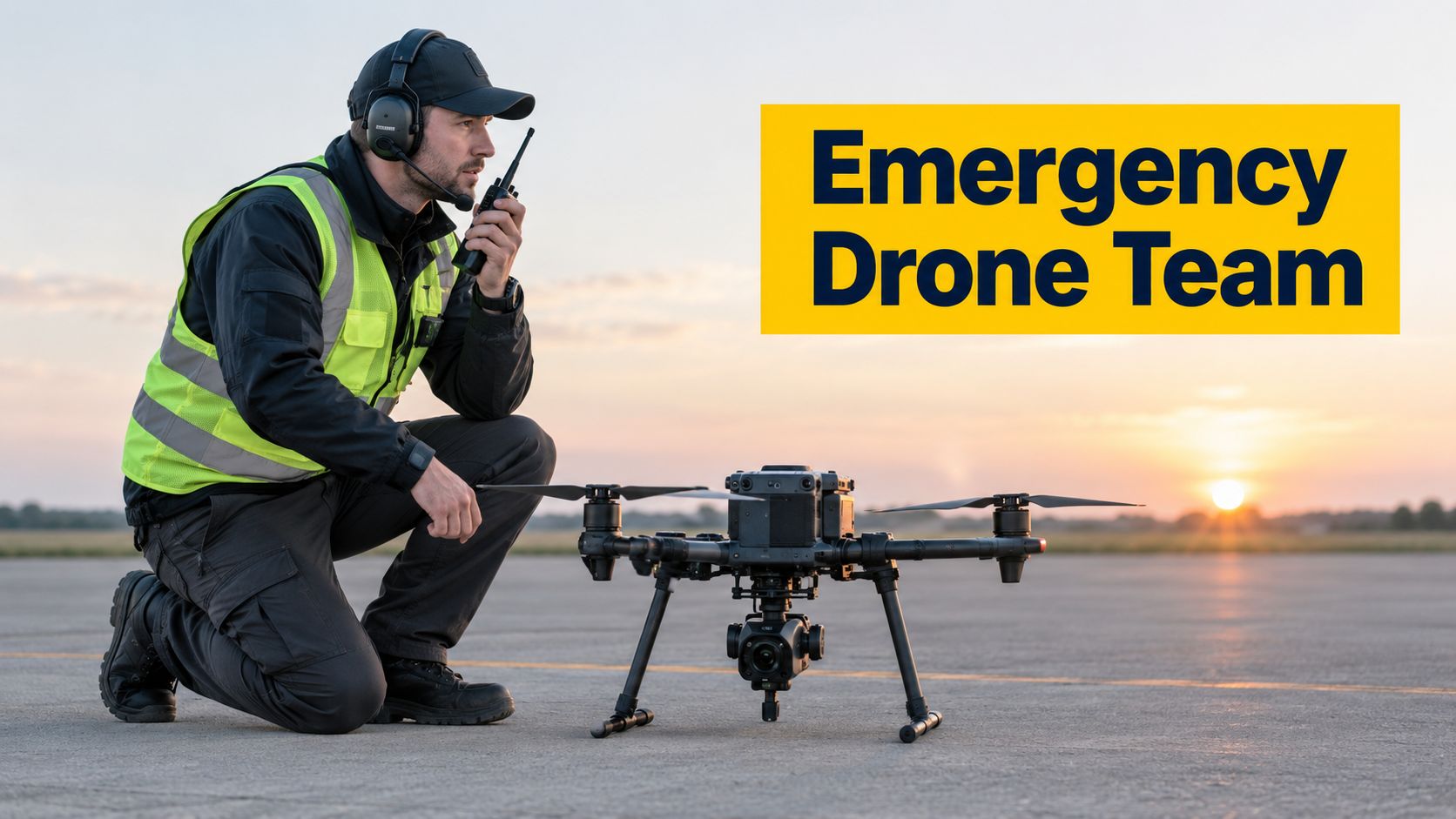
A drone crew is halfway through a roof inspection when the aircraft loses link, drifts toward a public road, and the spotter realises a rescue helicopter is tracking nearby at low level. In that moment, an emergency response team isn't a binder in the ute. It's the people on site who know who takes command, who calls cease operations, who secures the ground area, who handles radio traffic, and who speaks to external agencies without adding confusion.
That's the difference between a formal emergency response team and a group of helpful bystanders. Ad hoc help usually creates duplicated tasks, missed hazards, and poor records. A defined team works from pre-assigned roles, a communications plan, and clear stop-work authority.
In Australian drone operations, that matters because the risk picture is different from ordinary field work. A drone incident can become an aviation issue, a public safety issue, and a compliance issue at the same time. CASA states that drones must not be flown during emergency operations, including bushfires, floods, traffic accidents, tactical response, training or rescue operations, unless permission is obtained from the emergency agency first, as set out in CASA's guidance on flying near emergencies and wildlife. On a live site, that rule changes how teams plan launch locations, standby procedures, and shutdown calls.
Australia's response environment is also large and heavily tasked. The national ambulance system recorded 4.5 million incidents in 2024–25, resulting in 5.9 million ambulance responses and 4.3 million patients assessed, treated, or transported, with 25,568 full-time equivalent salaried personnel, 5,891 volunteers, and 26,603 registered paramedics according to the Report on Government Services ambulance services data. Fire and emergency services attended 472,361 emergency incidents in 2024–25, including 101,553 fire events, and total government expenditure reached $7.4 billion, based on the national emergency services reporting. Those figures matter because drone crews don't operate in a vacuum. They enter a system that is already structured, regulated, and time-critical.
Table of Contents
- Introduction to Emergency Response Teams in Aviation and Drone Operations
- Core Roles and Responsibilities That Make the Team Work
- Communications Planning and AROC Requirements for Emergency Teams
- Building Rosters Training and Competency for Readiness
- Drills Exercises and Integration With Site Safety Systems
- Conclusion and Next Steps for Your Emergency Response Team
Introduction to Emergency Response Teams in Aviation and Drone Operations
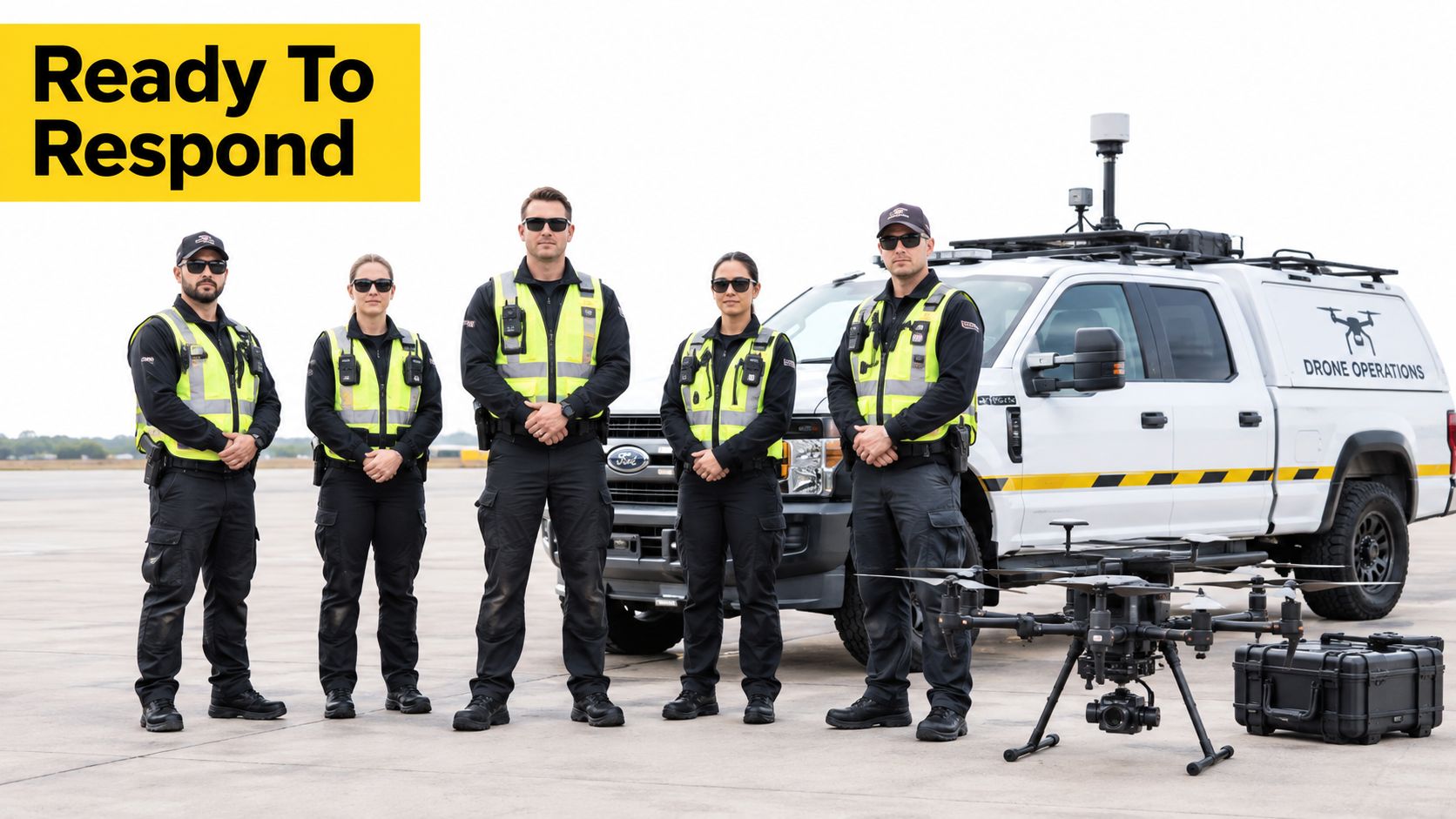
An aviation-integrated emergency response team is built to manage more than injury or fire. It handles airspace conflicts, flyaway risk, battery events, lost-link procedures, unauthorised people entering the operating area, and coordination with emergency services if the site condition changes. In drone work, the emergency isn't always dramatic. Sometimes it's a small technical fault that becomes serious because nobody owns the next decision.
A good team starts with one principle. The first emergency action is rarely flying skill. It's recognition, communication, and control.
What the team is actually there to do
On a drone job, the emergency response team protects three things at once:
- People on the ground: crew, clients, bystanders, contractors, and road users.
- Aircraft and airspace: the RPAS, nearby manned aviation, and any temporary restrictions or active emergency traffic.
- Regulatory position: evidence that the operator acted within procedures, approvals, and site controls.
That's why casual site arrangements fail under pressure. A pilot can't safely fly, monitor airspace, manage bystanders, call emergency services, and document decisions at the same time.
Practical rule: If one person is expected to fly the drone and run the emergency at the same time, the system is already overloaded.
The Australian operating backdrop
For Australian operators, the emergency response team has to fit inside aviation and public safety controls, not sit alongside them. That includes site inductions, contractor rules, first aid arrangements, and any local emergency management plan already in place.
It also includes understanding how incidents are measured and reviewed. In Australian emergency services, response time is often tracked using percentile methods rather than simple averages. The Report on Government Services defines ambulance response time as the interval from emergency call receipt to first unit arrival and reports the 50th percentile and 90th percentile for high-priority incidents, which gives a more useful picture of reliability than an average, as outlined in the Report on Government Services methodology. For drone teams, that mindset is useful. The delay that matters is often the slowest part of the chain, not the average day when nothing goes wrong.
For operators building site procedures, a practical companion is AAA's guide to drone pilot emergency procedures and incident preparation, which is useful for translating aviation-style emergency thinking into day-to-day RPAS work.
Core Roles and Responsibilities That Make the Team Work
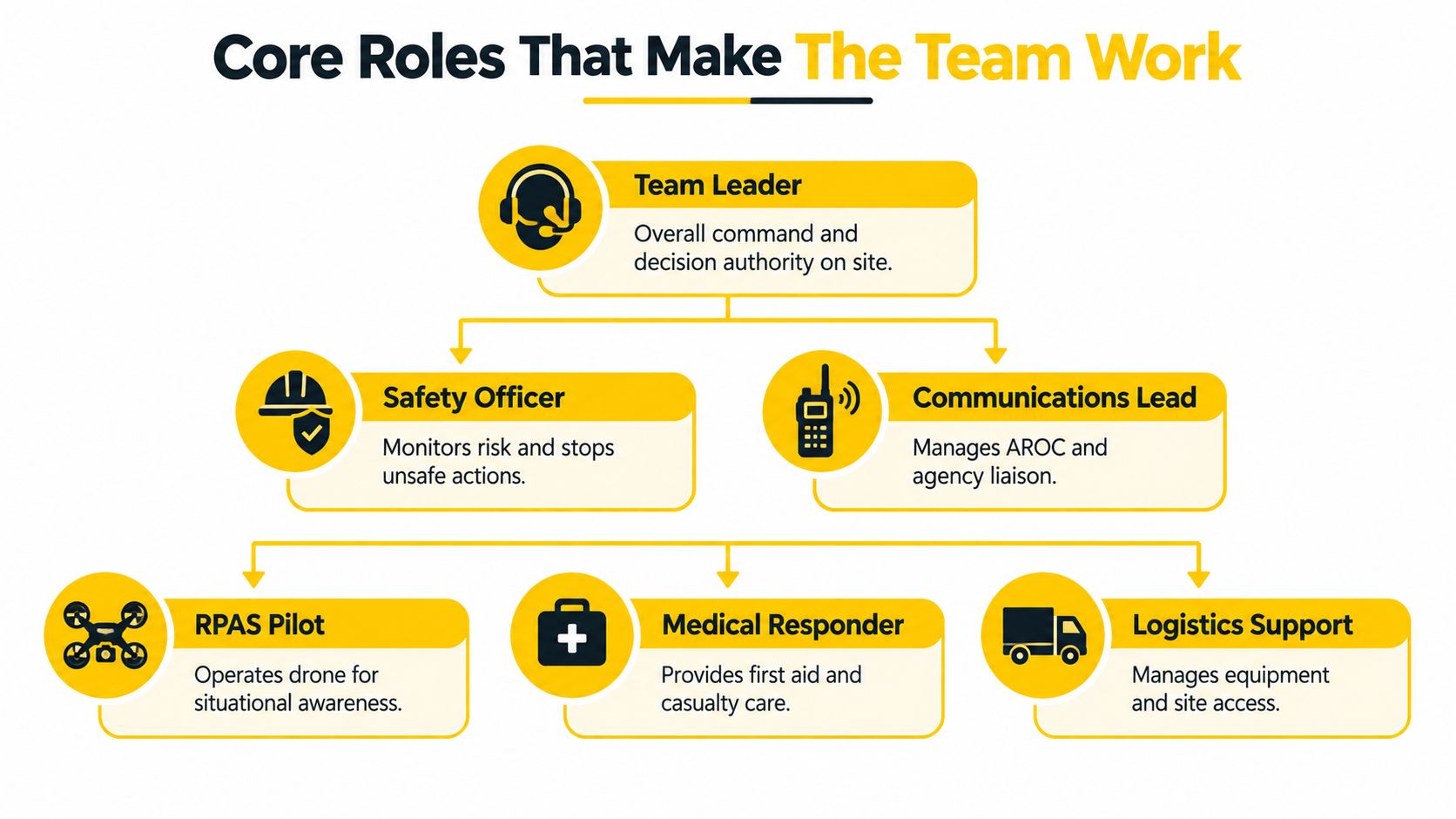
Role clarity decides whether an emergency response team works or stalls. On a small drone crew, one person may hold more than one function. That's fine until the functions compete. The fix isn't more paperwork. It's clear authority, simple handovers, and pre-agreed backup.
The minimum structure on most drone sites
The following roles cover most commercial and government RPAS operations:
- Team leader or incident lead: Holds overall decision authority on site. Stops the operation, allocates tasks, and decides when external escalation is required.
- Pilot in command: Focuses on aircraft control, emergency flight actions, and shutdown. This role should not be dragged into ground crowd control unless the aircraft is secure.
- Observer or airspace monitor: Watches for aircraft conflict, people entering the area, and hazard changes beyond the pilot's field of attention.
- Safety officer: Monitors risk controls, confirms exclusion areas, and has stop-work authority if the site becomes unsafe.
- Communications lead: Manages radio calls, phone escalation, agency liaison, and logging of key times and instructions.
- First aid or medical responder: Handles casualty care and coordinates access for ambulance if required.
- Logistics support: Secures batteries, vehicles, access gates, manifests, and replacement equipment.
Where teams usually get it wrong
The most common failure isn't lack of goodwill. It's role collision.
A pilot sees a problem and starts handling radio calls. The observer starts briefing the client. The safety officer assumes someone else has called site security. Nobody marks the last known aircraft position accurately. Everyone is active, but no one is controlling the event.
When a site goes noisy, the best teams reduce the number of voices, not increase them.
A simple accountability model works better than a complex chart. Every role should answer three questions:
| Role | Owns what | Hands over when |
|---|---|---|
| Team leader | Site control, escalation, external decisions | Formal transfer to agency incident controller or senior manager |
| Pilot in command | Aircraft actions and technical status | Aircraft is landed, terminated, or no longer controllable |
| Communications lead | Radio and phone traffic, event log | Another designated communicator takes over |
| Safety officer | Exclusion zones and unsafe acts | Site is stabilised or merged into broader safety control |
| Medical responder | Casualty care and handoff | Ambulance or higher clinical support arrives |
Small crews and larger teams
A two-person crew won't mirror a large emergency service unit, but it still needs separation of tasks. At minimum, one person flies and one person manages the outside world.
For enterprise and government teams, responsibilities should align with operating approvals, manuals, and training records. Operators building that structure often start with licence pathways such as the Remote Pilot Licence guidance, then map role requirements above the minimum licence standard.
An entry-level pathway can also help new staff understand basic operating discipline before they're assigned emergency duties. ACE READY is an entry level drone training course for beginners that covers drone fundamentals, aviation safety, CASA regulations, flight operations, and preparation for advanced Remote Pilot Licence training in Australia. That sort of baseline matters because emergency roles fail quickly when team members don't share the same operating language.
Communications Planning and AROC Requirements for Emergency Teams
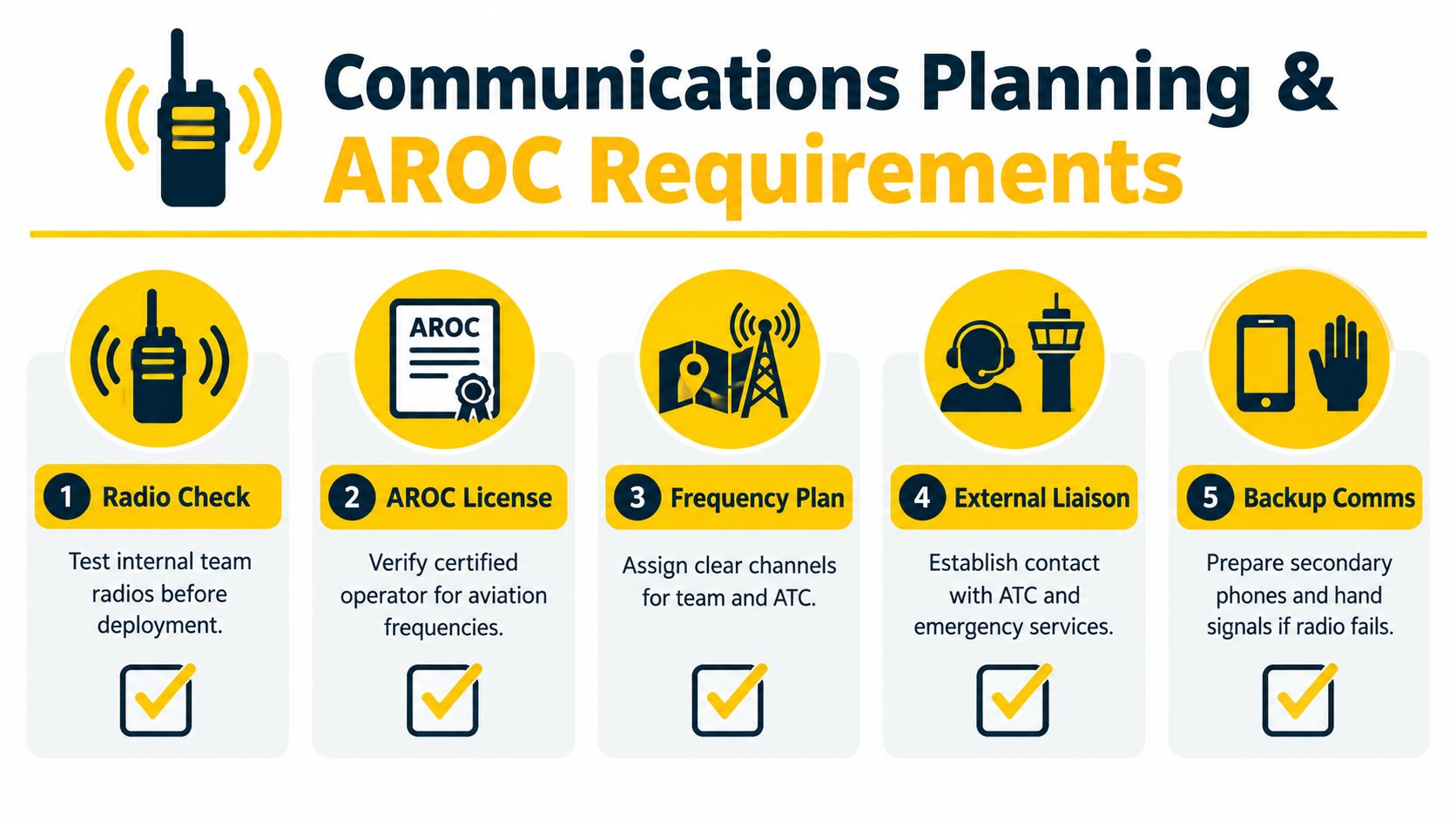
Most site emergency plans spend too much time on equipment and not enough on who can legally talk to whom. In aviation-linked incidents, communications planning is part safety system, part compliance control.
Choosing the right communication method
Different channels solve different problems. The mistake is assuming one radio solves everything.
| Communication method | Best use | Main limit |
|---|---|---|
| Hand signals and verbal commands | Immediate close-range control on a noisy site | Useless once people separate or line of sight is lost |
| UHF or site radios | Crew coordination, gate control, ground safety | May not be lawful or interoperable for aviation or emergency agency use |
| Mobile phones | Escalation to management, site contacts, ambulance, police | Slow in fast-moving airspace conflicts and vulnerable to coverage gaps |
| Aviation radio | Airspace coordination where authorised and required | Needs a properly qualified operator and disciplined phraseology |
| Agency communications channels | Direct liaison during integrated operations | Access depends on approvals, licensing, and incident command arrangements |
When AROC and radio licensing matter
If a team member is using aeronautical radio communications in an operational setting, an Aeronautical Radio Operator Certificate may be required for that task. That isn't a nice extra. It's part of lawful and competent aviation communication.
Separately, emergency teams also need to think about ground communications authority. The ACMA provides a public safety and emergency response class licence that authorises the use of radio equipment for public safety or emergency response functions, which is directly relevant when teams need lawful radio capability during incidents, as set out in ACMA's public safety and emergency response licence information.
A sound communications plan should identify:
- Primary comms: who uses which device and on what channel
- Secondary comms: what happens if the primary path fails
- Authority points: who may call cease operations, abort launch, or transfer control
- External contacts: site security, emergency services, air traffic contact where relevant, and client representative
- Logging: who writes down times, approvals, and instructions
Operators working under an organisational approval structure often need those communication controls documented properly. AAA's overview of how ReOC systems work in Australia is relevant here because communications procedures are rarely standalone. They sit inside the broader operational control system.
Approval before flight means exactly that
If an emergency is already underway nearby, a drone crew doesn't self-authorise because the imagery would be useful. CASA's position is clear in the earlier section. Keep the drone on the ground unless permission has been obtained.
The ACT emergency services guidance is even more specific. It states that RPAS operations must not occur over an area where a fire, flood, police or other public safety operation is underway unless approval is granted by the Incident Controller, ACT RFS Aviation Officer and ACT ESA RPA Chief Pilot, according to the ACT guidance on RPAS drone operations. It also instructs personnel who see a drone near an emergency incident to direct the operator to cease and desist and report it immediately.
A cease-operations call only works if everyone knows who can make it, what words they use, and what each person does next.
For teams looking at digital coordination tools, this overview of active 911 calls and 3rd-i safety is a useful example of how live incident information can support situational awareness, provided the operator still works within Australian approvals, radio rules, and local incident command.
Building Rosters Training and Competency for Readiness
A response plan that depends on one capable person isn't a team. It's a vulnerability. Readiness comes from roster coverage, verified competency, and evidence that the right person is available when the phone rings.
Build the roster around functions, not names
Many operators start with people they trust and then assign roles around them. That works until leave, fatigue, or a second tasking breaks the pattern.
A better method is to roster by function:
- Operational command cover: someone who can take site control and make stop-work decisions
- RPAS flight cover: a current and authorised pilot for the intended category of operation
- Communications cover: a person competent to manage radio and escalation duties
- Medical and safety cover: people trained for first aid and site risk control
- Administration cover: someone who can maintain logs, notifications, and post-incident records
Fatigue matters here. Emergency standby sounds efficient on paper, but if the same small group is repeatedly carrying after-hours coverage, decision quality drops first, usually before anyone notices it formally.
Competence is more than holding a certificate
Qualifications matter, but they aren't the end point. A person can hold a certificate and still be weak at incident communication, checklists, or pressure management.
The useful question is, can this person perform the role under stress, on this site, with this aircraft and this procedure set?
| Team Role | Required Qualification | Currency Check |
|---|---|---|
| RPAS pilot | Relevant drone qualification such as a Remote Pilot Licence (RePL) where required for the operation | Recent flight activity, emergency procedure drill sign-off, aircraft-specific familiarisation |
| Communications lead | AROC where aeronautical radio duties are part of the role | Radio phraseology refresher, comms failure exercise, current contact list verification |
| Team leader | Internal emergency management and operational authority under the organisation's system | Recent exercise performance, decision log review, escalation drill participation |
| Observer or airspace monitor | Internal training on lookout duties and conflict reporting | Scenario-based airspace scan assessment and local area briefing |
| Medical responder | Relevant first aid qualification | Current certificate and practical casualty handover exercise |
| ReOC administrator or compliance support | Knowledge of the operator's manuals and records process | Audit check, document control review, incident reporting rehearsal |
Training pathways that support actual readiness
For aviation-integrated emergency teams, the usual building blocks are straightforward:
- RePL: relevant where the operation requires licensed remote pilot capability.
- AROC: relevant when staff need to use aeronautical radio legally and competently.
- Certificate III in Aviation: relevant for organisations that want broader aviation grounding in operational discipline and systems.
- Enterprise Drone Training or Corporate Drone Training: relevant when an organisation needs procedures aligned to its own aircraft, risk profile, and operational approvals.
- ReOC consulting: relevant when the team's readiness has to align with formal operating manuals, competencies, and records.
One practical test is whether the roster can survive an audit and a call-out on the same day. If the records are current but nobody available can perform the role, the system isn't ready.
Teams planning advanced or extended operational profiles should also consider how emergency capability scales with mission complexity. AAA's material on BVLOS operations and supporting capability requirements is useful for that reason. Once the operation becomes more complex, supervision, communications, and contingency staffing usually need to mature with it.
Drills Exercises and Integration With Site Safety Systems
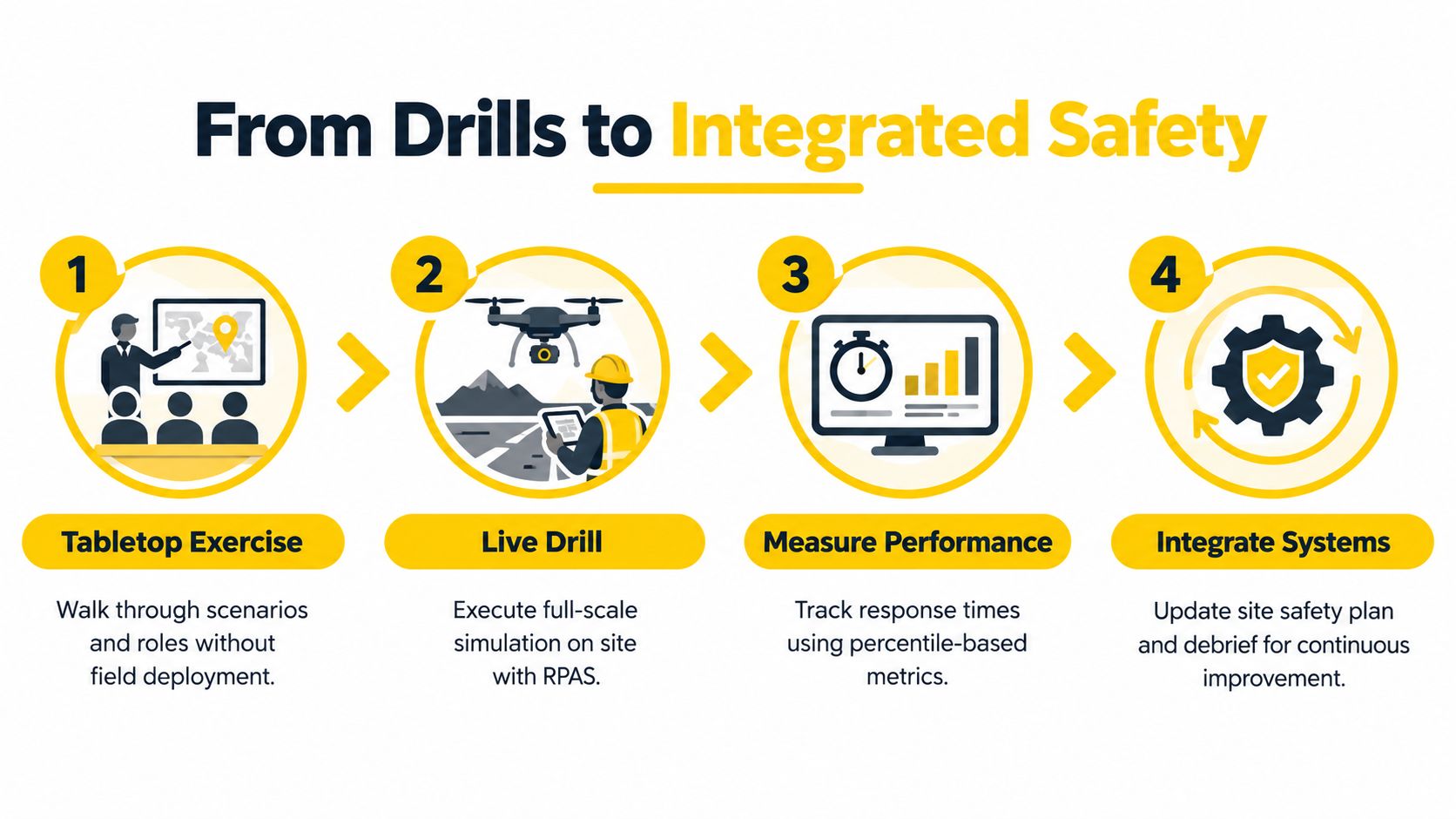
The team becomes real when it drills. A manual can assign roles. Only repetition shows whether the pilot can keep flying while the communications lead handles pressure, whether the observer scans effectively, and whether the site supervisor respects stop-work authority.
Use a drill sequence that grows pressure gradually
A sensible progression looks like this:
Tabletop exercise
Walk through a lost-link event, battery thermal issue, or nearby emergency activation. No aircraft. No field deployment. Just decisions, timing, and language.Dry run on site
Stand in position with radios, vehicles, barriers, and paperwork. Practice who moves where and who calls what.Live drill with aircraft
Introduce a controlled technical or operational trigger, such as simulated comms failure or unauthorised entry to the operating area.Multi-agency integration
Bring in site security, emergency wardens, or local responders where relevant, and test how the RPAS team fits into the broader incident structure.
Measure what actually matters
Many organisations still review emergency performance with a rough average. That hides weak responses. Queensland Ambulance Service uses a more operational mix by reporting the 50th and 90th percentile response times for Code 1 and 2A incidents, while Code 2B and 2C are measured against 30 minute and 60 minute thresholds for first arrivals on scene, according to the QAS performance indicator publication. The lesson for drone teams is simple. Measure the full chain and look at the slow responses, not just the neat average.
For a drone emergency drill, that can mean tracking:
- Recognition time: from fault or trigger to first correct identification
- Decision time: from identification to stop-work, land, or terminate command
- Communication time: from decision to successful crew acknowledgement
- Escalation time: from internal control to external notification where required
- Site stabilisation time: until hazards are contained and access is controlled
The debrief should ask where time was lost between trigger, decision, communication, and control. That's where real improvement sits.
Tie the drill back into the site safety system
A good exercise isn't complete when the last person signs the attendance sheet. It needs to change the operating system.
That means updating:
- Risk assessments for recurring failure points
- Site maps showing emergency assembly points, safe launch areas, and vehicle access
- Pre-start checklists for radio checks, contact verification, and exclusion zones
- Airspace and location checks for local restrictions, nearby aviation activity, and site-specific hazards
There are also hard operational limits that must be built into exercises, not left as theory. Australian government guidance cited in a submission on public safety training notes that UAVs must not operate within 30 metres of a person not directly associated with the operation, must not be flown over or above people in a populous area, and must remain outside a 5.5 kilometre radius no-fly zone around airfields unless an exemption applies, as stated in the public safety training and response submission.
A final point often missed in drills is capability growth. Emergency-response drone teams are increasingly used for rapid mapping, thermal imaging, route reconnaissance, and 3D modelling, not only visual search. Australian public reporting also shows state-based fleet development. South Australia's SES reported operating about 50 drones, conducting more than 500 deployments in 2025, and adding nine new drones through a $2 million 2025–26 budget investment, including regional bases in Port Lincoln, Quorn, Ceduna, Port Pirie, Gawler, and Kangaroo Island, as reported by Glam Adelaide on the SES drone investment. For site operators, the practical takeaway is that readiness isn't just pilot skill. It includes maintenance, fleet suitability, and regional support.
Teams drilling near aviation infrastructure should also align emergency actions with local airport and helicopter risk controls. AAA's guide to drone safety around airports and helicopter landing sites in Australia is a useful reference for building those checks into the site system.
Conclusion and Next Steps for Your Emergency Response Team
An emergency response team for drone operations works when it is treated as an aviation capability with ground safety consequences, not as a generic site add-on. The strongest teams keep the structure simple. One person leads. One person flies. One person owns communication. Safety authority is clear, and no one assumes they can improvise legal radio use or operate near an active emergency without approval.
For most operators, the next useful step isn't writing a longer procedure. It's a short gap review against the pressure points:
- Roles: Is command clear on a two-person crew as well as a larger team?
- Communications: Is there a lawful, tested plan for internal, site, and aviation communications?
- Competency: Can each role be filled by someone current and available, not just nominally trained?
- Exercises: Have the likely failure modes been drilled in realistic site conditions?
- System integration: Do the emergency actions line up with the organisation's manuals, site rules, and risk controls?
The organisations that handle incidents best usually don't have the thickest binders. They have the clearest triggers, the calmest radio discipline, and the most honest debriefs.
Where formal operating approvals or enterprise procedures are involved, training should map directly to the role. A Remote Pilot Licence (RePL) supports the flight function. An AROC supports lawful aviation radio duties. Certificate III in Aviation can support broader aviation knowledge where the operation needs that foundation. ReOC consulting matters when the team's emergency procedures have to align with the operator's documented system rather than sit outside it. Enterprise Drone Training and Corporate Drone Training are most useful when the team needs scenario-based readiness on its own aircraft, sites, and workflows.
FAQ
What is an emergency response team in drone operations
It's the defined group responsible for managing on-site emergencies during RPAS activities. In practice, that includes command, aircraft actions, communications, safety control, and coordination with external agencies if the event escalates.
Does every drone business need a formal emergency response team
Any operator flying in commercial, government, or managed-site conditions needs clear emergency roles, even if the crew is small. A two-person team still needs assigned authority, communications, and stop-work actions.
Can a drone be flown near an active emergency in Australia
Not as a casual decision. CASA states that drones must not be flown during emergency operations unless permission is obtained from the emergency agency first, and some agency procedures require specific approvals before RPAS activity can begin.
When is an AROC relevant to an emergency response team
It's relevant when a team member needs to conduct aeronautical radio communications as part of the operation. If aviation radio is part of the emergency plan, the role should be assigned deliberately and trained properly.
How often should an emergency response team run drills
The exact interval depends on the operation, but drills should be regular enough to keep emergency actions, radio procedures, and handovers current. A mix of tabletop exercises, dry runs, and live drills usually gives better results than repeating the same format.
What should be reviewed after a drill or real incident
Review the timeline from trigger to control, communication clarity, role separation, airspace awareness, compliance with site procedures, and whether the records are good enough to support internal review or external reporting.
Ace Aviation Aerospace Academy provides Australian aviation and drone training that fits directly into this kind of emergency readiness work, including RePL, AROC, Certificate III in Aviation, ReOC consulting, and organisation-specific drone training. For operators who need a team that's not only qualified on paper but workable on site, visit Ace Aviation Aerospace Academy and match the training pathway to the actual roles in the response plan.