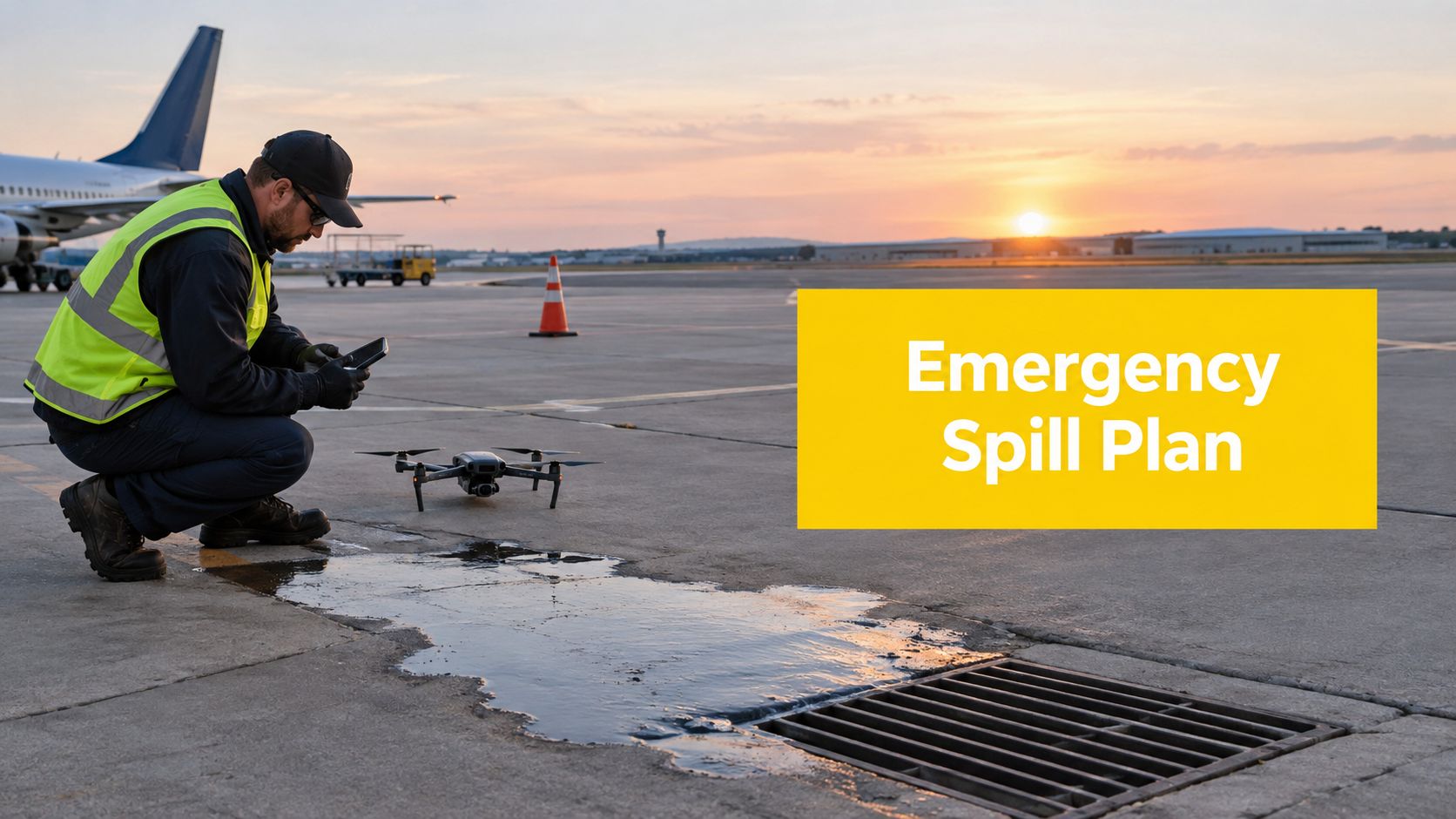
A pre-flight check at a regional aerodrome can change in seconds. A drone operator is transferring Jet A1 from a 200-litre drum when a cam-lock releases, fuel spreads across the apron, and the flow heads towards a stormwater grate. The aircraft is still serviceable, but the immediate priorities are no longer flight planning and battery checks. People, ignition sources, drainage and notification now matter more.
An effective emergency spill response plan gives the crew a sequence to follow before confusion takes over. Aviation fuel, agricultural chemicals, hydraulic fluid and lithium battery electrolyte don't present the same fire, vapour, exposure or environmental risks. A procedure copied from an office or general warehouse may miss airside access controls, aircraft movement, public exposure and runoff pathways.
The same principle applies to commercial operators working under CASA Part 101 or Part 102, agricultural RPA crews, hangar tenants and contractors sharing fuel infrastructure and operational areas. Operators can also use this drone safety guide for airports and HLS operations when integrating spill actions with aviation-site controls. For a broader operations-management perspective, the guide for operations managers provides useful planning context.
Table of Contents
- Why Aviation and Drone Operations Need a Tailored Spill Plan
- Core Elements Every Australian Spill Response Plan Must Include
- Applying the CCCC Method at Airside and Drone Sites
- Deciding When a Spill Becomes Reportable
- Using Drones for Aerial Assessment After a Spill
- Practical Checklist and Spill Kit Recommendations
- Frequently Asked Questions on Drone and Aviation Spill Response
- Does a pilot need a RePL to fly a spill-assessment mission?
- Does a Chief Remote Pilot authorisation apply?
- Is an AROC required near a controlled aerodrome?
- Do emergency exemptions cover every spill response flight?
- How should crews maintain spill-response competency?
- What records and insurance checks matter?
Why Aviation and Drone Operations Need a Tailored Spill Plan
The apron is not an ordinary workplace
A fuel spill beside an aircraft or drone launch area creates several problems at once. Vapour can travel towards engines, vehicles, electrical equipment or other ignition sources. A liquid that looks contained on concrete can move through surface gradients into a grate, drain or unsealed edge. At an agricultural site, pesticide concentrate can follow the same route into soil, paddocks or waterways.
The operating environment also changes the response. A regional airstrip may have limited personnel, long distances to emergency services and aircraft moving through the same area. A hangar may contain chargers, batteries, maintenance fluids and combustible materials in a confined space. A spray operation may add chemical exposure, windborne drift and contaminated wash-down water.
Practical rule: The spill plan must identify where the liquid will travel, not just where it was released.
A plan starts with the site map. It marks fuel stores, chemical stores, charging benches, drains, interceptors, access roads, muster points, fire equipment, exclusion zones and safe approach directions. It also states who can stop an operation, who contacts the aerodrome operator and who controls drone activity during the response.
Different products demand different decisions
Jet A1 and Avgas require attention to vapour, ignition and recovery. Hydraulic fluid can create a slip hazard and contaminate hardstand surfaces. Agricultural chemicals require product-specific SDS advice, suitable PPE and careful control of contaminated soil and water. Damaged lithium batteries may remain hazardous after a visible event, so crews shouldn't treat them like an ordinary liquid spill or apply water without competent, product-specific direction.
The Australian national response framework shows why planning has to evolve with the hazard. The National Plan to Combat Pollution of the Sea by Oil became operational on 1 October 1973, supported by a $1 million Commonwealth contribution, and expanded in 1998 to include hazardous and noxious substances, as documented by the Australian Maritime Safety Authority's national plan history. That progression reflects a practical lesson for aviation and RPAS operators: response capability must change as the substances and activities change.
Core Elements Every Australian Spill Response Plan Must Include
Build the plan around the contaminant inventory
A marine or coastal facility's plan is expected to identify its objectives, scope and extent, and include an inventory of contaminants, including the types and quantities stored or handled on site, according to AMSA's technical guidelines for contingency plans. An aviation or drone site should apply the same discipline.
The inventory should list Avgas, Jet A1, diesel, hydraulic fluid, agricultural spray concentrates, cleaning products and lithium battery electrolyte where applicable. Each entry should point to the current SDS, storage location, maximum on-site quantity, incompatible materials, required PPE, spill-kit type and disposal pathway.
The front of the plan should identify the site, operating entity, address, access instructions and map reference. It should name a spill coordinator, deputies, the incident controller, first-aid contacts and the person authorised to stop flight or ground operations. A printed contact register is essential because a phone may be inaccessible, damaged or out of power during an incident.
Define communications, equipment and records
WA guidance says an emergency response plan should identify responsibilities, prevention and containment measures, clean-up procedures, reporting processes and disposal arrangements for waste generated during clean-up, as set out in the WA contaminant spills emergency response guidance. A useful emergency planning Facility Management Insights resource can help structure supporting registers, but aviation operators still need to adapt the document to their site and hazards.
The plan should include:
- Notification chain: Internal management, airport reporting officer, emergency services, local council, the relevant state environment authority and other regulators identified by the site's approvals. RPAS operators should also define when aviation stakeholders and CASA must be contacted.
- PPE matrix: Match gloves, eye protection, respiratory protection, footwear and protective clothing to each SDS and task. PPE isn't a substitute for isolation or competent chemical handling.
- Spill-kit controls: Separate hydrocarbon absorbents, chemical-compatible materials, drain covers, booms, overpack containers, waste bags, labels and fire-response equipment according to the hazard.
- Training evidence: Keep induction records, competency records, toolbox briefings, drill outcomes, equipment inspections and corrective actions.
- Incident records: Record what happened, the product, estimated quantity, location, drainage exposure, actions taken, waste removed, notifications made and investigation findings.
| Contaminant | Primary hazard | Minimum PPE | First-action step |
|---|---|---|---|
| Avgas or Jet A1 | Vapour, fire and environmental contamination | SDS-specified chemical-resistant gloves, eye protection and protective clothing | Stop the source if safe, remove ignition sources and protect drains |
| Diesel or hydraulic fluid | Slip hazard and surface or soil contamination | Gloves, eye protection and protective footwear | Isolate the leak and deploy hydrocarbon absorbents |
| Agricultural spray concentrate | Toxicity, exposure and runoff | Product-specific PPE from the SDS | Keep people away, stop the source and prevent environmental escape |
| Lithium battery electrolyte | Chemical exposure, thermal event and damaged-cell hazards | SDS-specified gloves, eye protection and protective clothing | Isolate the battery area and follow the battery manufacturer's emergency instructions |
Regulatory obligations depend on the state, site approvals, substance and circumstances. The plan should therefore be reviewed by the responsible WHS and environmental personnel rather than treated as a generic template. For beginners who need aviation fundamentals before advanced licensing, ACE READY covers drone fundamentals, aviation safety, CASA regulations and flight operations.
Applying the CCCC Method at Airside and Drone Sites
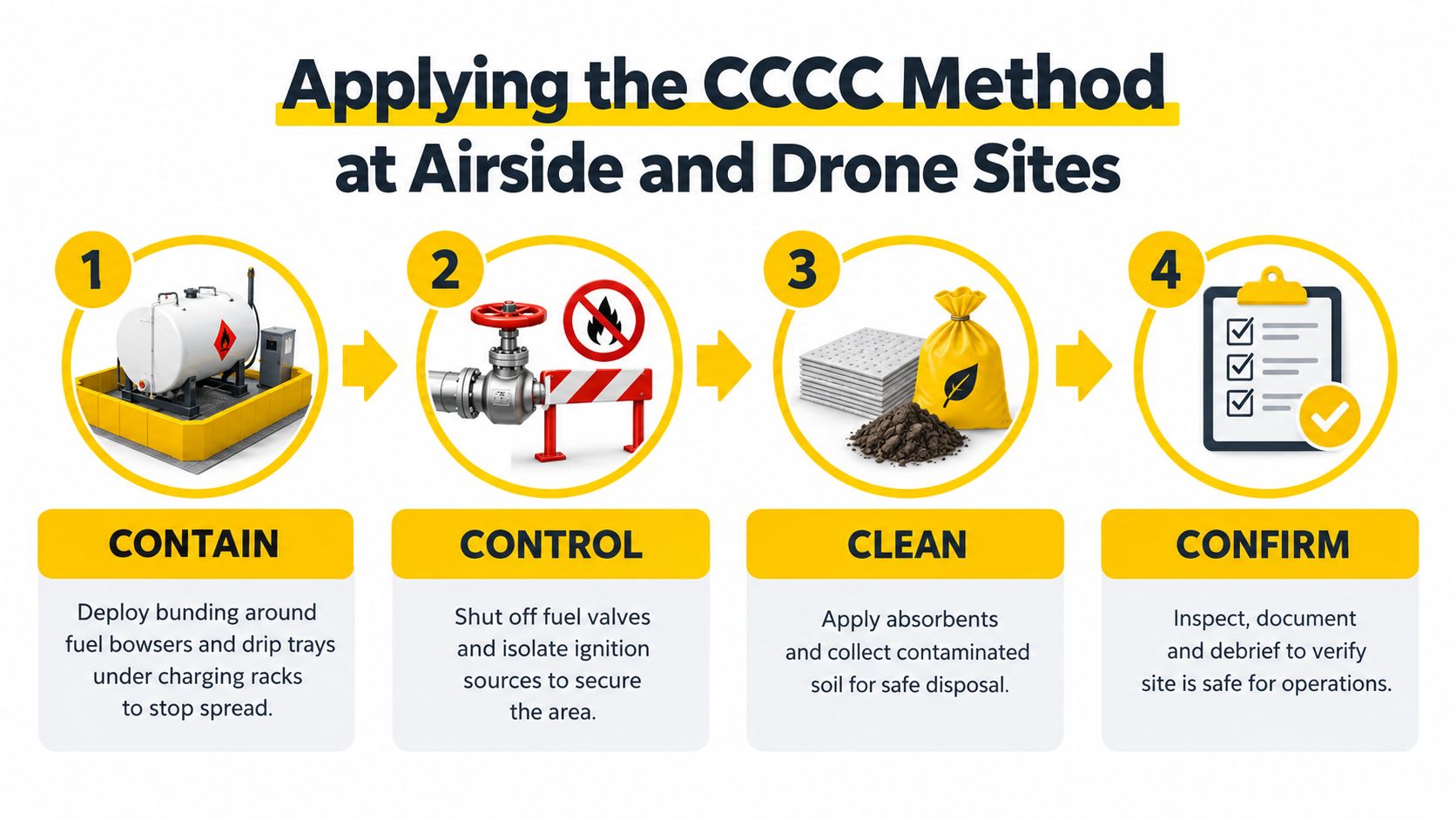
Australian spill-response guidance commonly uses the four-action CCCC sequence, Control, Contain, Contact and Clean up. The exact wording and order should follow the site's adopted procedure. WA guidance emphasises immediate source isolation, upwind exclusion, cordoning and absorbent damming around drains and down-gradient edges, while warning crews not to move containers unless necessary because movement can spread the spill. Large-scale emergencies or life-risk situations require an immediate call to 000, as stated in WA spill prevention and response guidance.
Control and contain
Control means stopping the release and securing the area. Shut a valve, activate an emergency stop, close a tap or isolate a pump only when the action can be completed safely. Move people upwind, stop vehicle and aircraft movement, eliminate ignition sources and establish an exclusion zone.
Contain means preventing migration. A refuelling bowser should have suitable bunding and absorbent materials ready before transfer begins. A charging area should have suitable drip trays and a clear isolation zone. Absorbent socks at a hangar doorway can stop liquid leaving the building, while drain covers and a dam around a grate protect the first environmental pathway.
Contact and clean up
Contact is not an administrative afterthought. The person calling should state the product, location, hazards, approximate quantity, whether the release has reached a drain or waterway, whether anyone is exposed and what controls are already in place. The Australian emergency response guide for dangerous goods incidents directs responders to use the emergency response telephone number shown on the transport document first and, for a large spill, to build a dike well ahead of the moving material so it can later be recovered.
Clean up depends on the substance. Hydrocarbon pads and booms can recover Jet A1 or hydraulic fluid from hard surfaces. Pesticide residues require the SDS and product label, controlled collection, and disposal through an appropriate waste pathway. Crews shouldn't hose fuel or chemical residues into stormwater. A swollen battery venting on a charging bench needs isolation and specialist direction, not improvised washing.
For incident coordination principles that sit alongside the spill sequence, operators can use this drone pilot emergency handbook covering ANCA, CANCA and ATSB considerations. The final CCCC check confirms the source is secure, the area is safe, recovered material is documented, waste is labelled and the site controller has authorised a return to operations.
Deciding When a Spill Becomes Reportable
A volume threshold alone can't determine environmental urgency. A relatively small pesticide release beside a drainage line may present greater off-site risk than a larger, fully contained hydrocarbon release inside sound bunding. The decision tree should consider the substance, fumes, fire risk, drainage, soil permeability, weather, nearby people, waterways, wildlife and the likelihood that the product will escape.
Victorian EPA guidance says emergency services should be called on 000 when a spill involves a hazardous substance such as flammable or toxic material, or when it is likely to escape to the environment. If the response is safe, the source should be stopped, spill-control and absorbent materials used, and residues kept out of stormwater. The guidance also requires incidents to be recorded, reported to management and investigated so corrective actions can reduce recurrence, as explained in Victorian EPA publication 1698.
Use a risk-based escalation matrix
The table below is a planning tool, not a universal legal threshold. The plan must replace broad categories with the contacts and triggers applicable to the state, airport, chemical approval and site licence.
| Contaminant | Reportable volume | Notify first | Timeframe |
|---|---|---|---|
| Avgas or Jet A1 | Any release with fire, vapour, public-safety or drainage risk | 000 where life or major hazard exists, then the site and aerodrome contacts | Immediately |
| Diesel or hydraulic fluid | Any release that may leave the hardstand or enter drainage | Site coordinator and environmental contact, escalating to emergency services where required | Without delay |
| Agricultural chemical | Any release involving exposure, fumes, off-site movement or a drain, waterway or sensitive receptor | 000 for hazardous or escaping material, then the site and environmental contacts | Immediately where risk exists |
| Lithium battery electrolyte or damaged pack | Any uncontrolled venting, fire, thermal event or exposure risk | 000 for fire, life risk or uncontrolled hazardous release, then the site coordinator | Immediately |
A remote airstrip doesn't become exempt because it is remote. A contained fuel release may be managed under the local plan, but the coordinator still needs to assess whether vapour, ignition, soil or drainage creates escalation. A smaller pesticide release near a drainage line should be treated as urgent because the pathway matters more than the volume alone.
Operators should avoid inventing reporting windows. The plan must state the actual obligations for the jurisdiction and approval, including any airport, environmental, dangerous-goods or aviation notifications. A current overview of Australian operating requirements is available in this guide to drone laws in Australia, but it doesn't replace regulator or site-specific advice.
Using Drones for Aerial Assessment After a Spill
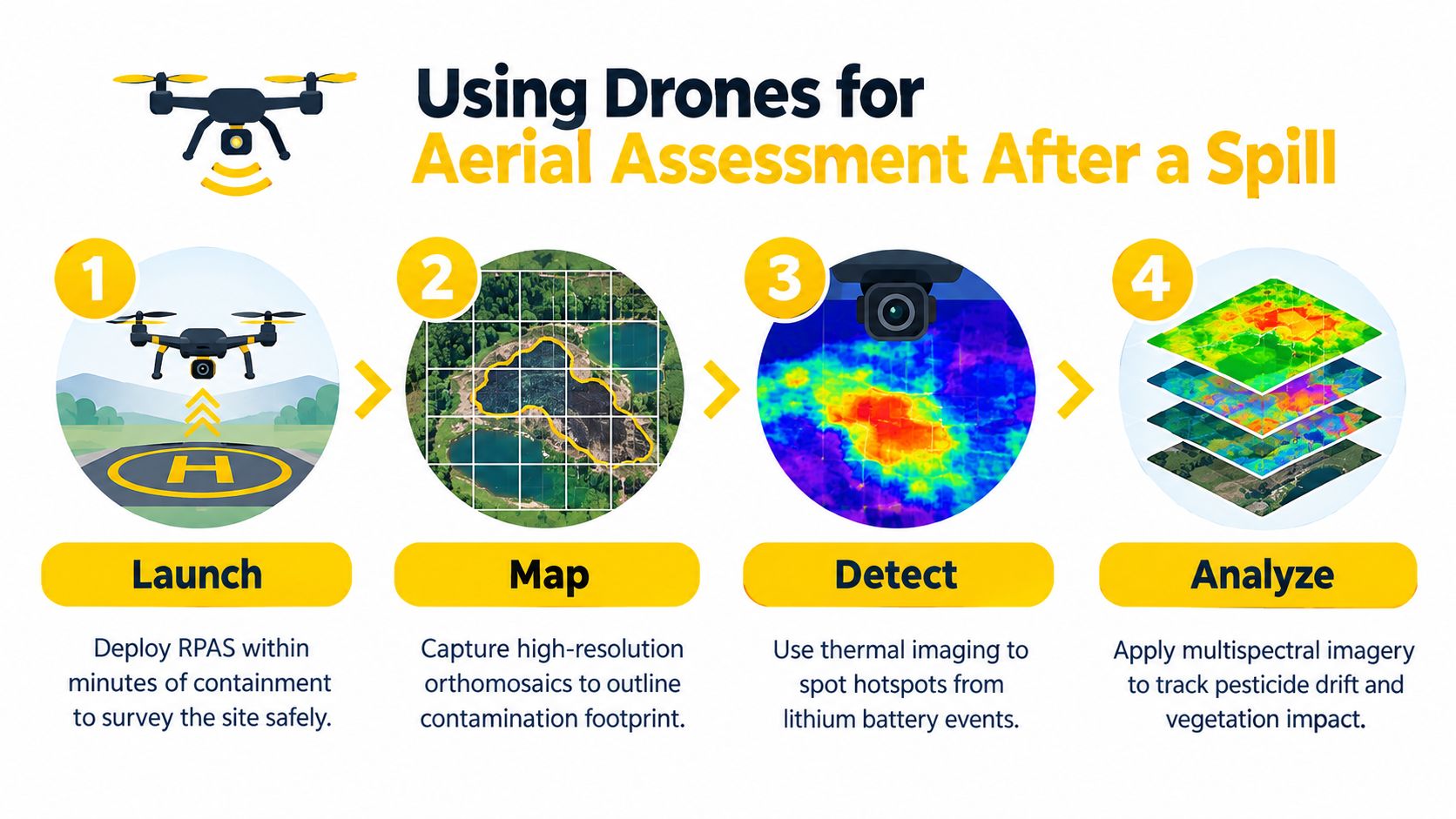
A drone can improve situational awareness after the release has been controlled, but it must never delay emergency services, containment or evacuation. Australian spill and pollution plans commonly emphasise notification, isolation, containment, drainage protection and escalation, while providing less practical detail on RPAS deployment, aerial mapping and incident-command integration. That gap matters at remote agricultural sites, airfields, construction areas and mining operations where a safe overview may be difficult to obtain from ground level.
Deploy only under an authorised flight plan
The incident controller should approve the mission after confirming that the scene is safe enough for flight. The remote pilot must assess people, vehicles, aircraft, smoke, vapour, wind, emergency-service activity, temporary restrictions and the risk of the RPAS becoming another hazard. At an aerodrome, the operator must coordinate with the relevant aerodrome authority and comply with applicable CASA requirements. A RePL alone doesn't authorise every operation, and a ReOC or other operational approval may be relevant to the organisation and task.
The pilot should brief emergency services and ground teams before launch. The brief should identify the launch point, operating area, altitude, observer, lost-link actions, landing zone, radio arrangements and how emergency vehicles can move without entering the flight path. The ultimate guide to ReOC in Australia can support operators reviewing the organisational side of commercial RPAS work.
Match the sensor to the question
An RGB camera can document the visible footprint, damaged containers, drain protection and recovery work. An orthomosaic can help the incident controller mark the affected hardstand, soil and access routes. Thermal imaging may help identify heat associated with a battery event, but it doesn't prove chemical identity or make a damaged pack safe. Multispectral imagery may help assess vegetation impact or possible pesticide drift, but it also requires careful interpretation and shouldn't be treated as a laboratory result.
Evidence handling needs the same care as flight safety. The operator should preserve original files, record the aircraft and sensor, note the time and location, retain mission logs, document processing steps and restrict editing of the source imagery. Copies prepared for the EPA, insurer or investigator should be clearly identified as processed outputs, with the original material retained.
The current Australian planning gap is practical rather than technological. Operators need a written trigger for when aerial assessment begins, a nominated pilot, a safe launch procedure, a data custodian and a clear rule that incident command controls the mission.
Practical Checklist and Spill Kit Recommendations
A spill kit only works when it is close to the hazard, compatible with the product and checked before an incident. A single general-purpose kit is rarely enough for a refuelling point, an agricultural spray operation and a lithium battery charging station. Each location needs equipment selected against the contaminant inventory and SDS advice.
Field checklist for supervisors and remote pilots
Before operations begin, the responsible supervisor should confirm:
- Contacts: The current site coordinator, deputy, airport reporting officer, emergency services and environmental contacts are printed and available.
- Access: Emergency vehicles can reach the fuel, chemical and charging areas without crossing an active launch zone.
- Drainage: Drains, flow directions, interceptors and low points are marked on the site map.
- Equipment: Spill kits are sealed, accessible, compatible with the hazards and stocked with replacement materials.
- Ignition control: Refuelling and battery areas have identified isolation points and clear no-ignition controls.
- PPE: Gloves, eye protection, protective clothing and other SDS-required equipment are available in the correct sizes.
- Waste: Containers, bags, labels and a disposal contact are ready for contaminated absorbents, soil and damaged materials.
- Briefing: Contractors, pilots, ground crew and subcontractors know who can stop work and who makes the emergency call.
Match kits to the operating area
A refuelling bowser kit should include hydrocarbon absorbent pads, socks or booms, drain covers, compatible gloves, eye protection, waste bags, labels and tools for safe recovery. A chemical spray-drone kit should include product-specific PPE, chemical-compatible absorbents, drain protection, overpack capability and a copy of the relevant SDS. A battery station needs fire and isolation arrangements determined by the battery system and site risk assessment, alongside suitable gloves, eye protection and a controlled method for segregating damaged equipment.
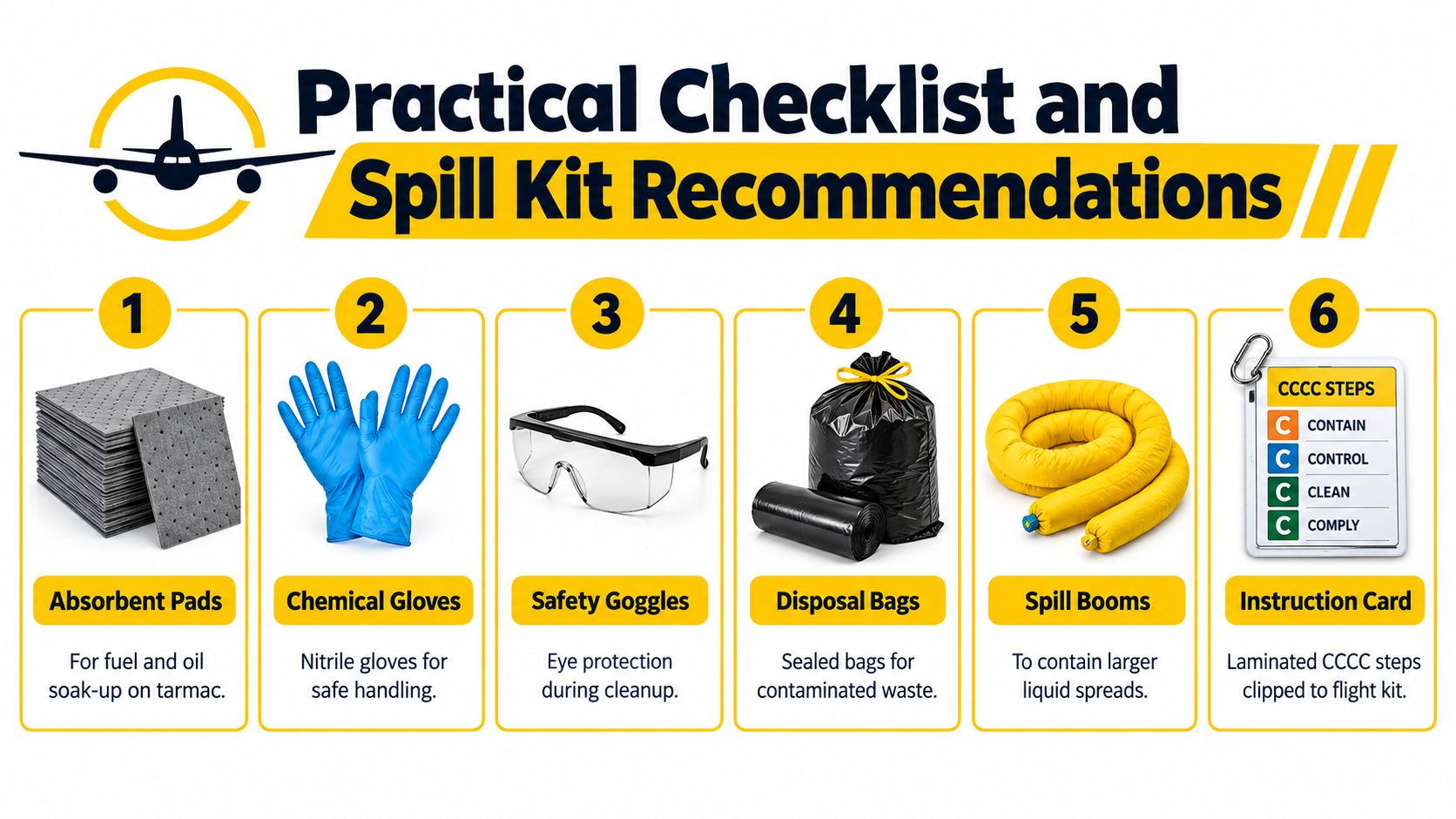
Inspection should occur before use, after any incident, after a drill and whenever a kit's seal or contents indicate that equipment may be missing or degraded. Restocking isn't complete until the kit is returned to its marked position and the inspection record is updated. The plan should specify drill arrangements based on the site's risks, changes and regulatory duties, rather than choosing a frequency without checking the applicable WHS, environmental and aviation requirements.
For a site-specific review of operational controls, teams can use Ace Aviation Aerospace Academy's consultation service alongside their WHS and environmental advisers. The useful test is simple: can a new crew member find the kit, identify the drain path, state the first call and follow the CCCC sequence without searching through an office folder?
Frequently Asked Questions on Drone and Aviation Spill Response
Does a pilot need a RePL to fly a spill-assessment mission?
The required authorisations depend on the operation, aircraft, location, operating organisation and applicable CASA rules. A genuine emergency doesn't automatically remove every aviation obligation. The incident controller and operator should confirm the legal basis, risk controls and coordination requirements before launch.
Does a Chief Remote Pilot authorisation apply?
For an organisation operating under a ReOC, the Chief Remote Pilot is responsible for the operational system and authorisations within that organisation. The appointed pilot still needs the competency and approvals appropriate to the task. A spill mission should be documented as an operational activity, not treated as an informal favour.
Is an AROC required near a controlled aerodrome?
Radio requirements depend on the airspace, aerodrome procedures and the operation. Where aeronautical radio use is required, the relevant operator should hold the appropriate qualification and use the published procedures. The aerodrome operator or Airservices Australia should be consulted before flight.
Do emergency exemptions cover every spill response flight?
No blanket assumption is safe. Part 101 or Part 102 permissions, exemptions and emergency provisions depend on the facts and conditions of the operation. The pilot must still manage people, airspace, aircraft, emergency responders and evidence collection.
How should crews maintain spill-response competency?
The CCCC sequence should be practised through documented briefings and scenario drills suited to the site's hazards. The responsible employer or training provider should assess competency against the actual role. A drone-specific chemical-handling unit may support the task, but it doesn't automatically replace WHS, SDS, dangerous-goods or site-specific spill training.
What records and insurance checks matter?
Under the Work Health and Safety Act 2011 and associated duties, the organisation should retain incident, training, inspection, investigation and corrective-action records as required for its circumstances. A contaminated apron may also require operational coordination, including consideration of aerodrome notices or NOTAM processes by the responsible aviation authority. Cross-border work into New Zealand or Papua New Guinea requires a separate review of local aviation, environmental, dangerous-goods and insurance requirements. Before each sortie, the RPAS provider should brief subcontractors on the spill plan, reporting chain, public liability cover and the limits of their assigned role.
Ace Aviation Aerospace Academy provides relevant aviation and drone education, including Remote Pilot Licence, Aeronautical Radio Operator Certificate and operational training pathways that can support safer RPAS work around airports, agriculture and emergency scenes. Review the available training and operational support at Ace Aviation Aerospace Academy, then align the chosen course with the organisation's aircraft, operating area and spill-response responsibilities.