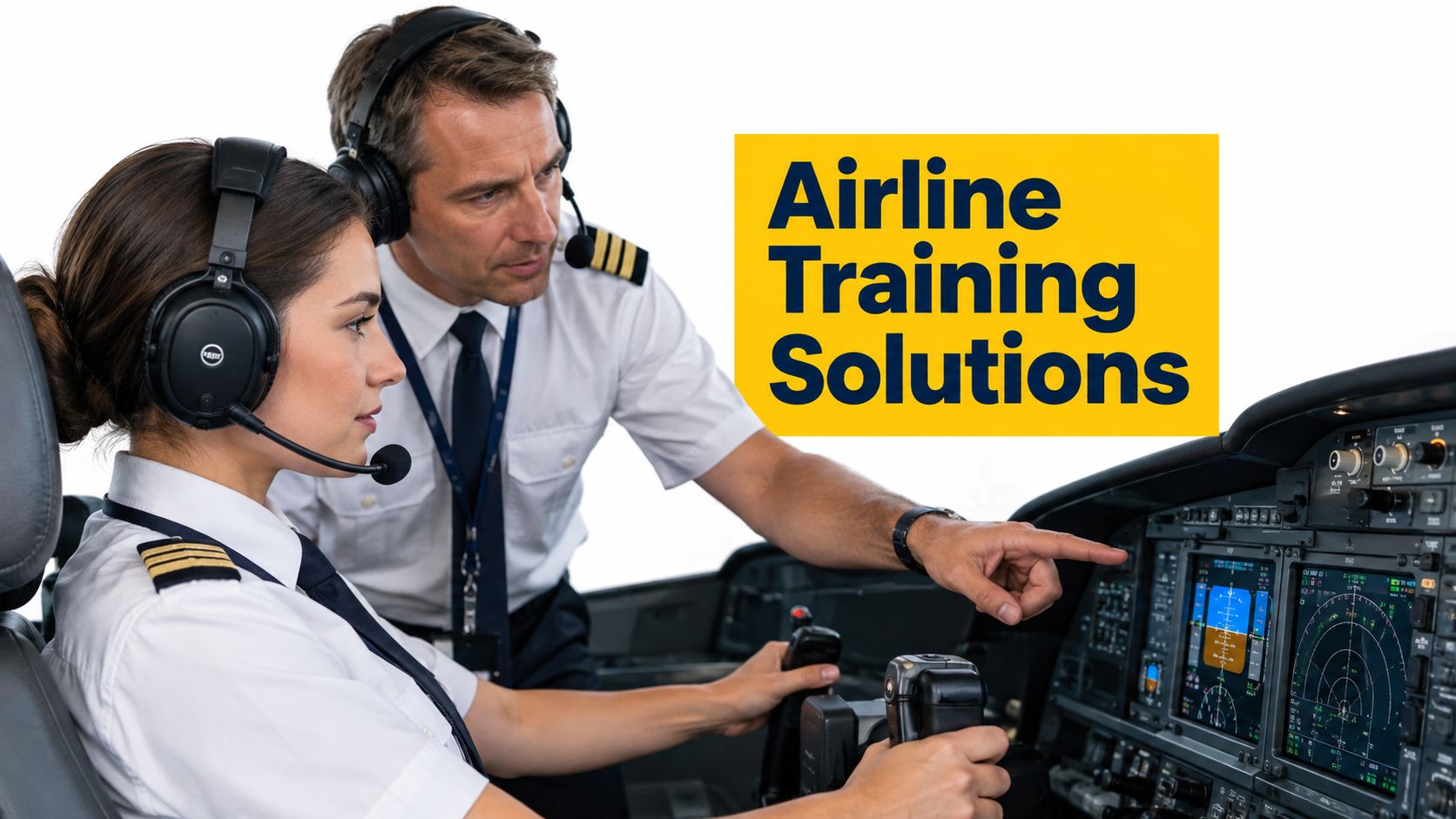
Australia's drone pilots have already overtaken traditional aviation pilots in number. In February 2024, CASA reported 33,388 licensed uncrewed pilots compared with 30,843 licensed crewed pilots, the first time drone pilots had outnumbered crewed-aircraft licence holders in Australia (CASA's student drone guide). That milestone changes how aviation organisations should think about airline training solutions. Training is no longer limited to airline flight decks. It now includes structured pathways for RPAS operators, aviation radio users, ground teams, safety personnel and businesses operating drones as part of their work.
The common principle remains the same across crewed and uncrewed aviation. Competence must be demonstrated, procedures must be repeatable, and training records must support safe, compliant operations. The aircraft may differ, but the need for sound judgement, communication, risk management and recurrent training does not.
Table of Contents
- What Airline Training Solutions Actually Mean in Australia
- Core Training Modalities Used Across Aviation
- CASA Licensing Pathways Every Buyer Should Understand
- Real-World Examples of Structured Aviation Training
- How to Choose the Right Training Provider
- Workforce Capacity and Instructor Shortages
- Measuring Training ROI and Long-Term Compliance
- Matching Ace Aviation to Your Training Needs
- Frequently Asked Questions
What Airline Training Solutions Actually Mean in Australia
By August 2025, CASA had issued more than 40,000 Remote Pilot Licences, while drone registrations increased 18% year on year between 2023-24 and 2024-25, according to the same CASA guide. Those figures show why airline training solutions now need to address both traditional flight operations and Australia's expanding commercial drone sector.
An airline training solution is an organised system for building, checking and maintaining aviation competence. In a crewed-aircraft organisation, it may cover flight crew instruction, type-related training, simulator sessions, cabin crew preparation, ground operations, safety and emergency procedures, crew resource management, checking and recurrent assessments. For RPAS teams, the same structure applies through remote pilot licensing, aviation radio communication, operating procedures, risk controls and practical flight competence.
A course provides instruction. A training solution connects that instruction to performance. A classroom session may explain a regulation, but it cannot by itself show whether an operator can apply the rule during changing weather, a communications failure or a time-sensitive mission. The complete cycle is knowledge, practice, assessment and ongoing currency. Like a flight plan, it gives each stage a defined purpose and a way to confirm that the learner is ready for the next one.
One aviation system with different pathways
Australia combines a mature crewed-aircraft sector with a fast-growing commercial drone field. RPAS operations sit within the CASA framework, including the rules for remotely piloted aircraft under Part 101 and the wider operational context of Part 102. Airline and general aviation pathways use their own licences and competency structures, yet both require formal instruction and evidence that a person can perform safely.
The training pathway should match the operation. A remote pilot supporting agriculture may need practice with mission planning, site hazards and communications. An airline crew requires coordinated procedures, aircraft-specific knowledge and recurrent checking. An emergency services unit may need both, adapted to pressure, changing conditions and multiple agencies.
Why competency-based training matters
Australian aviation education has developed through regulated progression. Industry Skills Australia reported that enrolments in aviation qualifications had grown by about 46% per year since 2017 (Industry Skills Australia aviation workforce plan). This growth reflects demand for structured skills across pilot, maintenance and operations roles.
Training buyers should examine four practical points:
- What competence is assessed? Separate written knowledge, practical flying, radio communication and operational judgement.
- How is currency maintained? Regular practice helps prevent procedures and decision-making skills from deteriorating.
- How are records managed? Accessible evidence supports governance, audits and operational reviews.
- Does the programme reflect the operation? Airline crews, agricultural drone teams and emergency services units face different risks.
Strong airline training solutions apply consistent compliance and competency principles across crewed and uncrewed aviation, while keeping instruction tied to the work people must perform.
Core Training Modalities Used Across Aviation
Aviation providers rarely rely on one delivery method. They combine several modalities because each solves a different training problem. Classroom instruction can establish concepts, simulation can create safe practice, and supervised flight can demonstrate whether a learner can perform under operational conditions.
Simulation and instructor-led learning
Simulator training gives flight crew a controlled environment for practising abnormal and emergency procedures. A crew can rehearse decision-making, workload management and communication without exposing an aircraft or passengers to the consequences of an error. Simulation is particularly useful for recurrent training because it allows instructors to repeat difficult scenarios consistently and observe how crew members respond.
Classroom and instructor-led learning establish the theoretical base. Topics can include aerodynamics, airspace, aviation safety, human factors and CASA requirements. This modality suits subjects that require explanation and discussion, especially when learners need to ask questions about how a rule affects a real operation.
E-learning, CRM and safety practice
E-learning and learning management systems help providers deliver trackable modules to geographically dispersed crews and remote operators. Digital lessons can prepare learners before a practical session, record completion and identify knowledge gaps for instructors. Delivery choices should be matched to the task. A useful comparison of e-learning vs VILT pros and cons can help managers distinguish between flexible digital study and live virtual instruction.
Crew resource management, or CRM, addresses the human behaviours that support safe operations. It covers communication, leadership, decision-making, situational awareness and the management of workload. These skills matter in an airline cockpit, but they also matter when a drone operator coordinates with a spotter, incident controller, air traffic service or ground team.
Safety and emergency procedures training provides another layer. Depending on the role, it can include evacuation, firefighting, first aid, emergency communications and responses to equipment failure. Practical rehearsal is important because a written procedure doesn't guarantee effective performance under pressure.
Blended delivery for RPAS operations
Drone training commonly combines theory, supervised practical flying and assessment. Operators must understand the operating environment before they can make safe decisions in the field. Practical flight training then tests whether the learner can apply that knowledge while managing the aircraft, the mission and surrounding risks.
A provider's aviation and drone course catalogue can help buyers compare how these components are arranged. For beginners, ACE READY covers drone fundamentals, aviation safety, CASA regulations and flight operations while preparing learners for advanced RePL training in Australia.
A useful programme should make the relationship between each modality explicit:
| Training modality | Main purpose | Suitable application |
|---|---|---|
| Simulation | Rehearse complex or abnormal scenarios safely | Airline checking and recurrent crew training |
| Classroom instruction | Build theoretical knowledge and regulatory understanding | Initial aviation and RPAS ground school |
| E-learning | Deliver flexible, trackable preparation | Distributed teams and pre-course learning |
| CRM | Develop communication and decision-making | Multi-person crewed and uncrewed operations |
| Practical flight training | Demonstrate applied competence | RPAS licensing and operational qualification |
| Safety and emergency procedures | Rehearse responses to urgent events | Airline, airport and commercial drone environments |
CASA Licensing Pathways Every Buyer Should Understand
Training decisions become clearer when each CASA credential is treated as a separate capability rather than as a general “drone licence”. The right combination depends on the aircraft, the purpose of the operation, the operating environment and whether the work is conducted for a business.
Remote Pilot Licence
A Remote Pilot Licence, or RePL, is required when a person wants to fly for a ReOC holder or operate a drone over 25 kilograms but under 150 kilograms over the person's own land, according to CASA's RePL requirements. CASA says an applicant must complete the theory component of an approved training course.
Practical flying is also a formal part of the pathway. CASA guidance requires at least 5 hours of logged live flight time under standard operating conditions on the relevant RPA category before a RePL can be granted (CASA remote pilot training guidance). This is why a theory-only programme isn't enough for a buyer seeking operational readiness.
Aeronautical Radio Operator Certificate
An Aeronautical Radio Operator Certificate, or AROC, applies to people who need to communicate on an aviation air-band radio frequency and aren't already licensed or qualified. CASA requires applicants to be at least 17, hold an aviation reference number, complete training, demonstrate competence and hold current English language proficiency at the specified level or an accepted GELP (CASA radio operator requirements).
For RPAS operations in controlled airspace, CASA identifies an AROC as an additional requirement alongside the RePL. Buyers should therefore check whether a proposed course covers radio communication or whether the AROC must be completed separately.
ReOC and crewed-aircraft pathways
A Remote Operator's Certificate, or ReOC, relates to the organisation conducting the operation rather than the individual flying the aircraft. A business considering regular commercial drone work should clarify whether it will operate under an existing ReOC holder or needs organisational support for its own operating framework. ReOC consulting can help a business organise the documentation, responsibilities and procedures required for a compliant operation, but the exact approval pathway depends on the proposed activities.
CASA also requires any drone used for business or as part of a job to be registered regardless of weight. Business users must also obtain operator accreditation and a RePL, as set out in CASA's drone registration requirements.
For crewed aviation, licences such as the Commercial Pilot Licence and Air Transport Pilot Licence sit within a progressive competency pathway, with aircraft-specific training and checking added where relevant. A buyer can use the licence finder to identify the likely starting point, then confirm the exact requirements with the training provider and CASA.
Real-World Examples of Structured Aviation Training
A training programme proves its value when a learner can transfer classroom knowledge into a controlled mission. The following examples show how the same sequence, theory, supervised practice, operational procedures and assessment, applies across different commercial drone environments.
An agricultural operator may begin with aviation safety, CASA requirements, pre-flight planning and the risks associated with working around people, property and chemicals. Practical training can then focus on documented pre-flight checks, calibrated spraying patterns and controlled chemical handling on properties across the Murray-Darling basin. The operational outcome isn't a completed flight. It is a repeatable process that supports compliance and reduces avoidable mission errors.
In surveying and mining, a RePL holder may need to combine flight planning with ground control point workflows and photogrammetry processing. A Queensland coal operation could use standardised briefings to ensure the pilot understands terrain, exclusion zones, equipment limitations and the intended data output before launching. The resulting orthomosaic is useful only when the flight and data-capture process has been controlled from the start.
Emergency services require a different emphasis. A drone unit may rehearse search grids, coordination with an incident controller, tethering procedures and night-vision transition checks during bushfire reconnaissance. Scenario-based practice helps the team respond to changing priorities while maintaining communications and separation from other aircraft and personnel.
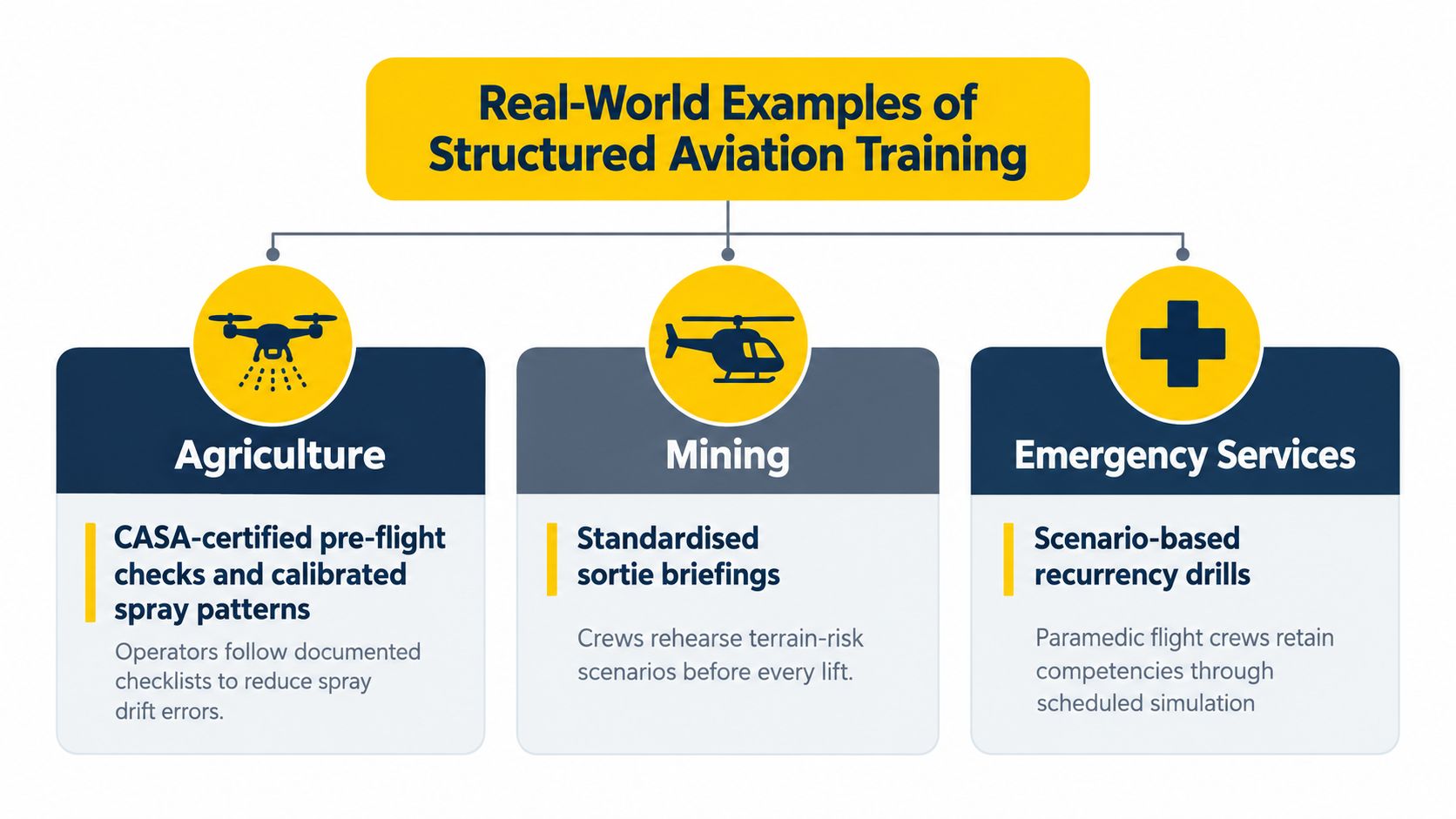
Each example links a training input to an operational output:
- Agriculture: Theory and practical checks support controlled, repeatable application work.
- Surveying and mining: Standardised flight planning supports dependable mapping and site information.
- Emergency services: Rehearsed scenarios help teams coordinate missions in dynamic conditions.
This is the central lesson for airline training solutions. Training should be designed around the decisions and actions that the operation requires.
How to Choose the Right Training Provider
Provider selection should begin with the operation, not the course title. A manager can list the aircraft, missions, airspace, locations, staffing model and required credentials, then score each provider against those needs. This approach prevents a low-cost or convenient course from being treated as suitable when it doesn't cover the relevant operational risks.
A practical evaluation framework
The provider should explain its approval status, the scope of its training, the assessment pathway and the currency of its learning materials. Buyers should also ask who delivers the practical instruction and whether instructors retain recent operational experience relevant to the intended sector.
Important checks include:
- Regulatory alignment: Confirm that the programme addresses the relevant CASA pathway and current operating requirements.
- Assessment evidence: Ask how theory, practical flying, radio communication and operational judgement are assessed.
- Instructor access: Establish how practical sessions are scheduled and how learners receive feedback.
- Delivery mix: Check whether classroom, e-learning, simulation and practical training are used for the right learning objectives.
- Ongoing support: Determine whether the provider can support recurrent CRM, safety training, operational updates or ReOC work where needed.
- Sector relevance: Look for examples connected to agriculture, surveying, mining, infrastructure or emergency services if those sectors match the business.
A provider that can't describe its syllabus, assessment records or instructor qualifications presents a governance risk. Vague claims about “industry-ready” training shouldn't replace clear evidence of what learners practise and what assessors record.
In-house and outsourced models
| Criterion | In-House Team | Outsourced Provider |
|---|---|---|
| Scheduling control | Strong control over internal priorities and recurrent sessions | Dependent on provider capacity and booking arrangements |
| Regulatory expertise | Must be developed and maintained internally | May provide specialised CASA and aviation knowledge |
| Simulator access | Requires internal investment and maintenance | May offer access without the organisation owning the platform |
| Fleet expansion | Can scale closely with established procedures if staff capacity exists | Can add external capacity, subject to availability |
| CRM and type support | Can be tailored closely to organisational culture | Can provide structured external facilitation and assessment |
| Records and governance | Records remain within the organisation's systems | Provider records must be integrated into internal governance |
An organisation developing internal credentials may also benefit from guidance on how to design a digital credential program, especially when it needs consistent evidence across locations. External reviews can add another perspective, and Ace Aviation reviews may form one part of a broader due-diligence process.
The final decision should reflect the fleet profile. A small operator may value specialist external instruction, while a larger organisation may combine internal induction with outsourced regulatory or recurrent training.
Workforce Capacity and Instructor Shortages
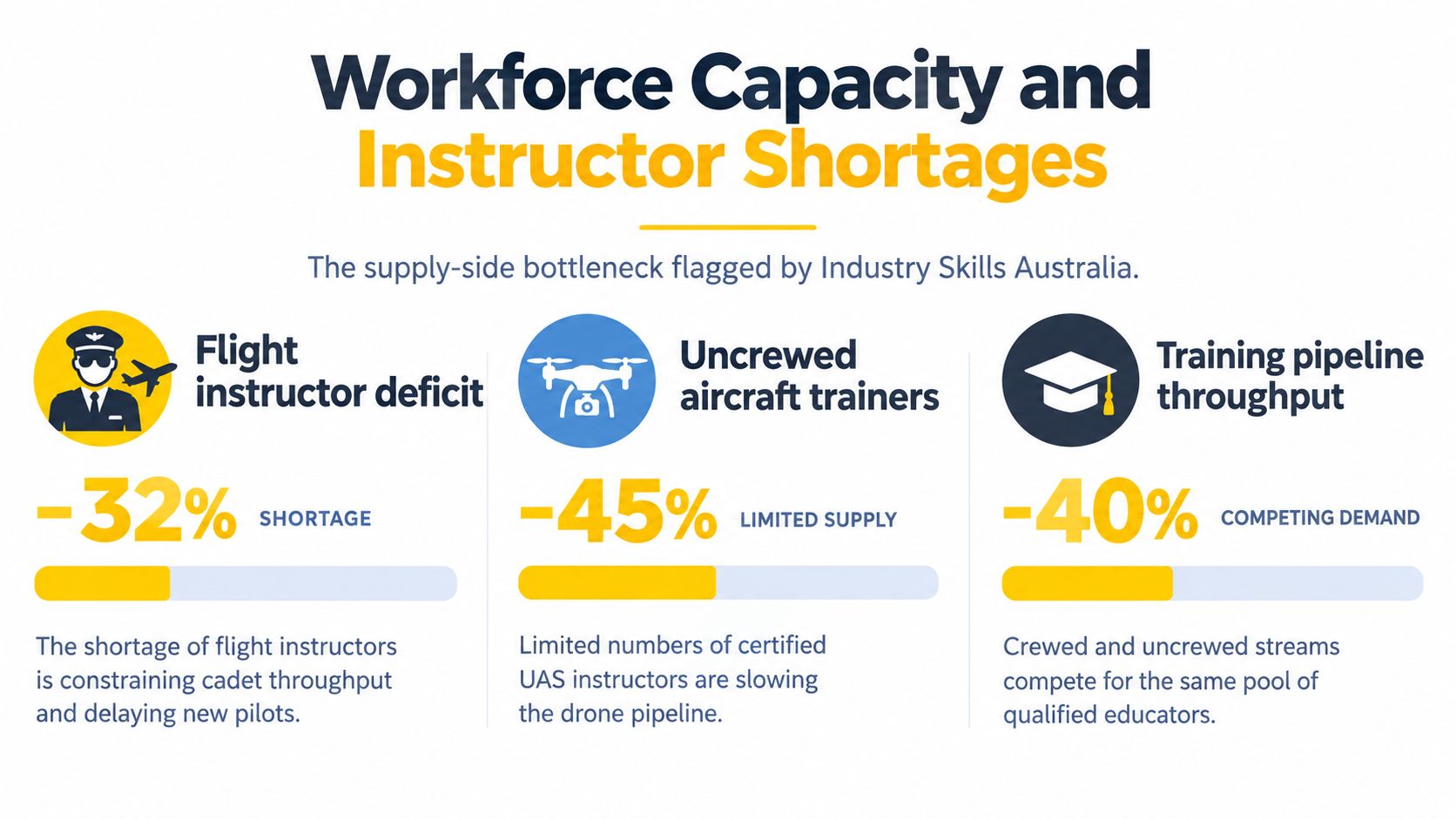
Training demand does not automatically create training capacity. Industry Skills Australia's workforce update identifies shortages among pilots, flight instructors, air traffic controllers and maintenance engineers. It also reports that the Diploma of Aviation (Flight Instructor) is being reviewed and updated in response to a national shortage of flight instructors, which is restricting pilot training capacity.
The same pressure reaches Australia's expanding RPAS and drone training ecosystem. Crewed and uncrewed aviation use different aircraft, yet both depend on qualified instructors, documented competency and evidence that each learner can operate within approved procedures. Without enough instructors, registered training organisations may struggle to schedule practical lessons, assessments and instructor development. Businesses increasing drone operations can then face longer booking lead times and less flexibility during operational peaks.
Planning around limited capacity
Managers can plan for the bottleneck while keeping training standards intact. Practical measures include:
- Build an instructor pipeline: Work with training organisations so experienced operators can progress towards instructional roles.
- Use blended preparation: Complete suitable theory and regulatory modules through e-learning before instructor-led practical work.
- Reserve cohorts early: Schedule training before seasonal demand, contract mobilisation or fleet expansion creates a rush.
- Retain internal capability: Develop qualified staff who can support induction, currency and procedure reinforcement inside the organisation.
- Separate training from deployment: Do not treat a newly enrolled learner as operationally ready until required assessment and supervised experience are complete.
The Australian Air Force Cadets' launch of CASA-accredited RPATS training in April 2025, followed by progressive delivery throughout Australia, shows how distributed training can extend access. The CASA student drone guide provides context for this initiative. The workforce question is therefore how compliant capacity can grow without weakening instruction or oversight.
Practical rule: Check instructor availability before promising a new service, contract or fleet capability.
Measuring Training ROI and Long-Term Compliance
Training return on investment should be measured through operational evidence rather than course completions alone. A completed module shows participation. It doesn't necessarily show that a crew communicates clearly, that a remote pilot follows a checklist or that an organisation can demonstrate control during an audit.
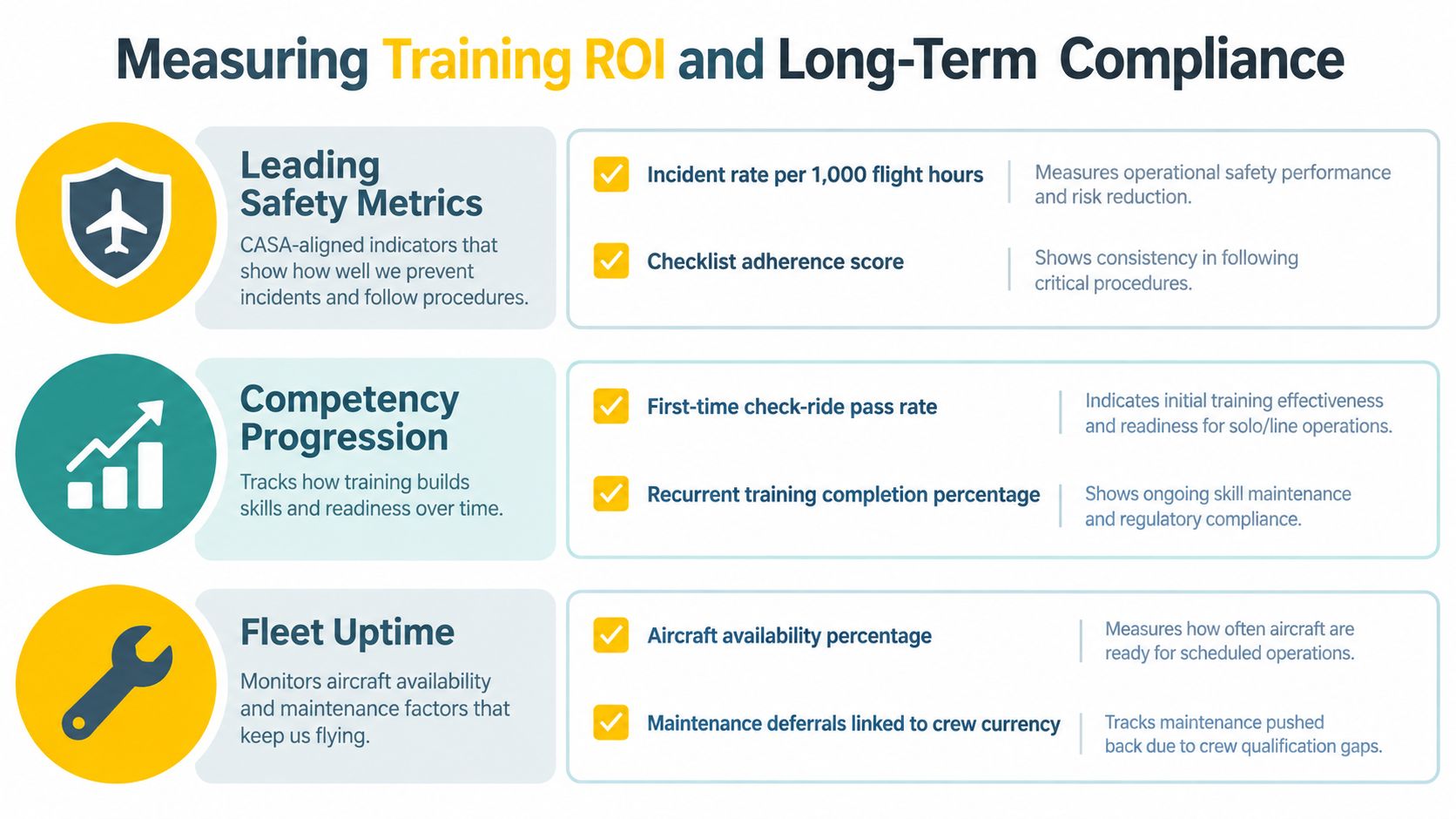
A useful measurement system connects three areas: safety, competency and availability. Each area should have an owner, a defined reporting method and a clear relationship to the operation's CASA obligations.
Safety and competency indicators
Leading safety indicators can include incident reports by flight or sector hours, checklist adherence, manual handling errors, hazard reports and the quality of post-flight debriefs. The aim is to identify weak controls before they become serious events. ATSB research identified 7,863 training-related safety occurrences between 2000 and 2019, with landing and approach phases more likely to generate occurrences than in broader general aviation (ATSB training safety research). That finding supports phase-specific practice and assessment rather than generic refresher training.
Competency measures can include recurring flight checks, first-time assessment outcomes, simulator performance, practical observation and documented CRM behaviours. Drone operators can also track completion of required practical training, radio competence where relevant and the currency of operational records.
Availability and reporting rhythm
Fleet uptime should be connected to training without pretending that training is the only cause of availability. Managers can examine whether crew currency, procedural errors or delayed competency checks contribute to cancellations, stand-downs or avoidable maintenance requests.
A practical reporting rhythm could include:
- Monthly competency dashboards: Show completed training, outstanding checks, assessment outcomes and currency status.
- Quarterly safety reviews: Examine trends, recurring errors, near misses and changes to operating conditions.
- Annual compliance audits: Test records, procedures, approvals and evidence against organisational requirements.
Drone businesses can use the quote calculator as part of early planning, then compare the expected training investment with measurable readiness and compliance outcomes. The exact indicators will differ between an airline and an RPAS team, but the management logic is consistent: define the required behaviour, observe it, record it and improve the training when results fall short.
Matching Ace Aviation to Your Training Needs
Ace Aviation Aerospace Academy can be assessed against the same criteria used for any aviation training provider. Its relevant focus is professional drone pilot education, aviation qualifications and industry certification, with offerings connected to RePL, AROC, ReOC consulting and broader aviation education. The practical fit depends on the buyer's operation, staff numbers, aircraft, locations and intended missions.
A single operator seeking a structured entry into commercial drone work has different needs from a government or enterprise team requiring coordinated training across multiple personnel. The evaluation should therefore examine the specific course scope, delivery method, assessment arrangements and support required before enrolment.
| Buyer Criterion | Ace Aviation Offering | Fit Notes |
|---|---|---|
| RePL pathway | Remote Pilot Licence training | Relevant to operators who need the CASA licensing pathway for applicable commercial or other regulated operations |
| Aviation radio capability | Aeronautical Radio Operator Certificate training | Relevant where personnel need to communicate on an aviation air-band frequency |
| Organisational compliance | ReOC consulting | Relevant to businesses reviewing their organisational drone operating framework |
| Entry-level preparation | ACE READY | Suitable for beginners learning drone fundamentals, safety, CASA regulations and flight operations before advanced RePL training |
| Enterprise requirements | Enterprise and corporate drone training | Should be matched to cohort size, locations, aircraft and recurring operational needs |
| Broader aviation education | Aviation qualifications and related training | Relevant to organisations building capability beyond a single drone credential |
The Ace Aviation approach can be compared with other providers using the earlier scoring framework. Buyers should ask for the exact syllabus, practical requirements, assessment evidence, instructor availability and arrangements for maintaining currency. Those questions matter more than a broad course label.
A sensible next step is to document the proposed operation, identify each required credential, separate initial training from recurrent training and request written course information. That process gives an individual pilot, commercial operator, government agency or aviation manager a defensible basis for choosing airline training solutions that support both competence and compliance.
Ace Aviation Aerospace Academy offers CASA-aligned drone education including RePL and AROC pathways, ReOC consulting, and training for enterprise and corporate operations. Organisations can review the relevant options and discuss training needs with Ace Aviation Aerospace Academy before selecting a programme.
Frequently Asked Questions
What are airline training solutions?
Airline training solutions are structured programmes that develop, assess and maintain aviation competence. They can include flight training, simulator work, classroom learning, e-learning, CRM, safety procedures, practical RPAS training and recurrent checking.
Is a RePL required for every drone flight in Australia?
No. CASA states that a RePL is required for people flying for a ReOC holder or operating a drone over 25 kilograms but under 150 kilograms over their own land. The exact requirements depend on the operation and the applicable rules.
Is an AROC required for commercial drone operations?
An AROC is required for anyone who needs to communicate on an aviation air-band radio frequency and isn't already licensed or qualified. CASA also identifies an AROC as an additional requirement for RePL operations in controlled airspace.
How much practical flight time is required for a RePL?
CASA guidance requires at least 5 hours of logged live flight time under standard operating conditions on the relevant RPA category before a RePL can be granted. The requirement is separate from theory training.
Does a business need to register a drone?
CASA says any drone used for business or as part of a job must be registered regardless of weight. Business users must also obtain operator accreditation and a RePL.
How should an organisation choose a training provider?
The organisation should compare CASA alignment, syllabus coverage, practical assessment, instructor experience, delivery methods, records management, recurrent support and sector relevance. The provider should be scored against the organisation's actual aircraft, missions, locations and staffing plan.