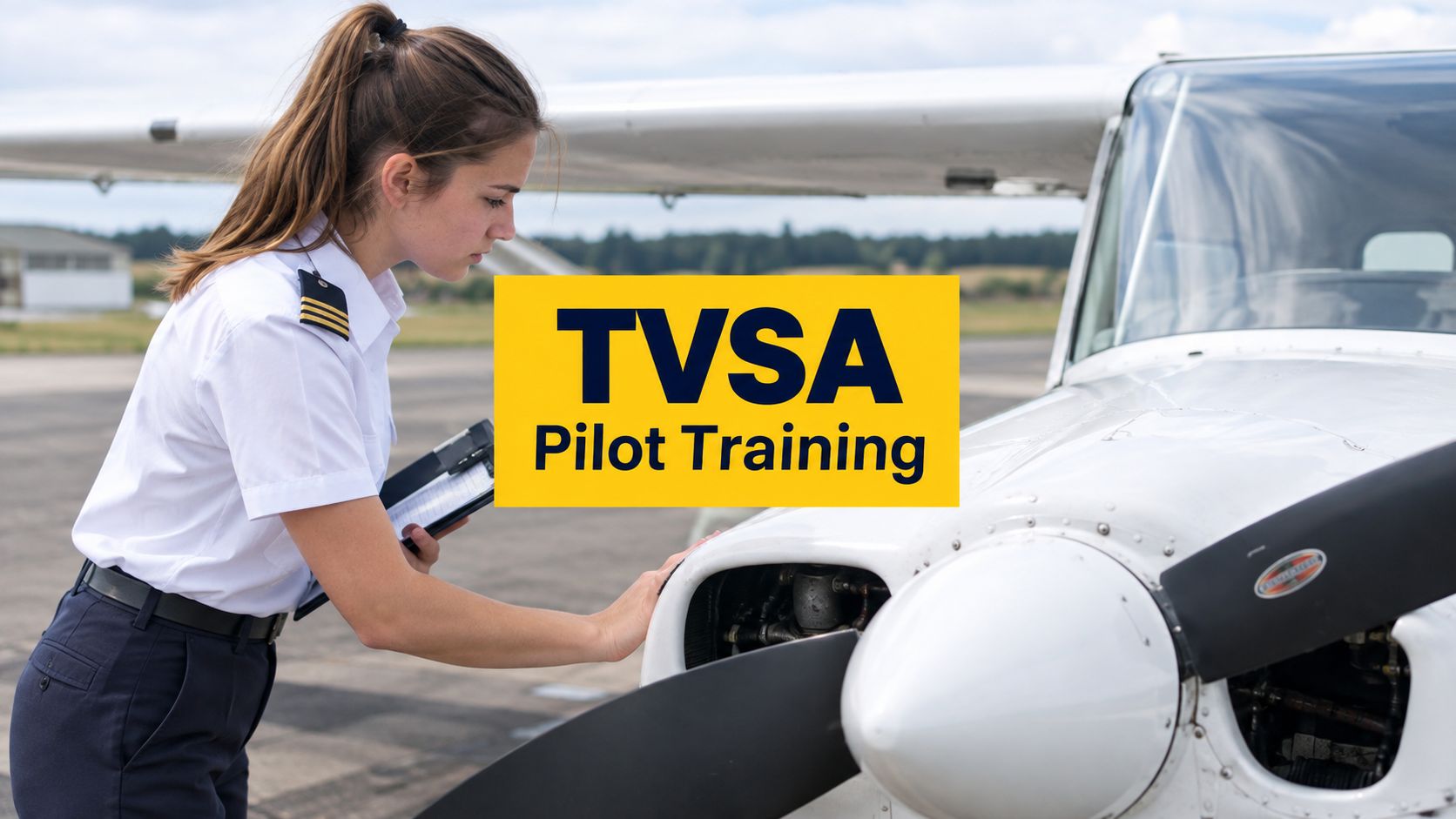
TVSA Pilot Training is a CASA Part 142 approved flight school based at Bacchus Marsh Aerodrome in Victoria, with published pathways ranging from about AUD 14,086 for an RPL to AUD 78,585 for a non-integrated CPL. Its integrated CPL syllabus is published around a minimum of 150 flight hours, while the non-integrated pathway uses 200 hours.
A prospective student comparing Victorian flight schools will usually be weighing more than aircraft availability. The important questions include how CASA approval affects training, which licence stage matches the intended career, whether a diploma is required, and how additional flying affects the final bill. TVSA provides a useful example for examining those decisions, but the same checks apply to any Australian aviation training provider.
Table of Contents
- What TVSA Pilot Training Is and Where It Operates
- How CASA Regulates Pilot Training in Australia
- The History and Registration Status of TVSA
- Course Pathways from RPL Through to Flight Instructor
- Comparing Integrated and Non-Integrated CPL Tracks
- Published Pricing and Completion Timelines
- Entry Requirements and the Path to an Instructor Rating
- How to Verify Any Australian Pilot Training Provider
What TVSA Pilot Training Is and Where It Operates
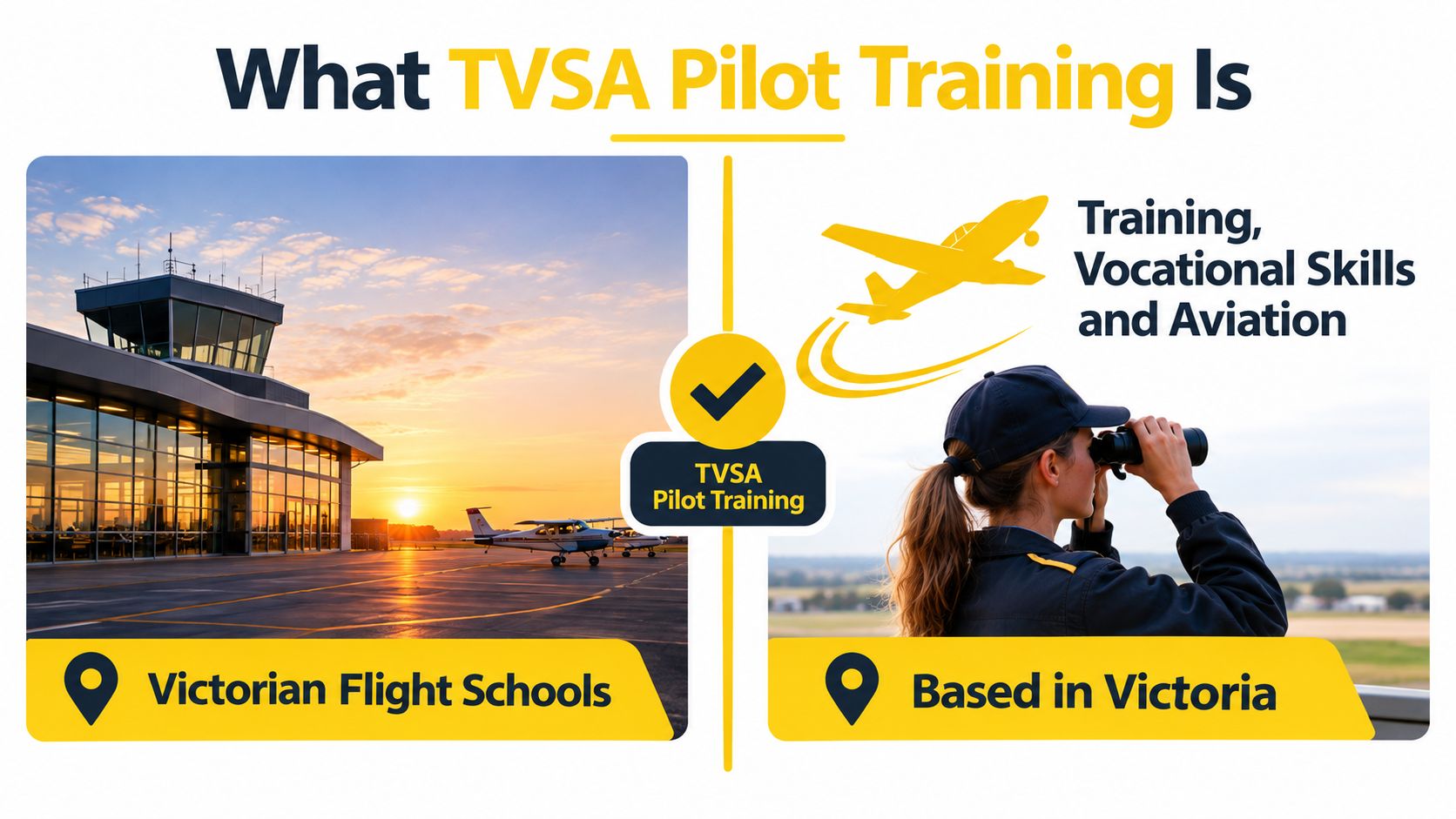
A student researching flight schools in Victoria may encounter several different business models, including flying clubs, independent instructors, registered training organisations and integrated aviation colleges. TVSA Pilot Training, which refers to Training, Vocational Skills and Aviation, sits within the regulated training environment and operates from Bacchus Marsh Aerodrome in Parwan, Victoria.
TVSA's published information covers a progression from recreational and private flying through commercial pilot training and flight instruction. The organisation also states that it flies seven days a week, a practical detail for students balancing employment, family responsibilities or other study. A schedule like that can provide more opportunities to maintain training continuity, although a student should still confirm aircraft availability, instructor allocation and weather procedures before enrolling.
What Part 142 means for a student
TVSA is listed as a CASA Part 142 approved training organisation. That approval is relevant because the organisation's training system is designed around an approved aviation syllabus rather than informal, lesson-by-lesson instruction. It doesn't mean every student will complete in exactly the same time. Weather, individual progress, aircraft serviceability and examination results still affect the experience.
The location also matters. Bacchus Marsh is a single operating base identified in the provider's registration material, so prospective students should assess travel time, accommodation, transport and the practical effect of attending regularly. Students comparing training locations can also review the Sydney aviation training location as part of a broader location comparison.
The useful starting point is therefore simple: TVSA is one regulated Victorian option, not the automatic choice for every student. The right comparison should include approval status, scope of training, published course structure, student support, aircraft access and the financial consequences of taking longer than the planned schedule.
How CASA Regulates Pilot Training in Australia
Australian pilot training has several layers of oversight, and students often confuse an aviation licence with a vocational qualification. CASA governs the aviation licensing environment, including the standards a pilot must meet to exercise particular privileges. A training organisation may also operate within the nationally recognised vocational education system, where the scope of an RTO determines which qualifications it can deliver.
The practical distinction is important. A CASA licence demonstrates that the pilot has met aviation requirements for a defined privilege. A Diploma of Aviation is a nationally recognised qualification delivered through an approved training framework. One doesn't automatically replace the other.
The main approval layers
| Approval Type | Regulator | What It Authorises |
|---|---|---|
| CASA pilot training approval | Civil Aviation Safety Authority | Delivery of approved aviation training within the organisation's authorised scope |
| Part 141 training framework | CASA | Approved non-integrated training arrangements and associated syllabus requirements |
| Part 142 training framework | CASA | Approved integrated and advanced training arrangements within the organisation's scope |
| RTO registration | Australian Skills Quality Authority framework | Delivery of nationally recognised vocational qualifications within the registered scope |
The table shows why a student should ask for the exact approval and course scope rather than relying on broad phrases such as “CASA approved”. An organisation might hold one approval while advertising a different course, aircraft category or qualification. The approval needs to match the training being purchased.
TVSA's Part 142 status is relevant to its integrated and non-integrated commercial pathways. Its published material describes an integrated CPL syllabus based on 150 flight hours, compared with 200 hours for the non-integrated syllabus, as documented in its pilot training frequently asked questions. Those different hour structures can change the schedule, training budget and way a student builds experience.
Students beginning with drone education face a separate CASA pathway. ACE READY is described as an entry-level drone course covering fundamentals, aviation safety, CASA regulations and flight operations before advanced RePL training. For broader regulatory context, an Australian learner can also consult this guide to drone laws in Australia.
The History and Registration Status of TVSA
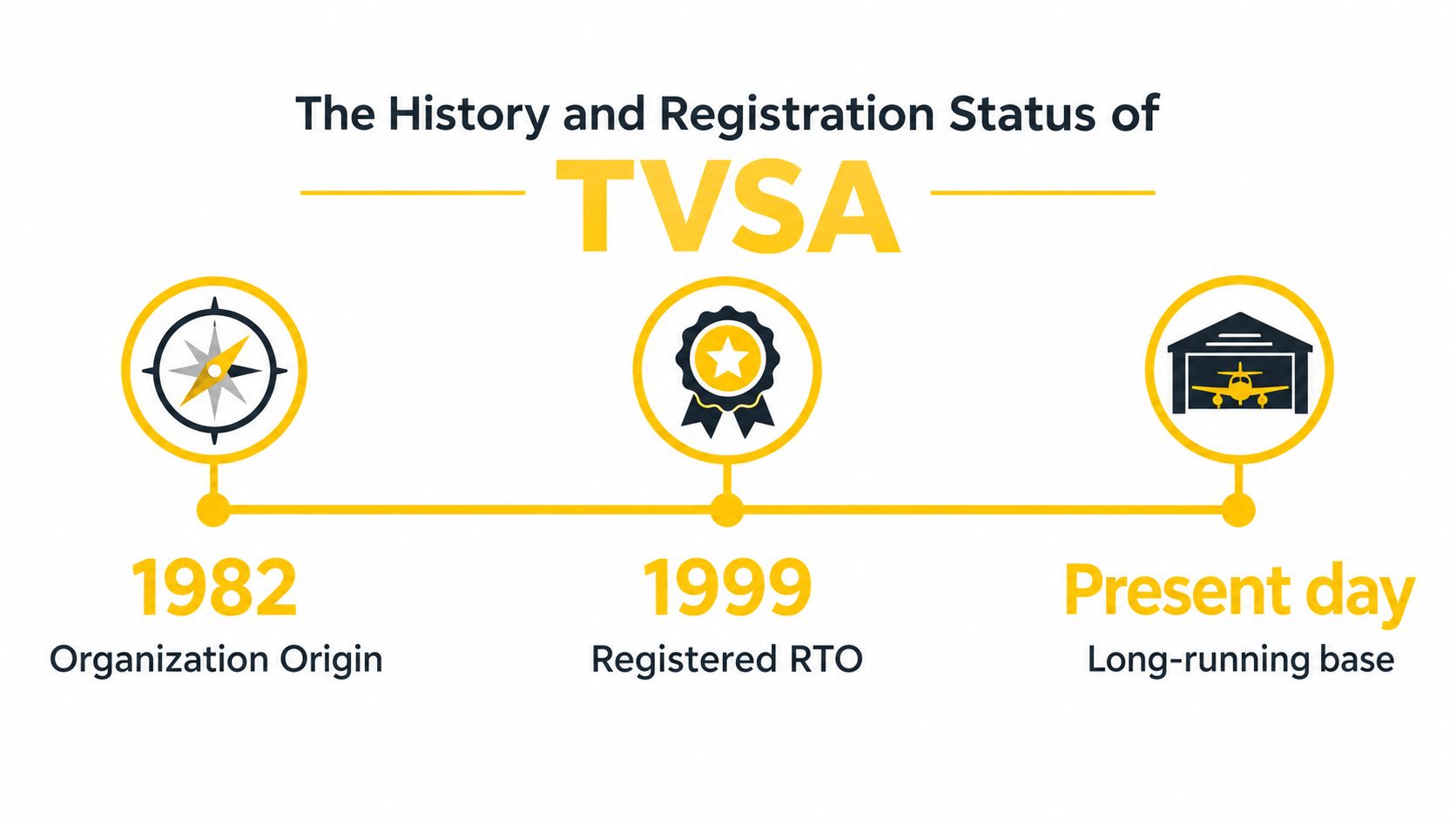
A school can have a long operating history and still require current verification. TVSA has operated since 1982, while its official training provider record gives an initial registration date of 5 August 1999. The registered training location is Bacchus Marsh Aerodrome in Parwan, Victoria. These details help establish continuity, but they do not confirm that a particular course, aircraft or intake is available today.
What the record can and cannot prove
The official record identifies the provider and its registered training location. It lists a registration period running from 1 August 2026 through 31 July 2033, so the current status should be confirmed directly on training.gov.au rather than copied from an older course page. The TVSA training provider record is the appropriate place to check registration information.
TVSA's own materials identify Longwarry as its first base and state that the school now flies seven days a week. Alongside the operating history, those details support a picture of continuity. They do not prove that every course, intake or aircraft is available at all times. A prospective student should still read the student handbook and confirm the arrangements for the selected course.
The published course structure includes the AVI50222 Diploma of Aviation Commercial Pilot Licence and the AVI50419 Diploma of Aviation Flight Instructor. Study Australia lists the commercial pilot diploma at about 14 months and the flight instructor diploma at 13 weeks full time. Actual completion depends on the delivery model selected and the student's progress.
History is one part of due diligence, much like checking an aircraft's logbook before relying on it. TVSA's long operation, Victorian aerodrome base and aviation and vocational registrations provide useful context. The decision should rest on the current approval scope, contract terms, aircraft access, instructor availability and total cost. The same checks apply to any CASA Part 142 training organisation, not only TVSA.
Course Pathways from RPL Through to Flight Instructor
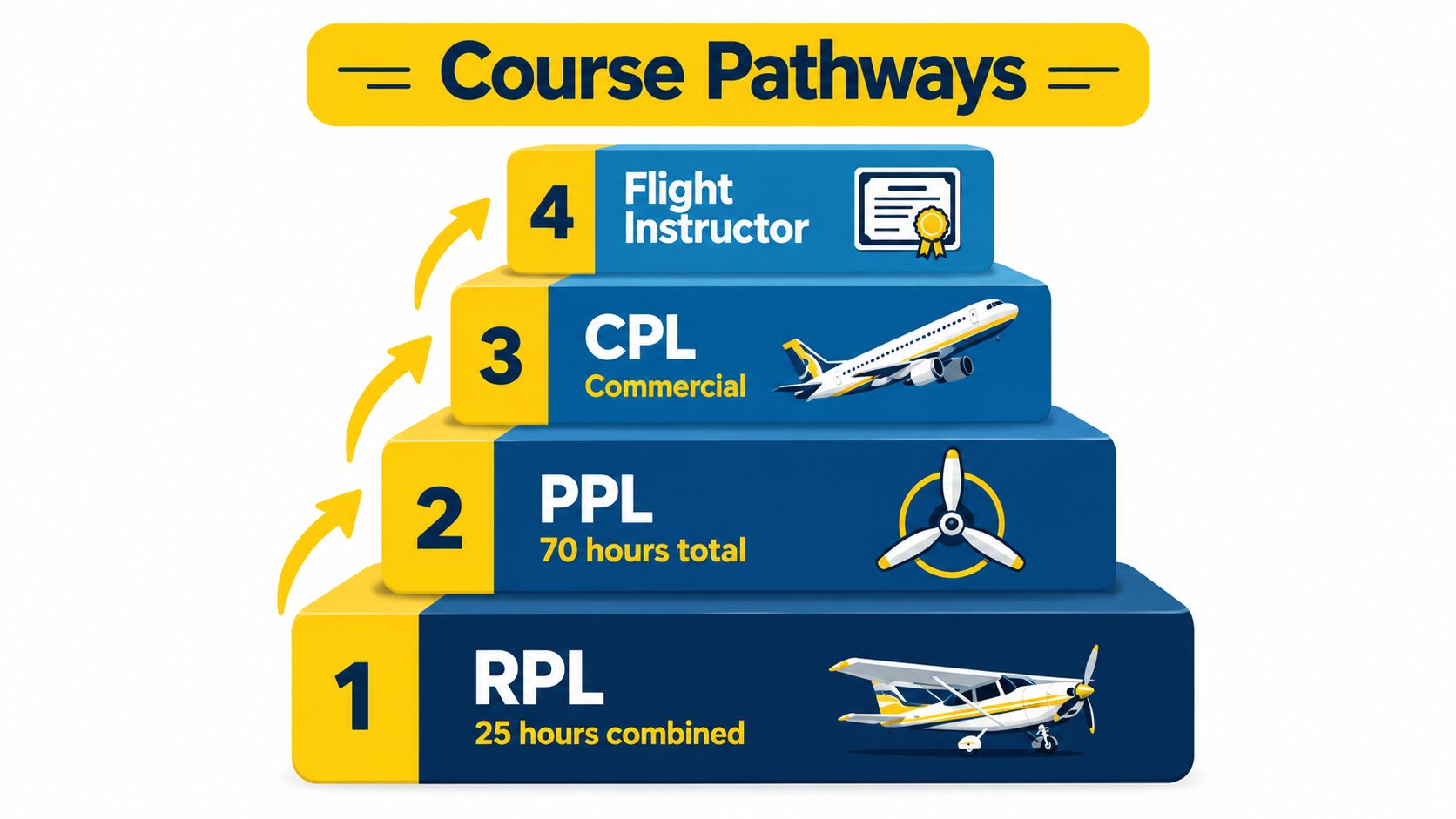
Pilot training works as a ladder, not a single purchase. Each licence introduces a different level of privilege and responsibility, and a student generally needs to meet the earlier standard before progressing to the next stage.
The Recreational Pilot Licence is commonly the first formal milestone for a person who wants to fly recreationally. The Private Pilot Licence supports broader private flying. The Commercial Pilot Licence is the key licence for paid commercial flying, subject to the conditions of the operation and any additional ratings or approvals. A Flight Instructor Rating then allows a suitably qualified pilot to teach within the authorised training environment.
Why the CPL structure differs
TVSA's published Part 142 information describes an integrated CPL pathway using 150 total flight hours, while its non-integrated pathway uses 200 hours. The difference is not just a discount for choosing a different timetable. It reflects the way an approved integrated syllabus combines flight training, theory, simulator work and structured progression.
TVSA's instructor pathway adds 39 flying hours, including simulator time, to the student's logbook. The provider also states that eligible commercial pilots entering the instructor pathway need 200 total flight hours and 100 hours as pilot in command. Those thresholds show why instructor training is a post-CPL development stage rather than a beginner course.
A student comparing aviation education with drone education should keep the qualification systems separate. ACE BRONZE is described as a foundation commercial drone course covering drone operations, flight safety, aviation theory and practical skills. It doesn't represent a step on the aeroplane RPL to CPL ladder.
A practical way to plan the ladder
A prospective student can assess the pathway in this order:
- Flying objective: Decide whether the goal is recreational flying, private travel, paid work or instruction.
- Training format: Compare an integrated structure with a modular program around employment or other commitments.
- Experience requirements: Check the logbook thresholds before assuming that a short specialist course leads directly to employment.
- Next qualification: Identify whether the next step is a licence, rating, diploma or operational approval.
The current course information can be compared with other aviation education options through the Australian aviation courses catalogue. The important point is that every stage has a different purpose. A lower licence level may suit a recreational objective, while a commercial career requires a longer and more demanding sequence.
Comparing Integrated and Non-Integrated CPL Tracks
TVSA's two commercial delivery models illustrate a common Australian training decision. An integrated course is organised as a continuous full-time program, while a non-integrated course breaks the training into modules that can be completed around work or other commitments.
The published TVSA handbook describes a 47-week full-time model and a 76-week part-time model, alongside a non-integrated CPL option. The handbook also gives an estimate of 12 to 24 months to reach a CPL, showing that the planned calendar and the final completion date aren't always identical.
| Factor | Integrated CPL | Non-Integrated CPL |
|---|---|---|
| Published hour structure | Minimum 150 total flight hours | 200 total flight hours |
| Published delivery example | 47 weeks full time | 76 weeks part time |
| Scheduling | More continuous and cohort-based | More modular and adaptable |
| Main student trade-off | Greater commitment to a planned timetable | More flexibility, with greater exposure to interruptions |
| Financial planning | Larger concentrated training commitment | Costs spread over a longer period, with more hours in the published structure |
The integrated route can suit a student who can commit consistently to full-time study, ground training and flying. A non-integrated route may be more practical for someone who needs to retain employment or manage family responsibilities. Neither format eliminates the possibility of extra lessons, delays or revised scheduling.
The licensing outcome and the training experience should be assessed separately. Students comparing regulatory frameworks may find this explanation of which flight training path fits best useful, particularly when comparing structured and modular study.
Practical rule: The cheaper-looking timetable isn't necessarily the cheaper completed licence. The relevant comparison is the total published hours, the schedule a student can realistically maintain and the provider's process for extra training.
Before paying a deposit, a student should request a written breakdown covering aircraft hire, instructor time, simulator charges, theory units, examinations, equipment and likely administrative fees. A clear timetable is useful, but it isn't a guarantee of completion on a particular date.
Published Pricing and Completion Timelines
TVSA's published figures show why “how much does pilot training cost?” has no single answer. The amount changes sharply between licence levels because each stage involves a different amount of flying, theory and assessment.
The figures below are approximate published totals and should be confirmed directly with the provider before enrolment. The source for the licence pricing and timing is TVSA's Australian pilot training cost guide, while the non-integrated CPL structure is also described in the provider's student handbook.
| Course | Approx. Published Fee (AUD) | Typical Duration | Training Hours |
|---|---|---|---|
| RPL | 14,086 | 3 to 6 months | Licence-specific training hours |
| PPL | 26,961 | Not stated in the verified material | Licence-specific training hours |
| Non-integrated CPL | 78,585 | 12 to 24 months | 200 total hours |
| Integrated CPL | Not stated as a total fee in the verified material | 47 weeks full time | 150 total hours |
| Flight Instructor diploma | Course cost should be confirmed directly | 13 weeks full time | 39 hours, including simulator time |
A student shouldn't compare only the classroom component. Aircraft hire, instructor briefings, simulator exposure and the number of hours required to reach the relevant standard drive much of the final cost. A student who needs additional flying beyond the planned syllabus should expect the final total and completion time to change.
The post-CPL instructor route also requires careful budgeting. The published instructor structure is a specialist upgrade built on existing commercial experience, so it shouldn't be treated as part of the beginner licence price. Students reviewing international explanations of training expenses can use this CFII training cost breakdown as a comparison resource, while still applying Australian CASA and provider-specific requirements.
Other expenses may include medical assessments, an Aviation Security Identification Card, a headset, travel, accommodation, examinations and personal study materials. A student can use an aviation training quote calculator to organise questions, but the provider's written quotation and enrolment agreement remain the controlling documents.
Entry Requirements and the Path to an Instructor Rating
The most important entry question is whether the student can satisfy the applicable aviation and education requirements for the selected course. Entry conditions can include English proficiency, education background, medical certification and age-related CASA requirements, but the exact requirements vary by licence, course and applicant circumstances.
The published verified material gives the clearest detail at the commercial and instructor stages. A commercial pilot considering the instructor pathway must already have substantial logged experience. TVSA's published information identifies 200 total flight hours and 100 pilot-in-command hours as CASA-aligned thresholds for eligible commercial pilots entering the instructor pathway.
The logbook is the progression record
A student's logbook is more than a record of aircraft time. It allows the training organisation and regulator to confirm whether the required experience has been built in the relevant categories before the student attempts a higher licence or rating.
| Stage | Total Hours | PIC Hours | Cross-Country |
|---|---|---|---|
| Beginner training | Recorded progressively | Recorded progressively | Recorded progressively |
| Commercial eligibility | 200 hours | 100 hours where applicable | Confirm the current course and CASA requirement |
| Flight Instructor pathway | Built on commercial eligibility | Confirm the current rating requirements | Confirm the current course and CASA requirement |
The instructor diploma adds 39 flying hours, including simulator time, according to TVSA's published course information. That figure describes the additional instructor pathway component, not the entire history of the student's flight training.
A new instructor also needs more than aircraft handling. The pathway involves aeronautical knowledge, lesson planning, teaching technique, briefing and debriefing, risk management and observed instructional performance. The exact assessment and practice-teaching arrangements should be confirmed in the current course documents rather than assumed from a general description of a Grade 3 instructor route.
Before enrolling, a student should:
- Check the approval: Confirm that the intended course sits within the provider's current CASA approval.
- Check the qualification: Confirm the diploma code and RTO scope on training.gov.au.
- Request the handbook: Read the entry rules, assessment process, refund terms, equipment list and extra-fee policy.
- Check medical suitability: Obtain appropriate aviation medical advice early, particularly if commercial flying is the objective.
An instructor rating can provide a structured way to gain further operational experience after the CPL. It isn't an automatic airline pathway, and future employers will assess the full record, including qualifications, experience, instrument capability, professionalism and recruitment requirements.
How to Verify Any Australian Pilot Training Provider
The same due diligence process works for TVSA and for other Victorian, interstate or international providers advertising Australian training pathways. The student's objective is to confirm three separate things: the organisation's aviation approval, its vocational registration and the commercial terms of the course.
A three-step verification process
First, confirm the CASA approval. The provider should identify whether it operates under Part 141 or Part 142 and what training the approval covers. A Part 142 approval is relevant to TVSA's published integrated and non-integrated CPL structures, but a student should still confirm that the specific course, aircraft category and location are included in the current scope.
Second, check the RTO record. Search the organisation on training.gov.au and compare the provider name, registered location and qualification codes with the course being advertised. Registration can confirm that a qualification is within the recorded vocational framework, but it doesn't guarantee a particular instructor, aircraft, timetable or employment outcome.
Third, read the student handbook before paying. The handbook should explain entry requirements, attendance, assessment, additional training, cancellation, refunds, equipment and the process for handling delays. If the advertising language is broader than the written approval or contract, the written documents deserve priority.
A student can use an aviation licence and training finder to organise the initial comparison. The tool doesn't replace CASA confirmation or a direct review of the provider's documents.
Frequently asked questions
Is TVSA Pilot Training a CASA approved organisation?
TVSA is identified in the verified material as a CASA Part 142 approved training organisation. Students should confirm the current approval scope for the exact course before enrolling.
Where is TVSA based?
The current registered training location is Bacchus Marsh Aerodrome in Parwan, Victoria. Travel, transport and regular attendance should be considered before a student commits to a course.
How many hours does the TVSA CPL require?
TVSA's published structure describes an integrated CPL around 150 total flight hours and a non-integrated pathway using 200 hours. The applicable structure depends on the course selected.
Is the Flight Instructor pathway suitable for a beginner?
No. The instructor pathway is a post-CPL milestone. TVSA's published information identifies 200 total flight hours and 100 pilot-in-command hours for eligible commercial pilots entering that pathway.
Does a diploma replace a pilot licence?
No. A Diploma of Aviation is a vocational qualification, while a CASA pilot licence is an aviation credential. A student should confirm how the selected course delivers both components.
Ace Aviation Aerospace Academy offers CASA-compliant drone education, including Remote Pilot Licence training, Aeronautical Radio Operator Certificate training and ReOC consulting for relevant operators. Prospective drone pilots, businesses and aviation teams can review the available pathways by visiting Ace Aviation Aerospace Academy.