A surveying business in New South Wales is comparing two mapping platforms. One has an advertised take-off weight of 1.9 kg. The other is a more capable enterprise aircraft listed at 2.1 kg. The difference looks minor on a purchasing spreadsheet, but it crosses a CASA weight boundary and may change the operator's registration, pilot, radio and operating requirements.
That's why drone size regulations in Australia can't be reduced to the aircraft's marketing label or its empty weight. CASA uses maximum take-off weight, and the relevant figure includes the aircraft as it will operate. A camera, mapping sensor, spray system, battery or other equipment can move a platform into a different category.
The practical rule is simple: identify the aircraft's operational mass first, then select the appropriate compliance pathway. The sections below walk through the thresholds, explain what changes at each boundary, and show why weight now matters to future BVLOS planning as well as today's operations.
Table of Contents
- Why Drone Size Shapes Every Australian Operation
- CASA Weight Categories and Their Exact Thresholds
- Measuring Operational Mass the Right Way
- Licensing, Accreditation, and Radio Requirements by Size
- How Drone Size Affects BVLOS and Future Rules
- A Practical Compliance Checklist for Commercial Operators
- Two Operator Scenarios That Show Size in Action
- Key Takeaways and Where Training Fits In
- Frequently Asked Questions
Why Drone Size Shapes Every Australian Operation
A commercial operator can buy two drones for the same mapping task and still face different compliance work. The reason is similar to choosing between a small car and a heavy truck: both use roads, but their mass changes the rules that apply. For remotely piloted aircraft, CASA's starting point is the aircraft's maximum take-off weight.
CASA divides remotely piloted aircraft into five categories: micro, very small, small, medium and large. The key boundaries are 250 grams, 2 kilograms, 25 kilograms and 150 kilograms. Crossing one can change the available compliance pathway, even when the difference seems minor on a purchasing spreadsheet. CASA's weight-category guidance explains the categories and related requirements.
Weight also shapes decisions beyond registration. It can affect whether a pilot follows an accreditation pathway or needs a Remote Pilot Licence (RePL), and whether the business is better suited to an RePL-based operation or a Remote Operator Certificate (ReOC) pathway. It can also bring radio requirements into the planning, particularly for RPA over 2 kg.
The effect reaches future planning. A heavier aircraft may alter how an operator assesses eligibility for a BVLOS trial pathway, while future ADS-B OUT proposals could create further equipment or operating questions. These are not purchasing details to resolve after delivery. They belong in the aircraft-selection discussion.
The purchase decision has lasting consequences
A platform's operational mass can influence:
- Pilot preparation, including the intended RePL or ReOC pathway.
- Airspace planning, including restrictions around controlled airports.
- Radio competency, where the aircraft is over 2 kg.
- Future operations, including BVLOS trial eligibility and responses to future ADS-B OUT proposals.
A boundary is not a rounding issue. A drone just below it and one just above it may require different records, training or controls. Check the aircraft, batteries, payload and accessories as one flight-ready system.
Practical rule: The aircraft's flight-ready maximum take-off weight matters more than the number printed in a product brochure.
CASA Weight Categories and Their Exact Thresholds
CASA's weight categories work like gates in an operating plan. Crossing one can change the training, registration, radio, airspace and operating pathway available to you. The category is based on the aircraft's maximum take-off weight, not just its frame size or the label on the box.
The five key boundaries
- Micro: Up to and including 250 grams.
- Very small: More than 250 grams up to and including 2 kilograms.
- Small: More than 2 kilograms up to and including 25 kilograms.
- Medium: More than 25 kilograms up to and including 150 kilograms.
- Large: More than 150 kilograms.
These thresholds should be read as hard regulatory boundaries. A platform at 2 kilograms remains in the very small category, while one just above 2 kilograms enters the small category and can bring additional radio considerations. The same principle applies at 25 kilograms, where the pathway changes again.
| Weight Band | Threshold | Registration Required | Key Compliance Shift |
|---|---|---|---|
| Micro | Up to and including 250 g | Recreational treatment differs from work operations | The 250 g boundary affects recreational registration and accreditation |
| Very small | More than 250 g to 2 kg inclusive | Required for business use | Standard operating conditions may apply, with accreditation for business operations |
| Small | More than 2 kg to 25 kg inclusive | Required for business use | Additional radio considerations can apply above 2 kg |
| Medium | More than 25 kg to 150 kg inclusive | Required | A RePL for the type of drone is generally required |
| Large | More than 150 kg | Requires substantial regulatory treatment | The aircraft falls outside the standard listed size categories |
The 250 gram boundary also matters for airport planning, because drones over 250 grams cannot operate within 5.5 km of a controlled airport unless the applicable rules and approvals allow it. CASA's drone safety rules explains the relevant operating conditions.
Weight does not decide only the aircraft's category. It can influence whether an operator uses an accreditation pathway, pursues a Remote Pilot Licence (RePL), or develops an operation under a Remote Operator Certificate (ReOC). It may also affect eligibility for a BVLOS trial pathway. Future ADS-B OUT proposals could introduce further equipment or operating questions, so these thresholds belong in the aircraft-selection decision.
An operator considering a platform near 25 kilograms should review the training implications before purchase. The 25 kg upgrade course information can help identify the relevant training pathway, after which the current CASA requirements for the aircraft and operation should be confirmed. A threshold is not a rounding issue. Treat the aircraft as a flight-ready system, and apply the correct category to the intended configuration.
Measuring Operational Mass the Right Way
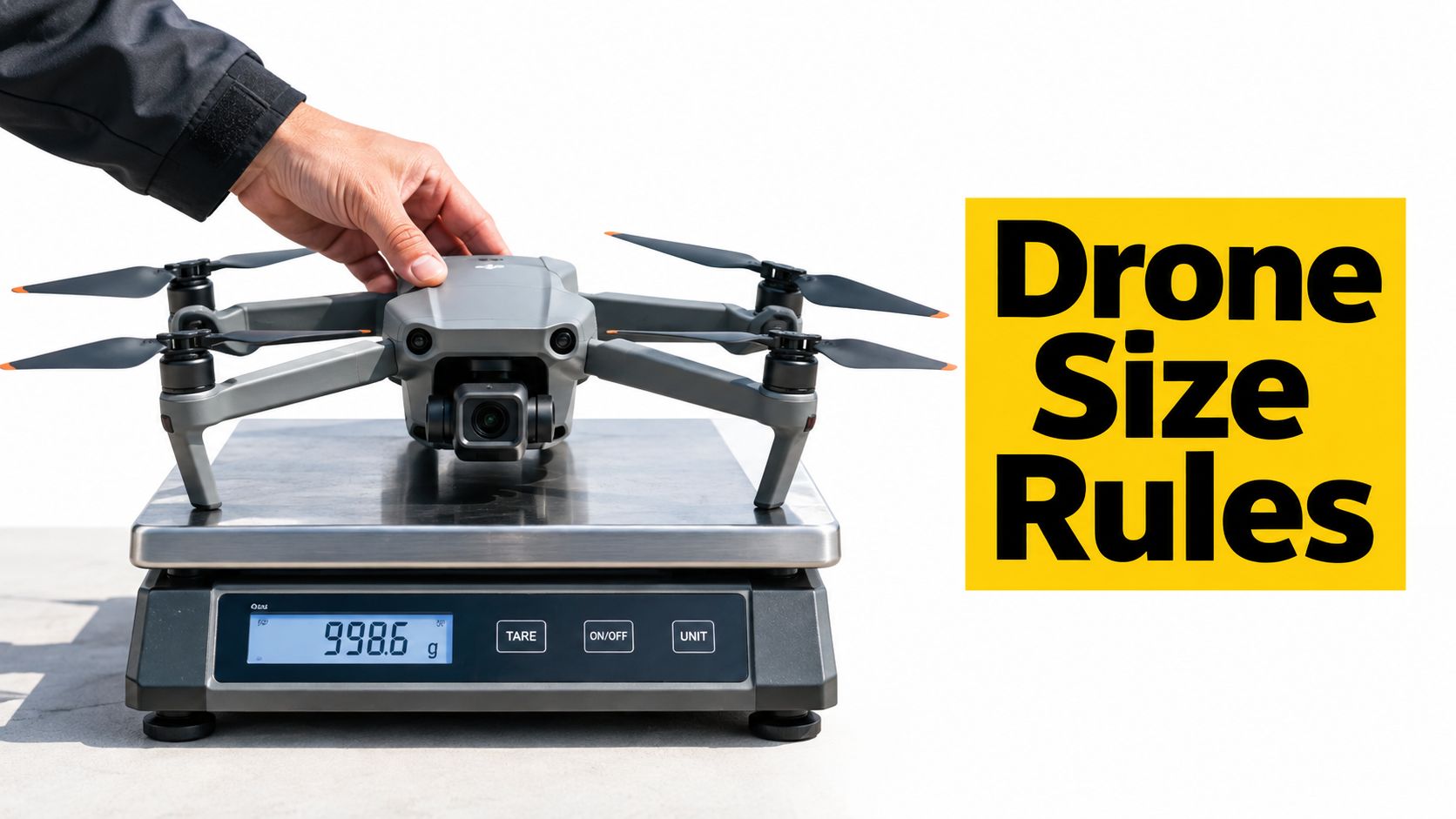
The most common weight mistake is measuring the aircraft in its lightest configuration and treating that figure as the operational mass. That approach can produce the wrong category.
For compliance purposes, the relevant question is what the aircraft weighs at maximum take-off in the configuration used for the mission. The calculation should account for the airframe, batteries, payload and equipment that remains fitted during flight. A fleet manager should include mapping sensors, protective cages, spray equipment, counterweights and other application hardware.
Build a flight-ready weight record
A reliable process follows these steps:
- Identify the heaviest intended battery configuration. A larger battery can increase the aircraft's take-off mass even when it's sold as an optional accessory.
- Add every payload. Cameras, multispectral sensors, LiDAR equipment and spray systems belong in the calculation.
- Include fitted safety and support equipment. Protective structures, recovery equipment and other attached accessories remain part of the operational configuration.
- Weigh the complete aircraft. Use calibrated scales and record the result before a new payload or battery combination enters service.
- Compare the result with the CASA boundaries. Don't round down to remain in a lighter category.
The mass should reflect the aircraft at the moment of take-off, including the relevant battery or fuel state and any detachable accessory that remains fitted for the flight. A payload change can therefore create a new compliance question even when the aircraft itself hasn't changed.
Operational discipline: A weight record should describe the aircraft that actually leaves the ground, not the aircraft as delivered by the manufacturer.
For beginners building a foundation before advanced licensing, ACE READY covers drone fundamentals, aviation safety, CASA regulations and flight operations, with preparation for advanced RePL training in Australia.
Licensing, Accreditation, and Radio Requirements by Size
Commercial operators should separate three questions that are often blended together: who may fly, which operator framework applies, and what communications competency is required. The answer depends on the aircraft, the purpose of the operation and the conditions under which the flight will occur.
A very small aircraft can operate for business under specified standard operating conditions, but CASA requires the operator to obtain accreditation and register the aircraft. This pathway is not the same as recreational flying. It also doesn't mean that a light aircraft can be used for every commercial mission.
A RePL becomes increasingly relevant as the aircraft and operation require formal pilot competency. CASA identifies medium RPA as aircraft above 25 kg and up to and including 150 kg, and generally requires a RePL for the type of drone being flown. Medium operations also bring additional operational record-keeping and safety obligations. CASA's agriculture guidance provides relevant context for heavier agricultural aircraft.
Compare the main pathways
| Drone Size Band | Pilot Certification | Operator Accreditation | Radio Licensing Trigger |
|---|---|---|---|
| Up to and including 250 g | Depends on the purpose and operating conditions | Recreational treatment differs from work operations | Assess the actual communications equipment and airspace |
| More than 250 g to 2 kg | Accreditation can apply to business operations under specified conditions | Required for business use | Controlled-airspace operations and equipment must be assessed |
| More than 2 kg to 25 kg | Select the competency pathway required by the operation | Determine whether the organisation needs an approved operator framework | CASA identifies additional aeronautical-radio requirements for RPA over 2 kg in relevant controlled-airspace operations |
| More than 25 kg to 150 kg | A RePL for the type of drone is generally required | Registration, safety-rule compliance and records remain necessary | Additional radio requirements apply above 2 kg |
| Above 150 kg | Substantial regulatory treatment is required | Case-specific assessment is necessary | Case-specific assessment is necessary |
The licence finder tool can help an operator identify questions for further assessment. It shouldn't replace confirmation of the aircraft's actual mass, the proposed airspace and the organisation's operating structure.
Standard control links shouldn't be assumed to answer every radio question. An operator should assess any additional transmitter, telemetry system or relay equipment separately and confirm whether further communications requirements apply.
How Drone Size Affects BVLOS and Future Rules
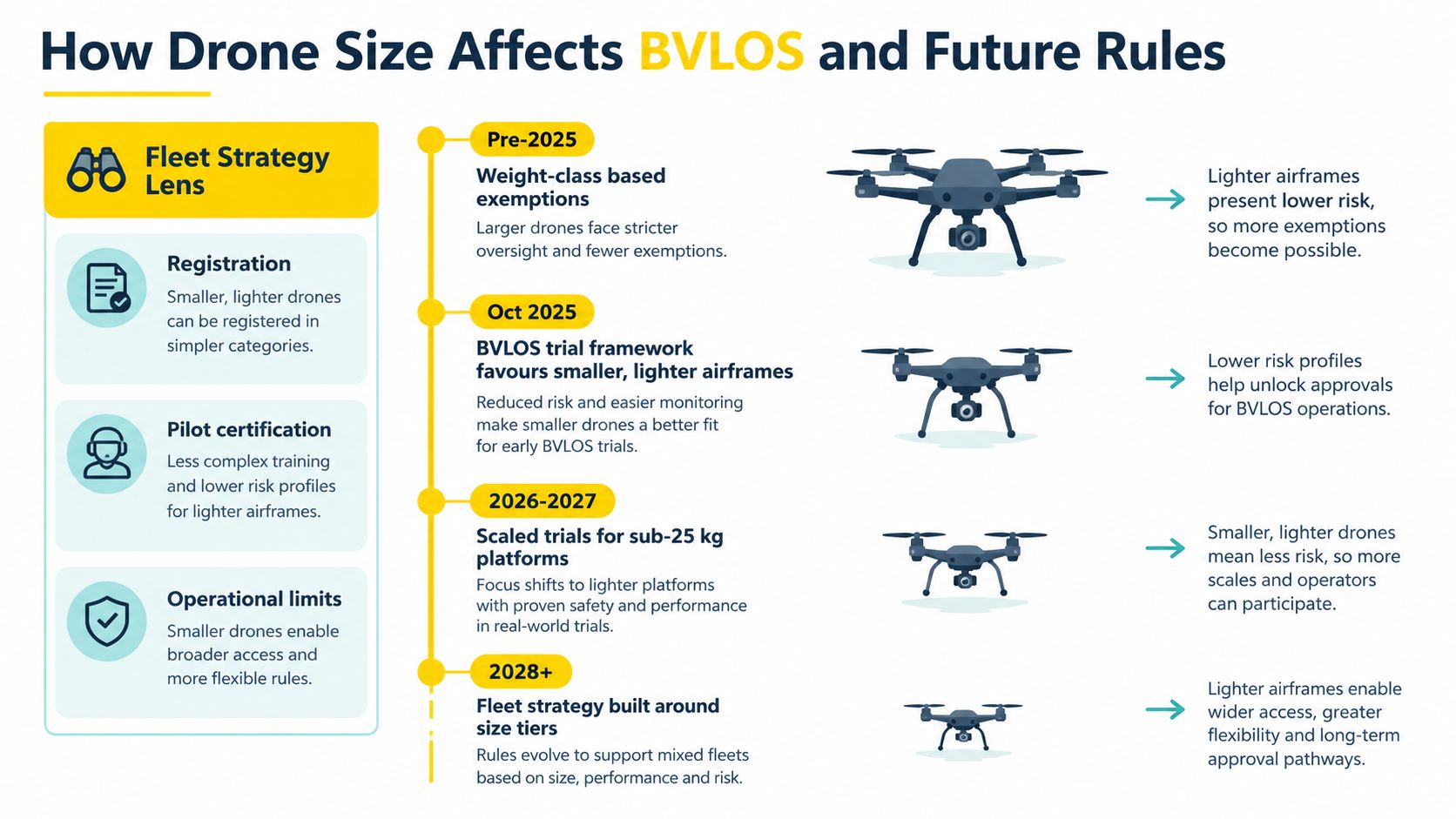
A commercial operator choosing between a compact survey drone and a heavier platform is also choosing a regulatory pathway. Payload may decide whether the aircraft can complete the job, while operational mass can determine BVLOS trial eligibility, organisational requirements and future equipment planning.
CASA introduced trial pathways for beyond visual line-of-sight operations beginning 15 October 2025. The trial is available to ReOC holders operating drones of 25 kg or less, with four broad-area approval pathways. Their conditions vary with the drone's size and the operating environment. CASA's drone safety rules information describes the framework and its limits.
The size threshold works like a gate. Smaller aircraft may qualify for pathways in suburban areas, whereas larger aircraft are directed towards lightly or sparsely populated areas. Passing the weight threshold does not grant BVLOS authority by itself. The operator still needs an approved operating framework, and each pathway lasts 12 months, so it should be treated as a conditional approval rather than a permanent right.
Plan for proposals without treating them as current law
A 2025 federal consultation paper proposes that, from the end of 2028, ADS-B OUT could be required for small drones operating above 400 feet above ground level, along with all medium and large drones. This remains a proposal, so the final requirement may change. Operators should check the current CASA consultation material before fitting equipment or changing fleet specifications.
The choice between a sub-2 kg aircraft and a heavier platform therefore involves payload, mission area, RePL or ReOC pathway, equipment integration and possible future compliance hardware. Operators planning BVLOS work can review BVLOS training and operational information before assessing which approval pathway fits the proposed operation.
A Practical Compliance Checklist for Commercial Operators
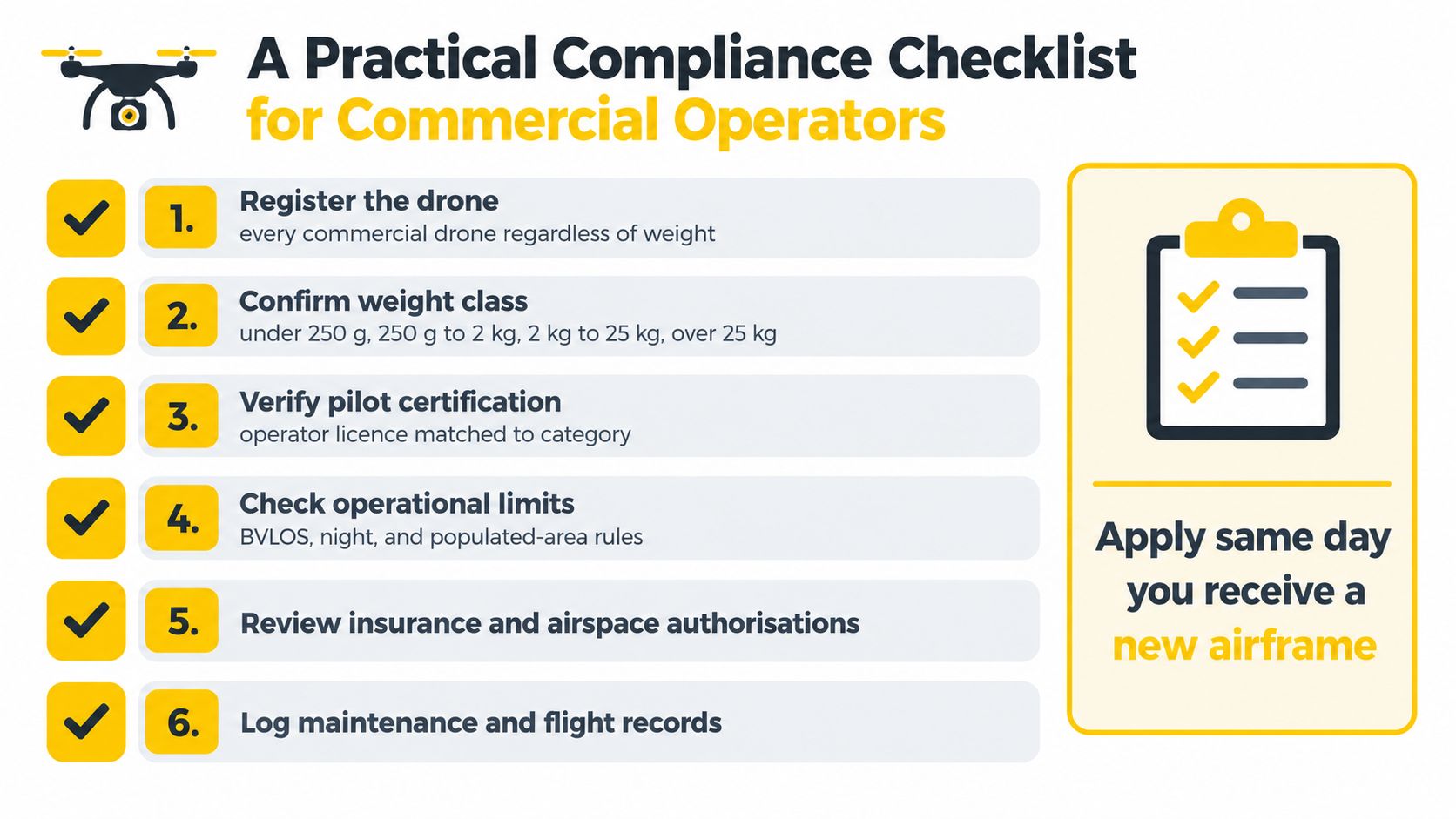
A new airframe should enter the organisation's compliance system before it enters the flight line. The checklist below can be adapted into an internal standard operating procedure.
- Register the aircraft. Business operators should confirm registration requirements before flight and attach the registration label in a visible, durable location.
- Confirm the weight class. Record the complete operational mass and identify whether the aircraft is at or below 250 g, above 250 g to 2 kg, above 2 kg to 25 kg, above 25 kg to 150 kg, or above 150 kg.
- Verify pilot competency. Match the pilot's accreditation or RePL pathway to the aircraft and proposed operation.
- Check operating limits. Review airport proximity, controlled airspace, visual line-of-sight requirements and any relevant approval before scheduling the job.
- Review organisational documents. Keep risk assessments, operating procedures, authorisations and evidence of competency organised for internal review or CASA inspection.
- Log maintenance and flight records. Record inspections, defects, repairs, configuration changes and flights in a consistent system.
Record-keeping should also support evidence review. Organisations producing video or other digital material may find this resource on compliance documentation for video verification useful when designing an auditable documentation process.
Re-weigh the aircraft after a payload or battery change. A change in configuration can affect the aircraft's category and the documents that support the operation. Operators developing an organisational framework can also consult this ReOC compliance guide for Australia.
Two Operator Scenarios That Show Size in Action
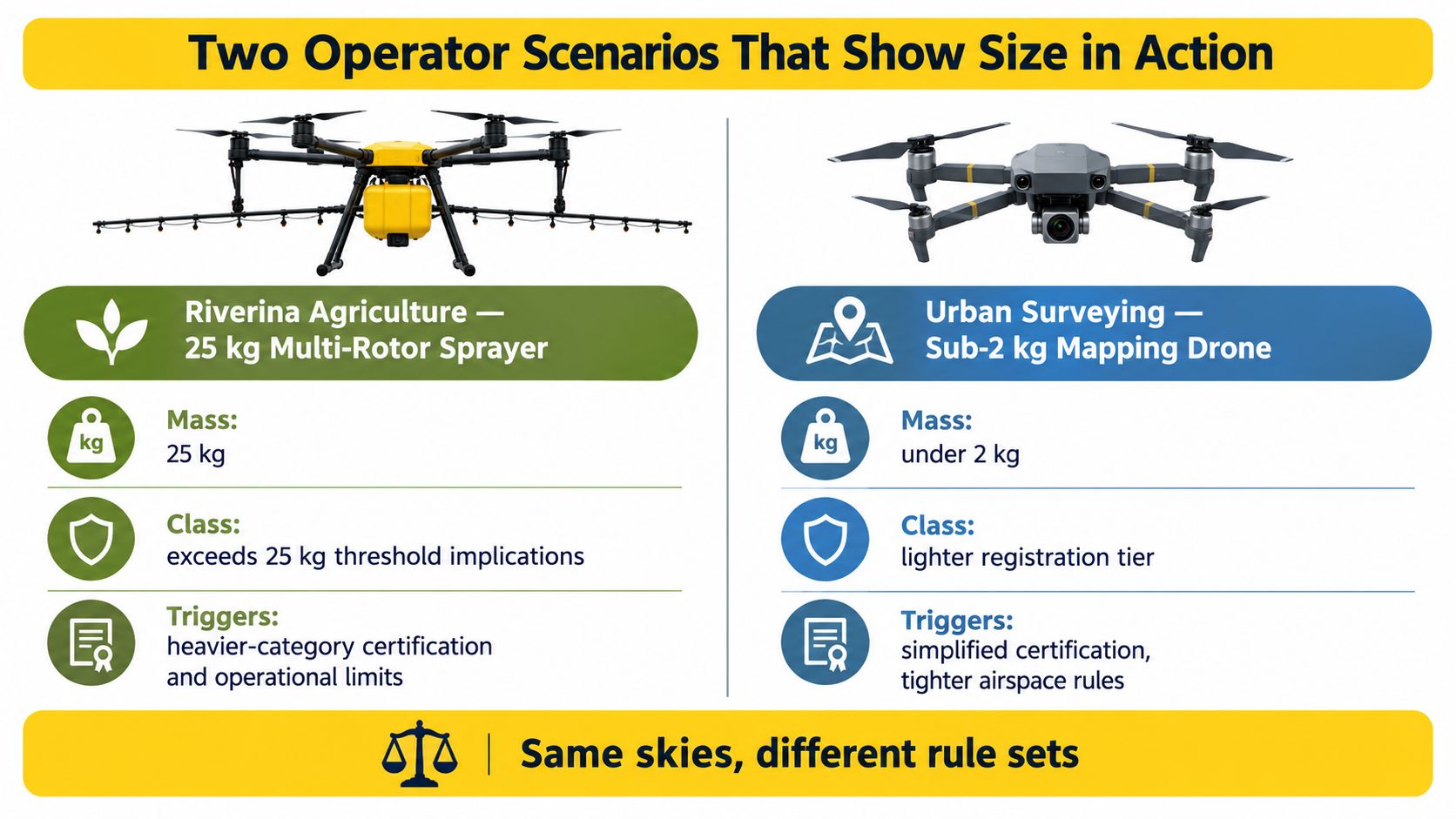
Consider an agricultural operator in the Riverina preparing a multi-rotor sprayer with a flight-ready mass of 25 kg. The operator can't rely on the aircraft's empty specification. The spray system, battery configuration and any fitted application equipment must be considered together before the aircraft's category is assessed.
At 25 kg, the aircraft remains at the upper boundary of the small category. If the operational configuration exceeds that boundary, it enters the medium category, which materially changes the qualification pathway. A medium RPA generally requires a RePL for the type, and CASA also identifies additional aeronautical-radio requirements for aircraft above 2 kg in relevant operations. The business must therefore assess the aircraft configuration before finalising training, procedures and contracts.
A lighter mapping platform creates a different starting point
A Brisbane mapping pilot uses an 850 g aircraft. That platform sits above 250 g and within the very small category, so the pilot must treat the work as a business operation rather than relying on recreational treatment. Registration and accreditation requirements apply, and the pilot must still comply with the operating conditions relevant to the mission.
The lighter aircraft may be easier to deploy, but it isn't exempt from airspace and safety rules. CASA's airport guidance treats drones over 250 g differently from aircraft at or below that boundary near controlled airports, so the mapping pilot must check the operating area before accepting a job.
The two operators face different planning questions. The agricultural business must control payload and category changes, while the mapping pilot must preserve the aircraft's documented configuration and confirm that the proposed work fits the applicable standard conditions.
Key Takeaways and Where Training Fits In
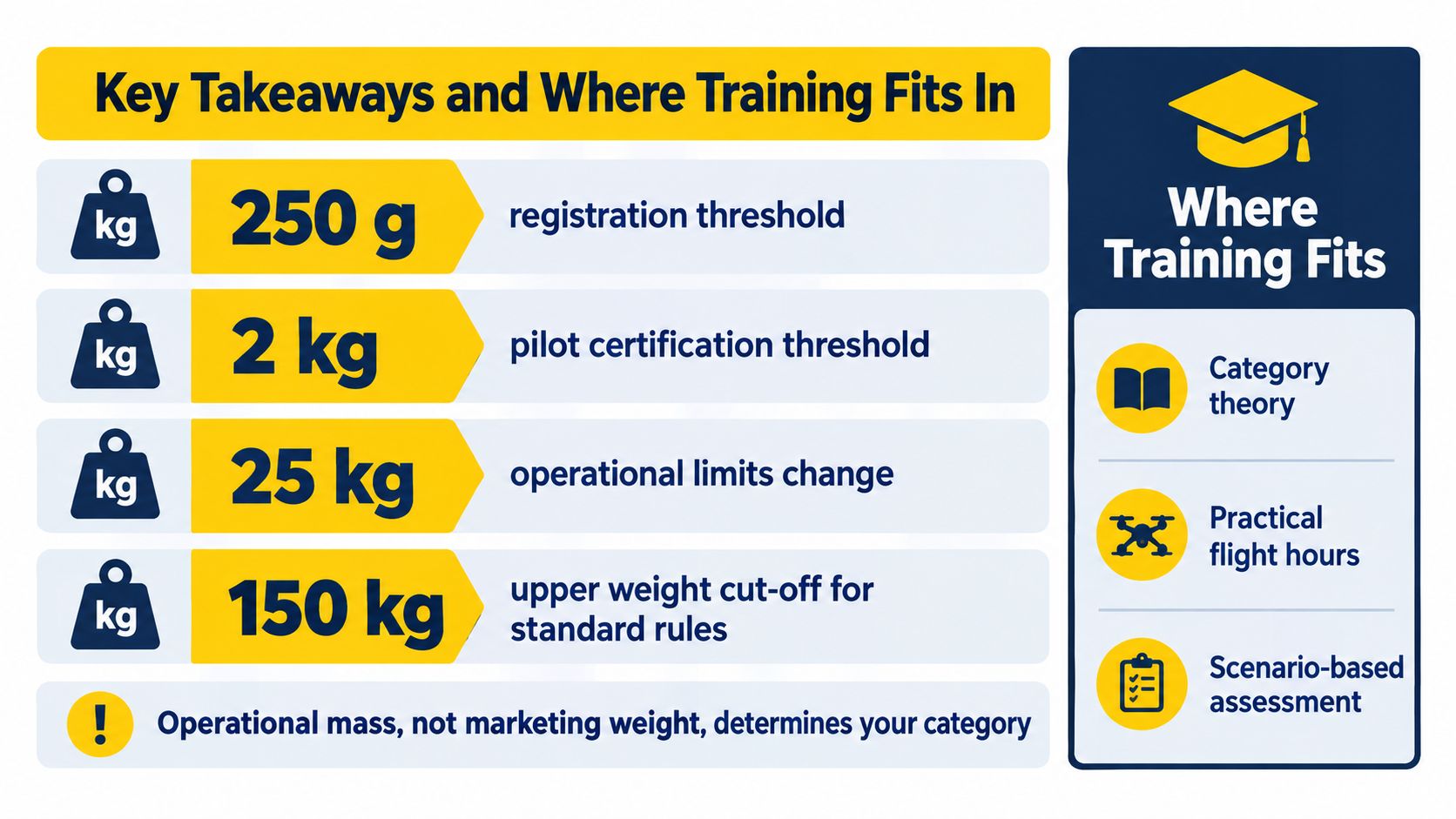
Four boundaries organise most first-stage drone size decisions in Australia: 250 grams, 2 kilograms, 25 kilograms and 150 kilograms. They affect how CASA treats the aircraft, but the number only helps when it represents the aircraft's real operational mass.
The 250 gram boundary is especially important to recreational users. The 2 kg boundary can affect aeronautical-radio requirements in controlled airspace. Above 25 kg, the medium category generally brings a RePL requirement for the aircraft type, while aircraft above 150 kg fall outside the standard listed size categories and require more substantial regulatory treatment.
Match training to the actual mission
A pilot preparing for small-drone commercial work should assess whether a Remote Pilot Licence is required for the intended operation. An operator working with heavier aircraft should examine RePL requirements for the aircraft type and any relevant Aeronautical Radio Operator Certificate pathway. Organisations planning complex or multi-aircraft work may also need to assess their operator authorisation and management system.
CASA's BVLOS trial pathways and the proposed ADS-B OUT requirements add a forward-looking consideration. A platform that suits today's job may create different approval or equipment questions as the business expands. Medium-category training information can help operators identify the training issues that require closer assessment.
The central lesson is practical: operational mass, not marketing weight, determines the category. Every new aircraft should be weighed in its working configuration, documented, registered where required and matched to the right pilot and operator pathway.
Ace Aviation Aerospace Academy provides CASA-aligned education including Remote Pilot Licence and Aeronautical Radio Operator Certificate training, as well as ReOC consulting and enterprise drone training. Operators can review the relevant pathways and discuss their aircraft, mission and compliance needs by visiting Ace Aviation Aerospace Academy.
Frequently Asked Questions
Does drone weight determine whether a business must register the aircraft?
For business operations, registration requirements apply to the aircraft and the intended use, not only to whether the drone is light. CASA states that a very small drone can be used for business under specified conditions, but the operator must register the aircraft and obtain accreditation.
What happens when a drone crosses the 2 kg boundary?
The aircraft moves from the very small category into the small category. CASA also identifies additional aeronautical-radio qualifications and usage requirements that can apply to operations involving an RPA over 2 kg in controlled airspace.
Does a payload count towards the drone's category?
Yes. The operator should assess the aircraft's operational gross mass, including its battery configuration, payload and equipment fitted for flight. A sensor, spray system or additional battery can move the aircraft across a CASA threshold.
When is a RePL relevant?
CASA generally requires a RePL for the type of medium RPA above 25 kg and up to 150 kg. RePL requirements for lighter aircraft depend on the operation and the applicable pathway, so the operator should assess the specific mission rather than rely on weight alone.
Can a small drone automatically operate BVLOS?
No. CASA's BVLOS trial pathways apply to eligible ReOC holders and drones of 25 kg or less, with conditions that vary by aircraft size and operating environment. The pathways are approval-based and issued for 12 months, so they don't create permanent permission to fly BVLOS.