

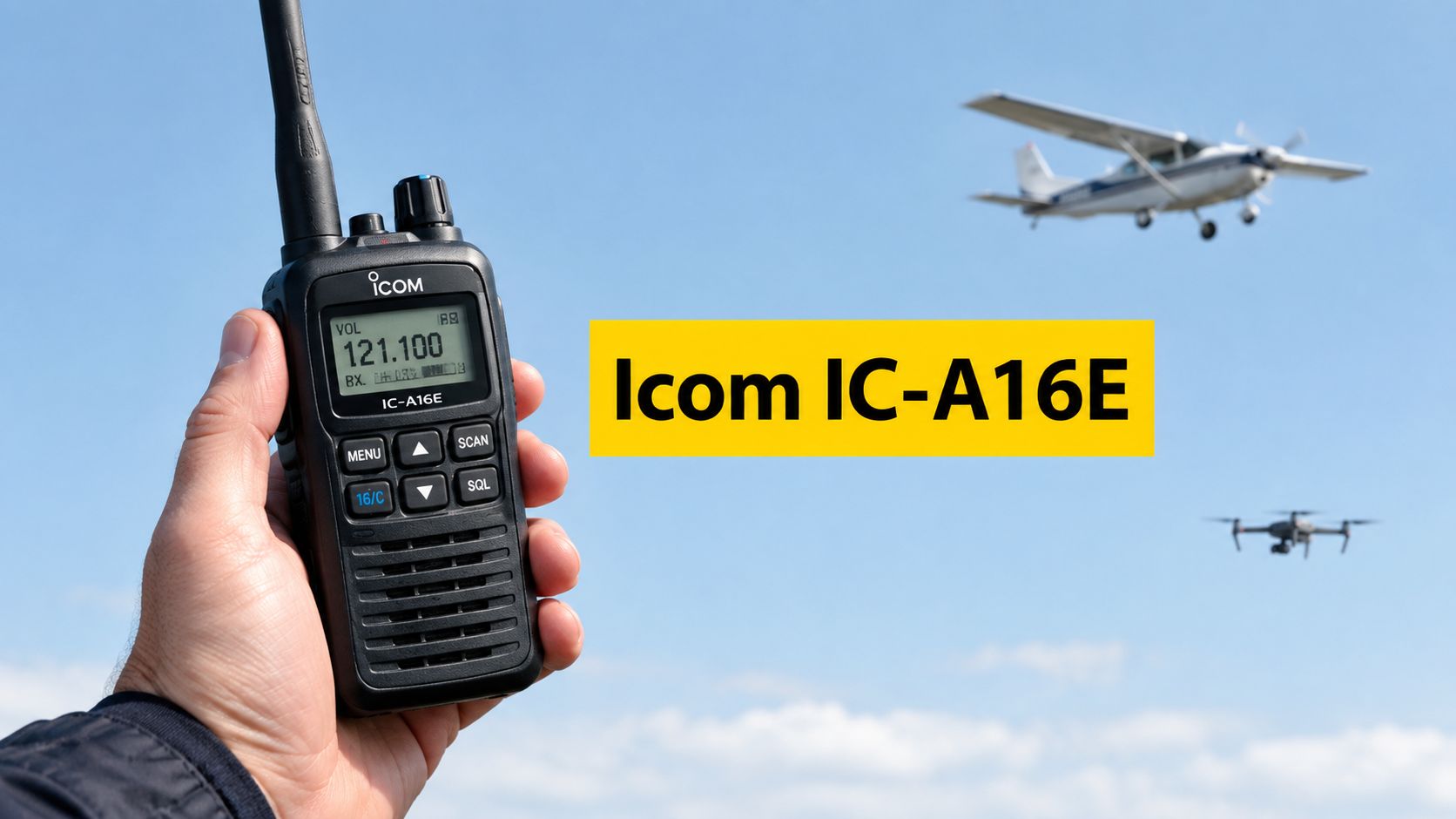
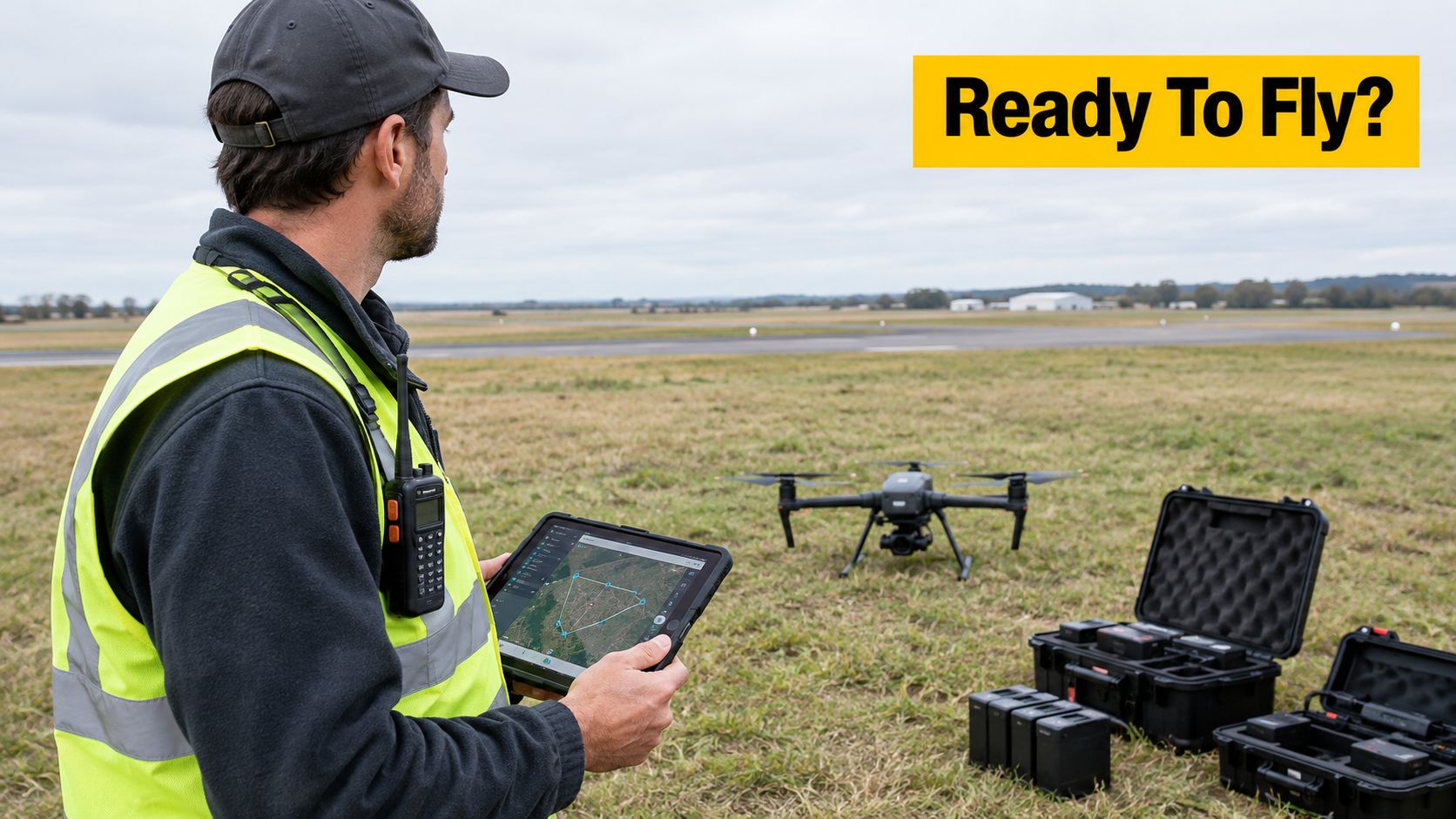
An Australian drone operator arrives at a rural launch site near a regional aerodrome with batteries checked, a flight plan prepared and an Icom IC-A16E clipped to a vest. The practical question is immediate: can that handheld radio be used to transmit, or is it only suitable for listening until the operator has the right qualification and authority?
The answer depends on more than the radio's construction or output power. The Icom IC-A16E is a purpose-built aviation VHF transceiver for ground-to-air communications, but its technical capability doesn't grant permission to use aeronautical frequencies. Equipment, operator qualification, airspace and local procedures all have to be considered together.
Table of Contents
- Meet the Icom IC-A16E and Why Pilots Are Looking at It
- Key Specifications Explained in Plain Language
- AROC, CASA and the Legal Boundary Around Aviation Radios
- Where the IC-A16E Fits in Different Operating Contexts
- Practical Scenarios for RePL, AROC and Aerial Work Operators
- Buying, Programming and Caring for the Radio
- How the IC-A16E Compares With Common Alternatives
- Bringing It All Together
- Frequently Asked Questions
- Does owning an Icom IC-A16E allow transmission on aviation frequencies?
- Is an AROC relevant to drone operators?
- What frequencies does the IC-A16E cover?
- How many channels can the IC-A16E store?
- Can the IC-A16E replace an aircraft's installed radio?
- What should a drone business check before using the radio?
Meet the Icom IC-A16E and Why Pilots Are Looking at It
At a rural launch site, a remote pilot may need to monitor aviation traffic while coordinating a flight team. The radio clipped to the vest must suit the frequencies and channel plans used around Australian aerodromes, not merely survive dust and knocks.
The Icom IC-A16E is designed for the civil aviation VHF band used for aerodrome and aircraft communications. Icom Australia specifies transmit-and-receive coverage from 118.000 to 136.992 MHz, with support for 8.33 kHz and 25 kHz channel spacing. That makes it a dedicated aviation transceiver rather than a general-purpose two-way handheld or scanner.
Capability is not authorisation
At a launch site, the difference is practical. A general radio may be durable, yet still lack the tuning range, channel spacing or aviation controls needed for a particular operation. The IC-A16E is built around aviation channel use, with memory for operational frequencies and a BNC connector intended for a 50-ohm antenna system.
Pilots, remote operators and aviation businesses also look at its documented 6.0 W peak-envelope-power output, compact handheld format and channel storage. These features can support work around airfields, rural sites and other locations where carrying a radio is more practical than using a permanently installed aircraft set.
The radio can provide the capability to transmit, but that capability does not itself authorise transmission. CASA requires an Aeronautical Radio Operator Certificate, or AROC, for anyone who needs to communicate on an aviation air-band radio frequency and is not already licensed or qualified, including relevant remote-pilot operations in controlled airspace. The IC-A16E is equipment for a qualified operator; the qualification itself is covered in the AROC discussion.
Key Specifications Explained in Plain Language
The figures below turn the published specification sheet into programming and planning decisions. Frequency coverage, channel spacing and output describe what the radio can do. They do not, by themselves, show whether a transmission is authorised or whether another station will hear it.
| Specification | Published Value | What It Means in Practice |
|---|---|---|
| Transmit and receive range | 118.000 to 136.992 MHz | Covers the Australian civil aviation VHF band used for aerodrome and aircraft communications |
| Channel spacing | 8.33 kHz and 25 kHz | Allows compatibility with different aeronautical frequency plans and equipment configurations |
| Output | 6.0 W PEP, 1.8 W carrier at 7.2 V DC | Provides a handheld aviation transmit capability, subject to antenna, terrain, installation and authorisation |
| Internal speaker audio | Typically 1,500 mW | Supports clear local monitoring in field conditions |
| Channel memory | Up to 200 channels | Allows organised storage of aerodrome, CTAF, area and operational channels |
| Channel naming | Up to eight characters per name | Makes stored channels easier to identify without relying on memory |
| Frequency stability | ±1 ppm | Helps the radio remain accurately aligned with the selected frequency |
| Antenna connection | BNC, 50-ohm impedance | Supports a compatible aviation antenna system |
Channel spacing is a programming decision, not just a number on a specification sheet. An aviation frequency plan may call for 8.33 kHz spacing, while another operating context may use 25 kHz. Selecting the wrong spacing can produce an incorrect channel selection even when the displayed frequency looks familiar. Confirm the applicable frequency plan before programming the radio.
Output figures describe transmission characteristics, not guaranteed range. Terrain, antenna position, aircraft altitude, obstructions, receiver sensitivity and local interference all affect whether a ground station or aircraft hears the call. A higher-power setting cannot compensate for a blocked antenna or poor radio technique.
Organising channels for field work
The IC-A16E stores up to 200 channels, with names of up to eight characters, according to the manufacturer's Australian specifications. That capacity can support a structured plan containing local aerodrome, CTAF, area and operational channels. The operator still needs to confirm which frequencies are relevant and authorised for the planned activity.
Use labels that can be recognised quickly. An aerodrome or service name is more useful in a busy launch area than an unexplained channel number. Treat the memory as a checklist, not as permission to transmit. Programming a frequency does not replace the operator's responsibility to identify the correct channel and follow local procedures.
Before field work, operators can also review the drone pilot emergency handbook as part of broader communications and safety preparation. A radio supports the plan, but it cannot replace briefing, situational awareness or a clear response to an abnormal event.
The frequency stability and BNC connector affect the equipment side of that plan. Stable frequency performance helps the set remain aligned with the selected channel, while the 50-ohm BNC interface provides a defined connection for a compatible antenna system. These features support reliable use, but CASA requirements still apply to the operator and the operation.
For beginners who need foundational aviation knowledge, ACE READY covers drone fundamentals, aviation safety, CASA regulations and flight operations, while preparing students for advanced RePL training in Australia. That knowledge helps put the IC-A16E's capabilities into the correct AROC and RePL context.
AROC, CASA and the Legal Boundary Around Aviation Radios
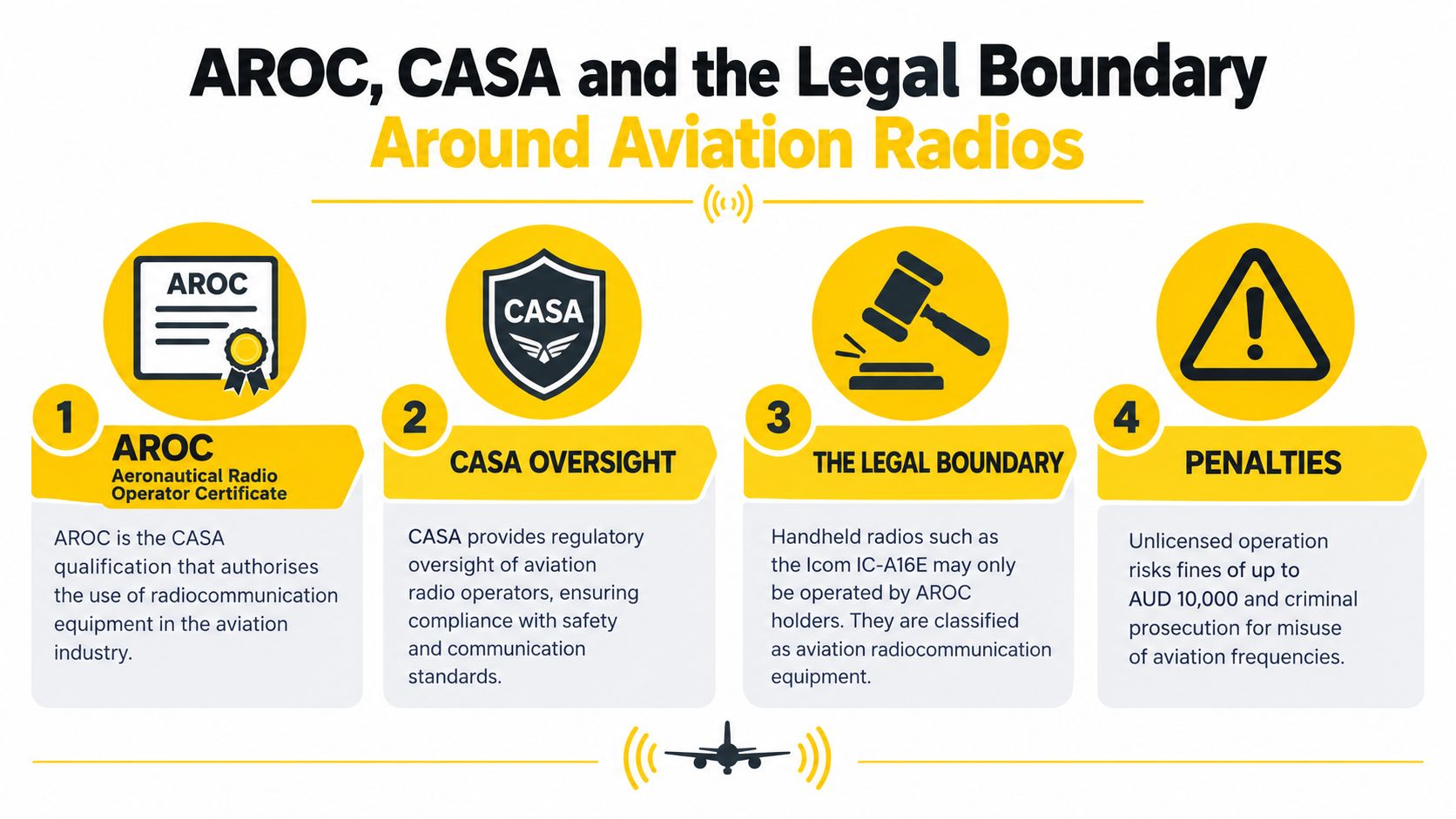
An AROC is an operator qualification, not a feature embedded in a handheld radio. CASA states that a person who needs to communicate on an aviation air-band radio frequency and isn't already licensed or qualified requires an AROC. That principle applies whether the equipment is a handheld such as the IC-A16E or another aviation radio.
CASA's published requirements include being at least 17 years old, holding an aviation reference number, completing approved training, demonstrating the required competency and holding a current English Language Proficiency assessment at the applicable level. The CASA requirements should be checked directly before enrolment because qualification and application processes can change.
The qualification and the operation must match
A remote pilot may hold a RePL and still need an AROC for an operation that requires aviation radio communication. Conversely, holding an AROC doesn't automatically authorise every possible use of a handheld at every launch site. The operating context, frequency authorisation, station classification and aerodrome procedures still need to be considered.
The ACMA class licence information is relevant because it identifies the regulatory framework for aeronautical mobile stations and separately identifies an apparatus aeronautical licence for a ground station communicating with aircraft. That separation is why a business shouldn't assume that one qualification or one licence covers every ground-to-air arrangement.
Practical rule: A CASA certificate qualifies the operator to perform the relevant radio function. It doesn't turn every location, frequency or operating method into an authorised one.
A sensible compliance check asks four questions:
- Who is transmitting? Confirm that the person operating the radio holds the required qualification or is otherwise appropriately qualified.
- What is the station? Establish whether the radio is being used from an aircraft, on the ground or as part of a ground station arrangement.
- Which frequency is involved? Use only the frequency relevant to the operation and local procedure.
- What does the aerodrome require? Controlled and uncontrolled aerodromes can involve different communication arrangements, so local instructions must be followed.
Operators seeking structured training can review the AROC course information and compare its relevance with the requirements published by CASA. The radio should be purchased and programmed as part of that compliance process, not before it.
Where the IC-A16E Fits in Different Operating Contexts
The easiest way to assess an IC-A16E is to start with the operation rather than the product. The same handheld can be technically suitable in one situation and insufficient or unauthorised in another.
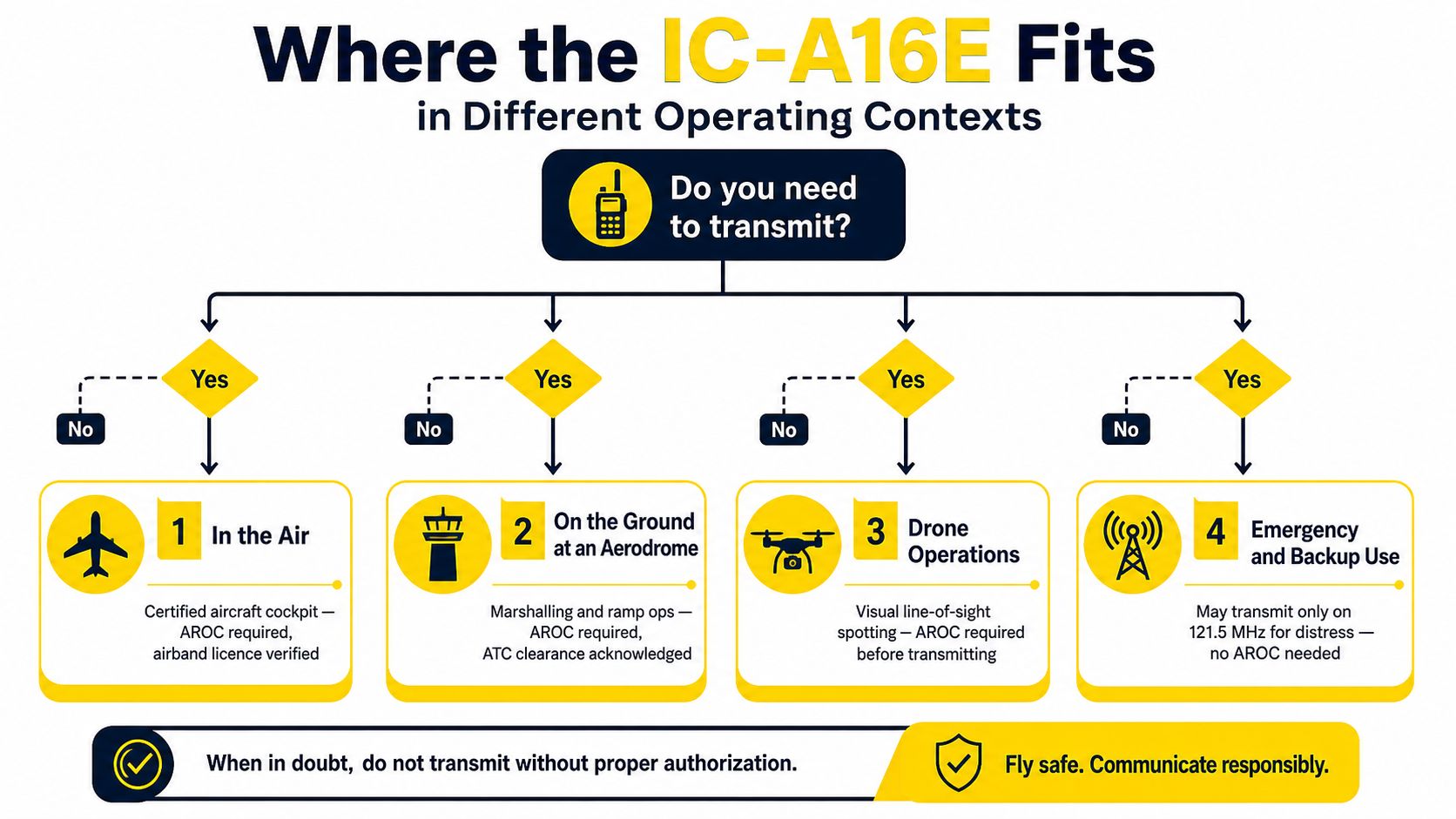
In the air
In a certified aircraft, the aircraft's installed radio and approved equipment remain central to the operation. A handheld may provide a supplementary listening or communication capability where its use is permitted, but it doesn't replace an installed set or any required aircraft equipment. The operator still needs the applicable radio qualification and must follow the aircraft's operating procedures.
The IC-A16E's 118.000 to 136.992 MHz coverage and selectable channel spacing make it relevant to aviation VHF communications, but they don't determine whether a particular aircraft operation may use it.
On the ground near an aerodrome
A drone team working near an active aerodrome must distinguish between monitoring and transmitting. Listening to understand local traffic can support situational awareness, but transmitting requires the appropriate operator qualification and operating authority. The team also needs to follow the aerodrome's published procedures and any applicable airspace requirements.
At a controlled aerodrome, a handheld can't replace the required communication path with the relevant service. At an uncontrolled strip, local procedures still apply, and the absence of a control tower doesn't create unrestricted permission to transmit.
A quick decision tree
- Does the operation require a transmission? If not, the radio may be used for listening where that use is permitted, but the team should still verify local rules.
- Is the operator qualified? If communication on an aviation frequency is required, CASA's AROC requirements become relevant.
- Is the station airborne or ground-based? The station classification affects which authorisation may apply.
- Is the site controlled or uncontrolled? Local aerodrome and airspace procedures determine the next step.
The drone safety guide for airports can support broader site planning. The key locator question is simple: is the IC-A16E being used in an aircraft, at an aerodrome, at a drone launch site or at a remote work location? That answer identifies the compliance branch requiring further checking.
Practical Scenarios for RePL, AROC and Aerial Work Operators
A RePL holder conducting a long-line survey near a regional strip may carry the IC-A16E on the ground to monitor the relevant local traffic frequency before launch. The radio can help the team hear activity and develop a disciplined communications routine, but the holder must not treat possession of the handheld as permission to transmit. If a transmission is required, the operator needs the relevant qualification and authority.
A student preparing for an AROC assessment may use an aviation handheld during supervised training to become familiar with channel selection, listening technique and phraseology. The student learns why the distinction between 8.33 kHz and 25 kHz matters, how a channel label reduces selection errors and why a clear, concise call is safer than unnecessary radio traffic. Training should occur under the arrangements established by the recognised training organisation.
An agricultural operator working from a remote property may need to coordinate aviation activity around a work area. The IC-A16E's aviation-band design and 6.0 W PEP capability may support that workflow, subject to the antenna system, terrain and the operating context. The operator's authority to communicate still comes from the applicable qualification and permissions, not from the output rating.
What each scenario teaches
- The RePL scenario: A drone licence and a radio qualification address different responsibilities.
- The student scenario: Familiarity with controls is valuable, but supervised practice isn't a substitute for completed certification.
- The agricultural scenario: A remote location doesn't remove the need to confirm the correct frequency, station arrangement and operator authority.
Businesses planning complex aerial work can also review the guide to ReOC requirements. ReOC compliance, RePL qualifications and AROC requirements should be mapped separately, even when the same operator carries the radio.
Buying, Programming and Caring for the Radio
A buyer should begin with the Australian-market version and a supplier that can confirm the equipment's suitability for the intended aviation use. The published IC-A16E specifications establish the frequency range, channel spacing, output, memory and connector details, but they don't confirm the legal authorisation for a proposed operation.
Programming deserves more than a list of frequencies. A useful channel plan should identify the purpose of each channel, the relevant spacing and the location or procedure associated with it. The radio's capacity for up to 200 channels can support a detailed plan, but it can also create confusion if duplicate or obsolete entries are left in memory.
A practical preparation sequence
- Confirm the operating context: Decide whether the radio will be carried in an aircraft, used on the ground or used around an aerodrome.
- Verify the frequency plan: Check current Australian aviation information and local procedures before programming.
- Use clear labels: Keep channel names within the radio's published eight-character limit and make each label recognisable.
- Check the antenna system: Inspect the BNC connection and use a compatible antenna arrangement.
- Protect the equipment: Keep the radio clean and dry, inspect the connector after field work and follow the manufacturer's battery and charging guidance.
- Keep records current: Record who programmed the set, which plan was used and when the frequencies were checked.
The licence finder can help businesses identify the regulatory questions that require further investigation. It shouldn't be used as a substitute for advice from CASA, ACMA, an approved training provider or an aviation communications specialist.
How the IC-A16E Compares With Common Alternatives
The IC-A16E occupies a defined middle ground. It is more aviation-specific than a general handheld and more portable than a panel-mounted aircraft transceiver, but it isn't a replacement for either an aircraft installation or an operator qualification.
Older handhelds such as the A14 and A15 may remain familiar to operators, yet their suitability depends on their exact specifications and the frequency plan in use. The ability to support 8.33 kHz and 25 kHz spacing is a significant consideration when an operator needs compatibility with different aeronautical configurations.
| Criterion | Icom IC-A16E | Older Icom Handhelds (A14/A15) | Panel-Mount Transceiver |
|---|---|---|---|
| Portable ground use | Designed as a handheld aviation transceiver | Depends on the individual model and condition | Not portable |
| Channel spacing | Supports 8.33 kHz and 25 kHz | Must be checked against the specific model | Depends on the installed unit |
| Aviation frequency coverage | 118.000 to 136.992 MHz, according to Icom Australia | Must be verified for the individual radio | Depends on the installation |
| Channel organisation | Up to 200 channels with names up to eight characters | Depends on the individual model | Usually managed through the aircraft installation |
| Aircraft integration | Not a panel-mounted installation | Not a panel-mounted installation | Designed for permanent aircraft integration |
| Ground-based drone work | Can be carried to a launch site, subject to authorisation | May be suitable if specifications and approvals align | Cannot accompany a ground team |
| Legal permission | Does not grant permission to transmit | Does not grant permission to transmit | Does not grant permission to transmit |
A non-aviation handheld may be inexpensive or convenient, but it isn't an equivalent substitute for an aviation-band transceiver. A panel-mounted set can suit an aircraft cockpit, while the IC-A16E suits an operator who needs a portable aviation radio for an authorised task.
The decision should therefore focus on the job. If portability, aviation-band coverage and flexible channel spacing matter, the IC-A16E may fit. If aircraft integration is the priority, a panel-mounted installation may be more appropriate. If the proposed use involves only non-aviation communications, an aviation handheld may be the wrong tool entirely.
Bringing It All Together
The Icom IC-A16E combines documented 118.000 to 136.992 MHz VHF coverage, 8.33 kHz and 25 kHz channel spacing, 6.0 W PEP output, memory for up to 200 channels and a 50-ohm BNC antenna connection. Those specifications explain why the model is considered a purpose-built aviation radio rather than a general two-way handheld. They don't, however, establish permission to transmit.
The compliance decision belongs to the operator and the operating context. CASA's AROC requirements apply when a person needs to communicate on an aviation air-band frequency and isn't already appropriately qualified. ACMA licensing and class-licence arrangements may also need to be checked, particularly where a ground station communicates with aircraft.
For RePL holders and aerial-work operators, the IC-A16E can support disciplined listening, CTAF awareness and supervised radio practice where the operating arrangements permit it. It can't extend the authority attached to a certificate, replace an aircraft installation or override aerodrome procedures.
Students building aviation knowledge can also use external resources such as study tips for student pilots, while confirming regulatory details through current CASA and ACMA information. A radio becomes genuinely useful when it sits inside a documented operation, a current qualification and a clear communication plan.
Ace Aviation Aerospace Academy offers relevant Australian training pathways including the Remote Pilot Licence and Aeronautical Radio Operator Certificate, with ReOC Consulting, Enterprise Drone Training and Corporate Drone Training available where those services match the organisation's needs. Operators can review the Ace Aviation Aerospace Academy options and confirm which qualification or compliance pathway fits the proposed IC-A16E use.
Frequently Asked Questions
Does owning an Icom IC-A16E allow transmission on aviation frequencies?
No. CASA states that anyone who needs to communicate on an aviation air-band radio frequency and isn't already licensed or qualified requires an AROC. The radio's technical specifications don't create legal permission.
Is an AROC relevant to drone operators?
Yes. CASA identifies the AROC as relevant to remote pilots who need to operate in controlled airspace. The exact requirements depend on the operation, airspace and communication task.
What frequencies does the IC-A16E cover?
Icom Australia specifies transmit-and-receive coverage from 118.000 to 136.992 MHz. The radio supports both 8.33 kHz and 25 kHz channel spacing.
How many channels can the IC-A16E store?
The radio can store up to 200 channels, with names of up to eight characters for identifying programmed entries.
Can the IC-A16E replace an aircraft's installed radio?
No. A handheld may supplement an aircraft's communication equipment where its use is permitted, but it doesn't replace a required panel-mounted or installed radio.
What should a drone business check before using the radio?
The business should confirm the operator's AROC status, the relevant airspace and aerodrome procedures, the frequency and station authorisation, and whether any ACMA requirements apply to the proposed ground-to-air use.