A remote pilot is preparing a site briefing when a colleague asks whether the location label ends in B or D. The signal is weak, background machinery is running, and repeating the letter more loudly doesn't settle the question. A wrong entry could send the crew to the wrong part of the site.
The aviation phonetic alphabet gives each letter a recognised spoken word. Effective radio use also requires standard number pronunciation and the correct callsign, because spelling an identifier, transmitting a value and identifying a station are different jobs.
Table of Contents
- The Full A to Z Phonetic Alphabet Chart
- Spoken Numbers and Standard Terms for Radio
- How the Code Words Resist Noise and Confusion
- When to Spell Words with the Phonetic Alphabet
- Callsigns Versus Phonetic Spelling
- Common Pronunciation Mistakes and Their Effects
- Speaking Clearly on Air
- Build Your Alphabet Skills Before You Transmit
- Frequently Asked Questions About the Phonetic Alphabet
The Full A to Z Phonetic Alphabet Chart
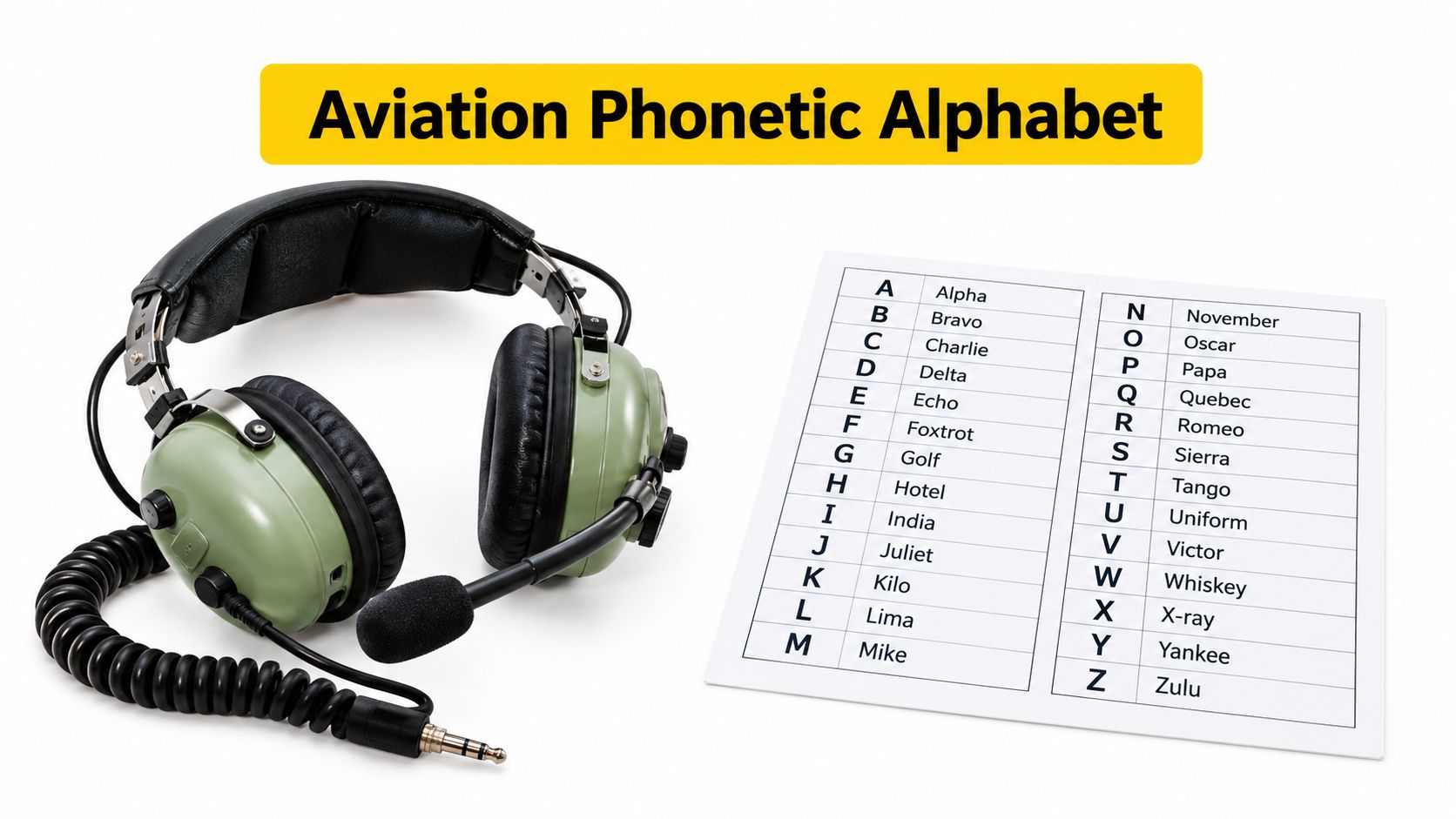
Australia applies the International Radiotelephony Spelling Alphabet. CASA's Radiotelephony Manual for Ground Operators prescribes a complete 26-letter system, with a distinctive spoken code word for each Roman-alphabet letter. On a clear channel the words can feel excessive. On a weak one, where B and D collapse into the same murmur, BRAVO and DELTA remain far apart in sound.
ICAO and Australian phonetic alphabet code words
| Letter | Code word | Pronunciation |
|---|---|---|
| A | ALFA | AL fah |
| B | BRAVO | BRAH voh |
| C | CHARLIE | CHAR lee |
| D | DELTA | DEL tah |
| E | ECHO | ECK oh |
| F | FOXTROT | FOKS trot |
| G | GOLF | GOLF |
| H | HOTEL | hoh TEL |
| I | INDIA | IN dee ah |
| J | JULIETT | JEW lee ETT |
| K | KILO | KEE loh |
| L | LIMA | LEE mah |
| M | MIKE | MIKE |
| N | NOVEMBER | no VEM ber |
| O | OSCAR | OSS car |
| P | PAPA | pah PAH |
| Q | QUEBEC | keh BEK |
| R | ROMEO | ROW me oh |
| S | SIERRA | see AIR ah |
| T | TANGO | TANG go |
| U | UNIFORM | YOO nee form |
| V | VICTOR | VIK tah |
| W | WHISKEY | WISS key |
| X | X-RAY | ECKS ray |
| Y | YANKEE | YANG key |
| Z | ZULU | ZOO loo |
The pronunciation column is a speaking guide. Spellings stay as listed in the code word column; the respellings exist only to show which syllables deserve emphasis. Capital letters mark those syllables, so a trainee reading NOVEMBER pushes VEM harder than the surrounding sounds. That matters because the stressed syllable is often the part that survives static.
Many code words spread their sound across several syllables, but GOLF and MIKE demonstrate why there isn't a universal syllable-count rule. The task is to reproduce the listed pronunciation, not stretch every word to the same length. Each letter is protected by the word's distinct sound shape rather than its duration.
Turning a letter into a spoken word
When a letter needs spelling, the speaker replaces its ordinary name with the complete code word. A site label C becomes CHARLIE. Saying the plain letter name first and then the code word adds an extra unit the listener has to filter out, and on a marginal channel the plain letter is exactly the part most likely to be misheard.
A useful learning sequence separates recognition from delivery:
- Find the letter. Match the written character to its code word without guessing from a familiar everyday word.
- Say the complete word. Keep the beginning and ending audible, including the final sound in FOXTROT or JULIETT.
- Apply the marked stress. HOTEL needs emphasis on TEL; PAPA needs emphasis on its final PAH.
- Keep an even pace. Leave enough separation for the listener to recognise individual words without turning the transmission into disconnected syllables.
SIERRA makes a good drill word because its opening "see" tends to sink into background hiss. Practise it as see AIR ah, giving the stressed AIR enough force to carry the word when the first syllable fades. If a training partner still mishears it, slow the pace before reaching for more volume; crowding the syllables together is what makes them blur.
For a hypothetical site label CAT, the spoken group is CHARLIE ALFA TANGO. The listener should write CAT, not the names of the code words. That distinction matters during training: the speaker encodes letters into words, and the receiver converts those words back into letters.
Practical rule: The complete code word carries the letter. A louder ordinary letter name isn't an equivalent substitute.
The same word set covers flight operations and ground operations, so there is no separate alphabet for drone work.
The chart also helps with listening practice. A trainee who can recite the alphabet in order may still hesitate when hearing WHISKEY followed by LIMA and QUEBEC. Random-letter exercises reveal that gap more effectively than another uninterrupted recital, because real traffic rarely arrives in alphabetical order.
Numbers follow a separate system, and knowing the code words does not tell you the correct callsign or the format for a complete radio call.
Spoken Numbers and Standard Terms for Radio
Numbers aren't encoded with alphabet words. Airservices Australia's AIP specifies the numeral forms below, while CASA's aeronautical knowledge requirements document places transmitting numerals alongside phonetic spelling, callsigns, listening and communication procedures within aeronautical radiotelephony knowledge.
Standard spoken numbers and radio terms
| Item | Standard form | Stress or usage note |
|---|---|---|
| 0 | ZE-RO | Both syllables are shown in capitals |
| 1 | WUN | Single syllable |
| 2 | TOO | Single syllable; context distinguishes the digit from the ordinary word to |
| 3 | TREE | Single syllable |
| 4 | FOW-er | Stress FOW; the hyphen separates syllables |
| 5 | FIFE | Single syllable |
| 6 | SIX | Single syllable |
| 7 | SEV-en | Stress SEV |
| 8 | AIT | Single syllable |
| 9 | NIN-er | Stress NIN |
| Decimal | DAY-SEE-MAL | Separates whole and fractional parts |
| Hundred | HUN-dred | Used in applicable whole-hundred expressions |
| Thousand | TOU-SAND | Used in applicable whole-thousand expressions |
Capitalisation, rather than the hyphen itself, indicates emphasis. TOO isn't acoustically different from the ordinary word to, so correct message structure remains important. Pronunciation alone can't remove every possible ambiguity.
Worked number examples
The following are hypothetical pronunciation exercises, not operational frequencies or instructions:
- Frequency 123.45: WUN TOO TREE DAY-SEE-MAL FOW-er FIFE. The decimal term separates the whole and fractional portions.
- Flight level 350: FLIGHT LEVEL TREE FIFE ZE-RO. The digits are transmitted separately.
- Altitude 3,000 feet: TREE TOU-SAND FEET. The whole-thousand expression uses the standard thousand term.
A flight level and an altitude aren't interchangeable references. The examples demonstrate spoken forms, not when either vertical reference should be used.
On a weak channel, TOO and TREE can be difficult to separate if the opening sound disappears. FOW-er, SEV-en and NIN-er also need their full endings; rushing those endings reduces the listener's opportunity to recognise the intended digit.
Practice should include a three-digit group, a frequency and a pressure setting, spoken aloud and checked against the table. Operational use also requires learning the transmission rules for the particular type of number.
The Aeronautical Radio Operator Certificate learning pathway is relevant to that broader radio competence. For accompanying technical instructions and written procedures, teams can find approved STE terms in the STE Guide; Simplified Technical English is a writing resource, not a replacement for aviation radiotelephony phraseology.
How the Code Words Resist Noise and Confusion
Ordinary letter names offer little material for a listener to recover when part of a transmission disappears. B, D, E, P and T share similar vowel sounds, so if the opening consonant is lost, the surviving fragment could belong to any of them. M and N can also be hard to distinguish when background noise masks their endings.
The code words attack that failure mode by giving each letter a different sound shape. BRAVO, DELTA, ECHO, PAPA and TANGO carry distinct stress patterns. MIKE is short and sharply bounded, while NOVEMBER has a longer rhythm with a prominent middle syllable. Even when noise strips away part of a word, what survives often narrows the answer to a single letter.
A weak-channel failure
A crew transmitting a site letter P sends a single short syllable. The receiver hears a brief sound resembling B and writes the wrong label on the task sheet. Both people may believe the exchange succeeded because the received sound still resembles a plausible letter.
PAPA changes the available evidence. Its rhythm and stressed final syllable differ from BRAVO, so the listener has more than an initial consonant to work with. If the word still arrives broken, the receiver's correct response is "Say again", and the sender repeats PAPA slowly until the letter is confirmed. Heavy interference or an overlapping transmission can erase the whole word, and in that case the repeat request is the fix, not the vocabulary.
The alphabet provides a one-to-one mapping, with 26 code words for 26 letters, and each code word begins with the letter it represents. An Australian Department of Defence teaching document records NATO's formal adoption of the current alphabet on 1 January 1956 and its subsequent use in military, civilian and amateur-radio communications.
What standardisation can and can't do
- Shared vocabulary helps recognition. The receiver can expect BRAVO rather than guess among improvised words that differ from crew to crew.
- Distinct rhythms provide extra clues. Words such as UNIFORM and ZULU remain different even when an accent changes some vowel sounds.
- Poor reception still needs correction. A missing or uncertain word must be repeated and confirmed; expectation alone is not evidence of the letter that was sent.
When to Spell Words with the Phonetic Alphabet
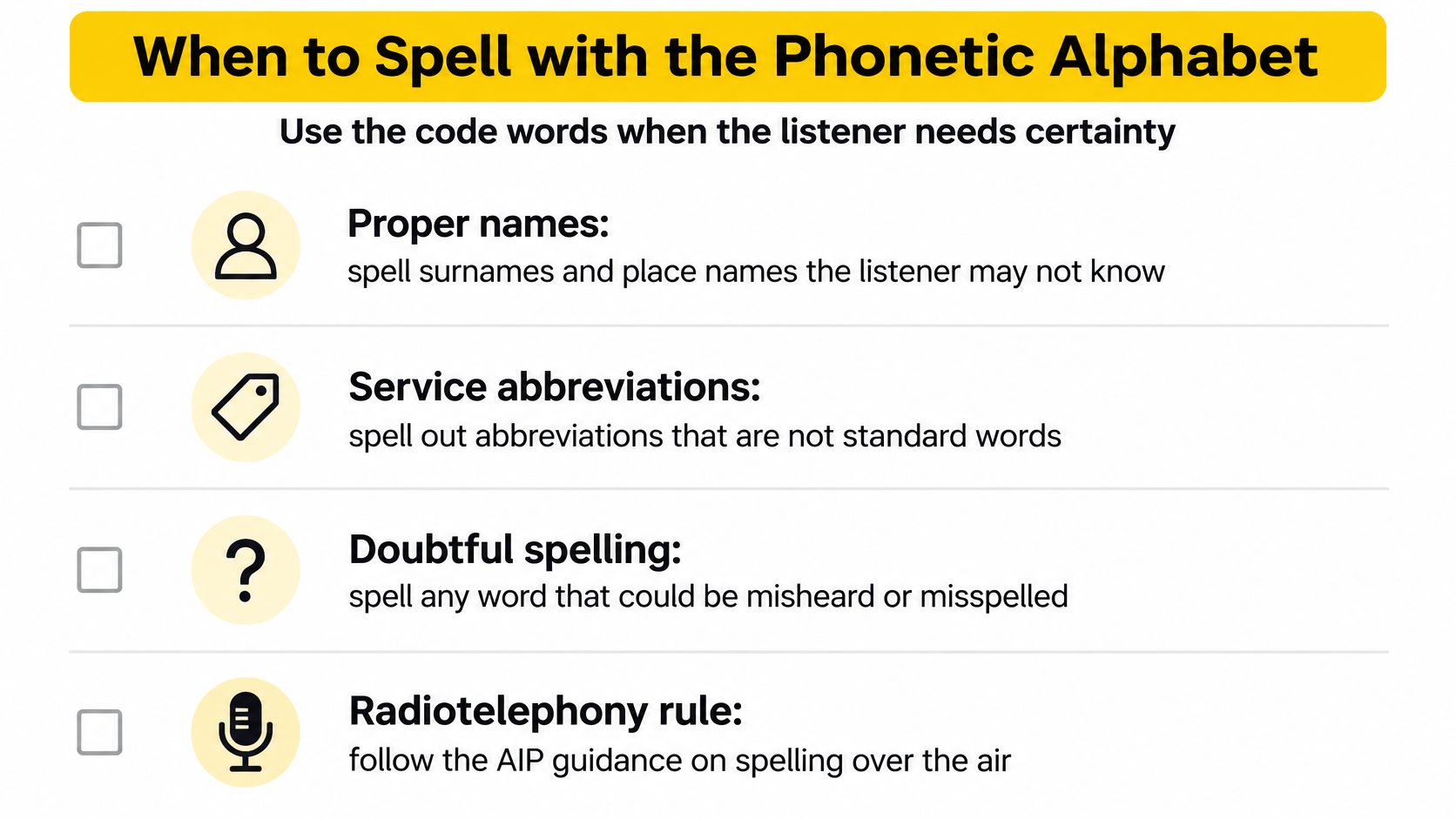
Australia's AIP requires the phonetic alphabet when proper names, service abbreviations or words of doubtful spelling are spelled out in radiotelephony. The wording matters: it specifies the method for spelling these items, not a requirement to spell every ordinary word in every call.
The spelling checklist
- Proper names: A station name, unfamiliar place name or surname may need spelling when the listener must record it accurately.
- Service abbreviations: When an abbreviation needs spelling, its letters should be transmitted with the prescribed code words rather than run together.
- Doubtful spelling: A word that could be heard or written differently needs clarification when its exact spelling affects the message.
- Required radiotelephony form: The applicable procedure determines how an identifier or item is transmitted. Personal preference doesn't replace that procedure.
Applying the rule to drone and aviation work
Suppose a training exercise uses a waypoint named Bega. If its spelling needs clarification, the spelled form is BRAVO ECHO GOLF ALFA. The listener can then record the name without deciding whether an unfamiliar vowel or consonant was intended.
A site reference can need similar treatment even when the surrounding sentence is clear. For example, a crew discussing access to sector Q should preserve QUEBEC rather than substitute a vaguely similar ordinary letter sound. A correct instruction attached to the wrong sector remains a wrong instruction.
Registrations and other letter-based identifiers also need exact treatment under their applicable procedures. The important distinction is between explaining what an operation is doing and transmitting an identifier whose characters must survive unchanged.
Spelling should remove uncertainty, not fill the channel with an encoded version of every sentence.
A familiar word that the receiver understands in plain speech generally doesn't need spelling merely because code words are available. Excessive spelling slows the exchange and can make the essential instruction harder to follow.
Checking the received item
A safety-critical spelled item should be checked through an appropriate read-back or confirmation. The transmitting person must listen to the response, not treat any reply as proof of accuracy.
If the receiver returns the wrong location, the correction should identify the disputed item clearly. The crew should settle the actual reference before acting, rather than proceed on the assumption that the other person probably meant the intended place.
This is particularly useful in mixed teams where a remote pilot, site supervisor and aviation contact may know different local names. Clear spelling establishes the written identifier; a separate check establishes that everyone associates it with the same physical location.
Callsigns Versus Phonetic Spelling
On a congested or fading channel, a single transmission does three different jobs: it names who is calling, it carries the message, and it sometimes has to push individual letters through the noise. A callsign handles the first job. Phonetic spelling handles the letters. Plain English and standard phraseology carry everything else. Confusing those jobs is how a correctly spoken word ends up doing the wrong work.
Callsign, phonetic spelling and plain English compared
| Element | What it does | Example | Common error |
|---|---|---|---|
| Callsign | Identifies the aircraft, station or operation | The callsign spoken in its prescribed format: a designator plus numbers, or VH-ABC passed as VICTOR HOTEL ALFA BRAVO CHARLIE, delivered as the identifying group in the opening call | Treating every callsign as an ordinary word to be spelled, regardless of its prescribed format |
| Phonetic spelling | Spells individual letters | BRAVO ECHO GOLF ALFA for Bega | Substituting an ordinary word such as apple |
| Plain English | Carries the message using applicable English phraseology | Standard phraseology in English | Using another language for air–ground radiotelephony |
CASA's Visual Flight Rules Guide states that English must be used for all air–ground radiotelephony under CASR 61.255 to 61.270 and distinguishes radio callsigns from the phonetic alphabet. Knowing the code words therefore leaves the wider communication procedure still to learn.
Spelling a registration inside a call
In a hypothetical exercise, the registration VH-ABC can be spelled VICTOR HOTEL ALFA BRAVO CHARLIE when its individual letters need transmission. Spelling those characters is one step inside a complete exchange. The full call still needs the prescribed callsign format and the message itself.
A callsign is an identifier in its own format; some callsigns contain letters, so spelling and identification are different jobs. The callsign belongs in the identifying part of the exchange, spoken the way its format prescribes. Some callsigns contain letters pronounced phonetically; others include spoken designators or numbers.
Trainees often confuse purpose with pronunciation here. A sequence of code words may form part of a callsign, and in that position its job is identification. The same code words used to clarify a waypoint's spelling do a different job, even though the sounds are identical on the channel.
Checks before an operation
Remote pilots working near aerodromes need more than a memorised alphabet. The drone safety guide for airports and helicopter landing sites in Australia provides relevant operational context, while current aviation information and the operation's applicable requirements determine the actual radio arrangements.
Pre-operation preparation should establish:
- The identifier: The correct callsign for the aircraft, station or operation.
- The communication procedure: Who must be contacted, what must be transmitted and which confirmations apply.
- The frequency arrangement: The correct published or otherwise applicable frequency and any local requirements.
- The operator's authority: Whether the person making the calls holds the required radio qualification.
Each item on that list guards a different failure point. Get the identifier wrong and perfectly spelled letters reach the wrong station. Get the frequency wrong and nothing reaches anyone at all.
Common Pronunciation Mistakes and Their Effects
A trainee can choose the correct code word and still be copied wrong on air. The subtler failures sit inside the word itself: an ending shortened, a stress moved, an opening sound swallowed. On a quiet channel the receiver may still recover the word from context, but a weak or noisy one removes that margin.
Written spelling and spoken pronunciation also need separate treatment. ALFA and alpha can sound the same in ordinary English, so the spelling difference isn't an automatic audible failure. JULIETT's double T is likewise a written requirement, not an instruction to say two separate T sounds.
Common pronunciation errors and why they matter
| Code word | Common mistake | Why it matters |
|---|---|---|
| ALFA | Using the written form alpha | Departs from the prescribed ICAO spelling even though the spoken sounds can match |
| JULIETT | Writing Juliet, or dropping the final T sound | The written form needs the double T; a swallowed final T leaves the stressed syllable ending in a vowel that fades into noise |
| QUEBEC | Stressing the first syllable | With emphasis pulled forward to KEH, the unstressed BEK can sink below the noise and leave only half the word |
| NOVEMBER | Stressing the first syllable | The VEM that carries the word's identity loses prominence, leaving NO and BER to do the work alone |
| X-RAY | Rushing or clipping the opening ECKS sound | With ECKS clipped, only RAY reaches the receiver, and RAY by itself is not the code word |
| SIERRA | Misplacing emphasis away from AIR | Without AIR carrying the peak, the remaining syllables sit evenly in the noise with nothing for the receiver to catch |
| Any letter | Replacing the code word with an ordinary spelling phrase | Introduces vocabulary the receiver isn't expecting |
SIERRA deserves particular attention because its stress belongs on the second syllable. Trainees sometimes flatten see AIR ah after being warned against misplaced stress, which removes the very prominence that carries the word through static. The relevant check is whether AIR stays loudest.
Listening for an actual error
A trainee who records a practice callsign and plays it back will often hear a clipped ending or a flattened stress that felt correct while speaking. That gap between the intended word and the captured sound is exactly what a receiver hears, so practice belongs offline rather than on an operational frequency.
A review can separate several problems:
- Word selection: Was the prescribed code word used?
- Stress: Did the marked syllable remain prominent?
- Completeness: Were the opening and final sounds audible?
- Separation: Could the listener identify the boundary between neighbouring words?
Listening check: A spelling difference on a page isn't necessarily a sound difference on a radio. Corrections should target the actual error.
Single-syllable words need a different check. MIKE and GOLF have no stressed syllable to protect, so a clipped opening or a swallowed ending removes the whole word at once. For longer words the test is whether the marked syllable still stands out when the volume drops.
The verdict comes from the receiver's copy. If a read-back returns a different letter, the delivery is the first thing to fix, and the corrected version should be confirmed against what the receiver actually wrote.
Speaking Clearly on Air
A speaker who starts talking before the transmitter is ready may lose the opening callsign or key word. Releasing the push-to-talk control before finishing can remove the end of a number or identifier. Either failure can leave a plausible but incomplete message, and the missing piece is usually the part that matters most: a callsign at the start, a numeral at the end.
Deliberate microphone timing prevents both. Key the transmitter, allow it to establish transmission, deliver the message, then release after the final word. Listening before transmitting also helps avoid talking over another station, which on a shared frequency can merge two readable messages into one garbled one.
Practical habits for clear delivery
Sort the message before keying. Decide which group is the callsign, which items are spoken numbers and which identifier needs spelling. Searching for a code word mid-transmission occupies the channel while adding nothing.
Pause between groups, sparingly. Brief pauses between meaningful groups give the receiver time to write the callsign before the numbers arrive. Pausing inside a code word can split it into fragments the receiver cannot reassemble.
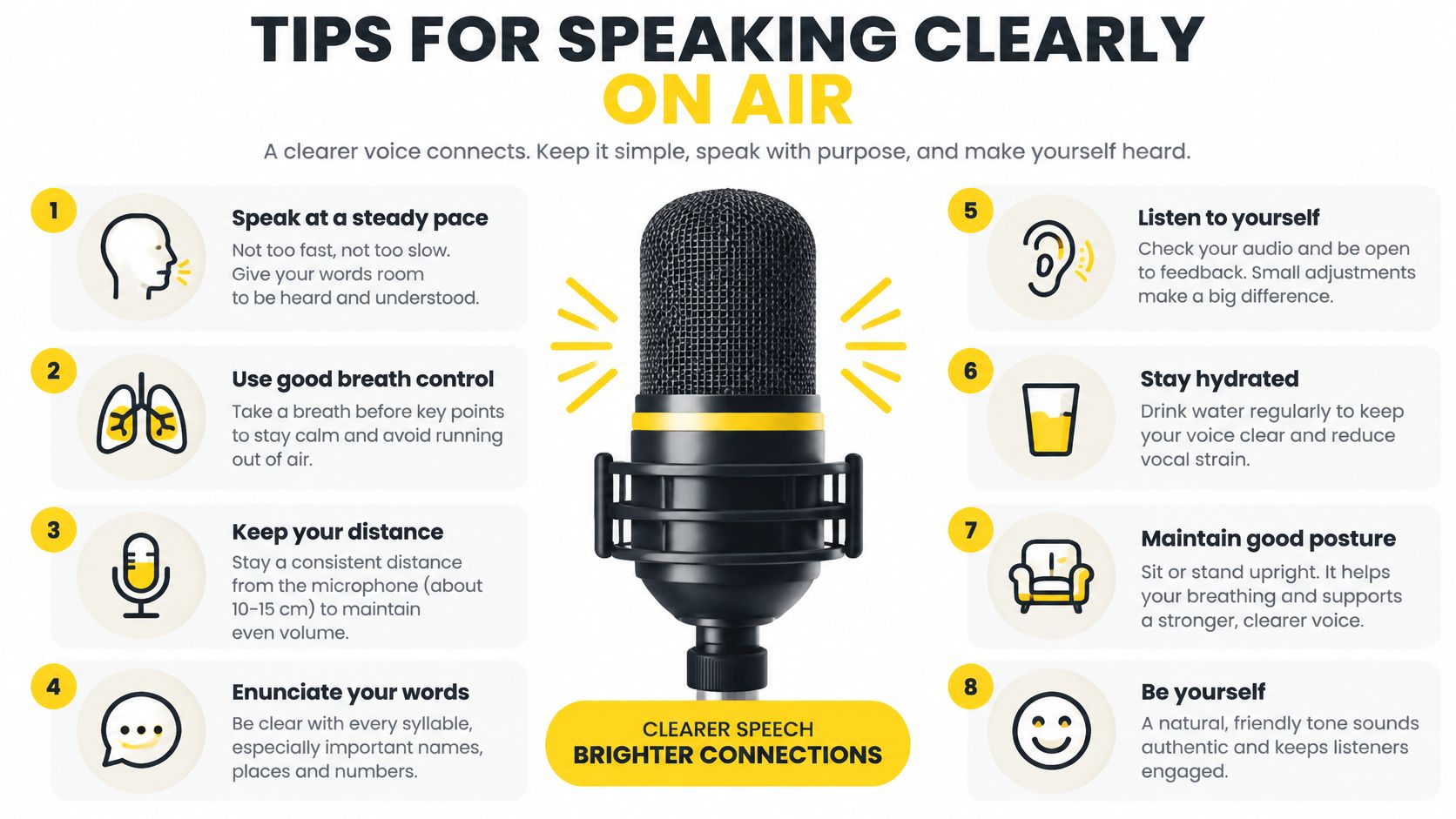
Let emphasis, not volume, carry the word. On a weak or noisy channel the stressed syllable is often the only part that survives, so a steady voice that keeps it prominent beats a loud one. Excessive volume can overload the microphone and make the audio less intelligible.
Read back in the same code. Frequencies, altitudes, locations and clearances need confirmation in accordance with the applicable procedure. Repeating the item in the same code words and numeral forms exposes a mismatch immediately; a paraphrased acknowledgement can hide one.
Cut conversational padding. Unnecessary words consume channel time and can mask the start of the next group. The callsign, essential reference and required phraseology must remain intact.
Spell only the item that needs it. Encoding one uncertain identifier keeps the listener's attention on the part whose exact characters matter, rather than burying it among code words that carry no new information.
Repeat the disputed item when requested. A targeted repetition is usually clearer than restarting an unrelated transmission. If more context is needed, include enough to identify which item is being corrected.
Fix the microphone's position. A displaced headset microphone, wind across the grille or an inconsistent mouth distance can strip the opening or closing sound of a code word. Keep the microphone in a stable position relative to the mouth for the whole transmission.
Under pressure, concise communication still needs complete information. The drone pilot emergency handbook provides related preparation for abnormal situations; emergency planning should identify the relevant contacts and reporting actions before the crew needs them.
Build Your Alphabet Skills Before You Transmit
Alphabet fluency should develop away from the operational frequency. A trainee needs reliable recall, accurate listening and clear delivery before speed matters.
A practical learning sequence
Learn the chart aloud in letter order. The aim is for each code word to become the immediate response to its letter. Difficult words deserve separate practice rather than being hidden inside a fluent recital.
Spell familiar identifiers. A trainee can use a personal name and the hypothetical registration VH-ABC, marking the stressed syllables before speaking. This exposes hesitation when letters don't arrive in alphabetical order.
Practise with a partner. One person reads random code words at a measured pace while the other writes the letters, then the pair swaps roles. Playing the exercise back with background noise shows quickly which words survive a weak channel and which collapse into each other. Separate number exercises test numeral recognition without mixing the systems prematurely.
Check the authoritative forms. A current published chart should be the reference before operational use. Saved charts and informal training notes can carry older or incorrect forms, so any word that differs from the current standard should be relearned.
Intonetic's guide to phonetic transcription can help learners distinguish written pronunciation guides from the sounds they represent. Linguistic phonetic transcription describes speech sounds; aviation's spelling alphabet assigns spoken words to written letters. A chart marking stressed syllables guides how to say the word clearly, and a noisy channel is where that clarity gets tested.
Choosing relevant qualifications
Ace Aviation Aerospace Academy offers Aeronautical Radio Operator Certificate (AROC) and Remote Pilot Licence (RePL) training. Its ACE SILVER package combines sub-7kg RePL and AROC radio training, with commercial course packages starting from $1,199.
Prospective operators should confirm with CASA which radio qualifications their intended operation requires before enrolling. Memorising the alphabet is useful preparation, but it isn't a substitute for the required certificate, licence or operating permissions.
Frequently Asked Questions About the Phonetic Alphabet
Does a radio operator need to memorise every code word?
Yes, and the reason is what happens when recall fails mid-transmission. An operator who hesitates on a letter tends to invent a substitute, and improvised words carry the exact weakness the standard set was chosen to avoid: similar vowel shapes that blur together on a weak channel. Practise until retrieval is automatic, first in order, then in random strings.
Can you swap in a familiar word if a code word slips your mind?
Choosing "S for Sydney" or "M for Melbourne" in the moment seems harmless, but an unplanned word has no guarantee its sounds will survive distortion, so the receiving station may write down a different letter entirely. Pause, recall the correct word and spell again rather than transmitting a guess.
How can you practise the alphabet with a partner?
Run short drills that imitate the channel, not the chart. One partner reads a mixed string of letters and digits as a callsign or registration would be sent; the other writes it down, then reads it back in the standard words. Swap roles and add interference, such as a phone speaker or a noisy room, and note which letters collapse first. Drill those.
What should you do when a read-back does not match?
Repeat the correct version once, clearly, and have the other station read it back again. If a particular letter keeps coming back wrong, spell that element phonetically rather than raising volume or speed. A mismatched read-back is a signal to slow the exchange down, not to push through it.
Operators who want guided practice can build these habits inside structured training. Ace Aviation Aerospace Academy delivers AROC and RePL courses where spelling, numbers and callsign procedures are exercised together under instructor supervision. A free 60-second quiz produces a personalised course recommendation, and current options are listed at Ace Aviation Aerospace Academy.