

A drone pilot returns from a survey job with a useful map, but also a near miss: the aircraft drifted towards a work crew after a gust, and the observer had to call for an immediate landing. The flight is over, but the safety work isn't. The operator now needs to work out what happened, whether the controls were adequate and what should change before the next job.
That's the practical purpose of an aviation safety management system (SMS). For a small Australian drone business, it doesn't have to mean a large manual or layers of paperwork. It means having a proportionate, repeatable way to notice hazards, make decisions, record actions and check whether those actions work.
Table of Contents
- What Is an Aviation Safety Management System
- The Four Core Components of a CASA SMS
- Why Safety Data Matters for Drone Operators
- How to Build an SMS for Your Drone Operation
- Using External Data and the FIMS Transition
- SMS in Practice for Real Drone Operations
- SMS Templates and Audit-Ready Evidence
- Frequently Asked Questions About SMS for Drone Operators
What Is an Aviation Safety Management System
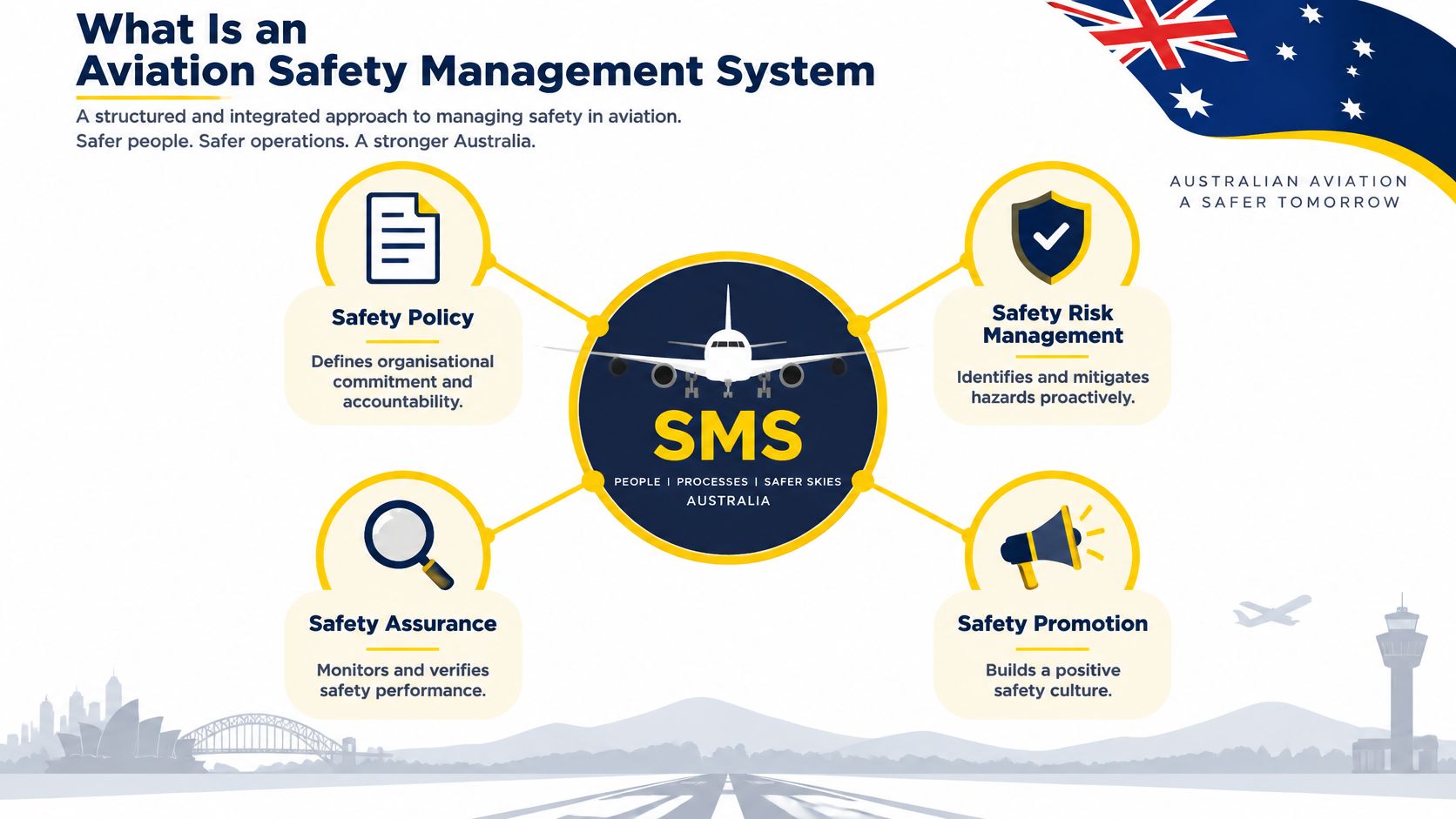
An SMS is a structured way for an aviation organisation to manage safety as part of its everyday work. CASA describes it as a framework connecting an organisation's safety policy and objectives, safety risk management, safety assurance, and safety training and promotion. These parts work together, so a report about a near miss can lead to a risk assessment, a change in procedure, staff communication and a later check that the change has helped. CASA's introduction to safety management systems explains the framework.
A useful analogy is a vehicle's instrument panel. The manual explains how to operate the vehicle, but the instruments help the driver notice what's happening now and respond when something is wrong. An SMS should do something similar for an operation: it gives people clear responsibilities and procedures, while reporting and review help the organisation spot weaknesses before they become more serious.
That distinction matters. A static manual can describe a pre-flight process without showing whether people follow it, whether it addresses the actual worksite or whether recurring equipment faults are being acted on. A functioning SMS connects written processes to operational decisions and evidence of improvement.
When an SMS is required
An SMS obligation depends on the organisation's certificate, approval and type of operation. CASA identifies requirements for several kinds of aviation organisations, including air operator certificate holders under Part 119, specified aerial work operators under Part 138, certified aerodrome operators under Part 139, maintenance organisations under Part 145, sport and recreational organisations under Part 149, and certain approved service providers under Parts 171, 172, 173 and 175. A business using drones shouldn't assume that drone use alone automatically determines its SMS obligations. The applicable rules must be checked against its specific operation and approval.
For a plain-language overview of related operating requirements, operators can consult this guide to drone laws in Australia. Organisations also face broader technology and process changes across aviation; a discussion of digital transformation in aerospace can help put those changes in context.
The Four Core Components of a CASA SMS
CASA's four components make more sense as a connected cycle than as four documents to file away. One sets direction, another manages hazards, a third checks that controls work, and the fourth helps people understand and use the system.

Safety policy and objectives
The policy sets the organisation's commitment to safety and identifies who is responsible for making it real. In a small surveying business, that could mean the manager approves operating limits and provides time for pre-flight planning, while the remote pilot reports hazards and follows agreed controls. Objectives turn that commitment into priorities the team can review, rather than leaving “safety first” as an untested slogan.
Safety risk management
Risk management starts with recognising hazards in the operation, then assessing their likelihood and severity, selecting controls and recording the decision. A hazard register might include a poorly defined operating boundary, a battery fault or an unexpected person entering the work area. The register needs to make clear who owns the hazard, what action is required and when the control will be reviewed.
For operators who want to strengthen their understanding of mitigation approaches, this risk mitigation playbook offers a wider perspective. Its principles still need to be adapted to the aircraft, worksite and applicable aviation rules.
Safety assurance and promotion
Assurance checks whether the system's controls are working. That might involve reviewing occurrence reports, checking whether actions were completed, auditing operating records or looking for recurring issues. Promotion supports safe practice through training, communication and reporting. A short briefing before a new type of job can be more useful than a general reminder that doesn't address its specific hazards.
CASA recommends a gap analysis to score each SMS area, identify missing processes or records and prioritise work. Supporting records can include a safety policy, hazard and risk register, safety reports, audit plans and records, and SMS training records. For people beginning their drone learning, ACE READY is an entry-level course covering drone fundamentals, aviation safety, CASA regulations and flight operations, with preparation for advanced RePL training.
Why Safety Data Matters for Drone Operators
A collection of forms isn't an SMS unless the operator uses the information to make decisions. Reports about loss of control, airspace errors, equipment failures, near misses and human factors can reveal hazards that a checklist alone won't expose. The useful question isn't whether something was reported. It's whether the report led to a control, an owner and a review.

The Australian Transport Safety Bureau's National Aviation Occurrence Database contains de-identified records from July 2003 onward. Operators can examine occurrences by factors such as date, aircraft, operation type, injury level, occurrence category, location and airspace class. That allows a drone business to look beyond its own experience and consider whether similar hazards have arisen elsewhere. The ATSB's annual report describes the database and reports that remotely piloted aircraft had become the second most common aircraft type involved in an accident from 2016 onward, surpassing helicopters.
The same report records that in 2019, 220 aircraft were involved in accidents in Australia and 154 in serious incidents. It also records 22 fatal accidents resulting in 35 fatalities. Those figures cover all aviation sectors, not only remotely piloted aircraft. They nevertheless show why aviation safety systems need structured ways to collect and learn from occurrence information, rather than waiting for a serious event to prompt change.
Indicators that help show change
A safety performance indicator (SPI) helps an operator monitor a defined aspect of safety over time. Possible drone-operation indicators include:
- Operational events: incidents per 100 operational hours, lost-link events or flyaways.
- Airspace and site controls: airspace-infringement reports or unauthorised operating-area entries.
- Equipment and maintenance: battery or propulsion anomalies, defects and rejected take-offs.
- Corrective action: overdue actions and the time taken to close them.
The Australian National Aviation Safety Plan uses a decreasing three-year moving average for accidents and tracks air-navigation safety separately, rather than judging performance from one year alone. The plan reports 170 aviation accidents in financial year 2024–25, compared with 136 in the previous year and a 10-year annual average of 190. It also records 200 serious incidents, above the 10-year average of 174, and 17 fatal accidents, compared with 189 fatal accidents across the decade. The annual report on the National Aviation Safety Plan provides this multi-year context. For a drone operator, the lesson is to watch indicators over time, investigate adverse trends and adjust controls when performance moves away from the organisation's objectives.
How to Build an SMS for Your Drone Operation
A small operator's SMS should fit the work being done. An agricultural spray business, a surveying team and a construction contractor won't face identical hazards, so copying a large organisation's paperwork without adapting it may add work without improving daily decisions.

Start by confirming which rules and approvals apply to the organisation. CASA notes that Part 5 of the Civil Aviation Safety Regulations 1998 provides a single source of SMS rules and standards, but the detailed obligation depends on the relevant regulatory provision. The operator should verify the exact requirement for its certificate or approval rather than relying on a generic manual.
Then define a short safety policy that identifies who makes decisions, who reports hazards and who verifies corrective actions. Build a hazard register around the operation's real work: aircraft, batteries, payloads, sites, airspace, people, contractors and environmental conditions. For each hazard, record an owner, initial likelihood and severity, controls, residual risk and a review date. The detail should be sufficient to explain what the operator decided and why, without duplicating information that the team already uses effectively elsewhere.
Practical rule: If a pilot can't use the control during job planning or the flight, it may be documentation rather than an operational safeguard.
Choose a small set of useful indicators and give them a clear purpose. For example, an operator could track lost-link events per 100 operational hours or overdue corrective actions. The metric should prompt a question and response, not just populate a spreadsheet. When an indicator changes, someone should review the reports behind it, decide whether the risk picture has shifted and record any new action.
Corrective actions need owners and follow-up. If a report leads to a revised pre-flight check, the operator should retain evidence that the check was changed, communicated and later reviewed. That creates a practical audit trail from hazard to decision to verification. Operations that grow from visual line of sight work into BVLOS, spraying or multi-crew activity should reassess their hazards and controls instead of assuming the original arrangements still fit. Teams can also review whether an operation falls within an excluded category of drone operations, while checking the rules that apply to the specific activity.
Using External Data and the FIMS Transition
Internal reports show what has happened within one organisation. External occurrence data can point to hazards the operator hasn't yet encountered. CASA's sample SMS material identifies external aviation occurrence databases as a source for emerging hazards and specifies periodic review as an SMS output. For relevant Part 119 and Part 138 systems, the sample material sets out a six-monthly review interval. CASA's sample SMS manual for Part 119 and Part 138 describes that approach.
A useful review should be more than a database search saved to a folder. The operator can scan occurrences relevant to its aircraft category, operating environment and work type, then decide whether a finding applies to its own hazards. Reports involving communication failure, airspace misidentification, battery malfunction or operations near people may prompt a revised briefing, a site-survey requirement or additional competency checks. The operator can then monitor whether internal reports indicate that the control is working.
Airspace planning also needs active review as processes change. CASA and Airservices expect the FIMS-based model to begin replacing the CASA Digital Platform process at civil-controlled aerodromes, with a transition expected to last about 12 months. Participating UAS Service Suppliers are expected to provide authorisations at 28 civil-controlled aerodromes. CASA says FIMS will support authorisation, real-time airspace awareness, operational planning and strategic coordination. CASA's information on future automated authorisations and drone safety apps outlines the transition.
Digital authorisation doesn't remove the need for a pilot to assess the wider operation. An SMS should identify which source is authoritative at each stage, who verifies the information, and what happens if a system is unavailable or sources disagree. Dispatch procedures should include a fallback, and the occurrence-reporting process should capture relevant system or connectivity failures. Operators working near aerodromes can also review this drone safety guide for airports. A control loop that adapts to changing tools is more useful than a checklist that assumes the process never changes.
SMS in Practice for Real Drone Operations
A common SMS framework can serve very different jobs, provided each operator identifies the hazards of its own work. The safety policy and risk process can stay consistent while site controls, briefings and indicators change with the task.
In an agricultural operation, the team might assess the risk of people or livestock entering the work area, as well as equipment and battery anomalies. Before the job, the operator can define how the crew will keep the operating area clear, communicate a stop-work decision and record an interruption. If the same issue recurs, that pattern belongs in the safety review, not just in the pilot's memory.
A surveying team may need to consider airspace identification, ground-crew positioning and changes in access to a site. A construction operator might focus on moving plant, cranes, temporary obstacles and changing work zones. In each case, the control should be specific enough for the pilot and support staff to use, and clear about who is responsible for checking that it's in place.
Make reporting part of the crew's work
Pilots, observers and ground staff all see different parts of an operation. A simple reporting route helps the team raise a near miss or equipment concern without waiting for an accident. Safety promotion means more than delivering training. It includes explaining how to report, sharing relevant lessons and making sure staff know that a safety report leads to review and action.
As the operation expands, the SMS should expand with it. More crews, different aircraft or more complex operating approvals can introduce new interfaces and responsibilities. The operator should reassess who coordinates the operation, how information reaches the pilot and how controls are verified. Teams preparing for an emergency can use an emergency handbook for drone pilots to support operational planning, alongside their own procedures.
SMS Templates and Audit-Ready Evidence
Templates can help an operator organise an SMS, but a completed template doesn't prove that controls work. CASA provides guidance and tools, including sample manuals, emergency response plans, gap-analysis tools and implementation-planning material. These are starting points. The operator still needs to tailor them to its approval, work and risks.
A hazard register should connect each hazard to its assessment, controls, owner and review date. A safety policy should clarify responsibilities and objectives. An emergency response plan should identify how the organisation will coordinate its response to an emergency. Training records should show what safety instruction was provided and who completed it. These records are most useful when they reflect the actual operating arrangements, rather than a generic procedure no one uses.
CASA's evaluation approach expects evidence such as hazard logs, risk assessments, meeting records, safety-performance reports, audits and trend analysis. For each reported hazard, retain dated evidence of the decision, assigned action and subsequent check of effectiveness. If a control didn't work as intended, record what changed next. That demonstrates a functioning risk-control loop rather than a collection of completed forms.
| Record | Purpose | Review frequency |
|---|---|---|
| Safety policy and roles | Records management commitment, objectives and responsibilities | When responsibilities or operations change |
| Hazard and risk register | Tracks hazards, assessments, controls, owners and review dates | When hazards or controls change, and at planned reviews |
| Occurrence and safety reports | Captures incidents, near misses and other reported concerns | As reports are received |
| Safety-performance records | Shows indicator results and emerging trends | At the organisation's defined review intervals |
| Audit and corrective-action records | Documents findings, assigned actions and effectiveness checks | After audits and when actions are due |
| Training records | Shows relevant safety training and communication | After training and when requirements change |
These review intervals are practical examples, not a universal CASA schedule for every record. Operators should check the rules that apply to their approval and set intervals suited to their operation. A guide to ReOC requirements in Australia can support that review, but it doesn't replace checking the applicable CASR provisions.
Frequently Asked Questions About SMS for Drone Operators
Does every small drone operator need a formal SMS?
Not automatically. CASA's SMS requirements depend on the organisation's certificate, approval and operation, not on whether it uses a drone. Operators should verify the specific rules that apply and maintain safety processes proportionate to their activities.
How can a small business keep its SMS manageable?
Keep records close to operational decisions. A hazard register, a clear reporting method, assigned action owners and periodic review can be more useful than a large manual that staff don't consult. Add processes when the operation's complexity or obligations require them.
What happens in an SMS audit?
The operator may need to show how its system works in practice, including how it identifies hazards, assesses risks, applies controls and checks performance. Evidence should connect reports to decisions and follow-up, rather than showing only that forms exist.
How should contractors be included?
The operator should define how contractors receive relevant safety information, follow site and operating controls, report hazards and communicate changes. Responsibilities should be clear before work begins, especially where contractor activity affects the drone's operating area.
How often should safety performance indicators be reviewed?
There isn't one universal interval for every operator and indicator. The organisation should define a review schedule that suits its operation and applicable requirements, then examine adverse changes promptly rather than waiting for a routine meeting.
What should happen when a hazard appears during a job?
The pilot or crew should follow the operation's stop, pause or reassessment procedure, apply the relevant control and communicate the change to the people involved. The operator should record the hazard afterwards, assess whether procedures need updating and assign any follow-up action.
Ace Aviation Aerospace Academy provides aviation and drone education, including the Remote Pilot Licence, Aeronautical Radio Operator Certificate, Certificate III in Aviation, ReOC consulting, and enterprise and corporate drone training. Operators can visit Ace Aviation Aerospace Academy to explore training and support relevant to safe, compliant drone operations.