
The usual advice for a drone spraying business is to buy a large spray aircraft, post a rate per hectare, and wait for growers to call. That advice treats the quote as the business. In Australia, the quote is the last step, not the first.
A job is only real when the chemical label allows aerial application by an unmanned aircraft, the pilot and operator hold the right credentials, the state chemical rules are met, and the weather window is flyable. A premium rate on a block you cannot legally treat, or cannot finish before the wind moves, is not revenue. It is a cancelled day plus the cost of getting there.
Build the model from compliant, weather-feasible hectares per season. Mobilisation, mixing, water, battery cycles, refills, insurance and stand-down time sit inside that number. The rate per hectare does not.
Table of Contents
- Compliance Workflow Before Quoting a Spraying Job
- Licences and Approvals by Business Model
- Spray Drift Limits That Shape Every Job
- Profitability After Compliance and Weather Costs
- Equipment Selection for Commercial Spraying Operations
- How to Run a Field Job From Scouting to Verification
- Insurance and Risk Management for Spraying Businesses
- Starting Your Business and Finding First Clients
Compliance Workflow Before Quoting a Spraying Job
Do not price a paid spray until five checks are closed for that paddock, that product and that aircraft. CASA treats aerial distribution or spraying as a complex operation that needs extra training and flight authorisations in many circumstances. One-drone spraying on the operator's own land may not need a CASA authorisation when the applicable conditions are met. State chemical law still applies.
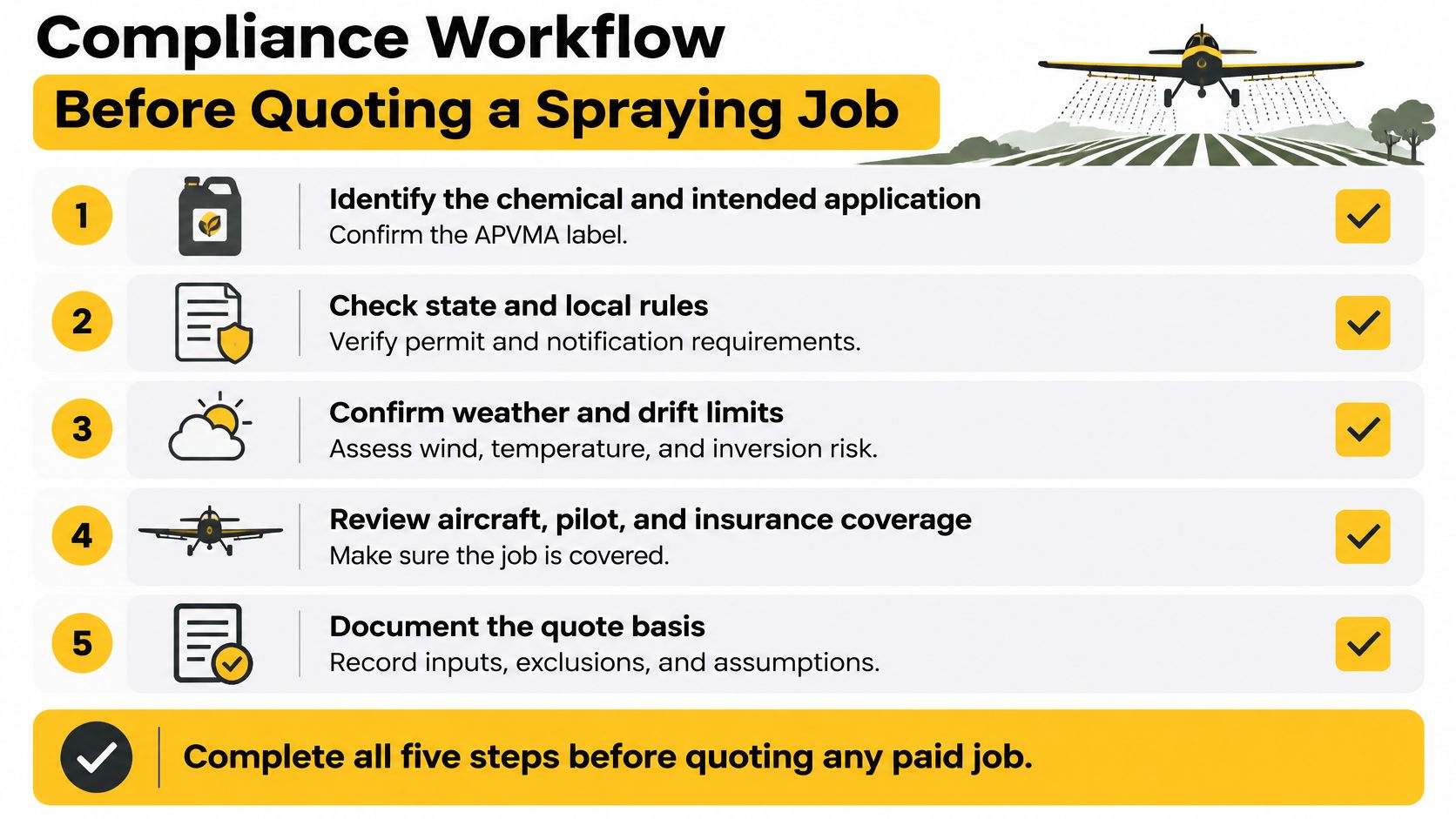
- Identify the chemical and the intended application. Read the approved label. The APVMA treats an aircraft as a fixed-wing or rotary aircraft that applies spray in flight, and that definition includes unmanned aerial vehicles. A product approved only for ground application is not authorised for a drone unless the label, or a relevant approval or permit, supports aerial use. Buffer zones, droplet quality, water volume and release height on that label become job constraints, not suggestions.
- Confirm the aircraft, payload and operating area. Weight, tank load and where you will fly decide which remote-pilot category and which authorisation path apply. A heavy spray platform is not a sub-2 kg excluded operation.
- Decide whether CASA authorisation is required. Standard operating conditions do not automatically cover aerial distribution. If the flight needs an approval, the quote waits until that approval exists. The current Australian drone laws are the federal baseline, not a substitute for the chemical rules.
- Obtain the state or territory chemical-application licence. Queensland, for example, requires a Remote Pilot Licence and a state-issued pilot chemical rating for aerial distribution, including on land the operator owns. Federal permission does not replace that rating.
- Write the operation into procedures and risk controls. Drift controls, spray-quality settings and local equipment standards belong in the job file before a price goes out. CASA also requires operators to check state or territory laws and APVMA spray-drift information before chemical application.
Where quotes fail
Three misses show up again and again. People treat a CASA approval as if it covered chemical use. They skip label-specific drift controls. They never check local spray-quality or equipment standards.
Binary test: If any of the five steps cannot be validated for that job, the job is not quotable.
Ace Aviation Aerospace Academy's ReOC consulting is aimed at operators who need those procedures written before they sell spray work. The ACE GOLD program combines a Remote Pilot Licence, ReOC support, practical flight training, aviation compliance and business readiness for commercial operations. It does not remove the chemical-label check on a specific product.
Licences and Approvals by Business Model
The right paperwork depends on the aircraft, where you'll work, and how many drones one pilot will operate. Set those details before buying equipment or quoting a job.
| Business case | Licence or approval | Authority or basis |
|---|---|---|
| Commercial flight of a drone over 2 kg, or outside the standard rules | Remote Pilot Licence (RePL) for each pilot | CASA |
| Sub-2 kg drone flown commercially in the excluded category | Free operator accreditation | CASA |
| Single drone spraying on the operator's own land within conditions | CASA authorisation may not be required; check state chemical rules | CASA and state law |
| Aerial distribution in Queensland, including own land | RePL plus a state-issued pilot chemical rating | Queensland state rules |
| One pilot operating multiple drones as a fleet | ReOC plus CASA approval under regulation 101.029 | CASA |
| Radio communication where the operation requires it | Aeronautical Radio Operator Certificate (AROC) | CASA |
A RePL is an individual credential that allows its holder to fly a drone commercially. Flying drones over 2 kg commercially, or operating outside standard rules, generally requires one. A ReOC authorises a business to conduct commercial drone operations. Under regulation 101.300 of the Civil Aviation Safety Regulations 1998, a remote pilot is generally limited to one remotely piloted aircraft at a time. Operating multiple spray drones from one pilot requires a ReOC and specific approval under regulation 101.029; the pilot also needs a RePL for the type and category being flown. The ReOC guide to operator certificates explains the ReOC process.
A sole operator flying one aircraft and a business operating a coordinated fleet face different approval requirements. A pilot licence alone does not cover fleet operations. For commercial flight of a sub-2 kg drone in the excluded category, free operator accreditation may apply. That accreditation does not cover chemical application, and a loaded spray drone will not fall into that weight class.
Write the row down first
Record the aircraft weight, state of operation and number of drones each pilot will control. Match those details to the table before ordering airframes, tanks or a generator. Then price mobilisation, stand-down and application separately. 2026 estimate invoice downloads can help keep those costs visible when weather cancels a planned spraying day.
Spray Drift Limits That Shape Every Job
A quoted hectare is only revenue if the aircraft can spray it within the product label and the day's conditions. Release height, droplet size, downwind buffers and permitted weather define the workable area before speed or tank capacity matters. For aircraft applications, APVMA spray-drift labelling may set a maximum release height above the target canopy of 3 metres or 25% of the wingspan or rotor diameter, whichever is greatest. Droplets must meet the label's stated category, and the label may set minimum distances to downwind sensitive areas.
| Control | Rule or value | Effect on the job |
|---|---|---|
| Release height | 3 m or 25% of wingspan or rotor diameter, whichever is greatest | Sets maximum flight height above the canopy |
| Spray droplet category | Not smaller than the category stated on the label | Determines nozzle choice and pressure |
| Downwind sensitive areas | Minimum distances set by the label | Changes block layout and buffers |
| Wind where the label is silent (Victoria) | Above 3 km/h and below 13 km/h | Cuts usable spraying windows |
| Hours of application (Victoria) | Not before sunrise or after sunset | Shortens the productive day |
| Label wind parameters | Conditions stated on the label | Apply when the label specifies them |
Victoria's fallback wind limits and application hours apply where relevant when the product label is silent; check the Victorian spraying requirements before scheduling work.
What a windy afternoon does to ten hectares
A 10-hectare block scheduled for mid-afternoon may have to wait if the wind falls outside the permitted conditions. Rebook it for a compliant window, keep release height within the label limit, and leave required downwind buffers unsprayed. A full tank does not justify flying outside those limits.
Put two checks in every quote file:
- Read the label for each product before pricing, including droplet category, release height and any buffer.
- Record wind, weather and downwind sensitive areas for each block so the job file shows the conditions and limits used.
Set nozzles from the droplet category on the label, then check the flow against the planned speed.
Profitability After Compliance and Weather Costs
A quoted rate per hectare can conceal a thin margin. Australian online guidance puts standard broadacre drone spraying at roughly A$15 to A$35 per hectare, with difficult terrain or high-volume applications exceeding A$100 per hectare. A GRDC case study of four Australian farms using optical spot-spraying reported operating costs of A$3.65 to A$13.50 per hectare and savings of A$12.38 to A$29 per hectare, as discussed in CSIRO-linked precision-agriculture work. Farm savings are not contractor profit: they do not account for a spraying business's overhead.
| Benchmark | Figure per hectare | Scope and limits |
|---|---|---|
| Standard broadacre drone spraying quote | A$15 to A$35 | Online guidance; quoted rate, not profit |
| Difficult terrain or high-volume work | More than A$100 | Online guidance; quoted rate, not profit |
| Optical spot-spraying operating cost, four Australian farms | A$3.65 to A$13.50 | GRDC case study; operating cost only |
| Reported savings, optical spot-spraying | A$12.38 to A$29 | GRDC case study; farm savings, not contractor profit |

The quote must cover mobilisation, charging capacity, mixing and loading, water logistics, label limits, refill time, insurance, maintenance, compliance administration and weather delays. Wind limits and permitted application hours, covered in the Spray Drift section, determine how much of the day is usable. A high rate on fragmented blocks, long travel routes or frequently postponed jobs can still leave a weak annual return.
Break-even from flyable hectares
Build the season's break-even around compliant, weather-feasible hectares, not the drone's purchase cost multiplied by a headline rate. Estimate hectares per productive day, setup and refill time, travel radius, battery cycles and likely cancellations, then include capital recovery and overheads. The drone spraying quote calculator can help organise the estimate, provided those inputs reflect the work you can realistically deliver.
Victorian guidance identifies a A$15,000 spray-drift fine. A drift incident can erase the margin from many completed jobs. High-value work on difficult country has different economics from broadacre contracting; before the season starts, calculate how many compliant hectares you need to break even and how many weather-permitted hectares you can spray.
Equipment Selection for Commercial Spraying Operations
The cheapest aircraft can become the most expensive choice if it cannot work within the block, label requirements and refill plan. Manufacturer flight-time claims do not reflect every full-tank, warm-weather operation.
Tank capacity should fit the block and the distance to water. A larger tank reduces refill stops but adds weight and shortens each sortie. On a compact horticultural block with a nurse tank at the gate, a smaller hopper and quick turns may outperform a heavy load. On broadacre work with water a long drive away, avoiding refills may justify the larger tank.
Batteries determine how much of a flyable window becomes productive. Match the number of sets to sortie length, charge time and promised turnaround. Too few packs leave the crew waiting while chargers catch up, cutting into the hectares you can complete.
Nozzles, mixing and the category you hold
- Nozzles: Carry sets that maintain the label's droplet category at the flow rates you plan to use, plus spares for thicker mixes. Check performance with the intended mix, not just water.
- Mixing and loading: A consistent mix setup and planned water supply can save more time on a remote site than adding another aircraft. Ground time reduces productive hectares.
- Maintenance: Inspect pumps, filters and seals regularly, including after chemical exposure. A damaged seal can mean drift risk, a stopped job and lost working time.
Choose an aircraft that fits the pilot's RePL category and the operation's ReOC limitations. For model-specific context, read about the XAG P150 Max in Australian agriculture. ACE Aviation provides aircraft-type agricultural spray training for existing RePL holders on the XAG P150 MAX, XAG P150, XAG P100, DJI T100 and DJI T50. Compare the aircraft's payload, battery turnaround and field logistics against the hectares you can legally and practically treat.
How to Run a Field Job From Scouting to Verification
A profitable spray job starts with a map that defines where the aircraft should work and where it must stay clear. Split the job into scouting, prescription, calibration, a test pass and a written close-out. That sequence helps keep chemical use, flight time and drift exposure tied to the target.

- Capture georeferenced imagery and mark the target patches. The map records the locations the prescription is based on, rather than relying on a ground estimate.
- Turn detections into exclusion zones and a variable-rate prescription. Remove houses, water, sensitive crops and label buffers from the spray map before mixing.
- Calibrate nozzle output, height, speed, swath and tank mix. Set droplet category and release height to the label requirements.
- Fly a controlled test pass over a short run before treating the full block. Check the swath and fittings while any error is still limited to a small amount of product and time.
- Record weather, batch, treated hectares, battery cycles and the block's condition afterwards. These records support an audit, an insurance query or a response to a dispute.
What wipes the margin in the paddock
Refills, wind delays, calibration errors, drift events and low target density all reduce the hectares you can treat in a flyable window. A spot-spraying quote can look strong per hectare yet return poorly if the crew spends more time travelling, setting up and refilling than spraying. For example, if a short target run needs a separate site trip and several refills, those hours and costs have to be covered by the few hectares treated. Broadacre work can also lose margin when a long drive and repeated refills cut into the day's productive flight time.
Use one page per job. Record the paddock ID, product and batch, label constraints, wind and time, hectares treated, battery cycles, test-pass result, exclusions and post-treatment condition. Imagery supports the prescription; calibration logs show the settings used. Together with the close-out notes, they provide a job record if efficacy is challenged. Missing records leave the operator without evidence to support the work.
Insurance and Risk Management for Spraying Businesses
A spraying quote is only viable if the insurance covers the work and the weather leaves enough time to fly. Before accepting a paid job, check the policy wording for aerial chemical application, third-party injury or drift damage, and aircraft or payload damage during low-level operations. If spraying is not clearly covered, ask the insurer to confirm the position in writing.

CASA's agricultural-flying safety profile recorded 92 accidents and 185 serious incidents involving spreading and spraying between 2014 and 2023, across agricultural aviation, not drones alone. The same profile reports 918,400 flying hours for the category over that decade. The figures cover hazards relevant to spraying work, including low-level flight, weather, people, equipment and chemical handling.
What the policy will ask to see
Be ready to provide a risk assessment, pilot currency records, maintenance logs and an incident-reporting process. Confirm whether the policy covers your aircraft, payload, chemical application and operating model. If you plan to fly multiple aircraft or work outside standard conditions, check the applicable exclusions and limits before committing to that setup.
Keep insurance documents and operating procedures together with the job records. That file helps show what the business is insured to do and how it manages risk. Ace Aviation Aerospace Academy offers training for RePL, AROC and ReOC licences, alongside agricultural drone operations. For a broader starting-business sequence, see the compliance steps above.
Starting Your Business and Finding First Clients
A spraying business reaches break-even on compliant hectares it can fly, not the hectares in a rate-card calculation. Weather, chemical rules and travel all limit the work you can complete. Build your first season's plan around those limits.
Before quoting, check the aircraft, operating approvals and state chemical requirements for the job. The compliance gates are covered in the earlier sections on licences and approvals, and spray-drift limits. For each prospect, identify the label conditions, location and likely flyable window before you commit to a rate.
Who to approach first
Start with agronomists and contract sprayers who already work with product labels and buffers. Offer a documented test block, pricing in chemical and travel, and keep a clear job sheet. That record gives a prospective client concrete evidence of what the service includes: work completed within label requirements, with the application documented.
After getting licensed, students can find paid commercial jobs through DroneWork. The Australian drone work ecosystem explains how training, operational compliance and job opportunities connect. For a solo operator, fulfilment for freelance services covers the practical steps of taking a booking, delivering the service and getting paid while keeping records in order.
Frequently asked questions
Can a sub-2 kg drone spray chemicals commercially?
Sub-2 kg drones can be flown commercially under CASA's excluded category with free operator accreditation. That flight category does not by itself establish that a chemical application is permitted. Check the product label, pilot requirements and relevant state chemical rules for the proposed job.
Does every drone spraying business need a ReOC from the first job?
The answer depends on the operating model and approvals required. Use the licence and approval requirements discussed earlier to determine what applies to your aircraft and operation before accepting work.
Will ordinary business insurance cover spray drift?
Do not assume it will. Ask the insurer to confirm cover for chemical application, drift liability and equipment damage during low-level work. Keep risk assessments, pilot currency records and maintenance logs available when arranging cover.
Can one state chemical rating cover work in another state?
Check the destination state's aerial-distribution requirements before taking a job across a border. Read the product label for each application, as its conditions govern how that product may be used.
What if the product label changes mid-season?
Pause before the next mix and check the current label. Its requirements for droplet category, wind, buffers and release height determine whether the application can proceed. If aerial application is not allowed, do not quote that product for drone spraying.
Where do margins disappear?
Weather downtime, unpriced refills and travel, and an incident that stops work can all cut into the return. Estimate the compliant hectares you can realistically finish during the season, then compare that figure with your costs. A client pays for a service that fits the label, can be scheduled around flyable conditions and comes with clear job records.
Ace Aviation Aerospace Academy provides CASA-compliant commercial drone training, including RePL, AROC, agricultural operations and ReOC consulting. Its advisors can help plan equipment, insurance and client acquisition. Graduates also get exclusive access to DroneWork, which connects qualified pilots with commercial drone jobs across Australia. Explore Ace Aviation Aerospace Academy's RePL, radio and agricultural drone courses.