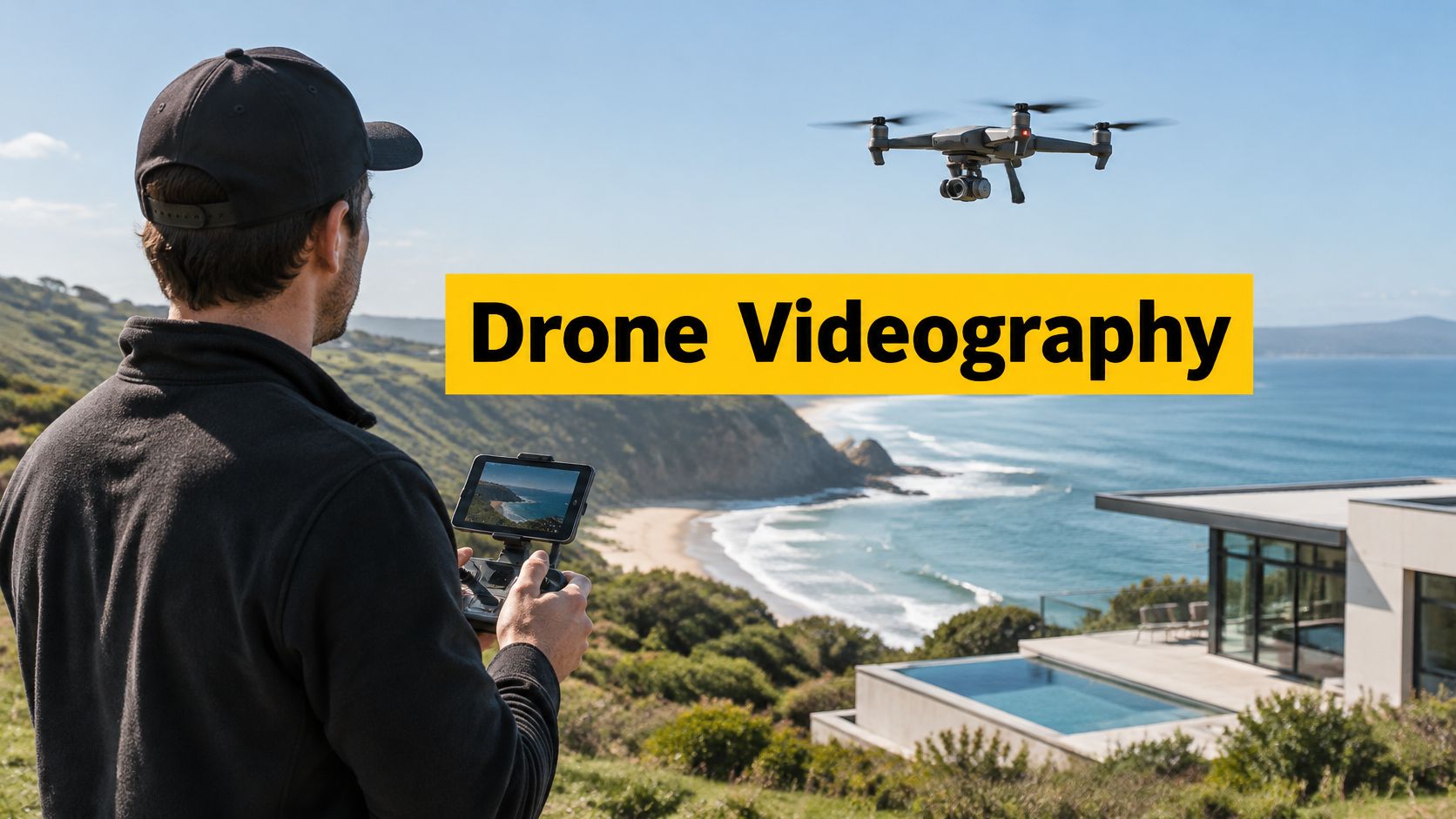
A property client wants aerial coverage tomorrow. The brief sounds straightforward: reveal the building, follow the driveway and finish above the neighbouring streets. Then an event organiser asks whether the drone can pass over arriving guests. Before either booking is accepted, the producer needs to establish which shots can be flown, which people can be filmed and what the editor must receive.
Professional drone videography involves more than smooth stick control. Australian aerial producers must connect the creative brief to aviation permissions, site controls, privacy decisions and a usable delivery package. A shot can look excellent on the monitor and still be unsuitable for flight or publication.
Table of Contents
- What Paid Drone Videography Requires
- How to Plan Every Shot Before Launch
- Settings and Moves Clients Can Use
- Consent When People Appear in Frame
- Aerodromes and Flights Beyond Sight
- Edit Delivery and a Usable Portfolio
- Training Pathway for Commercial Videographers
- Frequently Asked Questions
What Paid Drone Videography Requires
Classify the operation before choosing the camera. Paid property filming, government communications and business promotional work are not recreational flights just because the aircraft is small or the pilot enjoys flying.
CASA's guidance for non-recreational drone operations requires drone registration and operator accreditation for the relevant pathway, and identifies the RePL and ReOC requirements for commercial aircraft weighing more than 2 kilograms. Sub-2 kg drones can operate commercially under the excluded category with free operator accreditation, provided the operation meets that category's conditions.
What a commercial filming job needs
The contract must match the operation, aircraft and conditions before camera work is planned.
| Operation | Aircraft and conditions | What you need |
|---|---|---|
| Sport or recreation only | Standard operating conditions | Drone rules; not a paid filming pathway |
| Commercial, excluded category | 2 kg or less, inside standard conditions | Drone registration and operator accreditation |
| Commercial over 2 kg | More than 2 kg | RePL for the pilot and a ReOC for the organisation |
| Near people, 15 to 30 metres | Commercial operations only, under specific ReOC, aircraft-weight and consent conditions | Meet those conditions; the ordinary buffer is 30 metres |
| Controlled-aerodrome no-fly zone | Below 400 ft within 3 nautical miles of a runway measurement point, plus approach and departure paths | Eligible holders may use digital authorisation for certain aerodrome operations; operations inside the no-fly zone must initially be referred to CASA's RPAS office |
| Beyond visual line of sight | Pilot cannot keep the aircraft in sight, or flies from another location | ReOC, RePL with the relevant examination pass or qualified supervision, plus BVLOS flight approval |
The specialised rows aren't permission to launch. Near-people, aerodrome and beyond-sight work each requires its applicable conditions and approval process to be satisfied.
A Remote Pilot Licence (RePL) is an individual credential that allows its holder to fly commercially within the relevant scope. A remotely piloted aircraft operator's certificate (ReOC) concerns the organisation conducting the operation. A pilot's licence alone doesn't provide every organisational authorisation a production business may need.
Checks before signing
Record the operational assumptions alongside the quote:
- Aircraft and pathway: Confirm operating weight, category and the organisation responsible for the flight.
- Location and route: Identify the intended height, airspace, proximity to people and proposed launch position.
- Approvals and personnel: Establish whether the work needs additional authorisation, operating procedures or qualified crew.
- Commercial scope: Separate aerial capture, ground filming, editing, weather contingencies and publication rights.
Flying heavier aircraft commercially, or operating outside standard rules, generally requires a RePL. However, outside-standard work may also need specific approvals, so a licence shouldn't be treated as unrestricted authority.
Sound belongs in the production scope too. Isolate Audio's a filmmaker's guide to better sound is useful when aerial sequences must integrate with interviews and ground coverage. Rotor noise isn't a substitute for clean location audio.
For training-cost planning, the training quote calculator provides a separate starting point. Training costs and the client's production quote should remain distinct.
How to Plan Every Shot Before Launch
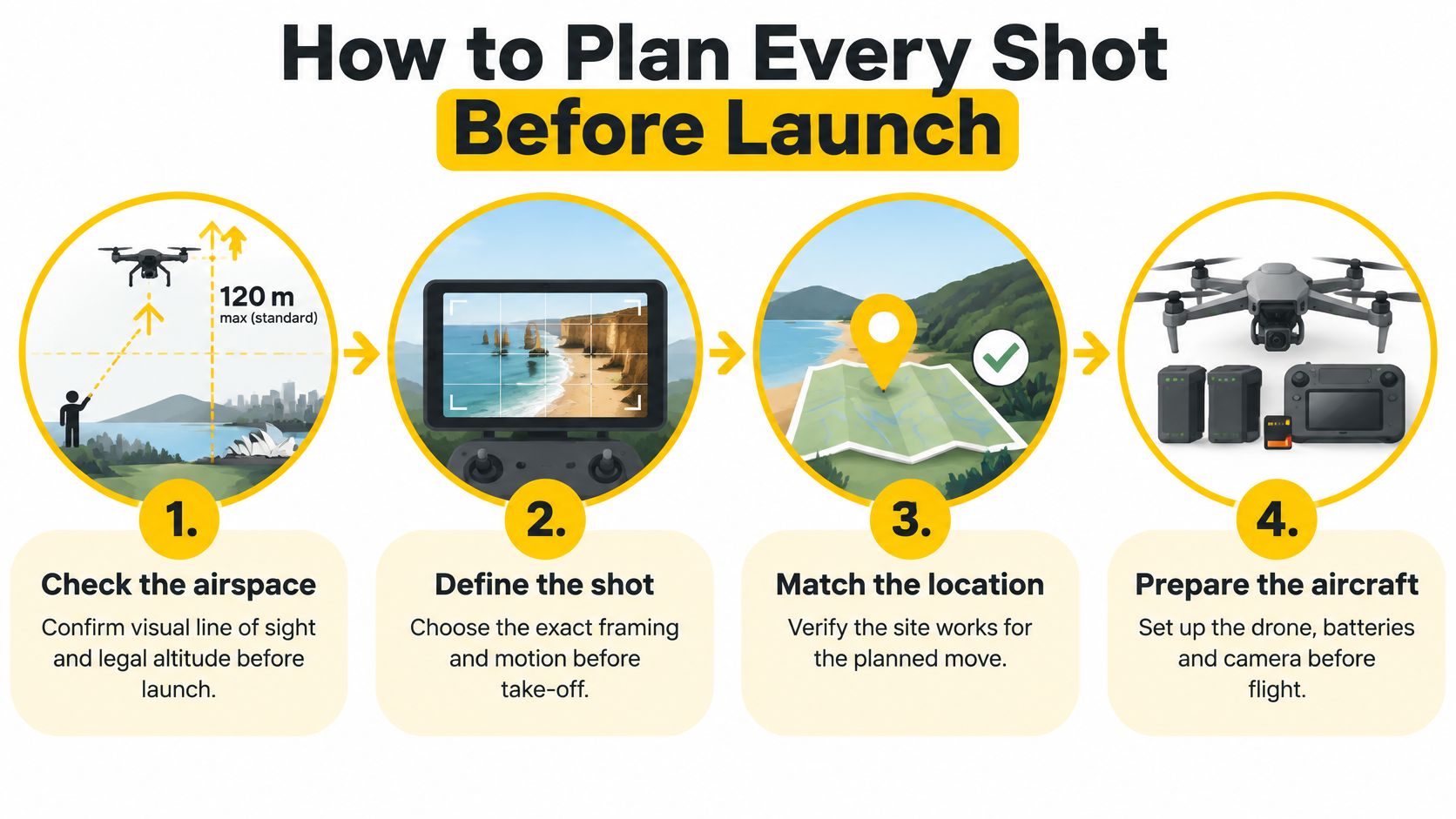
A shot list should function as an aviation plan, not just a collection of attractive references. Under CASA's standard operating guidance, ordinary flights must remain within visual line of sight, at or below 120 metres above ground level, during daytime and at least 30 metres from people not directly involved.
The live camera feed doesn't replace the pilot's own view. The pilot must continually see, orient, guide, and positively control the aircraft, rather than relying on a screen, goggles or magnified viewing device.
The planning sequence connects legal access to framing and aircraft preparation.
Build the flight around the site
- Classify each location separately. Check airspace, nearby aerodromes and temporary restrictions. A production moving between properties shouldn't assume that permission at the first site covers the next.
- Walk the operating area. Identify pedestrians, roads, buildings, overhead obstructions and emergency landing options. Mark the exclusion area and lateral flight boundary on the site map.
- Resolve access and filming permissions. Obtain landowner permission where needed and identify subjects requiring a release before framing private activity.
- Brief the crew. Assign camera, observer and people-management responsibilities. Name who calls an abort and establish an unambiguous stop instruction.
- Prepare aircraft recovery. Confirm battery condition, lost-link behaviour and return-to-home settings. The recovery route must clear obstacles without breaching the authorised operating envelope.
- Reconnoitre before recording. Fly a short assessment pass where safe, verify framing and clearance, then record the planned take.
LesFM's explanation of the key parts of a shot list helps turn a creative idea into a shared production document. For aerial work, add pilot position, flight boundary, abort trigger and recovery route alongside framing and movement.
Record the decision, not just the footage
The shot record should include:
- Risk controls: People management, operating boundary and emergency landing area.
- Aircraft readiness: Battery status, recovery settings and lost-link procedure.
- Conditions: Visibility, weather assessment and reasons for postponing or refusing a take.
Cloud, thick fog, smoke and poor visibility aren't creative opportunities for a standard operation. They can remove the pilot's ability to maintain aircraft orientation.
Practical rule: If the planned recovery cannot be completed legally and safely, the shot isn't ready to launch.
A distant establishing shot often fails at the planning stage because the camera position sits beyond direct sight or outside the permitted height. The workable alternative may be a closer launch position, a shorter reveal or ground coverage, not a longer transmission link.
Settings and Moves Clients Can Use
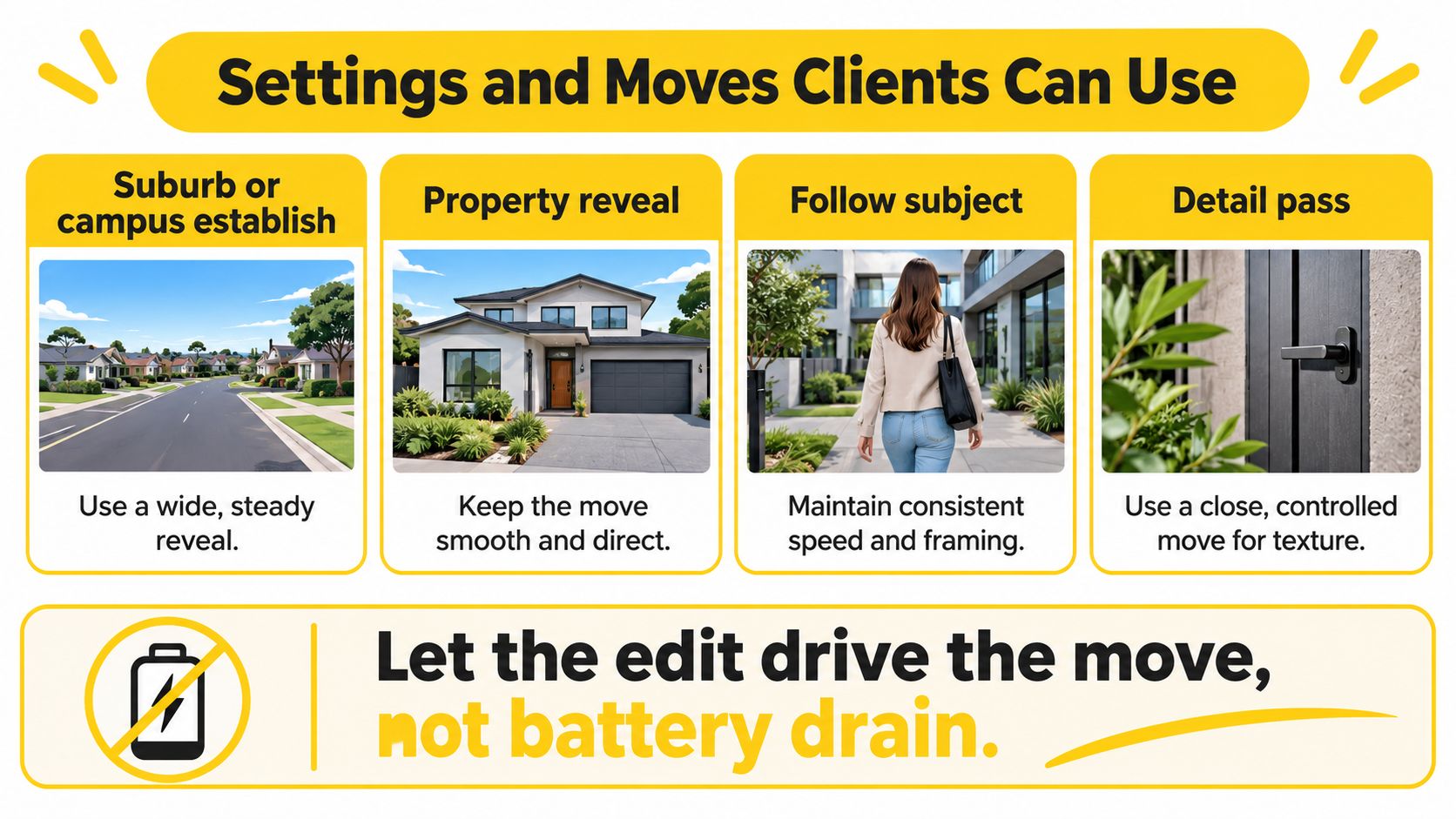
| Client shot | Move | Height and separation | Camera start point |
|---|---|---|---|
| Wide establish | Slow single-direction reveal or partial orbit | Inside the planned height cap and site boundary, in VLOS | 4K, 25 fps, shutter near 1/50, ND, low ISO |
| Property or venue hero | Gentle push-in, then a two-second hold | Inside the planned cap, at least 30 m from uninvolved people | 4K, 25 fps, flat profile only if grading is booked |
| Moving subject | Lateral track matched to subject speed | Pilot keeps eyes on the aircraft; never closer than 30 m to bystanders | 50 fps, shutter near 1/100 if slow motion is required |
| Detail or facade | Locked hover, no stick input during the take | Low enough to resolve detail, clear of people and obstacles | 4K, 25 fps, faster shutter only if the frame must freeze motion |
These starting recipes for common client shots are production choices, not additional flight permissions. The people-separation and visibility constraints follow CASA's drone rules; camera settings never override them.
The edit should determine which move gets flown.
Set exposure for the intended edit
Confirm delivery frame rate before take-off. The table's shutter settings are practical starting points for natural-looking movement; an ND filter reduces incoming light so the camera can retain the chosen shutter speed without unnecessarily raising ISO or overexposing the image.
Lock white balance when lighting permits. Automatic changes during a reveal can leave the editor correcting a visible colour shift across the same take.
Record at a resolution that supports the agreed delivery and reasonable reframing. Extra pixels don't rescue missed focus, excessive motion blur or an awkward camera angle.
A flat or log profile makes sense when someone will perform colour management and grading. For a quick-turnaround job without that workflow, a well-exposed standard profile can be the more dependable choice.
Give each move a purpose
A campus establish should explain geography. A property push-in should reveal the entrance or relationship between spaces, rather than approach a wall just because forward motion looks cinematic.
For a moving subject, agree the route and speed before launch. Automated tracking doesn't manage bystanders, preserve the pilot's sightline or decide whether the route remains suitable.
- Keep motion consistent: Establish direction and speed before the usable portion of the take.
- Protect edit handles: Hold a stable composition at the beginning and end rather than stopping recording immediately.
- Watch the horizon: Check gimbal alignment before a flight, not after the client has left.
- Preserve recovery margin: Plan the landing before chasing another take.
A controlled hover can be more useful than a complicated orbit. It gives the editor a readable detail and avoids combining unnecessary yaw, gimbal movement and sideways flight.
Consent When People Appear in Frame
A lawful flight is not automatically lawful filming. Aviation compliance addresses the aircraft's operation; privacy, surveillance and publication decisions address what the camera captures and how that material is used.
CASA's guidance on flying over and near people sets the ordinary 30-metre separation and describes restricted commercial operations between 15 and 30 metres under specific ReOC, aircraft-weight and consent conditions. Someone agreeing to appear in a promotional video doesn't, by itself, authorise a closer flight.
The privacy check belongs beside the people-management plan.
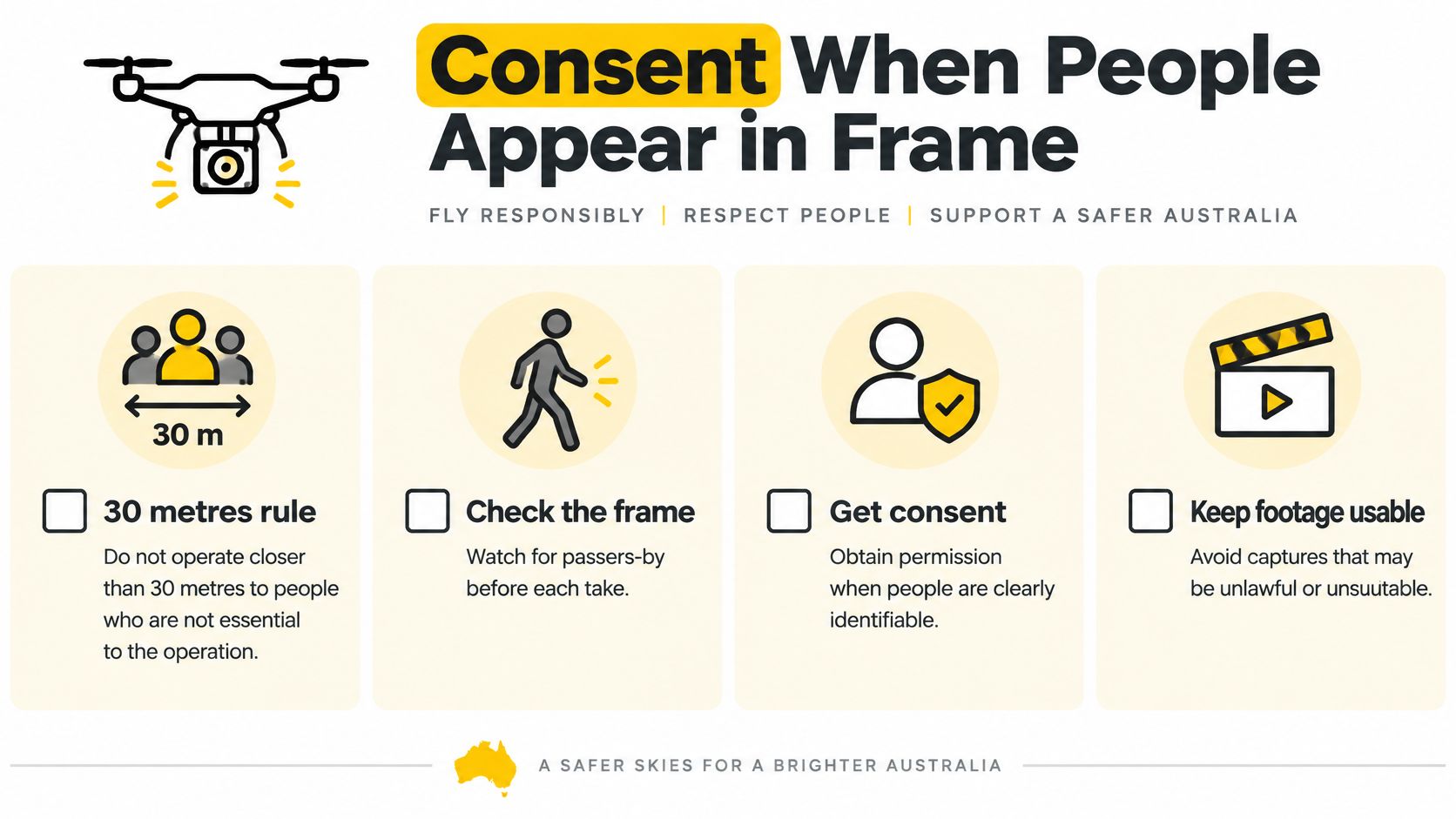
Assess the frame before recording
For organisations covered by the Privacy Act, OAIC guidance calls for notification before image capture, secure handling and destruction or de-identification when the information is no longer needed. The Act generally doesn't cover individuals acting in a purely private capacity, but businesses and agencies must assess whether they're covered.
State, territory and local requirements may add obligations. A production should check the laws relevant to its location and intended activity rather than treating public airspace as permission to record private life.
A pre-flight privacy assessment should address:
- Identifiability: Could faces, number plates, backyards or indoor activity identify someone?
- Purpose: What does the client need to communicate?
- Audience: Is the footage for an internal report, public campaign or another defined use?
- Handling: Who receives the rushes, who can access them and when will they be removed?
Use consent and retention controls on set
For a market or sports day, obtain written releases for featured participants and brief staff on managing passers-by. Entry signage can explain that aerial filming is underway, identify the responsible organisation and provide a contact for questions.
Signage isn't a universal substitute for consent. Nor does a release automatically cover unrelated future advertising, portfolio use or every person visible in the background.
Permission to operate above a location and permission to publish identifiable activity are separate decisions.
Agree the retention period and access arrangements in the contract. Secure raw footage and releases, distinguish authorised client material from rejected takes, and remove identifiable material once there's no legitimate reason to retain it, subject to applicable obligations.
The Australian drone laws guide provides broader operating context, but a site-specific privacy assessment still matters. If a person cannot be kept clear or appropriately filmed, change the framing, lens, operating position or shot rather than hoping a crop will solve the problem later.
Aerodromes and Flights Beyond Sight
A skyline, coastline or sports venue can require airspace authorisation even when the runway isn't visible from the launch point. Distance judged from the ground isn't a reliable airspace assessment.
Airservices Australia's controlled-airspace guidance describes a controlled-aerodrome no-fly zone as airspace below 400 feet, within 3 nautical miles of a runway measurement point, together with relevant approach and departure paths, including paths extending beyond that distance.
Separate the map check from authorisation
Eligible commercial ReOC or RePL holders may request digital authorisation through connected unmanned-aircraft services for certain controlled-aerodrome operations. However, operations inside the no-fly zone, or above the specified controlled-airspace height, must initially be referred to CASA's remotely piloted aircraft office.
That distinction matters when quoting. Access to a digital request system doesn't mean every requested camera position can be approved through it.
Before confirming the shot, establish:
- Airspace geometry: Identify runway approaches, departures and relevant boundaries.
- Authorisation route: Determine which organisation processes the proposed operation.
- Operating conditions: Record the approved area, height, timing and any communication requirements.
CASA-verified drone safety applications assist with checking airspace. They don't replace the approval or relieve the operator of its conditions.
Treat BVLOS as a separate operation
A road, rail or pipeline fly-through becomes a different proposition when the remote pilot cannot maintain direct visual contact. Strong video reception doesn't make that flight a standard visual-line-of-sight operation.
CASA's BVLOS requirements require a ReOC, BVLOS flight approval and a remote pilot holding a RePL with an Instrument Rating or BVLOS examination pass, or operating under appropriately qualified supervision. A conventional VLOS RePL alone doesn't authorise BVLOS filming.
The producer must therefore budget for the organisation, pilot competency and approval process, not merely a drone with greater advertised range. A shorter route filmed from suitable pilot positions may be a more practical production design, provided each flight remains compliant.
Where an aerodrome approval requires aviation-radio use, the relevant credential is an Aeronautical Radio Operator Certificate (AROC). The final shot plan should reflect written authorisation, the approved height envelope and applicable radio requirements before the crew commits to capture.
Edit Delivery and a Usable Portfolio
The editor needs footage that answers the client's brief, not every orbit recorded during the session. Label clips with location, date, aircraft and pilot in command so production and compliance questions can be traced to the correct flight.
A consistent ingest and review process helps separate usable takes from technically attractive footage that shouldn't be published.
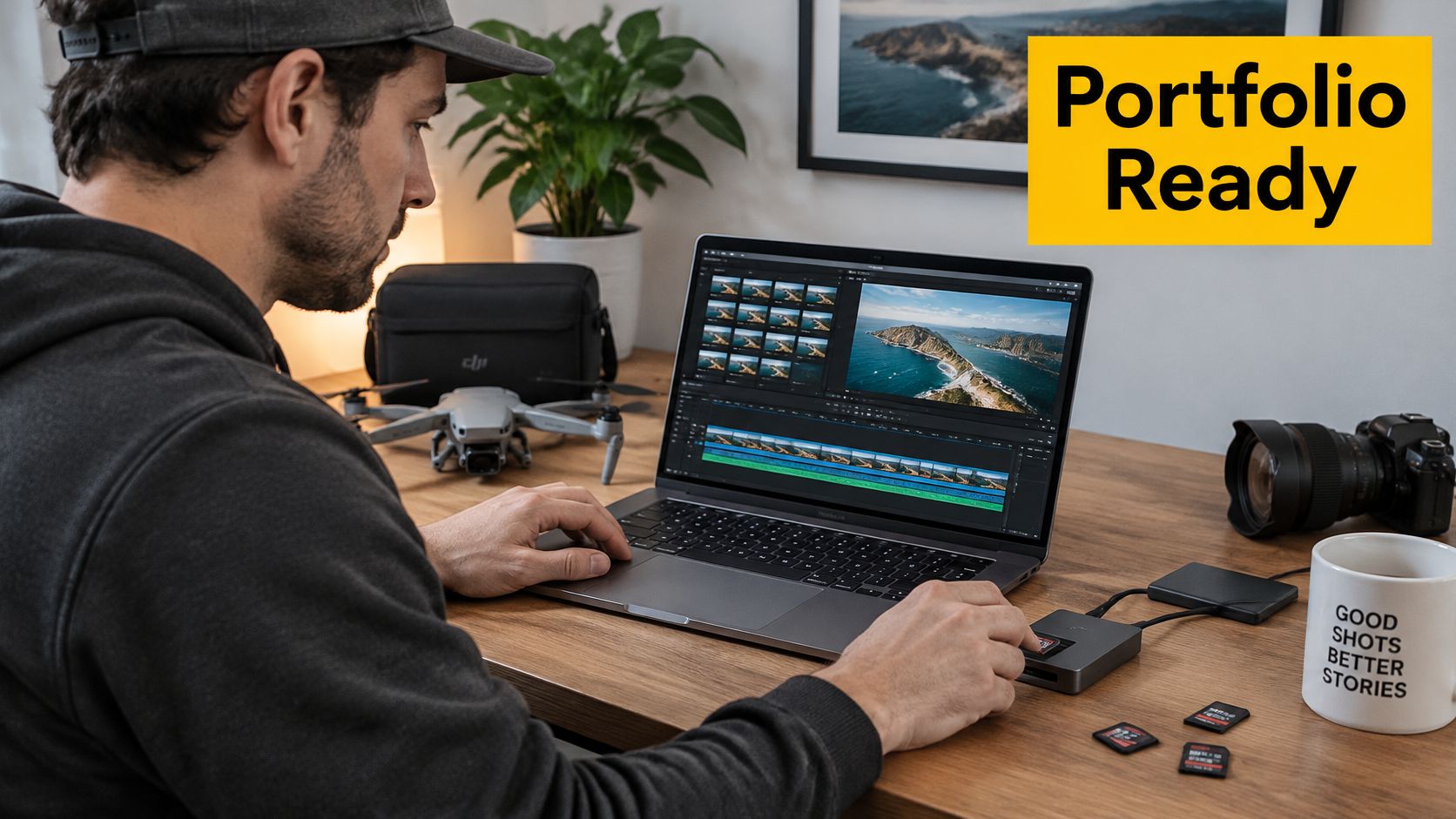
Deliver an agreed package
Unless the contract specifies otherwise, a practical delivery package includes:
- Graded master: The approved edit in the agreed codec, resolution and frame rate.
- Clean version: The same programme without graphics, where required for reuse.
- Selects reel: Approved usable shots with timecodes and matching clip references.
- Shot log: Capture notes, restrictions and takes refused because of people, weather or airspace.
Stabilise small errors, not an unsuitable capture. Heavy digital stabilisation crops the frame and can introduce distracting distortions around buildings or vegetation.
Match exposure and white balance before applying a creative look. Keep skin tones believable and avoid grading or speed effects that misrepresent a property's appearance or relationship to surrounding infrastructure.
For interview-led edits, Saturalabs explains how to compare isolated speech with original audio. Listening to both versions helps assess whether processing has damaged speech, but audio cleanup doesn't provide rights to reuse someone else's recording.
Show finished sequences, not a storage archive
A useful portfolio demonstrates repeatable framing and editorial judgement. Select complete examples of an establish, property or infrastructure pass, moving subject and detail, each with a short explanation of the brief and operating constraint.
Portfolio test: A prospective buyer should be able to understand what the shot achieved and why the producer chose that approach.
Avoid publishing footage because it looks impressive. Client delivery permission may not include portfolio publication, and identifiable bystanders or private activity still require appropriate handling.
Music, logos and other supplied assets need their own rights checks. Retain project files and consent records according to the agreed schedule and applicable obligations, then remove identifiable material that no longer has a legitimate purpose.
Training Pathway for Commercial Videographers
A videographer planning paid drone work should match training to the aircraft and operation. Sub-2 kg drones can be flown commercially under CASA's excluded category with a free operator accreditation. Flying drones over 2 kg commercially, or operating outside standard rules, generally requires a Remote Pilot Licence (RePL).
Match training to the work
Ace Aviation Aerospace Academy delivers CASA-approved RePL and commercial drone courses Australia-wide across eight major locations, including Sydney's metropolitan area. Its commercial training is designed for complete beginners and requires no prior experience. Training aircraft are provided, so students do not need to own a drone.
The ACE READY entry-level course is an option for beginners. For a broader vocational pathway, read the Certificate III in Aviation careers guide.
Before enrolling, clarify the work you plan to take on:
- Aircraft and operating scope: Identify the drone category and the rules that apply to the intended filming.
- Business structure: Establish whether you will work under an existing organisation's ReOC or need to arrange your own.
- Production environment: Consider the airspace, communications and crew responsibilities involved in the work.
ACE advisors can help with planning equipment, insurance and finding clients for a drone business. After getting licensed, students can find paid commercial jobs through DroneWork, which connects qualified pilots with commercial drone work across Australia. Job access is one part of building a videography business; clients still need footage that meets the brief and can be captured lawfully.
A credential supports the operation. Production planning and sound judgement determine whether a requested shot can be flown and delivered responsibly.
Frequently Asked Questions
What should the shot record say if a bystander enters during a take?
Record when the interruption occurred and which take was affected. This gives the editor and client a clear account of why the shot is missing or needs to be repeated.
How long should drone footage be kept?
Set a retention period in the production contract that reflects the footage's purpose and any applicable obligations. Identifiable footage should be deleted or de-identified when it is no longer needed.
Does the people buffer apply to the crew?
People involved in the operation may be treated differently from bystanders, but a crew label alone does not establish that role. Confirm each person's duties during the briefing, and plan separation for clients, spectators and anyone else not involved in the flight.
What if the client requests work outside the operator's approvals?
Revise the shot to fit the operator's authorised scope, or arrange for an appropriately authorised organisation to conduct the work. The drone licence pathway information can help identify a credential gap; the planned flight still needs to fit the applicable operational requirements.
Ace Aviation Aerospace Academy offers commercial drone training, including RePL and aviation-radio training, relevant to aerial production. Producers can discuss the aircraft, filming environment and organisational requirements behind a planned drone videography service with Ace Aviation Aerospace Academy.