
A fully rated pilot steps out of the ute at the farm gate: licence in hand, hours logged, a drum of chemical in the tray. The flying side is in order. Whether anyone has read the label on that drum decides whether the spray goes ahead.
Safe Work Australia surveillance has found that workers exposed to chemicals on the job do not always receive employer-provided safe-handling training. The same gap sits on spray jobs. The licence covers the aircraft. The chemical decision is separate: someone turns the approved product label and the day's conditions into a recorded go or no-go call.
Before take-off, the crew confirms the product, crop, pest, application method and conditions are permitted, and knows how to respond if something goes wrong.
Table of Contents
- Labels Permits and the Rules around Aerial Use
- What Chemical Handling Training Covers on a Spray Job
- Chemical safety gaps and emergency response protocols
- Turning the Label into a Go or No-Go Call
- Compliance records and documentation standards
- Qualifications to Line Up before You Spray
- Questions Drone Operators Still Ask
Labels Permits and the Rules around Aerial Use
Before anyone opens a drum, the crew needs a reliable information chain. In Australia, agricultural and veterinary chemical products must be approved by the Australian Pesticides and Veterinary Medicines Authority (APVMA) before they can legally be sold. Each product must carry an approved label that complies with the Agricultural Labelling Code. The APVMA's labelling guidance explains why operators must identify the exact product and read its label, rather than rely on general knowledge about a chemical class.
The label can set the permitted circumstances, application method, timing and frequency, along with withholding periods, re-entry periods, disposal requirements, safe-handling directions and first aid. A registered product isn't automatically suitable for drone application. The crew must confirm that the proposed crop, pest, rate, equipment and aircraft method are covered by the label or an applicable permit.
| Regulator | Governing instrument | Crew confirmation required |
|---|---|---|
| APVMA | Approved label and permit | Product, crop, pest, rate, timing and aircraft application method are explicitly covered |
| State or territory chemical regulator | Chemical use and licensing legislation | Local chemical user licence held and neighbour notification completed if required |
| Work health and safety regulator | WHS Regulations and Codes of Practice | Hazardous chemical register, current SDS and worker induction records are on site |
| CASA | Remote Pilot Licence and ReOC | Flight is authorised under aviation rules, distinct from chemical use authorisation |
The division matters. CASA's aviation requirements govern the flight; they don't, by themselves, authorise the chemical application. State and territory requirements can add chemical-use controls, so a crew must check the rules applying where the job will take place. There isn't one national spray licence that covers every chemical operation.

Keep the label, safety directions and SDS distinct
Label safety directions describe hazards and precautions, including safe handling, mixing, storage, use and personal protective equipment (PPE). Other label directions, such as spill response, container disposal, re-entry and withholding periods, also matter, but they address different controls.
A safety data sheet (SDS), produced by the manufacturer or importer, provides information about the substance's identity, properties and health hazards. The workplace should keep a hazardous-chemical register and current SDSs, make relevant information accessible to workers, and retain induction and training records. The operator should consult the product's SDS before mixing, transferring, storing or transporting it, and when responding to a spill.
For a drone crew, the job file should connect the product and label to the site plan and flight decision. That means identifying the exact product, checking the proposed use, and documenting relevant site conditions and notifications. A pilot's overview of Australian drone laws is useful for understanding the aviation side, but chemical-use approval must be checked separately.
What Chemical Handling Training Covers on a Spray Job
A practical chemical handling training checklist should take the mixer, loader and remote pilot through the job in order, from product identification to equipment cleaning. The goal isn't extra stick time. It's to make sure everyone who handles the chemical or contaminated equipment can follow the product's controls and recognise when a task shouldn't proceed.
| Topic | Skill the crew must show | Why it matters in drone spraying |
|---|---|---|
| Label and SDS | Identify the product and read the approved label and current SDS before transfer | Aircraft use isn't lawful just because the product is registered |
| PPE | Match safety directions to mixing, loading, spraying and cleaning tasks | Loaders and cleaners are exposed as well as the pilot |
| Storage | Keep original labels, use secure storage and separate flammables from ignition sources | Drums may sit on utes and pads rather than in a chemical shed |
| Mixing | Dilute only at the labelled rate and never into food or drink containers | A wrong rate can be applied over a wide area quickly |
| Application method | Confirm crop, pest, rate and aircraft use are on the label or a permit | Ground directions don't authorise aerial application |
| People and produce | Apply exclusion, re-entry and withholding directions | Bystanders, workers, crops and livestock share the site |
| Emergencies | Know first aid, spill isolation and who to call | A remote pad may be far from help |
| Waste | Dispose of containers and rinsate, and clean equipment as directed | Residue on the aircraft can contaminate the next job |
Train in the order the work happens
Start with product identity. Before transferring chemical, the worker should match the container to the job, find the approved label and consult the current SDS. That prevents a familiar-looking container or a remembered procedure from substituting for product-specific instructions.
Set up protection before handling begins. The crew should identify the PPE required for mixing, loading, application and cleaning, and make sure each person understands when it must be worn. The pilot isn't the only person at risk: loaders, ground crew and anyone cleaning contaminated equipment also need task-specific instruction.
Control storage and mixing. Keep chemicals in their original labelled containers and secure them between tasks. Separate flammable or combustible liquids from ignition sources, and never transfer a chemical into a food or drink container. Mix and dilute only as directed by the label.
Confirm application and finish safely. Check that the label or permit covers the proposed aircraft method, then plan how people, livestock and treated areas will be managed. Before work starts, the crew should know how to isolate a spill, get first-aid information and dispose of waste. After the job, clean the aircraft and handle containers and rinsate according to the label.
Queensland farm-safety guidance also recommends secure storage, correct labelling and keeping flammable or combustible liquids away from ignition sources. Those practical controls fit into a wider set of chemical considerations for pest management, including how application choices affect the surrounding site.
The table can be used as a toolbox-talk checklist before work begins. Training should include practice, not just a discussion: the crew can locate a product's label and SDS, identify the required PPE, and explain what to do if a container leaks. State rules may also require chemical-user licensing, so training topics alone don't establish that every local requirement has been met.
For agricultural drone work, job-ready training for XAG agricultural drone operations can help pilots understand aircraft-specific work. That aircraft familiarisation sits alongside, rather than replaces, chemical-user competence.
Chemical safety gaps and emergency response protocols
Safe-handling training was among the least frequently reported exposure controls in Safe Work Australia's NHEWS chemicals report: coverage sat at 50% among exposed construction workers, compared with 75% in health and community services and 73% in government administration and defence. The survey covered workers generally rather than drone crews, and the pattern still matters here. Flying authority proves nothing about how a crew handles its load.
A tanker can be driven safely while its cargo is mishandled. In the same way, a pilot can control a drone competently while the crew gets the chemical decision wrong. RePL flight authority and chemical cargo management are different responsibilities. The gap becomes urgent when there's a spill, an exposure or a suspected release of fumes.
Incompatible chemicals can cause explosions, toxic or flammable gas releases, or corrosive reactions, which is why storage and training matter together. Safe Work Australia's guidance on storing hazardous chemicals also draws attention to preparing for incidents, as well as routine handling. A worker who crosses into a contaminated zone to retrieve equipment can turn one exposure into two.
Rehearse the first actions after an incident
A crew can practise this response sequence before working at a remote pad:
- Stop work and control bystanders. Move people away from the incident and keep them upwind where conditions allow. Don't approach a spill or suspected off-gassing to investigate without the training and protection required for that situation.
- Avoid secondary exposure. Don't remove contaminated PPE while still in a contaminated zone. Keep other workers out until the area has been assessed and the response is safe.
- Find the product information. Use the SDS for product-specific first aid and hazard information. Tell responders the product name and known exposure route, such as skin contact or inhalation, if that information is available.
- Isolate equipment without re-entering the hazard area. Contaminated aircraft, hoses and equipment should be kept out of service. Don't cross into the affected zone to retrieve them.
- Call for appropriate help. Contact the Poisons Information Centre or emergency services as the situation requires, and say if off-gassing is suspected. Fumes can injure responders who approach without protection, so that one detail changes how help arrives.
- Preserve incident details. Keep the label information, batch details and a timeline of events for medical and regulatory follow-up.

A drone pilot emergency handbook can support the aviation side of emergency planning. The chemical side still needs rehearsal with the crew's actual products, SDS access and incident procedures, because a label nobody has read is a poor teacher mid-incident.
While responders are on site, one crew member should keep a written timeline: when the exposure was noticed, when the area was cleared, when help was called and which product was in the tank. Those notes feed the medical handover and the incident report. Training is incomplete if workers can describe PPE yet haven't rehearsed evacuation, information handover and record preservation, especially when a chemical hazard may be invisible or its effects delayed.
Turning the Label into a Go or No-Go Call
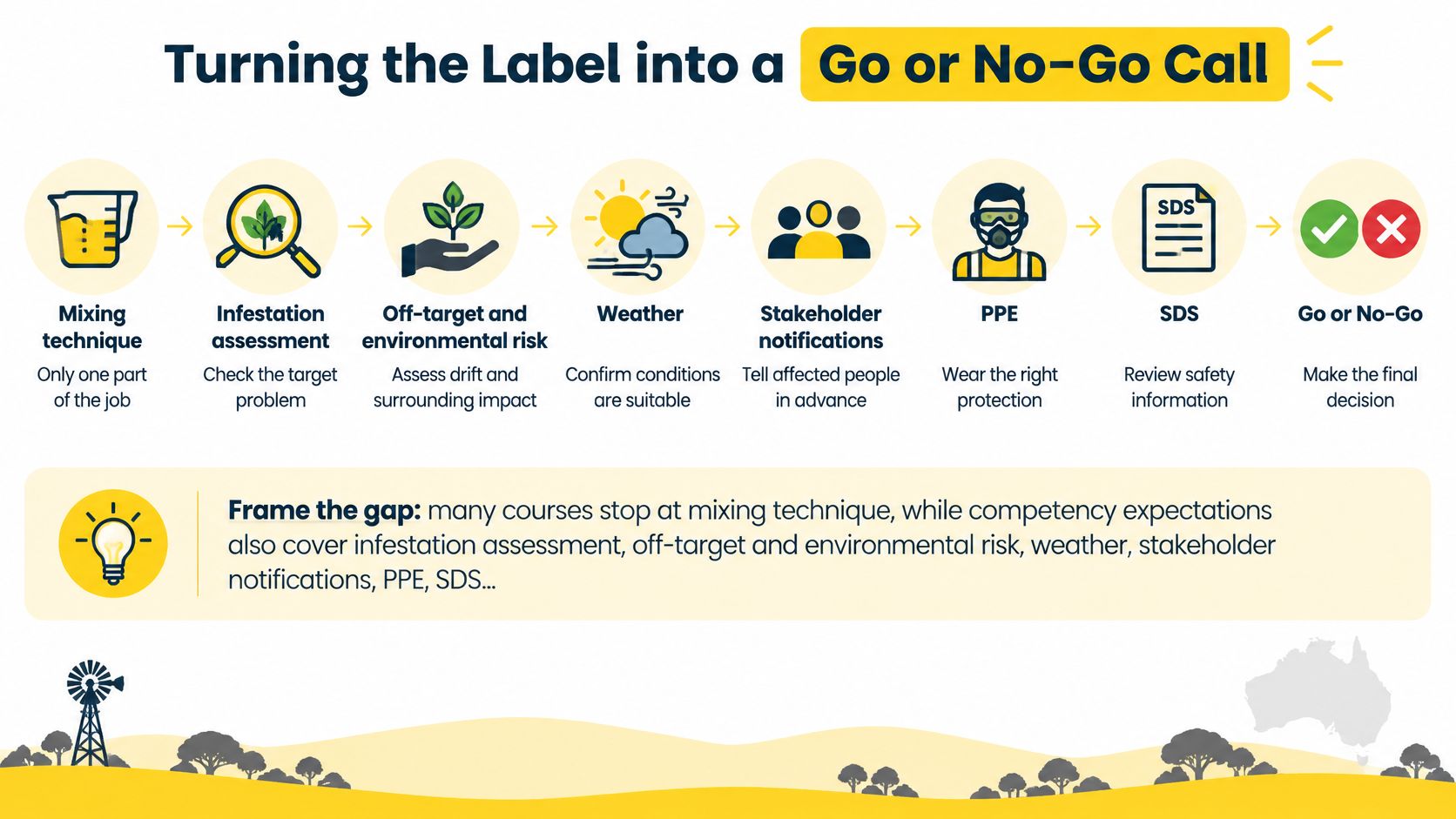
Chemical handling training must build judgement, not just mixing technique. Competency requirements include assessing infestation, off-target and environmental risks, weather, stakeholder notifications, PPE, SDS information and incident records. They also include integrated pest management and resistance-management principles. The national unit AHCCHM307 assessment requirements codify decision-making that goes beyond demonstrating how to mix or apply a product.
Consider a broadacre job with a labelled insecticide, a drone carrying a spray tank, a neighbouring house, a waterway and a forecast wind shift. Even if the aircraft is ready, the pilot and crew still need to decide whether the application is appropriate. More drone practice doesn't automatically make that chemical decision safer.
Use a repeatable pre-application workflow
- Read the label and SDS. Write down the crop and pest, permitted rate and application method, required PPE, re-entry conditions and withholding period. If the label doesn't cover the proposed task, don't infer permission from the product's general registration.
- Confirm aircraft use. Check that the proposed application method is covered by the approved label or an APVMA permit. If it isn't, stop and resolve the authorisation question before preparing the chemical.
- Assess weather. Check wind, temperature and inversion risk against the label's limits and the conditions at the site. A forecast wind shift or changing conditions can turn an acceptable plan into a no-go.
- Map people and sensitive areas. Identify the house, waterway, workers and any other relevant locations. Set exclusion zones and complete any required stakeholder notification before application.
- Check the response setup. Confirm that required PPE, decontamination water and spill equipment are on site and accessible to the crew.
- Make and record the decision. Choose whether to apply, postpone or switch to another control. Record the conditions, rationale and people notified.
- Stop if conditions change. If conditions become unsuitable during the operation, stop the application and record why.
The written rationale is the test of a sound decision. Another person should be able to read the job record and understand why the application went ahead, was postponed or did not proceed. This is the difference between a repeatable operational decision and a pilot relying on confidence or memory.
Compliance records and documentation standards
An auditor arrives and asks for the records of one spray job from three months ago. The next hour shows whether the file is a system or a shoebox. A usable file lets a reader trace one job end to end: which product was applied, who handled it, which aircraft and nozzle set put it down, and what the go or no-go call recorded at the planning step.
A practical spray-job file brings together:
- Chemical register: Keep the workplace hazardous-chemical register current and consistent with the products held on site.
- SDSs: Maintain current SDSs for hazardous products on site and make them accessible to the people who handle them.
- Training and induction records: Record who received training, what it covered and how it relates to the tasks performed. Where relevant, identify recognised units such as AHCCHM307.
- Equipment records: Keep calibration and maintenance notes that help the operator verify equipment condition and application settings, including nozzle and flow checks where applicable.
- Incident reports: Record spills, exposures, response actions and any decontamination checks.
- Notification evidence: Retain neighbour or stakeholder notification records where local requirements call for them.
Organise records so a responder can find them
Keep the label and SDS filed with the job records, so a supervisor or responder can identify the chemical and pull up the relevant safety information without searching unrelated folders. For one job, a retrievable set means the SDS, the register entry, the calibration note for the nozzle set used, any notification record and the training record of the person who mixed the load, all reachable from a single job reference.
Retention periods differ between document types and jurisdictions, so confirm the period that applies to each record rather than assuming one rule covers everything. Operators who prepare for industrial compliance audits build exactly this kind of retrievable, consistent evidence instead of collecting certificates in isolation.
Certificates from a training provider such as Ace Aviation Aerospace Academy belong in the file, though chemical-user training, hazardous-chemical records and job documentation remain the operator's responsibility under workplace and agricultural requirements. For businesses building an aviation operations system, guidance on ReOC requirements in Australia can clarify the operator-approval side of the work.
The test is retrieval speed. If a worker cannot produce the SDS, the training record and the decision record for a given job within minutes, the file needs reorganising rather than more documents.
Qualifications to Line Up before You Spray
Every spray job rests on two separate qualifications, and confusing them is how compliant-looking operations come undone. The first is chemical competence: the ability to use labels and SDSs, assess risk and maintain records. Recognised agricultural chemical units such as AHCCHM307, and industry programs such as ChemCert where required by the relevant state framework, form that pathway.
The second is aviation competence. Commercial remote pilots need to meet the applicable CASA requirements, including a Remote Pilot Licence where required for the operation. Some work also calls for an Aeronautical Radio Operator Certificate. A business flying for hire needs appropriate operator arrangements; ReOC consulting can support that system, while chemical-use competence still comes from the chemical side.
Match training to the aircraft and the task
Aircraft-type training prepares a pilot to operate a particular platform, and it does that job well. It does not, by itself, satisfy chemical-handling requirements. Because the XAG P150 Max carries and applies chemicals, additional chemical-application accreditation may also apply.
Ace Aviation Aerospace Academy is a CASA Approved Training Provider with reference CASA.ReOC.1421. For existing RePL holders, its aircraft-type agricultural spray and spread training covers the XAG P150 MAX, XAG P150, XAG P100, DJI T100 and DJI T50. Pilots weighing that pathway can review the XAG licensed pilot course details to see what the aircraft-specific training involves.
Pilots who have not begun flight training can start with ACE READY, an entry-level course covering drone fundamentals, aviation safety, CASA regulations and flight operations, preparing learners for advanced RePL training. Chemical-user units remain a separate line-up for anyone who will handle product on the job.
The order matters less than the coverage. Before booking flight training for a spray operation, the business should confirm the state's chemical-user requirements and keep each person's training records with the spray job file. Certificates alone do not run a safe operation, though. Hearing Max Wagner on challenge and support shows the people side of a chemical department: qualified staff still depend on a manager who backs their judgement when the day's conditions turn a job into a no-go.
Questions Drone Operators Still Ask
Is chemical handling training legally required for every drone pilot? The duty generally sits with the operator running the spray job and with any employer of the people handling the chemicals. A pilot who never mixes, loads or applies chemicals holds different duties to a spray crew member. Once a person handles hazardous chemicals, though, training relevant to that work and the applicable requirements is expected.
What should a crew do when a label is updated mid-season? Treat the updated label as the controlling document from the date it takes effect, even if the product in the shed was bought under the old wording. Pull the new label, check the planned use against it, replace the SDS copy if the product details changed, and brief the crew. Note the update in the next spray decision record.
Do chemical-use rules match across Australia? No. State and territory requirements can differ, so crews need to check local licensing and notification rules before the job.
Who on the crew needs training? Mixers, loaders, pilots and people who clean or maintain contaminated equipment may all need training relevant to their tasks. Handling risk doesn't stop at the transmitter.
How does an employer show training happened, and when is it refreshed? Keep the hazardous-chemical register, current SDSs and induction or training records together with the spray decision record. Review training when the product, label, task or equipment changes, or when a worker can't demonstrate the required controls. Refresher timing follows those triggers and the worker's demonstrated competence rather than one fixed expiry date. Record each session the day it happens.
Ace Aviation Aerospace Academy provides RePL and AROC training, ReOC consulting and aircraft-type agricultural spray and spread training for existing RePL holders. Operators can visit Ace Aviation Aerospace Academy to review relevant aviation training options and registration information.