A farm manager has been told to get a drone licence before arranging aerial spraying. The aircraft supplier talks about UAVs, the training paperwork says RPAS, and an insurance form asks about unmanned aircraft systems. These terms overlap, but they don't describe exactly the same thing.
The distinction matters because a safe, lawful flight involves more than an aircraft and someone holding a controller. Australian operators must match the pilot, equipment, operating procedures and permissions to the proposed job.
Table of Contents
- Unmanned Aircraft Systems Defined and Compared
- How Commercial Drones Are Classed by Weight
- Core Components of an Unmanned Aircraft System
- Payloads and Use Cases Across Australian Industries
- Training Pathways from RePL to ReOC and AROC
- Approvals and Airspace Limits for Commercial Operators
- Safety Record and Managing Near-Encounter Risk
- Confirm Your Pathway Before You Fly
Unmanned Aircraft Systems Defined and Compared
An unmanned aircraft system (UAS) is the complete arrangement that allows an aircraft without an onboard pilot to fly. It includes the aircraft, its control link, the ground control station and the person managing the flight.
A useful analogy is a crewed aircraft with its cockpit moved to the ground. The pilot still makes aviation decisions, but now relies on radio links, displays and ground-based observation rather than sitting inside the aircraft.
Terms used for unmanned aircraft
| Term | Meaning | Where You Will See It |
|---|---|---|
| UAS | Complete system: aircraft, control link, ground station and operator | Industry and international usage |
| RPAS | Remotely piloted aircraft system, the term used in CASA rules | Australian regulations and CASA publications |
| UAV | Aircraft only, without the ground control station or the pilot | Engineering and defence writing |
| Drone | Everyday term for any small unmanned aircraft | Media, consumer and marketing use |
RPAS emphasises the remote pilot. UAS is broader terminology and doesn't, by itself, establish how an aircraft is controlled. A flight with automated waypoints can still involve a remote pilot supervising the operation and remaining responsible for decisions.
The distinction also helps when assessing technical material. American Additive Manufacturing's resource on 3D printing for UAV drones concerns aircraft manufacturing, which is only part of the complete operational system. An airframe modification must also be considered alongside weight, balance, maintenance and operating procedures.
Why the terminology matters in Australia
The scale of professional drone aviation makes precise language important. CASA's account of licensed drone pilot growth reports fewer than 3,300 RePLs about four years before mid-2020 and approximately 16,500 in mid-2020, followed by 38,874 licensed drone operators at 1 May 2025, compared with 30,845 pilots licensed for conventional crewed aircraft.
Those measures describe licences and licensed operators, not the number of aircraft available for work. Businesses shouldn't treat an aircraft purchase as equivalent to establishing an aviation operation.
Practical distinction: A UAV is equipment. A UAS includes the people and connections needed to operate that equipment.
The terminology used here follows that distinction: UAS describes the complete system, RPAS follows CASA's regulatory terminology, and drone provides the everyday name.
How Commercial Drones Are Classed by Weight
Australian obligations begin with two questions: what does the aircraft weigh in its operating configuration, including batteries and payload, and is the flight for paid work or business? A camera, spray load or replacement battery can change the relevant operating weight.
The baseline operating limit is 120 metres above ground level (AGL), equivalent to 400 feet; CASA's drone rules also set the controlled-airport restrictions summarised below, including the limited allowance for micro drones.
Weight classes and commercial obligations
| Weight Class | Commercial Obligation | Key Operating Limit |
|---|---|---|
| Micro, 250 g or less | Register; operator accreditation or RePL depending on the operation | Up to 45 m high within 5.5 km of a controlled airport, outside the airport boundary and without creating an aircraft hazard |
| Over 250 g up to 2 kg, excluded category | Register; operator accreditation for commercial work under excluded-category conditions | Flight within 5.5 km of a controlled airport prohibited without authorisation |
| Over 2 kg | Register; RePL generally required for commercial work | Flight within 5.5 km of a controlled airport prohibited without authorisation |
The micro-drone allowance isn't unrestricted airport access. The operator must remain outside the airport boundary and avoid creating a hazard to aircraft, as required by CASA's rules.
Sub-2 kg drones can be flown commercially under the excluded category with free operator accreditation. Flying heavier aircraft commercially, or operating outside standard rules, generally requires a RePL. These are starting points for classification, not substitutes for checking the current CASA category conditions and any applicable exceptions.
Applying the classification to a job
Consider a hypothetical 1.8 kg mapping drone used for a surveying client. Under the excluded-category pathway, the pilot needs operator accreditation for that paid work, and the aircraft needs registration. The operator must still assess the location and proposed flight against the operating conditions.
A hypothetical 4 kg spraying drone used by a contractor for a farmer generally points towards a RePL pathway. That example doesn't establish permission to spray, approval for a particular site or compliance with other requirements applicable to chemical application.
Commercial status matters even for the lightest aircraft. Registration is required for commercial use, and flying an unregistered drone commercially is an offence.
The useful habit is to record the actual take-off configuration, not copy the empty-aircraft weight from a sales brochure. Before relying on a category, the operator should confirm current CASA guidance for the aircraft, purpose and proposed operating conditions.
Core Components of an Unmanned Aircraft System
A working UAS is a chain of connected parts. Separating the cockpit, aircraft and pilot creates additional dependencies: a serviceable aircraft can still become unusable if its controller fails or its command link drops.
The diagram groups the principal hardware functions. Flight preparation must also account for the software, ground equipment and people connecting those functions.
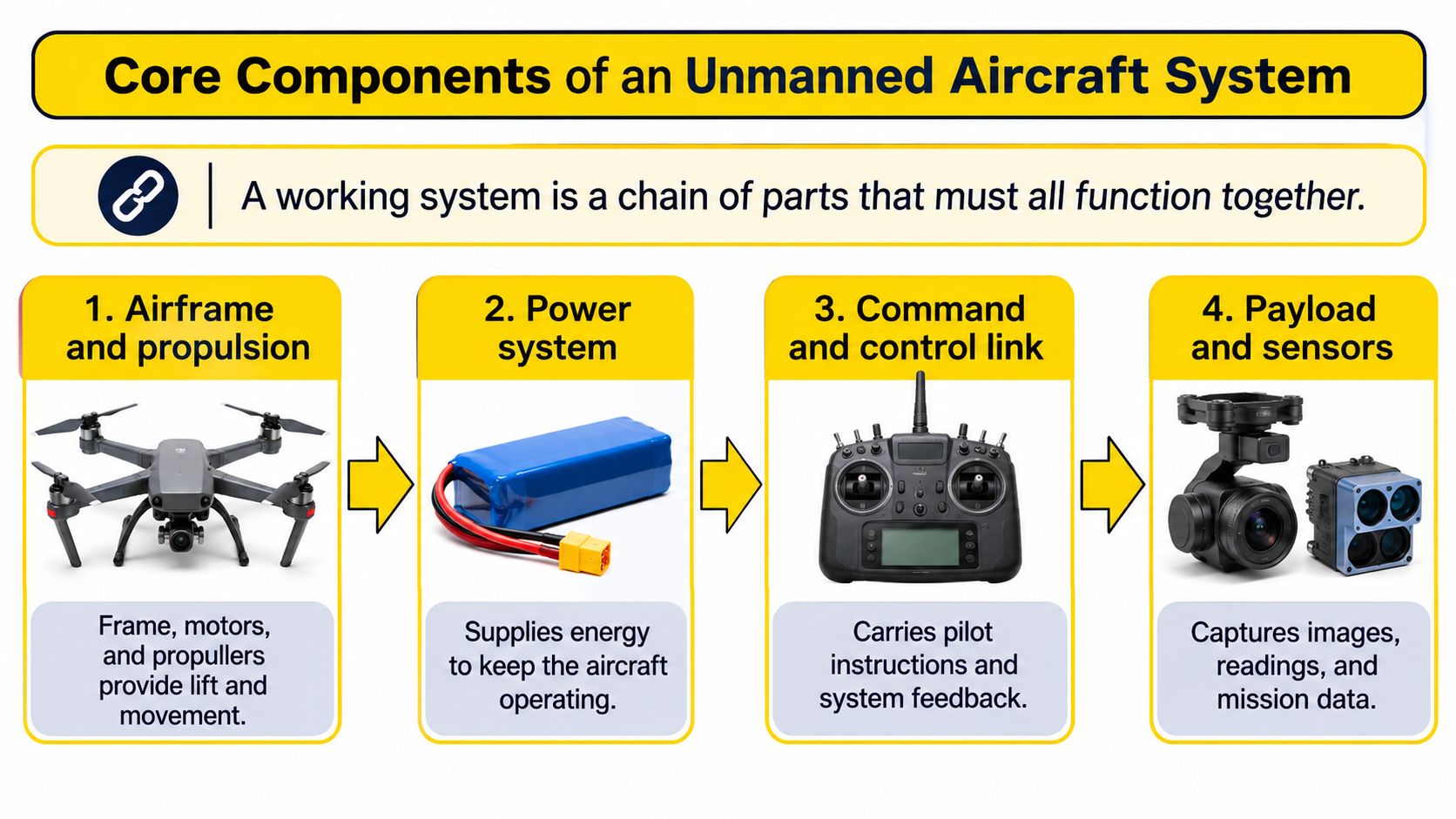
Following the chain from aircraft to operator
- Airframe and propulsion. The frame carries the load; motors and propellers provide lift and movement. A chipped propeller or loose motor mounting can undermine an otherwise normal pre-flight check.
- Flight controller and sensors. The controller uses inputs such as satellite positioning, compass readings and barometric pressure to manage flight. Magnetic interference near steel structures can make heading information unreliable.
- Command and control link. The radio connection carries pilot commands and system feedback, or telemetry. A building between the pilot and aircraft can interrupt that connection.
- Ground control station. A handset, tablet or computer provides mission planning and flight information. An overheating tablet can remove the pilot's map and telemetry display.
- Payload. A camera, sensor, spray tank or spreader performs the job. A loose mount can affect balance, while an incorrectly configured camera can produce unusable survey imagery.
- Power system. Batteries, connectors and charging equipment support the operation. Cold batteries, damaged cells or contaminated connectors can compromise available power.
- Human elements. The remote pilot and any visual observer manage the operation. An observer who hasn't agreed on clear traffic calls may see a hazard without communicating it effectively.
Checking interfaces rather than isolated parts
A maintenance record should identify the aircraft configuration and any changes affecting compatibility. A payload installation, for example, warrants checks of mounting security, power supply, balance and clearance from moving parts.
Technical preparation can include the disciplines addressed through RPAS engineering and maintenance. The operational question is whether the configured system remains serviceable and suitable for its intended task.
A capable aircraft can't compensate for an unreliable control link, an unsuitable payload installation or an unprepared crew.
For approvals, the relevant subject is the combined system in its operating environment, supported by evidence that its risks are controlled.
Payloads and Use Cases Across Australian Industries
The payload defines the job. An aircraft carrying a thermal camera supports a different task from the same platform carrying a photographic camera, and each configuration changes what the operator must plan.
A useful mission description names the output first: crop treatment, a site model, an inspection record or situational awareness. The operator can then select equipment and assess whether the proposed flight is permissible.
Payloads and operation types by use case
| Use Case | Typical Payload | Typical Operation |
|---|---|---|
| Agricultural spraying and spreading | Spray tank or spreader hopper | Low-altitude repeated passes over crops |
| Mapping and surveying | RGB or multispectral camera, or LiDAR | Grid flights producing maps and models |
| Infrastructure inspection | Zoom or thermal camera | Close-range inspection of power lines, roofs and bridges |
| Construction monitoring | Photo camera and survey markers | Regular progress mapping on site |
| Emergency response | Thermal camera or loudspeaker | Situational awareness under incident command |
| Media production | Stabilised camera gimbal | Controlled filming, often near people |
Matching each task to its approval questions
For agricultural spraying, a grain grower may plan repeated passes across a paddock. The assessment must consider workers, neighbouring property, operating weight and the substance being applied, not just whether the flight stays low. The XAG P150 Max agricultural operations overview provides context for this equipment category.
A civil surveyor may fly a grid to create a site model. The planning questions include whether the entire route remains observable, whether site personnel can be controlled and whether nearby aviation activity affects the mission.
During infrastructure inspection, an energy inspector may use zoom or thermal imagery around a transmission line. Structure clearance, electromagnetic interference, link obstruction and emergency landing options deserve attention alongside airspace permission.
For construction monitoring, repeat photographs and surveyed markers support progress comparisons. The site changes between visits, so cranes, delivery routes and worker access need reassessment rather than automatic reuse of the previous flight plan.
An emergency-response crew may use thermal imagery to support a search. Incident command must coordinate the drone with other responders and aviation activity; urgency doesn't establish unrestricted permission to launch.
For media production, a camera operator may film a property with a stabilised gimbal. Resources explaining how to showcase properties with drone footage can help define the visual objective, but the operator must separately assess neighbours, occupants and public access.
The practical test is straightforward: identify the payload, the location and the people nearby before deciding which operating pathway applies.
Training Pathways from RePL to ReOC and AROC
A pilot, an operating organisation and a radio operator have different responsibilities. RePL, ReOC and AROC address those separate roles, so the right pathway depends on the work planned.
RePL, ReOC and AROC compared
| Qualification | Who Holds It | Link to Operations |
|---|---|---|
| Remote Pilot Licence (RePL) | Individual remote pilot; generally required for commercial flying over 2 kg or outside standard rules | Provides the pilot qualification used within a ReOC operation |
| Remotely piloted aircraft operator's certificate (ReOC) | Organisation or individual conducting operations requiring the certificate | Establishes the operator framework; pilots need RePLs, aircraft registration and compliance with approved procedures |
| Aeronautical Radio Operator Certificate (AROC) | Individual operating aeronautical radio | Covers aeronautical radio operation where required by CASA |
For paid work or business use, CASA's drone safety rules set requirements for aircraft registration and operator accreditation or a RePL, depending on the operation. Under a ReOC, the remote pilot needs a RePL and must follow the operator's approved procedures.
The ReOC belongs to the organisation or individual responsible for the operation, while the RePL belongs to the pilot. A company can hold a ReOC and employ appropriately licensed pilots; it does not hold a personal pilot licence.
Building the pathway around the intended operation
Start by defining the intended work. If it requires licensed pilots, RePL training addresses their individual qualification. If the operation requires a ReOC, the operator must establish the procedures and responsibilities that apply to its work.
An AROC covers a separate task: operating aeronautical radio equipment where required. A RePL does not, by itself, establish radio qualifications, and an AROC does not authorise a drone mission.
Consider a regional agricultural business preparing to introduce a large spraying aircraft. It should check:
- Pilot qualifications. Each assigned pilot needs the appropriate licence and aircraft scope.
- Operator arrangements. The business must establish whether the operation requires a ReOC and whether the activity fits its scope.
- Radio duties. Anyone assigned aeronautical radio operation must meet applicable requirements.
- Operational procedures. Training, aircraft configuration and emergency actions must align with the intended work.
The Australian ReOC guide explains the distinction between organisational preparation and individual pilot training.
Ace Aviation Aerospace Academy offers a Remote Pilot Licence course, an Aeronautical Radio Operator Certificate course and ReOC consulting. Its entry-level ACE READY course is a starting point before advanced RePL training.
Check current CASA guidance against the intended operating scope before choosing a training pathway.
Approvals and Airspace Limits for Commercial Operators
A suitable aircraft and qualified pilot don't settle whether a particular location is available for flight. Airspace, height and proximity to people can trigger additional approval requirements.
CASA's flight approvals and permissions framework identifies authorisation triggers including flight above 120 m AGL, operations within 5.5 km (3 NM) of a controlled aerodrome, controlled-aerodrome movement areas, relevant approach or departure paths, and Sydney Harbour's R407 A/B areas; relevant applications are submitted by a ReOC holder's chief remote pilot.
Operating situations that trigger approval
| Situation | Requirement | Applies To |
|---|---|---|
| Flying above 120 m AGL | CASA approval or other applicable authorisation | Operator |
| Within 5.5 km (3 NM) of a controlled aerodrome | Approval or authorisation required, subject to applicable exceptions | Operator |
| Flying over a person | CASA approval required | Operator |
| Closer than 30 m to people without consent | CASA approval required | Operator |
| Closer than 15 m to people, even with consent | CASA approval required | Operator |
| Under 150 kg, consent given, at least 15 m away | No separate proximity approval for ReOC holders meeting the conditions | ReOC holder |
For the people-related entries, CASA's flying over and near people guidance specifies that 30 metres is measured from the point directly below the drone, regardless of height, and allows qualifying ReOC operations with aircraft under 150 kilograms, consent and at least 15 metres separation; closer-operation applications require rigorous risk assessment and documented mitigations.
Consent therefore isn't blanket permission. Flying over someone, flying closer than the consent-based minimum, or operating without the required consent changes the approval question.
Preparing evidence and digital workflows
For complex operations, CASA's RPAS Australian Skies update identifies AusSORA as the default assessment method under its updated Part 101 framework, with guidance addressing containment, ground risk, emergency response and cybersecurity. Aircraft capability alone doesn't demonstrate that these controls will work.
Digital authorisation arrangements also require monitoring. CASA's digital-platform guidance describes Airservices Australia's revised FIMS launch as planned for the second half of 2026, with transition of automated authorisations at civil-controlled aerodromes expected to begin during that period.
Operators should retain approval conditions, validity information and relevant records, then update procedures when official workflows change. A drone-safety app display shouldn't be treated as an approval unless the applicable process issues one.
For a suburban roof inspection near a regional airport, the preparation record should include planned height, aerodrome distance, affected people, consent and the relevant permission. The Australian drone laws overview provides supporting regulatory context.
Safety Record and Managing Near-Encounter Risk
Near-encounter risk isn't just a question of how many drones operate nearby. The interaction between drone activity and conventional aviation matters, especially around metropolitan corridors and busy airspace.
The Australian Transport Safety Bureau's historical RPAS analysis recorded 242 RPAS-related occurrences from January 2012 to June 2017, with more than 60% involving near encounters with manned aircraft and nearly three-quarters of those encounters occurring from January 2016 onward. That historical pattern highlighted the importance of traffic interaction around controlled and high-traffic airspace.
Understanding the broader reporting picture
CASA's annual report records 939 reported encounters with remotely piloted aircraft between 2015 and 2024, says RPAS aircraft types accounted for around 1% of all ATSB-reported occurrences during that decade, describes most as accidents involving very low levels of concern, and notes that new drone safety-occurrence reporting requirements began on 30 September 2021.
These are reporting measures, not a calculated probability of collision for an individual flight. Operators shouldn't interpret the broader occurrence share as permission to relax site-specific controls.
Turning the pattern into operational controls
- Check current aeronautical information. Review the information relevant to the planned location and operating period before each flight.
- Identify traffic pathways. Locate nearby aerodromes, helicopter landing sites and likely approach and departure routes.
- Maintain effective observation. Allocate visual scanning duties and agree on concise traffic calls.
- Document the airspace-risk process. Record responsibilities, launch restrictions and the conditions requiring a mission change.
- Prepare an immediate response. The pilot must be able to descend or land safely when needed, rather than improvise after traffic appears.
A surveying team near a city aviation corridor might observe low-flying crewed traffic crossing its planned work area. The appropriate response is to hold or change the mission, record the observation and reassess the operating window, not assume the aircraft will avoid the drone.
The airport and helicopter landing-site safety guide supports this location-based preparation.
Operational evidence: A reviewer needs to see who detects traffic, who makes the decision and how the aircraft reaches a safe state.
Documented controls make those responsibilities testable before launch.
Confirm Your Pathway Before You Fly
Before choosing equipment or applying for approval, write down what the operation involves: the aircraft as configured, its purpose, and where it will fly. This description helps connect the aircraft's capabilities with the operating conditions and the controls needed for the mission.
- Weigh the configured aircraft. Include payload and batteries, then identify the applicable weight category.
- Identify the purpose. Clarify whether the flight is recreational, paid work or another business activity.
- Confirm commercial credentials. Check whether the operation calls for operator accreditation or a RePL.
- Assess the location. Consider height limits, controlled-airspace proximity, nearby people and potential approval requirements.
- Confirm the applicant. If the relevant CASA approval requires a ReOC, arrange submission through its chief remote pilot.
- Check personnel. Confirm RePL coverage for pilots in ReOC operations and whether radio duties require an AROC.
- Record the decision. Keep the risk controls, permissions and operating conditions together, and review them before changing the operation.
A different payload, site or operating method can change the risk picture. Keep the decision record specific to the planned operation so the team can check that its permissions and controls still apply.
Frequently asked questions
Can a sub-2 kg drone be used commercially without a RePL?
Eligible flights can be conducted under CASA's excluded category with free operator accreditation. Check that the planned operation meets the category's conditions.
What should I prepare before discussing a commercial pathway?
Bring the proposed aircraft, intended work and operating locations. These details help identify the training, approvals and operating arrangements relevant to the proposed work.
Ace Aviation Aerospace Academy offers RePL and AROC training and ReOC consulting for pilots and organisations planning commercial drone operations. Prospective operators can visit Ace Aviation Aerospace Academy to discuss their aircraft, intended work and operating locations.