Short Direct Answer
Yes, but only with CASA compliance and the asset owner's written consent. In Australia you need both. Each network and rail operator sets its own clearance and access rules, so conditions change from site to site.
What a drone licence australia actually unlocks near critical infrastructure
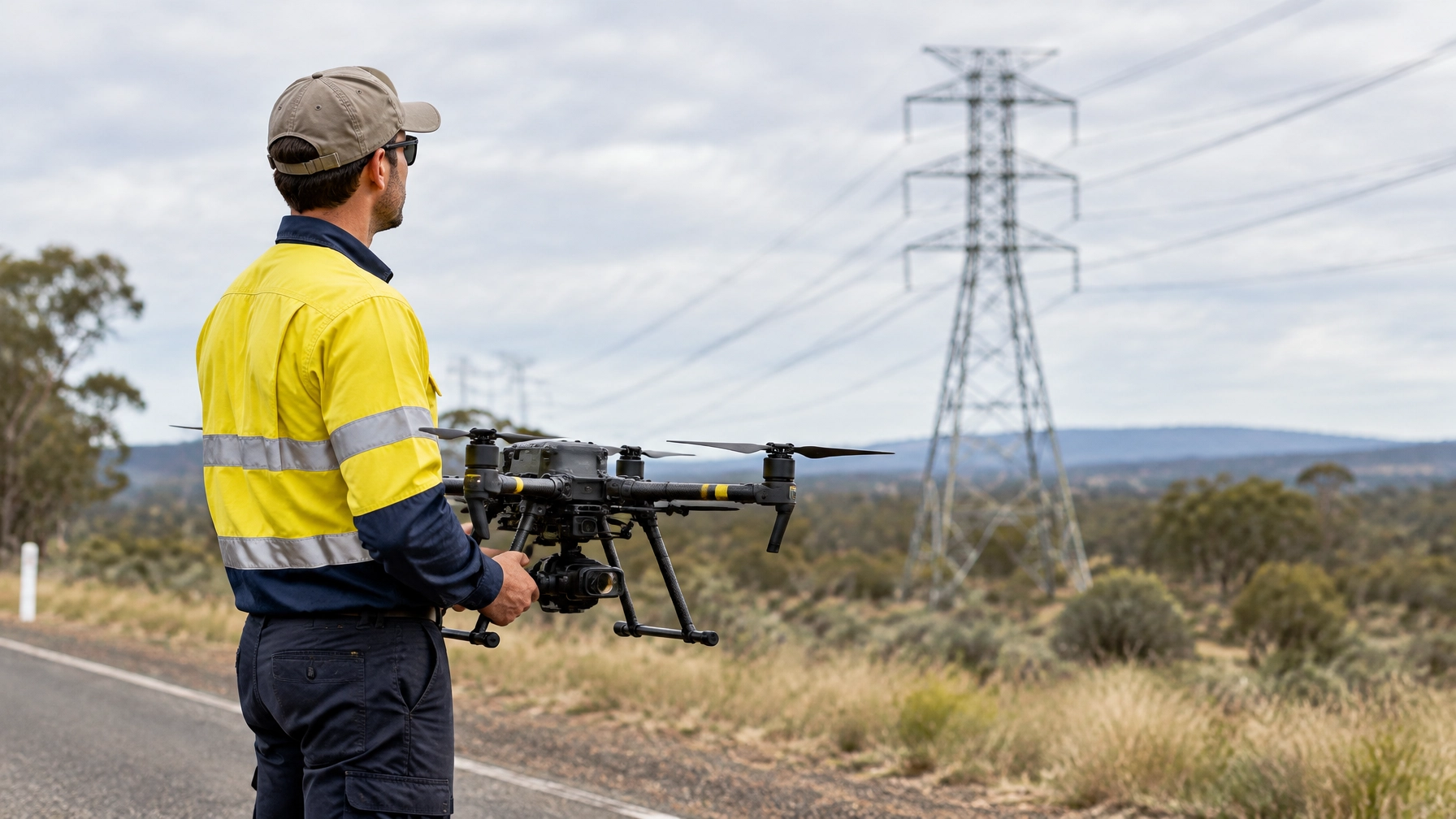
A Remote Pilot Licence (RePL) is a start, not a site pass. CASA sets the national aviation rules. On top of that, the owner of the powerlines or the rail line sets its own site rules.
That second gate is easy to miss. A pilot can meet every CASA rule and still have no right to enter the site, film the asset or fly near the network. Check both gates before you quote a job.
A commercial drone licence australia employers recognise is worth having for exactly this reason. It shows you know the framework a utility or rail buyer will test you on.
This matters if you want drone pilot jobs australia or you plan to sell powerline inspection drone work. Utilities and big contractors usually buy this work through panels and tenders. So they read your safety paperwork as closely as they watch you fly.
Our team trains pilots under CASA.ReOC.1421. We have taught more than 4,000 students, and we train across Australia, Singapore, Dubai, Korea and Malaysia. Students choose from our course options and lean on our training and support approach, the Altitude+ program and the DroneWork job board. None of that replaces an owner's written approval, though. You still have to ask.
Why network owners buy drone data at all
Network owners already fly drones at scale. Ausgrid says its 2026 LiDAR patrols cost less than low-flying helicopters and cause less noise. Western Power reported 63 trained remote pilots and 24 aircraft in February 2026.
That tells you two things. Demand is real and steady. The buyer also knows what good data looks like, so a shaky video will not win the contract.
Key facts: two approval layers
| Requirement | Who sets it | What it means for you |
|---|---|---|
| Registration and operator accreditation for business use of small drones; relevant RePL and CASA operating conditions | CASA | Meet aviation requirements before planning the job. |
| Six-metre minimum separation near transmission lines and towers; no flying over substations | Powerlink, Queensland | Contact Powerlink's easement maintenance team and follow its site guidance. |
| No flying within or over transmission-line easements; no unauthorised recording | Transgrid, NSW | Get written consent and confirm the exact permitted area before work. An easement is land set aside for infrastructure access and protection. |
| ReOC with at least 7 kg certification for external operators | ARTC | Confirm current ARTC requirements before quoting rail work. |
| Check mapped overhead lines before planning | Look Up and Live | Use the free map and app as a planning aid, not as permission to fly. |
| Report serious RPAS accidents and incidents | ATSB | Know your reporting duties and notify the asset owner when required. |
Look Up and Live maps overhead lines across NSW, Queensland, South Australia and Victoria. A map is not consent, though. Read the CASA drone safety rules and the ATSB reporting rules as you plan.
Electricity network rules: check the operator first
A network border is not a green light. Powerlink and Transgrid, for example, publish very different limits. So work out who owns the asset, where the site sits and what voltage runs through it before you pitch a flight.
| Network operator | Published guidance and programme details |
|---|---|
| Powerlink, Queensland | Do not fly over substations. Maintain at least six metres from transmission lines and towers when flying under, next to or over them. Set return-to-home so the drone cannot collide with lines. Notify Powerlink if an incident occurs, and contact its easement maintenance team. |
| Transgrid, NSW | Do not fly within or over transmission-line easements, or near or over substation and telecommunications-site security fences. Published easement widths vary: examples include 80 m for 330 kV, 50 m for 220 kV and 45 m for 132 kV. Do not capture, use or store footage, images or audio of its infrastructure without written consent. Read its UAV fact sheet. |
| Ausgrid, NSW | Its 2026 inspection programme uses drones with high-resolution LiDAR, laser-based distance measurement, to build 3D models of lines, poles and vegetation. Starting 1 April, it covers thousands of kilometres in bushfire-prone areas across Sydney, the Central Coast and the Hunter. Ausgrid says drones complement helicopter patrols with less noise and disruption, and lower operating cost and emissions. |
| Western Power, WA | In February 2026, the network reported 63 trained remote pilots and 24 specialist aircraft across a network spanning more than 255,000 km. It uses drones for inspections, patrols, fault finding and reporting. Its trials include LiDAR mapping and drone-in-a-box security patrols. Western Power was finalising EVLOS rules with CASA; EVLOS means extended visual line of sight. Ask Western Power about current external-operator requirements. |
Line work uses many methods and sensors. Our guide to surveying, mapping and thermal inspection skills covers those. A rail corridor drone survey has its own access and safety process, though.

Rail corridor rules: ARTC, RIW and worksite protection
ARTC sets out what it wants from outside drone operators. That includes a current CASA RePL, currency on the type you fly, and a ReOC rated to at least 7 kg. Every corridor flight also needs a written Worksite Protection Plan and a place in the pre-work brief.
A Protection Officer runs rail site safety. If you do not hold Rail Industry Worker (RIW) track awareness training, a Protection Officer must go with you. Check ARTC's current rules before you quote, because they can change.
A fence line or a public lookout is not access. Agree the launch spot, entry permission and site safety plan with the rail operator first.

What a network owner asks before it lets you on site
Tender documents vary, yet the same themes keep turning up.
- A current ReOC, plus a RePL for every pilot on the crew.
- Currency on the aircraft type, with logged hours behind it.
- A safety management system and written procedures for this job type.
- Risk assessments, and a worksite plan where the owner wants one.
- Current insurance certificates, at the limits the client names.
- A data spec: formats, resolution, file naming and delivery dates.
- An incident process, including your ATSB reporting duties.
- Privacy and recording rules for the owner's assets.
None of that is glamorous. All of it decides who wins the panel spot.
Sensors: what the aircraft actually has to carry
Match the payload to the defect you are hunting. Utilities buy a finding, not a flight. The same holds across drone inspection australia contracts in mining, ports and water utilities.
High-resolution stills do most of the work. Tight passes on conductors, insulators and fittings reveal cracked insulators, worn fittings and damaged strands.
Thermal cameras show joints and connections running hotter than they should. A hot joint is a fault waiting to happen, and it is hard to see on a normal camera.
LiDAR fires lasers to build a dense point cloud of lines, poles and the trees nearby. Ausgrid's 2026 programme uses it to model vegetation encroachment before fire season.
RTK positioning sharpens where each image sits. That matters when the client wants the same flight repeated in six months and compared like for like.
Western Power is already testing what comes next: drone line-stringing over water, and drone-in-a-box units that patrol substations on their own. The pilot work does not vanish there. Someone still plans the flights, reads the data and signs off the report.
Ten steps to win and safely deliver a first job
- Map the site. Check Look Up and Live for overhead lines and note who might own them.
- Name the asset owner. Confirm who runs the power or rail asset, and the exact work area.
- Ask before you quote. Request written permission, access steps, filming consent and the owner's current rules.
- Check the aviation side. Confirm your registration, accreditation, RePL, ReOC and operating conditions fit the job.
- Confirm the site process. On rail work, settle the Worksite Protection Plan, pre-work brief and Protection Officer cover.
- Scope the task. Agree the area, method, timing, access, reporting needs and limits.
- Assess the hazards. List people, vehicles, wires, weather, entry routes and emergency actions. Plan the gear you need. RTK means real-time kinematic, a satellite correction that sharpens position accuracy.
- Brief the team. Confirm roles, comms, launch and landing points, return-to-home settings and stop-work triggers.
- Fly inside the approval. Stay in the approved area and inside CASA limits. Stop if the weather turns or the drone misbehaves.
- Close out the job. Secure the images, hit the delivery terms, keep records and report incidents to the owner or ATSB.
For planning beyond network sites, our guides cover port and over-water inspection and RF interference, GPS dropouts and flight safety.
What the client actually buys: the report, not the flight
A network owner does not pay for airtime. It pays for a defensible record of the asset's condition. Build that record into the flight plan, not the night before delivery.
Start with a defect register. For every finding, log the asset ID, the span or location, the defect type, the severity and the image reference. Keep one row per defect so an engineer can sort and cost the work.
Name files so a stranger can find them. A pattern that carries site, asset, date and sequence beats a folder of camera defaults. Pair it with the flight log.
Georeference what you can. If the owner wants the same flight repeated in six months, the second dataset has to sit on top of the first. RTK helps, but so does a fixed launch point and a consistent altitude.
Say what you did not see. Weather, foliage, glare and battery limits all hide defects. A short limitations note protects the client and protects you. It also shows the engineer where a follow-up flight is worth the money.
Agree the format before you fly. Some owners want a PDF summary. Others want the raw set plus a point cloud. Ask early, because the answer changes the sensors you carry.
Then deliver on time, in the agreed structure. Keep your own copies for the period the contract names, and follow the owner's rules on storing images of its assets.
None of this is flying. All of it decides whether the same buyer calls you for the next round of patrols.
City-specific examples: where local work may differ
The rules follow the asset, not the postcode. Even so, each city has a different mix of owners and programmes, so start there.
Brisbane. Powerlink runs the Queensland transmission network and publishes a six-metre separation rule, plus a ban on flying over substations. Distribution sits with Energex and Ergon Energy, which Look Up and Live covers. Read the owner's guide, then plan around it. See training in Brisbane.
Sydney. Transgrid owns transmission and bans flights inside its easements. Ausgrid runs distribution, and its 2026 inspection programme starts on 1 April across Sydney, the Central Coast and the Hunter, with Service Stream on the ground. Expect to subcontract to a firm like that before you win direct work. Book Sydney training.
Melbourne. Victorian networks appear in Look Up and Live, and Jemena is one participant. Confirm the owner for each site, because one street can carry assets from more than one network. Find Melbourne training.
Perth. Western Power runs one of the world's largest stand-alone grids, more than 255,000 km from Kalbarri to Albany and out to Kalgoorlie. It had 63 trained remote pilots and 24 aircraft in February 2026, and it is working with CASA on extended visual line of sight. See training in Perth.
Hobart. TasNetworks owns the state's transmission and distribution network and contracts a specialist firm, Fulcrum Robotics, for its pole and wire inspections. Its published programme lists Hobart suburbs and runs all year, 7.30am to 4.30pm on weekdays. So the utility work is already taken. Hobart pilots do better aiming at other sectors and staying ready for subcontract work. Start with Hobart training.
Common mistakes that can cost a pilot the job
- Treating a RePL as permission to enter an asset owner's site.
- Quoting before checking the operator's rules or written-consent process.
- Assuming Look Up and Live grants approval to fly.
- Treating a mapped easement as a universal clearance zone.
- Forgetting that recorded footage may need specific consent.
- Arriving at a rail corridor without the required protection briefing.
- Using a return-to-home setting that could direct a drone towards lines.
- Failing to document the plan, permissions, flight and incident response.
CASA considerations for powerline and rail work
CASA's standard operating conditions cover four basics. Keep the aircraft in visual line of sight (VLOS). Stay under 120 m above ground level. Keep clear of people. And fly one aircraft at a time in the excluded category.
Business use of small drones also needs registration and operator accreditation. Check the current rules for your aircraft, operation and location.
Some work falls outside those conditions. An asset owner saying yes does not make a flight legal, because CASA rules still apply. The reverse is also true. Meeting CASA rules never overrides an owner's conditions.
If the job uses aviation VHF radio, confirm whether you need an Aeronautical Radio Operator Certificate (AROC). Keep records of approvals, planning, briefs, flights and maintenance. Report serious RPAS accidents and incidents to the ATSB. Tell the asset owner too, wherever its rules require it.
Frequently asked questions
1. Can I fly a drone near powerlines in Australia?
Yes, if CASA rules and the network operator's requirements allow it. Obtain the required permission and clearance first.
2. Does a RePL let me fly over any power network?
No. A RePL is a pilot qualification, not permission from an asset owner.
3. Can I fly over a Powerlink substation?
Powerlink says not to fly over substations. Contact its team for site guidance.
4. How close can I fly to Powerlink lines?
Powerlink's published guidance calls for a minimum six-metre separation when flying under, next to or over lines and towers.
5. Can I fly in a Transgrid easement?
Transgrid says uncrewed aircraft must not fly within or over its transmission-line easements. Seek its guidance and written consent for proposed activity.
6. What does an easement mean?
It is land set aside for infrastructure access and protection. Its size and conditions depend on the asset and owner.
7. Is Look Up and Live approval to fly?
No. It helps with planning by showing mapped overhead lines. You still need the asset owner's consent.
8. What does ARTC require from external drone operators?
Its published expectations include a current RePL, aircraft type currency, a ReOC with at least 7 kg certification, and documented worksite planning. Confirm current requirements with ARTC.
9. What is a Protection Officer?
A rail worksite role that oversees protection arrangements. Follow the operator's briefing and access process.
10. What does RIW mean?
RIW means Rail Industry Worker, a rail-industry competency and worker system. Pilots without the required track awareness competency must be accompanied by a Protection Officer under ARTC's published expectations.
11. Do rail corridor flights need a Worksite Protection Plan?
ARTC says each rail corridor flight needs a documented plan and inclusion in the pre-work brief.
12. Can I record Transgrid infrastructure?
Transgrid says not to capture, use or store footage, images or audio of its infrastructure without written consent.
13. Does every inspection need LiDAR?
No. The method depends on the job. Ausgrid uses high-resolution LiDAR for its described 2026 programme, but that is not a universal requirement.
14. What is RTK?
RTK means real-time kinematic satellite positioning. It refines location data and may be useful for suitable mapping tasks.
15. What is EVLOS?
EVLOS means extended visual line of sight. CASA and the relevant operator must allow the proposed operation.
16. Do I need AROC for every drone job?
Not necessarily. Confirm the requirement if the work involves aviation VHF radio.
17. What should I do if my drone acts erratically near a line?
Move away, land safely and check the controller for errors or warnings. Follow the asset owner's incident process.
18. How can I find drone pilot jobs in Australia?
Build relevant qualifications and documented safety systems, then check the DroneWork job board. Utilities and tier-one contractors often procure work through panels and tenders.
Summary
Powerline and rail corridor work can offer a path into specialist inspection, but CASA compliance is only the first gate. Each network and rail operator can set its own permission, access, clearance and documentation requirements.
Check the asset owner before quoting. Confirm current rules, obtain written consent, plan the worksite and keep clear records. For training advice, explore our RePL and aviation courses, request a training quote, or review the booking options.
Ready to start? Book your training at aaa.edu.au or call 1300 336 366.
{“@graph”:[{“@type”:”Article”,”author”:{“name”:”Ace Aviation Aerospace Academy”,”@type”:”Organization”},”headline”:”Drone Licence Australia 2026: Powerline and Rail Corridor Inspection Work — the Critical Infrastructure Jobs Most Pilots Never Hear About”,”publisher”:{“url”:”https://aaa.edu.au”,”name”:”Ace Aviation Aerospace Academy”,”@type”:”Organization”},”description”:”Drone licence australia opens doors to utility and rail inspection, but operator approvals still apply. Learn the rules and plan your next step with Ace.”,”datePublished”:”2026-11-22″,”mainEntityOfPage”:”https://blog.aaa.edu.au/drone-licence-australia-2026-powerline-and-rail-corridor-inspection-work”},{“@type”:”FAQPage”,”mainEntity”:[{“name”:”Can I fly a drone near powerlines in Australia?”,”@type”:”Question”,”acceptedAnswer”:{“text”:”Yes, if CASA rules and the network operator’s requirements allow it. Obtain the required permission and clearance first.”,”@type”:”Answer”}},{“name”:”Does a RePL let me fly over any power network?”,”@type”:”Question”,”acceptedAnswer”:{“text”:”No. A RePL is a pilot qualification, not permission from an asset owner.”,”@type”:”Answer”}},{“name”:”Can I fly over a Powerlink substation?”,”@type”:”Question”,”acceptedAnswer”:{“text”:”Powerlink says not to fly over substations. Contact its team for site guidance.”,”@type”:”Answer”}},{“name”:”How close can I fly to Powerlink lines?”,”@type”:”Question”,”acceptedAnswer”:{“text”:”Powerlink’s published guidance calls for a minimum six-metre separation when flying under, next to or over lines and towers.”,”@type”:”Answer”}},{“name”:”Can I fly in a Transgrid easement?”,”@type”:”Question”,”acceptedAnswer”:{“text”:”Transgrid says uncrewed aircraft must not fly within or over its transmission-line easements. Seek its guidance and written consent for proposed activity.”,”@type”:”Answer”}},{“name”:”What does an easement mean?”,”@type”:”Question”,”acceptedAnswer”:{“text”:”It is land set aside for infrastructure access and protection. Its size and conditions depend on the asset and owner.”,”@type”:”Answer”}},{“name”:”Is Look Up and Live approval to fly?”,”@type”:”Question”,”acceptedAnswer”:{“text”:”No. It helps with planning by showing mapped overhead lines. You still need the asset owner’s consent.”,”@type”:”Answer”}},{“name”:”What does ARTC require from external drone operators?”,”@type”:”Question”,”acceptedAnswer”:{“text”:”Its published expectations include a current RePL, aircraft type currency, a ReOC with at least 7 kg certification, and documented worksite planning. Confirm current requirements with ARTC.”,”@type”:”Answer”}},{“name”:”What is a Protection Officer?”,”@type”:”Question”,”acceptedAnswer”:{“text”:”A rail worksite role that oversees protection arrangements. Follow the operator’s briefing and access process.”,”@type”:”Answer”}},{“name”:”What does RIW mean?”,”@type”:”Question”,”acceptedAnswer”:{“text”:”RIW means Rail Industry Worker, a rail-industry competency and worker system. Pilots without the required track awareness competency must be accompanied by a Protection Officer under ARTC’s published expectations.”,”@type”:”Answer”}},{“name”:”Do rail corridor flights need a Worksite Protection Plan?”,”@type”:”Question”,”acceptedAnswer”:{“text”:”ARTC says each rail corridor flight needs a documented plan and inclusion in the pre-work brief.”,”@type”:”Answer”}},{“name”:”Can I record Transgrid infrastructure?”,”@type”:”Question”,”acceptedAnswer”:{“text”:”Transgrid says not to capture, use or store footage, images or audio of its infrastructure without written consent.”,”@type”:”Answer”}},{“name”:”Does every inspection need LiDAR?”,”@type”:”Question”,”acceptedAnswer”:{“text”:”No. The method depends on the job. Ausgrid uses high-resolution LiDAR for its described 2026 programme, but that is not a universal requirement.”,”@type”:”Answer”}},{“name”:”What is RTK?”,”@type”:”Question”,”acceptedAnswer”:{“text”:”RTK means real-time kinematic satellite positioning. It refines location data and may be useful for suitable mapping tasks.”,”@type”:”Answer”}},{“name”:”What is EVLOS?”,”@type”:”Question”,”acceptedAnswer”:{“text”:”EVLOS means extended visual line of sight. CASA and the relevant operator must allow the proposed operation.”,”@type”:”Answer”}},{“name”:”Do I need AROC for every drone job?”,”@type”:”Question”,”acceptedAnswer”:{“text”:”Not necessarily. Confirm the requirement if the work involves aviation VHF radio.”,”@type”:”Answer”}},{“name”:”What should I do if my drone acts erratically near a line?”,”@type”:”Question”,”acceptedAnswer”:{“text”:”Move away, land safely and check the controller for errors or warnings. Follow the asset owner’s incident process.”,”@type”:”Answer”}},{“name”:”How can I find drone pilot jobs in Australia?”,”@type”:”Question”,”acceptedAnswer”:{“text”:”Build relevant qualifications and documented safety systems, then check the DroneWork job board. Utilities and tier-one contractors often procure work through panels and tenders.”,”@type”:”Answer”}}]},{“url”:”https://aaa.edu.au”,”name”:”Ace Aviation Aerospace Academy”,”@type”:”Organization”}],”@context”:”https://schema.org”}