Short Direct Answer
A drone licence in Australia opens more doors than solo contracting. In 2026, utilities, emergency services and councils are building in-house drone teams. They still need licensed pilots, strong records and people who follow site rules.
Drone licence Australia: employers are building their own teams
The big career story of 2026 is not more people buying drones. It is large employers training their own staff and volunteers to fly them. Water utilities, emergency services and police are all doing it in public.
That changes what a hiring manager looks for. A licence gets you in the door. Good judgement, a tidy logbook and the habit of following site rules keep you on the crew.
A drone licence in Australia still matters. It shows you know the aviation side. It also gives an employer a fixed standard to check.
This guide uses four published cases from 2025 and 2026. Each one shows a different way in. Then it sets out how to plan your own path, as a staff pilot or as a contractor.
Key facts: four in-house programs compared
| Program | What was announced | What it shows a pilot |
|---|---|---|
| Sunwater, Queensland, 15 May 2026 | A one-day course built in house and run across five regions | Employers value training aimed at their own sites and rules |
| South Australia SES, 21 Jan 2026 | Nine new aircraft, plus funding to train more pilots | Emergency services need many more trained pilots |
| WA Police DFR X, 25 Oct 2026 | Remote drone response from a Perth command centre | Specialist work runs on specific approvals and team effort |
| Kowanyama Rangers, 11 Mar 2025 | Five rangers finished a six-day course and gained licences | Local knowledge plus a licence is a strong mix |
Four case studies: where the work is going
Sunwater: training for real assets
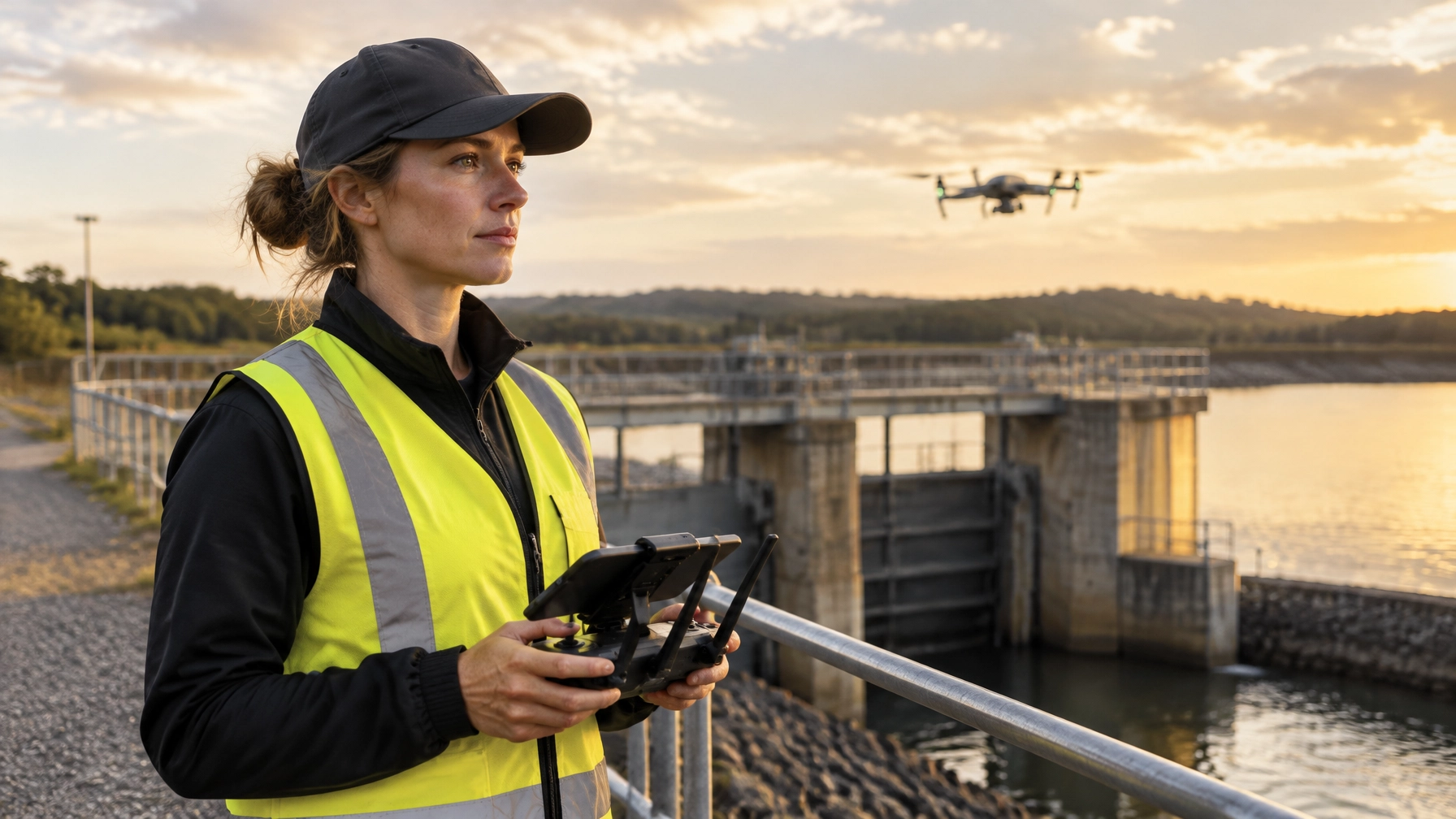
On 15 May 2026, Queensland bulk water provider Sunwater reported a new course built in house. Two staff from its Operations Technology team, Nick and Ben, wrote it. The course runs one full day, half theory and half flying.
Staff train on real Sunwater sites and assets. The tasks match the day job. Crews practise checks over water, survey work and safe flying on live sites. Sunwater said the course keeps training even across its five regions. It also makes staff skill easier to see. And it sets the utility's own rules and safety culture in from day one.
Ben summed it up well. “It's more than just flying an RPA – it's about understanding what RPA operations mean in a Sunwater context.”
That line is the whole story. A general course teaches you to fly. It cannot teach you a dam, a pump station or a utility's own paperwork.
South Australia SES: capability for emergency response
On 21 January 2026, South Australia’s State Emergency Service reported nine new aircraft. The money came from a $2 million fund in the 2025-26 state budget. That fund also pays to train more pilots, including for CASA licensing.
Six aircraft sit in regional towns: Port Lincoln, Quorn, Ceduna, Port Pirie, Gawler and Kangaroo Island. Three stay in Adelaide. In 2025, SES drones flew on more than 500 jobs. Most of that work helped SA Police search for missing people.
The new aircraft carry thermal cameras, spotlights and loudspeakers. They also use AI to spot people, vehicles and boats. A six-month trial of tiny drones comes next, with each aircraft under 250 grams. Training for that started in February.
Chief Officer Kristy Phelps made the career case plainly. “We know not everyone can or wants to go on a truck, but having a capability such as being a drone pilot is a specialist skill that we will need more of in the future.”
Read the SES announcement.
WA Police: remote response with specific arrangements
Announced on 25 October 2026, WA Police’s Drone as First Responder program, DFR X, was called an Australian first by the WA Government. Drones sit in docking stations across the southern suburbs. A crew in a Perth CBD command centre sends them out.
They fly beyond visual line of sight (BVLOS). That means the pilot cannot see the aircraft directly for the whole flight. Early work covers Baldivis, Kwinana and Rockingham, under the Mandurah Police District. Jobs range from missing people and land searches to stolen cars and crimes in progress.
This is not an entry-level path. It runs on specific approvals. Those approvals do not change the rules for anyone else.
The lesson for a new pilot is the shape of the team. These programs need remote pilots, sensor operators, data people and flight planners. One person alone cannot run one.
Police Minister Reece Whitby put the aim simply. “This is about giving our police an invaluable tool – the ability to have eyes on the scene much sooner.”
See the WA Government announcement.

Kowanyama: local knowledge with licensed skills
On 11 March 2025, five Kowanyama Land and Sea Rangers finished a six-day course and became licensed remote pilots. The drones and the training were funded through the Commonwealth’s TopWatch and Ghost Nets programs.
Their planned work suits the country they know. Crews will survey beaches for ghost nets, turtle tracks and illegal fishing. Training covered thermal imaging too, which helped them find magpie goose eggs in the grass. Rangers also learned how to move the aircraft so curious kites and sea eagles lost interest.
The council said it was writing a drone policy for all its staff. Read the council’s report.
Western Power offers the same signal at much larger scale. In February 2026 it reported 63 trained remote pilots and 24 specialist aircraft across a network of more than 255,000 km.
Five lessons for your drone career
The licence is the entry ticket. The procedure is the job. Every one of these programs wraps flying in local rules. Site inductions, permits, checklists and reporting are not extras. They are the work.
Employers go in-house because generic courses miss their assets. Sunwater said it plainly. Its course covers its own sites and its own safety ethos. That gap is where a new pilot can stand out. Learn one employer's world and speak its language.
They still need CASA-certified pilots underneath. A bespoke course does not replace a licence. It sits on top. The SES even funded training towards CASA licensing.
In-house teams do not kill contractor work. They shift it. Routine patrols move inside. Surge jobs, odd sensors and remote sites stay outside.
Documented competency is what gets audited. Flew 40 hours last month? Show the log, the task, the conditions and the sign-off. A hiring panel will ask.
How to read an employer's drone job ad
Most of these roles are not advertised as drone jobs. They appear as asset inspector, field officer, GIS technician or emergency service volunteer. Read past the title.
Look for four things in the text. First, an aviation qualification: RePL, AROC or equivalent. Second, a mention of procedures, permits or a safety system. Third, a data task, such as reporting, imagery or records. Fourth, a licence to work in the field and travel.
If a listing names an aircraft type, learn that type. If it names a region, learn the assets in that region. If it asks for a portfolio, build one from your training flights and any volunteer work.
Ask two questions in the interview. Who signs off your flights? And what does the audit trail look like? The answers tell you whether the employer has a real program or a drone in a cupboard.
Where the contract work sits
In-house teams usually take routine patrols and repeat tasks. That is the steady work, and owning it keeps the asset knowledge inside the business.
Outside pilots still pick up plenty. Expect peak volume, specialist sensors, remote locations and after-hours call-outs. A utility that flies its own lines in spring may still need a contractor after a storm.
For a new operator, the first step is rarely a direct contract with a utility. It is more often a place on a tier-one field services firm's subcontract roster, or on a supplier panel. Both routes value documented safety systems over sales talk.
So prepare like a supplier, not a freelancer. Have your certificates ready. Have your insurance ready. Have a two-page capability statement that names the assets you can inspect and the sensors you own.
Then ask the boring question. What does the buyer need at month end? Most want a defect list they can cost, not a folder of video.
For adjacent work, explore powerline and rail corridor inspection roles, surveying, mapping and thermal inspection skills and RF interference and GPS safety.
What this looks like in Brisbane, Sydney, Melbourne, Perth and Hobart
Brisbane
Sunwater runs its five Queensland regions from the state's water network, so irrigation and dam assets sit close to home. Water utilities, councils and construction contractors round out the market. Learn one asset type and be ready for site rules. Start with drone training in Brisbane.
Sydney
NSW has deep emergency service and utility drone capacity, and much of it is team based. Volunteering, subcontracting or a field services role can be a way in. Employers will ask about procedures and records, so bring both. See drone training in Sydney.
Melbourne
Victorian water authorities and utilities run their own programs and buy specialist support when volume spikes. Pick a sector, learn its defects and build evidence of safe repeatable work. Ask about supplier panels early. Find drone training in Melbourne.
Perth
WA Police DFR X shows the specialist end of remote operations. Western Power reported 63 in-house pilots and 24 aircraft in February 2026. Both point to real teams, not guaranteed vacancies. View drone training in Perth.
Hobart
The Tasmanian market is smaller, and much utility inspection already sits with specialist contractors. Aim at councils, aquaculture, forestry and emergency service volunteering to build hours. Keep your records tidy for the day a panel opens. See drone training in Hobart.
Step-by-step: from no licence to a team or roster
- Get your RePL. A Remote Pilot Licence builds the foundation for professional remote piloting. Compare available RePL and aviation courses.
- Add AROC where aviation radio is used. The Aeronautical Radio Operator Certificate supports radio communication in relevant aviation settings.
- Register and gain operator accreditation for business use. Check the requirements that apply to your drone and operation.
- Build a documented logbook. Record flights, conditions, tasks, competency and any relevant practice.
- Learn one asset type deeply. Choose water, power, rail or emergency response, then learn its risks and workflow.
- Write your own procedures. Practise preparing clear checklists and risk controls that an employer can assess.
- Get site-ready. Prepare for inductions, insurance, fatigue management and privacy requirements.
- Apply through the employer’s pathway or a contractor. Check aviation job opportunities and ask about subcontract or supplier panel requirements.

Common mistakes
- Treating the licence as the whole qualification. Employers also test judgement, site awareness and record keeping.
- Assuming every drone job follows the same rules. Aircraft, location, task and conditions all change the answer.
- Chasing specialist work before the basics. Learn safe, repeatable flights before you pitch thermal or BVLOS work.
- Keeping poor records. A clean log proves competency and saves you at audit time.
- Borrowing someone else's approval. Special arrangements apply to the operator that holds them, not to you.
- Ignoring the employer's own paperwork. Site inductions and permits are part of the job, not red tape.
- Skipping the data side. A buyer wants a defect list, not raw footage.
- Applying only through job boards. Panels and subcontract rosters rarely appear there.
CASA considerations
Standard operating conditions cover four basics. Keep the aircraft in visual line of sight. Stay at or below 120 m above ground level. Keep clear of people. Fly one aircraft at a time in the excluded category.
Business use of small drones also needs registration and operator accreditation. Check the rule that fits your aircraft, your task and your location.
Anything beyond those conditions needs approval. BVLOS flights, night work outside the standard conditions and operations near people all sit in that group. So a police program flying BVLOS from a command centre cannot be copied by a private operator.
Emergency service work does not exempt anyone from the aviation rules. Volunteers and staff follow the same framework, plus the service's own procedures.
Keep records of approvals, briefs, flights and maintenance. Report serious accidents and incidents to the ATSB. Tell the employer as well, wherever its own rules require it.
Always check the current CASA drone rules and guidance before a flight. Requirements can depend on the operation and may change.
Ace Aviation is a CASA-approved training provider, CASA.ReOC.1421, with more than 4,000 students trained. Its footprint spans Australia, Singapore, Dubai, Korea and Malaysia. The Altitude+ student program and DroneWork job board add support as students develop their career. In-house employer programmes make rigorous foundational training more important, not less. Learn more about why students choose Ace.
Frequently asked questions
1. Is a drone licence enough to get hired?
It is a foundation, not a job guarantee. Employers may also assess site knowledge, procedures, records and specialist skills.
2. What is a RePL?
A Remote Pilot Licence is a qualification for remote pilots. Training covers the knowledge and practical skills needed for professional operations.
3. Do employers train staff after they get a RePL?
Some build in-house courses for their own equipment, sites and procedures. The Sunwater example shows how that training can complement licensed pilot skills.
4. Does a contractor need a RePL?
Requirements depend on the operation. Employers and contractors should confirm applicable CASA rules and qualifications before work begins.
5. Do I need AROC?
You may need an Aeronautical Radio Operator Certificate where aviation radio operations are part of the work.
6. Can I fly commercially without registering?
Business use of small drones needs registration and operator accreditation. Check CASA guidance for the aircraft and operation.
7. Can I fly beyond visual line of sight with a RePL?
Not automatically. BVLOS operations need approvals or specific arrangements.
8. Does emergency response work give pilots an exemption?
No. Emergency service work does not, by itself, exempt pilots from aviation rules.
9. What should I put in my logbook?
Record your flights, tasks and relevant competency evidence. Keep entries accurate and easy to review.
10. How can I get utility experience?
Build relevant skills, learn an asset type and ask employers about entry routes. A subcontract roster or supplier panel may be a practical starting point.
11. Do in-house drone teams reduce contractor demand?
Not necessarily. Contractors may support peak workloads, specialist tasks, remote locations and after-hours response.
12. What is the best specialisation for a new pilot?
Choose a sector that fits your interests and local opportunities, such as water, power, rail or emergency response. Then build relevant experience.
13. Do I need insurance?
Requirements vary by employer, contract and operation. Confirm the necessary cover before accepting work.
14. Can I join an emergency service drone team as a volunteer?
Some services recruit volunteers and may have their own entry and training pathways. Contact the service directly to check current opportunities.
15. What is the DroneWork job board?
It lists drone-related roles and is run by Ace Aviation. Treat it as one channel. Also approach field services firms, councils and utilities directly.
16. What does a Chief Remote Pilot do?
A Chief Remote Pilot oversees an organisation's drone operations and safety. South Australia's SES lists one, and larger operators commonly appoint one. It is a senior role that sits above line pilots.
17. Should I aim for an in-house role or my own business?
In-house work suits people who like steady teams and procedures. A business suits people who like sales, quoting and variety. Many pilots do both over a career, moving between them as the market shifts.
18. Where can I compare training options?
Review the course information and contact the academy if you need help choosing a pathway.
Summary
The 2026 cases point one way. Big organisations are building drone capability in house, and they still need licensed pilots who can prove what they can do.
So start with a RePL, then add AROC where radio work is involved. Keep a logbook you would happily hand to an auditor. Learn one asset type properly, so you can talk about its defects and its paperwork. Then apply through the employer's own route or a contractor's roster.
Our team trains pilots under CASA.ReOC.1421, with more than 4,000 students taught and a footprint across Australia, Singapore, Dubai, Korea and Malaysia. Compare course options, ask for a training quote, or review the booking options. The Altitude+ program and the DroneWork job board support students well past the exam.
Ready to start? Book your training at aaa.edu.au or call 1300 336 366.
{“@graph”:[{“@type”:”Article”,”image”:”https://cdn.marblism.com/DHYnPzciPti.webp”,”author”:{“name”:”Ace Aviation Aerospace Academy”,”@type”:”Organization”},”headline”:”Drone Licence Australia 2026: The Employers Training Their Own Pilots, and What It Means for Your Career”,”keywords”:[“drone licence australia”,”commercial drone licence australia”,”how to become a drone pilot australia”,”RePL”],”publisher”:{“url”:”https://aaa.edu.au”,”name”:”Ace Aviation Aerospace Academy”,”@type”:”Organization”},”inLanguage”:”en-AU”,”description”:”Explore drone licence Australia career paths in 2026, from in-house teams to contractor rosters. Get trained and take your next step with Ace.”,”dateModified”:”2026-11-23″,”datePublished”:”2026-11-23″,”articleSection”:[“Aviation Training”,”Drone Pilot Careers”,”CASA Compliance”]},{“url”:”https://aaa.edu.au”,”name”:”Ace Aviation Aerospace Academy”,”@type”:”Organization”,”description”:”CASA-approved aviation training provider offering professional drone pilot training and certification.”},{“@type”:”FAQPage”,”mainEntity”:[{“name”:”Is a drone licence enough to get hired?”,”@type”:”Question”,”acceptedAnswer”:{“text”:”It is a foundation, not a job guarantee. Employers may also assess site knowledge, procedures, records and specialist skills.”,”@type”:”Answer”}},{“name”:”What is a RePL?”,”@type”:”Question”,”acceptedAnswer”:{“text”:”A Remote Pilot Licence is a qualification for remote pilots. Training covers the knowledge and practical skills needed for professional operations.”,”@type”:”Answer”}},{“name”:”Do employers train staff after they get a RePL?”,”@type”:”Question”,”acceptedAnswer”:{“text”:”Some build in-house courses for their own equipment, sites and procedures. The Sunwater example shows how that training can complement licensed pilot skills.”,”@type”:”Answer”}},{“name”:”Does a contractor need a RePL?”,”@type”:”Question”,”acceptedAnswer”:{“text”:”Requirements depend on the operation. Employers and contractors should confirm applicable CASA rules and qualifications before work begins.”,”@type”:”Answer”}},{“name”:”Do I need AROC?”,”@type”:”Question”,”acceptedAnswer”:{“text”:”You may need an Aeronautical Radio Operator Certificate where aviation radio operations are part of the work.”,”@type”:”Answer”}},{“name”:”Can I fly commercially without registering?”,”@type”:”Question”,”acceptedAnswer”:{“text”:”Business use of small drones needs registration and operator accreditation. Check CASA guidance for the aircraft and operation.”,”@type”:”Answer”}},{“name”:”Can I fly beyond visual line of sight with a RePL?”,”@type”:”Question”,”acceptedAnswer”:{“text”:”Not automatically. BVLOS operations need approvals or specific arrangements.”,”@type”:”Answer”}},{“name”:”Does emergency response work give pilots an exemption?”,”@type”:”Question”,”acceptedAnswer”:{“text”:”No. Emergency service work does not, by itself, exempt pilots from aviation rules.”,”@type”:”Answer”}},{“name”:”What should I put in my logbook?”,”@type”:”Question”,”acceptedAnswer”:{“text”:”Record your flights, tasks and relevant competency evidence. Keep entries accurate and easy to review.”,”@type”:”Answer”}},{“name”:”How can I get utility experience?”,”@type”:”Question”,”acceptedAnswer”:{“text”:”Build relevant skills, learn an asset type and ask employers about entry routes. A subcontract roster or supplier panel may be a practical starting point.”,”@type”:”Answer”}},{“name”:”Do in-house drone teams reduce contractor demand?”,”@type”:”Question”,”acceptedAnswer”:{“text”:”Not necessarily. Contractors may support peak workloads, specialist tasks, remote locations and after-hours response.”,”@type”:”Answer”}},{“name”:”What is the best specialisation for a new pilot?”,”@type”:”Question”,”acceptedAnswer”:{“text”:”Choose a sector that fits your interests and local opportunities, such as water, power, rail or emergency response. Then build relevant experience.”,”@type”:”Answer”}},{“name”:”Do I need insurance?”,”@type”:”Question”,”acceptedAnswer”:{“text”:”Requirements vary by employer, contract and operation. Confirm the necessary cover before accepting work.”,”@type”:”Answer”}},{“name”:”Can I join an emergency service drone team as a volunteer?”,”@type”:”Question”,”acceptedAnswer”:{“text”:”Some services recruit volunteers and may have their own entry and training pathways. Contact the service directly to check current opportunities.”,”@type”:”Answer”}},{“name”:”What is the DroneWork job board?”,”@type”:”Question”,”acceptedAnswer”:{“text”:”It is a resource for finding drone-related job opportunities through Ace Aviation.”,”@type”:”Answer”}},{“name”:”Where can I compare training options?”,”@type”:”Question”,”acceptedAnswer”:{“text”:”Review the course information and contact the academy if you need help choosing a pathway.”,”@type”:”Answer”}}]}],”@context”:”https://schema.org”}