Australia's drone sector already shows why micro drones matter in Adelaide. A federal report found almost 35,000 distinct drone registrations, compared with just under 16,000 aircraft registrations, and CASA had issued three times as many ReOCs as Air Operator's Certificates at the time of publication, while 84% of the sampled public were familiar with drone technology and 18.5% already owned a drone (federal report). In other words, Adelaide operators are working inside a mature drone ecosystem, not an emerging novelty.
Table of Contents
- What Micro Drones Are and Why They Matter in Adelaide
- CASA Rules and Licensing for Micro Drone Pilots
- Where You Can and Cannot Fly Micro Drones in Adelaide
- How Adelaide Industries Use Micro Drones in Practice
- Training Pathways for Aspiring and Commercial Micro Drone Pilots
- Safety Best Practices for Micro Drone Operations in Adelaide
- Frequently Asked Questions About Adelaide Micro Drones
- Do micro drones need to be registered in Australia
- Can a micro drone fly over people in Adelaide
- What should a pilot do if a manned aircraft appears nearby
- Is insurance required for commercial micro drone work
- What if a flight incident needs to be reported
- Can a micro drone be flown anywhere because it is light
What Micro Drones Are and Why They Matter in Adelaide
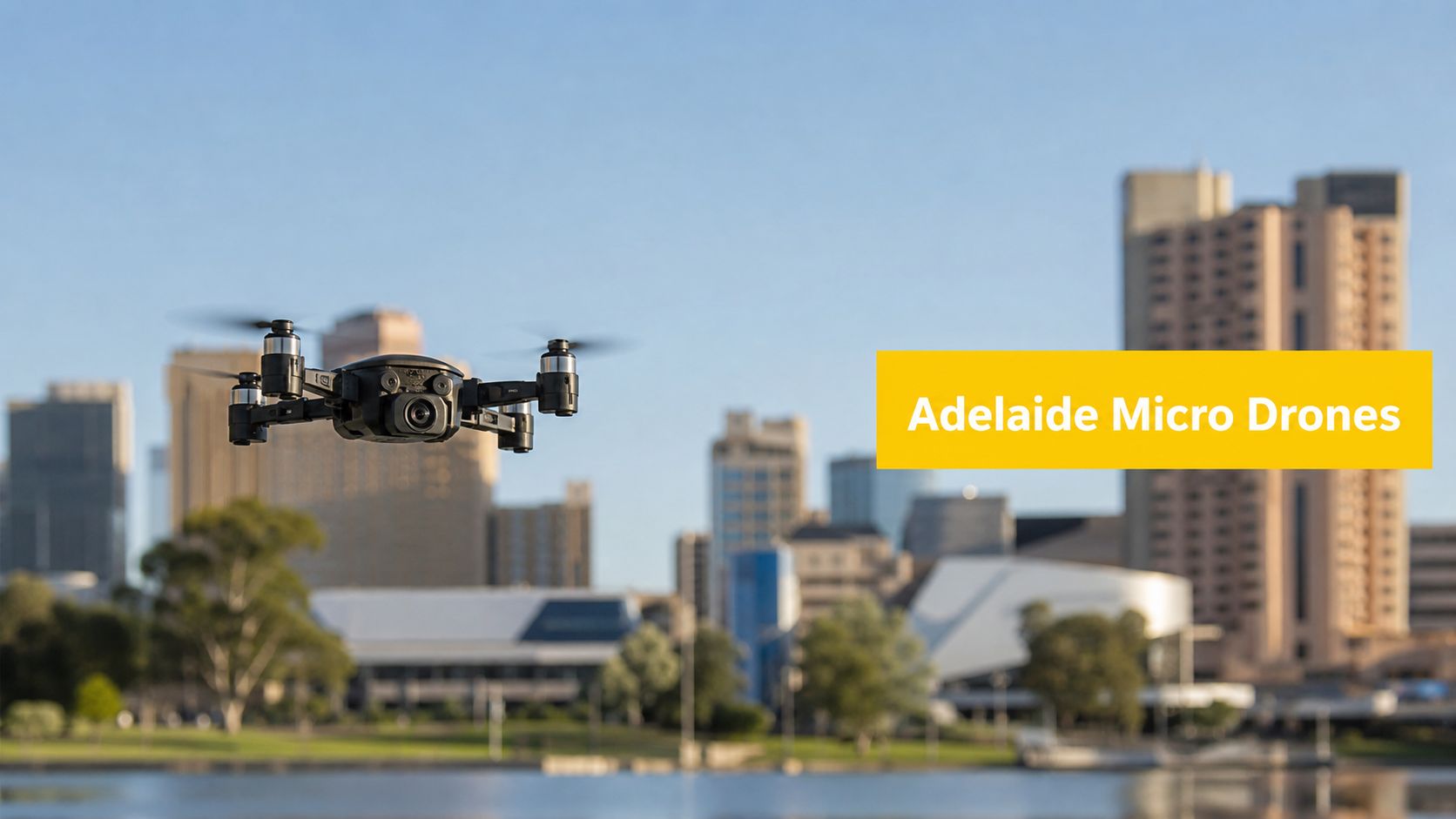
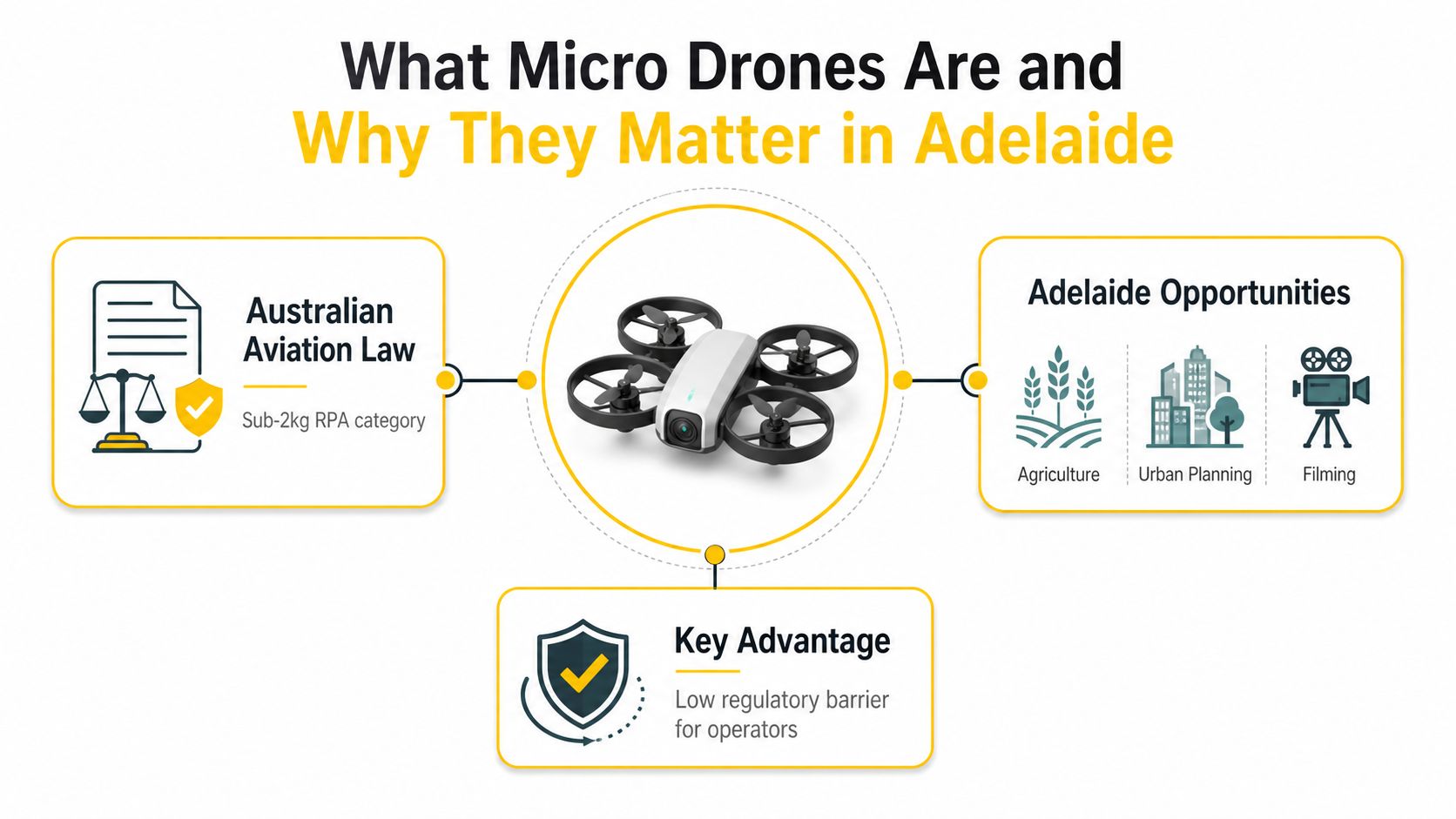
A micro RPA is a drone that weighs 250 g or less under CASA rules (CASA drone rules). That threshold matters because it affects how much compliance work sits behind the flight, how much the pilot has to carry, and how quickly a short urban mission can be put into the air. For Adelaide operators, that usually means a lighter aircraft is easier to transport, faster to deploy, and better suited to short-notice inspection or reconnaissance work.
Why the 250 g threshold changes the job
A sub-250 g aircraft usually gives pilots a tighter operating envelope. Battery capacity, payload, wind margin, and link stability all have less room to move because the airframe has to stay light and controllable. The common market example of the DJI Mavic Mini class lists a 249 g take-off weight and a 30-minute maximum flight time, which shows the design priority is portability and regulatory simplicity rather than heavy-lift performance (product listing).
That trade-off suits many Adelaide use cases. Roof inspections, campus perimeter checks, property marketing, and quick situational awareness tasks often suit a compact platform more than a larger aircraft. It also fits work that starts from a vehicle, a courtyard, or a tightly controlled take-off area, where speed and convenience matter as much as endurance. For pilots working in agriculture-adjacent settings, the same logic applies to compliance training for farming (compliance training for farming), where small, repeatable flights are often more practical than long-range sorties.
Why Adelaide is already set up for micro drone adoption
Adelaide also sits in a setting where drone use is already familiar. Australia has a large drone-installed base, and the technology is no longer treated as a novelty in many public and private operations (federal report). South Australia uses drones in routine public-safety work, so small aircraft are part of normal operational planning rather than an experiment.
Local airspace and approval steps still matter. A micro drone may be light, but it still has to fit the site, the task, and the permissions attached to the location. That is why campus work, council property, and other controlled sites often require approval before launch, even when the aircraft itself sits in the simplest weight class. For pilots comparing training options, an aviation licence finder can help sort the pathway before they commit to a course or operational role.
Practical rule: a micro drone makes the most sense when the job is short, local, and tightly controlled. If the mission needs heavy payloads, long endurance, or complex sensor packages, the 250 g class stops being the right tool.
For new Adelaide pilots, that is the key decision point. Micro drones are not the answer to every flight task, but they are often the right starting point for training, light commercial work, and simple operational checks.
CASA Rules and Licensing for Micro Drone Pilots
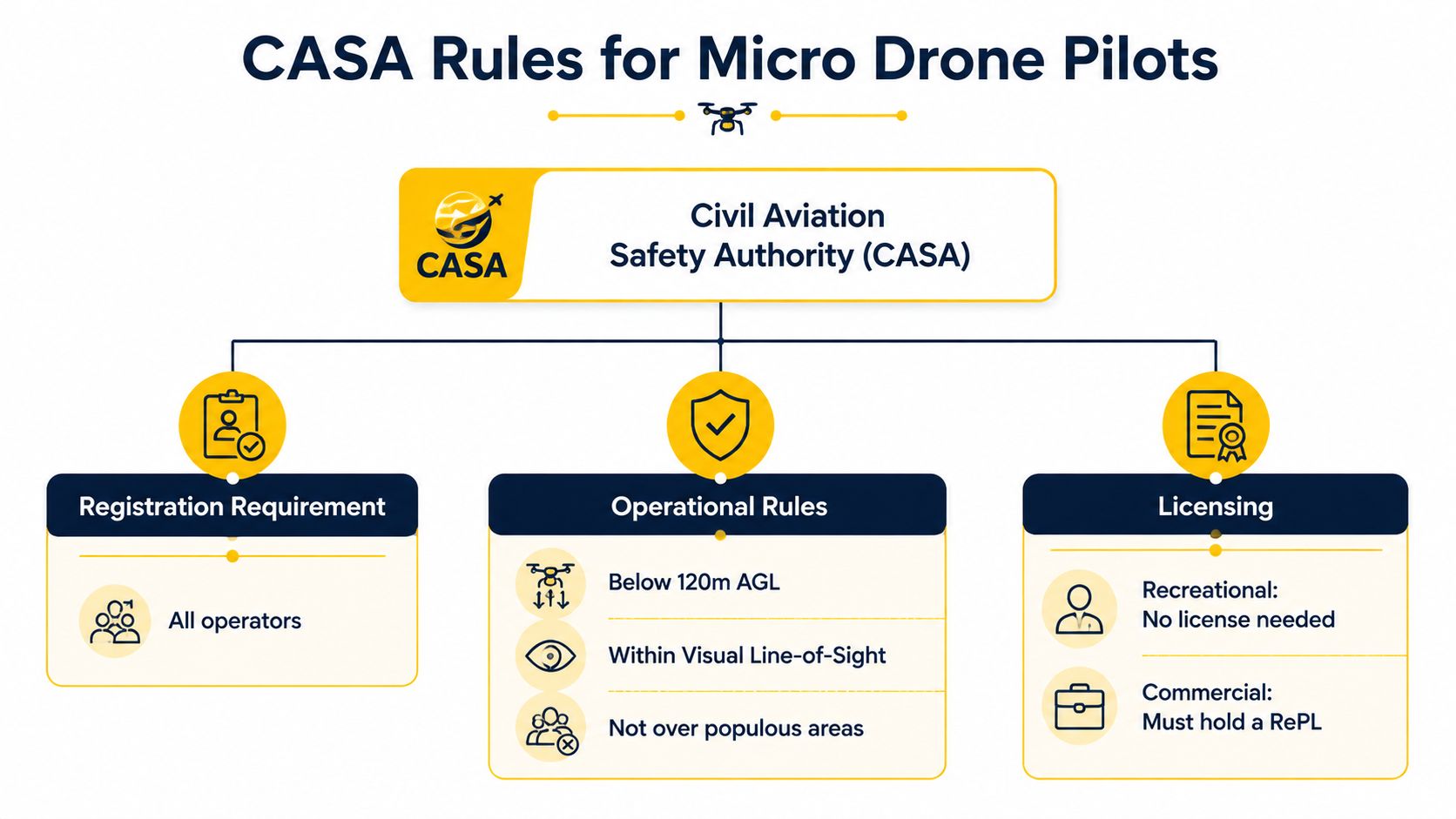
CASA's framework is where many Adelaide pilots get confused, because the answer depends on what kind of flying is taking place. For recreational flying, CASA says a micro RPA at 250 g or less does not need a licence, operator accreditation, or drone registration, provided the flight stays within the normal rules (CASA drone rules). That does not mean the flight is unrestricted, it only means the pilot does not need a formal licence pathway for that recreational operation.
Recreational and commercial obligations
The operational picture changes when the flight is commercial. Under Australia's excluded-category approach, a sub-250 g drone can usually be flown commercially without a Remote Pilot Licence or Remote Operator's Certificate, provided the operation still stays inside the standard rules. That distinction is important because many people assume “micro” automatically means “anything goes”. It doesn't.
A simple way to think about it is this. Recreational use can sit inside the lightest compliance pathway. Commercial use can also be possible in the micro category, but only while the flight stays within the relevant operating limits. Once the task moves into more complex airspace, higher-risk conditions, or a managed commercial program, the paperwork and qualifications start to matter.
For people trying to map the right pathway, the academy's licence finder is a useful way to match intended operations to the likely credential set.
Where formal qualifications become necessary
Formal qualifications become relevant when the operation grows beyond excluded-category simplicity. A RePL is the core commercial pilot qualification for many drone roles, especially where the work is structured, repetitive, or tied to a business operation. A Remote Operator's Certificate becomes part of the picture when an organisation needs to authorise and manage commercial drone activity at an operator level. An AROC matters when radio communication skills are needed as part of the operation.
For readers who want an entry point before stepping into that pathway, ACE READY is an entry level drone training course for beginners. It covers drone fundamentals, aviation safety, CASA regulations, flight operations, and preparation for advanced RePL training in Australia.
Compliance note: micro-drone status reduces some barriers, but it doesn't remove the obligation to plan the flight properly, respect airspace, or get the right approval when the operation moves beyond the normal excluded category.
Where agricultural and compliance-heavy operations are involved, a separate regulatory training resource such as compliance training for farming can help teams think through documentation and governance, even when the aircraft itself is small.
Where You Can and Cannot Fly Micro Drones in Adelaide
A micro drone may be small enough to fit in one hand, but Adelaide still treats it as an aircraft. The pilot has to deal with three layers at once, CASA safety rules, local council limits, and any extra permission process from the site owner. New pilots often miss that last part, then discover that a light drone can still be refused access because the location has its own controls.
Start with distance and airspace limits
The City of Adelaide guidance sets the basic public-space limits. Drones must stay at least 30 metres away from people, vehicles, boats and buildings, must not fly over populous areas, and must remain within visual line of sight in daytime VMC conditions (City of Adelaide guidance). Adelaide-focused guidance also reinforces the 5 km airport separation rule and notes that national parks or conservation reserves are off-limits (Adelaide flying guidance). Together, those rules show a simple point. The aircraft may be small, but the operating area still has to be suitable.
| Restriction | Requirement | Applies To |
|---|---|---|
| People and property separation | Stay at least 30 metres away | City of Adelaide areas and comparable safety planning |
| Airport exclusion | Stay at least 5 km away from airports | Flights near controlled airport environments |
| Populous areas | Do not fly over populous areas | Urban and event settings |
| Parks and reserves | Do not fly in national parks or conservation reserves | Protected land areas |
| Daylight and visibility | Fly in daytime VMC and keep visual line of sight | Standard local flying conditions |
A practical way to read that table is to start with the ground, then the air. First check whether people, buildings, roads, or events make the site unsuitable. Then check whether the site sits inside airport, reserve, or other restricted airspace. A micro drone does not change those steps.
Campus and institution approvals change the process
University land adds another layer of control. Adelaide University's URAF requires RePL and ReOC documentation, insurance, risk assessments, and written permission before campus flying is approved (Adelaide University URAF). A pilot can be legal in a suburban open space and still be stopped on campus if the university paperwork is not complete.
That process becomes clearer if you separate “can I fly” from “am I allowed here.” CASA sets the aviation baseline. Local councils set public-space limits. Institutions set their own access rules, and they can ask for proof of qualifications, insurance, and an approved flight plan before anything lifts off. For a new cohort of pilots, that distinction matters because the drone may meet the technical rules while the location still remains closed to operations.
For readers comparing the layers, the academy's guide to excluded-category drone operations explains why some flights stay simple while others need a formal operator structure. ACE BRONZE also gives beginners a structured starting point, with drone operations, flight safety, aviation theory, and practical skills covered in a commercial training context.
How Adelaide Industries Use Micro Drones in Practice
South Australia's emergency-services work shows how quickly micro drones move from interesting tools to routine equipment. The SA SES deployed drones over 500 times in 2025, mostly for missing-person searches (SA SES reporting). That pattern matters because it shows where micro aircraft earn their place in real operations, in jobs that reward fast launch, close-in visibility, and low setup burden.
Emergency response and search tasks
In missing-person work, a micro drone can get airborne quickly, move into tight terrain, and give crews short-range reconnaissance without the logistical load of a larger aircraft. That makes it useful in scrub, parks, roadside search areas, and built-up edges where speed and manoeuvrability matter more than endurance. The 250 g class is not about carrying the biggest sensor package, it is about getting eyes on scene fast.
Micro drones also fit the rhythm of field coordination. Crews can confirm a search line, check a bend in a track, or inspect a narrow drainage area before committing people on foot. That kind of task is why small aircraft are often the first aviation asset on scene.
Urban inspection, media, and property work
In Adelaide's built environment, micro drones suit roof checks, façade looks, property marketing, and short inspection passes where access is tight. They are also useful for media production because they can launch from small spaces and reach angles that do not suit a larger platform. In all of those tasks, the aircraft is chosen for convenience, not spectacle.
For operators, the practical question is simple. Does the job need a fast visual check, a small launch footprint, and less setup friction? If the answer is yes, a micro drone often fits better than a heavier machine.
Why the market keeps absorbing small aircraft
Australian drone activity is growing across policing, mining, deliveries, and environmental monitoring, and that demand is spreading through normal commercial work as well. The point for Adelaide businesses is not a future headline figure, it is the steady expansion of flight activity across practical use cases. That creates more demand for operators who can work safely, document properly, and understand the local flying environment.
A useful way to see the wider picture is to look at the drone ecosystem overview, which connects training, regulation, and sector demand in one frame. ACE PLATINUM is the enterprise package that combines RePL, AROC, Aviation English, Express ReOC, Certificate III in Aviation, advanced operations training, and preparation to operate and manage a commercial drone business.
Training Pathways for Aspiring and Commercial Micro Drone Pilots
The best training path depends on what the pilot wants to do with the aircraft. A hobby flyer only needs to understand the CASA rules and local restrictions. A business operator needs a stronger pathway, because the aircraft is only one part of a commercial system that also includes paperwork, radio procedures, airspace awareness, and organisational controls.
Entry level to commercial readiness
A sensible progression starts with fundamental flying skill, then moves into commercial compliance. The entry stage is where pilots learn how a micro drone responds in wind, how to manage battery reserve, and how to keep situational awareness while staying within local limits. The next stage is commercial ground theory and flight training, which is where the rules become operational rather than theoretical.
For Adelaide operators, the academy's course pathway can be matched to the intended role through the courses page. That helps separate beginner education from commercial licensing, and it stops people from enrolling in the wrong level too early.
Qualifications that matter for real operations
A RePL is the most common milestone for commercial pilots who need formal flight authority. An AROC is relevant when radio communication is part of the working environment, and it becomes more useful as operations move into more structured or shared airspace contexts. A ReOC sits above the individual pilot and supports the operator framework that a business or government team may need.
For learners starting from the ground up, ACE SILVER is the commercial RePL training option that includes classroom instruction, practical flight training, CASA-compliant certification, AROC, and aviation English proficiency for professional drone pilots. Organisations that need fleet-level consistency often pair this with enterprise training so different staff members are working to the same standard.
Training principle: the right course is the one that matches the operation, not the other way around.
That is why training for Adelaide micro drone work should be tied to the intended job, whether the pilot is flying property inspection, public-safety support, survey assistance, or corporate fleet work. Enterprise Drone Training and Corporate Drone Training become relevant when an organisation needs multiple pilots to operate under a common safety and compliance system.
Safety Best Practices for Micro Drone Operations in Adelaide
Adelaide conditions can expose weak planning fast. A light aircraft is easier to move, but it's also easier for wind to disturb and for a rushed pilot to misjudge the operating margin. The right safety routine needs to be short, repeatable, and strict.
Pre-flight discipline matters more with light aircraft
A micro drone should be checked before every launch, even for a short inspection task. Adelaide's coastal winds and urban turbulence can punish a pilot who assumes the aircraft will behave like a heavier platform. Summer heat also affects battery performance, so launch decisions should be based on current conditions, not the plan written an hour earlier.
A simple field routine keeps errors down
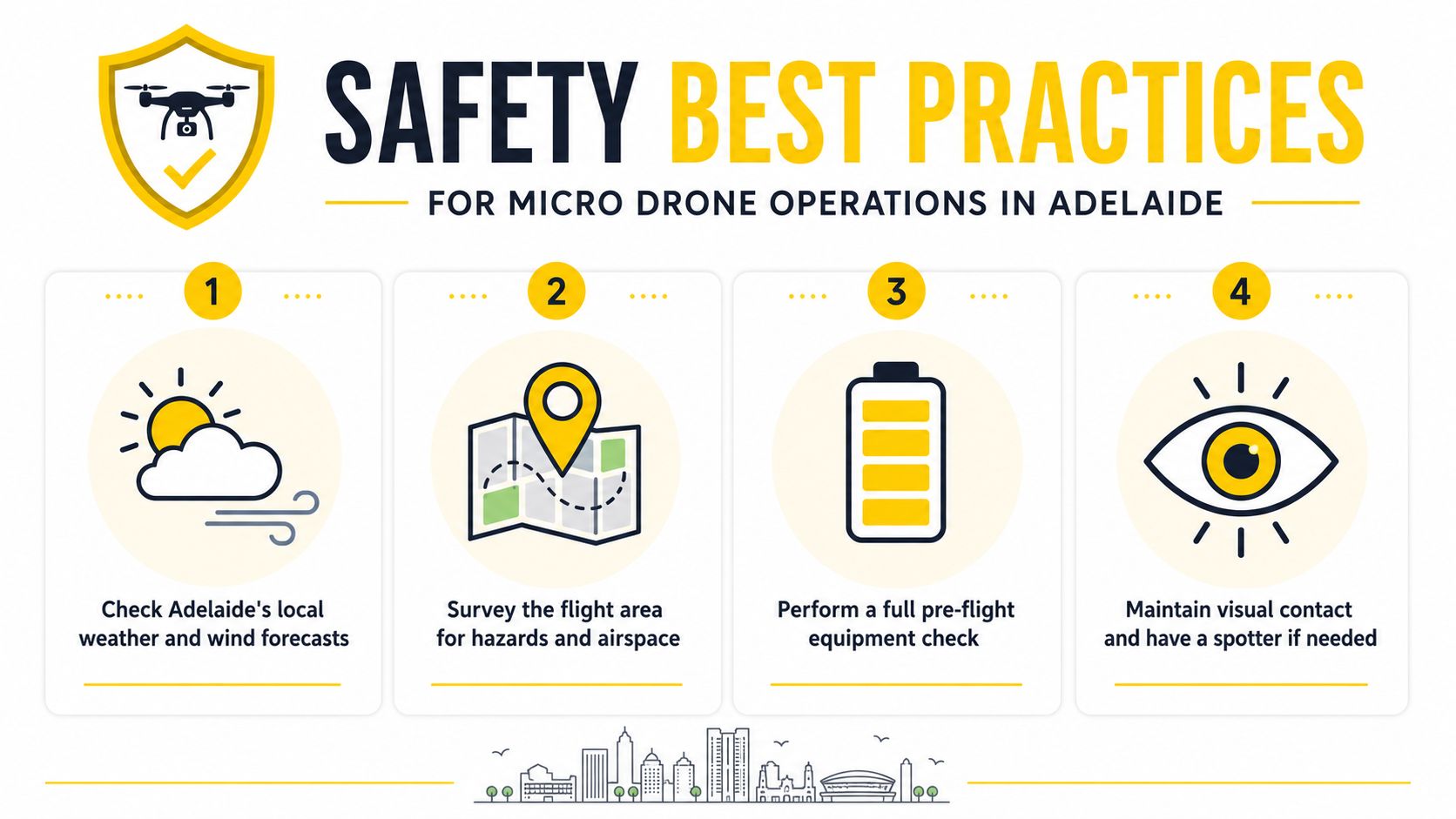
- Check the weather first: Confirm wind, gusts, and any change in local conditions before powering up.
- Walk the site: Look for wires, trees, reflective surfaces, people, and take-off obstructions.
- Inspect the aircraft: Verify props, battery fit, controller link, and return-to-home settings.
- Keep the drone in sight: Use a spotter when the work area is cluttered or visibility is uneven.
The emergency planning guide at drone pilot emergency handbook is useful for pilots who want a clearer response routine after a lost-link, flyaway, or incident event. That kind of planning matters because short flights often create a false sense of simplicity.
A micro drone only stays safe when the pilot treats every launch as a controlled aviation task, not a casual gadget flight.
The working rule for Adelaide is straightforward. Keep the aircraft light, the mission short, the site controlled, and the decision to launch conservative. That mindset prevents most avoidable errors before they start.
Frequently Asked Questions About Adelaide Micro Drones
Do micro drones need to be registered in Australia
For recreational flying, a micro drone at 250 g or less does not need registration, licensing, or operator accreditation if it is flown within the normal rules. The key point is that the aircraft's small size does not remove the operating limits, it only reduces some of the paperwork. Commercial use depends on the type of operation, so pilots still need to confirm whether the flight stays within excluded-category conditions.
Can a micro drone fly over people in Adelaide
No. The City of Adelaide guidance requires drones to stay at least 30 metres away from people, vehicles, boats and buildings, and to avoid populous areas. A micro drone is lighter and easier to carry, but that does not change the separation requirement. In practice, the pilot still needs a site with clear margins, because a small aircraft can still create a safety risk if the area is crowded or constrained.
What should a pilot do if a manned aircraft appears nearby
Descend the drone and clear the area immediately. Manned aircraft have the right of way, so the pilot's first task is to create separation and stop the operation. If the drone cannot be controlled safely, the flight should end rather than continue. Treat it like stepping off a shared roadway when an emergency vehicle approaches, the correct move is to give way at once.
Is insurance required for commercial micro drone work
Insurance is not described in the CASA recreational rule summary, but institutions and commercial clients often ask for it before they approve access or work. Adelaide University's campus approval process also asks for insurance documentation before flight permission is granted. That means pilots should check the client or site requirements early, because an otherwise acceptable flight can still be paused at the approval stage.
What if a flight incident needs to be reported
Document the incident immediately, then follow the reporting path required by the organisation or regulator involved. A written record helps preserve details that are easy to forget after a loss-of-link event, a collision, or an unsafe landing. Keep the account factual, note what happened, where it happened, and who was involved, then complete any internal or formal reporting steps without delay.
Can a micro drone be flown anywhere because it is light
No. Micro status changes the regulatory burden, but Adelaide still has layered limits from CASA, local council rules, airport proximity restrictions, parks controls, and institution-specific approval systems. The aircraft may be small, yet the operating environment still determines whether the flight is lawful. A good pilot checks the airspace, the site owner's rules, and any campus or council approvals before the motors start.
Ace Aviation Aerospace Academy provides CASA-aligned drone training that fits this operational picture, from beginner foundations through commercial credentials and operator support. For pilots, businesses, and agencies planning Adelaide micro drone work, the next practical step is to review the course pathway and compare it with the intended flight profile at Ace Aviation Aerospace Academy.