Many aspiring drone pilots in Australia start in the same place. They've bought a capable aircraft, they're looking at paid work, and they keep seeing the term CASA Remote Pilot Licence without a clear explanation of what it enables.
That confusion is understandable. The licensing pathway mixes pilot qualifications, operating rules, business approvals, and practical training. A person can complete a course and still be unsure whether they're legally ready to take on commercial jobs. That's where most simple guides fall short.
A clear starting point helps. A RePL is the pilot qualification, but commercial drone work often depends on more than the licence itself. Understanding that distinction early saves time, money, and false expectations.
Table of Contents
- What Is a CASA Remote Pilot Licence RePL?
- RePL Eligibility and Prerequisites
- Your Step-by-Step Guide to Obtaining an RePL
- The Critical Link RePL ReOC and AROC Explained
- Typical Costs and Timelines for Your RePL
- How to Choose a Quality RePL Training Provider
- Ace Aviation RePL Courses and Support
- Frequently Asked Questions
What Is a CASA Remote Pilot Licence RePL?
A CASA Remote Pilot Licence, usually shortened to RePL, is the individual pilot qualification used in Australia for certain commercial drone operations. It sits inside CASA's aviation safety framework and shows that the pilot has completed formal training and assessment for remotely piloted aircraft operations.
The basic purpose of a RePL
The reason this licence exists is simple. Commercial drone flying isn't treated as casual gadget use. It takes place in the same broader aviation system that includes controlled airspace, emergency operations, helicopters, aerodromes, and people on the ground who can be harmed by poor decision-making.
For that reason, Australian rules draw a line between lower-complexity work and operations that require a licensed pilot. A commercial operator needs a Remote Pilot Licence if the drone weighs more than 2kg, or if the operation will take place outside CASA's standard operating conditions, regardless of aircraft weight, according to this Australian drone licence guide.
That's why the licence matters. It isn't just about proving that a person can fly the aircraft. It's about showing competence in air law, risk, airspace, and safe operating practice.
Pilots who aren't sure which pathway applies to them can use Ace Aviation's drone licence finder to narrow down the likely training and compliance route.
Practical rule: A RePL is about legal authority and operational competence, not just stick skills.
RePL vs excluded category operations
A common misunderstanding involves small drones used for paid work. Some operators hear that sub-2kg drones can be used commercially and assume a RePL is never necessary. That isn't correct.
The excluded category only applies in a narrower situation. The aircraft must be under 2kg and the operation must remain within standard operating conditions.
| Feature | Remote Pilot Licence (RePL) | Excluded Category (Sub-2kg) |
|---|---|---|
| Pilot qualification | Formal pilot qualification for applicable commercial operations | No RePL required if the operation fits the excluded category rules |
| Drone weight | Required for commercial work when the drone is over 2kg | Limited to drones under 2kg |
| Standard operating conditions | Needed if operating outside standard conditions, regardless of weight | Must remain within standard operating conditions |
| Commercial work scope | Used for broader commercial pathways | Narrower pathway for paid work with small drones |
| Training depth | Formal theory and practical training | Lower regulatory threshold, but still requires compliance |
The safest way to think about it is this. The excluded category is a limited exception. The RePL is the mainstream pathway for pilots who want broader commercial capability.
RePL Eligibility and Prerequisites
A common mistake happens before training even starts. A new pilot books a course, passes the assessments, then discovers there are still licence issue requirements to meet before CASA can finalise the RePL. It is similar to passing a driving test without first checking the licence application rules. Training matters, but eligibility matters too.
What applicants need before issue
CASA is not only looking for someone who can keep a drone in the air. It is assessing whether the applicant can operate safely in an aviation system that relies on clear communication, traceable records, and sound judgement.
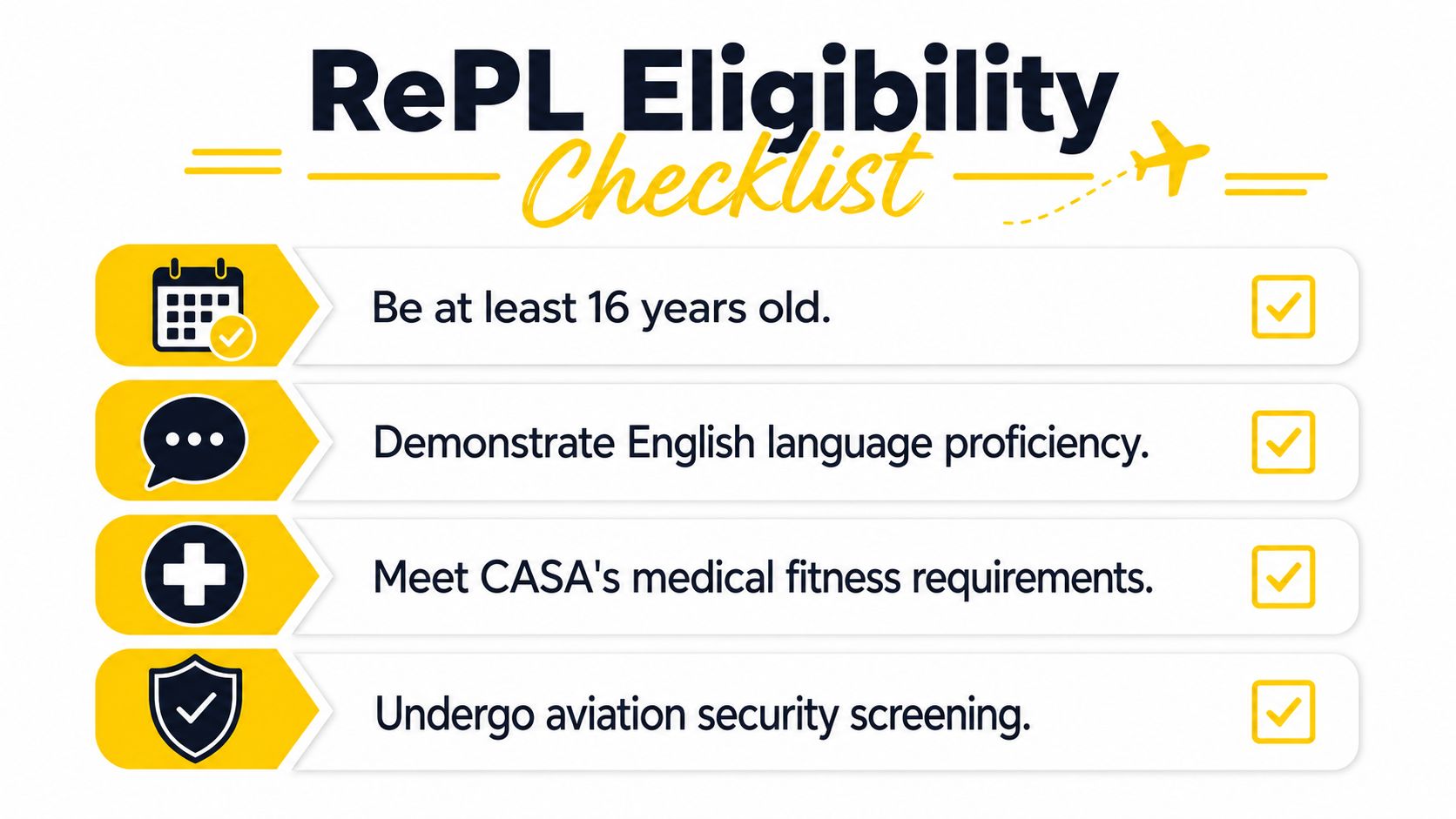
These are the main prerequisites to check early:
- Minimum age: You must be at least 16 years old.
- Identity and aviation records: You will generally need an Aviation Reference Number so CASA can identify you and process your application correctly.
- English language ability: You need to understand training, operating procedures, and aviation-related communication well enough to act on them safely.
- Medical fitness: You must be fit for the duties involved in the operation.
- Security requirements: Some workplaces or operating environments may require aviation security screening.
If you are still working out whether you need the full licensing path, this guide to excluded category drone operations helps clarify when a simpler pathway may apply and when a RePL is the better fit.
One point often surprises new entrants. Getting an RePL does not automatically mean you can start commercial drone work on your own terms. For many paid operations, the employment pathway also depends on working under, or being connected to, an ReOC holder. That is the gap many new pilots only discover after training. The licence proves pilot competence. The operator certificate covers the business and operational approval framework around that pilot.
Why the flight log matters
The practical requirement many applicants overlook is logged flight time.
For RePL issue, you need at least five hours of logged flight time operating an RPA under standard operating conditions, and that log must be submitted with the application. As noted earlier, this must be actual aircraft control time. Time spent observing, acting only as a spotter, or practising in a simulator does not satisfy the requirement.
The reason is straightforward. CASA wants evidence that the pilot has handled the aircraft in real conditions, not only studied the theory. Classroom learning can teach airspace rules and procedures, but logged flight time shows you can translate those rules into stable control, safe decisions, and disciplined habits.
Logged flight time is proof of hands-on aircraft control under normal operating conditions. It shows CASA that the applicant has done more than complete a course.
This is also why aspiring commercial pilots should think beyond the licence itself. A strong start is not just meeting the minimums for issue. It is building the record, judgement, and operational discipline that make you useful to an ReOC holder once the RePL is in your hand.
Your Step-by-Step Guide to Obtaining an RePL
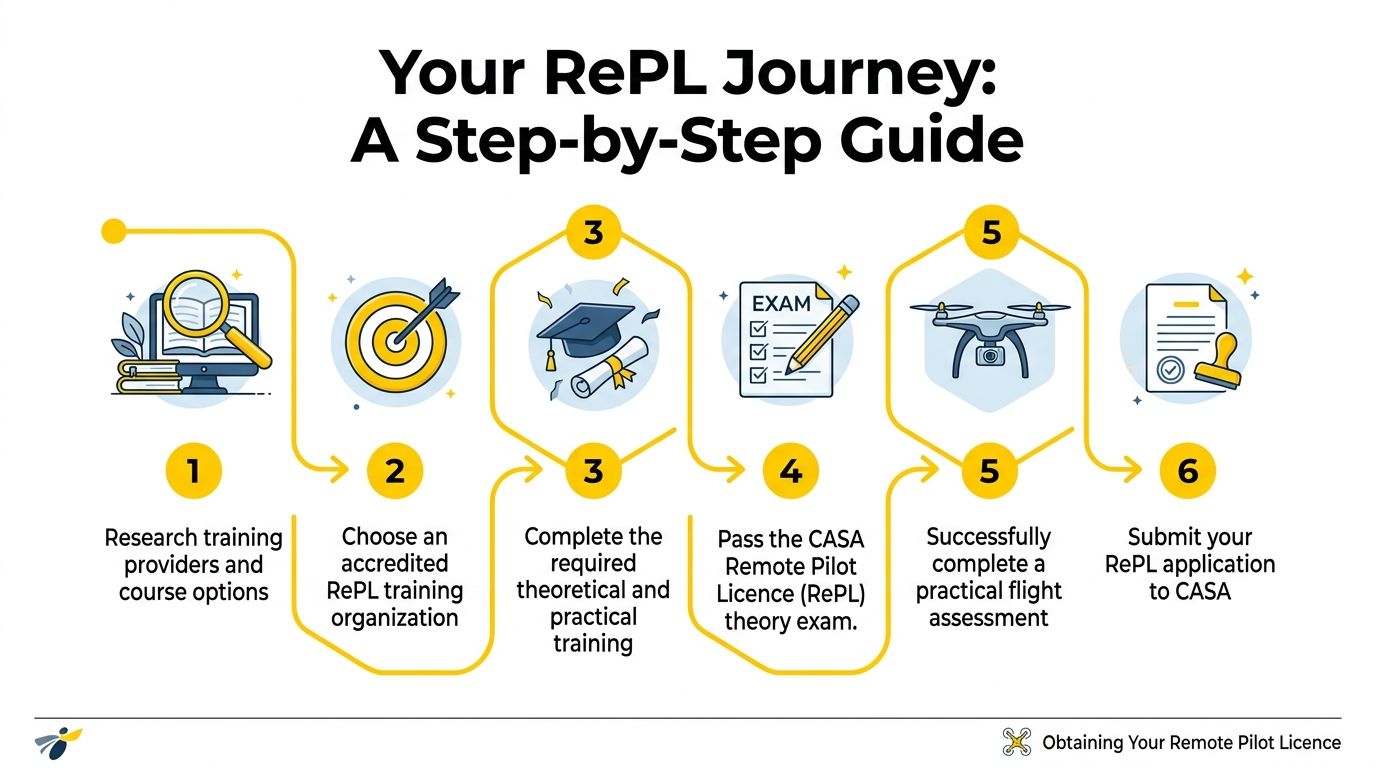
The RePL process is easier to understand when it's treated as a sequence instead of a single event. Training, examination, flight assessment, and application each solve a different part of the licensing problem.
The training and assessment sequence
A typical pathway looks like this:
Research training providers
Compare providers based on compliance, instructor background, aircraft access, and post-course support.Choose an accredited training organisation
A formal course should align with CASA requirements, not just teach basic drone handling.Complete theory training
This covers aviation regulations, meteorology, airspace, human factors, and operating procedures.Undertake practical flight training
Students learn aircraft setup, normal manoeuvres, risk management, and controlled decision-making.Pass the formal theory exam
The aeronautical knowledge examination is a defined hurdle, not an informal quiz.Complete the practical assessment and application
Once training and assessment are complete, the application package can be submitted to CASA.
Pilots who are still learning where drones fit into the broader aviation environment often benefit from reading about drone safety near airports and helicopter landing sites in Australia, because it gives context to why the theory content is so airspace-focused.
What the theory exam is testing
The exam requirement is more demanding than many newcomers expect. To obtain a CASA RePL, applicants must pass an aeronautical knowledge examination with 100 multiple-choice questions and achieve at least 85% to pass, according to The Industry Leaders' RePL guide.
That pass mark tells applicants something important. CASA doesn't treat theory as a box-ticking exercise. The exam is there to confirm that the pilot understands regulations, meteorology, and airspace rules before moving on to practical assessment.
A simple example makes the point. A pilot may be excellent at flying smooth cinematic orbits in an open paddock. That same pilot can still make poor decisions if they can't interpret airspace limits, understand weather changes, or recognise when radio procedures may be needed.
A sensible study approach
A better way to prepare is to break the syllabus into operating questions:
- Air law: What is legally allowed in this operation?
- Meteorology: What weather factors could make this flight unsafe?
- Airspace: Who else may be using this area, and under what rules?
- Human factors: What mistakes become more likely under pressure or fatigue?
Strong candidates don't just memorise answers. They learn how rules connect to real flights.
The Critical Link RePL ReOC and AROC Explained
Many guides prove incomplete on this particular topic. A person can earn a RePL and still not be ready to conduct commercial work independently in the way they expected.
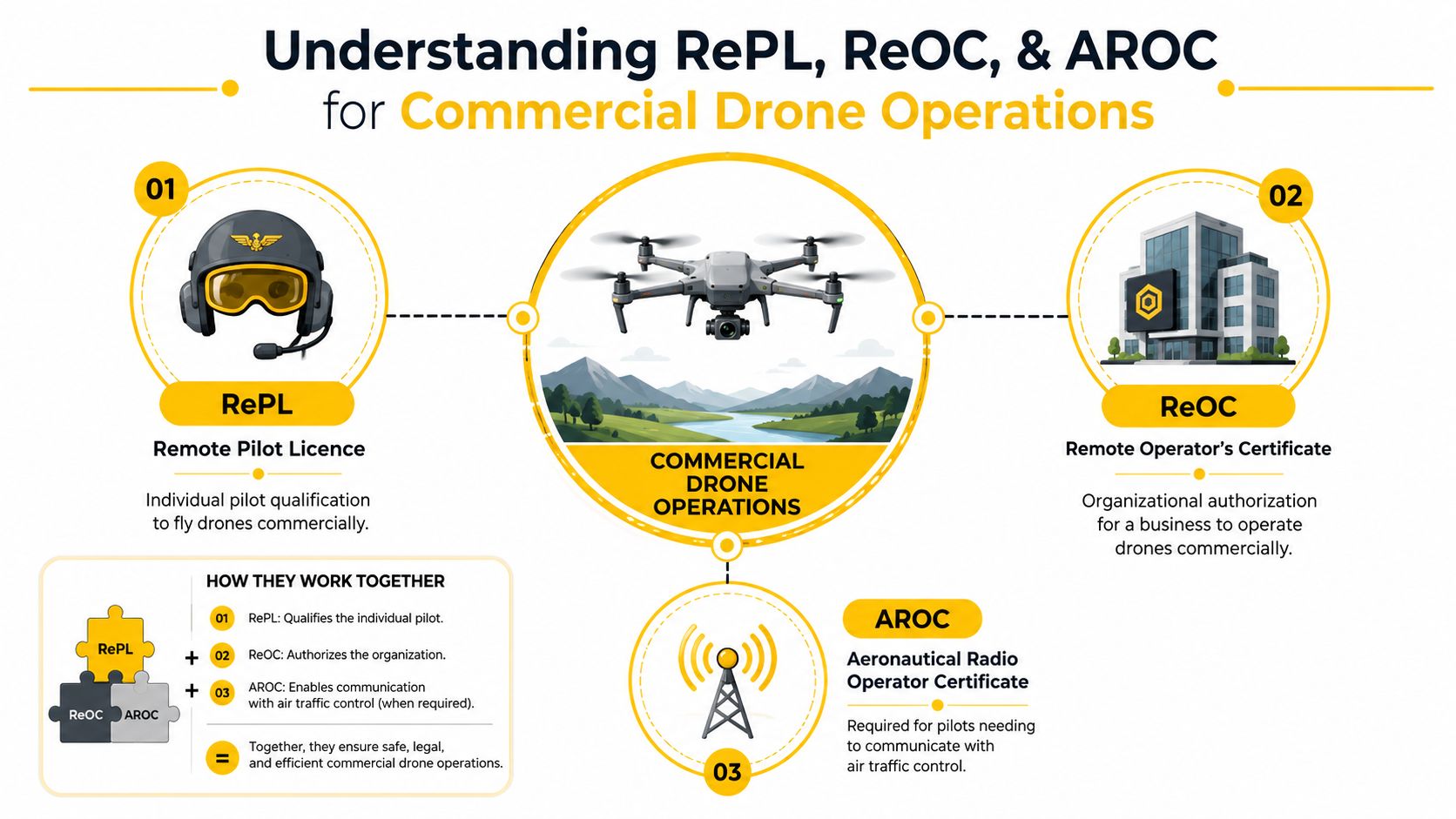
A simple way to understand the three approvals
The easiest analogy is road transport.
- RePL: The pilot's licence. It qualifies the individual to operate the aircraft.
- ReOC: The business operator's authority. It authorises the organisation conducting commercial drone operations.
- AROC: The radio qualification used when aviation radio communication is required.
That distinction matters because pilot qualification and business authorisation aren't the same thing. A person may be personally trained and assessed, but the commercial operation itself still needs to sit inside an approved operating structure.
Readers who want the operator side explained in more depth can review this guide to the ReOC in Australia.
Why many new pilots hit an employment gap
One of the most overlooked realities in the Australian market is the gap between holding a licence and getting usable commercial access. According to Open Exam Prep's RePL practice page, most content explains how to obtain the CASA RePL but misses the gatekeeper problem that a RePL holder cannot conduct commercial work without being employed by a ReOC holder. The same source states that 100% of commercial operations, excluding sub-2kg excluded categories, require a ReOC.
That changes the practical career question. For many people, a key challenge isn't “How does a person pass the course?” It's “How does a newly licensed pilot gain access to a ReOC and real work?”
The same source notes that many pilots face a 3–6 month unemployment gap while waiting for a ReOC holder to hire them. That's a critical planning issue for anyone treating drone training as a near-term career move.
What this means for career planning
A new pilot should think about employment access before enrolling, not after course completion.
Useful questions include:
- Industry access: Does the training provider have links to operators, employers, or ReOC holders?
- Operational pathway: Is the goal employment under an existing ReOC, or eventual progression toward business operations?
- Radio needs: Will the intended work involve areas where an AROC becomes relevant?
- Post-course support: Does the provider help students understand the next compliance step after licensing?
A RePL is a base licence. Commercial access often depends on the operator framework around the pilot.
Typical Costs and Timelines for Your RePL
Many readers search for a single figure or a single course duration. In practice, both cost and timing depend on how the training is packaged and what the pilot needs beyond the licence itself.
What usually makes up the cost
The main cost components are usually:
- Training fees: The core RePL course, including theory and practical instruction.
- Bundled qualifications: Some courses include related items such as AROC training.
- CASA application or processing costs: Administrative charges may apply through the licensing process.
- Travel and accommodation: These matter if the course is delivered away from the student's local area.
- Equipment and operational setup: Depending on the intended work, the pilot may also need aircraft, batteries, software, safety equipment, and insurance.
A buyer should compare what is included, not just the headline course fee. A lower advertised price can still lead to a higher total cost if key elements are excluded.
How long the process usually feels in practice
Timelines vary with course format and student availability.
| Timeline factor | What affects it |
|---|---|
| Course delivery | Intensive in-person formats move faster than part-time scheduling |
| Study readiness | Students with stronger aviation study habits often progress more smoothly |
| Flight practice | Weather, aircraft availability, and instructor scheduling can influence practical completion |
| Administration | Application preparation and processing add time after training |
Some students prefer a concentrated format because it compresses theory and practical work into a shorter window. Others need a flexible option that fits around work or family commitments.
A realistic mindset helps. The licence itself is one timeline. Job readiness is another. If the intended goal is commercial employment, the pilot should allow time not only for training but also for building access to a ReOC pathway.
How to Choose a Quality RePL Training Provider
Price matters, but it shouldn't be the first filter. The provider shapes how well the pilot understands aviation, not just whether they finish a course.
What to check before enrolling
A quality provider usually stands out in a few practical ways:
- Instructor background: Look for instructors with real aviation and operational experience, not just classroom familiarity.
- Training aircraft quality: Students should train on aircraft and systems that reflect genuine commercial use.
- Practical supervision: The flight component should be structured, observed, and clearly tied to operational decision-making.
- Regulatory clarity: Good providers explain why a rule exists, not just what must be memorised.
- Post-course guidance: This is especially valuable where students need help understanding ReOC employment realities.
A provider also needs to communicate clearly about what the course does and doesn't deliver. If a course leads to a pilot qualification, that should be stated plainly. If separate operator approvals or business support are needed later, that should also be clear.
Questions worth asking a provider
A short question list can reveal a lot:
- How is practical flight time structured and recorded?
- Who teaches the theory components, and what aviation background do they have?
- Is AROC training included where relevant?
- What support is available after course completion?
- How does the provider explain the pathway from RePL to commercial work under a ReOC?
The strongest providers don't avoid hard questions. They answer them directly, including the less comfortable topic of what happens after the student holds the licence.
Ace Aviation RePL Courses and Support
A common real-world scenario is this. A student finishes RePL training, assumes commercial work can start immediately, then discovers a second layer of requirements around operator authorisation and business structure. Training is easier to choose when the provider is clear about that gap from the start.
For readers comparing options, Ace Aviation's drone and aviation course catalogue brings those pathways into one place. It helps to view the training in two parts. First, the pilot must gain the licence and practical competence to operate safely. Second, anyone planning paid work must understand how that pilot qualification fits under a ReOC holder, or within a business working toward its own operator approval.
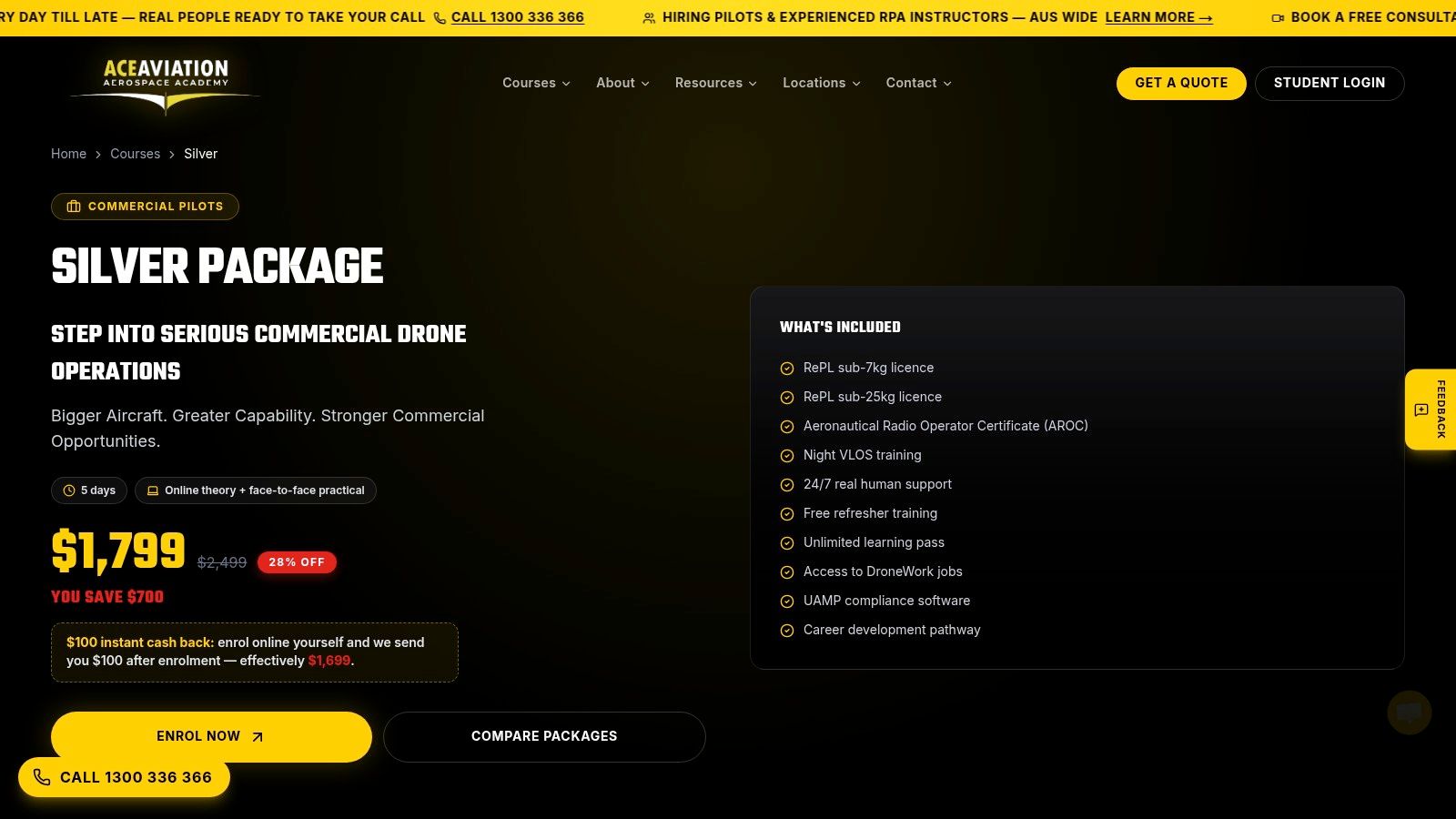
Ace Aviation presents course options for both individual pilots and organisations. For an individual, the main question is usually whether the training covers the licence, practical flying, and any related operational subjects such as radio use and aviation English where relevant. For a business, the question shifts. The business may need staff training, internal procedures, and support to build an operator framework that matches CASA requirements.
That difference matters because a pilot qualification and an operator approval do different jobs. The RePL shows the person has been trained to fly in the relevant category. The ReOC, where required, is the system that allows commercial operations to be conducted legally and consistently. A provider that explains both sides clearly gives students a more accurate picture of what happens after the course ends.
Frequently Asked Questions
Does a RePL need to be renewed regularly?
CASA administrative requirements can change, and licence maintenance depends on the current regulatory framework and the type of operation involved. Pilots should check current CASA requirements directly or confirm them through a qualified training provider before assuming a licence is current or operationally sufficient.
Can an Australian RePL be used overseas?
A RePL is an Australian aviation qualification. Other countries have their own aviation authorities and recognition rules, so overseas use depends on the destination's regulatory system rather than on the RePL alone.
Is an AROC always required for drone work?
No. An AROC becomes relevant when a pilot needs to communicate on aviation radio frequencies as part of the operation. Not every drone mission requires that, but some operational environments make radio competency important.
Can a person start a drone business with only a RePL?
Not for standard commercial operations that require an operator framework. As explained earlier, the pilot qualification and the operator authorisation are different things. A business model that relies on commercial operations usually needs the appropriate ReOC pathway unless it falls within the excluded category.
What should a new pilot ask before enrolling in training?
The key questions are practical. What operations does the student want to perform, what aircraft will be used, will radio training be needed, and what pathway exists from licence completion to lawful commercial work?
Ace Aviation Aerospace Academy provides Australian aviation and drone training for aspiring pilots, commercial operators, and organisations seeking structured support with qualifications such as the RePL and AROC, along with broader operational guidance. More information is available through Ace Aviation Aerospace Academy.