
A project team is standing beside a launch site near Botany Bay. A drone operator is running the final checks. A trainer is about to open a safety briefing. Someone asks a familiar question: “Who gives the Acknowledgement of Country, and what should it say here in Sydney?”
That moment catches many professionals. They want to be respectful, accurate, and confident, but they also don't want to sound scripted or guess the wrong Traditional Custodians. In aviation and drone work, the pressure is sharper because operations are mobile, briefings are time-sensitive, and teams often work across multiple sites in a single day.
A practical guide helps. In Sydney, an Acknowledgement of Country is not just a ceremonial extra. It is part of how many organisations open meetings, training sessions, public events, and operational activities with respect for the First Peoples of the land. For aviation professionals, that respect needs to work in classrooms, hangars, offices, field sites, and remote operations alike. Professionals attending drone training in Sydney often find that the challenge is not willingness. It is applying the protocol properly in a real operational setting.
Table of Contents
- Why Acknowledging Country in Sydney Matters
- Welcome to Country vs Acknowledgement of Country
- How to Write and Deliver Your Acknowledgement
- Integrating Acknowledgement into Organisational Protocol
- Protocols for Aviation and Remote Drone Operations
- Continuing Your Journey in Reconciliation
- Frequently Asked Questions
- Can anyone give an Acknowledgement of Country in Sydney
- Who are the Traditional Custodians for central Sydney
- Does a drone pilot need to give an acknowledgement before every flight
- What should a remote pilot do when operating from a different location
- Is a generic script enough for all Sydney operations
- Where can readers find more practical aviation guidance
Why Acknowledging Country in Sydney Matters
In Sydney workplaces, the Acknowledgement of Country often happens right before the practical work begins. A council meeting opens. A contractor briefing starts. A drone crew prepares to launch. The words may be brief, but the act matters because it recognises that work is taking place on Aboriginal land with deep cultural continuity.
For many professionals, the most helpful shift is to stop treating the acknowledgement as a script to get through. It is better understood as a respectful statement of place, history, and continuing custodianship. That changes the tone immediately. The speaker is not performing expertise. The speaker is showing respect.
A professional practice, not a box to tick
Sydney's public and professional life has normalised this practice across formal settings. That matters because repetition can either build culture or drain meaning. The difference comes from care.
A strong acknowledgement does three things:
- Names place clearly. It recognises the Traditional Custodians of the land where the activity is happening.
- Shows respect properly. It pays respect to Elders past and present, and where appropriate, emerging.
- Matches the occasion. A short internal meeting needs different wording from a public ceremony or operational briefing.
Practical rule: If the words sound interchangeable with any city, they're probably too generic for Sydney.
Professionals in aviation, surveying, infrastructure, and government often work under tight timelines. That makes it tempting to memorise one version and use it everywhere. In Sydney, that can create avoidable mistakes. The better approach is to understand the purpose first, then adapt the wording to the site, audience, and activity.
Why this matters in modern industries
Technology-heavy sectors sometimes assume cultural protocol belongs only to formal events. In practice, it belongs anywhere people gather to make decisions, deliver services, or operate on Country.
For drone operations, this becomes especially important because teams often move between office planning, on-site launch, and remote monitoring. The acknowledgement should still make sense in each setting. Respect does not disappear when the operation becomes technical.
Welcome to Country vs Acknowledgement of Country
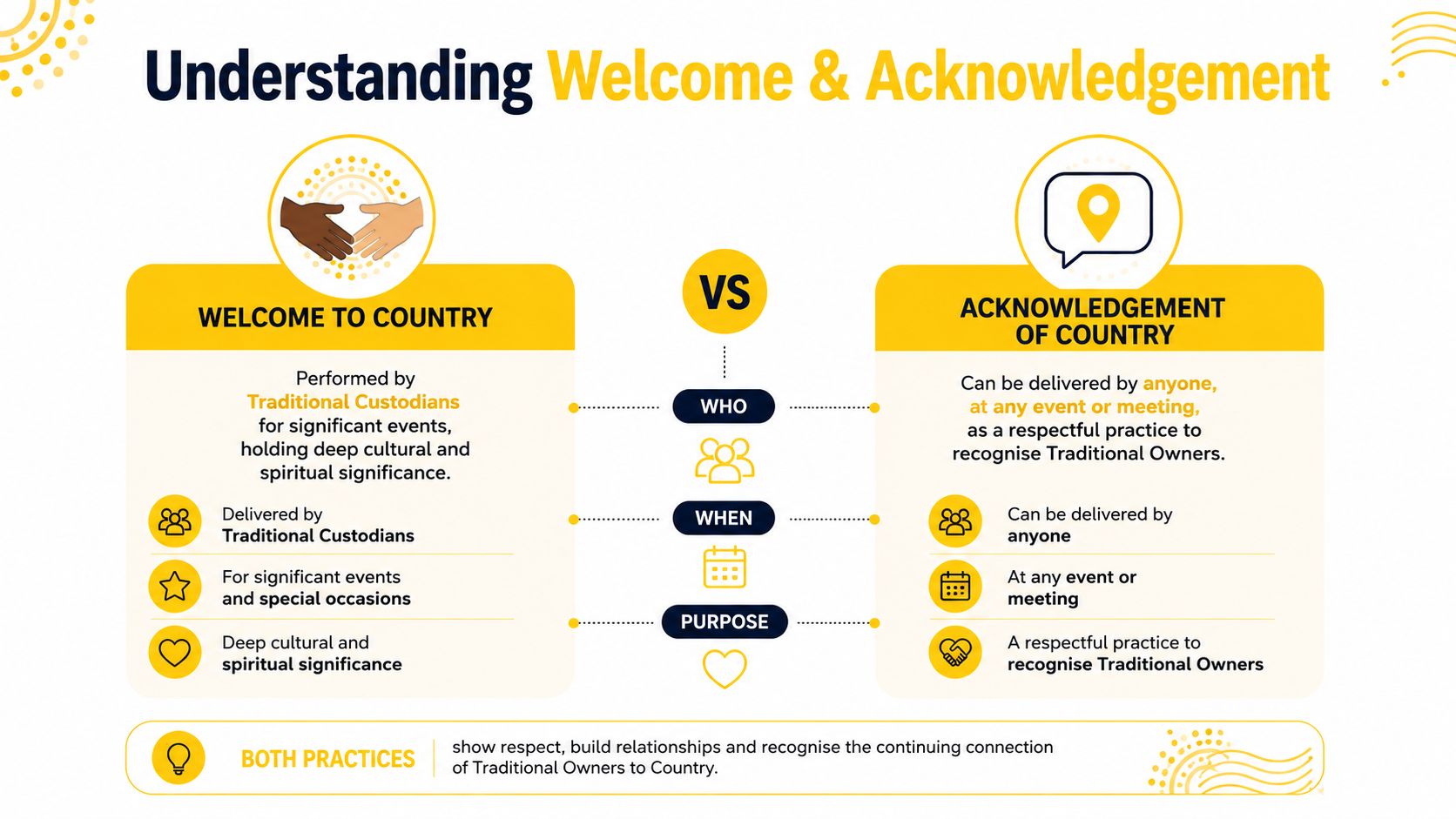
Confusion between these two terms is common, and it causes most of the hesitation around acknowledgement of country Sydney practice. The distinction is straightforward once the roles are clear.
The core difference
A Welcome to Country must be delivered by a recognised Aboriginal or Torres Strait Islander Elder or Traditional Owner from the area. It is a cultural protocol of permission and welcome.
An Acknowledgement of Country can be delivered by any person, whether Aboriginal or non-Aboriginal. It is appropriate when a Welcome to Country is not being given, and it is commonly used at meetings, conferences, seminars, and professional gatherings.
In Sydney, the Gadigal people of the Eora nation are the recognised Traditional Owners, and their connection to the land spans at least 65,000 years according to the summary of Sydney protocol and cultural context set out in the Welcome to Country overview. The same source also notes that the City of Sydney uses a formal protocol that allows an Acknowledgement to be performed by any person at events such as council meetings, conferences, and seminars, while a Welcome to Country must be delivered by a recognised Elder.
That distinction relieves a common anxiety. A project manager, trainer, pilot, or team leader doesn't need special status to give an Acknowledgement of Country. What they need is accuracy, respect, and context.
For professionals reading aviation resources on the Ace Aviation blog, this distinction also helps with training environments. A classroom session usually begins with an acknowledgement. A major graduation, public ceremony, or significant event may instead involve arranging a Welcome to Country through the appropriate community channels.
A quick comparison
| Attribute | Welcome to Country | Acknowledgement of Country |
|---|---|---|
| Who can deliver it | Recognised Elder or Traditional Owner | Any person |
| Purpose | Welcomes people onto Country through cultural authority | Recognises Traditional Custodians and shows respect |
| Typical use | Significant events and ceremonies | Meetings, seminars, briefings, classes, daily professional settings |
| Requirement for local cultural authority | Yes | No |
| Suitable for routine workplace use | Usually no | Yes |
Why beginners often mix them up
Many people hear the terms used close together and assume they are interchangeable. They aren't. One practical way to remember the difference is this:
- Welcome comes from those with cultural authority connected to that Country.
- Acknowledgement comes from those gathering and working on that Country.
For beginners entering drone operations, ACE READY is an entry level drone training course covering drone fundamentals, aviation safety, CASA regulations, flight operations, and preparation for advanced Remote Pilot Licence training in Australia. Training of that kind gives newcomers a useful framework for operational discipline, which also helps with respectful briefing practice.
Respectful delivery starts with choosing the right protocol, not with memorising the longest script.
How to Write and Deliver Your Acknowledgement
The most effective acknowledgement is accurate, concise, and spoken with understanding. It doesn't need elaborate language. It needs care.

Start with the essentials
A practical Sydney acknowledgement usually includes these elements:
- Recognition of the Traditional Custodians
- Naming the local people where appropriate
- Paying respect to Elders past and present
- Optional mention of emerging Elders
- A brief connection to the activity or gathering
Pronunciation often creates unnecessary stress. Two names that readers commonly want help with are:
- Gadigal: Gad-i-gal
- Eora: Ee-or-a
Those guides won't replace local advice, but they help speakers avoid freezing at the opening line.
Sample wording for common situations
For a short internal meeting in central Sydney:
The meeting acknowledges the Traditional Custodians of the land on which this gathering takes place, the Gadigal people of the Eora nation, and pays respect to Elders past and present.
For a training session or professional seminar:
The session acknowledges the Gadigal people of the Eora nation as the Traditional Custodians of the land on which everyone is meeting today. Respect is paid to Elders past, present, and emerging.
For a public-facing event with stronger context:
The event acknowledges the Traditional Custodians of the land, the Gadigal people of the Eora nation. Respect is paid to Elders past, present, and emerging, and recognition is given to the enduring connection of Aboriginal and Torres Strait Islander peoples to land, waters, and community.
How to sound respectful rather than rehearsed
Readers often ask whether they should personalise the wording. The answer is yes, carefully. The safest way to personalise an acknowledgement is not to improvise history or symbolism. It is to connect the acknowledgement to the purpose of the gathering.
Examples include:
- For a drone briefing: mention that operations are being conducted on Country and that the team recognises continuing custodianship.
- For a classroom session: note that learning is taking place on Country and that respect underpins professional practice.
- For a project kickoff: connect the acknowledgement to responsible work in the community.
Three delivery habits make a noticeable difference:
- Slow the opening line. Most rushed acknowledgements lose clarity in the first sentence.
- Say the Nation and people names carefully. Confidence matters less than care.
- Pause before moving into agenda items. Acknowledgement should not sound stapled onto the start of a checklist.
A common mistake is trying to sound ceremonial in every setting. A plain, respectful acknowledgement is usually stronger than ornate language. Another mistake is overloading the wording with claims the speaker can't verify. If there is uncertainty about the correct Traditional Custodians for a site outside central Sydney, it is better to check first than to guess.
Delivery note: Respect is heard in pace, pronunciation, and intent. It isn't created by formal wording alone.
Integrating Acknowledgement into Organisational Protocol
An organisation that only remembers an acknowledgement when a senior guest attends is treating cultural protocol as theatre. A stronger approach is to build it into ordinary practice.
That does not mean every communication needs the same wording. It means the organisation has thought about where acknowledgement belongs, who is responsible for it, and how staff can deliver it accurately.
Where organisations should include it
Many Sydney organisations include acknowledgement in several routine places:
- Meeting openings. Board meetings, toolbox talks, training sessions, and project kickoffs.
- Event programs. Public forums, conferences, graduations, and stakeholder briefings.
- Written materials. Official documents, manuals, invitations, and web pages where appropriate.
- Digital presence. Email signatures, intranet pages, and website footers when aligned with policy.
These uses serve different purposes. A spoken acknowledgement marks a live gathering. A written acknowledgement signals institutional commitment. Both can be useful, but neither should be copied blindly into every context.
Why policy matters
A short internal policy helps teams avoid confusion. It can set out:
| Organisational question | Practical policy response |
|---|---|
| When should an acknowledgement be given | At formal meetings, training sessions, public events, and major operational briefings |
| Who gives it | Chair, facilitator, instructor, pilot in command, or another nominated person |
| What wording should be used | Approved base wording with room for site-specific adaptation |
| When is a Welcome to Country considered | For significant public or ceremonial occasions |
This kind of policy is especially helpful for larger teams, contractors, and agencies with rotating staff. Consistency reduces awkwardness. It also shows that the organisation sees acknowledgement as part of professional conduct.
When organisations need guidance on training pathways, operational procedures, or industry-specific implementation, contact points such as Ace Aviation Aerospace Academy enquiries can help direct teams to relevant aviation education or consulting options without turning the protocol into a compliance script.
Protocols for Aviation and Remote Drone Operations
Many standard guides often conclude their scope prematurely. Aviation and drone work create situations that office-based acknowledgement templates don't fully address.
Pre-flight and field briefing practice
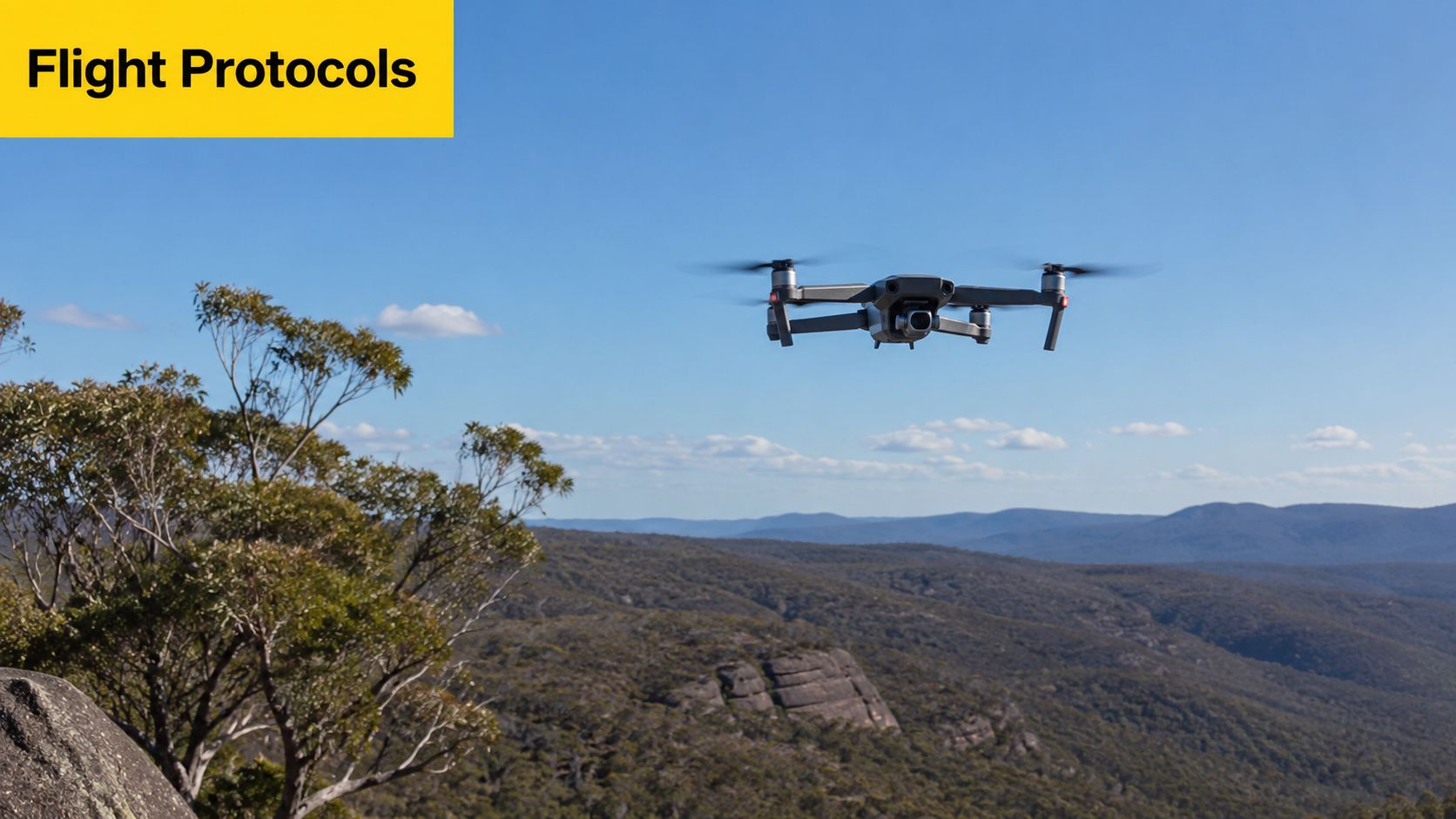
A practical approach is to place the acknowledgement early in the pre-flight or operational briefing, before task allocation and hazard review. That position matters. It frames the work as taking place on Country, not just at a technical site.
For example, a commercial operator preparing a survey flight in Sydney might include:
- Site identification
- Acknowledgement of Traditional Custodians
- Safety and airspace briefing
- Operational roles
- Emergency procedures
That sequence keeps cultural respect integrated with operational planning instead of treating it as a separate ceremony.
Aviation professionals also work within licensing and training structures that demand planning discipline. Commercial drone operations in Australia generally require a Remote Pilot Licence (RePL) or an excluded category qualification when flying for reward, using drones over 2 kg, or operating outside standard operating conditions, while recreational pilots flying consumer drones under 2 kg don't need a licence if they stay within standard conditions, as outlined in drone licence guidance for Australia. To obtain a RePL, applicants must complete a mandatory minimum of 5 hours of flight time under standard operating conditions and submit a flight log with the application, according to Remote Pilot Licence application guidance.
Those requirements don't create a formal Acknowledgement of Country rule. They do show that professional drone work already relies on documented preparation, correct procedures, and site-specific judgment. Cultural safety fits naturally into that discipline.
Remote and virtual operations
Remote operations create a genuine gap. General virtual acknowledgement advice exists, but there are no formal guidelines for how commercial drone pilots in Sydney should acknowledge Country during aerial operations, even though 68% of Australian drone operators now conduct remote fieldwork, as noted by Reconciliation Australia guidance on acknowledgement and welcome.
That gap matters because the pilot may be in one place while the aircraft is operating over another. A control room briefing in western Sydney might support a mission over Botany Bay or another site entirely. In that case, the acknowledgement should refer to the Country where the operation is taking place, not just where the operator is sitting.
For remote drone work, the relevant Country is usually the operational site, not the office address.
A useful practical model is:
- Before launch: acknowledge the Traditional Custodians of the operational site during the mission briefing.
- For recorded briefings: include the acknowledgement in the opening script if the site is fixed and known.
- For multi-site work: prepare location-specific wording in advance rather than using one generic statement all day.
Operators dealing with controlled or sensitive airspace already use structured planning tools, and the same planning discipline can support this cultural step. Teams refining their field procedures often also review related operational topics such as drone safety near airports and helicopter landing sites in Australia.
Flight-path and site-specific care
Sydney is not culturally uniform. Central Sydney acknowledgements often refer to Gadigal Country, but aviation and enterprise drone operations can cross into other areas quickly. That is where many professionals become uncertain.
A safe working approach includes:
- Checking the exact site location before the mission
- Confirming the relevant Traditional Custodians for that location
- Avoiding assumptions based on the client's suburb name or postal address
- Using a general acknowledgement if the team is still verifying local details, rather than naming the wrong group
This is especially relevant for enterprise operations in infrastructure, utilities, and corridor inspections, where flights may extend across multiple areas. The closer the operation is to a specific place, the more important precise local recognition becomes.
Professionals training for advanced operations also need to understand the regulatory side of field work. Under current CASA regulations, all micro, small, and medium RPA weighing more than 250 g must be registered, and operators must complete a short online course and pass an examination for accreditation, with a minimum age of 16 years for accreditation, under the Civil Aviation Safety Regulations amendment framework. Instructor standards are also specific. RePL instructors must hold a RePL for each RPA type they train on and meet qualification requirements set out in the CASA consultation material on instructor requirements.
That same level of specificity is a good model for acknowledgement practice in the field. The lesson is simple. Accuracy matters.
Continuing Your Journey in Reconciliation
A respectful acknowledgement in Sydney begins with understanding place, protocol, and purpose. It becomes stronger when organisations embed it in routine practice, and it becomes more nuanced when aviation teams apply it to mobile and remote operations.
No single script solves every situation. The better habit is ongoing learning. For aviation professionals, that means treating cultural protocol with the same seriousness given to planning, briefings, and operational accuracy.
Useful places to keep learning
These resources are useful starting points for further learning:
- Reconciliation Australia for practical guidance on acknowledgement and broader reconciliation work
- AIATSIS Map of Indigenous Australia for a national reference point when working beyond one location
- Metropolitan Local Aboriginal Land Council for Sydney-specific community context and local engagement pathways
When training providers discuss responsible drone operations, cultural respect belongs alongside airspace awareness, safety planning, and professional conduct. This is one area where better habits improve both the quality of the operation and the quality of the relationship with the place in which that work occurs.
Frequently Asked Questions
Can anyone give an Acknowledgement of Country in Sydney
Yes. An Acknowledgement of Country can be delivered by any person. The important point is that the wording is accurate and respectful, and that it is used in the right context rather than confused with a Welcome to Country.
Who are the Traditional Custodians for central Sydney
For central Sydney, the recognised Traditional Owners are the Gadigal people of the Eora nation. For sites beyond central Sydney, professionals shouldn't assume the same wording applies without checking the exact location.
Does a drone pilot need to give an acknowledgement before every flight
There is no formal aviation rule that requires an acknowledgement before every flight. In professional practice, it is most appropriate where there is a briefing, formal gathering, training activity, public-facing operation, or an organisational protocol that includes it.
What should a remote pilot do when operating from a different location
The acknowledgement should generally refer to the Country where the operation is taking place. For remote work, that means preparing site-specific wording before the mission rather than relying on the office location alone.
Is a generic script enough for all Sydney operations
Not always. A generic script may work for a broad meeting, but field operations often need place-specific wording. If the exact Traditional Custodians are uncertain, it is better to verify first than to name the wrong group.
Where can readers find more practical aviation guidance
Readers looking for general training and policy questions can use the Ace Aviation FAQ for additional information relevant to aviation education and drone operations.
Ace Aviation Aerospace Academy provides Australian aviation and drone training, including the Remote Pilot Licence (RePL), AROC, Enterprise Drone Training, Corporate Drone Training, and ReOC Consulting. For professionals who want structured education in CASA-aligned drone operations and field practice, Ace Aviation Aerospace Academy is one option to consider.